Wind turbines types
and construction.
By :
Shashank
120101MER136
Mechanical-C
Introduction :
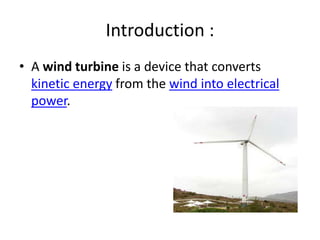
• A wind turbine is a device that converts
kinetic energy from the wind into electrical
power.
Turbines :
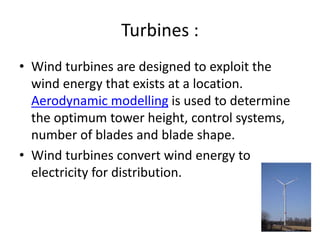
• Wind turbines are designed to exploit the
wind energy that exists at a location.
Aerodynamic modelling is used to determine
the optimum tower height, control systems,
number of blades and blade shape.
• Wind turbines convert wind energy to
electricity for distribution.
Continued :
Wind turbines convert wind energy to electricity for
distribution. Conventional horizontal axis turbines
can be divided into three components:
• The rotor component,
• The generator component - includes the electrical
generator,[29][30] the control electronics, and most likely a
gearbox (e.g. planetary gearbox),[31] adjustable-speed
drive[32] or continuously variable transmission[33]
component for converting the low speed incoming rotation
to high speed rotation suitable for generating electricity.
• The structural support component includes the tower and
rotor yaw mechanism.[34
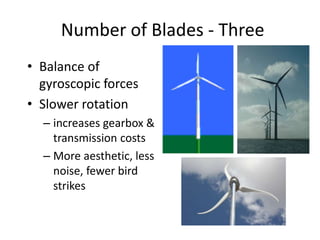
Number of Blades - Three
• Balance of
gyroscopic forces
• Slower rotation
– increases gearbox &
transmission costs
– More aesthetic, less
noise, fewer bird
strikes
Lift & Drag Forces
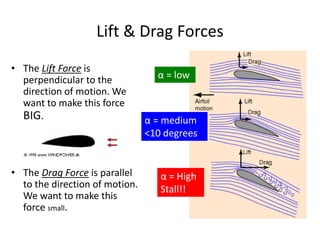
• The Lift Force is
perpendicular to the
direction of motion. We
want to make this force
BIG.
• The Drag Force is parallel
to the direction of motion.
We want to make this
force small.
α = low
α = medium
<10 degrees
α = High
Stall!!
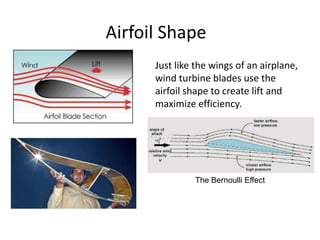
Airfoil Shape
Just like the wings of an airplane,
wind turbine blades use the
airfoil shape to create lift and
maximize efficiency.
The Bernoulli Effect
Small wind turbines
• Small wind turbines may be used for a variety
of applications including on- or off-grid
residences, telecom towers, offshore
platforms, rural schools and clinics, remote
monitoring and other purposes that require
energy where there is no electric grid, or
where the grid is unstable.
Future of wind power :
• Wind turbines are seen to be increasingly
competitive with conventional energy generating
sources..
• Wind turbines have also proven valuable in providing
power for irrigation, watering cattle, cooling and
desalination.
Wind Turbines_Brief

Wind Turbines_Brief

  • 1.
    Wind turbines types andconstruction. By : Shashank 120101MER136 Mechanical-C
  • 2.
    Introduction : • Awind turbine is a device that converts kinetic energy from the wind into electrical power.
  • 3.
    Turbines : • Windturbines are designed to exploit the wind energy that exists at a location. Aerodynamic modelling is used to determine the optimum tower height, control systems, number of blades and blade shape. • Wind turbines convert wind energy to electricity for distribution.
  • 4.
    Continued : Wind turbinesconvert wind energy to electricity for distribution. Conventional horizontal axis turbines can be divided into three components: • The rotor component, • The generator component - includes the electrical generator,[29][30] the control electronics, and most likely a gearbox (e.g. planetary gearbox),[31] adjustable-speed drive[32] or continuously variable transmission[33] component for converting the low speed incoming rotation to high speed rotation suitable for generating electricity. • The structural support component includes the tower and rotor yaw mechanism.[34
  • 5.
    Number of Blades- Three • Balance of gyroscopic forces • Slower rotation – increases gearbox & transmission costs – More aesthetic, less noise, fewer bird strikes
  • 6.
    Lift & DragForces • The Lift Force is perpendicular to the direction of motion. We want to make this force BIG. • The Drag Force is parallel to the direction of motion. We want to make this force small. α = low α = medium <10 degrees α = High Stall!!
  • 7.
    Airfoil Shape Just likethe wings of an airplane, wind turbine blades use the airfoil shape to create lift and maximize efficiency. The Bernoulli Effect
  • 8.
    Small wind turbines •Small wind turbines may be used for a variety of applications including on- or off-grid residences, telecom towers, offshore platforms, rural schools and clinics, remote monitoring and other purposes that require energy where there is no electric grid, or where the grid is unstable.
  • 9.
    Future of windpower : • Wind turbines are seen to be increasingly competitive with conventional energy generating sources.. • Wind turbines have also proven valuable in providing power for irrigation, watering cattle, cooling and desalination.