Continuous Kubernetes
Security
@sublimino and @controlplaneio
I’m:
- Andy
- Dev-like
- Sec-ish
- Ops-y
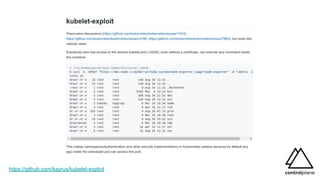
Common Pwns
https://github.com/kayrus/kubelet-exploit
Security vs Features
No RBAC
Attacking Kubernetes - Dino Dai Zovi, Capsule8
No Workload Security
Building for Trust: How to Secure Your Kubernetes Cluster [I] - Alexander Mohr & Jess Frazelle
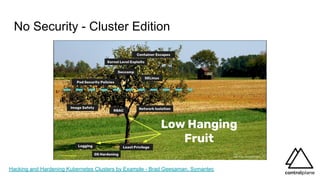
No Security - Cluster Edition
Hacking and Hardening Kubernetes Clusters by Example - Brad Geesaman, Symantec
Helm
Exploring The Security Of Helm / Using SSL Between Helm and Tiller
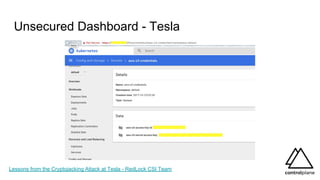
Unsecured Dashboard - Tesla
Lessons from the Cryptojacking Attack at Tesla - RedLock CSI Team
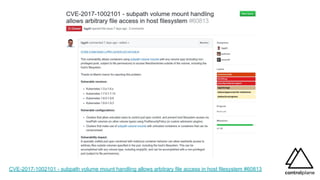
CVE-2017-1002101 - subpath volume mount handling allows arbitrary file access in host filesystem #60813
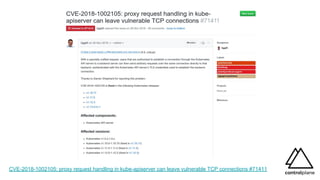
CVE-2018-1002105: proxy request handling in kube-apiserver can leave vulnerable TCP connections #71411
Is this Kubernetes cluster secure?
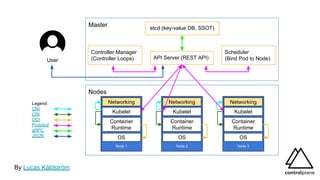
The Kubernetes
Control Plane
Nodes
Master
Node 3
OS
Container
Runtime
Kubelet
Networking
Node 2
OS
Container
Runtime
Kubelet
Networking
Node 1
OS
Container
Runtime
Kubelet
Networking
API Server (REST API)
Controller Manager
(Controller Loops)
Scheduler
(Bind Pod to Node)
etcd (key-value DB, SSOT)
User
Legend:
CNI
CRI
OCI
Protobuf
gRPC
JSON
By Lucas Käldström
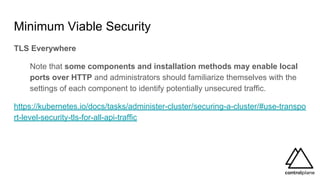
Minimum Viable Security
TLS Everywhere
Note that some components and installation methods may enable local
ports over HTTP and administrators should familiarize themselves with the
settings of each component to identify potentially unsecured traffic.
https://kubernetes.io/docs/tasks/administer-cluster/securing-a-cluster/#use-transpo
rt-level-security-tls-for-all-api-traffic
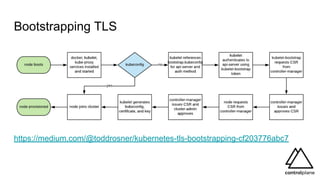
Bootstrapping TLS
https://medium.com/@toddrosner/kubernetes-tls-bootstrapping-cf203776abc7
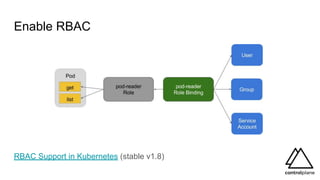
Enable RBAC
RBAC Support in Kubernetes (stable v1.8)
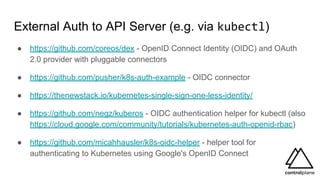
External Auth to API Server (e.g. via kubectl)
● https://github.com/coreos/dex - OpenID Connect Identity (OIDC) and OAuth
2.0 provider with pluggable connectors
● https://github.com/pusher/k8s-auth-example - OIDC connector
● https://thenewstack.io/kubernetes-single-sign-one-less-identity/
● https://github.com/negz/kuberos - OIDC authentication helper for kubectl (also
https://cloud.google.com/community/tutorials/kubernetes-auth-openid-rbac)
● https://github.com/micahhausler/k8s-oidc-helper - helper tool for
authenticating to Kubernetes using Google's OpenID Connect
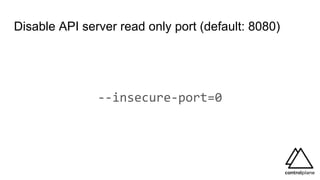
Disable API server read only port (default: 8080)
--insecure-port=0
Disable API server read only port (default: 8080)
andy@kube-master:~ [0]# curl localhost:8080/api/v1/secrets?limit=1
{
"kind": "SecretList",
"apiVersion": "v1",
"metadata": {...},
"items": [
{
"metadata": {
"name": "default-token-dhj8b",
"namespace": "default",
...
"annotations": {
"kubernetes.io/service-account.name": "default",
"kubernetes.io/service-account.uid": "a7e874b7-6186-11e8-92ba-4af3186f8390"
}
},
"data": {
"ca.crt": "LS0tLS1CRUdJTiBD...",
"namespace": "ZGVmYXVsdA==",
"token": "ZXlKaGJHY..."
},
"type": "kubernetes.io/service-account-token"
}
]
}
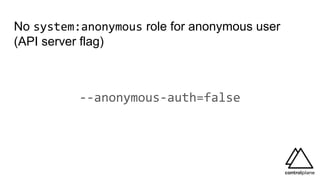
No system:anonymous role for anonymous user
(API server flag)
--anonymous-auth=false
No system:anonymous role for anonymous user
(API server flag)
andy@localhost:~ [0]# curl https://kube-master:6443/version
{
"major": "1",
"minor": "10",
"gitVersion": "v1.10.3",
"gitCommit": "2bba0127d85d5a46ab4b778548be28623b32d0b0",
"gitTreeState": "clean",
"buildDate": "2018-05-21T09:05:37Z",
"goVersion": "go1.9.3",
"compiler": "gc",
"platform": "linux/amd64"
}
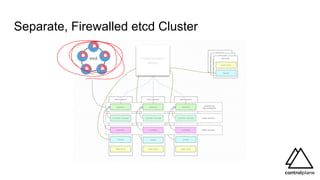
Separate, Firewalled etcd Cluster
Implementation
details
Rotate keys
Securing Workloads
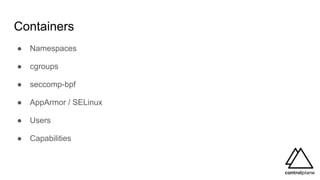
Containers
Containers
● Namespaces
● cgroups
● seccomp-bpf
● AppArmor / SELinux
● Users
● Capabilities
Pods
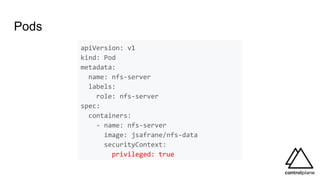
Pods
apiVersion: v1
kind: Pod
metadata:
name: nfs-server
labels:
role: nfs-server
spec:
containers:
- name: nfs-server
image: jsafrane/nfs-data
securityContext:
privileged: true
kubesec.io - risk score for K8S YAML
kubesec.io - example insecure pod
{
"score": -30,
"scoring": {
"critical": [{
"selector": "containers[] .securityContext .privileged == true",
"reason": "Privileged containers can allow almost completely unrestricted host access"
}],
"advise": [{
"selector": "containers[] .securityContext .runAsNonRoot == true",
"reason": "Force the running image to run as a non-root user to ensure least privilege"
}, {
"selector": "containers[] .securityContext .capabilities .drop",
"reason": "Reducing kernel capabilities available to a container limits its attack surface",
"href": "https://kubernetes.io/docs/tasks/configure-pod-container/security-context/"
},
...
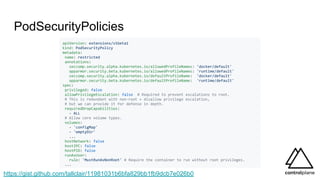
PodSecurityPolicies
apiVersion: extensions/v1beta1
kind: PodSecurityPolicy
metadata:
name: restricted
annotations:
seccomp.security.alpha.kubernetes.io/allowedProfileNames: 'docker/default'
apparmor.security.beta.kubernetes.io/allowedProfileNames: 'runtime/default'
seccomp.security.alpha.kubernetes.io/defaultProfileName: 'docker/default'
apparmor.security.beta.kubernetes.io/defaultProfileName: 'runtime/default'
spec:
privileged: false
allowPrivilegeEscalation: false # Required to prevent escalations to root.
# This is redundant with non-root + disallow privilege escalation,
# but we can provide it for defense in depth.
requiredDropCapabilities:
- ALL
# Allow core volume types.
volumes:
- 'configMap'
- 'emptyDir'
...
hostNetwork: false
hostIPC: false
hostPID: false
runAsUser:
rule: 'MustRunAsNonRoot' # Require the container to run without root privileges.
...
https://gist.github.com/tallclair/11981031b6bfa829bb1fb9dcb7e026b0
Resource Linting
● https://kubesec.io/ - calculate “risk” of Kubernetes resource YAML by use of
security features
● https://github.com/garethr/kubetest - unit tests for your Kubernetes
configurations
Deployments
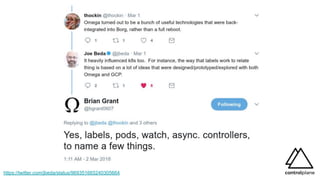
https://twitter.com/jbeda/status/969351665240305664
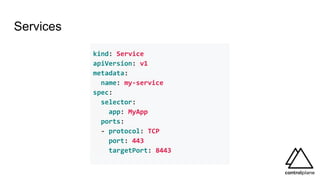
Services
Services
kind: Service
apiVersion: v1
metadata:
name: my-service
spec:
selector:
app: MyApp
ports:
- protocol: TCP
port: 443
targetPort: 8443
ServiceAccounts
“We recommend you create and use a minimally privileged service account to
run your Kubernetes Engine Cluster”
https://cloudplatform.googleblog.com/2017/11/precious-cargo-securing-containers-
with-Kubernetes-Engine-18.html
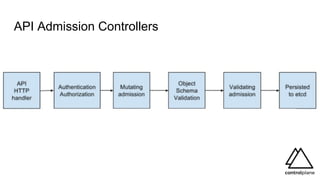
API Admission Controllers
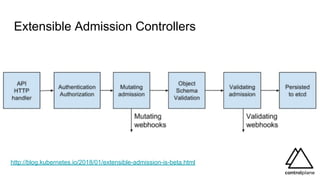
Extensible Admission Controllers
http://blog.kubernetes.io/2018/01/extensible-admission-is-beta.html
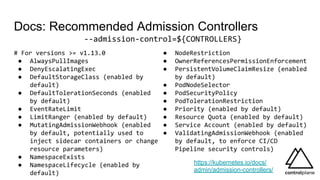
Docs: Recommended Admission Controllers
# For versions >= v1.13.0
● AlwaysPullImages
● DenyEscalatingExec
● DefaultStorageClass (enabled by
default)
● DefaultTolerationSeconds (enabled
by default)
● EventRateLimit
● LimitRanger (enabled by default)
● MutatingAdmissionWebhook (enabled
by default, potentially used to
inject sidecar containers or change
resource parameters)
● NamespaceExists
● NamespaceLifecycle (enabled by
default)
https://kubernetes.io/docs/
admin/admission-controllers/
● NodeRestriction
● OwnerReferencesPermissionEnforcement
● PersistentVolumeClaimResize (enabled
by default)
● PodNodeSelector
● PodSecurityPolicy
● PodTolerationRestriction
● Priority (enabled by default)
● Resource Quota (enabled by default)
● Service Account (enabled by default)
● ValidatingAdmissionWebhook (enabled
by default, to enforce CI/CD
Pipeline security controls)
--admission-control=${CONTROLLERS}
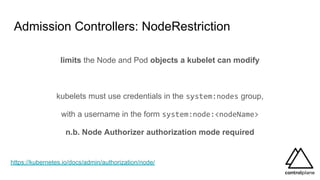
Admission Controllers: NodeRestriction
limits the Node and Pod objects a kubelet can modify
kubelets must use credentials in the system:nodes group,
with a username in the form system:node:<nodeName>
n.b. Node Authorizer authorization mode required
https://kubernetes.io/docs/admin/authorization/node/
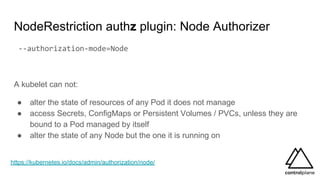
NodeRestriction authz plugin: Node Authorizer
--authorization-mode=Node
A kubelet can not:
● alter the state of resources of any Pod it does not manage
● access Secrets, ConfigMaps or Persistent Volumes / PVCs, unless they are
bound to a Pod managed by itself
● alter the state of any Node but the one it is running on
https://kubernetes.io/docs/admin/authorization/node/
Admission Controllers: PodSecurityPolicy
determines if it should be admitted based on the requested
security context and available Pod Security Policies
https://github.com/kubernetes/examples/tree/master/staging/podsecuritypolicy/rbac
Admission Controllers: ServiceAccount
automation for serviceAccounts
if not exist, set:
ServiceAccount, ImagePullSecrets,
/var/run/secrets/kubernetes.io/serviceaccount volume
Admission Controllers:
ValidatingAdmissionWebhook (v1.9 beta)
calls validating webhooks in parallel,
rejects pod if any fail
Compliance Scanning
● https://github.com/nccgroup/kube-auto-analyzer - review Kubernetes installations against the
CIS Kubernetes 1.8 Benchmark
● https://github.com/aquasecurity/kube-bench - test versions of Kubernetes (1.6, 1.7 and 1.8)
against CIS Kubernetes 1.0.0, 1.1.0 and 1.2.0
● https://github.com/heptio/sonobuoy - running a set of Kubernetes conformance tests in an
accessible and non-destructive manner
● https://github.com/bgeesaman/sonobuoy-plugin-bulkhead - kube-bench for sonobouy
● https://github.com/bgeesaman/kubeatf - spin up, test, and destroy Kubernetes clusters in a
human and CI/CD friendly way
Image Scanning
● https://github.com/coreos/clair
● https://github.com/arminc/clair-local-scan
● https://github.com/optiopay/klar - integration of Clair and Docker Registry
● https://github.com/banyanops/collector
● https://github.com/anchore/anchore-engine
Securing Kubernetes
Networking
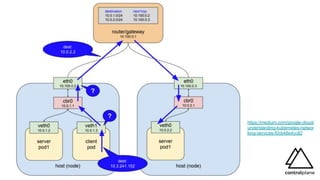
Kubernetes networking
https://medium.com/google-cloud/
understanding-kubernetes-networ
king-services-f0cb48e4cc82
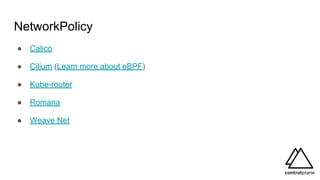
NetworkPolicy
● Calico
● Cilium (Learn more about eBPF)
● Kube-router
● Romana
● Weave Net
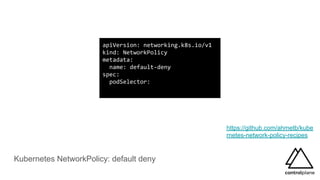
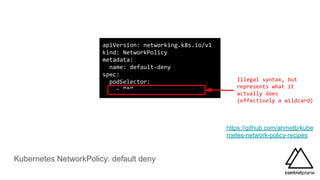
Kubernetes NetworkPolicy: default deny
apiVersion: networking.k8s.io/v1
kind: NetworkPolicy
metadata:
name: default-deny
spec:
podSelector:
https://github.com/ahmetb/kube
rnetes-network-policy-recipes
Kubernetes NetworkPolicy: default deny
apiVersion: networking.k8s.io/v1
kind: NetworkPolicy
metadata:
name: default-deny
spec:
podSelector:
- “*”
https://github.com/ahmetb/kube
rnetes-network-policy-recipes
Illegal syntax, but
represents what it
actually does
(effectively a wildcard)
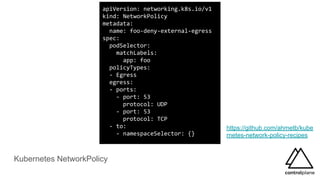
Kubernetes NetworkPolicy
https://github.com/ahmetb/kube
rnetes-network-policy-recipes
apiVersion: networking.k8s.io/v1
kind: NetworkPolicy
metadata:
name: foo-deny-external-egress
spec:
podSelector:
matchLabels:
app: foo
policyTypes:
- Egress
egress:
- ports:
- port: 53
protocol: UDP
- port: 53
protocol: TCP
- to:
- namespaceSelector: {}
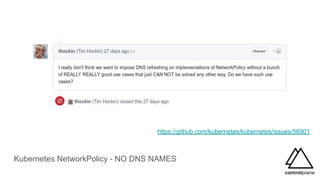
Kubernetes NetworkPolicy - NO DNS NAMES
https://github.com/kubernetes/kubernetes/issues/56901
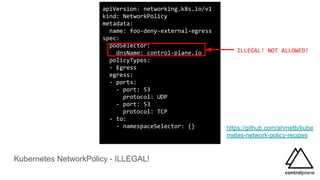
Kubernetes NetworkPolicy - ILLEGAL!
https://github.com/ahmetb/kube
rnetes-network-policy-recipes
apiVersion: networking.k8s.io/v1
kind: NetworkPolicy
metadata:
name: foo-deny-external-egress
spec:
podSelector:
dnsName: control-plane.io
policyTypes:
- Egress
egress:
- ports:
- port: 53
protocol: UDP
- port: 53
protocol: TCP
- to:
- namespaceSelector: {}
ILLEGAL! NOT ALLOWED!
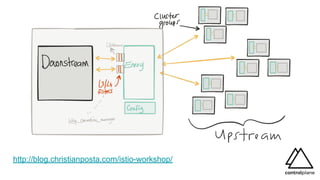
http://blog.christianposta.com/istio-workshop/
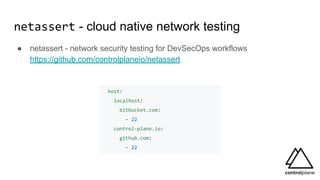
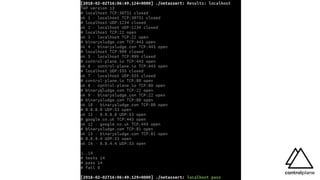
netassert - cloud native network testing
● netassert - network security testing for DevSecOps workflows
https://github.com/controlplaneio/netassert
host:
localhost:
bitbucket.com:
- 22
control-plane.io:
github.com:
- 22
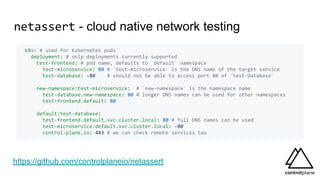
netassert - cloud native network testing
k8s: # used for Kubernetes pods
deployment: # only deployments currently supported
test-frontend: # pod name, defaults to `default` namespace
test-microservice: 80 # `test-microservice` is the DNS name of the target service
test-database: -80 # should not be able to access port 80 of `test-database`
new-namespace:test-microservice: # `new-namespace` is the namespace name
test-database.new-namespace: 80 # longer DNS names can be used for other namespaces
test-frontend.default: 80
default:test-database:
test-frontend.default.svc.cluster.local: 80 # full DNS names can be used
test-microservice.default.svc.cluster.local: -80
control-plane.io: 443 # we can check remote services too
https://github.com/controlplaneio/netassert
Multi Tenancy
Principles
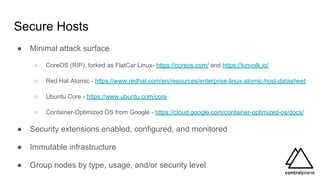
Secure Hosts
● Minimal attack surface
○ CoreOS (RIP), forked as FlatCar Linux- https://coreos.com/ and https://kinvolk.io/
○ Red Hat Atomic - https://www.redhat.com/en/resources/enterprise-linux-atomic-host-datasheet
○ Ubuntu Core - https://www.ubuntu.com/core
○ Container-Optimized OS from Google - https://cloud.google.com/container-optimized-os/docs/
● Security extensions enabled, configured, and monitored
● Immutable infrastructure
● Group nodes by type, usage, and/or security level
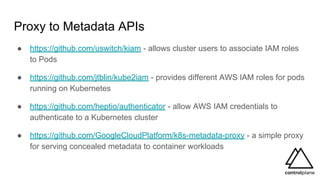
Proxy to Metadata APIs
● https://github.com/uswitch/kiam - allows cluster users to associate IAM roles
to Pods
● https://github.com/jtblin/kube2iam - provides different AWS IAM roles for pods
running on Kubernetes
● https://github.com/heptio/authenticator - allow AWS IAM credentials to
authenticate to a Kubernetes cluster
● https://github.com/GoogleCloudPlatform/k8s-metadata-proxy - a simple proxy
for serving concealed metadata to container workloads
MULTI TENANCY: Soft
MULTI TENANCY: Soft
● Isolate by namespace
○ Don't forget the default NetworkPolicy and PodSecurityPolicy
○ Assign limits to the namespace with LimitRanges
https://kubernetes.io/docs/tasks/administer-cluster/memory-default-namespace/
● Separate dev/test from production
● Image scanning
○ Private registry and build artefacts/supply chain
MULTI TENANCY: Soft
● Policed, scanned, compliant base images, stored within organisation
○ Minimal attack surface
○ FROM scratch if possible
● Deploy Admission Controllers, PodSecurityPolicy, etc
● Everything as code
○ https://www.weave.works/blog/gitops-operations-by-pull-request
MULTI TENANCY: Hard
MULTI TENANCY: Hard
● All users untrusted, potentially malicious
○ Comfortable running code from multiple third parties, with the potential for malice that implies,
in the same cluster
● Only co-tenant along your existing security boundaries
● Segregate logically by application type, security level, and/or physically by
project/account
● Separate node pools for different tenants
MULTI TENANCY: Hard
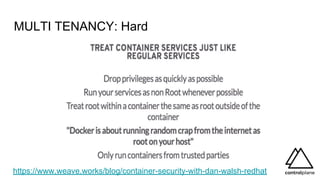
● This may not look a lot like hard multitenancy?
○ It's still running a centralised control plane
● Run kubedns in a sidecar to restrict DNS leakage
● Mixed vm and container workload
○ Dan Walsh nailed it
○ "glasshouse VMs"
● Defence in depth
● Remote logging
MULTI TENANCY: Hard
https://www.weave.works/blog/container-security-with-dan-walsh-redhat
Persisting
Configuration:
Continuous Security
Continuous
Security
Continuous Infra Security
● The system can continually self-validate
● Test pipelines are more robust
● Highly skilled penetration testers are free to focus on the
“high-hanging fruit”
Conclusion
● The brave new world of Kubernetes increases
attack surface and potential for misconfiguration
● Lots of new security primitives are landing
● The only way to iterate quickly is: supported by a
test suite
● Security testing keeps you young

Control Plane: Continuous Kubernetes Security (DevSecOps - London Gathering, January 2019)

  • 1.
  • 2.
  • 4.
  • 5.
  • 6.
  • 7.
    No RBAC Attacking Kubernetes- Dino Dai Zovi, Capsule8
  • 8.
    No Workload Security Buildingfor Trust: How to Secure Your Kubernetes Cluster [I] - Alexander Mohr & Jess Frazelle
  • 9.
    No Security -Cluster Edition Hacking and Hardening Kubernetes Clusters by Example - Brad Geesaman, Symantec
  • 10.
    Helm Exploring The SecurityOf Helm / Using SSL Between Helm and Tiller
  • 11.
    Unsecured Dashboard -Tesla Lessons from the Cryptojacking Attack at Tesla - RedLock CSI Team
  • 12.
    CVE-2017-1002101 - subpathvolume mount handling allows arbitrary file access in host filesystem #60813
  • 13.
    CVE-2018-1002105: proxy requesthandling in kube-apiserver can leave vulnerable TCP connections #71411
  • 14.
    Is this Kubernetescluster secure?
  • 16.
  • 17.
    Nodes Master Node 3 OS Container Runtime Kubelet Networking Node 2 OS Container Runtime Kubelet Networking Node1 OS Container Runtime Kubelet Networking API Server (REST API) Controller Manager (Controller Loops) Scheduler (Bind Pod to Node) etcd (key-value DB, SSOT) User Legend: CNI CRI OCI Protobuf gRPC JSON By Lucas Käldström
  • 18.
    Minimum Viable Security TLSEverywhere Note that some components and installation methods may enable local ports over HTTP and administrators should familiarize themselves with the settings of each component to identify potentially unsecured traffic. https://kubernetes.io/docs/tasks/administer-cluster/securing-a-cluster/#use-transpo rt-level-security-tls-for-all-api-traffic
  • 19.
  • 20.
    Enable RBAC RBAC Supportin Kubernetes (stable v1.8)
  • 21.
    External Auth toAPI Server (e.g. via kubectl) ● https://github.com/coreos/dex - OpenID Connect Identity (OIDC) and OAuth 2.0 provider with pluggable connectors ● https://github.com/pusher/k8s-auth-example - OIDC connector ● https://thenewstack.io/kubernetes-single-sign-one-less-identity/ ● https://github.com/negz/kuberos - OIDC authentication helper for kubectl (also https://cloud.google.com/community/tutorials/kubernetes-auth-openid-rbac) ● https://github.com/micahhausler/k8s-oidc-helper - helper tool for authenticating to Kubernetes using Google's OpenID Connect
  • 22.
    Disable API serverread only port (default: 8080) --insecure-port=0
  • 23.
    Disable API serverread only port (default: 8080) andy@kube-master:~ [0]# curl localhost:8080/api/v1/secrets?limit=1 { "kind": "SecretList", "apiVersion": "v1", "metadata": {...}, "items": [ { "metadata": { "name": "default-token-dhj8b", "namespace": "default", ... "annotations": { "kubernetes.io/service-account.name": "default", "kubernetes.io/service-account.uid": "a7e874b7-6186-11e8-92ba-4af3186f8390" } }, "data": { "ca.crt": "LS0tLS1CRUdJTiBD...", "namespace": "ZGVmYXVsdA==", "token": "ZXlKaGJHY..." }, "type": "kubernetes.io/service-account-token" } ] }
  • 24.
    No system:anonymous rolefor anonymous user (API server flag) --anonymous-auth=false
  • 25.
    No system:anonymous rolefor anonymous user (API server flag) andy@localhost:~ [0]# curl https://kube-master:6443/version { "major": "1", "minor": "10", "gitVersion": "v1.10.3", "gitCommit": "2bba0127d85d5a46ab4b778548be28623b32d0b0", "gitTreeState": "clean", "buildDate": "2018-05-21T09:05:37Z", "goVersion": "go1.9.3", "compiler": "gc", "platform": "linux/amd64" }
  • 26.
    Separate, Firewalled etcdCluster Implementation details
  • 27.
  • 28.
  • 29.
  • 30.
    Containers ● Namespaces ● cgroups ●seccomp-bpf ● AppArmor / SELinux ● Users ● Capabilities
  • 31.
  • 32.
    Pods apiVersion: v1 kind: Pod metadata: name:nfs-server labels: role: nfs-server spec: containers: - name: nfs-server image: jsafrane/nfs-data securityContext: privileged: true
  • 33.
    kubesec.io - riskscore for K8S YAML
  • 34.
    kubesec.io - exampleinsecure pod { "score": -30, "scoring": { "critical": [{ "selector": "containers[] .securityContext .privileged == true", "reason": "Privileged containers can allow almost completely unrestricted host access" }], "advise": [{ "selector": "containers[] .securityContext .runAsNonRoot == true", "reason": "Force the running image to run as a non-root user to ensure least privilege" }, { "selector": "containers[] .securityContext .capabilities .drop", "reason": "Reducing kernel capabilities available to a container limits its attack surface", "href": "https://kubernetes.io/docs/tasks/configure-pod-container/security-context/" }, ...
  • 35.
    PodSecurityPolicies apiVersion: extensions/v1beta1 kind: PodSecurityPolicy metadata: name:restricted annotations: seccomp.security.alpha.kubernetes.io/allowedProfileNames: 'docker/default' apparmor.security.beta.kubernetes.io/allowedProfileNames: 'runtime/default' seccomp.security.alpha.kubernetes.io/defaultProfileName: 'docker/default' apparmor.security.beta.kubernetes.io/defaultProfileName: 'runtime/default' spec: privileged: false allowPrivilegeEscalation: false # Required to prevent escalations to root. # This is redundant with non-root + disallow privilege escalation, # but we can provide it for defense in depth. requiredDropCapabilities: - ALL # Allow core volume types. volumes: - 'configMap' - 'emptyDir' ... hostNetwork: false hostIPC: false hostPID: false runAsUser: rule: 'MustRunAsNonRoot' # Require the container to run without root privileges. ... https://gist.github.com/tallclair/11981031b6bfa829bb1fb9dcb7e026b0
  • 36.
    Resource Linting ● https://kubesec.io/- calculate “risk” of Kubernetes resource YAML by use of security features ● https://github.com/garethr/kubetest - unit tests for your Kubernetes configurations
  • 37.
  • 38.
  • 39.
  • 40.
    Services kind: Service apiVersion: v1 metadata: name:my-service spec: selector: app: MyApp ports: - protocol: TCP port: 443 targetPort: 8443
  • 41.
    ServiceAccounts “We recommend youcreate and use a minimally privileged service account to run your Kubernetes Engine Cluster” https://cloudplatform.googleblog.com/2017/11/precious-cargo-securing-containers- with-Kubernetes-Engine-18.html
  • 42.
  • 43.
  • 44.
    Docs: Recommended AdmissionControllers # For versions >= v1.13.0 ● AlwaysPullImages ● DenyEscalatingExec ● DefaultStorageClass (enabled by default) ● DefaultTolerationSeconds (enabled by default) ● EventRateLimit ● LimitRanger (enabled by default) ● MutatingAdmissionWebhook (enabled by default, potentially used to inject sidecar containers or change resource parameters) ● NamespaceExists ● NamespaceLifecycle (enabled by default) https://kubernetes.io/docs/ admin/admission-controllers/ ● NodeRestriction ● OwnerReferencesPermissionEnforcement ● PersistentVolumeClaimResize (enabled by default) ● PodNodeSelector ● PodSecurityPolicy ● PodTolerationRestriction ● Priority (enabled by default) ● Resource Quota (enabled by default) ● Service Account (enabled by default) ● ValidatingAdmissionWebhook (enabled by default, to enforce CI/CD Pipeline security controls) --admission-control=${CONTROLLERS}
  • 45.
    Admission Controllers: NodeRestriction limitsthe Node and Pod objects a kubelet can modify kubelets must use credentials in the system:nodes group, with a username in the form system:node:<nodeName> n.b. Node Authorizer authorization mode required https://kubernetes.io/docs/admin/authorization/node/
  • 46.
    NodeRestriction authz plugin:Node Authorizer --authorization-mode=Node A kubelet can not: ● alter the state of resources of any Pod it does not manage ● access Secrets, ConfigMaps or Persistent Volumes / PVCs, unless they are bound to a Pod managed by itself ● alter the state of any Node but the one it is running on https://kubernetes.io/docs/admin/authorization/node/
  • 47.
    Admission Controllers: PodSecurityPolicy determinesif it should be admitted based on the requested security context and available Pod Security Policies https://github.com/kubernetes/examples/tree/master/staging/podsecuritypolicy/rbac
  • 48.
    Admission Controllers: ServiceAccount automationfor serviceAccounts if not exist, set: ServiceAccount, ImagePullSecrets, /var/run/secrets/kubernetes.io/serviceaccount volume
  • 49.
    Admission Controllers: ValidatingAdmissionWebhook (v1.9beta) calls validating webhooks in parallel, rejects pod if any fail
  • 50.
    Compliance Scanning ● https://github.com/nccgroup/kube-auto-analyzer- review Kubernetes installations against the CIS Kubernetes 1.8 Benchmark ● https://github.com/aquasecurity/kube-bench - test versions of Kubernetes (1.6, 1.7 and 1.8) against CIS Kubernetes 1.0.0, 1.1.0 and 1.2.0 ● https://github.com/heptio/sonobuoy - running a set of Kubernetes conformance tests in an accessible and non-destructive manner ● https://github.com/bgeesaman/sonobuoy-plugin-bulkhead - kube-bench for sonobouy ● https://github.com/bgeesaman/kubeatf - spin up, test, and destroy Kubernetes clusters in a human and CI/CD friendly way
  • 51.
    Image Scanning ● https://github.com/coreos/clair ●https://github.com/arminc/clair-local-scan ● https://github.com/optiopay/klar - integration of Clair and Docker Registry ● https://github.com/banyanops/collector ● https://github.com/anchore/anchore-engine
  • 52.
  • 53.
  • 54.
    NetworkPolicy ● Calico ● Cilium(Learn more about eBPF) ● Kube-router ● Romana ● Weave Net
  • 55.
    Kubernetes NetworkPolicy: defaultdeny apiVersion: networking.k8s.io/v1 kind: NetworkPolicy metadata: name: default-deny spec: podSelector: https://github.com/ahmetb/kube rnetes-network-policy-recipes
  • 56.
    Kubernetes NetworkPolicy: defaultdeny apiVersion: networking.k8s.io/v1 kind: NetworkPolicy metadata: name: default-deny spec: podSelector: - “*” https://github.com/ahmetb/kube rnetes-network-policy-recipes Illegal syntax, but represents what it actually does (effectively a wildcard)
  • 57.
    Kubernetes NetworkPolicy https://github.com/ahmetb/kube rnetes-network-policy-recipes apiVersion: networking.k8s.io/v1 kind:NetworkPolicy metadata: name: foo-deny-external-egress spec: podSelector: matchLabels: app: foo policyTypes: - Egress egress: - ports: - port: 53 protocol: UDP - port: 53 protocol: TCP - to: - namespaceSelector: {}
  • 58.
    Kubernetes NetworkPolicy -NO DNS NAMES https://github.com/kubernetes/kubernetes/issues/56901
  • 59.
    Kubernetes NetworkPolicy -ILLEGAL! https://github.com/ahmetb/kube rnetes-network-policy-recipes apiVersion: networking.k8s.io/v1 kind: NetworkPolicy metadata: name: foo-deny-external-egress spec: podSelector: dnsName: control-plane.io policyTypes: - Egress egress: - ports: - port: 53 protocol: UDP - port: 53 protocol: TCP - to: - namespaceSelector: {} ILLEGAL! NOT ALLOWED!
  • 61.
  • 62.
    netassert - cloudnative network testing ● netassert - network security testing for DevSecOps workflows https://github.com/controlplaneio/netassert host: localhost: bitbucket.com: - 22 control-plane.io: github.com: - 22
  • 63.
    netassert - cloudnative network testing k8s: # used for Kubernetes pods deployment: # only deployments currently supported test-frontend: # pod name, defaults to `default` namespace test-microservice: 80 # `test-microservice` is the DNS name of the target service test-database: -80 # should not be able to access port 80 of `test-database` new-namespace:test-microservice: # `new-namespace` is the namespace name test-database.new-namespace: 80 # longer DNS names can be used for other namespaces test-frontend.default: 80 default:test-database: test-frontend.default.svc.cluster.local: 80 # full DNS names can be used test-microservice.default.svc.cluster.local: -80 control-plane.io: 443 # we can check remote services too https://github.com/controlplaneio/netassert
  • 65.
  • 66.
    Secure Hosts ● Minimalattack surface ○ CoreOS (RIP), forked as FlatCar Linux- https://coreos.com/ and https://kinvolk.io/ ○ Red Hat Atomic - https://www.redhat.com/en/resources/enterprise-linux-atomic-host-datasheet ○ Ubuntu Core - https://www.ubuntu.com/core ○ Container-Optimized OS from Google - https://cloud.google.com/container-optimized-os/docs/ ● Security extensions enabled, configured, and monitored ● Immutable infrastructure ● Group nodes by type, usage, and/or security level
  • 67.
    Proxy to MetadataAPIs ● https://github.com/uswitch/kiam - allows cluster users to associate IAM roles to Pods ● https://github.com/jtblin/kube2iam - provides different AWS IAM roles for pods running on Kubernetes ● https://github.com/heptio/authenticator - allow AWS IAM credentials to authenticate to a Kubernetes cluster ● https://github.com/GoogleCloudPlatform/k8s-metadata-proxy - a simple proxy for serving concealed metadata to container workloads
  • 68.
  • 69.
    MULTI TENANCY: Soft ●Isolate by namespace ○ Don't forget the default NetworkPolicy and PodSecurityPolicy ○ Assign limits to the namespace with LimitRanges https://kubernetes.io/docs/tasks/administer-cluster/memory-default-namespace/ ● Separate dev/test from production ● Image scanning ○ Private registry and build artefacts/supply chain
  • 70.
    MULTI TENANCY: Soft ●Policed, scanned, compliant base images, stored within organisation ○ Minimal attack surface ○ FROM scratch if possible ● Deploy Admission Controllers, PodSecurityPolicy, etc ● Everything as code ○ https://www.weave.works/blog/gitops-operations-by-pull-request
  • 71.
  • 72.
    MULTI TENANCY: Hard ●All users untrusted, potentially malicious ○ Comfortable running code from multiple third parties, with the potential for malice that implies, in the same cluster ● Only co-tenant along your existing security boundaries ● Segregate logically by application type, security level, and/or physically by project/account ● Separate node pools for different tenants
  • 73.
    MULTI TENANCY: Hard ●This may not look a lot like hard multitenancy? ○ It's still running a centralised control plane ● Run kubedns in a sidecar to restrict DNS leakage ● Mixed vm and container workload ○ Dan Walsh nailed it ○ "glasshouse VMs" ● Defence in depth ● Remote logging
  • 74.
  • 75.
  • 76.
  • 77.
    Continuous Infra Security ●The system can continually self-validate ● Test pipelines are more robust ● Highly skilled penetration testers are free to focus on the “high-hanging fruit”
  • 79.
    Conclusion ● The bravenew world of Kubernetes increases attack surface and potential for misconfiguration ● Lots of new security primitives are landing ● The only way to iterate quickly is: supported by a test suite ● Security testing keeps you young