Secure your K8s cluster
from multi-layers
Jiantang Hao
Agend
• About me
• K8s bug report
• Why kubernetes make security difficult
• Infrastructure Layer
• K8s Control Plane Layer
• K8s Workload Layer
• K8s Container Runtime Layer
• User Misconfiguration Layer
• Useful Tool&Documents
• References
About me
• Jiantang Hao
• Platform Engineer at Yahoo! JAPAN
• Focus on CaaS(Container as a Service)
• Like Challengeable/Interesting tech
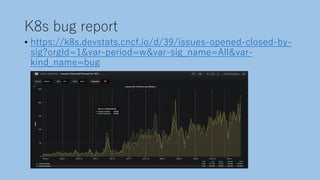
K8s bug report
• https://k8s.devstats.cncf.io/d/39/issues-opened-closed-by-
sig?orgId=1&var-period=w&var-sig_name=All&var-
kind_name=bug
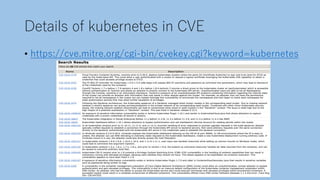
Details of kubernetes in CVE
• https://cve.mitre.org/cgi-bin/cvekey.cgi?keyword=kubernetes
Why kubernetes make security difficult
• Traffic is everywhere. Containers can be dynamically
deployed across hosts or even clouds.
• Increased attack surface. Each container and have a
different attack surface and vulnerabilities which can be
exploited.
• Old security tool. Old models and tools for security will not
be able to keep up in a constantly changing container
environment.
Infrastructure Layer
• Turn on audit log
• Never expose a port, which doesn't need exposure
• Host the cluster in a private subnet or VPC if possible
• Limit SSH to kubernetes nodes, use “kubectl” more
• Limit the access to kube-api
K8s Control Plane Layer
• Enable RBAC, at least make --anonymous-auth false.
• Enable TLS among component connection
• Encrypting Secret Data at Rest
• Turn on K8s audit logging
• Reserve Compute Resources for System Daemons
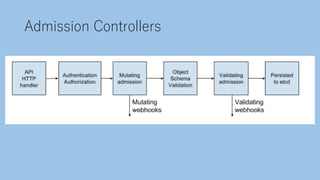
• Admission Controllers
Admission Controllers
• Enable by set flag in Kubernetes API server
• Admission controllers may be “validating”, “mutating”, or
both
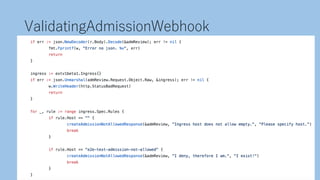
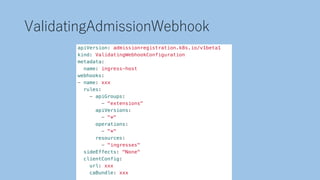
• This admission controller calls any validating webhooks
which match the request. Matching webhooks are called in
parallel
• Caution about using mutating webhooks
Admission Controllers
ValidatingAdmissionWebhook
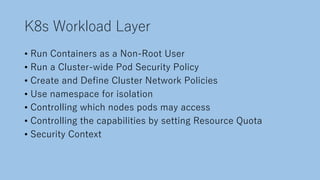
K8s Workload Layer
• Run Containers as a Non-Root User
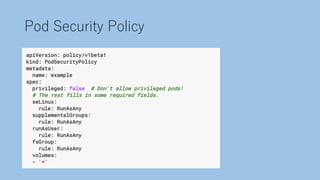
• Run a Cluster-wide Pod Security Policy
• Create and Define Cluster Network Policies
• Use namespace for isolation
• Controlling which nodes pods may access
• Controlling the capabilities by setting Resource Quota
• Security Context
Pod Security Policy
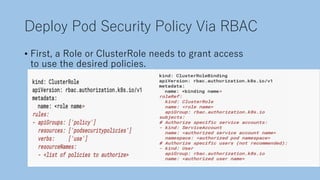
Deploy Pod Security Policy Via RBAC
• First, a Role or ClusterRole needs to grant access
to use the desired policies.
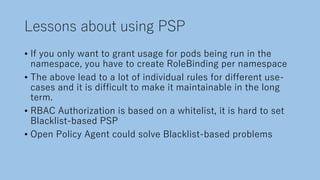
Lessons about using PSP
• If you only want to grant usage for pods being run in the
namespace, you have to create RoleBinding per namespace
• The above lead to a lot of individual rules for different use-
cases and it is difficult to make it maintainable in the long
term.
• RBAC Authorization is based on a whitelist, it is hard to set
Blacklist-based PSP
• Open Policy Agent could solve Blacklist-based problems
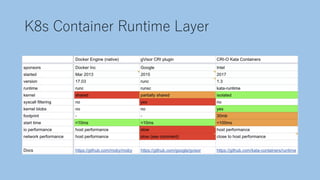
K8s Container Runtime Layer
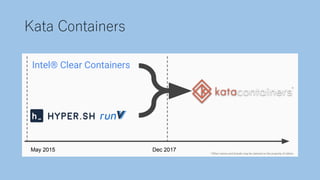
Kata Containers
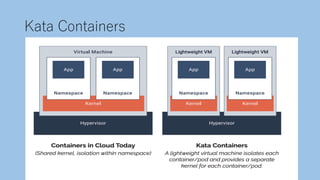
Kata Containers
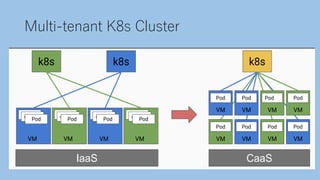
Multi-tenant K8s Cluster
User Misconfiguration Layer
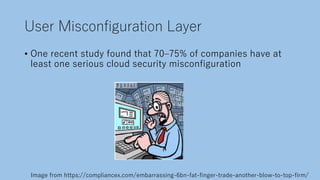
• One recent study found that 70‒75% of companies have at
least one serious cloud security misconfiguration
Image from https://compliancex.com/embarrassing-6bn-fat-finger-trade-another-blow-to-top-firm/
User Misconfiguration Layer
• Donʼt specify default values unnecessarily
• Simple, minimal configuration will make errors less likely
• Put object descriptions in annotations, to allow better
introspection
• Specify the latest stable API version
• Check the configuration on CICD pipeline
• https://kubesec.io/
Useful Tool&Documents
• (CIS) Benchmark for Kubernetes
• (CIS) Benchmark for Docker
• aquasecurity/kube-bench
• aquasecurity/kube-hunter
• Sysdig Inspect
• Shopify/kubeaudit
• coreos/clair
• Open Policy Agent
References• https://www.cncf.io/blog/2019/01/14/9-kubernetes-security-best-practices-everyone-must-follow/
• https://neuvector.com/container-security/kubernetes-security-guide/
• https://www.darkreading.com/vulnerabilities---threats/security-at-the-speed-of-devops-maturity-orchestration-
and-detection/a/d-id/1333583
• https://cve.mitre.org/cgi-bin/cvekey.cgi?keyword=kubernetes
• https://github.com/freach/kubernetes-security-best-practice
• https://kubernetes.io/docs/reference/access-authn-authz/admission-controllers/#imagepolicywebhook
• https://kubernetes.io/docs/tasks/debug-application-cluster/audit/
• https://kubernetes.io/blog/2018/07/18/11-ways-not-to-get-hacked/s
• https://kubernetes-security.info/#securing-the-cluster
• https://medium.com/devopslinks/kubernetes-security-are-your-container-doors-open-2c4b99c8d786
• https://kubernetes.io/docs/concepts/configuration/overview/
• https://kubedex.com/kubernetes-container-runtimes/
• https://katacontainers.io/
• https://katacontainers.io/media/uploads/katacontainers/uploads/katacontainers/kata-containers-on-boarding-
deck-for-website01022018.pdf
• https://katacontainers.io/media/uploads/katacontainers/uploads/katacontainers/kata_containers_overview.pdf
• https://itnext.io/kubernetes-authorization-via-open-policy-agent-a9455d9d5ceb
• https://kubernetes.io/docs/concepts/policy/pod-security-policy/
Yes! We are hiring!
jhao@yahoo-corp.jp
https://about.yahoo.co.jp/hr/en/
https://about.yahoo.co.jp/hr/
Thank you for your listening!
ご静聴ありがとうございました!

Secure your K8s cluster from multi-layers

  • 1.
    Secure your K8scluster from multi-layers Jiantang Hao
  • 2.
    Agend • About me •K8s bug report • Why kubernetes make security difficult • Infrastructure Layer • K8s Control Plane Layer • K8s Workload Layer • K8s Container Runtime Layer • User Misconfiguration Layer • Useful Tool&Documents • References
  • 3.
    About me • JiantangHao • Platform Engineer at Yahoo! JAPAN • Focus on CaaS(Container as a Service) • Like Challengeable/Interesting tech
  • 4.
    K8s bug report •https://k8s.devstats.cncf.io/d/39/issues-opened-closed-by- sig?orgId=1&var-period=w&var-sig_name=All&var- kind_name=bug
  • 5.
    Details of kubernetesin CVE • https://cve.mitre.org/cgi-bin/cvekey.cgi?keyword=kubernetes
  • 6.
    Why kubernetes makesecurity difficult • Traffic is everywhere. Containers can be dynamically deployed across hosts or even clouds. • Increased attack surface. Each container and have a different attack surface and vulnerabilities which can be exploited. • Old security tool. Old models and tools for security will not be able to keep up in a constantly changing container environment.
  • 7.
    Infrastructure Layer • Turnon audit log • Never expose a port, which doesn't need exposure • Host the cluster in a private subnet or VPC if possible • Limit SSH to kubernetes nodes, use “kubectl” more • Limit the access to kube-api
  • 8.
    K8s Control PlaneLayer • Enable RBAC, at least make --anonymous-auth false. • Enable TLS among component connection • Encrypting Secret Data at Rest • Turn on K8s audit logging • Reserve Compute Resources for System Daemons • Admission Controllers
  • 9.
    Admission Controllers • Enableby set flag in Kubernetes API server • Admission controllers may be “validating”, “mutating”, or both • This admission controller calls any validating webhooks which match the request. Matching webhooks are called in parallel • Caution about using mutating webhooks
  • 10.
  • 11.
  • 12.
  • 13.
    K8s Workload Layer •Run Containers as a Non-Root User • Run a Cluster-wide Pod Security Policy • Create and Define Cluster Network Policies • Use namespace for isolation • Controlling which nodes pods may access • Controlling the capabilities by setting Resource Quota • Security Context
  • 14.
  • 15.
    Deploy Pod SecurityPolicy Via RBAC • First, a Role or ClusterRole needs to grant access to use the desired policies.
  • 16.
    Lessons about usingPSP • If you only want to grant usage for pods being run in the namespace, you have to create RoleBinding per namespace • The above lead to a lot of individual rules for different use- cases and it is difficult to make it maintainable in the long term. • RBAC Authorization is based on a whitelist, it is hard to set Blacklist-based PSP • Open Policy Agent could solve Blacklist-based problems
  • 17.
  • 18.
  • 19.
  • 20.
  • 21.
    User Misconfiguration Layer •One recent study found that 70‒75% of companies have at least one serious cloud security misconfiguration Image from https://compliancex.com/embarrassing-6bn-fat-finger-trade-another-blow-to-top-firm/
  • 22.
    User Misconfiguration Layer •Donʼt specify default values unnecessarily • Simple, minimal configuration will make errors less likely • Put object descriptions in annotations, to allow better introspection • Specify the latest stable API version • Check the configuration on CICD pipeline • https://kubesec.io/
  • 23.
    Useful Tool&Documents • (CIS)Benchmark for Kubernetes • (CIS) Benchmark for Docker • aquasecurity/kube-bench • aquasecurity/kube-hunter • Sysdig Inspect • Shopify/kubeaudit • coreos/clair • Open Policy Agent
  • 24.
    References• https://www.cncf.io/blog/2019/01/14/9-kubernetes-security-best-practices-everyone-must-follow/ • https://neuvector.com/container-security/kubernetes-security-guide/ •https://www.darkreading.com/vulnerabilities---threats/security-at-the-speed-of-devops-maturity-orchestration- and-detection/a/d-id/1333583 • https://cve.mitre.org/cgi-bin/cvekey.cgi?keyword=kubernetes • https://github.com/freach/kubernetes-security-best-practice • https://kubernetes.io/docs/reference/access-authn-authz/admission-controllers/#imagepolicywebhook • https://kubernetes.io/docs/tasks/debug-application-cluster/audit/ • https://kubernetes.io/blog/2018/07/18/11-ways-not-to-get-hacked/s • https://kubernetes-security.info/#securing-the-cluster • https://medium.com/devopslinks/kubernetes-security-are-your-container-doors-open-2c4b99c8d786 • https://kubernetes.io/docs/concepts/configuration/overview/ • https://kubedex.com/kubernetes-container-runtimes/ • https://katacontainers.io/ • https://katacontainers.io/media/uploads/katacontainers/uploads/katacontainers/kata-containers-on-boarding- deck-for-website01022018.pdf • https://katacontainers.io/media/uploads/katacontainers/uploads/katacontainers/kata_containers_overview.pdf • https://itnext.io/kubernetes-authorization-via-open-policy-agent-a9455d9d5ceb • https://kubernetes.io/docs/concepts/policy/pod-security-policy/
  • 25.
    Yes! We arehiring! jhao@yahoo-corp.jp https://about.yahoo.co.jp/hr/en/ https://about.yahoo.co.jp/hr/
  • 26.
    Thank you foryour listening! ご静聴ありがとうございました!