Policy-based access control
An introduction to Open Policy Agent
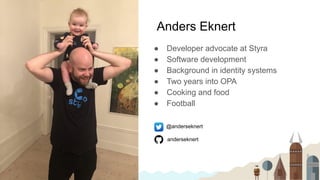
Anders Eknert
● Developer advocate at Styra
● Software development
● Background in identity systems
● Two years into OPA
● Cooking and food
● Football
@anderseknert
anderseknert
Challenge:
Manage policy in increasingly
distributed, complex and
heterogeneous systems
Challenge:
Manage policy in increasingly
distributed, complex and
heterogeneous systems
Challenge:
Manage policy in increasingly
distributed, complex and
heterogeneous systems
Challenge:
Manage policy in increasingly
distributed, complex and
heterogeneous systems
Challenge:
Manage policy in increasingly
distributed, complex and
heterogeneous systems
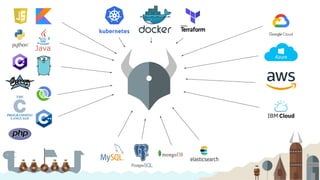
Goal:
Unify policy enforcement
across the stack
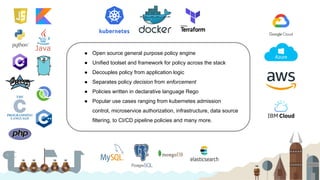
● Open source general purpose policy engine
● Unified toolset and framework for policy across the stack
● Decouples policy from application logic
● Separates policy decision from enforcement
● Policies written in declarative language Rego
● Popular use cases ranging from kubernetes admission
control, microservice authorization, infrastructure, data source
filtering, to CI/CD pipeline policies and many more.
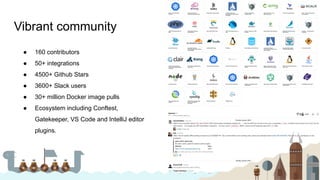
Vibrant community
● 160 contributors
● 50+ integrations
● 4500+ Github Stars
● 3600+ Slack users
● 30+ million Docker image pulls
● Ecosystem including Conftest,
Gatekeeper, VS Code and IntelliJ editor
plugins.
Production users
OPA and Rego
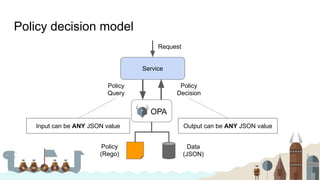
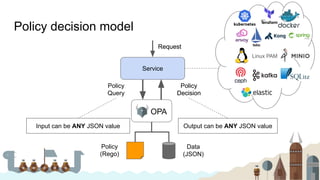
Policy decision model
Service
OPA
Policy
(Rego)
Data
(JSON)
Request
Policy
Decision
Policy
Query
Input can be ANY JSON value Output can be ANY JSON value
Policy decision model
Service
OPA
Policy
(Rego)
Data
(JSON)
Request
Policy
Decision
Policy
Query
Input can be ANY JSON value Output can be ANY JSON value
Request
Policy
Decision
Linux PAM
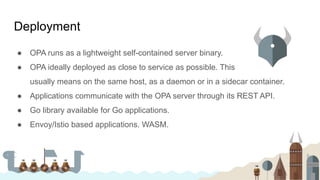
● OPA runs as a lightweight self-contained server binary.
● OPA ideally deployed as close to service as possible. This
usually means on the same host, as a daemon or in a sidecar container.
● Applications communicate with the OPA server through its REST API.
● Go library available for Go applications.
● Envoy/Istio based applications. WASM.
Deployment
Policy authoring and Rego
● Declarative high-level policy language used by OPA.
● Policy consists of any number of rules.
● Rules commonly return true/false but may return any
type available in JSON, like strings, lists and objects.
● 140+ built-in functions: JWTs, date/time, CIDR math ,etc.
● Policy testing is easy with provided unit test framework.
● Well documented! https://www.openpolicyagent.org/docs/latest/
● Try it out! https://play.openpolicyagent.org/
Policy data
● JSON Web Tokens
● As part of query input
● Push data
● Bundle API
● http.send function from inside policy
Demo
Kubernetes
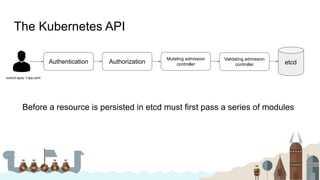
The Kubernetes API
Authentication
kubectl apply -f app.yaml
Authorization
Mutating admission
controller etcd
Validating admission
controller
Before a resource is persisted in etcd must first pass a series of modules
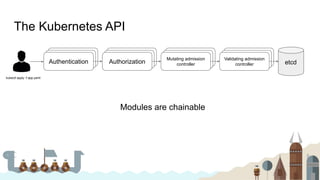
The Kubernetes API
Authentication
kubectl apply -f app.yaml
etcd
Authorization
Mutating admission
controller
Validating admission
controller
Modules are chainable
The Kubernetes API
Authentication
kubectl apply -f app.yaml
etcd
Authorization
Mutating admission
controller
Validating admission
controller
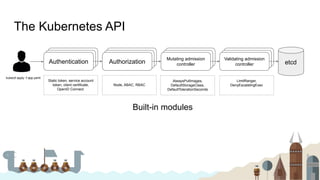
Built-in modules
Static token, service account
token, client certificate,
OpenID Connect.
Node, ABAC, RBAC
AlwaysPullImages,
DefaultStorageClass,
DefaultTolerationSeconds
LimitRanger,
DenyEscalatingExec
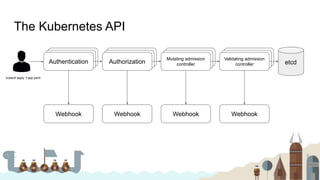
The Kubernetes API
Authentication
kubectl apply -f app.yaml
etcd
Authorization
Mutating admission
controller
Validating admission
controller
Webhook Webhook Webhook Webhook
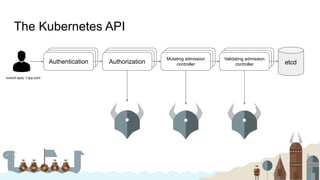
The Kubernetes API
Authentication
kubectl apply -f app.yaml
etcd
Authorization
Mutating admission
controller
Validating admission
controller
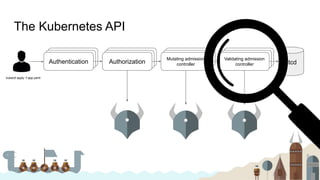
The Kubernetes API
Authentication
kubectl apply -f app.yaml
etcd
Authorization
Mutating admission
controller
Validating admission
controller
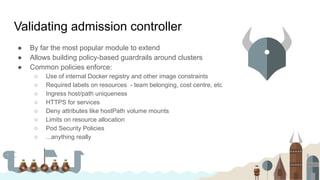
Validating admission controller
● By far the most popular module to extend
● Allows building policy-based guardrails around clusters
● Common policies enforce:
○ Use of internal Docker registry and other image constraints
○ Required labels on resources - team belonging, cost centre, etc
○ Ingress host/path uniqueness
○ HTTPS for services
○ Deny attributes like hostPath volume mounts
○ Limits on resource allocation
○ Pod Security Policies
○ ...anything really
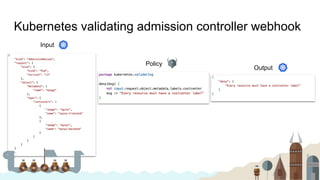
Kubernetes validating admission controller webhook
Input
Policy
Output
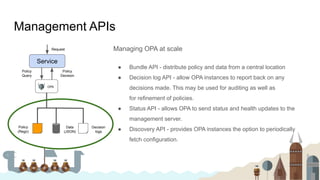
Management APIs
Service
OPA
Policy
(Rego)
Data
(JSON)
Request
Policy
Decision
Policy
Query
Decision
logs
Managing OPA at scale
● Bundle API - distribute policy and data from a central location
● Decision log API - allow OPA instances to report back on any
decisions made. This may be used for auditing as well as
for refinement of policies.
● Status API - allows OPA to send status and health updates to the
management server.
● Discovery API - provides OPA instances the option to periodically
fetch configuration.
Getting started
● Start small – write a few simple policies and tests.
● Browse the OPA documentation. Get a feel for the basics and the built-ins.
● Consider possible applications near to you - previous apps and libraries you’ve worked with.
Consider the informal policies it dealt with.
● Delegate policy responsibilities to OPA. Again, start small! Perhaps a single endpoint to begin
somewhere. Deploy and build experience.
● Scale up - consider management, logging, bundle server, etc.
● Styra Academy - https://academy.styra.com
● Join the OPA Slack community! - https://openpolicyagent.slack.com
Thank you!

DSO-LG 2021 Reboot: Policy As Code (Anders Eknert)

  • 1.
    Policy-based access control Anintroduction to Open Policy Agent
  • 2.
    Anders Eknert ● Developeradvocate at Styra ● Software development ● Background in identity systems ● Two years into OPA ● Cooking and food ● Football @anderseknert anderseknert
  • 3.
    Challenge: Manage policy inincreasingly distributed, complex and heterogeneous systems
  • 4.
    Challenge: Manage policy inincreasingly distributed, complex and heterogeneous systems
  • 5.
    Challenge: Manage policy inincreasingly distributed, complex and heterogeneous systems
  • 6.
    Challenge: Manage policy inincreasingly distributed, complex and heterogeneous systems
  • 7.
    Challenge: Manage policy inincreasingly distributed, complex and heterogeneous systems
  • 8.
  • 10.
    ● Open sourcegeneral purpose policy engine ● Unified toolset and framework for policy across the stack ● Decouples policy from application logic ● Separates policy decision from enforcement ● Policies written in declarative language Rego ● Popular use cases ranging from kubernetes admission control, microservice authorization, infrastructure, data source filtering, to CI/CD pipeline policies and many more.
  • 11.
    Vibrant community ● 160contributors ● 50+ integrations ● 4500+ Github Stars ● 3600+ Slack users ● 30+ million Docker image pulls ● Ecosystem including Conftest, Gatekeeper, VS Code and IntelliJ editor plugins.
  • 12.
  • 14.
  • 15.
  • 16.
    Policy decision model Service OPA Policy (Rego) Data (JSON) Request Policy Decision Policy Query Inputcan be ANY JSON value Output can be ANY JSON value Request Policy Decision Linux PAM
  • 17.
    ● OPA runsas a lightweight self-contained server binary. ● OPA ideally deployed as close to service as possible. This usually means on the same host, as a daemon or in a sidecar container. ● Applications communicate with the OPA server through its REST API. ● Go library available for Go applications. ● Envoy/Istio based applications. WASM. Deployment
  • 18.
    Policy authoring andRego ● Declarative high-level policy language used by OPA. ● Policy consists of any number of rules. ● Rules commonly return true/false but may return any type available in JSON, like strings, lists and objects. ● 140+ built-in functions: JWTs, date/time, CIDR math ,etc. ● Policy testing is easy with provided unit test framework. ● Well documented! https://www.openpolicyagent.org/docs/latest/ ● Try it out! https://play.openpolicyagent.org/
  • 19.
    Policy data ● JSONWeb Tokens ● As part of query input ● Push data ● Bundle API ● http.send function from inside policy
  • 20.
  • 21.
  • 22.
    The Kubernetes API Authentication kubectlapply -f app.yaml Authorization Mutating admission controller etcd Validating admission controller Before a resource is persisted in etcd must first pass a series of modules
  • 23.
    The Kubernetes API Authentication kubectlapply -f app.yaml etcd Authorization Mutating admission controller Validating admission controller Modules are chainable
  • 24.
    The Kubernetes API Authentication kubectlapply -f app.yaml etcd Authorization Mutating admission controller Validating admission controller Built-in modules Static token, service account token, client certificate, OpenID Connect. Node, ABAC, RBAC AlwaysPullImages, DefaultStorageClass, DefaultTolerationSeconds LimitRanger, DenyEscalatingExec
  • 25.
    The Kubernetes API Authentication kubectlapply -f app.yaml etcd Authorization Mutating admission controller Validating admission controller Webhook Webhook Webhook Webhook
  • 26.
    The Kubernetes API Authentication kubectlapply -f app.yaml etcd Authorization Mutating admission controller Validating admission controller
  • 27.
    The Kubernetes API Authentication kubectlapply -f app.yaml etcd Authorization Mutating admission controller Validating admission controller
  • 28.
    Validating admission controller ●By far the most popular module to extend ● Allows building policy-based guardrails around clusters ● Common policies enforce: ○ Use of internal Docker registry and other image constraints ○ Required labels on resources - team belonging, cost centre, etc ○ Ingress host/path uniqueness ○ HTTPS for services ○ Deny attributes like hostPath volume mounts ○ Limits on resource allocation ○ Pod Security Policies ○ ...anything really
  • 29.
    Kubernetes validating admissioncontroller webhook Input Policy Output
  • 30.
    Management APIs Service OPA Policy (Rego) Data (JSON) Request Policy Decision Policy Query Decision logs Managing OPAat scale ● Bundle API - distribute policy and data from a central location ● Decision log API - allow OPA instances to report back on any decisions made. This may be used for auditing as well as for refinement of policies. ● Status API - allows OPA to send status and health updates to the management server. ● Discovery API - provides OPA instances the option to periodically fetch configuration.
  • 31.
    Getting started ● Startsmall – write a few simple policies and tests. ● Browse the OPA documentation. Get a feel for the basics and the built-ins. ● Consider possible applications near to you - previous apps and libraries you’ve worked with. Consider the informal policies it dealt with. ● Delegate policy responsibilities to OPA. Again, start small! Perhaps a single endpoint to begin somewhere. Deploy and build experience. ● Scale up - consider management, logging, bundle server, etc. ● Styra Academy - https://academy.styra.com ● Join the OPA Slack community! - https://openpolicyagent.slack.com
  • 32.