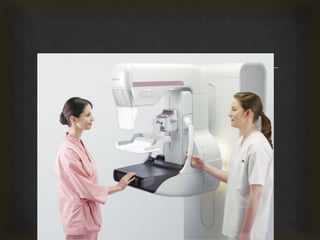
Dr. Umar Tauqir
PGR Radiology
ALNOOR DIAGNOSTICS

 International Atomic Energy Agency (IAEA) as "The
protection of people from harmful effects of
exposure to ionizing radiation , and the means for
achieving this".
 The IAEA also states "The accepted understanding
of the term radiation protection is restricted to
protection of people
DEFINITION

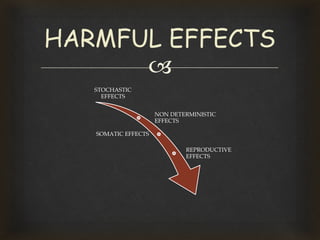
STOCHASTIC
EFFECTS
NON DETERMINISTIC
EFFECTS
SOMATIC EFFECTS
REPRODUCTIVE
EFFECTS
HARMFUL EFFECTS

PROTECTION GROUPS

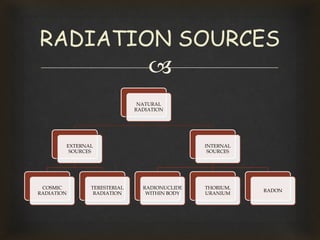
NATURAL
RADIATION
EXTERNAL
SOURCES
COSMIC
RADIATION
TERESTERIAL
RADIATION
INTERNAL
SOURCES
RADIONUCLIDE
WITHIN BODY
THORIUM,
URANIUM
RADON
RADIATION SOURCES

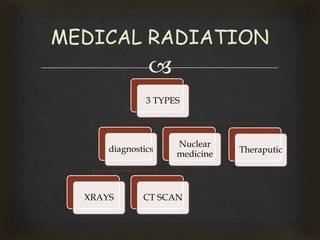
3 TYPES
diagnostics
XRAYS CT SCAN
Nuclear
medicine Theraputic
MEDICAL RADIATION

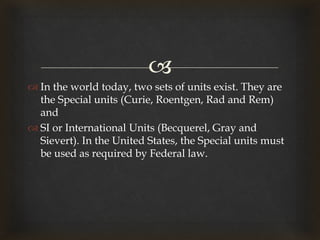
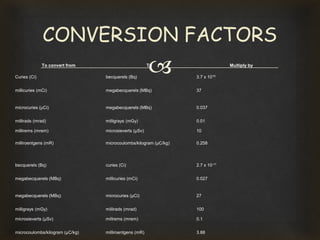
 In the world today, two sets of units exist. They are
the Special units (Curie, Roentgen, Rad and Rem)
and
 SI or International Units (Becquerel, Gray and
Sievert). In the United States, the Special units must
be used as required by Federal law.

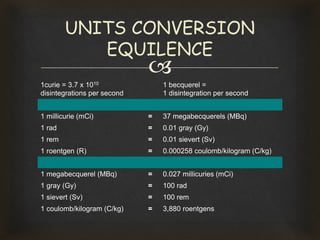
1curie = 3.7 x 10¹⁰
disintegrations per second
1 becquerel =
1 disintegration per second
1 millicurie (mCi) = 37 megabecquerels (MBq)
1 rad = 0.01 gray (Gy)
1 rem = 0.01 sievert (Sv)
1 roentgen (R) = 0.000258 coulomb/kilogram (C/kg)
1 megabecquerel (MBq) = 0.027 millicuries (mCi)
1 gray (Gy) = 100 rad
1 sievert (Sv) = 100 rem
1 coulomb/kilogram (C/kg) = 3,880 roentgens
UNITS CONVERSION
EQUILENCE
To convert from To Multiply by
Curies (Ci) becquerels (Bq) 3.7 x 10¹⁰
millicuries (mCi) megabecquerels (MBq) 37
microcuries (µCi) megabecquerels (MBq) 0.037
millirads (mrad) milligrays (mGy) 0.01
millirems (mrem) microsieverts (µSv) 10
milliroentgens (mR) microcoulombs/kilogram (µC/kg) 0.258
becquerels (Bq) curies (Ci) 2.7 x 10⁻¹¹
megabecquerels (MBq) millicuries (mCi) 0.027
megabecquerels (MBq) microcuries (µCi) 27
milligrays (mGy) millirads (mrad) 100
microsieverts (µSv) millrems (mrem) 0.1
microcoulombs/kilogram (µC/kg) milliroentgens (mR) 3.88
CONVERSION FACTORS

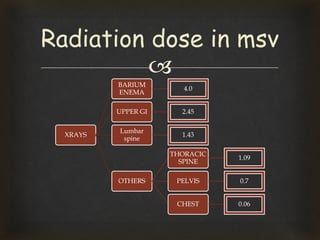
XRAYS
BARIUM
ENEMA
4.0
UPPER GI 2.45
Lumbar
spine
1.43
OTHERS
THORACIC
SPINE
1.09
PELVIS 0.7
CHEST 0.06
Radiation dose in msv

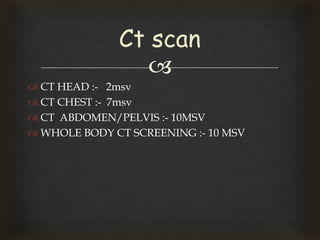
 CT HEAD :- 2msv
 CT CHEST :- 7msv
 CT ABDOMEN/PELVIS :- 10MSV
 WHOLE BODY CT SCREENING :- 10 MSV
Ct scan

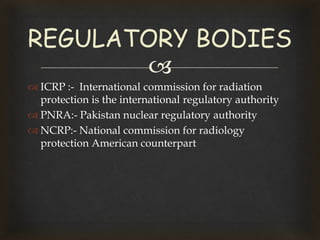
 ICRP :- International commission for radiation
protection is the international regulatory authority
 PNRA:- Pakistan nuclear regulatory authority
 NCRP:- National commission for radiology
protection American counterpart
REGULATORY BODIES

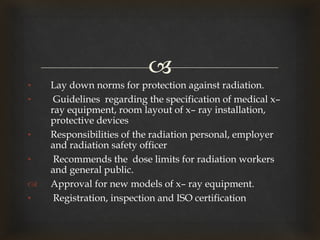
• Lay down norms for protection against radiation.
• Guidelines regarding the specification of medical x–
ray equipment, room layout of x– ray installation,
protective devices
• Responsibilities of the radiation personal, employer
and radiation safety officer
• Recommends the dose limits for radiation workers
and general public.
 Approval for new models of x– ray equipment.
• Registration, inspection and ISO certification

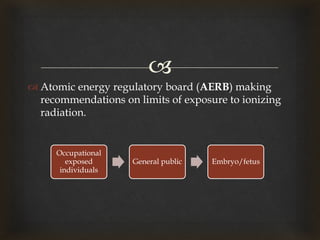
 Atomic energy regulatory board (AERB) making
recommendations on limits of exposure to ionizing
radiation.
Occupational
exposed
individuals
General public Embryo/fetus

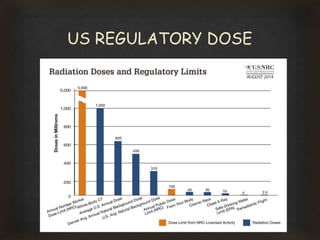
US REGULATORY DOSE

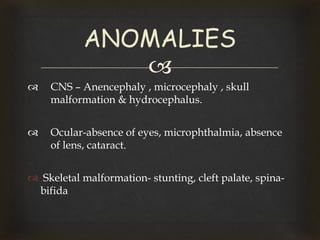
 CNS – Anencephaly , microcephaly , skull
malformation & hydrocephalus.
 Ocular-absence of eyes, microphthalmia, absence
of lens, cataract.
 Skeletal malformation- stunting, cleft palate, spina-
bifida
ANOMALIES

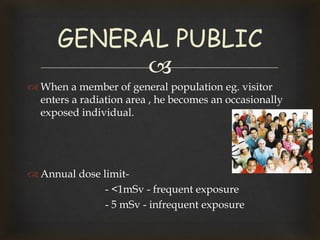
 When a member of general population eg. visitor
enters a radiation area , he becomes an occasionally
exposed individual.
 Annual dose limit-
- <1mSv - frequent exposure
- 5 mSv - infrequent exposure
GENERAL PUBLIC

 AS LOW AS REASONABLY ACHIEVABLE
 For any given radiation source, magnitude of
individual doses, number of people exposed, and
likelihood of incurring exposures should be kept to
as low as reasonably achievable, taking economic
and social factors into considerations.
ALARA

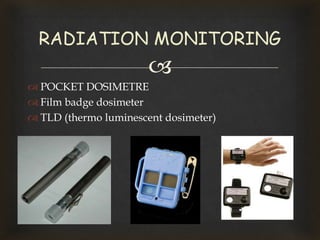
 POCKET DOSIMETRE
 Film badge dosimeter
 TLD (thermo luminescent dosimeter)
RADIATION MONITORING

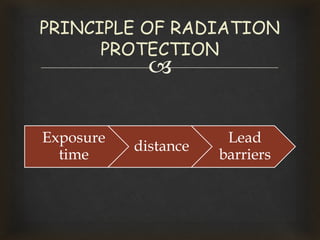
PRINCIPLE OF RADIATION
PROTECTION
Exposure
time
distance
Lead
barriers

 Exposure is the amount of light per unit area (the
image plane luminance times the exposure time)
reaching a photographic film or electronic image
sensor, as determined by shutter speed, lens aperture
and scene luminance
 Exposure is measured in lux seconds, and can be
computed from exposure value (EV) and scene
luminance in a specified region
 Total dose equilant x time
Exposure time

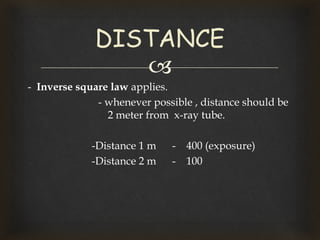
- Inverse square law applies.
- whenever possible , distance should be
2 meter from x-ray tube.
-Distance 1 m - 400 (exposure)
-Distance 2 m - 100
DISTANCE

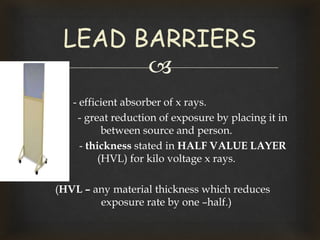
- efficient absorber of x rays.
- great reduction of exposure by placing it in
between source and person.
- thickness stated in HALF VALUE LAYER
(HVL) for kilo voltage x rays.
(HVL – any material thickness which reduces
exposure rate by one –half.)
LEAD BARRIERS

 Half-Value Layer . The thickness of any given
material where 50% of the incident energy has been
attenuated is know as the half-value layer (HVL).
 The HVL is expressed in units of distance (mm or
cm). Like the attenuation coefficient, it is photon
energy dependent. Increasing the penetrating energy
of a stream of photons will result in an increase in a
material's HVL.
HVL (HALF VALUE LAYER)


 tube must enclosed in metal housing that reduces
leakage radiation ( is radiation which penetrates the
protective housing )
Protective barriers in radiation and
fluoroscopy

• Useful beam ( radiation pass through
aperture)
• Leakage radiation
• Scattered radiation (radiation undergoes
change in direction through its path)
• Stray radiations (scattered + leakage
radiation)
4 types of radiations
Wall protection

PRIMARY
• In radiography up to 140 kV is about 1/16
inch lead extending 7 feet up from the floor
when tube is 5-7 f.t from the wall.
• protects from useful beam(mainly).
SECONDARY
• is about 1/32 inch lead.
• - extends from the top of the 1ry barrier to
ceiling.
• - ordinary plaster often suffice as a 2ry
barrier without added lead.
PROTECTIVE BARRIER

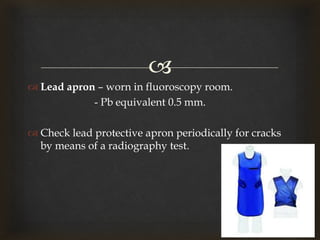
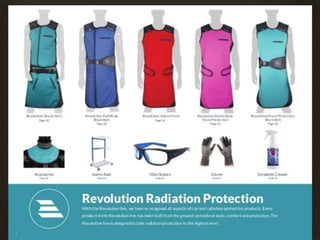
 Lead apron – worn in fluoroscopy room.
- Pb equivalent 0.5 mm.
 Check lead protective apron periodically for cracks
by means of a radiography test.

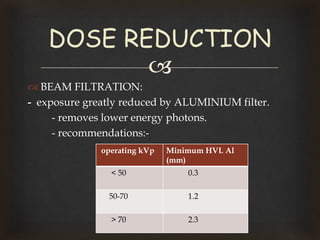
 BEAM FILTRATION:
- exposure greatly reduced by ALUMINIUM filter.
- removes lower energy photons.
- recommendations:-
DOSE REDUCTION
operating kVp Minimum HVL Al
(mm)
< 50 0.3
50-70 1.2
> 70 2.3

decrease in cross sectional area of the beam avoids
unnecessary exposure of tissues outside the area of
interest.
- also reduces amount of scattered radiation.
- modern equipment have automatic variable
beam limiting device with manual override.
COLLIMATION
(BEAM LIMITATION)

beam should be so restricted that direct exposure of
gonads does not occur.
- thyroid ,testes shield must have lead equivalent
0.5 mm.
- ovaries should be shielded whenever possible.
GONADAL’THYROID SHIELDING

In radiography of girls for scoliosis should be use PA
view.
- Reduces breast dose at least 98 % without loss of
radiographic quality.
MODIFIED SHIELDING

 HIGH KILOVOLTAGE :-
- high kVp with low mAs delivers smaller absorbed
dose to the patient.
 CAREFUL TECHNIQUE :-
- to minimize repeat examination.
 Radiographic examination in fertile women preferably
performed during 1st 10 days following onset of
menstrual period.
 Ovulation and pregnancy are much less apt during this
time than later menstrual cycle


 Skillful technique minimizes breast dose.
 Goal achieved by molybdenum targets and filters in
mammographic tubes.
 Low dose screens and films, with/ without grid
having ratios of 3:1 or 4:1.
 Efficient breast compression device :- reduces
breast thickness and make more uniform.
PROTECTION IN MAMOGRAPHY

 ADVANTAGES
1. decreases exposure factors with reduction of dose.
2. diminished amount of scattered thereby improving
contrast.
3. improved recorded details by bringing breast closer
to the image receptor.


 Dose in CT scanning , by measuring absorbed dose at the
center of one “slice” with small dosimeter in water
phantom.
 Scanning this slice and 3 adjoining slices on both side.
 Dosimeter record dose from direct beam through the
center slice, as well as scattered radiation from adjoining
slices.
 Collimator should also checked periodically to assure its
proper function.
CT SCANNING

 Intermittent fluoroscopy – decreases exposure and
prolong tube life.
 Restriction of field size – must be limited by suitably
lead shutters placed between tube and patient.
 Correct operating factors – exposure decreases as kVp
increases and mA is lowered.
 Recommended factors are 90-100 kVp, 2-3 mA and 2. mm
aluminium filter
PATIENT PROTECTION IN
FLUORORSCOPY

 The source-skin distance must be at least 15 inch
with stationary and 12 inch with mobile fluoroscopic
equipment.
 Filtration :-
– increase in hardness of x ray beam by filter.
– Filter removed relatively more soft than hard
x-rays.

 Medical compounds containing radionuclide's are
called radiopharmaceuticals.
 Types of radiation
– alpha particles
– beta particles
– gamma rays
 radiopharmaceuticals emits beta and gamma rays
PROTECTON IN NUCLEAR
MEDICINE

 Gamma rays are electromagnetic wave and have
much greater penetrability than beta particle.
 Beta particles consist of high-speed electrons.
 Beta particles are much less penetrating ,their effect
limited to the skin (external source) immediate
vicinity(internal source).



Radiation protection

  • 1.
    Dr. Umar Tauqir PGRRadiology ALNOOR DIAGNOSTICS
  • 2.
      International AtomicEnergy Agency (IAEA) as "The protection of people from harmful effects of exposure to ionizing radiation , and the means for achieving this".  The IAEA also states "The accepted understanding of the term radiation protection is restricted to protection of people DEFINITION
  • 3.
  • 4.
  • 5.
  • 6.
     3 TYPES diagnostics XRAYS CTSCAN Nuclear medicine Theraputic MEDICAL RADIATION
  • 7.
      In theworld today, two sets of units exist. They are the Special units (Curie, Roentgen, Rad and Rem) and  SI or International Units (Becquerel, Gray and Sievert). In the United States, the Special units must be used as required by Federal law.
  • 8.
     1curie = 3.7x 10¹⁰ disintegrations per second 1 becquerel = 1 disintegration per second 1 millicurie (mCi) = 37 megabecquerels (MBq) 1 rad = 0.01 gray (Gy) 1 rem = 0.01 sievert (Sv) 1 roentgen (R) = 0.000258 coulomb/kilogram (C/kg) 1 megabecquerel (MBq) = 0.027 millicuries (mCi) 1 gray (Gy) = 100 rad 1 sievert (Sv) = 100 rem 1 coulomb/kilogram (C/kg) = 3,880 roentgens UNITS CONVERSION EQUILENCE
  • 9.
    To convert fromTo Multiply by Curies (Ci) becquerels (Bq) 3.7 x 10¹⁰ millicuries (mCi) megabecquerels (MBq) 37 microcuries (µCi) megabecquerels (MBq) 0.037 millirads (mrad) milligrays (mGy) 0.01 millirems (mrem) microsieverts (µSv) 10 milliroentgens (mR) microcoulombs/kilogram (µC/kg) 0.258 becquerels (Bq) curies (Ci) 2.7 x 10⁻¹¹ megabecquerels (MBq) millicuries (mCi) 0.027 megabecquerels (MBq) microcuries (µCi) 27 milligrays (mGy) millirads (mrad) 100 microsieverts (µSv) millrems (mrem) 0.1 microcoulombs/kilogram (µC/kg) milliroentgens (mR) 3.88 CONVERSION FACTORS
  • 10.
  • 11.
      CT HEAD:- 2msv  CT CHEST :- 7msv  CT ABDOMEN/PELVIS :- 10MSV  WHOLE BODY CT SCREENING :- 10 MSV Ct scan
  • 12.
      ICRP :-International commission for radiation protection is the international regulatory authority  PNRA:- Pakistan nuclear regulatory authority  NCRP:- National commission for radiology protection American counterpart REGULATORY BODIES
  • 13.
     • Lay downnorms for protection against radiation. • Guidelines regarding the specification of medical x– ray equipment, room layout of x– ray installation, protective devices • Responsibilities of the radiation personal, employer and radiation safety officer • Recommends the dose limits for radiation workers and general public.  Approval for new models of x– ray equipment. • Registration, inspection and ISO certification
  • 14.
      Atomic energyregulatory board (AERB) making recommendations on limits of exposure to ionizing radiation. Occupational exposed individuals General public Embryo/fetus
  • 15.
  • 16.
      CNS –Anencephaly , microcephaly , skull malformation & hydrocephalus.  Ocular-absence of eyes, microphthalmia, absence of lens, cataract.  Skeletal malformation- stunting, cleft palate, spina- bifida ANOMALIES
  • 17.
      When amember of general population eg. visitor enters a radiation area , he becomes an occasionally exposed individual.  Annual dose limit- - <1mSv - frequent exposure - 5 mSv - infrequent exposure GENERAL PUBLIC
  • 18.
      AS LOWAS REASONABLY ACHIEVABLE  For any given radiation source, magnitude of individual doses, number of people exposed, and likelihood of incurring exposures should be kept to as low as reasonably achievable, taking economic and social factors into considerations. ALARA
  • 19.
      POCKET DOSIMETRE Film badge dosimeter  TLD (thermo luminescent dosimeter) RADIATION MONITORING
  • 20.
  • 21.
      Exposure isthe amount of light per unit area (the image plane luminance times the exposure time) reaching a photographic film or electronic image sensor, as determined by shutter speed, lens aperture and scene luminance  Exposure is measured in lux seconds, and can be computed from exposure value (EV) and scene luminance in a specified region  Total dose equilant x time Exposure time
  • 22.
     - Inverse squarelaw applies. - whenever possible , distance should be 2 meter from x-ray tube. -Distance 1 m - 400 (exposure) -Distance 2 m - 100 DISTANCE
  • 23.
     - efficient absorberof x rays. - great reduction of exposure by placing it in between source and person. - thickness stated in HALF VALUE LAYER (HVL) for kilo voltage x rays. (HVL – any material thickness which reduces exposure rate by one –half.) LEAD BARRIERS
  • 24.
      Half-Value Layer. The thickness of any given material where 50% of the incident energy has been attenuated is know as the half-value layer (HVL).  The HVL is expressed in units of distance (mm or cm). Like the attenuation coefficient, it is photon energy dependent. Increasing the penetrating energy of a stream of photons will result in an increase in a material's HVL. HVL (HALF VALUE LAYER)
  • 25.
  • 26.
      tube mustenclosed in metal housing that reduces leakage radiation ( is radiation which penetrates the protective housing ) Protective barriers in radiation and fluoroscopy
  • 27.
     • Useful beam( radiation pass through aperture) • Leakage radiation • Scattered radiation (radiation undergoes change in direction through its path) • Stray radiations (scattered + leakage radiation) 4 types of radiations Wall protection
  • 28.
     PRIMARY • In radiographyup to 140 kV is about 1/16 inch lead extending 7 feet up from the floor when tube is 5-7 f.t from the wall. • protects from useful beam(mainly). SECONDARY • is about 1/32 inch lead. • - extends from the top of the 1ry barrier to ceiling. • - ordinary plaster often suffice as a 2ry barrier without added lead. PROTECTIVE BARRIER
  • 29.
      Lead apron– worn in fluoroscopy room. - Pb equivalent 0.5 mm.  Check lead protective apron periodically for cracks by means of a radiography test.
  • 30.
      BEAM FILTRATION: -exposure greatly reduced by ALUMINIUM filter. - removes lower energy photons. - recommendations:- DOSE REDUCTION operating kVp Minimum HVL Al (mm) < 50 0.3 50-70 1.2 > 70 2.3
  • 31.
     decrease in crosssectional area of the beam avoids unnecessary exposure of tissues outside the area of interest. - also reduces amount of scattered radiation. - modern equipment have automatic variable beam limiting device with manual override. COLLIMATION (BEAM LIMITATION)
  • 32.
     beam should beso restricted that direct exposure of gonads does not occur. - thyroid ,testes shield must have lead equivalent 0.5 mm. - ovaries should be shielded whenever possible. GONADAL’THYROID SHIELDING
  • 33.
     In radiography ofgirls for scoliosis should be use PA view. - Reduces breast dose at least 98 % without loss of radiographic quality. MODIFIED SHIELDING
  • 34.
      HIGH KILOVOLTAGE:- - high kVp with low mAs delivers smaller absorbed dose to the patient.  CAREFUL TECHNIQUE :- - to minimize repeat examination.  Radiographic examination in fertile women preferably performed during 1st 10 days following onset of menstrual period.  Ovulation and pregnancy are much less apt during this time than later menstrual cycle
  • 35.
  • 36.
      Skillful techniqueminimizes breast dose.  Goal achieved by molybdenum targets and filters in mammographic tubes.  Low dose screens and films, with/ without grid having ratios of 3:1 or 4:1.  Efficient breast compression device :- reduces breast thickness and make more uniform. PROTECTION IN MAMOGRAPHY
  • 37.
      ADVANTAGES 1. decreasesexposure factors with reduction of dose. 2. diminished amount of scattered thereby improving contrast. 3. improved recorded details by bringing breast closer to the image receptor.
  • 38.
  • 39.
      Dose inCT scanning , by measuring absorbed dose at the center of one “slice” with small dosimeter in water phantom.  Scanning this slice and 3 adjoining slices on both side.  Dosimeter record dose from direct beam through the center slice, as well as scattered radiation from adjoining slices.  Collimator should also checked periodically to assure its proper function. CT SCANNING
  • 40.
      Intermittent fluoroscopy– decreases exposure and prolong tube life.  Restriction of field size – must be limited by suitably lead shutters placed between tube and patient.  Correct operating factors – exposure decreases as kVp increases and mA is lowered.  Recommended factors are 90-100 kVp, 2-3 mA and 2. mm aluminium filter PATIENT PROTECTION IN FLUORORSCOPY
  • 41.
      The source-skindistance must be at least 15 inch with stationary and 12 inch with mobile fluoroscopic equipment.  Filtration :- – increase in hardness of x ray beam by filter. – Filter removed relatively more soft than hard x-rays.
  • 42.
      Medical compoundscontaining radionuclide's are called radiopharmaceuticals.  Types of radiation – alpha particles – beta particles – gamma rays  radiopharmaceuticals emits beta and gamma rays PROTECTON IN NUCLEAR MEDICINE
  • 43.
      Gamma raysare electromagnetic wave and have much greater penetrability than beta particle.  Beta particles consist of high-speed electrons.  Beta particles are much less penetrating ,their effect limited to the skin (external source) immediate vicinity(internal source).
  • 44.
  • 45.