IMAGE
CHARACTERISTICS
PRESENTED BY: BHARGAVI SOOD
MODERATOR : DR. ARCHNA NAGPAL
INTRODUCTION
• A diagnostic radiograph, should provide a great deal of accurate anatomical information. The
images exhibit proper density and contrast, are of the same shape and size as the object
exposed, and have sharp outlines.
• It is important to understand the image characteristics, to understand the quality of the
radiograph..
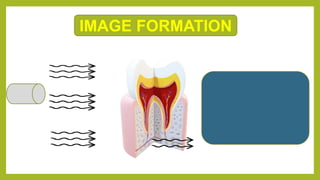
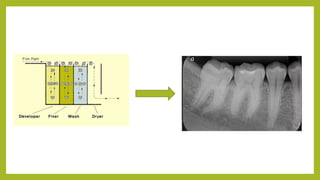
IMAGE FORMATION
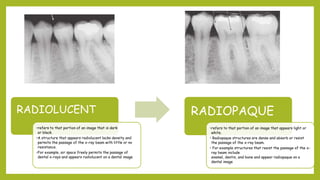
RADIOLUCENT
•refers to that portion of an image that is dark
or black.
•A structure that appears radiolucent lacks density and
permits the passage of the x-ray beam with little or no
resistance.
•For example, air space freely permits the passage of
dental x-rays and appears radiolucent on a dental image
RADIOPAQUE
•refers to that portion of an image that appears light or
white.
• Radiopaque structures are dense and absorb or resist
the passage of the x-ray beam.
• For example structures that resist the passage of the x-
ray beam include
enamel, dentin, and bone and appear radiopaque on a
dental image
RADIOGRAPHIC DENSITY
• When a film is exposed by an x-ray beam (or by light, in the case of screen-film combinations) and then
processed, the silver halide crystals in the emulsion that were struck by the photons are converted to grains of
metallic silver.
• These silver grains block the transmission of light from a viewbox and give the film its dark appearance
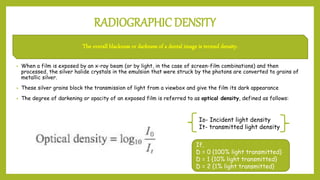
• The degree of darkening or opacity of an exposed film is referred to as optical density, defined as follows:
The overall blackness or darkness of a dental image is termed density.
Io- Incident light density
It- transmitted light density
If,
D = 0 {100% light transmitted}
D = 1 {10% light transmitted}
D = 2 {1% light transmitted}
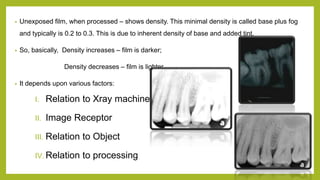
• Unexposed film, when processed – shows density. This minimal density is called base plus fog
and typically is 0.2 to 0.3. This is due to inherent density of base and added tint.
• So, basically, Density increases – film is darker;
Density decreases – film is lighter
• It depends upon various factors:
I. Relation to Xray machine
II. Image Receptor
III. Relation to Object
IV. Relation to processing
Sr.
No.
Factors affecting Density Effect on
Density
Reason
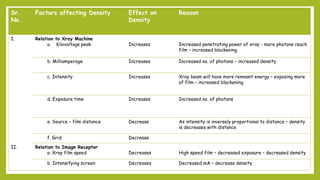
I. Relation to Xray Machine
a. Kilovoltage peak Increases Increased penetrating power of xray - more photons reach
film – increased blackening
b. Milliamperage Increases Increased no. of photons – increased density
c. Intensity Increases Xray beam will have more remnant energy – exposing more
of film – increased blackening
d. Exposure time Increases Increased no. of photons
e. Source – film distance Decrease As intensity is inversely proportional to distance – density
is decreases with distance
f. Grid Decrease
II. Relation to Image Receptor
a. Xray film speed Decreases High speed film – decreased exposure – decreased density
b. Intensifying screen Decreases Decreased mA – decrease density
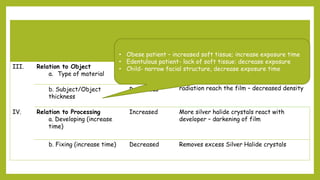
III. Relation to Object
a. Type of material Decreases
As density of material increases – less
radiation reach the film – decreased density
b. Subject/Object
thickness
Decreases
IV. Relation to Processing
a. Developing (increase
time)
Increased More silver halide crystals react with
developer – darkening of film
b. Fixing (increase time) Decreased Removes excess Silver Halide crystals
• Obese patient – increased soft tissue; increase exposure time
• Edentulous patient- lack of soft tissue: decrease exposure
• Child- narrow facial structure, decrease exposure time
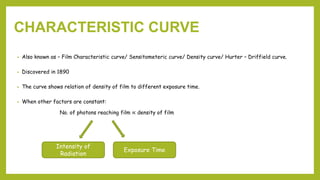
• Also known as – Film Characteristic curve/ Sensitometeric curve/ Density curve/ Hurter – Driffield curve.
• Discovered in 1890
• The curve shows relation of density of film to different exposure time.
• When other factors are constant:
No. of photons reaching film ∝ density of film
CHARACTERISTIC CURVE
Intensity of
Radiation
Exposure Time
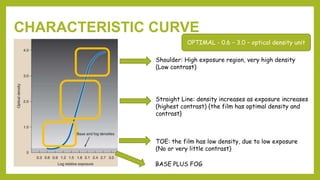
CHARACTERISTIC CURVE
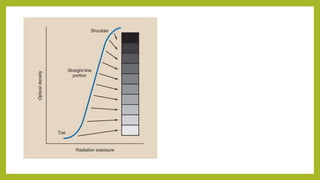
TOE: the film has low density, due to low exposure
(No or very little contrast)
Straight Line: density increases as exposure increases
(highest contrast) {the film has optimal density and
contrast}
Shoulder: High exposure region, very high density
(Low contrast)
OPTIMAL - 0.6 – 3.0 – optical density unit
BASE PLUS FOG
Reciprocity Law
• the Reciprocity Law states that the OD will be the same if the mA x s value is
constant.
• It does not depend upon the time of exposure.
• But on the energy imparted to the radiographic film.
• This is for direct exposure films, but fails for indirect exposure films.
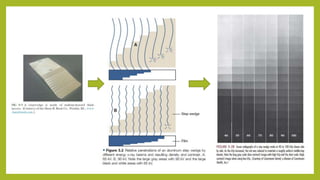
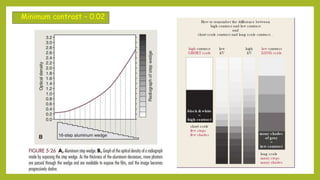
RADIOGRAPHIC CONTRAST
The difference in densities between light and dark regions on a radiograph
Only two densities
areas- black and white
are discernable
Due to low Kvp [<65
Kvp]
Many densities, in
different shades of
gray, is discernable.
Due to high Kvp [<70-
75]
High Contrast
Film/
Short scale
Contrast
Low Contrast
Film/
Long scale
Contrast
Sr.
NO
FACTORS AFFECTING CONTRAST EFFECT ON
CONTRAST
REASONS
I. Relation to Patient [ Subject Contrast]
a. Tissue Thickness Decreases with increases
subject thickness.
Depends upon different degree of
beam attenuation.
Increase in these factors -
more absorption of xray - less
remnant beam reaches film –
decreased density
b. Tissue Density Increased tissue density
decreases contrast
c. Atomic Number Increased atomic number,
increased contrast
Increases atomic number- higher
beam attenuation more contrast
variations
Eg. Cephalogram has high contrast
II. Relation to Xray Machine
a. Kvp
Low contrast with increased
Kvp
Less difference in attenuation
between the different parts of the
subject due to increased
penetrating power
b. Exposure rate Exposure rate – increase
brightness
Increased exposure time –
low contrast
Sr.
NO
FACTORS AFFECTING CONTRAST EFFECT ON CONTRAST REASONS
I. Relation to Film [ Film Contrast]
a. Optical Density Low or High OD exhibit poor
contrast
Decreased/ Increased number of
non-diagnostic photons reaching
film
b. Film Speed Increased speed, low
contrast
c. Type of film Direct vs Indirect film Less contrast in indirect film
d. Emulsion Double emulsion – less
contrast
II. Relation to Processing
a. Scatter Radiation
Compton/ Coherent scatter
decreases contrast
Less difference in attenuation
between the different parts of the
subject due to increased
penetrating power
b. Fog Decreases contrast Developing of unexposed silver
halide crystals
• Minimum contrast – 0.02
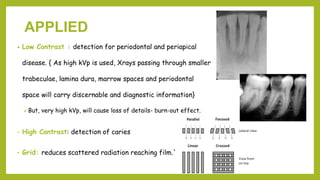
APPLIED
• Low Contrast : detection for periodontal and periapical
disease. { As high kVp is used, Xrays passing through smaller
trabeculae, lamina dura, marrow spaces and periodontal
space will carry discernable and diagnostic information}
 But, very high kVp, will cause loss of details- burn-out effect.
• High Contrast: detection of caries
• Grid: reduces scattered radiation reaching film.`
RADIOGRAPHIC SPEED
• Film speed frequently is expressed as the reciprocal of the exposure (in roentgens) required to
produce an optical density of 1 above base plus fog.
• Film speed ∝ 1
roentegens
• When numbers are used to express speed, all are relative to 100; this is called par speed. Numbers
higher than 100 refer to fast or high-speed image receptors.
• Film speed is controlled largely by the size of the silver halide grains and their silver content
Radiographic speed refers to the amount of radiation required to produce an image of a standard density.
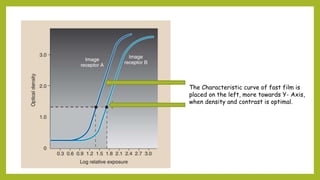
FAST FILM: LOW EXPOSURE
SLOW FILM: LONGER EXPOSURE
The Characteristic curve of fast film is
placed on the left, more towards Y- Axis,
when density and contrast is optimal.
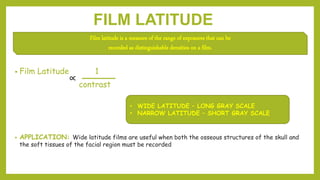
FILM LATITUDE
• Film Latitude 1
contrast
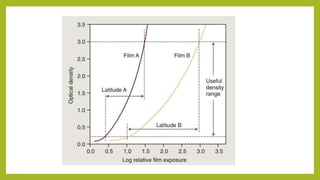
• APPLICATION: Wide latitude films are useful when both the osseous structures of the skull and
the soft tissues of the facial region must be recorded
Film latitude is a measure of the range of exposures that can be
recorded as distinguishable densities on a film.
• WIDE LATITUDE – LONG GRAY SCALE
• NARROW LATITUDE – SHORT GRAY SCALE
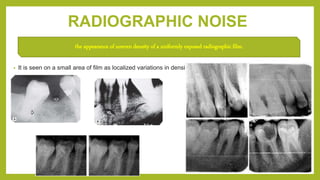
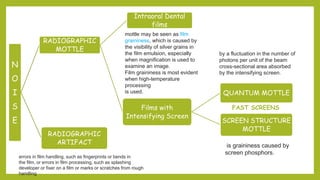
RADIOGRAPHIC NOISE
• It is seen on a small area of film as localized variations in density.
the appearance of uneven density of a uniformly exposed radiographic film.
N
O
I
S
E
RADIOGRAPHIC
MOTTLE
Intraoral Dental
films
Films with
Intensifying Screen
QUANTUM MOTTLE
SCREEN STRUCTURE
MOTTLE
RADIOGRAPHIC
ARTIFACT
errors in film handling, such as fingerprints or bends in
the film, or errors in film processing, such as splashing
developer or fixer on a film or marks or scratches from rough
handling
mottle may be seen as film
graininess, which is caused by
the visibility of silver grains in
the film emulsion, especially
when magnification is used to
examine an image.
Film graininess is most evident
when high-temperature
processing
is used.
by a fluctuation in the number of
photons per unit of the beam
cross-sectional area absorbed
by the intensifying screen.
is graininess caused by
screen phosphors.
FAST SCREENS
SHARPNESS AND RESOLUTION
Resolution, or resolving power, is the ability of a radiograph to record separate structures that are close together.
Sr.NO FACTORS AFFECTING RESOLUTION EFFECT ON RESOLUTION
I. Type of Film
a. Direct exposure film Increases
b. Indirect exposure film Decreases [ 9 – 10 lp/mm]
II. Speed
a. Fast Film Decreases
b. Slow Film Increases
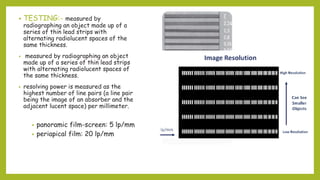
• TESTING:- measured by
radiographing an object made up of a
series of thin lead strips with
alternating radiolucent spaces of the
same thickness.
• measured by radiographing an object
made up of a series of thin lead strips
with alternating radiolucent spaces of
the same thickness.
• resolving power is measured as the
highest number of line pairs (a line pair
being the image of an absorber and the
adjacent lucent space) per millimeter.
• panoramic film-screen: 5 lp/mm
• periapical film: 20 lp/mm
SHARPNESS INCLUDES:
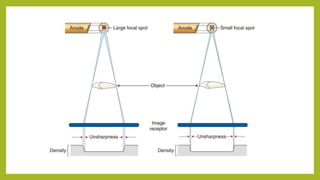
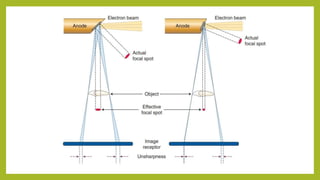
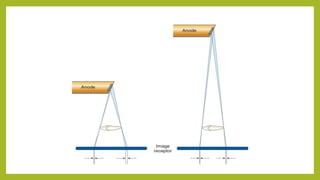
 Geometric unsharpness (including the penumbra effect)
 Motion unsharpness (caused by the patient moving during the exposure)
 Absorption unsharpness (caused by variation in object shape, e.g. cervical burn-out at the neck of a
tooth )
 Screen unsharpness (caused by the diffusion and spread of the light emitted from intensifying
screens)
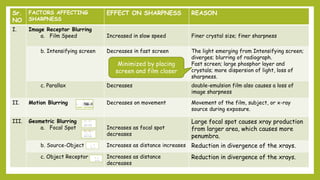
Sharpness is the ability of a radiograph to define an edge precisely (e.g., the dentin-enamel junction, or a thin trabecular plate
Sr.
NO
FACTORS AFFECTING
SHARPNESS
EFFECT ON SHARPNESS REASON
I. Image Receptor Blurring
a. Film Speed Increased in slow speed Finer crystal size; finer sharpness
b. Intensifying screen Decreases in fast screen The light emerging from Intensifying screen;
diverges; blurring of radiograph.
Fast screen; large phosphor layer and
crystals; more dispersion of light, loss of
sharpness.
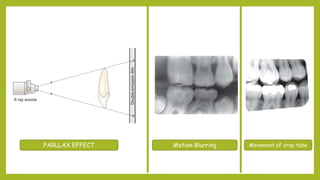
c. Parallax Decreases double-emulsion film also causes a loss of
image sharpness
II. Motion Blurring Decreases on movement Movement of the film, subject, or x-ray
source during exposure.
III. Geometric Blurring
a. Focal Spot Increases as focal spot
decreases
Large focal spot causes xray production
from larger area, which causes more
penumbra.
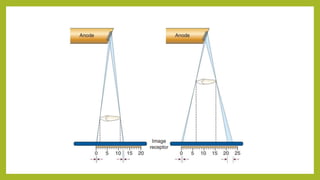
b. Source-Object Increases as distance increases Reduction in divergence of the xrays.
c. Object Receptor Increases as distance
decreases
Reduction in divergence of the xrays.
Minimized by placing
screen and film closer
THANK
YOU
REFERNCES
1. Mallya S, White LE. Pharoah's oral radiology: principles and
interpretation.
2. Bushong SC, Facmp SF. Radiologic Science for Technologists E-Book:
Physics, Biology, and Protection. Mosby; 2020 Dec 2.
3. Whaites E, Drage N. Essentials of dental radiography and radiology.
Elsevier Health Sciences; 2013 Jun 20.
PARLLAX EFFECT Motion Blurring Movement of xray tube
Image characteristics

Image characteristics

  • 1.
    IMAGE CHARACTERISTICS PRESENTED BY: BHARGAVISOOD MODERATOR : DR. ARCHNA NAGPAL
  • 2.
    INTRODUCTION • A diagnosticradiograph, should provide a great deal of accurate anatomical information. The images exhibit proper density and contrast, are of the same shape and size as the object exposed, and have sharp outlines. • It is important to understand the image characteristics, to understand the quality of the radiograph..
  • 3.
  • 5.
    RADIOLUCENT •refers to thatportion of an image that is dark or black. •A structure that appears radiolucent lacks density and permits the passage of the x-ray beam with little or no resistance. •For example, air space freely permits the passage of dental x-rays and appears radiolucent on a dental image RADIOPAQUE •refers to that portion of an image that appears light or white. • Radiopaque structures are dense and absorb or resist the passage of the x-ray beam. • For example structures that resist the passage of the x- ray beam include enamel, dentin, and bone and appear radiopaque on a dental image
  • 6.
    RADIOGRAPHIC DENSITY • Whena film is exposed by an x-ray beam (or by light, in the case of screen-film combinations) and then processed, the silver halide crystals in the emulsion that were struck by the photons are converted to grains of metallic silver. • These silver grains block the transmission of light from a viewbox and give the film its dark appearance • The degree of darkening or opacity of an exposed film is referred to as optical density, defined as follows: The overall blackness or darkness of a dental image is termed density. Io- Incident light density It- transmitted light density If, D = 0 {100% light transmitted} D = 1 {10% light transmitted} D = 2 {1% light transmitted}
  • 7.
    • Unexposed film,when processed – shows density. This minimal density is called base plus fog and typically is 0.2 to 0.3. This is due to inherent density of base and added tint. • So, basically, Density increases – film is darker; Density decreases – film is lighter • It depends upon various factors: I. Relation to Xray machine II. Image Receptor III. Relation to Object IV. Relation to processing
  • 8.
    Sr. No. Factors affecting DensityEffect on Density Reason I. Relation to Xray Machine a. Kilovoltage peak Increases Increased penetrating power of xray - more photons reach film – increased blackening b. Milliamperage Increases Increased no. of photons – increased density c. Intensity Increases Xray beam will have more remnant energy – exposing more of film – increased blackening d. Exposure time Increases Increased no. of photons e. Source – film distance Decrease As intensity is inversely proportional to distance – density is decreases with distance f. Grid Decrease II. Relation to Image Receptor a. Xray film speed Decreases High speed film – decreased exposure – decreased density b. Intensifying screen Decreases Decreased mA – decrease density
  • 9.
    III. Relation toObject a. Type of material Decreases As density of material increases – less radiation reach the film – decreased density b. Subject/Object thickness Decreases IV. Relation to Processing a. Developing (increase time) Increased More silver halide crystals react with developer – darkening of film b. Fixing (increase time) Decreased Removes excess Silver Halide crystals • Obese patient – increased soft tissue; increase exposure time • Edentulous patient- lack of soft tissue: decrease exposure • Child- narrow facial structure, decrease exposure time
  • 10.
    • Also knownas – Film Characteristic curve/ Sensitometeric curve/ Density curve/ Hurter – Driffield curve. • Discovered in 1890 • The curve shows relation of density of film to different exposure time. • When other factors are constant: No. of photons reaching film ∝ density of film CHARACTERISTIC CURVE Intensity of Radiation Exposure Time
  • 11.
    CHARACTERISTIC CURVE TOE: thefilm has low density, due to low exposure (No or very little contrast) Straight Line: density increases as exposure increases (highest contrast) {the film has optimal density and contrast} Shoulder: High exposure region, very high density (Low contrast) OPTIMAL - 0.6 – 3.0 – optical density unit BASE PLUS FOG
  • 13.
    Reciprocity Law • theReciprocity Law states that the OD will be the same if the mA x s value is constant. • It does not depend upon the time of exposure. • But on the energy imparted to the radiographic film. • This is for direct exposure films, but fails for indirect exposure films.
  • 14.
    RADIOGRAPHIC CONTRAST The differencein densities between light and dark regions on a radiograph Only two densities areas- black and white are discernable Due to low Kvp [<65 Kvp] Many densities, in different shades of gray, is discernable. Due to high Kvp [<70- 75] High Contrast Film/ Short scale Contrast Low Contrast Film/ Long scale Contrast
  • 15.
    Sr. NO FACTORS AFFECTING CONTRASTEFFECT ON CONTRAST REASONS I. Relation to Patient [ Subject Contrast] a. Tissue Thickness Decreases with increases subject thickness. Depends upon different degree of beam attenuation. Increase in these factors - more absorption of xray - less remnant beam reaches film – decreased density b. Tissue Density Increased tissue density decreases contrast c. Atomic Number Increased atomic number, increased contrast Increases atomic number- higher beam attenuation more contrast variations Eg. Cephalogram has high contrast II. Relation to Xray Machine a. Kvp Low contrast with increased Kvp Less difference in attenuation between the different parts of the subject due to increased penetrating power b. Exposure rate Exposure rate – increase brightness Increased exposure time – low contrast
  • 16.
    Sr. NO FACTORS AFFECTING CONTRASTEFFECT ON CONTRAST REASONS I. Relation to Film [ Film Contrast] a. Optical Density Low or High OD exhibit poor contrast Decreased/ Increased number of non-diagnostic photons reaching film b. Film Speed Increased speed, low contrast c. Type of film Direct vs Indirect film Less contrast in indirect film d. Emulsion Double emulsion – less contrast II. Relation to Processing a. Scatter Radiation Compton/ Coherent scatter decreases contrast Less difference in attenuation between the different parts of the subject due to increased penetrating power b. Fog Decreases contrast Developing of unexposed silver halide crystals
  • 18.
  • 19.
    APPLIED • Low Contrast: detection for periodontal and periapical disease. { As high kVp is used, Xrays passing through smaller trabeculae, lamina dura, marrow spaces and periodontal space will carry discernable and diagnostic information}  But, very high kVp, will cause loss of details- burn-out effect. • High Contrast: detection of caries • Grid: reduces scattered radiation reaching film.`
  • 20.
    RADIOGRAPHIC SPEED • Filmspeed frequently is expressed as the reciprocal of the exposure (in roentgens) required to produce an optical density of 1 above base plus fog. • Film speed ∝ 1 roentegens • When numbers are used to express speed, all are relative to 100; this is called par speed. Numbers higher than 100 refer to fast or high-speed image receptors. • Film speed is controlled largely by the size of the silver halide grains and their silver content Radiographic speed refers to the amount of radiation required to produce an image of a standard density. FAST FILM: LOW EXPOSURE SLOW FILM: LONGER EXPOSURE
  • 21.
    The Characteristic curveof fast film is placed on the left, more towards Y- Axis, when density and contrast is optimal.
  • 22.
    FILM LATITUDE • FilmLatitude 1 contrast • APPLICATION: Wide latitude films are useful when both the osseous structures of the skull and the soft tissues of the facial region must be recorded Film latitude is a measure of the range of exposures that can be recorded as distinguishable densities on a film. • WIDE LATITUDE – LONG GRAY SCALE • NARROW LATITUDE – SHORT GRAY SCALE
  • 24.
    RADIOGRAPHIC NOISE • Itis seen on a small area of film as localized variations in density. the appearance of uneven density of a uniformly exposed radiographic film.
  • 25.
    N O I S E RADIOGRAPHIC MOTTLE Intraoral Dental films Films with IntensifyingScreen QUANTUM MOTTLE SCREEN STRUCTURE MOTTLE RADIOGRAPHIC ARTIFACT errors in film handling, such as fingerprints or bends in the film, or errors in film processing, such as splashing developer or fixer on a film or marks or scratches from rough handling mottle may be seen as film graininess, which is caused by the visibility of silver grains in the film emulsion, especially when magnification is used to examine an image. Film graininess is most evident when high-temperature processing is used. by a fluctuation in the number of photons per unit of the beam cross-sectional area absorbed by the intensifying screen. is graininess caused by screen phosphors. FAST SCREENS
  • 26.
    SHARPNESS AND RESOLUTION Resolution,or resolving power, is the ability of a radiograph to record separate structures that are close together. Sr.NO FACTORS AFFECTING RESOLUTION EFFECT ON RESOLUTION I. Type of Film a. Direct exposure film Increases b. Indirect exposure film Decreases [ 9 – 10 lp/mm] II. Speed a. Fast Film Decreases b. Slow Film Increases
  • 27.
    • TESTING:- measuredby radiographing an object made up of a series of thin lead strips with alternating radiolucent spaces of the same thickness. • measured by radiographing an object made up of a series of thin lead strips with alternating radiolucent spaces of the same thickness. • resolving power is measured as the highest number of line pairs (a line pair being the image of an absorber and the adjacent lucent space) per millimeter. • panoramic film-screen: 5 lp/mm • periapical film: 20 lp/mm
  • 28.
    SHARPNESS INCLUDES:  Geometricunsharpness (including the penumbra effect)  Motion unsharpness (caused by the patient moving during the exposure)  Absorption unsharpness (caused by variation in object shape, e.g. cervical burn-out at the neck of a tooth )  Screen unsharpness (caused by the diffusion and spread of the light emitted from intensifying screens) Sharpness is the ability of a radiograph to define an edge precisely (e.g., the dentin-enamel junction, or a thin trabecular plate Sr. NO FACTORS AFFECTING SHARPNESS EFFECT ON SHARPNESS REASON I. Image Receptor Blurring a. Film Speed Increased in slow speed Finer crystal size; finer sharpness b. Intensifying screen Decreases in fast screen The light emerging from Intensifying screen; diverges; blurring of radiograph. Fast screen; large phosphor layer and crystals; more dispersion of light, loss of sharpness. c. Parallax Decreases double-emulsion film also causes a loss of image sharpness II. Motion Blurring Decreases on movement Movement of the film, subject, or x-ray source during exposure. III. Geometric Blurring a. Focal Spot Increases as focal spot decreases Large focal spot causes xray production from larger area, which causes more penumbra. b. Source-Object Increases as distance increases Reduction in divergence of the xrays. c. Object Receptor Increases as distance decreases Reduction in divergence of the xrays. Minimized by placing screen and film closer
  • 29.
  • 30.
    REFERNCES 1. Mallya S,White LE. Pharoah's oral radiology: principles and interpretation. 2. Bushong SC, Facmp SF. Radiologic Science for Technologists E-Book: Physics, Biology, and Protection. Mosby; 2020 Dec 2. 3. Whaites E, Drage N. Essentials of dental radiography and radiology. Elsevier Health Sciences; 2013 Jun 20.
  • 31.
    PARLLAX EFFECT MotionBlurring Movement of xray tube