

Contract Procurement Fraud
January 2016
Ron Steinkamp, CPA, CIA, CFE, CRMA, CGMA
314.983.1238
rsteinkamp@bswllc.com
Elements of a Contract
Methods of Procurement
Procurement Phases
Contract Procurement Fraud Schemes & Red Flags
Preventing Contract Procurement Fraud
© 2015 All Rights Reserved Brown
Smith Wallace LLC 2
Table of Contents
3
© 2015 All Rights Reserved Brown
Smith Wallace LLC
Elements of a Contract
A contract is a mutual oral or written agreement
between two or more parties that must contain the
following elements:
– Competent parties
– Lawful subject matter or objective
– Mutual consent
– Legal consideration
– Form permitted by law
© 2015 All Rights Reserved Brown
Smith Wallace LLC 4
Elements of a Contract
5
© 2015 All Rights Reserved Brown
Smith Wallace LLC
Methods of Procurement
• Competitive bidding using sealed bids.
• Contracting by negotiation:
– Competitive negotiation.
– Sole-source contracting.
• Simplified acquisition procedures:
– Charge accounts.
– Purchase cards.
– Purchase orders.
– Petty cash funds.
© 2015 All Rights Reserved Brown
Smith Wallace LLC 6
Methods of Procurement
7
© 2015 All Rights Reserved Brown
Smith Wallace LLC
Procurement Phases
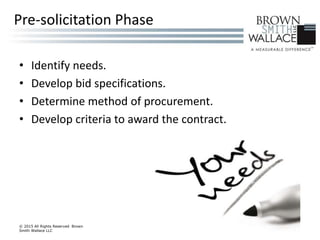
• Identify needs.
• Develop bid specifications.
• Determine method of procurement.
• Develop criteria to award the contract.
© 2015 All Rights Reserved Brown
Smith Wallace LLC 8
Pre-solicitation Phase
• Prepare solicitation document (RFI, RFQ, RFP, etc.).
• Provide notice of solicitation.
• Issue solicitation document.
• Receive bids and proposals.
© 2015 All Rights Reserved Brown
Smith Wallace LLC 9
Solicitation Phase
• Evaluates bids/proposals.
• May conduct discussions/negotiations.
• May provide opportunity to revise bids/proposals.
• Select winning bid/proposal.
• Execute contract and terms.
© 2015 All Rights Reserved Brown
Smith Wallace LLC 10
Bid Evaluation & Award Phase
• Performance of contractual obligations.
• Contract modifications/change orders.
• Review of completed portions and release of funds.
• Assessment of deliverables for compliance with
contracts terms and quality.
© 2015 All Rights Reserved Brown
Smith Wallace LLC 11
Post Award & Administration Phase
12
© 2015 All Rights Reserved Brown
Smith Wallace LLC
Contract Procurement
Fraud Schemes & Red
Flags
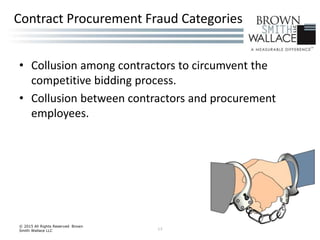
• Collusion among contractors to circumvent the
competitive bidding process.
• Collusion between contractors and procurement
employees.
© 2015 All Rights Reserved Brown
Smith Wallace LLC 13
Contract Procurement Fraud Categories
Schemes
• Complimentary Bidding – competitors submit token bids to
influence contract price and award.
• Bid Rotation – competitors conspire to alternate the business
between them on a rotating basis.
• Bid Suppression – competitors enter into an illegal agreement
whereby at least one refrains from bidding or withdraws a
previously submitted bid.
• Market Division – competitors enter into agreements to
divide and allocate markets and agree not to compete in each
others markets.
© 2015 All Rights Reserved Brown
Smith Wallace LLC 14
Collusion Among Contractors
Red Flags
• Limited competition.
• Winning bid appears to high.
• All contractors submit consistently high bids.
• Qualified contractors do not submit bids.
• Winning bidder subcontracts to losing bidder or non-bidders.
• Bids submitted by companies unqualified to do work.
• Bids fail to conform to requirements of the solicitation.
• Losing bids poorly prepared.
• Fewer competitors than normal submit bids.
© 2015 All Rights Reserved Brown
Smith Wallace LLC 15
Collusion Among Contractors
Red Flags (cont.)
• Bid prices fall when new contractor enters the competition.
• Rotational pattern to winning bidders.
• Evidence of collusion in bids, for example:
– Bidders make same mathematical or spelling errors.
– Bids prepared using same format or typeface.
– Bidders submit identical bids.
• Pattern where last party to bid wins the contract.
• Patterns of conduct that suggest collusion, for example:
– Subcontract with each other.
– Regularly socialize.
– Hold meetings or visit each others offices.
© 2015 All Rights Reserved Brown
Smith Wallace LLC 16
Collusion Among Contractors
Schemes
• Need Recognition – employee convinces employer that it
needs excessive or unnecessary products or services.
• Bid Tailoring – employee drafts bid specifications in a way
that gives unfair advantage to a certain contractor.
• Bid Manipulation – employee manipulates the bidding
process to benefit a favored contractor.
• Leaking Bid Data – employee leaks pre-bid information or
confidential information from competing bidders to a favored
bidder.
© 2015 All Rights Reserved Brown
Smith Wallace LLC 17
Collusion Between Contractors & Employees
Schemes (cont.)
• Bid Splitting – employee breaks up a large project into several
small projects that fall below the mandatory bidding level.
• Unjustified Sole Source Award or Other Noncompetitive
Method of Procurement
© 2015 All Rights Reserved Brown
Smith Wallace LLC 18
Collusion Between Contractors & Employees
Red Flags
• Need defined in a way that can only be met by a certain contractor.
• Assessment of need is not adequately or accurately developed.
• Services continually purchased from a single source.
• Estimates not prepared or are prepared after solicitations requested.
• Employee displays sudden wealth or lives beyond means.
• Employee has outside business.
• Multiple purchases that fall below the threshold limit.
• Weak controls over the bidding process.
• Only one or a few bidders respond to bid requests.
• Contract not re-bid even though fewer than minimum number of bids
received.
© 2015 All Rights Reserved Brown
Smith Wallace LLC 19
Collusion Between Contractors & Employees
Red Flags (cont.)
• Similarity between specs and winning contractor’s product/service.
• Bid specs are tailored to fit products or capabilities of a single contractor.
• Unusual or unreasonable narrow or broad specs for the type of goods or
services being procured.
• Unexplained changes in contract specs from previous proposals.
• Higher number of competitive awards to one supplier.
• Socialization or personal contacts between contracting personnel and
bidders.
• Specs developed by or in consultation with a contractor who is permitted
to compete in the procurement.
• High number of change orders for contractor.
© 2015 All Rights Reserved Brown
Smith Wallace LLC 20
Collusion Between Contractors & Employees
Red Flags (cont.)
• Evidence of changes to bids after received.
• Winning bid voided for errors and job re-bid or awarded to another
bidder.
• An otherwise qualified bidder is disqualified for seemingly arbitrary,
false, frivolous, or personal reasons.
• Employee accepts late bids.
• Contract awarded to non-responsive bidder.
• Bids of competing contractors are lost.
• Bid deadlines are changed.
• Invitations for bids are sent to unqualified contractors or those who
previously declined to bid.
© 2015 All Rights Reserved Brown
Smith Wallace LLC 21
Collusion Between Contractors & Employees
Red Flags (cont.)
• Winning bid is just under the next lowest bid.
• Winning bid is unusually close to the procuring entity’s estimate.
• Last party to bid wins the contract.
• Contractor submits false documentation to get a late bid accepted.
• Contracting personnel provides information or advice about contracts to
a contractor on a preferential basis.
• Unjustified split purchases that fall under the competitive bidding limits.
• Sequential purchases just under the upper-level review or competitive
bidding limits.
• Frequent use of sole source procurement contracts.
• High number of sole source awards to one contractor.
© 2015 All Rights Reserved Brown
Smith Wallace LLC 22
Collusion Between Contractors & Employees
Red Flags (cont.)
• Requests for sole source when there is an available pool of contractors.
• Procuring entity did not maintain accurate minutes of pre-bid meetings.
• False statements made to justify noncompetitive method of
procurement.
• Justifications for noncompetitive method signed/approved by employees
without authority.
• Fail to obtain required review for sole source justification.
© 2015 All Rights Reserved Brown
Smith Wallace LLC 23
Collusion Between Contractors & Employees
24
© 2015 All Rights Reserved Brown
Smith Wallace LLC
Preventing Contract
Procurement Fraud
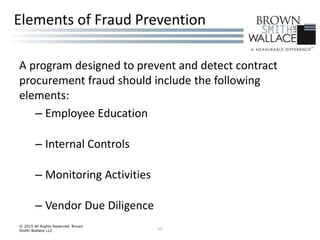
A program designed to prevent and detect contract
procurement fraud should include the following
elements:
– Employee Education
– Internal Controls
– Monitoring Activities
– Vendor Due Diligence
© 2015 All Rights Reserved Brown
Smith Wallace LLC 25
Elements of Fraud Prevention
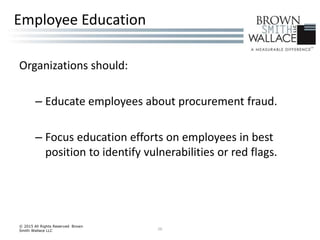
Organizations should:
– Educate employees about procurement fraud.
– Focus education efforts on employees in best
position to identify vulnerabilities or red flags.
© 2015 All Rights Reserved Brown
Smith Wallace LLC 26
Employee Education
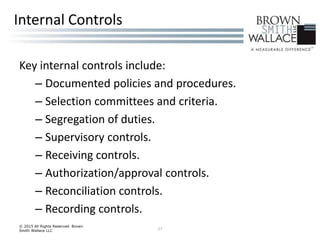
Key internal controls include:
– Documented policies and procedures.
– Selection committees and criteria.
– Segregation of duties.
– Supervisory controls.
– Receiving controls.
– Authorization/approval controls.
– Reconciliation controls.
– Recording controls.
© 2015 All Rights Reserved Brown
Smith Wallace LLC 27
Internal Controls
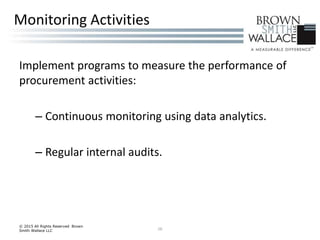
Implement programs to measure the performance of
procurement activities:
– Continuous monitoring using data analytics.
– Regular internal audits.
© 2015 All Rights Reserved Brown
Smith Wallace LLC 28
Monitoring Activities
A vendor due diligence program should include:
– Vendor background checks.
– Controls for vendor master file management.
– Vendor monitoring.
© 2015 All Rights Reserved Brown
Smith Wallace LLC 29
Vendor Due Diligence
© 2015 All Rights Reserved Brown
Smith Wallace LLC 30
Questions?
Ron Steinkamp
rsteinkamp@bswllc.com
314-983-1238
31
Connect
6 CityPlace Drive, Suite 900│ St. Louis, Missouri 63141 │ 314.983.1200
1520 S. Fifth St., Suite 309 │ St. Charles, Missouri 63303 │ 636.255.3000
2220 S. State Route 157, Ste. 300 │ Glen Carbon, Illinois 62034 │ 618.654.3100
1.888.279.2792 │ www.bswllc.com
© 2015 All Rights Reserved Brown
Smith Wallace LLC

Contract Procurement Fraud

  • 1.
    Contract Procurement Fraud January2016 Ron Steinkamp, CPA, CIA, CFE, CRMA, CGMA 314.983.1238 rsteinkamp@bswllc.com
  • 2.
    Elements of aContract Methods of Procurement Procurement Phases Contract Procurement Fraud Schemes & Red Flags Preventing Contract Procurement Fraud © 2015 All Rights Reserved Brown Smith Wallace LLC 2 Table of Contents
  • 3.
    3 © 2015 AllRights Reserved Brown Smith Wallace LLC Elements of a Contract
  • 4.
    A contract isa mutual oral or written agreement between two or more parties that must contain the following elements: – Competent parties – Lawful subject matter or objective – Mutual consent – Legal consideration – Form permitted by law © 2015 All Rights Reserved Brown Smith Wallace LLC 4 Elements of a Contract
  • 5.
    5 © 2015 AllRights Reserved Brown Smith Wallace LLC Methods of Procurement
  • 6.
    • Competitive biddingusing sealed bids. • Contracting by negotiation: – Competitive negotiation. – Sole-source contracting. • Simplified acquisition procedures: – Charge accounts. – Purchase cards. – Purchase orders. – Petty cash funds. © 2015 All Rights Reserved Brown Smith Wallace LLC 6 Methods of Procurement
  • 7.
    7 © 2015 AllRights Reserved Brown Smith Wallace LLC Procurement Phases
  • 8.
    • Identify needs. •Develop bid specifications. • Determine method of procurement. • Develop criteria to award the contract. © 2015 All Rights Reserved Brown Smith Wallace LLC 8 Pre-solicitation Phase
  • 9.
    • Prepare solicitationdocument (RFI, RFQ, RFP, etc.). • Provide notice of solicitation. • Issue solicitation document. • Receive bids and proposals. © 2015 All Rights Reserved Brown Smith Wallace LLC 9 Solicitation Phase
  • 10.
    • Evaluates bids/proposals. •May conduct discussions/negotiations. • May provide opportunity to revise bids/proposals. • Select winning bid/proposal. • Execute contract and terms. © 2015 All Rights Reserved Brown Smith Wallace LLC 10 Bid Evaluation & Award Phase
  • 11.
    • Performance ofcontractual obligations. • Contract modifications/change orders. • Review of completed portions and release of funds. • Assessment of deliverables for compliance with contracts terms and quality. © 2015 All Rights Reserved Brown Smith Wallace LLC 11 Post Award & Administration Phase
  • 12.
    12 © 2015 AllRights Reserved Brown Smith Wallace LLC Contract Procurement Fraud Schemes & Red Flags
  • 13.
    • Collusion amongcontractors to circumvent the competitive bidding process. • Collusion between contractors and procurement employees. © 2015 All Rights Reserved Brown Smith Wallace LLC 13 Contract Procurement Fraud Categories
  • 14.
    Schemes • Complimentary Bidding– competitors submit token bids to influence contract price and award. • Bid Rotation – competitors conspire to alternate the business between them on a rotating basis. • Bid Suppression – competitors enter into an illegal agreement whereby at least one refrains from bidding or withdraws a previously submitted bid. • Market Division – competitors enter into agreements to divide and allocate markets and agree not to compete in each others markets. © 2015 All Rights Reserved Brown Smith Wallace LLC 14 Collusion Among Contractors
  • 15.
    Red Flags • Limitedcompetition. • Winning bid appears to high. • All contractors submit consistently high bids. • Qualified contractors do not submit bids. • Winning bidder subcontracts to losing bidder or non-bidders. • Bids submitted by companies unqualified to do work. • Bids fail to conform to requirements of the solicitation. • Losing bids poorly prepared. • Fewer competitors than normal submit bids. © 2015 All Rights Reserved Brown Smith Wallace LLC 15 Collusion Among Contractors
  • 16.
    Red Flags (cont.) •Bid prices fall when new contractor enters the competition. • Rotational pattern to winning bidders. • Evidence of collusion in bids, for example: – Bidders make same mathematical or spelling errors. – Bids prepared using same format or typeface. – Bidders submit identical bids. • Pattern where last party to bid wins the contract. • Patterns of conduct that suggest collusion, for example: – Subcontract with each other. – Regularly socialize. – Hold meetings or visit each others offices. © 2015 All Rights Reserved Brown Smith Wallace LLC 16 Collusion Among Contractors
  • 17.
    Schemes • Need Recognition– employee convinces employer that it needs excessive or unnecessary products or services. • Bid Tailoring – employee drafts bid specifications in a way that gives unfair advantage to a certain contractor. • Bid Manipulation – employee manipulates the bidding process to benefit a favored contractor. • Leaking Bid Data – employee leaks pre-bid information or confidential information from competing bidders to a favored bidder. © 2015 All Rights Reserved Brown Smith Wallace LLC 17 Collusion Between Contractors & Employees
  • 18.
    Schemes (cont.) • BidSplitting – employee breaks up a large project into several small projects that fall below the mandatory bidding level. • Unjustified Sole Source Award or Other Noncompetitive Method of Procurement © 2015 All Rights Reserved Brown Smith Wallace LLC 18 Collusion Between Contractors & Employees
  • 19.
    Red Flags • Needdefined in a way that can only be met by a certain contractor. • Assessment of need is not adequately or accurately developed. • Services continually purchased from a single source. • Estimates not prepared or are prepared after solicitations requested. • Employee displays sudden wealth or lives beyond means. • Employee has outside business. • Multiple purchases that fall below the threshold limit. • Weak controls over the bidding process. • Only one or a few bidders respond to bid requests. • Contract not re-bid even though fewer than minimum number of bids received. © 2015 All Rights Reserved Brown Smith Wallace LLC 19 Collusion Between Contractors & Employees
  • 20.
    Red Flags (cont.) •Similarity between specs and winning contractor’s product/service. • Bid specs are tailored to fit products or capabilities of a single contractor. • Unusual or unreasonable narrow or broad specs for the type of goods or services being procured. • Unexplained changes in contract specs from previous proposals. • Higher number of competitive awards to one supplier. • Socialization or personal contacts between contracting personnel and bidders. • Specs developed by or in consultation with a contractor who is permitted to compete in the procurement. • High number of change orders for contractor. © 2015 All Rights Reserved Brown Smith Wallace LLC 20 Collusion Between Contractors & Employees
  • 21.
    Red Flags (cont.) •Evidence of changes to bids after received. • Winning bid voided for errors and job re-bid or awarded to another bidder. • An otherwise qualified bidder is disqualified for seemingly arbitrary, false, frivolous, or personal reasons. • Employee accepts late bids. • Contract awarded to non-responsive bidder. • Bids of competing contractors are lost. • Bid deadlines are changed. • Invitations for bids are sent to unqualified contractors or those who previously declined to bid. © 2015 All Rights Reserved Brown Smith Wallace LLC 21 Collusion Between Contractors & Employees
  • 22.
    Red Flags (cont.) •Winning bid is just under the next lowest bid. • Winning bid is unusually close to the procuring entity’s estimate. • Last party to bid wins the contract. • Contractor submits false documentation to get a late bid accepted. • Contracting personnel provides information or advice about contracts to a contractor on a preferential basis. • Unjustified split purchases that fall under the competitive bidding limits. • Sequential purchases just under the upper-level review or competitive bidding limits. • Frequent use of sole source procurement contracts. • High number of sole source awards to one contractor. © 2015 All Rights Reserved Brown Smith Wallace LLC 22 Collusion Between Contractors & Employees
  • 23.
    Red Flags (cont.) •Requests for sole source when there is an available pool of contractors. • Procuring entity did not maintain accurate minutes of pre-bid meetings. • False statements made to justify noncompetitive method of procurement. • Justifications for noncompetitive method signed/approved by employees without authority. • Fail to obtain required review for sole source justification. © 2015 All Rights Reserved Brown Smith Wallace LLC 23 Collusion Between Contractors & Employees
  • 24.
    24 © 2015 AllRights Reserved Brown Smith Wallace LLC Preventing Contract Procurement Fraud
  • 25.
    A program designedto prevent and detect contract procurement fraud should include the following elements: – Employee Education – Internal Controls – Monitoring Activities – Vendor Due Diligence © 2015 All Rights Reserved Brown Smith Wallace LLC 25 Elements of Fraud Prevention
  • 26.
    Organizations should: – Educateemployees about procurement fraud. – Focus education efforts on employees in best position to identify vulnerabilities or red flags. © 2015 All Rights Reserved Brown Smith Wallace LLC 26 Employee Education
  • 27.
    Key internal controlsinclude: – Documented policies and procedures. – Selection committees and criteria. – Segregation of duties. – Supervisory controls. – Receiving controls. – Authorization/approval controls. – Reconciliation controls. – Recording controls. © 2015 All Rights Reserved Brown Smith Wallace LLC 27 Internal Controls
  • 28.
    Implement programs tomeasure the performance of procurement activities: – Continuous monitoring using data analytics. – Regular internal audits. © 2015 All Rights Reserved Brown Smith Wallace LLC 28 Monitoring Activities
  • 29.
    A vendor duediligence program should include: – Vendor background checks. – Controls for vendor master file management. – Vendor monitoring. © 2015 All Rights Reserved Brown Smith Wallace LLC 29 Vendor Due Diligence
  • 30.
    © 2015 AllRights Reserved Brown Smith Wallace LLC 30 Questions?
  • 31.
    Ron Steinkamp rsteinkamp@bswllc.com 314-983-1238 31 Connect 6 CityPlaceDrive, Suite 900│ St. Louis, Missouri 63141 │ 314.983.1200 1520 S. Fifth St., Suite 309 │ St. Charles, Missouri 63303 │ 636.255.3000 2220 S. State Route 157, Ste. 300 │ Glen Carbon, Illinois 62034 │ 618.654.3100 1.888.279.2792 │ www.bswllc.com © 2015 All Rights Reserved Brown Smith Wallace LLC