PROCUREMENT IRREGULARITIES An action checklist to recognise and respond to potential irregularities in the procurement process (Use the notes (paper) for the full explenation of eacht slide)
This advisory guide has been produced by SourceExcellence for use by Procurement Management, Contracting & Sourcing Personnel, Project Management, Audit and Security The purpose is to enable those involved during and subsequent to the contracting and procurement process to :- (1) Recognise examples and symptoms of irregularities  which may occur during each of twelve key  procurement process steps (2) Identify preventive responses to minimise exposure
Process : Step 1 - Contract Administration 1. Plan requirements 2. Develop procurement plan 3. Develop specifications and clarify requirements 4. Define scope of supply/service 5. Condition bids and develop contract terms 6. Qualify  suppliers and develop bidders list 7. Bid evaluation elements 8. Invitation to bid/ request for quotation 9. Receipt, opening and storage of bids 10. Evaluate bids 11. Award contract and debrief bidders 12. Contract administration KEY PROCESS   STEPS REQUIREMENTS  EXPOSURE  : FALSE
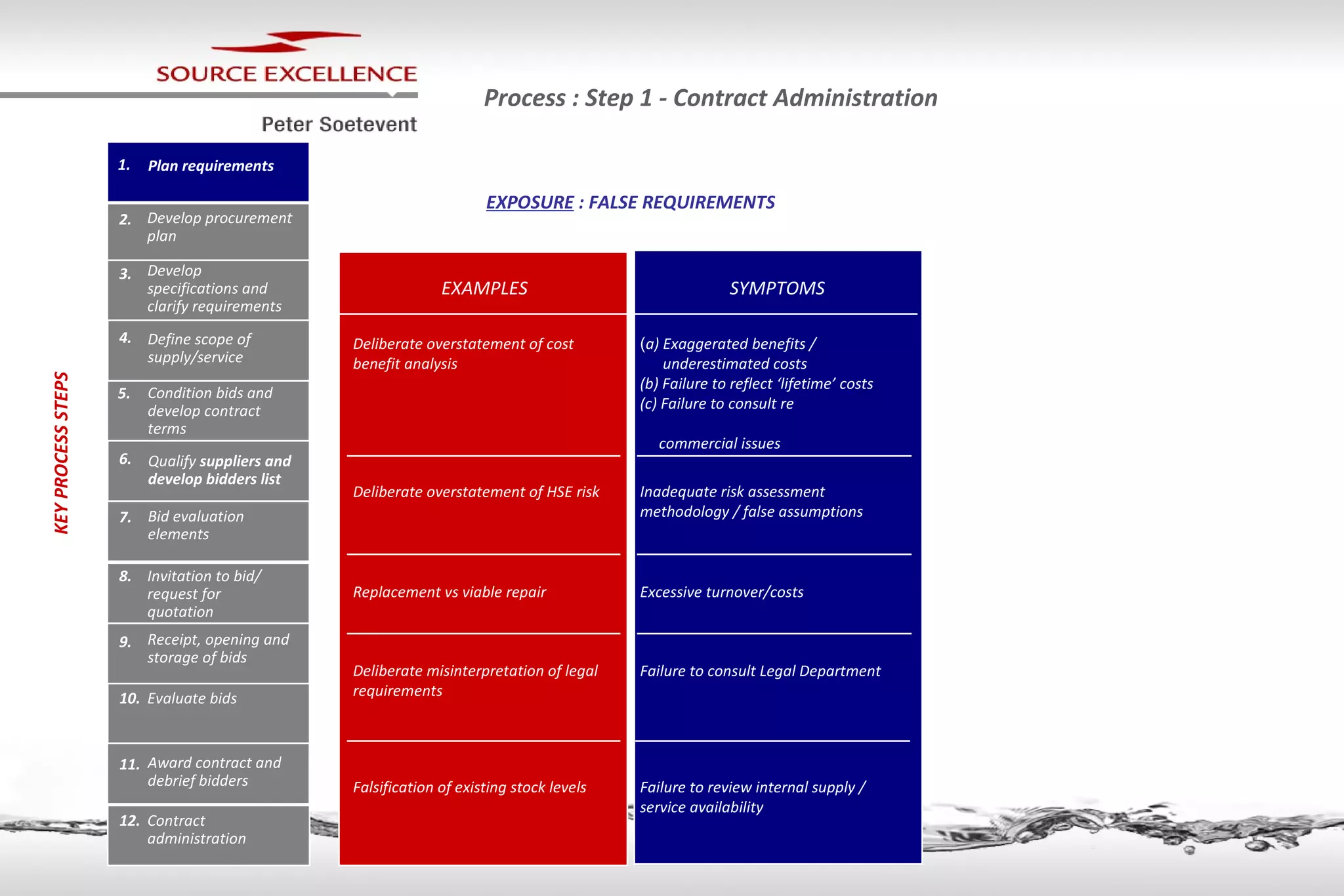
Process : Step 1 - Contract Administration EXAMPLES EXPOSURE  : FALSE REQUIREMENTS Deliberate overstatement of cost benefit analysis Deliberate overstatement of HSE risk Replacement vs viable repair Deliberate misinterpretation of legal requirements Falsification of existing stock levels 1. Plan requirements 2. Develop procurement plan 3. Develop specifications and clarify requirements 4. Define scope of supply/service 5. Condition bids and develop  contract terms 6. Qualify  suppliers and develop bidders list 7. Bid evaluation elements 8. Invitation to bid/ request for quotation 9. Receipt, opening and storage of bids 10. Evaluate bids 11. Award contract and debrief bidders 12. Contract administration KEY PROCESS   STEPS
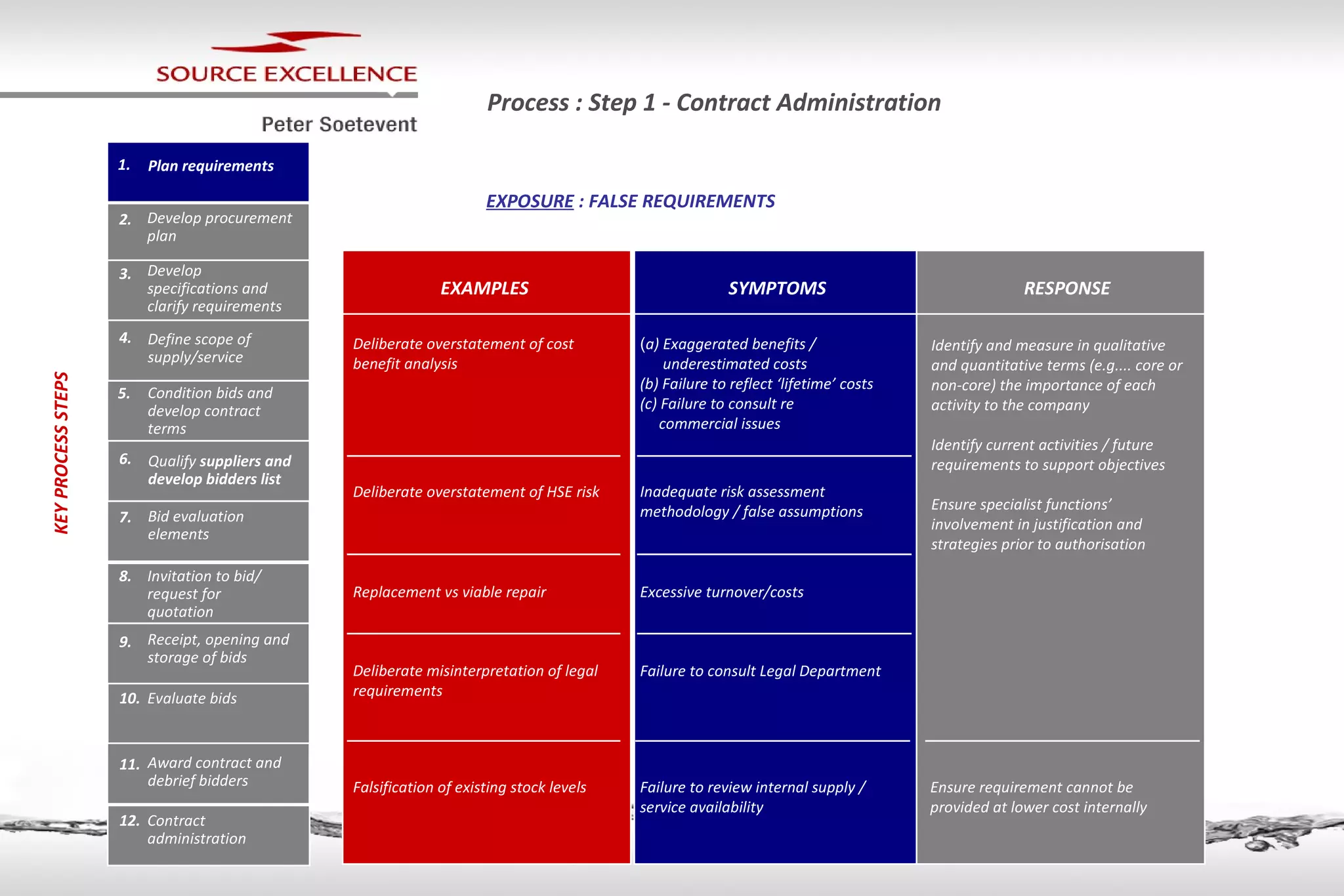
Process : Step 1 - Contract Administration EXAMPLES SYMPTOMS EXPOSURE  : FALSE REQUIREMENTS Deliberate overstatement of cost benefit analysis ( a) Exaggerated benefits /  underestimated costs (b) Failure to reflect ‘lifetime’ costs (c) Failure to consult re  commercial issues Deliberate overstatement of HSE risk Inadequate risk assessment methodology / false assumptions Replacement vs viable repair Excessive turnover/costs Deliberate misinterpretation of legal requirements Failure to consult Legal Department Falsification of existing stock levels Failure to review internal supply / service availability 1. Plan requirements 2. Develop procurement plan 3. Develop specifications and clarify requirements 4. Define scope of supply/service 5. Condition bids and develop contract terms 6. Qualify  suppliers and develop bidders list 7. Bid evaluation elements 8. Invitation to bid/ request for quotation 9. Receipt, opening and storage of bids 10. Evaluate bids 11. Award contract and debrief bidders 12. Contract administration KEY PROCESS   STEPS
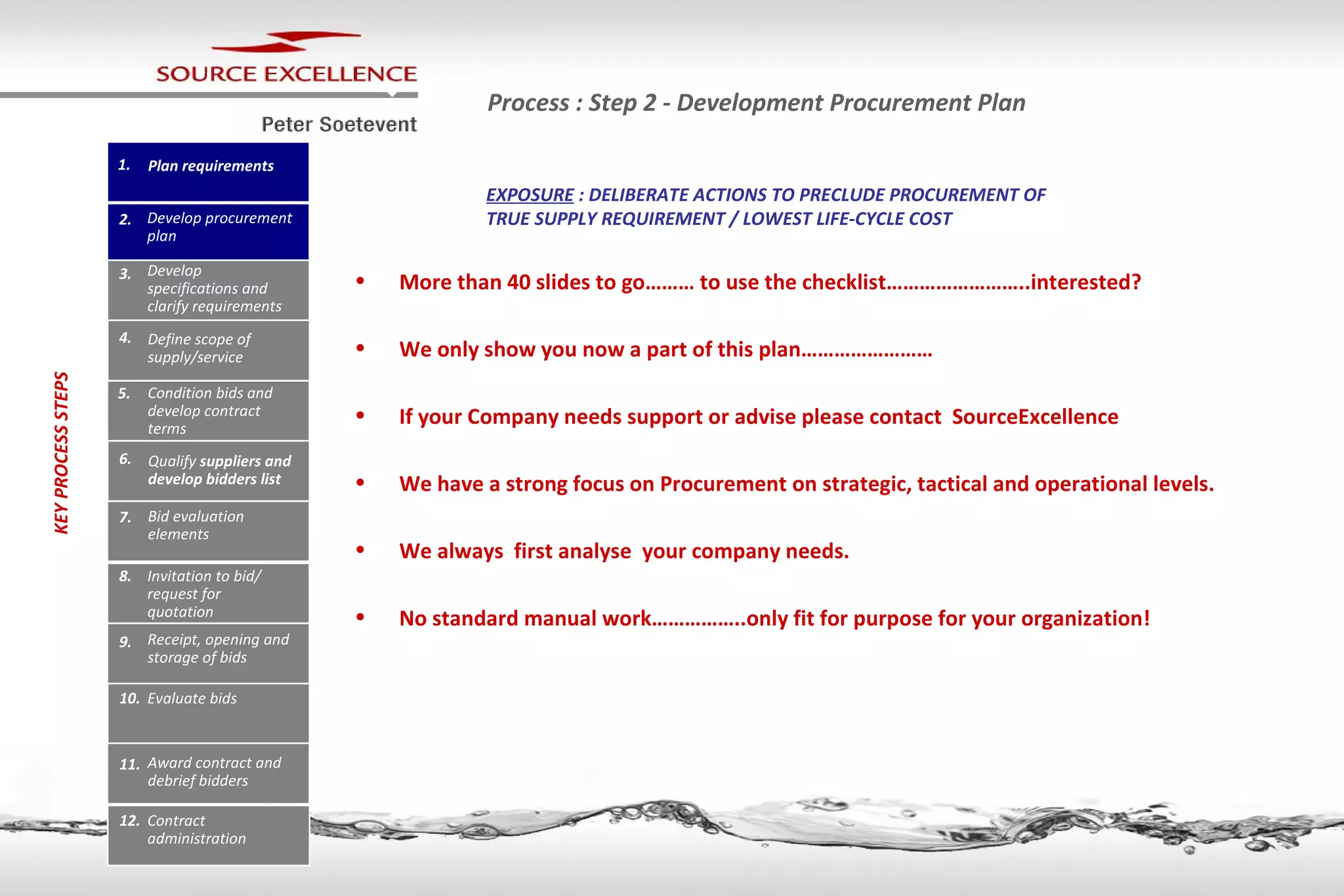
Process : Step 1 - Contract Administration EXAMPLES SYMPTOMS RESPONSE EXPOSURE  : FALSE REQUIREMENTS Deliberate overstatement of cost benefit analysis ( a) Exaggerated benefits /  underestimated costs (b) Failure to reflect ‘lifetime’ costs (c) Failure to consult re  commercial issues Identify and measure in qualitative and quantitative terms (e.g.... core or non-core) the importance of each activity to the company Identify current activities / future requirements to support objectives Ensure specialist functions’ involvement in justification and strategies prior to authorisation Deliberate overstatement of HSE risk Inadequate risk assessment methodology / false assumptions Replacement vs viable repair Excessive turnover/costs Deliberate misinterpretation of legal requirements Failure to consult Legal Department Falsification of existing stock levels Failure to review internal supply / service availability Ensure requirement cannot be provided at lower cost internally 1. Plan requirements 2. Develop procurement plan 3. Develop specifications and clarify requirements 4. Define scope of supply/service 5. Condition bids and develop contract terms 6. Qualify  suppliers and develop bidders list 7. Bid evaluation elements 8. Invitation to bid/ request for quotation 9. Receipt, opening and storage of bids 10. Evaluate bids 11. Award contract and debrief bidders 12. Contract administration KEY PROCESS   STEPS
Process : Step 2 - Development Procurement Plan More than 40  slides  to go……… to use the checklist…………………….. interested ? We only show you now a part of this plan…………………… If your Company needs support or advise please contact  SourceExcellence  We have a strong focus on Procurement on strategic, tactical and operational levels. We always  first analyse  your company needs. No standard manual work……………..only fit for purpose for your organization! EXPOSURE  : DELIBERATE ACTIONS TO PRECLUDE PROCUREMENT OF TRUE SUPPLY REQUIREMENT / LOWEST LIFE-CYCLE COST 1. Plan requirements 2. Develop procurement plan 3. Develop specifications and clarify requirements 4. Define scope of supply/service 5. Condition bids and develop contract terms 6. Qualify  suppliers and develop bidders list 7. Bid evaluation elements 8. Invitation to bid/ request for quotation 9. Receipt, opening and storage of bids 10. Evaluate bids 11. Award contract and debrief bidders 12. Contract administration KEY PROCESS   STEPS

Procurement Irregularities Source Excellence 1008 2010 Short

  • 1.
    PROCUREMENT IRREGULARITIES Anaction checklist to recognise and respond to potential irregularities in the procurement process (Use the notes (paper) for the full explenation of eacht slide)
  • 2.
    This advisory guidehas been produced by SourceExcellence for use by Procurement Management, Contracting & Sourcing Personnel, Project Management, Audit and Security The purpose is to enable those involved during and subsequent to the contracting and procurement process to :- (1) Recognise examples and symptoms of irregularities which may occur during each of twelve key procurement process steps (2) Identify preventive responses to minimise exposure
  • 3.
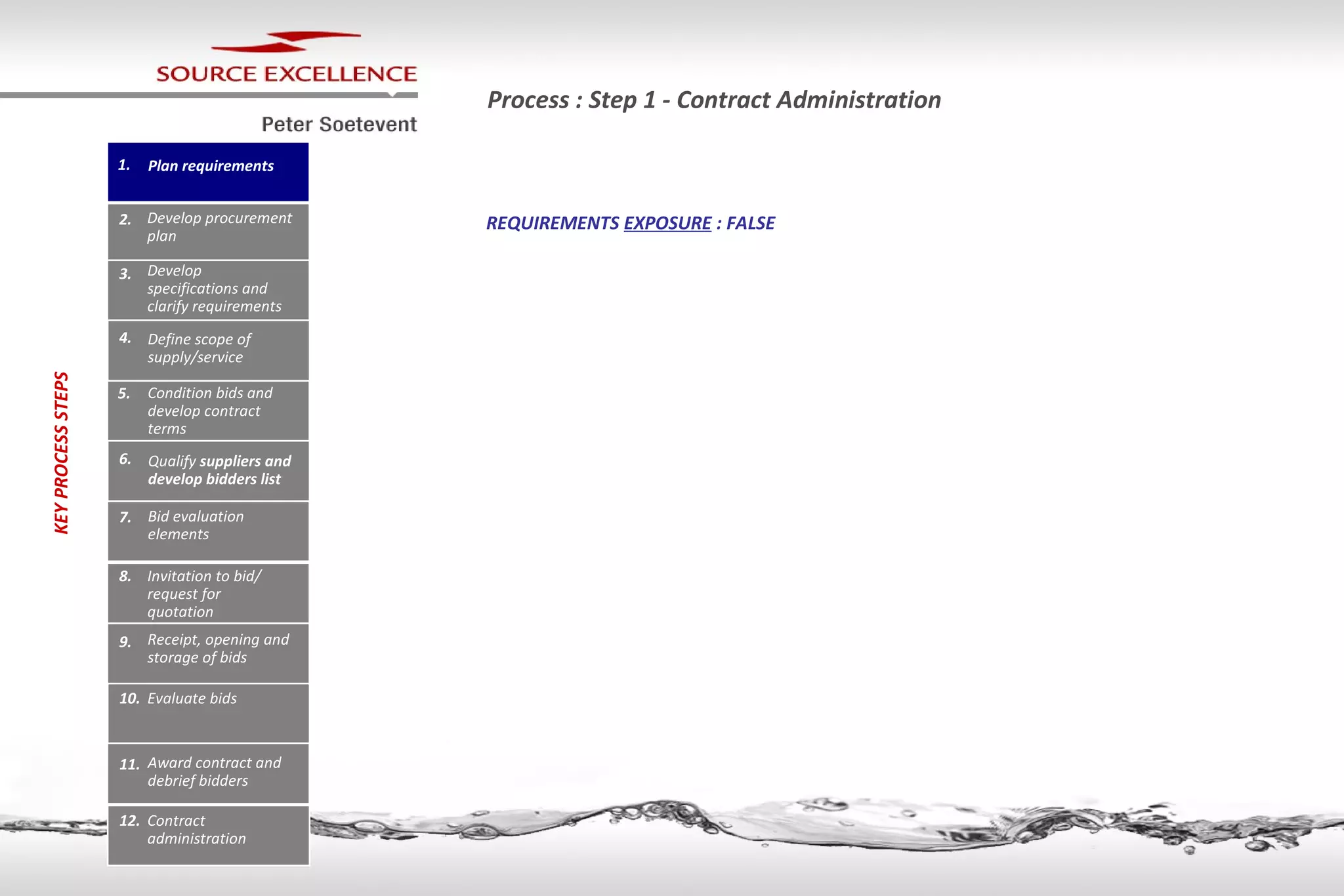
    Process : Step1 - Contract Administration 1. Plan requirements 2. Develop procurement plan 3. Develop specifications and clarify requirements 4. Define scope of supply/service 5. Condition bids and develop contract terms 6. Qualify suppliers and develop bidders list 7. Bid evaluation elements 8. Invitation to bid/ request for quotation 9. Receipt, opening and storage of bids 10. Evaluate bids 11. Award contract and debrief bidders 12. Contract administration KEY PROCESS STEPS REQUIREMENTS EXPOSURE : FALSE
  • 4.
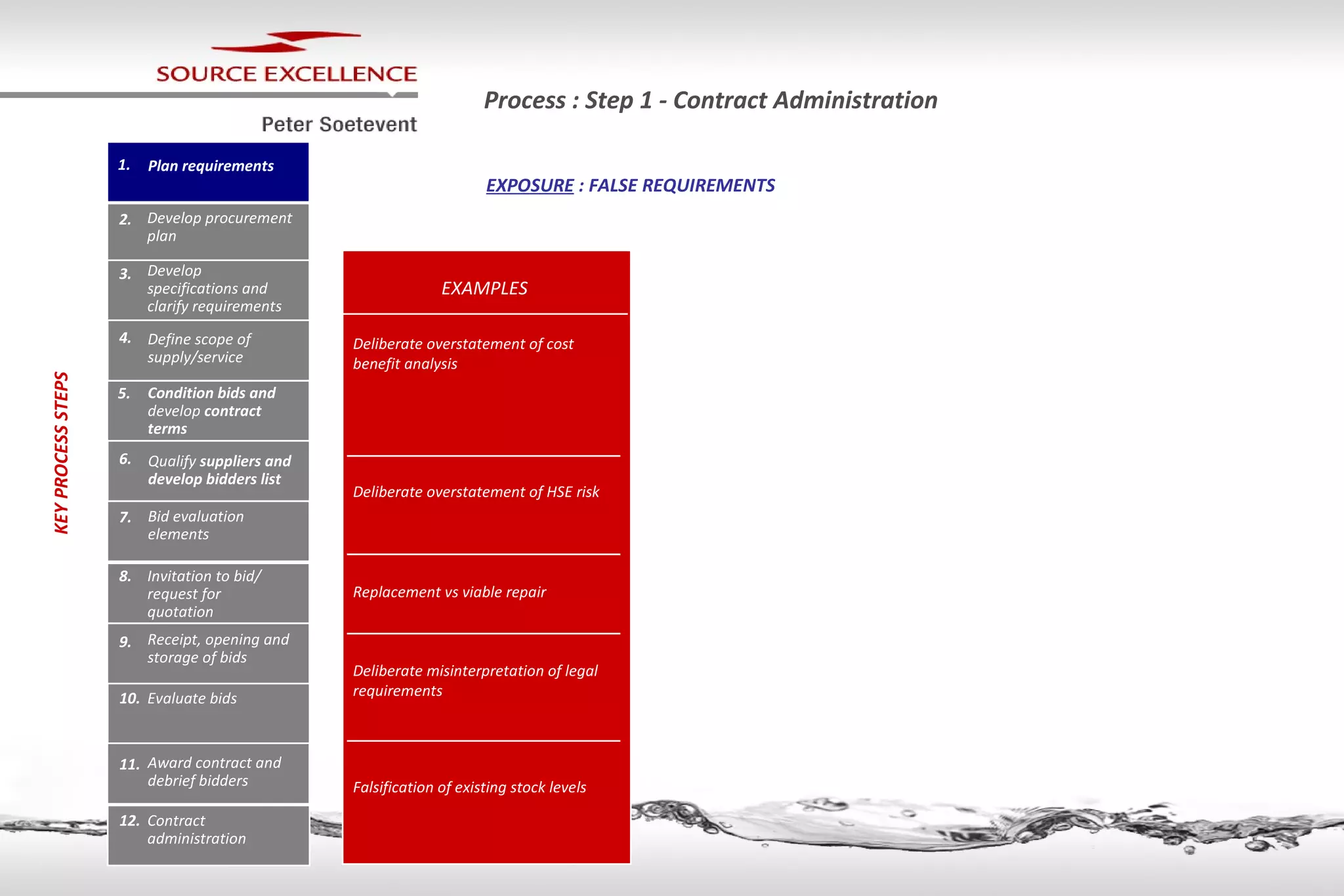
    Process : Step1 - Contract Administration EXAMPLES EXPOSURE : FALSE REQUIREMENTS Deliberate overstatement of cost benefit analysis Deliberate overstatement of HSE risk Replacement vs viable repair Deliberate misinterpretation of legal requirements Falsification of existing stock levels 1. Plan requirements 2. Develop procurement plan 3. Develop specifications and clarify requirements 4. Define scope of supply/service 5. Condition bids and develop contract terms 6. Qualify suppliers and develop bidders list 7. Bid evaluation elements 8. Invitation to bid/ request for quotation 9. Receipt, opening and storage of bids 10. Evaluate bids 11. Award contract and debrief bidders 12. Contract administration KEY PROCESS STEPS
  • 5.
    Process : Step1 - Contract Administration EXAMPLES SYMPTOMS EXPOSURE : FALSE REQUIREMENTS Deliberate overstatement of cost benefit analysis ( a) Exaggerated benefits / underestimated costs (b) Failure to reflect ‘lifetime’ costs (c) Failure to consult re commercial issues Deliberate overstatement of HSE risk Inadequate risk assessment methodology / false assumptions Replacement vs viable repair Excessive turnover/costs Deliberate misinterpretation of legal requirements Failure to consult Legal Department Falsification of existing stock levels Failure to review internal supply / service availability 1. Plan requirements 2. Develop procurement plan 3. Develop specifications and clarify requirements 4. Define scope of supply/service 5. Condition bids and develop contract terms 6. Qualify suppliers and develop bidders list 7. Bid evaluation elements 8. Invitation to bid/ request for quotation 9. Receipt, opening and storage of bids 10. Evaluate bids 11. Award contract and debrief bidders 12. Contract administration KEY PROCESS STEPS
  • 6.
    Process : Step1 - Contract Administration EXAMPLES SYMPTOMS RESPONSE EXPOSURE : FALSE REQUIREMENTS Deliberate overstatement of cost benefit analysis ( a) Exaggerated benefits / underestimated costs (b) Failure to reflect ‘lifetime’ costs (c) Failure to consult re commercial issues Identify and measure in qualitative and quantitative terms (e.g.... core or non-core) the importance of each activity to the company Identify current activities / future requirements to support objectives Ensure specialist functions’ involvement in justification and strategies prior to authorisation Deliberate overstatement of HSE risk Inadequate risk assessment methodology / false assumptions Replacement vs viable repair Excessive turnover/costs Deliberate misinterpretation of legal requirements Failure to consult Legal Department Falsification of existing stock levels Failure to review internal supply / service availability Ensure requirement cannot be provided at lower cost internally 1. Plan requirements 2. Develop procurement plan 3. Develop specifications and clarify requirements 4. Define scope of supply/service 5. Condition bids and develop contract terms 6. Qualify suppliers and develop bidders list 7. Bid evaluation elements 8. Invitation to bid/ request for quotation 9. Receipt, opening and storage of bids 10. Evaluate bids 11. Award contract and debrief bidders 12. Contract administration KEY PROCESS STEPS
  • 7.
    Process : Step2 - Development Procurement Plan More than 40 slides to go……… to use the checklist…………………….. interested ? We only show you now a part of this plan…………………… If your Company needs support or advise please contact SourceExcellence We have a strong focus on Procurement on strategic, tactical and operational levels. We always first analyse your company needs. No standard manual work……………..only fit for purpose for your organization! EXPOSURE : DELIBERATE ACTIONS TO PRECLUDE PROCUREMENT OF TRUE SUPPLY REQUIREMENT / LOWEST LIFE-CYCLE COST 1. Plan requirements 2. Develop procurement plan 3. Develop specifications and clarify requirements 4. Define scope of supply/service 5. Condition bids and develop contract terms 6. Qualify suppliers and develop bidders list 7. Bid evaluation elements 8. Invitation to bid/ request for quotation 9. Receipt, opening and storage of bids 10. Evaluate bids 11. Award contract and debrief bidders 12. Contract administration KEY PROCESS STEPS

Editor's Notes

  • #2 There are many case examples of Illegal Contract Information and other forms of Contract Award Corruption. During several presentations to Management Groups there was regularly asked:- 1. What are our exposures? 2. Do you have any examples? 3. What are the symptoms that would help us detect these incidents? AND MOST IMPORTANTLY:- 4. What preventive response should we have to minimise our exposure? To answer these questions and to provide a practical tool that you may take away and effectively work with, I make an Action Checklist.
  • #3 This Action Checklist has been produced by SourceExcellence for :- - Procurement Management - Contracting & Sourcing personnel - Project Management - Internal Audit - Security The checklist has been developed through :- 1. Identifying the 12 KEY PROCESS STEPS in a typical award. Then for each step:- 2. Highlighting the key EXPOSURE 3. Listing EXAMPLES of the exposure 4. Describing SYMPTOMS of each example 5. Proposing the best practice RESPONSE to minimise the exposure
  • #4 These charts are essentially a tool for you to take away and use. My objective here today is to introduce the charts to you so that you fully understand how they have been developed and how the various columns all fit together. You will see that there is a great deal of detail in the charts. I don’t intend to go through them all line by line. The first chart I will cover in some detail so that you can get familiar with the layout and concepts. Then we will go through the remaining charts and I’ll select aspects that I think are particularly important and relevant to your operations here. If you look at the left of the chart you will see the tall column of 12 ‘KEY PROCESS STEPS’ This chart analyses the 1st step, shown in red at the top of the tall column:- No 1 ‘PLAN REQUIREMENTS’ This is the very beginning of the Procurement Process when an organisation will be taking a broad view of requirements from strategic and cost-benefit perspectives. EXPOSURE So what is the exposure in this Process Step? The main and most obvious exposure here is 'FALSE REQUIREMENT’, either entirely or partially. Let’s look at some examples of false requirements in the blue column:-
  • #5 EXAMPLES Perhaps the cost benefit analysis has been falsified to demonstrate a benefit that really doesn’t exist. Or, Health, Safety and Environmental risks have been overstated to support a requirement which is really unnecessary. Perhaps the item could be easily repaired or maybe the legal requirements have been overstated. Perhaps there is plenty of this item in stock but the inventory levels have been falsified to cause an apparent but fictitious requirement. So as you can see there are many examples of how requirements can be falsified. What are the symptoms that something may be going wrong?
  • #6 SYMPTOMS In the middle column you can see Symptoms listed against every Example. I don’t intend to go through each of them with you one by one but I will select a few to mention to help you understand how these charts work. Maybe in the cost- benefit analysis the costs have been understated through not taking into account the full ‘lifetime’ costs; maybe repair and maintenance costs have been ignored. If it is seen that there has been poor risk assessment criteria applied to justify a requirement, or where there has been a very high turnover of an item, these could be symptoms of a false requirement. Similarly, if there has been a lack of consultation with management on commercial issues, or with Legal Department on legal aspects, or with internal warehouse management to check on existing internal availability, then these could all be symptoms of false requirements. So what should the best Response be that will minimise the vulnerability to the exposure of False Requirement?
  • #7 RESPONSE As is the case with so many of the best practice responses that you will see as we go through these charts, the best response is having a well defined and well managed process which assures that business procurement objectives are met. It is a matter of Quality Control. Precisely defined elements within a continual process that ensures the Integrity of the procurement process. In response to the exposure of ‘False Requirements’ there must be a process which measures in qualitative and quality terms the importance, justification and strategy for each requirement that is being considered. This requires the consideration of future as well as current objectives. It also requires the involvement of and consultation with each specialist function that is able to make a contribution to the process.
  • #8 Now we move on to the 2nd step in the Process: ‘DEVELOP PROCUREMENT PLAN.’ During this step in the process, the strategic decision taken concerning which procurement method and plan to use. So what is the Key Exposure? EXPOSURE As you can see, the exposure in this step is ‘ DELIBERATE ACTIONS TO PRECLUDE PROCUREMENT OF TRUE SUPPLY REQUIREMENT AT LOWEST LIFE- CYCLE COST ‘. Put more simply, it is deliberately selecting poor procurement strategy or poor bidder selection criteria which will result in the failure to identify the true requirement and failure to obtain best value. Let’s look at some examples that should help to explain what is meant here:-