Using Data Analytics
to Find Fraud Indicators
Ron Steinkamp
Joe Montes
November 30, 2016
• COSO Fraud Risk Management
• What is Data Analysis?
• Data Analysis Benefits & Challenges
• Perspectives on Data Analysis
• Using Data Analysis to Find Fraud Indicators
• Exercise
2
Agenda
© 2016 All Rights Reserved
Brown Smith Wallace LLP
© 2016 All Rights Reserved 3 Brown Smith Wallace LLP
• COSO issued Fraud Risk Management Guide.
• Guidance on how to deter fraud.
• 5 Fraud Risk Management Principles.
• Aligned with the COSO Framework Components
and Principles.
• Further detailed in Points of Focus related to
each Principle.
• Can be used as a starting point to develop a
Fraud Risk Management Program.
4
COSO Fraud Risk Management Guide
© 2016 All Rights Reserved
Brown Smith Wallace LLP
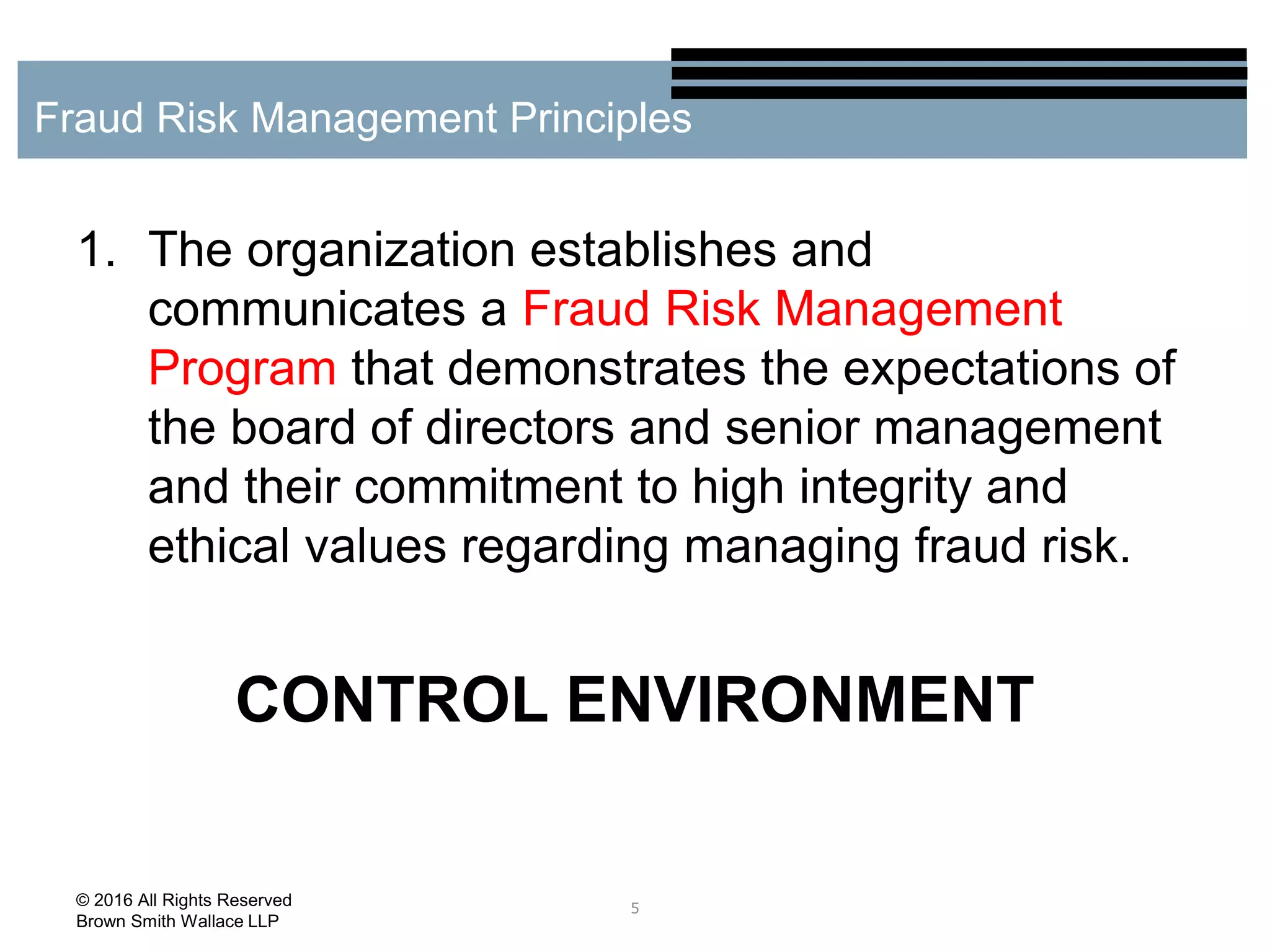
1. The organization establishes and
communicates a Fraud Risk Management
Program that demonstrates the expectations of
the board of directors and senior management
and their commitment to high integrity and
ethical values regarding managing fraud risk.
CONTROL ENVIRONMENT
5
Fraud Risk Management Principles
© 2016 All Rights Reserved
Brown Smith Wallace LLP
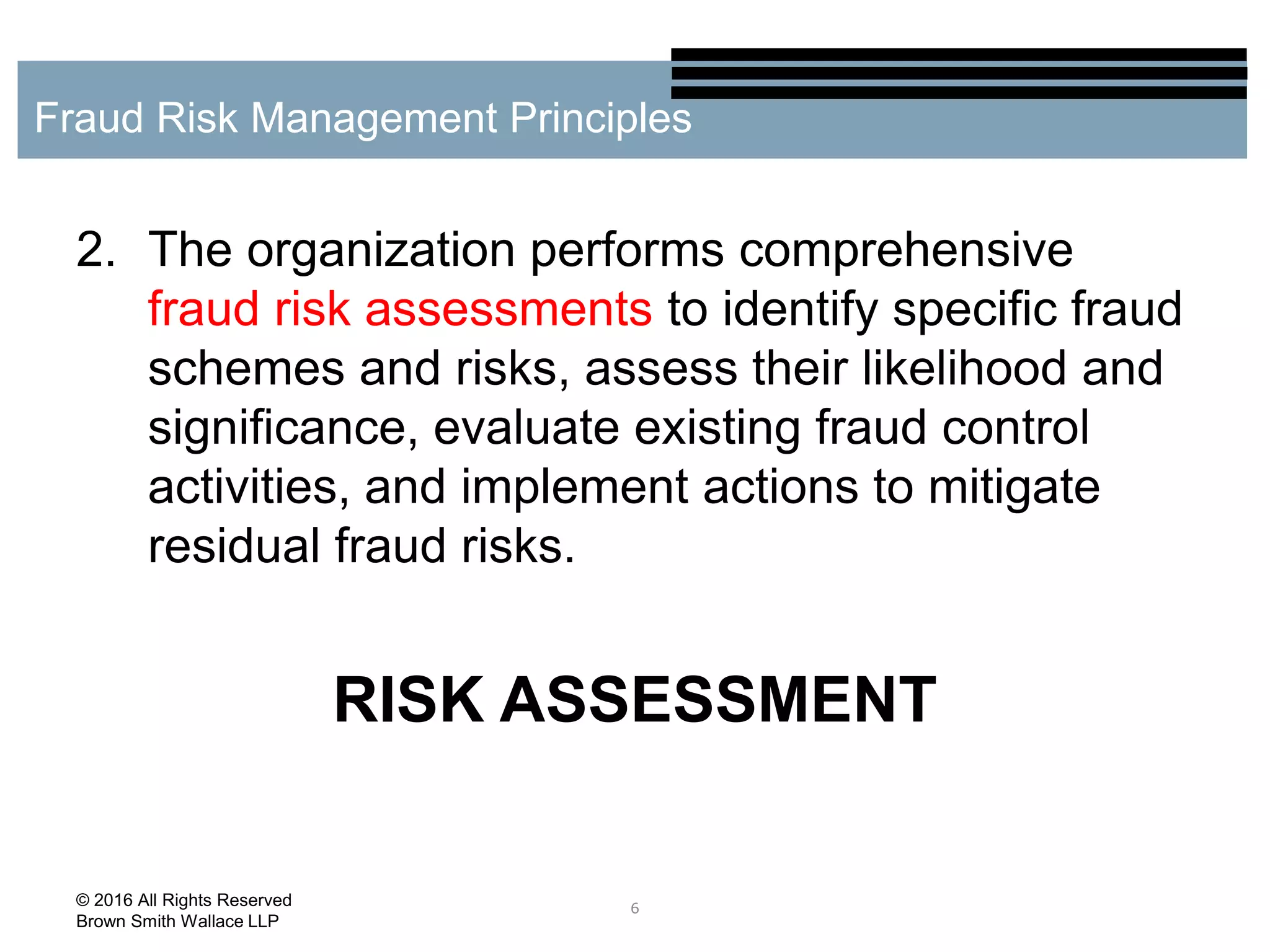
2. The organization performs comprehensive
fraud risk assessments to identify specific fraud
schemes and risks, assess their likelihood and
significance, evaluate existing fraud control
activities, and implement actions to mitigate
residual fraud risks.
RISK ASSESSMENT
6
Fraud Risk Management Principles
© 2016 All Rights Reserved
Brown Smith Wallace LLP
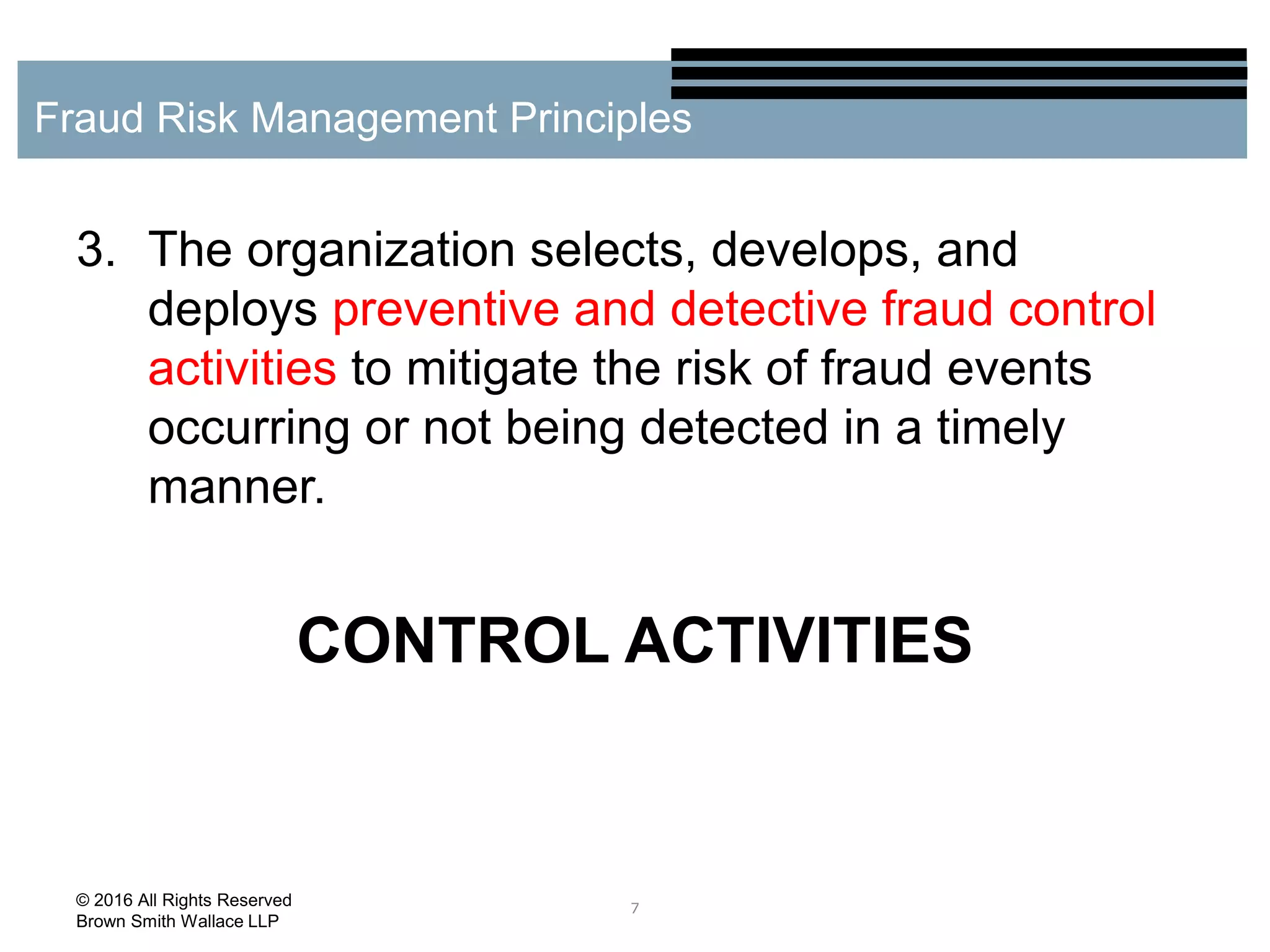
3. The organization selects, develops, and
deploys preventive and detective fraud control
activities to mitigate the risk of fraud events
occurring or not being detected in a timely
manner.
CONTROL ACTIVITIES
7
Fraud Risk Management Principles
© 2016 All Rights Reserved
Brown Smith Wallace LLP
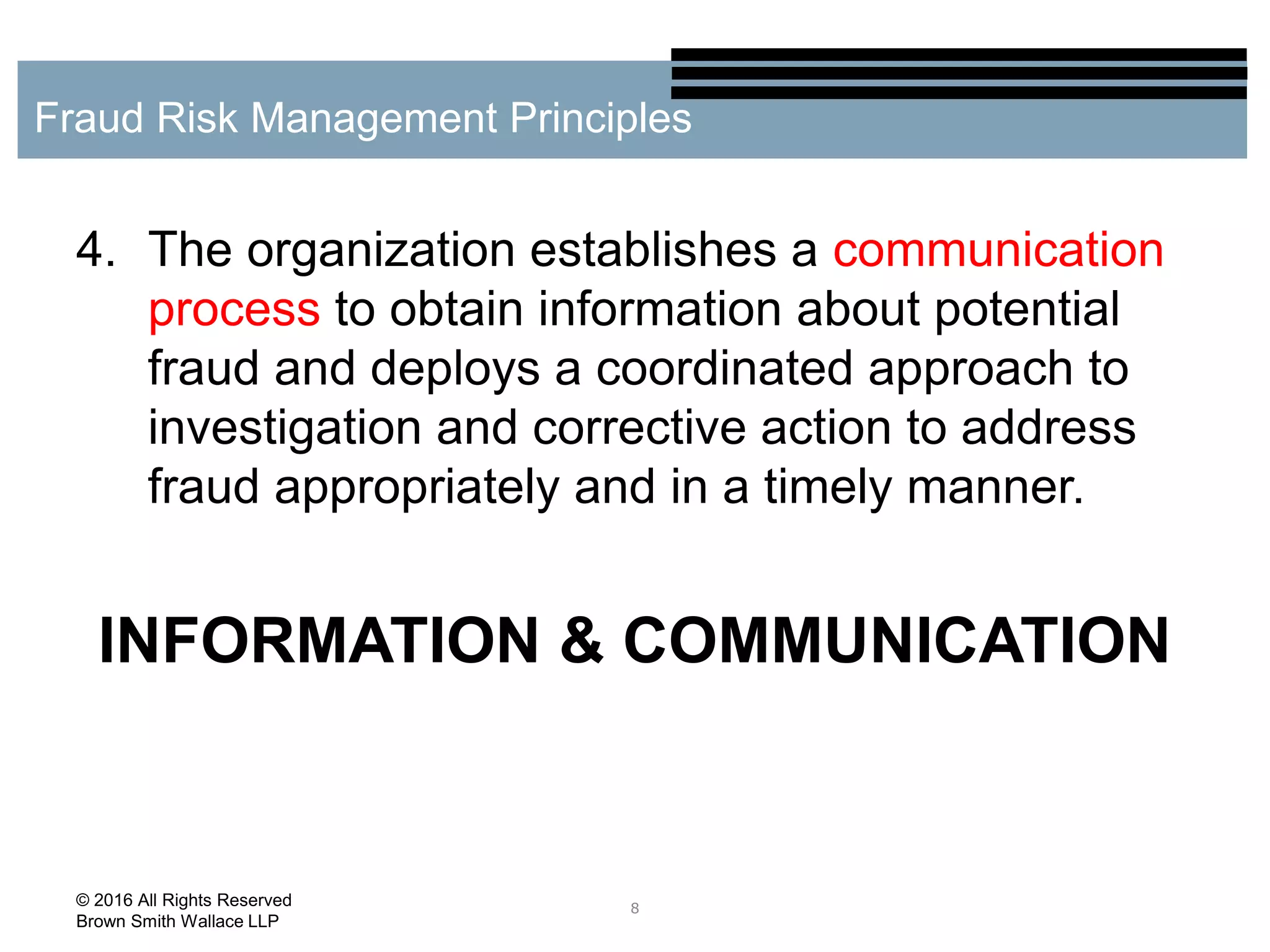
4. The organization establishes a communication
process to obtain information about potential
fraud and deploys a coordinated approach to
investigation and corrective action to address
fraud appropriately and in a timely manner.
INFORMATION & COMMUNICATION
8
Fraud Risk Management Principles
© 2016 All Rights Reserved
Brown Smith Wallace LLP
5. The organization selects, develops, an
performs ongoing evaluations to ascertain
whether each of the five principles of fraud risk
management is present and functioning and
communicates Fraud Risk Management
Program deficiencies in a timely manner to
parties responsible for taking corrective action,
including senior management and the board.
MONITORING ACTIVITIES
9
Fraud Risk Management Principles
© 2016 All Rights Reserved
Brown Smith Wallace LLP
• Data analytics is addressed as a Point of Focus
within the Fraud Risk Management Principles.
Use data analytics for fraud risk assessment and
response.
Use proactive data analytic procedures to identify
transactions or events for further investigation.
• Appendix E of the COSO Fraud Risk
Management Guide covers the use of data
analytics in fraud risk management.
10
What Does This Have to Do With Data Analytics?
© 2016 All Rights Reserved
Brown Smith Wallace LLP
© 2016 All Rights Reserved 11 Brown Smith Wallace LLP
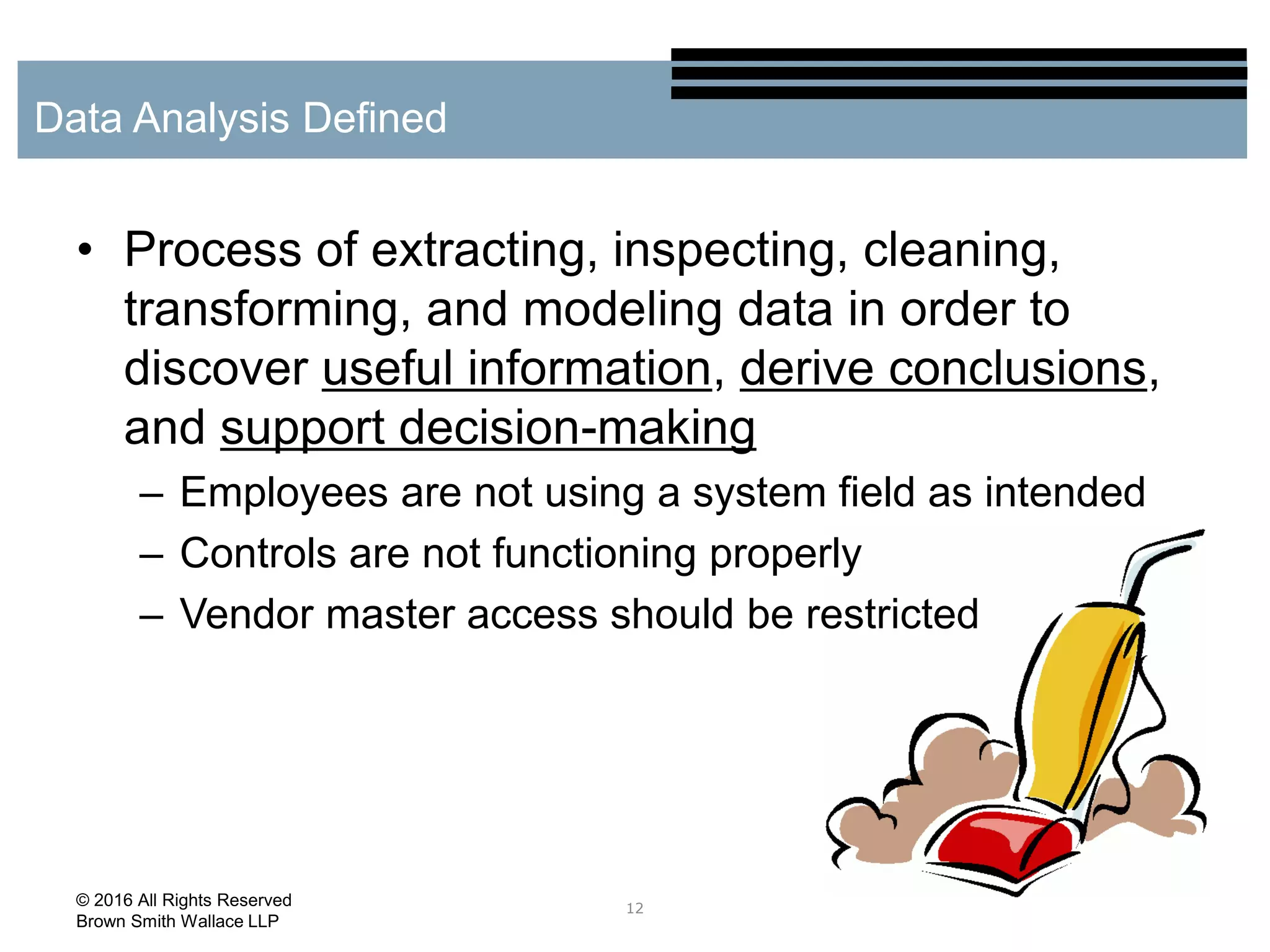
• Process of extracting, inspecting, cleaning,
transforming, and modeling data in order to
discover useful information, derive conclusions,
and support decision-making
– Employees are not using a system field as intended
– Controls are not functioning properly
– Vendor master access should be restricted
12
Data Analysis Defined
© 2016 All Rights Reserved
Brown Smith Wallace LLP
© 2016 All Rights Reserved 13 Brown Smith Wallace LLP
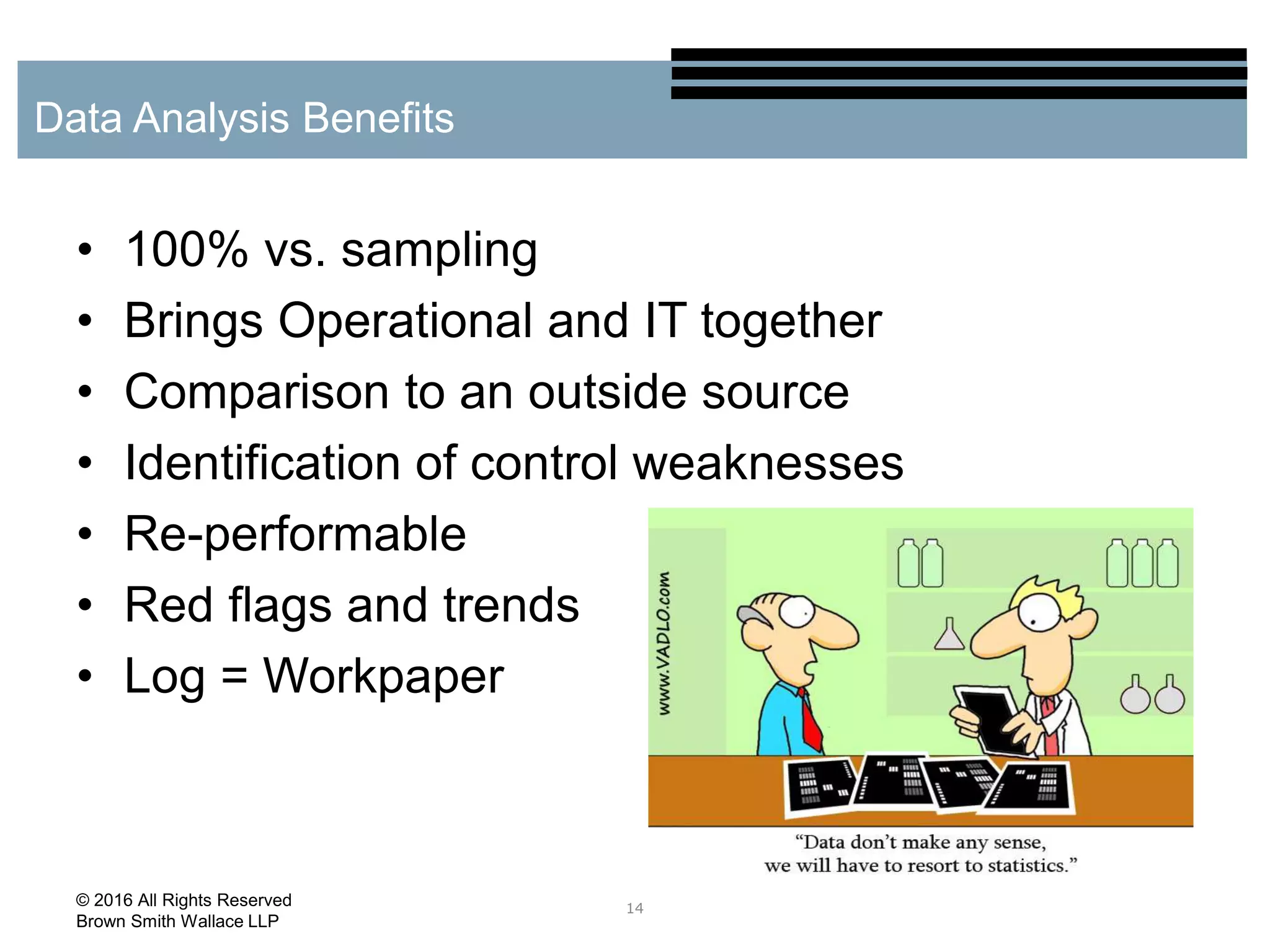
• 100% vs. sampling
• Brings Operational and IT together
• Comparison to an outside source
• Identification of control weaknesses
• Re-performable
• Red flags and trends
• Log = Workpaper
14
Data Analysis Benefits
© 2016 All Rights Reserved
Brown Smith Wallace LLP
15
Challenges
© 2016 All Rights Reserved
Brown Smith Wallace LLP
Overall
•Employee Resources
• Limited know how
• Analysis is most effective with good business,
process, and system knowledge
• Check the box mentality
•What is Success?
•Technology Choices
•Boiling the Ocean
Data Quality and Availability
• Lack of access
• Disparate systems
• Weak system controls lead to bad data
• Bad data leads to bad information
• Integrity tests:
• Corruption
• Completeness
• Uniqueness
• Logical relationships
• Proper boundaries
16
Challenges
© 2016 All Rights Reserved
Brown Smith Wallace LLP
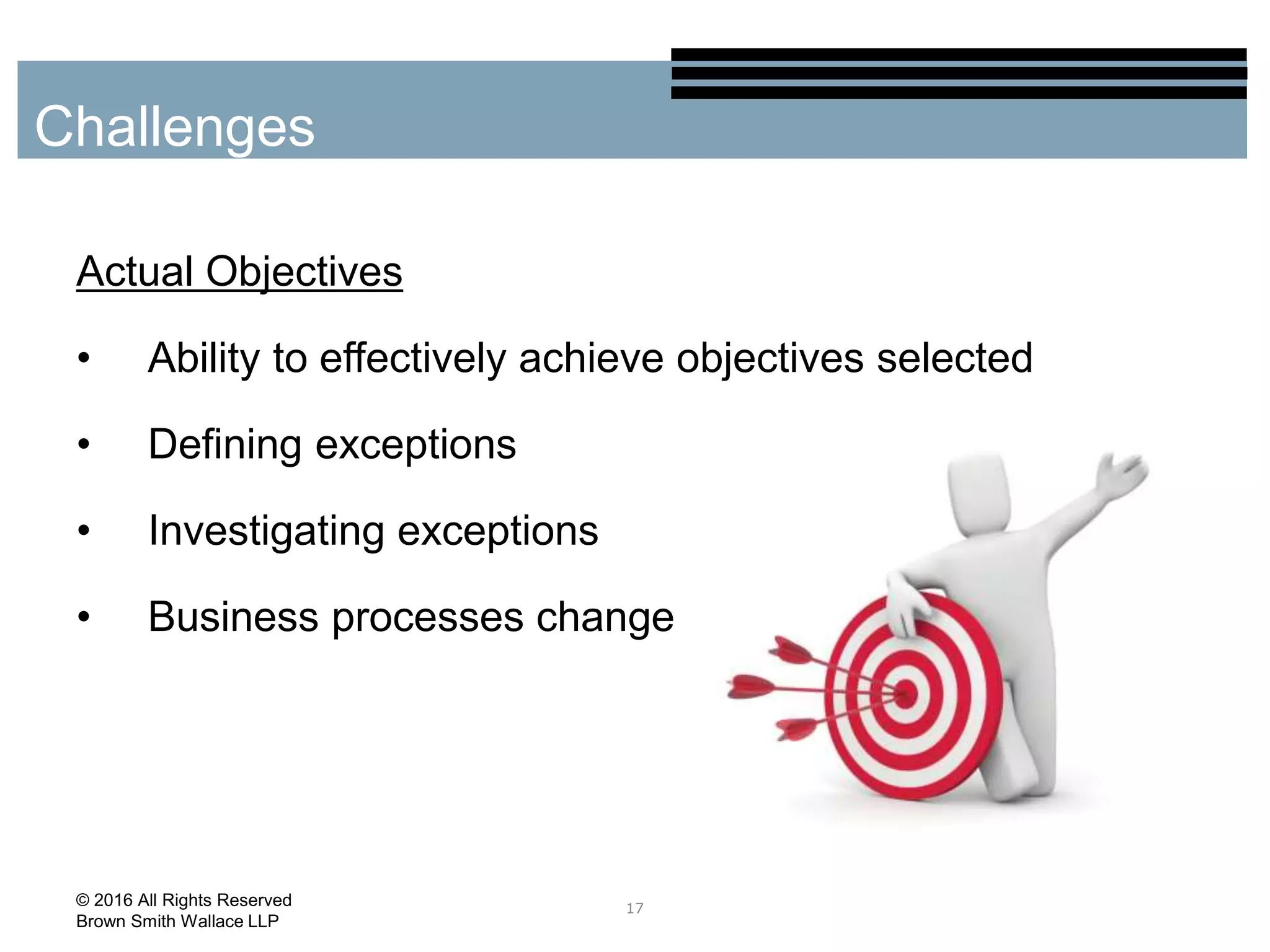
Actual Objectives
• Ability to effectively achieve objectives selected
• Defining exceptions
• Investigating exceptions
• Business processes change
17
Challenges
© 2016 All Rights Reserved
Brown Smith Wallace LLP
© 2016 All Rights Reserved 18 Brown Smith Wallace LLP
• The AICPA has said that use of technological
improvements in Audit have been incremental rather
than transformative
• To advance data analytics in Internal Audit
– Data analytics must be part of the mission
– Funding must be available to buy the tools and provide training
– Auditors must learn the appropriate skills
– Time must be budgeted and allocated
– The data must be readily available
– The data must be accurate
19
Data Surveys
© 2016 All Rights Reserved
Brown Smith Wallace LLP
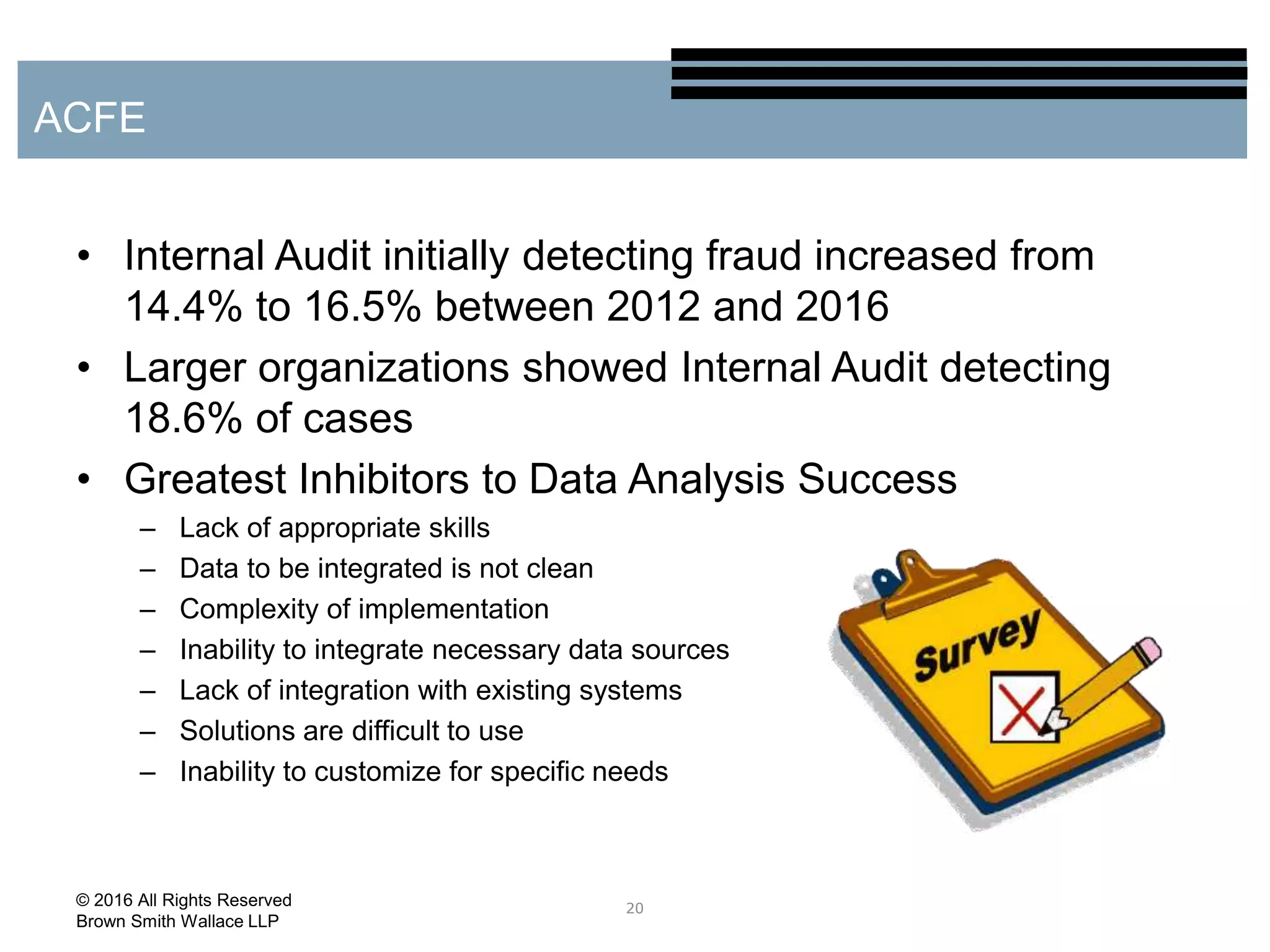
• Internal Audit initially detecting fraud increased from
14.4% to 16.5% between 2012 and 2016
• Larger organizations showed Internal Audit detecting
18.6% of cases
• Greatest Inhibitors to Data Analysis Success
– Lack of appropriate skills
– Data to be integrated is not clean
– Complexity of implementation
– Inability to integrate necessary data sources
– Lack of integration with existing systems
– Solutions are difficult to use
– Inability to customize for specific needs
20
ACFE
© 2016 All Rights Reserved
Brown Smith Wallace LLP
“Not auditing the data in your company’s ERP system wastes the
amount of money and time spent implementing it.”
“Analysts can’t just be good at scripting, they have to be able to identify
risks, interpret results, and audit exceptions.”
“None of the technologies understand relationships, business changes,
or critical thinking. The Human factor will always be there. You will
never set it and forget it.”
“Everything IT serves the business and is not just an IT risk.”
“In 10 years, computers will do all of this and humans won’t be
needed.”
21
Recent Conferences
© 2016 All Rights Reserved
Brown Smith Wallace LLP
“Analytics should be used to add, drop, and accelerate audits in the
audit plan. It should not be a document updated yearly.”
“Coordination between Compliance and Internal Audit to share data
and coordinate schedules will increase everyone’s effectiveness.”
“Data analysis is worth the effort. So much to gain. Hang in there.”
“Every control review can have a fraud focus with data analytics and
the right auditors.”
Intelligence should not be acquired just for the sake of integrating more
data; the strategic focus should be on ‘acquiring intelligence with a
purpose’.”
22
Recent Conferences
© 2016 All Rights Reserved
Brown Smith Wallace LLP
© 2016 All Rights Reserved 23 Brown Smith Wallace LLP
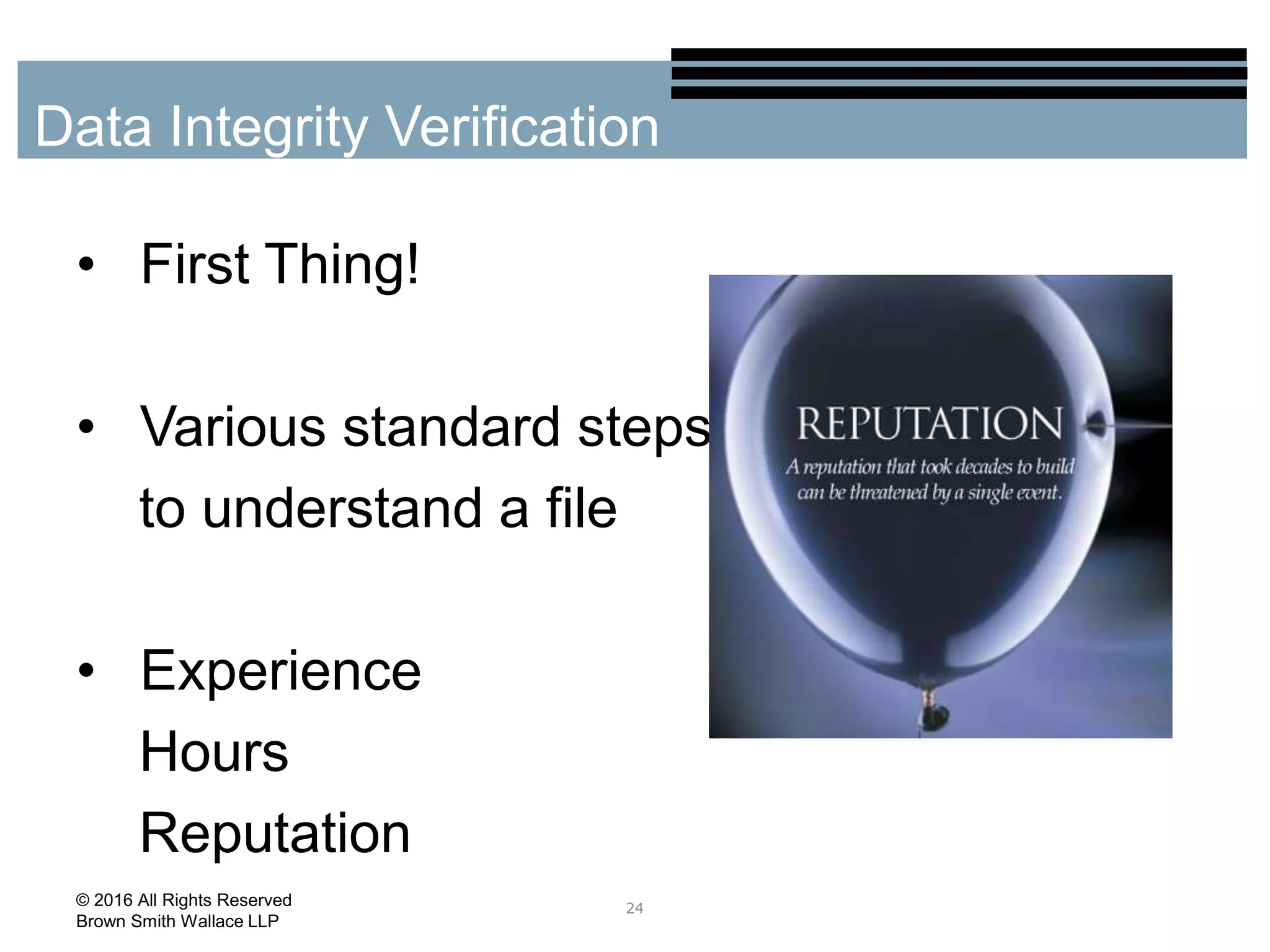
• First Thing!
• Various standard steps
to understand a file
• Experience
Hours
Reputation
24
Data Integrity Verification
© 2016 All Rights Reserved
Brown Smith Wallace LLP
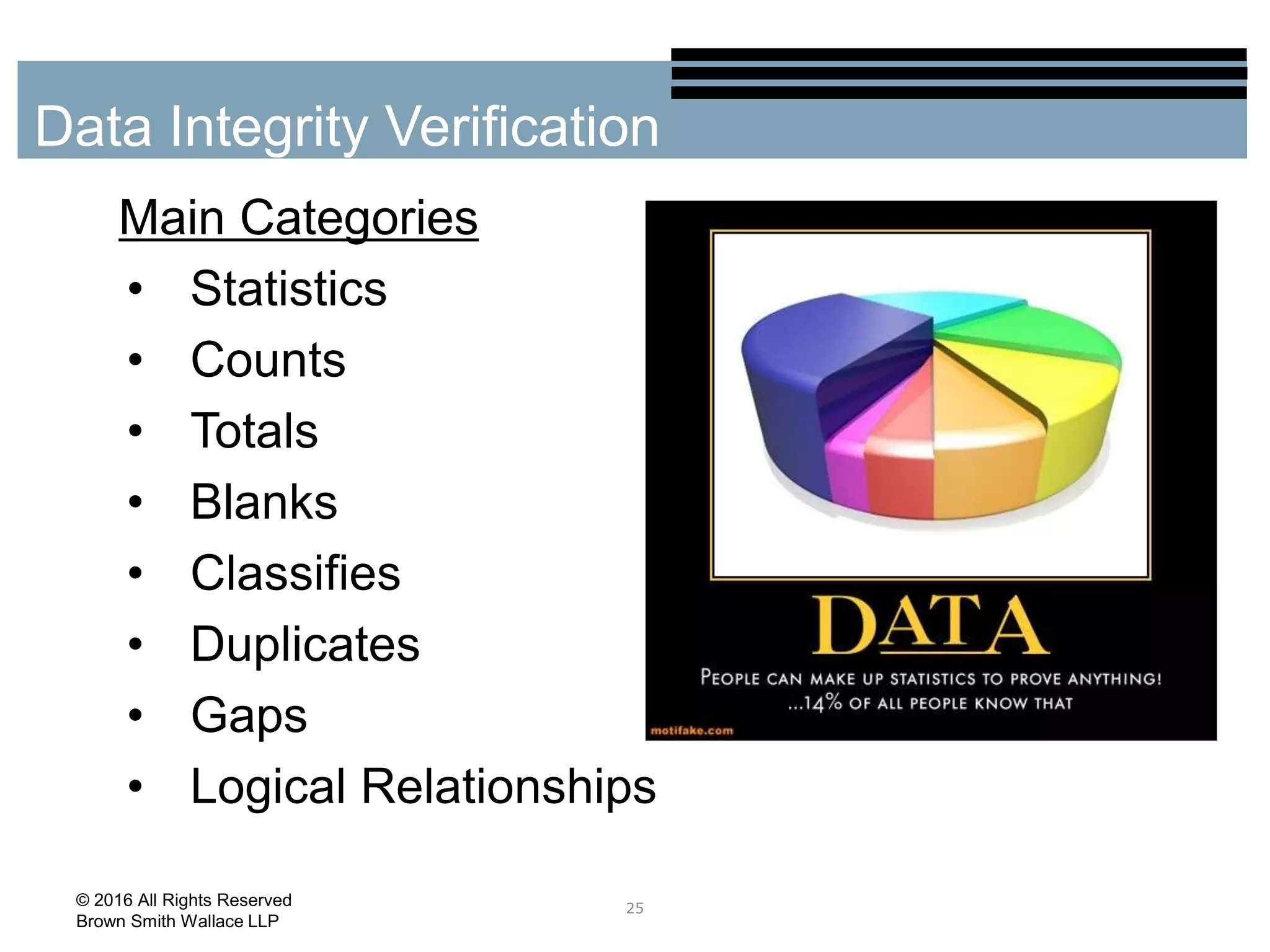
Main Categories
• Statistics
• Counts
• Totals
• Blanks
• Classifies
• Duplicates
• Gaps
• Logical Relationships
25
Data Integrity Verification
© 2016 All Rights Reserved
Brown Smith Wallace LLP
Ghost Employee red flags
• Duplicate addresses, routing numbers, SSNs
• Employee record has been accessed/edited by one person
• HR compared v. Payroll v. other systems
• No withholdings or deductions
• No vacation or sick time
• No overtime for hourly
• Blank fields
• PO Box
26
Payroll
© 2016 All Rights Reserved
Brown Smith Wallace LLP
Payment Red Flags
• Frequent changes to bank numbers
• Terminated employees with current pay
• Employees with multiple bank accounts
• Bank accounts with multiple employees
• Excessive Overtime
27
Payroll Continued
© 2016 All Rights Reserved
Brown Smith Wallace LLP
Process Red Flags
• Segregation of duties
• Date Comparisons
• Quantity Comparisons
• Amount Comparison
28
Accounts Payable
© 2016 All Rights Reserved
Brown Smith Wallace LLP
Employee / Vendor Red Flags
• Same name
• Matching addresses or
routing numbers
• Last name or Initials as part
of vendor name
• Disclosure and emergency
contact comparison
29
AP Continued
© 2016 All Rights Reserved
Brown Smith Wallace LLP
Vendor Red Flags
• Same vendor with different vendor number
• Vendor type does not match vendor spend
• Vendor type does not match purchaser
• Frequent or Inappropriate changes
• Inactive vendor with activity
• Unusual payment terms
• PO Box or no address
• One-time vendors
30
AP Continued
© 2016 All Rights Reserved
Brown Smith Wallace LLP
Payable Red Flags
• Frequent or Inappropriate changes
• Single payment run
• Payment runs at unusual times
• Checks to different address than master
• Invoice and check sequence
31
AP Continued
© 2016 All Rights Reserved
Brown Smith Wallace LLP
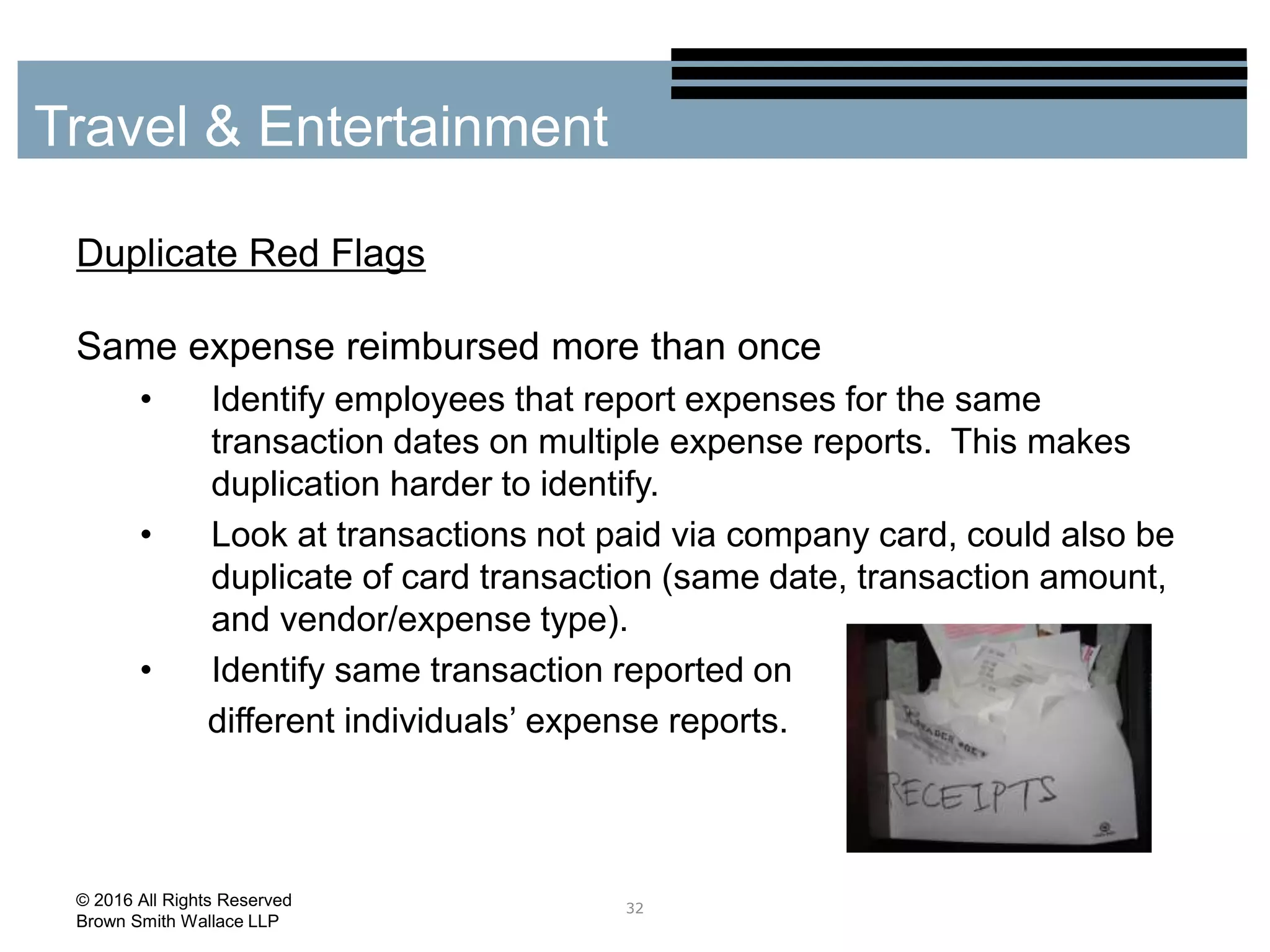
Duplicate Red Flags
Same expense reimbursed more than once
• Identify employees that report expenses for the same
transaction dates on multiple expense reports. This makes
duplication harder to identify.
• Look at transactions not paid via company card, could also be
duplicate of card transaction (same date, transaction amount,
and vendor/expense type).
• Identify same transaction reported on
different individuals’ expense reports.
32
Travel & Entertainment
© 2016 All Rights Reserved
Brown Smith Wallace LLP
Other Red Flags
• Unexpected dates, vendor names, individual names, or
keywords
• Round dollars (gift cards, cash)
• Employees who have more than the average quantity or
amount of transactions in higher risk or specific expense
categories.
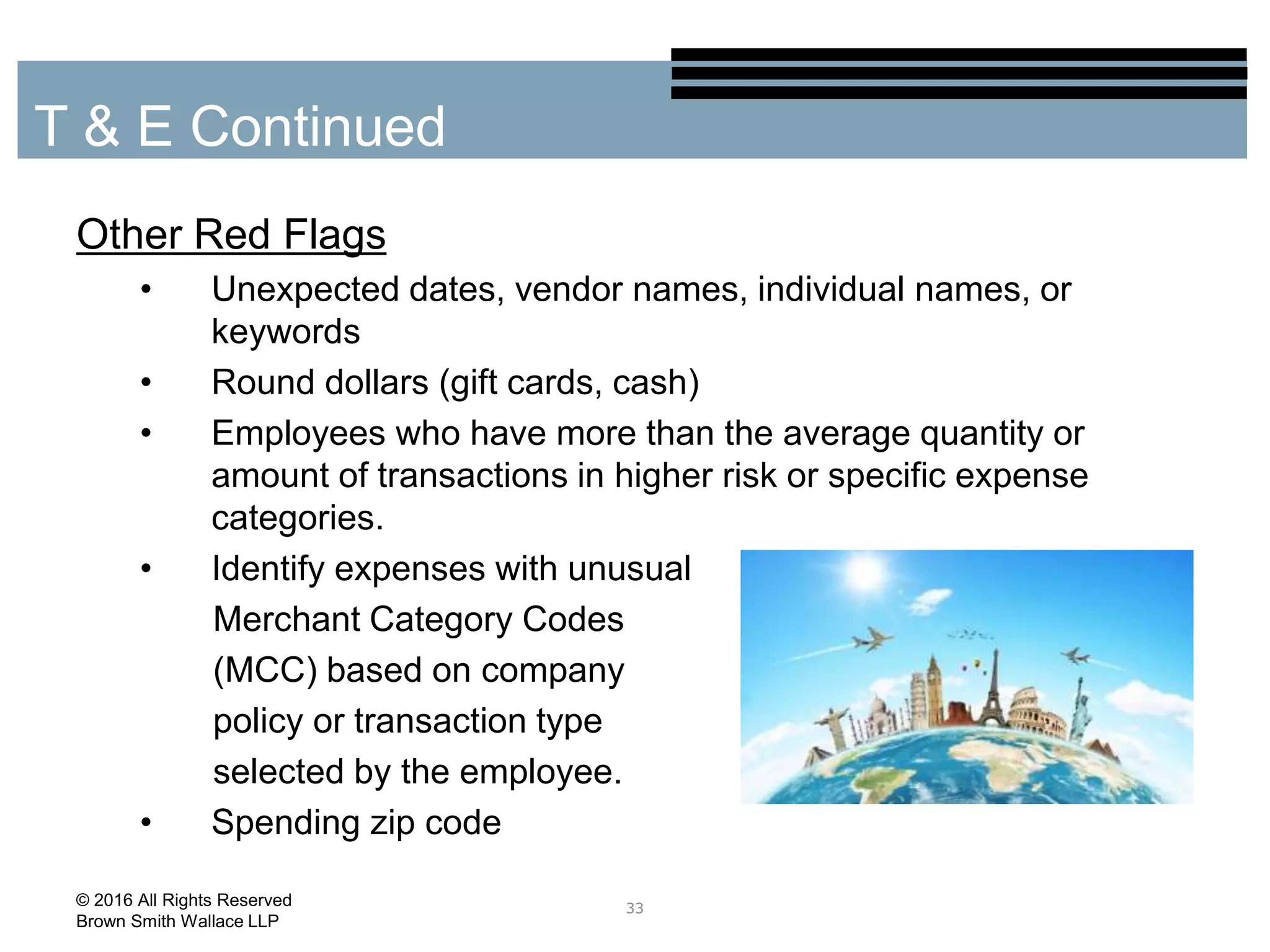
• Identify expenses with unusual
Merchant Category Codes
(MCC) based on company
policy or transaction type
selected by the employee.
• Spending zip code
33
T & E Continued
© 2016 All Rights Reserved
Brown Smith Wallace LLP
Other Red Flags
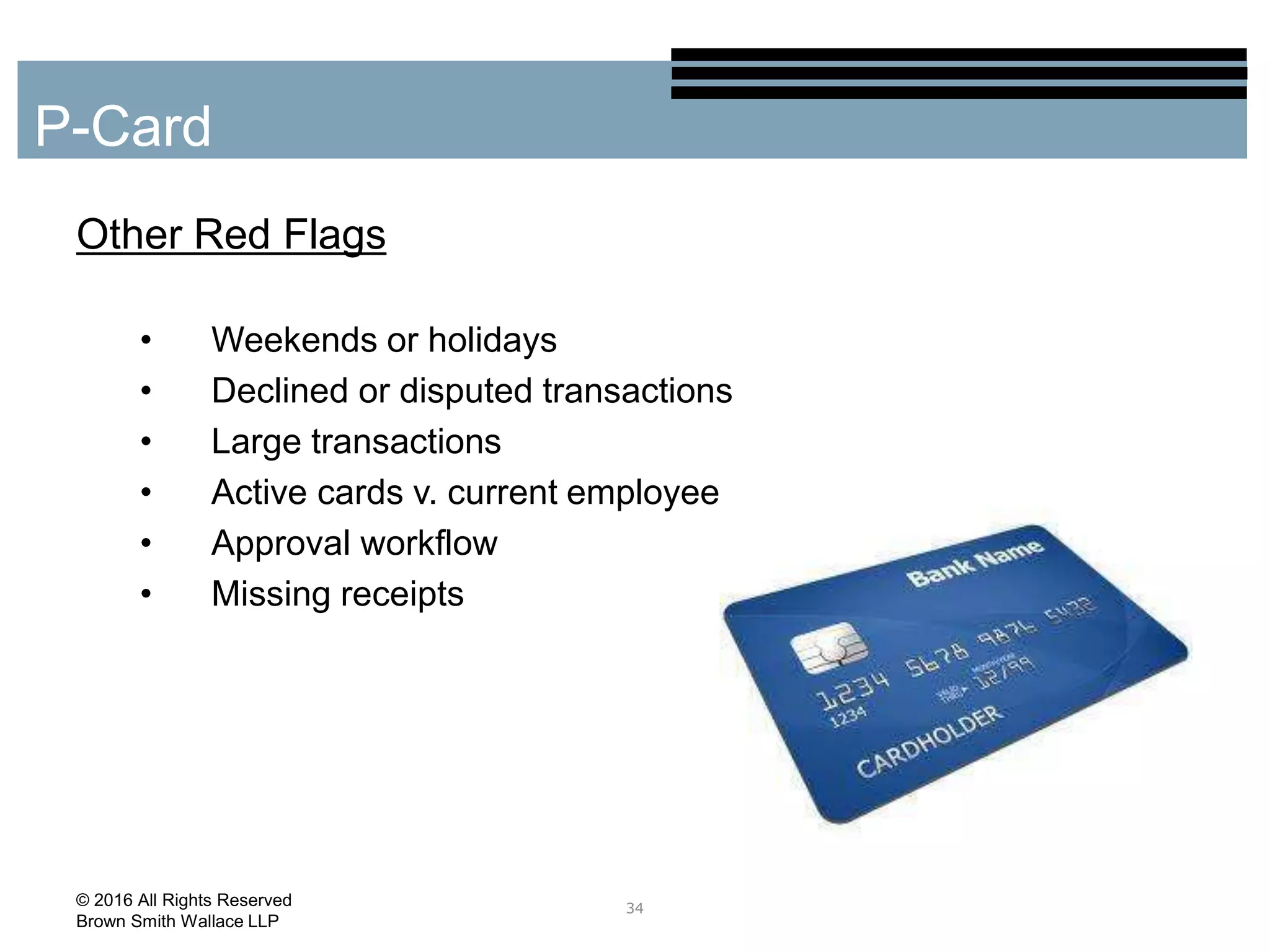
• Weekends or holidays
• Declined or disputed transactions
• Large transactions
• Active cards v. current employee
• Approval workflow
• Missing receipts
34
P-Card
© 2016 All Rights Reserved
Brown Smith Wallace LLP
Foreign Corrupt Practices Act
• It is unlawful to make a corrupt payment to a foreign official for
the purpose of influencing the official in order to assist in
obtaining/retaining business
• Companies who file reports with the SEC must maintain
records that accurately reflect transactions and the nature and
quantity of corporate assets and liabilities
• Yates memo made it personal
• Lower fines by making corruption as
difficult to perpetrate as you can
35
FCPA
© 2016 All Rights Reserved
Brown Smith Wallace LLP
Other Red Flags
• Names and addresses on the SAM list, etc.
• Keyword search in payables, general ledger, P-Cards, T&E
• Journal entries with unexpected account combinations of
accounts (e.g. debit to sales/credit to cash)
• Analyze sales and commission information
• Identify payroll, travel advances, or
travel reimbursements to non-employee
• Test currency exchange expectations
• Purchasing costs
36
FCPA
© 2016 All Rights Reserved
Brown Smith Wallace LLP
© 2016 All Rights Reserved 37 Brown Smith Wallace LLP
What data analysis procedures can we utilize
to help identify a fraud where employees
create approximately 2 million fake
bank/credit card accounts?
38
Question???
© 2016 All Rights Reserved
Brown Smith Wallace LLP
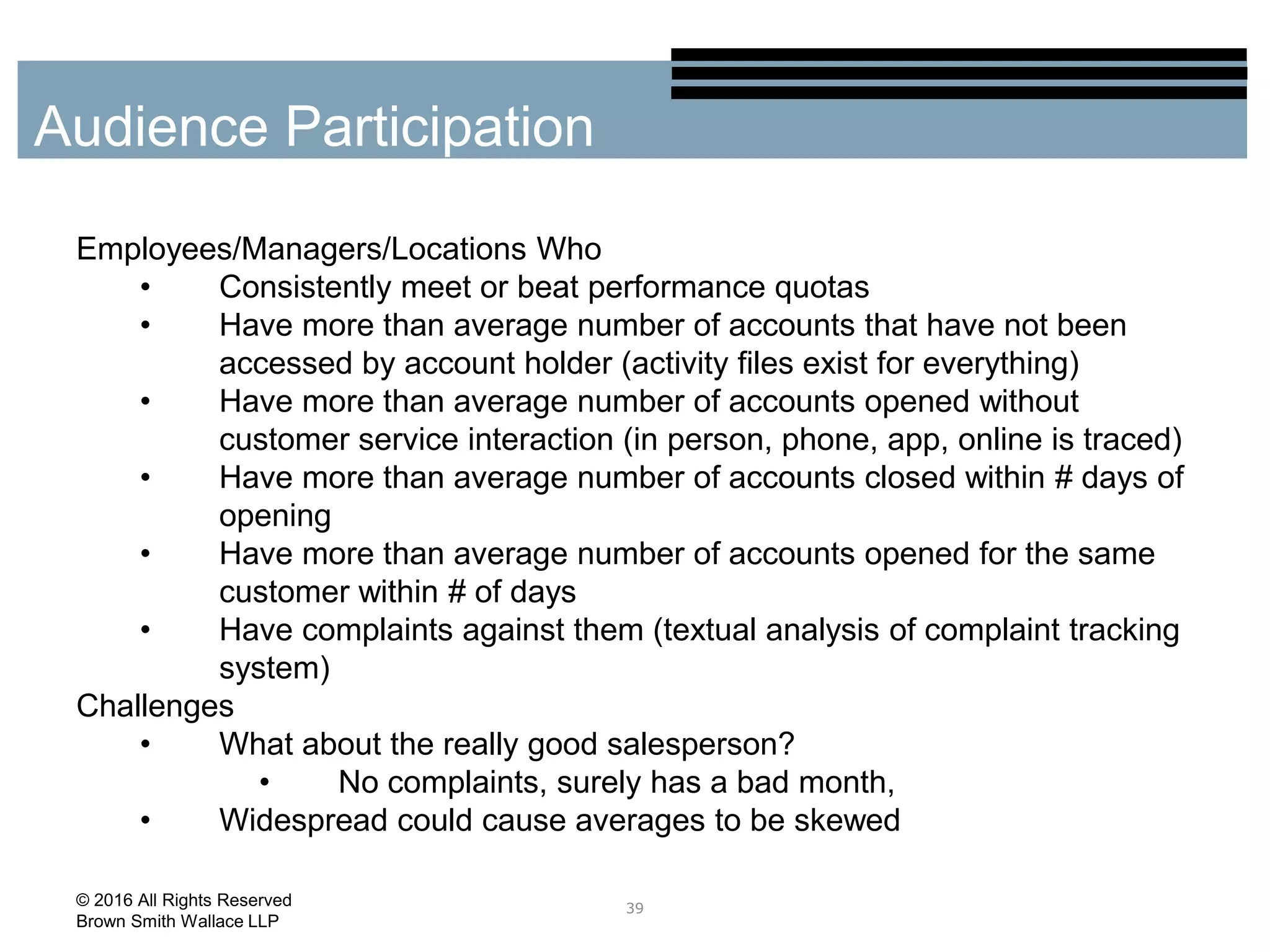
Employees/Managers/Locations Who
• Consistently meet or beat performance quotas
• Have more than average number of accounts that have not been
accessed by account holder (activity files exist for everything)
• Have more than average number of accounts opened without
customer service interaction (in person, phone, app, online is traced)
• Have more than average number of accounts closed within # days of
opening
• Have more than average number of accounts opened for the same
customer within # of days
• Have complaints against them (textual analysis of complaint tracking
system)
Challenges
• What about the really good salesperson?
• No complaints, surely has a bad month,
• Widespread could cause averages to be skewed
39
Audience Participation
© 2016 All Rights Reserved
Brown Smith Wallace LLP
• Fraud is not going away and we need to devise better
methods to prevent and detect it as early as possible.
• The new COSO Fraud Risk Management Guide encourages
the use of data analytics.
• Data analysis is a great preventative and detective control for
fraud.
• If people think you are watching, they are less likely to try to
commit fraud
• Payroll, P2P, T&E, and FCPA are great places to start
• Hindsight is 20/20, but it can be applied to the future.
40
In Summary
© 2016 All Rights Reserved
Brown Smith Wallace LLP
Any Questions?
Ron Steinkamp | rsteinkamp@bswllc.com | 314-983-1238
Joe Montes | jmontes@bswllc.com | 314-983-1380
41
A Measurable Difference
© 2016 All Rights Reserved
Brown Smith Wallace LLP
6 CityPlace Drive, Suite 900│ St. Louis, Missouri 63141 │ 314.983.1200
1520 S. Fifth St., Suite 309 │ St. Charles, Missouri 63303 │ 636.255.3000
2220 S. State Route 157, Ste. 300 │ Glen Carbon, Illinois 62034 │ 618.654.3100
1.888.279.2792 │ bswllc.com
Brown Smith Wallace is a Missouri Limited Liability Partnership

2016 MSCPA Fraud Conference Presentation

  • 1.
    Using Data Analytics toFind Fraud Indicators Ron Steinkamp Joe Montes November 30, 2016
  • 2.
    • COSO FraudRisk Management • What is Data Analysis? • Data Analysis Benefits & Challenges • Perspectives on Data Analysis • Using Data Analysis to Find Fraud Indicators • Exercise 2 Agenda © 2016 All Rights Reserved Brown Smith Wallace LLP
  • 3.
    © 2016 AllRights Reserved 3 Brown Smith Wallace LLP
  • 4.
    • COSO issuedFraud Risk Management Guide. • Guidance on how to deter fraud. • 5 Fraud Risk Management Principles. • Aligned with the COSO Framework Components and Principles. • Further detailed in Points of Focus related to each Principle. • Can be used as a starting point to develop a Fraud Risk Management Program. 4 COSO Fraud Risk Management Guide © 2016 All Rights Reserved Brown Smith Wallace LLP
  • 5.
    1. The organizationestablishes and communicates a Fraud Risk Management Program that demonstrates the expectations of the board of directors and senior management and their commitment to high integrity and ethical values regarding managing fraud risk. CONTROL ENVIRONMENT 5 Fraud Risk Management Principles © 2016 All Rights Reserved Brown Smith Wallace LLP
  • 6.
    2. The organizationperforms comprehensive fraud risk assessments to identify specific fraud schemes and risks, assess their likelihood and significance, evaluate existing fraud control activities, and implement actions to mitigate residual fraud risks. RISK ASSESSMENT 6 Fraud Risk Management Principles © 2016 All Rights Reserved Brown Smith Wallace LLP
  • 7.
    3. The organizationselects, develops, and deploys preventive and detective fraud control activities to mitigate the risk of fraud events occurring or not being detected in a timely manner. CONTROL ACTIVITIES 7 Fraud Risk Management Principles © 2016 All Rights Reserved Brown Smith Wallace LLP
  • 8.
    4. The organizationestablishes a communication process to obtain information about potential fraud and deploys a coordinated approach to investigation and corrective action to address fraud appropriately and in a timely manner. INFORMATION & COMMUNICATION 8 Fraud Risk Management Principles © 2016 All Rights Reserved Brown Smith Wallace LLP
  • 9.
    5. The organizationselects, develops, an performs ongoing evaluations to ascertain whether each of the five principles of fraud risk management is present and functioning and communicates Fraud Risk Management Program deficiencies in a timely manner to parties responsible for taking corrective action, including senior management and the board. MONITORING ACTIVITIES 9 Fraud Risk Management Principles © 2016 All Rights Reserved Brown Smith Wallace LLP
  • 10.
    • Data analyticsis addressed as a Point of Focus within the Fraud Risk Management Principles. Use data analytics for fraud risk assessment and response. Use proactive data analytic procedures to identify transactions or events for further investigation. • Appendix E of the COSO Fraud Risk Management Guide covers the use of data analytics in fraud risk management. 10 What Does This Have to Do With Data Analytics? © 2016 All Rights Reserved Brown Smith Wallace LLP
  • 11.
    © 2016 AllRights Reserved 11 Brown Smith Wallace LLP
  • 12.
    • Process ofextracting, inspecting, cleaning, transforming, and modeling data in order to discover useful information, derive conclusions, and support decision-making – Employees are not using a system field as intended – Controls are not functioning properly – Vendor master access should be restricted 12 Data Analysis Defined © 2016 All Rights Reserved Brown Smith Wallace LLP
  • 13.
    © 2016 AllRights Reserved 13 Brown Smith Wallace LLP
  • 14.
    • 100% vs.sampling • Brings Operational and IT together • Comparison to an outside source • Identification of control weaknesses • Re-performable • Red flags and trends • Log = Workpaper 14 Data Analysis Benefits © 2016 All Rights Reserved Brown Smith Wallace LLP
  • 15.
    15 Challenges © 2016 AllRights Reserved Brown Smith Wallace LLP Overall •Employee Resources • Limited know how • Analysis is most effective with good business, process, and system knowledge • Check the box mentality •What is Success? •Technology Choices •Boiling the Ocean
  • 16.
    Data Quality andAvailability • Lack of access • Disparate systems • Weak system controls lead to bad data • Bad data leads to bad information • Integrity tests: • Corruption • Completeness • Uniqueness • Logical relationships • Proper boundaries 16 Challenges © 2016 All Rights Reserved Brown Smith Wallace LLP
  • 17.
    Actual Objectives • Abilityto effectively achieve objectives selected • Defining exceptions • Investigating exceptions • Business processes change 17 Challenges © 2016 All Rights Reserved Brown Smith Wallace LLP
  • 18.
    © 2016 AllRights Reserved 18 Brown Smith Wallace LLP
  • 19.
    • The AICPAhas said that use of technological improvements in Audit have been incremental rather than transformative • To advance data analytics in Internal Audit – Data analytics must be part of the mission – Funding must be available to buy the tools and provide training – Auditors must learn the appropriate skills – Time must be budgeted and allocated – The data must be readily available – The data must be accurate 19 Data Surveys © 2016 All Rights Reserved Brown Smith Wallace LLP
  • 20.
    • Internal Auditinitially detecting fraud increased from 14.4% to 16.5% between 2012 and 2016 • Larger organizations showed Internal Audit detecting 18.6% of cases • Greatest Inhibitors to Data Analysis Success – Lack of appropriate skills – Data to be integrated is not clean – Complexity of implementation – Inability to integrate necessary data sources – Lack of integration with existing systems – Solutions are difficult to use – Inability to customize for specific needs 20 ACFE © 2016 All Rights Reserved Brown Smith Wallace LLP
  • 21.
    “Not auditing thedata in your company’s ERP system wastes the amount of money and time spent implementing it.” “Analysts can’t just be good at scripting, they have to be able to identify risks, interpret results, and audit exceptions.” “None of the technologies understand relationships, business changes, or critical thinking. The Human factor will always be there. You will never set it and forget it.” “Everything IT serves the business and is not just an IT risk.” “In 10 years, computers will do all of this and humans won’t be needed.” 21 Recent Conferences © 2016 All Rights Reserved Brown Smith Wallace LLP
  • 22.
    “Analytics should beused to add, drop, and accelerate audits in the audit plan. It should not be a document updated yearly.” “Coordination between Compliance and Internal Audit to share data and coordinate schedules will increase everyone’s effectiveness.” “Data analysis is worth the effort. So much to gain. Hang in there.” “Every control review can have a fraud focus with data analytics and the right auditors.” Intelligence should not be acquired just for the sake of integrating more data; the strategic focus should be on ‘acquiring intelligence with a purpose’.” 22 Recent Conferences © 2016 All Rights Reserved Brown Smith Wallace LLP
  • 23.
    © 2016 AllRights Reserved 23 Brown Smith Wallace LLP
  • 24.
    • First Thing! •Various standard steps to understand a file • Experience Hours Reputation 24 Data Integrity Verification © 2016 All Rights Reserved Brown Smith Wallace LLP
  • 25.
    Main Categories • Statistics •Counts • Totals • Blanks • Classifies • Duplicates • Gaps • Logical Relationships 25 Data Integrity Verification © 2016 All Rights Reserved Brown Smith Wallace LLP
  • 26.
    Ghost Employee redflags • Duplicate addresses, routing numbers, SSNs • Employee record has been accessed/edited by one person • HR compared v. Payroll v. other systems • No withholdings or deductions • No vacation or sick time • No overtime for hourly • Blank fields • PO Box 26 Payroll © 2016 All Rights Reserved Brown Smith Wallace LLP
  • 27.
    Payment Red Flags •Frequent changes to bank numbers • Terminated employees with current pay • Employees with multiple bank accounts • Bank accounts with multiple employees • Excessive Overtime 27 Payroll Continued © 2016 All Rights Reserved Brown Smith Wallace LLP
  • 28.
    Process Red Flags •Segregation of duties • Date Comparisons • Quantity Comparisons • Amount Comparison 28 Accounts Payable © 2016 All Rights Reserved Brown Smith Wallace LLP
  • 29.
    Employee / VendorRed Flags • Same name • Matching addresses or routing numbers • Last name or Initials as part of vendor name • Disclosure and emergency contact comparison 29 AP Continued © 2016 All Rights Reserved Brown Smith Wallace LLP
  • 30.
    Vendor Red Flags •Same vendor with different vendor number • Vendor type does not match vendor spend • Vendor type does not match purchaser • Frequent or Inappropriate changes • Inactive vendor with activity • Unusual payment terms • PO Box or no address • One-time vendors 30 AP Continued © 2016 All Rights Reserved Brown Smith Wallace LLP
  • 31.
    Payable Red Flags •Frequent or Inappropriate changes • Single payment run • Payment runs at unusual times • Checks to different address than master • Invoice and check sequence 31 AP Continued © 2016 All Rights Reserved Brown Smith Wallace LLP
  • 32.
    Duplicate Red Flags Sameexpense reimbursed more than once • Identify employees that report expenses for the same transaction dates on multiple expense reports. This makes duplication harder to identify. • Look at transactions not paid via company card, could also be duplicate of card transaction (same date, transaction amount, and vendor/expense type). • Identify same transaction reported on different individuals’ expense reports. 32 Travel & Entertainment © 2016 All Rights Reserved Brown Smith Wallace LLP
  • 33.
    Other Red Flags •Unexpected dates, vendor names, individual names, or keywords • Round dollars (gift cards, cash) • Employees who have more than the average quantity or amount of transactions in higher risk or specific expense categories. • Identify expenses with unusual Merchant Category Codes (MCC) based on company policy or transaction type selected by the employee. • Spending zip code 33 T & E Continued © 2016 All Rights Reserved Brown Smith Wallace LLP
  • 34.
    Other Red Flags •Weekends or holidays • Declined or disputed transactions • Large transactions • Active cards v. current employee • Approval workflow • Missing receipts 34 P-Card © 2016 All Rights Reserved Brown Smith Wallace LLP
  • 35.
    Foreign Corrupt PracticesAct • It is unlawful to make a corrupt payment to a foreign official for the purpose of influencing the official in order to assist in obtaining/retaining business • Companies who file reports with the SEC must maintain records that accurately reflect transactions and the nature and quantity of corporate assets and liabilities • Yates memo made it personal • Lower fines by making corruption as difficult to perpetrate as you can 35 FCPA © 2016 All Rights Reserved Brown Smith Wallace LLP
  • 36.
    Other Red Flags •Names and addresses on the SAM list, etc. • Keyword search in payables, general ledger, P-Cards, T&E • Journal entries with unexpected account combinations of accounts (e.g. debit to sales/credit to cash) • Analyze sales and commission information • Identify payroll, travel advances, or travel reimbursements to non-employee • Test currency exchange expectations • Purchasing costs 36 FCPA © 2016 All Rights Reserved Brown Smith Wallace LLP
  • 37.
    © 2016 AllRights Reserved 37 Brown Smith Wallace LLP
  • 38.
    What data analysisprocedures can we utilize to help identify a fraud where employees create approximately 2 million fake bank/credit card accounts? 38 Question??? © 2016 All Rights Reserved Brown Smith Wallace LLP
  • 39.
    Employees/Managers/Locations Who • Consistentlymeet or beat performance quotas • Have more than average number of accounts that have not been accessed by account holder (activity files exist for everything) • Have more than average number of accounts opened without customer service interaction (in person, phone, app, online is traced) • Have more than average number of accounts closed within # days of opening • Have more than average number of accounts opened for the same customer within # of days • Have complaints against them (textual analysis of complaint tracking system) Challenges • What about the really good salesperson? • No complaints, surely has a bad month, • Widespread could cause averages to be skewed 39 Audience Participation © 2016 All Rights Reserved Brown Smith Wallace LLP
  • 40.
    • Fraud isnot going away and we need to devise better methods to prevent and detect it as early as possible. • The new COSO Fraud Risk Management Guide encourages the use of data analytics. • Data analysis is a great preventative and detective control for fraud. • If people think you are watching, they are less likely to try to commit fraud • Payroll, P2P, T&E, and FCPA are great places to start • Hindsight is 20/20, but it can be applied to the future. 40 In Summary © 2016 All Rights Reserved Brown Smith Wallace LLP
  • 41.
    Any Questions? Ron Steinkamp| rsteinkamp@bswllc.com | 314-983-1238 Joe Montes | jmontes@bswllc.com | 314-983-1380 41 A Measurable Difference © 2016 All Rights Reserved Brown Smith Wallace LLP 6 CityPlace Drive, Suite 900│ St. Louis, Missouri 63141 │ 314.983.1200 1520 S. Fifth St., Suite 309 │ St. Charles, Missouri 63303 │ 636.255.3000 2220 S. State Route 157, Ste. 300 │ Glen Carbon, Illinois 62034 │ 618.654.3100 1.888.279.2792 │ bswllc.com Brown Smith Wallace is a Missouri Limited Liability Partnership