COMBATING PROCUREMENT
FRAUD
Colin M Cram FCIPS
Chief Executive Open Forum Events
Managing Director Marc1 Ltd
Colin.cram@marc1ltd.com
Tel: +44 (0)1457 239894
Mob: +44 (0)75251 49611
www.marc1ltd.com
© C M Cram FCIPS
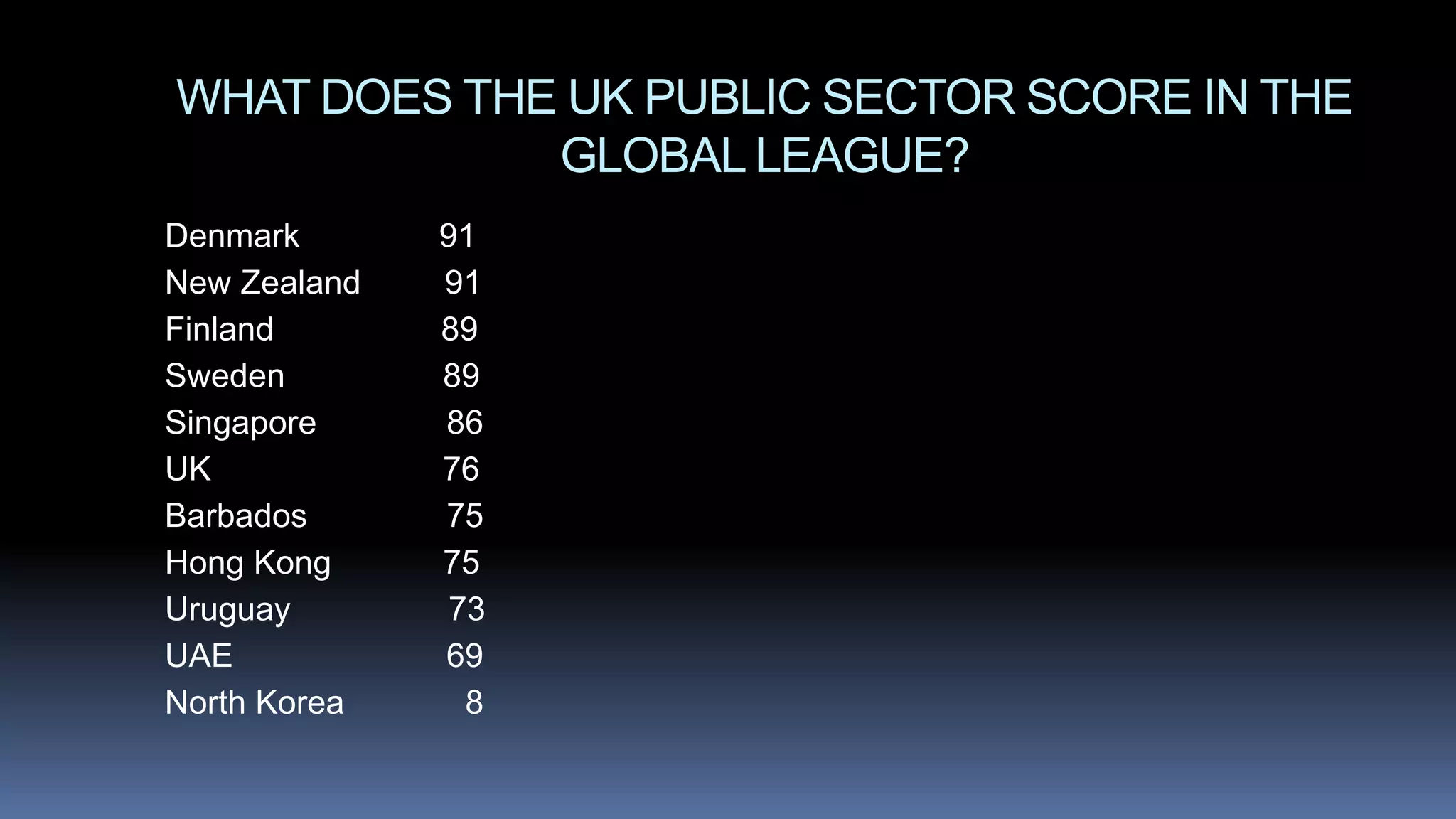
WHAT DOES THE UK PUBLIC SECTOR SCORE IN THE
GLOBAL LEAGUE?
Denmark 91
New Zealand 91
Finland 89
Sweden 89
Singapore 86
UK 76
Barbados 75
Hong Kong 75
Uruguay 73
UAE 69
North Korea 8
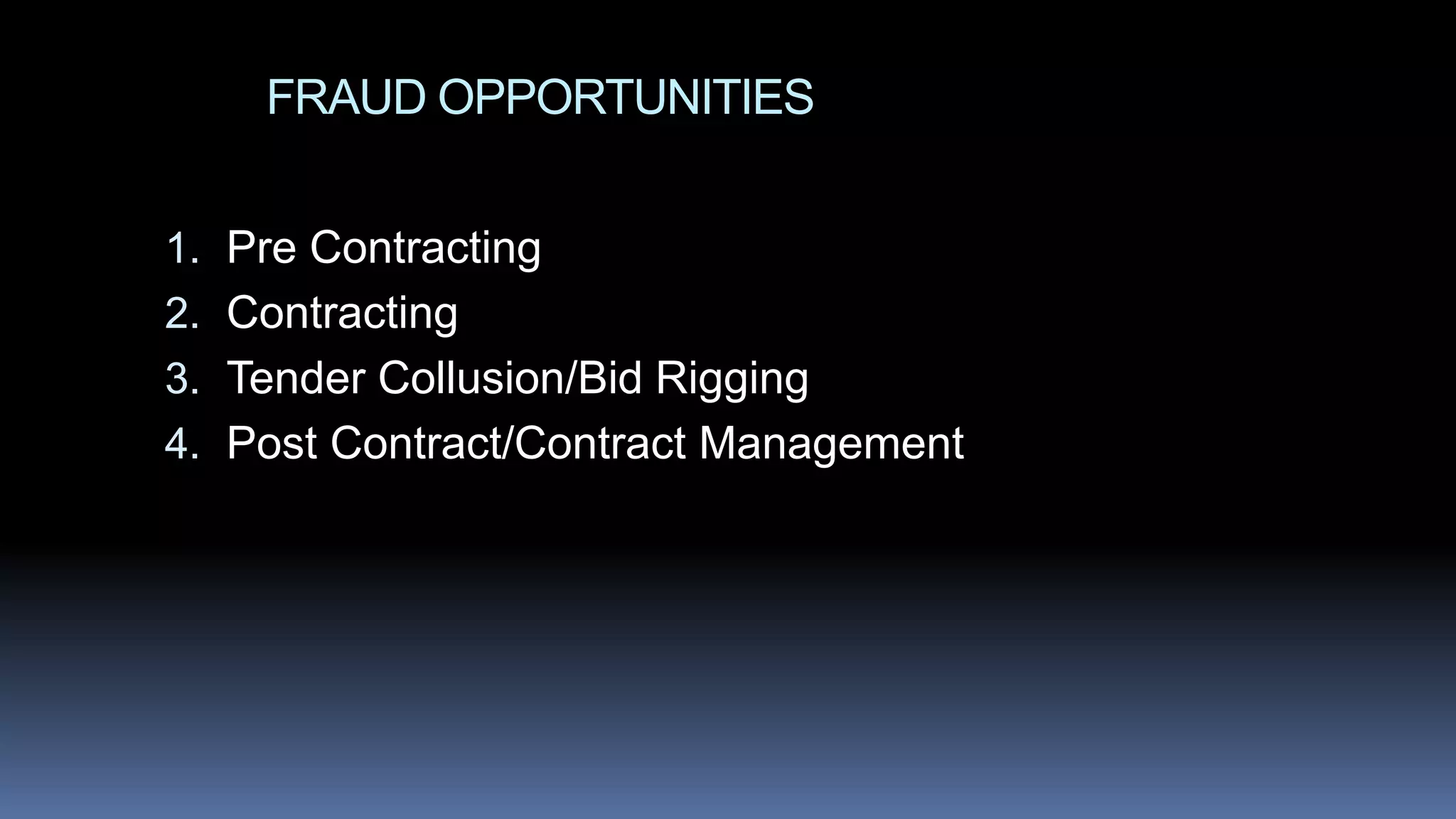
FRAUD OPPORTUNITIES
1. Pre Contracting
2. Contracting
3. Tender Collusion/Bid Rigging
4. Post Contract/Contract Management
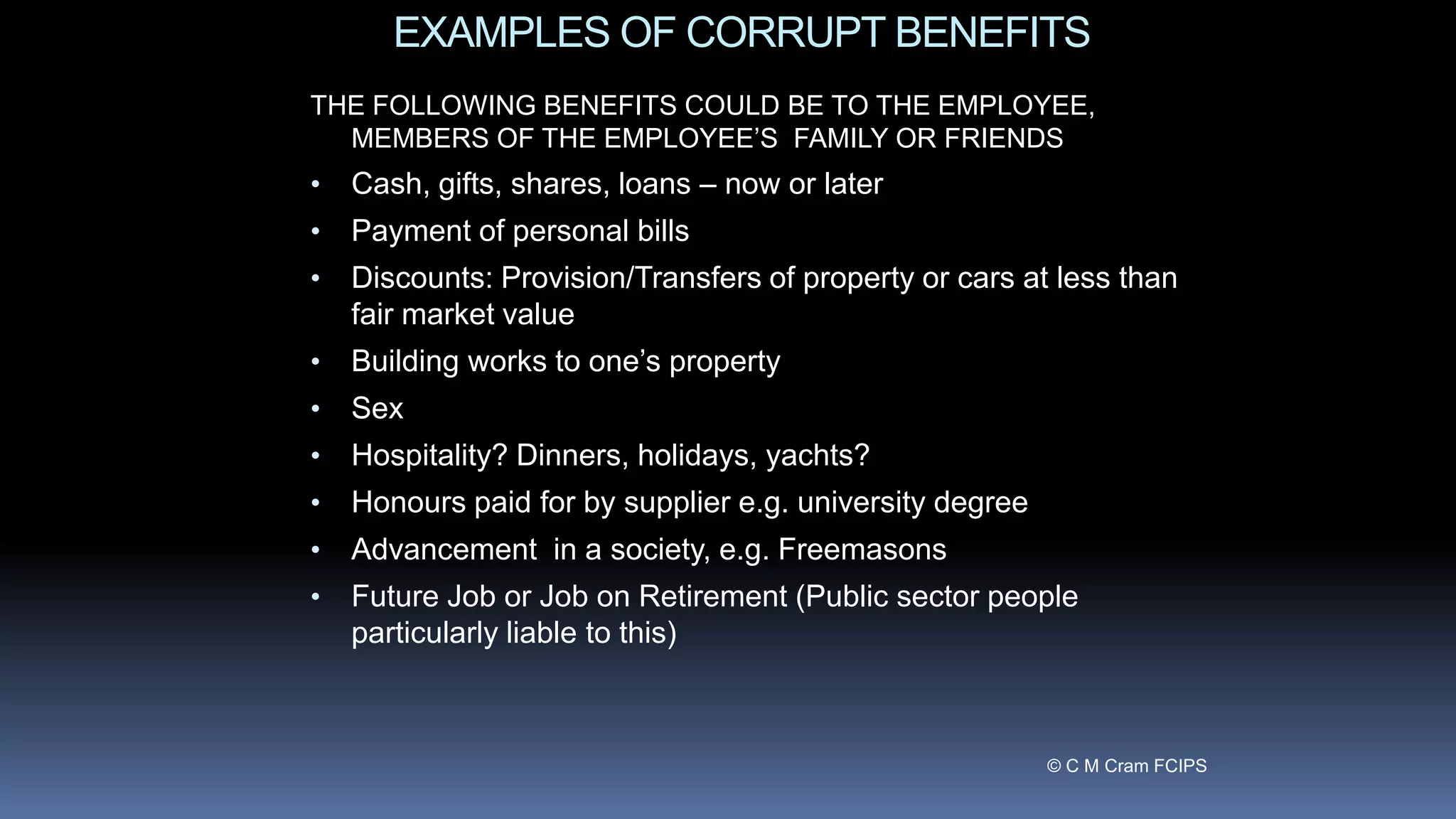
EXAMPLES OF CORRUPT BENEFITS
THE FOLLOWING BENEFITS COULD BE TO THE EMPLOYEE,
MEMBERS OF THE EMPLOYEE’S FAMILY OR FRIENDS
• Cash, gifts, shares, loans – now or later
• Payment of personal bills
• Discounts: Provision/Transfers of property or cars at less than
fair market value
• Building works to one’s property
• Sex
• Hospitality? Dinners, holidays, yachts?
• Honours paid for by supplier e.g. university degree
• Advancement in a society, e.g. Freemasons
• Future Job or Job on Retirement (Public sector people
particularly liable to this)
© C M Cram FCIPS
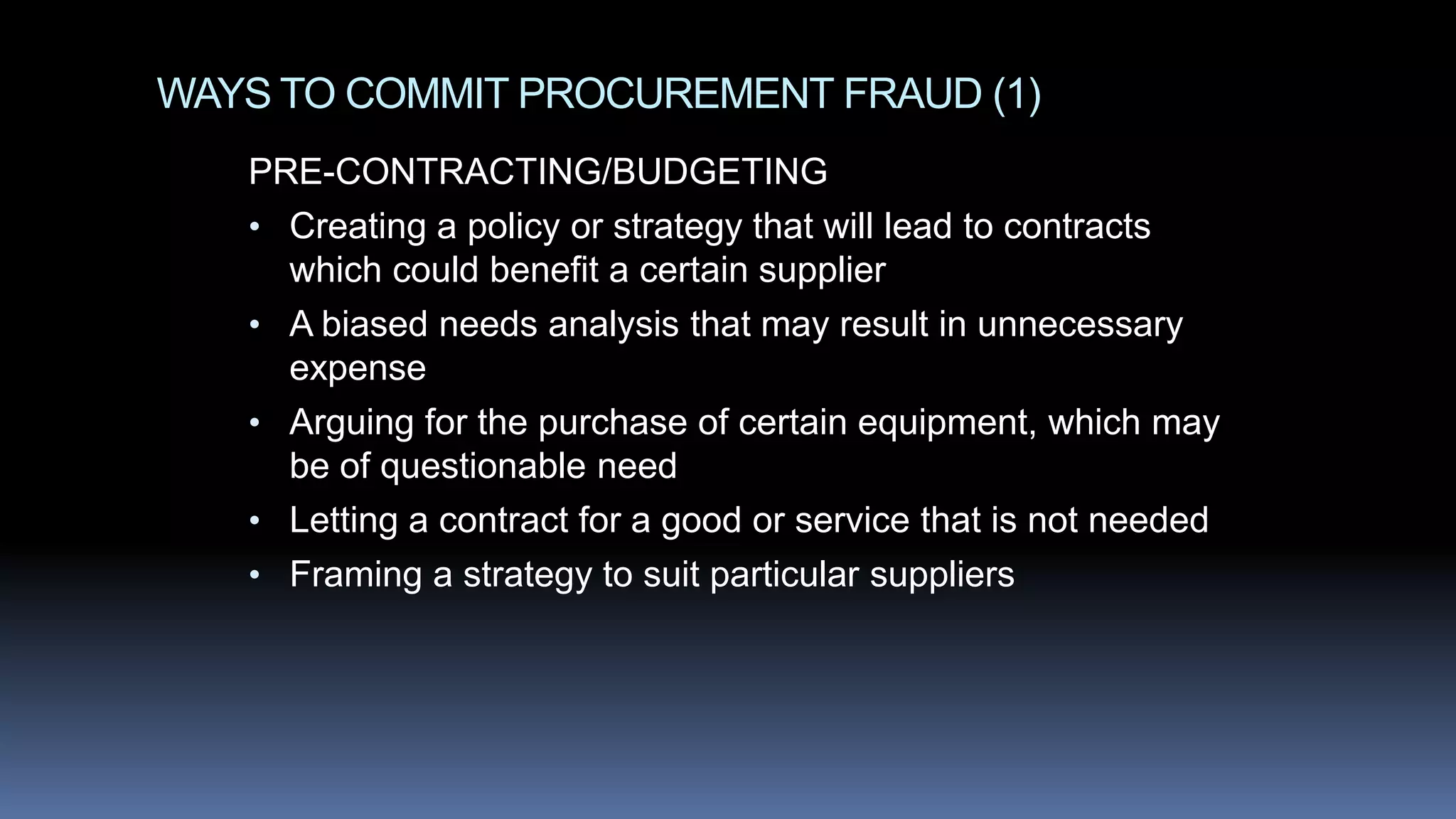
WAYS TO COMMIT PROCUREMENT FRAUD (1)
PRE-CONTRACTING/BUDGETING
• Creating a policy or strategy that will lead to contracts
which could benefit a certain supplier
• A biased needs analysis that may result in unnecessary
expense
• Arguing for the purchase of certain equipment, which may
be of questionable need
• Letting a contract for a good or service that is not needed
• Framing a strategy to suit particular suppliers
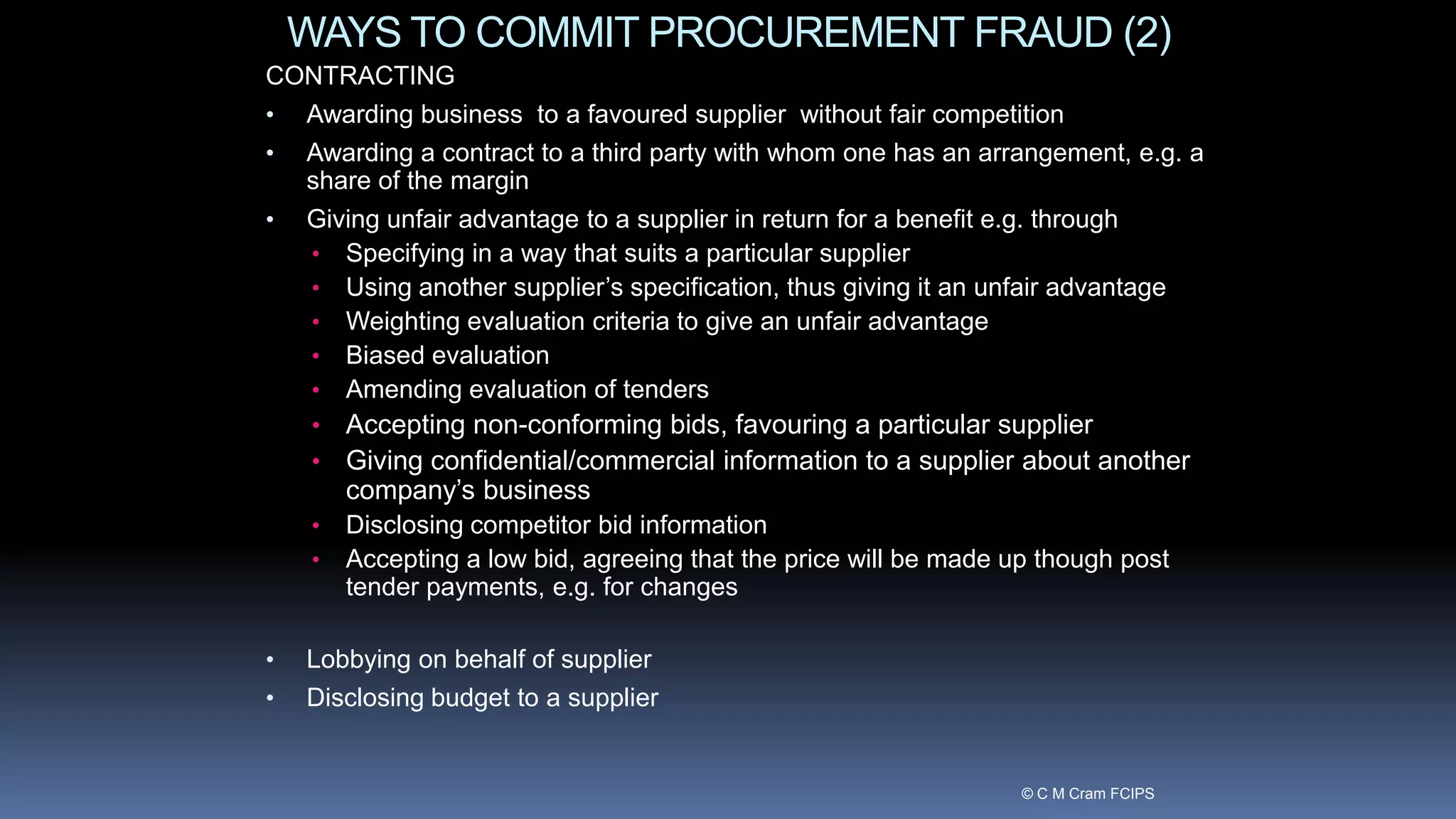
WAYS TO COMMIT PROCUREMENT FRAUD (2)
CONTRACTING
• Awarding business to a favoured supplier without fair competition
• Awarding a contract to a third party with whom one has an arrangement, e.g. a
share of the margin
• Giving unfair advantage to a supplier in return for a benefit e.g. through
• Specifying in a way that suits a particular supplier
• Using another supplier’s specification, thus giving it an unfair advantage
• Weighting evaluation criteria to give an unfair advantage
• Biased evaluation
• Amending evaluation of tenders
• Accepting non-conforming bids, favouring a particular supplier
• Giving confidential/commercial information to a supplier about another
company’s business
• Disclosing competitor bid information
• Accepting a low bid, agreeing that the price will be made up though post
tender payments, e.g. for changes
• Lobbying on behalf of supplier
• Disclosing budget to a supplier
© C M Cram FCIPS
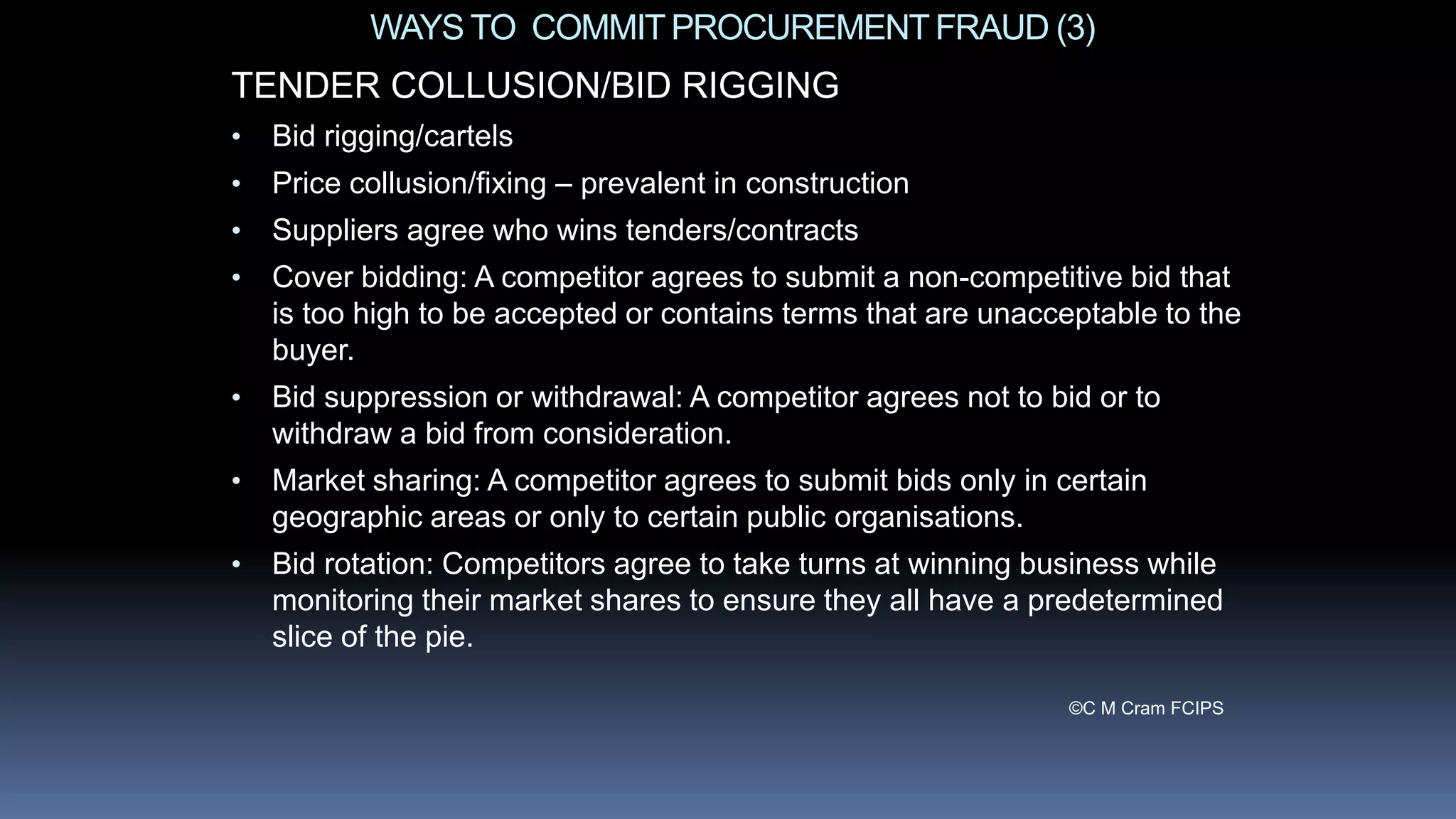
WAYS TO COMMITPROCUREMENTFRAUD (3)
TENDER COLLUSION/BID RIGGING
• Bid rigging/cartels
• Price collusion/fixing – prevalent in construction
• Suppliers agree who wins tenders/contracts
• Cover bidding: A competitor agrees to submit a non-competitive bid that
is too high to be accepted or contains terms that are unacceptable to the
buyer.
• Bid suppression or withdrawal: A competitor agrees not to bid or to
withdraw a bid from consideration.
• Market sharing: A competitor agrees to submit bids only in certain
geographic areas or only to certain public organisations.
• Bid rotation: Competitors agree to take turns at winning business while
monitoring their market shares to ensure they all have a predetermined
slice of the pie.
©C M Cram FCIPS
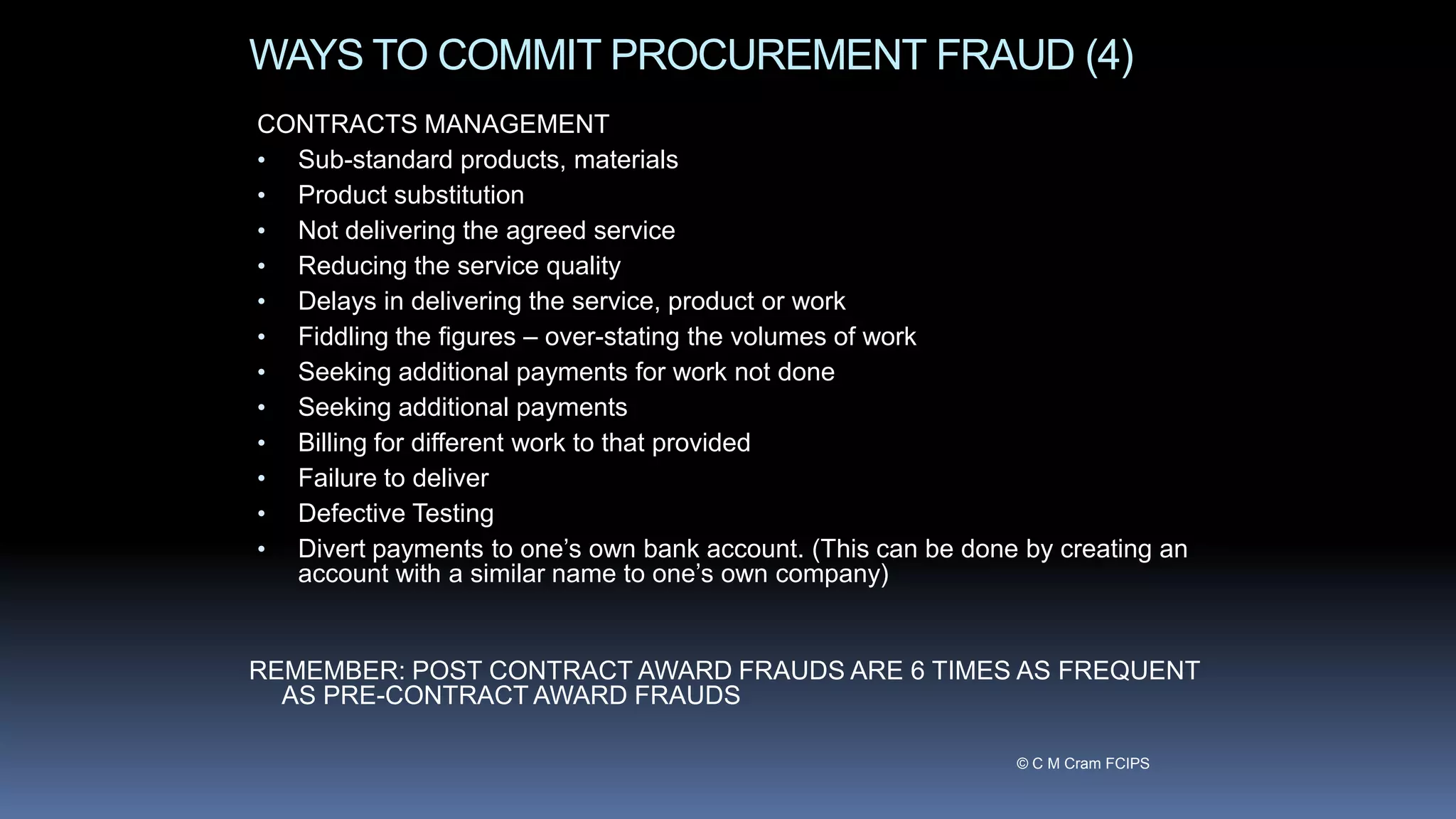
WAYS TO COMMIT PROCUREMENT FRAUD (4)
CONTRACTS MANAGEMENT
• Sub-standard products, materials
• Product substitution
• Not delivering the agreed service
• Reducing the service quality
• Delays in delivering the service, product or work
• Fiddling the figures – over-stating the volumes of work
• Seeking additional payments for work not done
• Seeking additional payments
• Billing for different work to that provided
• Failure to deliver
• Defective Testing
• Divert payments to one’s own bank account. (This can be done by creating an
account with a similar name to one’s own company)
REMEMBER: POST CONTRACT AWARD FRAUDS ARE 6 TIMES AS FREQUENT
AS PRE-CONTRACT AWARD FRAUDS
© C M Cram FCIPS
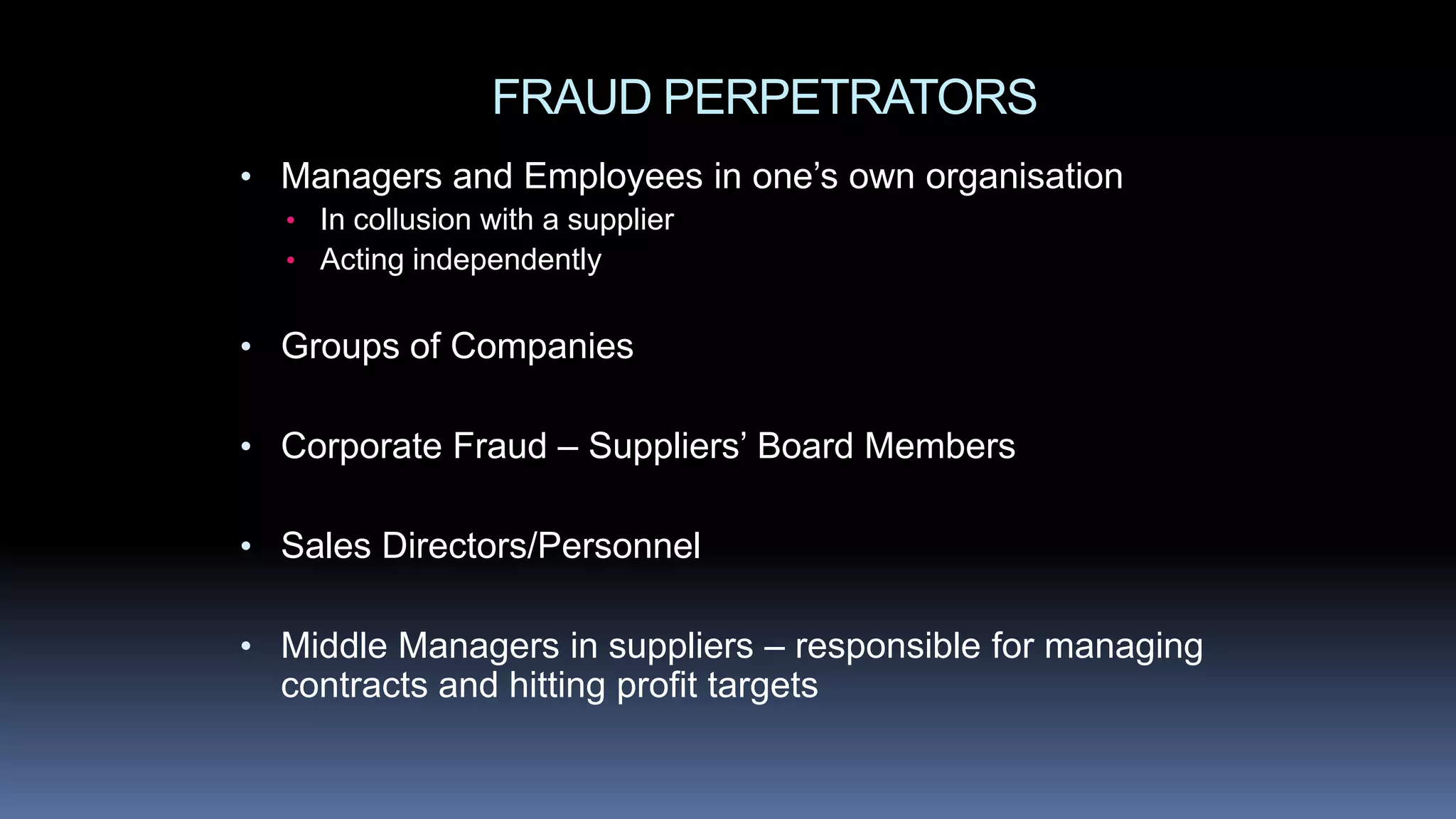
FRAUD PERPETRATORS
• Managers and Employees in one’s own organisation
• In collusion with a supplier
• Acting independently
• Groups of Companies
• Corporate Fraud – Suppliers’ Board Members
• Sales Directors/Personnel
• Middle Managers in suppliers – responsible for managing
contracts and hitting profit targets
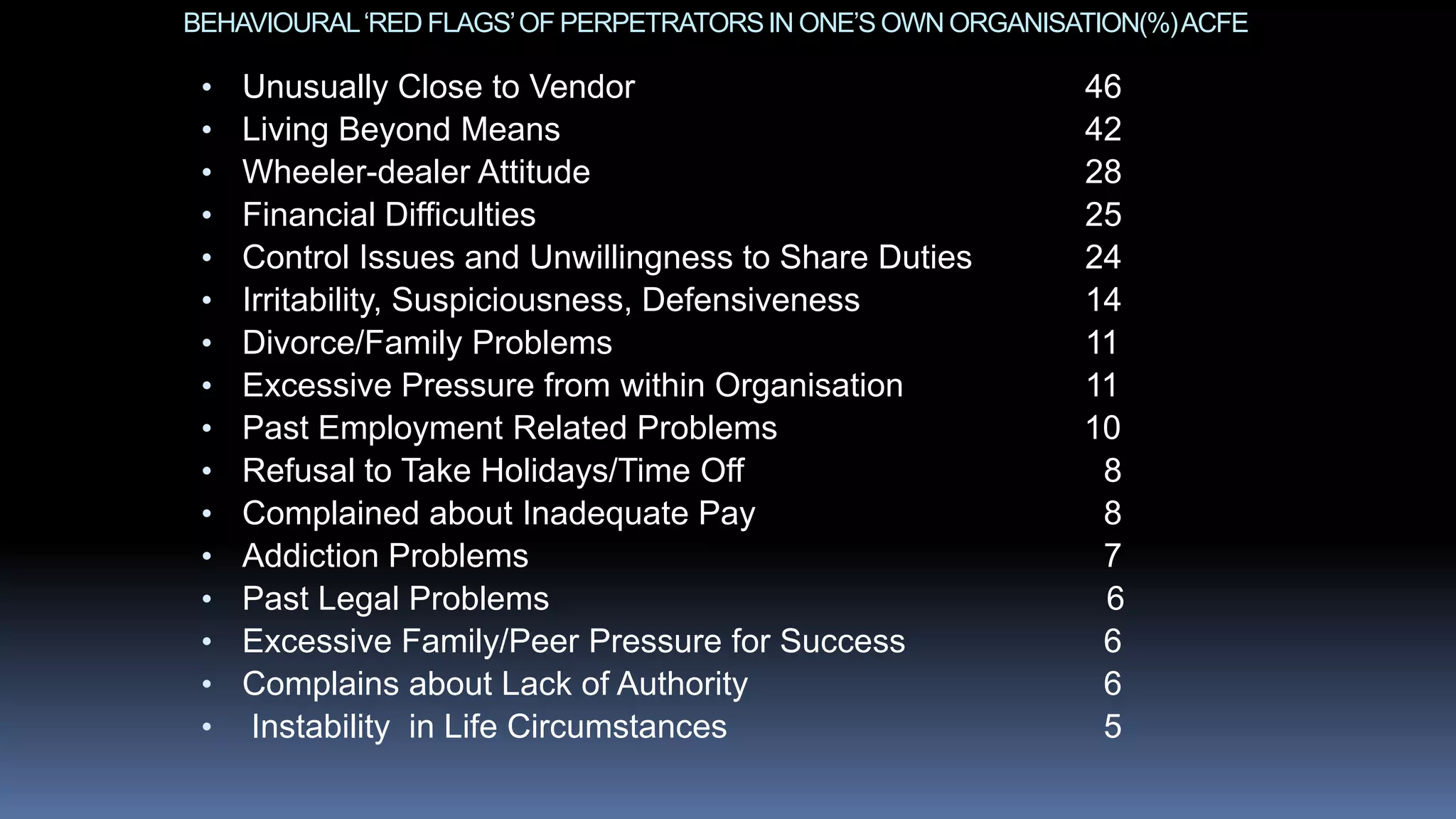
BEHAVIOURAL‘RED FLAGS’OF PERPETRATORSIN ONE’S OWN ORGANISATION(%)ACFE
• Unusually Close to Vendor 46
• Living Beyond Means 42
• Wheeler-dealer Attitude 28
• Financial Difficulties 25
• Control Issues and Unwillingness to Share Duties 24
• Irritability, Suspiciousness, Defensiveness 14
• Divorce/Family Problems 11
• Excessive Pressure from within Organisation 11
• Past Employment Related Problems 10
• Refusal to Take Holidays/Time Off 8
• Complained about Inadequate Pay 8
• Addiction Problems 7
• Past Legal Problems 6
• Excessive Family/Peer Pressure for Success 6
• Complains about Lack of Authority 6
• Instability in Life Circumstances 5
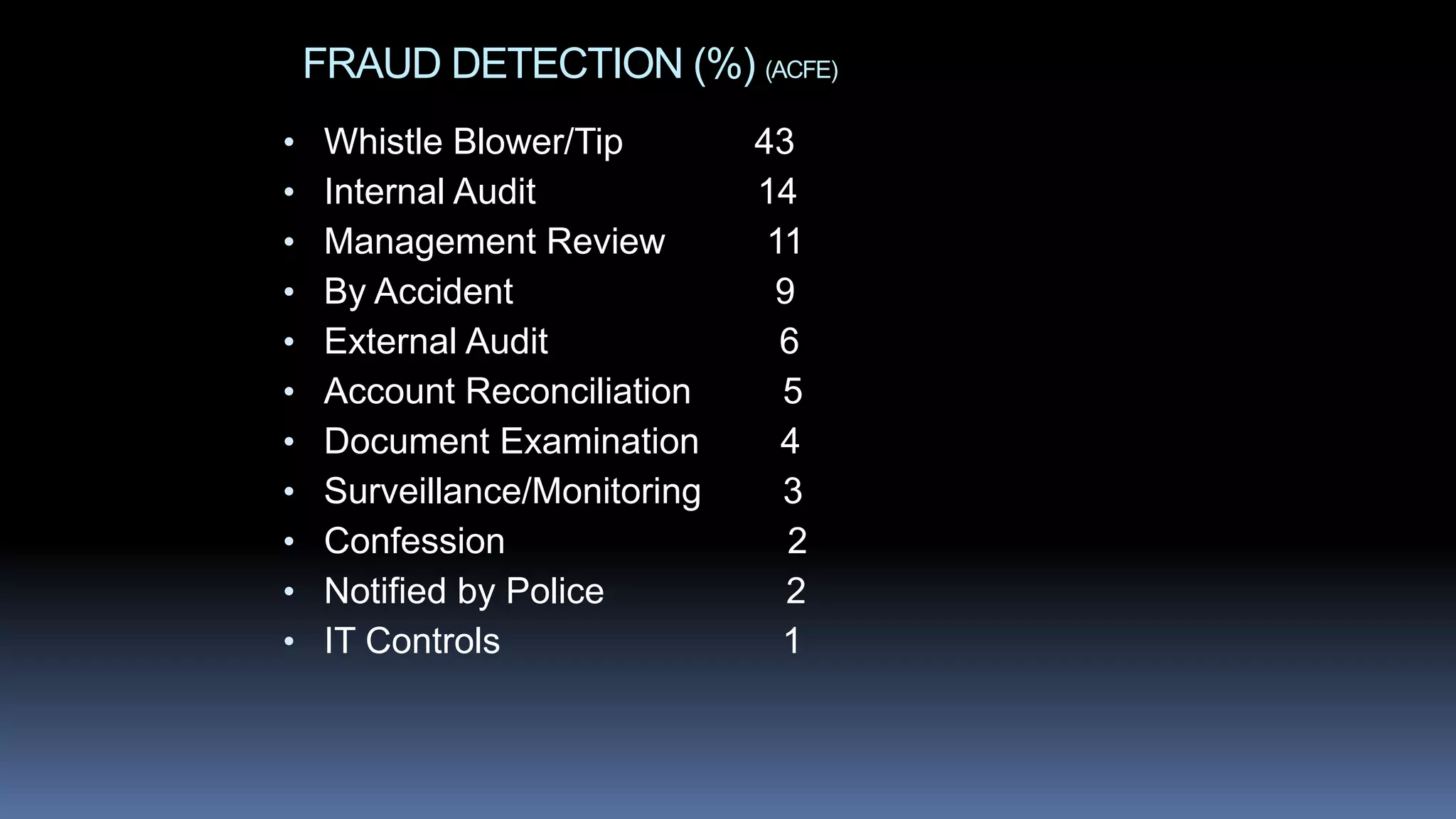
FRAUD DETECTION (%) (ACFE)
• Whistle Blower/Tip 43
• Internal Audit 14
• Management Review 11
• By Accident 9
• External Audit 6
• Account Reconciliation 5
• Document Examination 4
• Surveillance/Monitoring 3
• Confession 2
• Notified by Police 2
• IT Controls 1
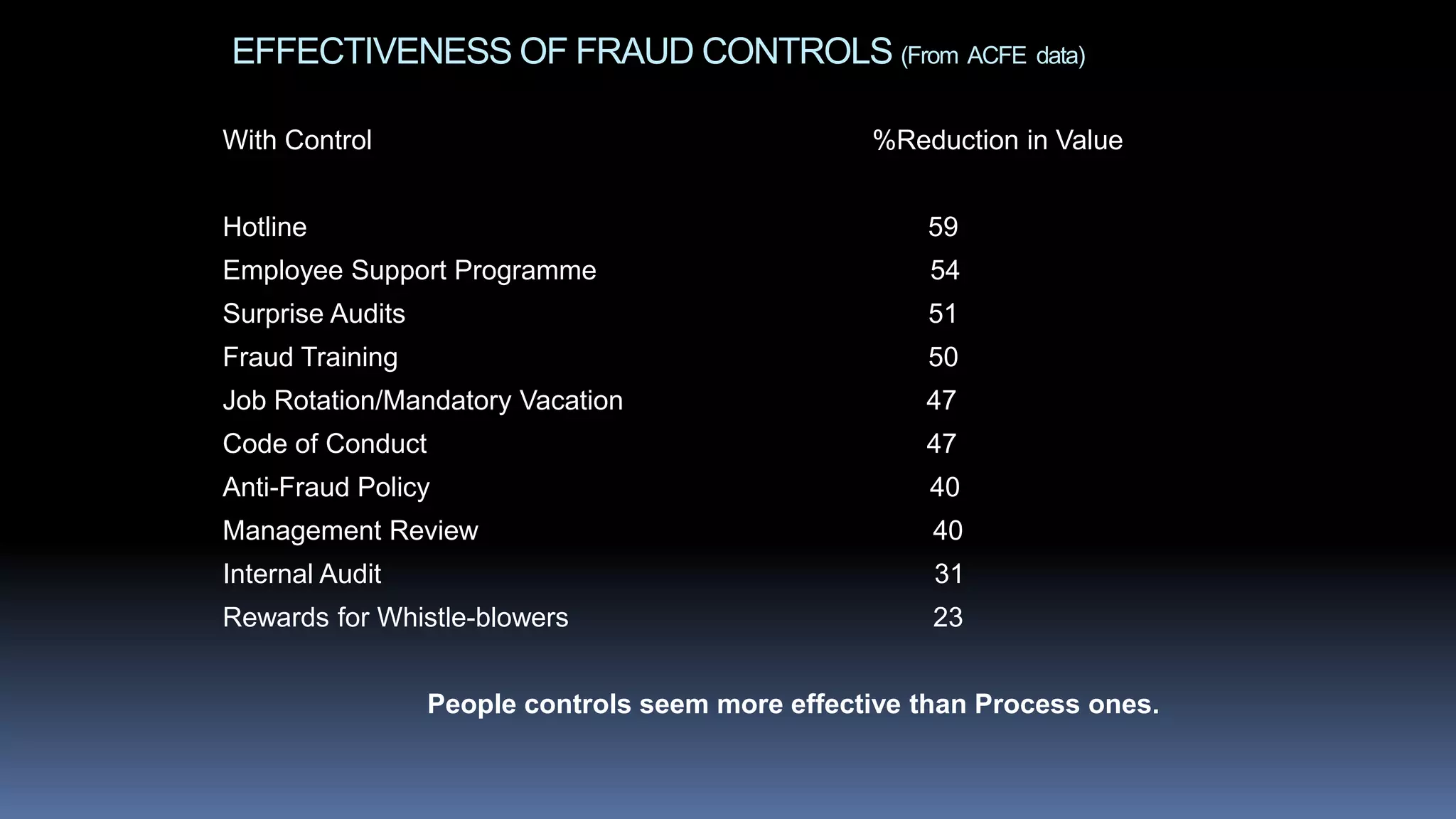
EFFECTIVENESS OF FRAUD CONTROLS (From ACFE data)
With Control %Reduction in Value
Hotline 59
Employee Support Programme 54
Surprise Audits 51
Fraud Training 50
Job Rotation/Mandatory Vacation 47
Code of Conduct 47
Anti-Fraud Policy 40
Management Review 40
Internal Audit 31
Rewards for Whistle-blowers 23
People controls seem more effective than Process ones.
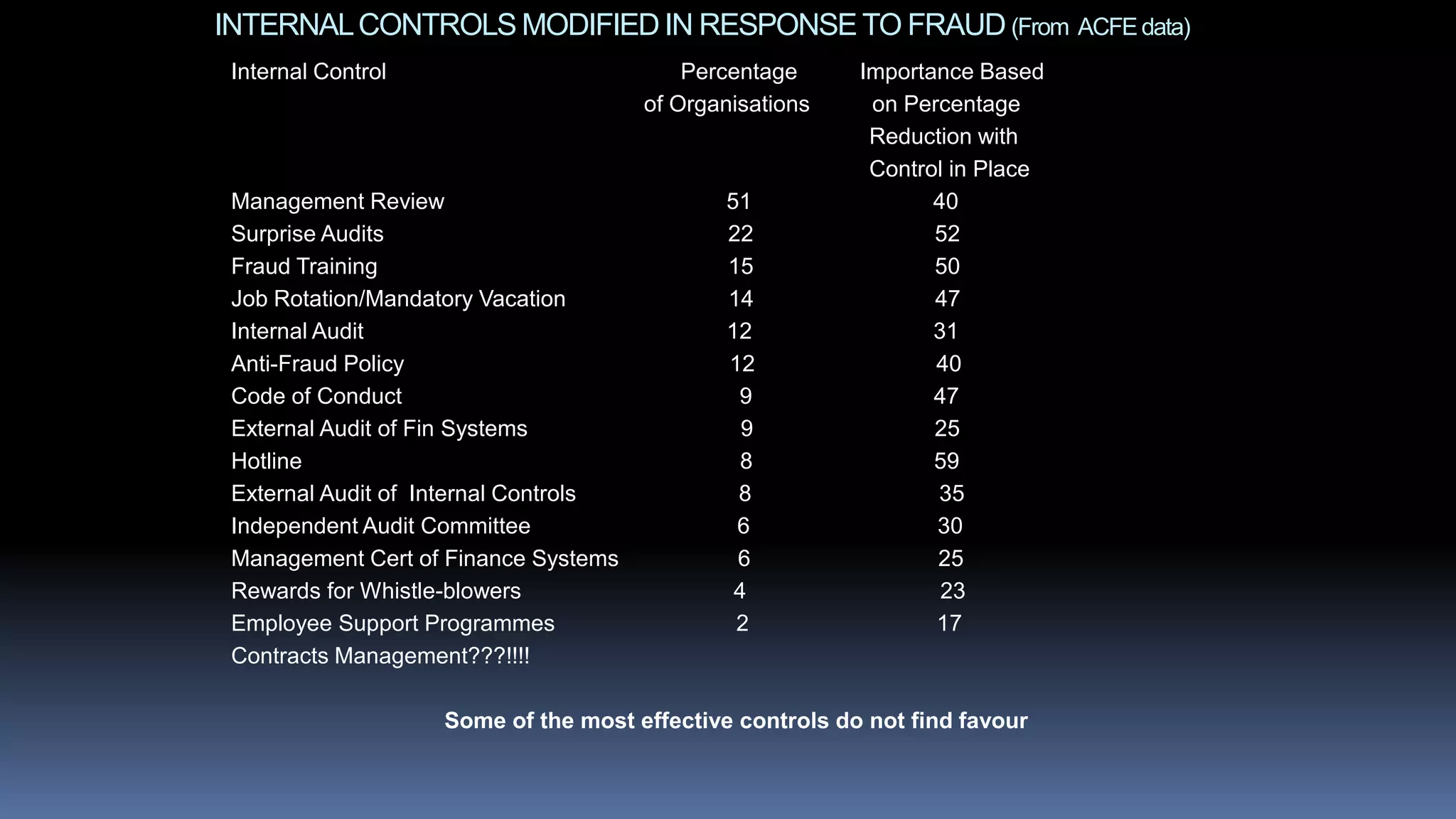
INTERNALCONTROLS MODIFIED IN RESPONSETO FRAUD (From ACFEdata)
Internal Control Percentage Importance Based
of Organisations on Percentage
Reduction with
Control in Place
Management Review 51 40
Surprise Audits 22 52
Fraud Training 15 50
Job Rotation/Mandatory Vacation 14 47
Internal Audit 12 31
Anti-Fraud Policy 12 40
Code of Conduct 9 47
External Audit of Fin Systems 9 25
Hotline 8 59
External Audit of Internal Controls 8 35
Independent Audit Committee 6 30
Management Cert of Finance Systems 6 25
Rewards for Whistle-blowers 4 23
Employee Support Programmes 2 17
Contracts Management???!!!!
Some of the most effective controls do not find favour
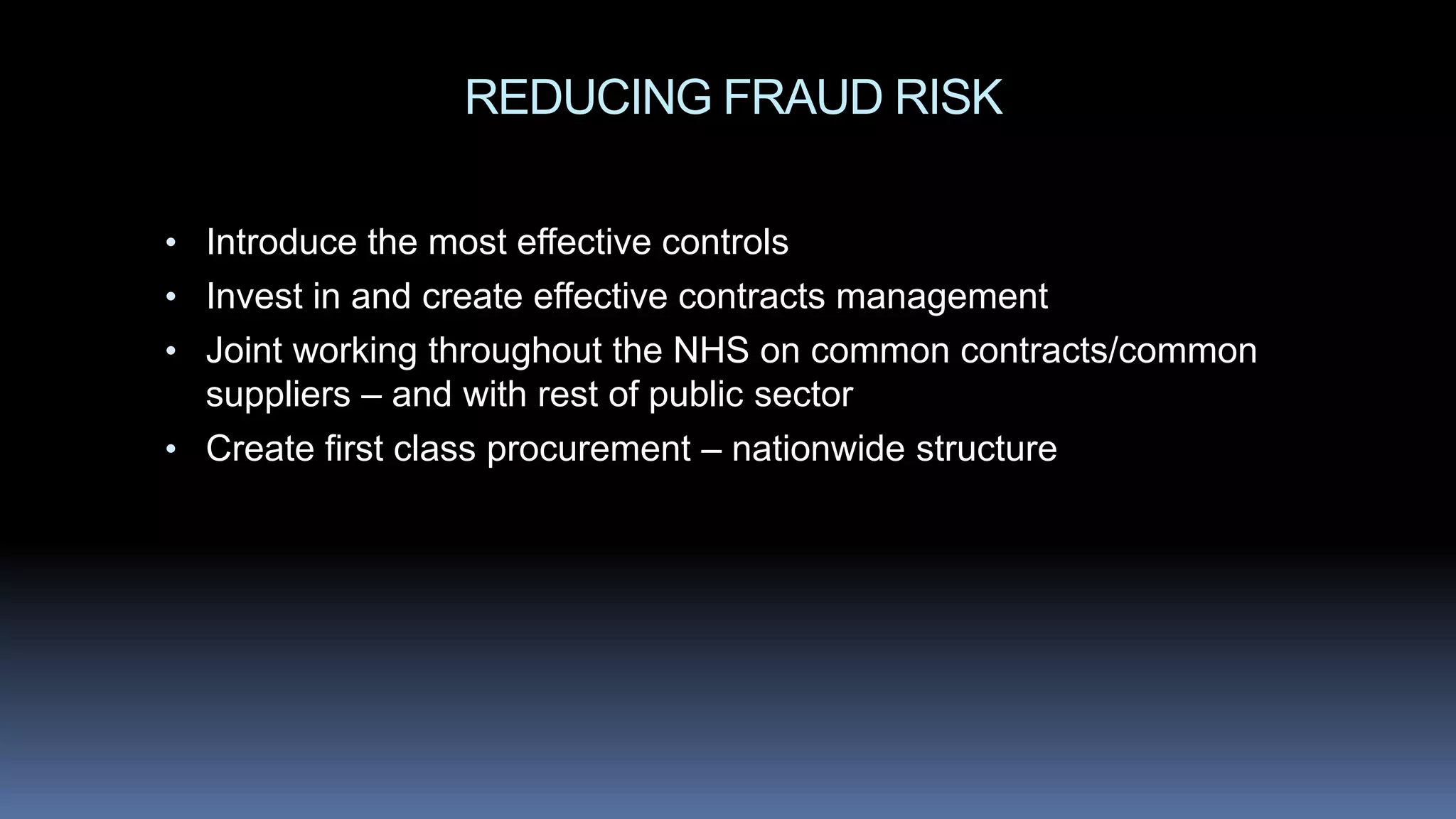
REDUCING FRAUD RISK
• Introduce the most effective controls
• Invest in and create effective contracts management
• Joint working throughout the NHS on common contracts/common
suppliers – and with rest of public sector
• Create first class procurement – nationwide structure
THANKS FOR LISTENING
Colin M Cram FCIPS
Tel: +44(0)1457 868107
Mob: +44(0)075251 49611
colin.cram@marc1ltd.com
www.marc1ltd.com
© C M Cram FCIPS

Colin Cram, Open Forum Events - Open Forum Events' NHS Commissioning and Procurement conference 2

  • 1.
    COMBATING PROCUREMENT FRAUD Colin MCram FCIPS Chief Executive Open Forum Events Managing Director Marc1 Ltd Colin.cram@marc1ltd.com Tel: +44 (0)1457 239894 Mob: +44 (0)75251 49611 www.marc1ltd.com © C M Cram FCIPS
  • 2.
    WHAT DOES THEUK PUBLIC SECTOR SCORE IN THE GLOBAL LEAGUE? Denmark 91 New Zealand 91 Finland 89 Sweden 89 Singapore 86 UK 76 Barbados 75 Hong Kong 75 Uruguay 73 UAE 69 North Korea 8
  • 3.
    FRAUD OPPORTUNITIES 1. PreContracting 2. Contracting 3. Tender Collusion/Bid Rigging 4. Post Contract/Contract Management
  • 4.
    EXAMPLES OF CORRUPTBENEFITS THE FOLLOWING BENEFITS COULD BE TO THE EMPLOYEE, MEMBERS OF THE EMPLOYEE’S FAMILY OR FRIENDS • Cash, gifts, shares, loans – now or later • Payment of personal bills • Discounts: Provision/Transfers of property or cars at less than fair market value • Building works to one’s property • Sex • Hospitality? Dinners, holidays, yachts? • Honours paid for by supplier e.g. university degree • Advancement in a society, e.g. Freemasons • Future Job or Job on Retirement (Public sector people particularly liable to this) © C M Cram FCIPS
  • 5.
    WAYS TO COMMITPROCUREMENT FRAUD (1) PRE-CONTRACTING/BUDGETING • Creating a policy or strategy that will lead to contracts which could benefit a certain supplier • A biased needs analysis that may result in unnecessary expense • Arguing for the purchase of certain equipment, which may be of questionable need • Letting a contract for a good or service that is not needed • Framing a strategy to suit particular suppliers
  • 6.
    WAYS TO COMMITPROCUREMENT FRAUD (2) CONTRACTING • Awarding business to a favoured supplier without fair competition • Awarding a contract to a third party with whom one has an arrangement, e.g. a share of the margin • Giving unfair advantage to a supplier in return for a benefit e.g. through • Specifying in a way that suits a particular supplier • Using another supplier’s specification, thus giving it an unfair advantage • Weighting evaluation criteria to give an unfair advantage • Biased evaluation • Amending evaluation of tenders • Accepting non-conforming bids, favouring a particular supplier • Giving confidential/commercial information to a supplier about another company’s business • Disclosing competitor bid information • Accepting a low bid, agreeing that the price will be made up though post tender payments, e.g. for changes • Lobbying on behalf of supplier • Disclosing budget to a supplier © C M Cram FCIPS
  • 7.
    WAYS TO COMMITPROCUREMENTFRAUD(3) TENDER COLLUSION/BID RIGGING • Bid rigging/cartels • Price collusion/fixing – prevalent in construction • Suppliers agree who wins tenders/contracts • Cover bidding: A competitor agrees to submit a non-competitive bid that is too high to be accepted or contains terms that are unacceptable to the buyer. • Bid suppression or withdrawal: A competitor agrees not to bid or to withdraw a bid from consideration. • Market sharing: A competitor agrees to submit bids only in certain geographic areas or only to certain public organisations. • Bid rotation: Competitors agree to take turns at winning business while monitoring their market shares to ensure they all have a predetermined slice of the pie. ©C M Cram FCIPS
  • 8.
    WAYS TO COMMITPROCUREMENT FRAUD (4) CONTRACTS MANAGEMENT • Sub-standard products, materials • Product substitution • Not delivering the agreed service • Reducing the service quality • Delays in delivering the service, product or work • Fiddling the figures – over-stating the volumes of work • Seeking additional payments for work not done • Seeking additional payments • Billing for different work to that provided • Failure to deliver • Defective Testing • Divert payments to one’s own bank account. (This can be done by creating an account with a similar name to one’s own company) REMEMBER: POST CONTRACT AWARD FRAUDS ARE 6 TIMES AS FREQUENT AS PRE-CONTRACT AWARD FRAUDS © C M Cram FCIPS
  • 9.
    FRAUD PERPETRATORS • Managersand Employees in one’s own organisation • In collusion with a supplier • Acting independently • Groups of Companies • Corporate Fraud – Suppliers’ Board Members • Sales Directors/Personnel • Middle Managers in suppliers – responsible for managing contracts and hitting profit targets
  • 10.
    BEHAVIOURAL‘RED FLAGS’OF PERPETRATORSINONE’S OWN ORGANISATION(%)ACFE • Unusually Close to Vendor 46 • Living Beyond Means 42 • Wheeler-dealer Attitude 28 • Financial Difficulties 25 • Control Issues and Unwillingness to Share Duties 24 • Irritability, Suspiciousness, Defensiveness 14 • Divorce/Family Problems 11 • Excessive Pressure from within Organisation 11 • Past Employment Related Problems 10 • Refusal to Take Holidays/Time Off 8 • Complained about Inadequate Pay 8 • Addiction Problems 7 • Past Legal Problems 6 • Excessive Family/Peer Pressure for Success 6 • Complains about Lack of Authority 6 • Instability in Life Circumstances 5
  • 11.
    FRAUD DETECTION (%)(ACFE) • Whistle Blower/Tip 43 • Internal Audit 14 • Management Review 11 • By Accident 9 • External Audit 6 • Account Reconciliation 5 • Document Examination 4 • Surveillance/Monitoring 3 • Confession 2 • Notified by Police 2 • IT Controls 1
  • 12.
    EFFECTIVENESS OF FRAUDCONTROLS (From ACFE data) With Control %Reduction in Value Hotline 59 Employee Support Programme 54 Surprise Audits 51 Fraud Training 50 Job Rotation/Mandatory Vacation 47 Code of Conduct 47 Anti-Fraud Policy 40 Management Review 40 Internal Audit 31 Rewards for Whistle-blowers 23 People controls seem more effective than Process ones.
  • 13.
    INTERNALCONTROLS MODIFIED INRESPONSETO FRAUD (From ACFEdata) Internal Control Percentage Importance Based of Organisations on Percentage Reduction with Control in Place Management Review 51 40 Surprise Audits 22 52 Fraud Training 15 50 Job Rotation/Mandatory Vacation 14 47 Internal Audit 12 31 Anti-Fraud Policy 12 40 Code of Conduct 9 47 External Audit of Fin Systems 9 25 Hotline 8 59 External Audit of Internal Controls 8 35 Independent Audit Committee 6 30 Management Cert of Finance Systems 6 25 Rewards for Whistle-blowers 4 23 Employee Support Programmes 2 17 Contracts Management???!!!! Some of the most effective controls do not find favour
  • 14.
    REDUCING FRAUD RISK •Introduce the most effective controls • Invest in and create effective contracts management • Joint working throughout the NHS on common contracts/common suppliers – and with rest of public sector • Create first class procurement – nationwide structure
  • 15.
    THANKS FOR LISTENING ColinM Cram FCIPS Tel: +44(0)1457 868107 Mob: +44(0)075251 49611 colin.cram@marc1ltd.com www.marc1ltd.com © C M Cram FCIPS