FRAUD RISK
AND CONTROL
Recognizing the Prevalence of Risk and the
Importance of Prevention
Stop Fraud in its Tracks
“Don’t wait until you are working on fraud
detection within business operations.”
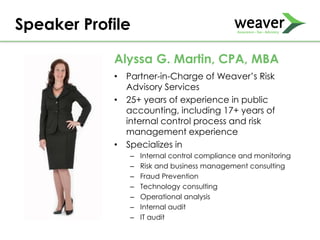
• Partner-in-Charge of Weaver’s Risk
Advisory Services
• 25+ years of experience in public
accounting, including 17+ years of
internal control process and risk
management experience
• Specializes in
– Internal control compliance and monitoring
– Risk and business management consulting
– Fraud Prevention
– Technology consulting
– Operational analysis
– Internal audit
– IT audit
Speaker Profile
Alyssa G. Martin, CPA, MBA
Session Agenda
• Definition of Fraud
• Identifying Fraud Schemes
• How Fraud Threatens Your
Organization’s Existence/Credibility
• Effective Elements of Fraud
Prevention & Detection
• Mitigating Fraud Risk
DEFINITION OF FRAUD
“… any illegal act
characterized by deceit,
concealment, or
violation of trust.
What is Fraud?
These acts are not dependent upon the threat
of violence or physical force. Frauds are
perpetrated by parties and organizations to
obtain money, property, or services; to avoid
payment or loss of services; or to secure
personal or business advantage.”
Fraud is defined as:
• Intentional act vs. error or mistake
• Ingenious schemes, limited only by
human imagination
• Gaining an advantage through false
suggestions and suppression of truth
• Using surprises, tricks or cunning, or any
other unfair means
The Nature of Fraud
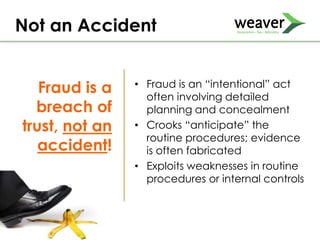
Fraud is a
breach of
trust, not an
accident!
• Fraud is an “intentional” act
often involving detailed
planning and concealment
• Crooks “anticipate” the
routine procedures; evidence
is often fabricated
• Exploits weaknesses in routine
procedures or internal controls
Not an Accident
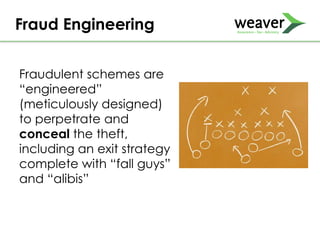
Fraudulent schemes are
“engineered”
(meticulously designed)
to perpetrate and
conceal the theft,
including an exit strategy
complete with “fall guys”
and “alibis”
Fraud Engineering
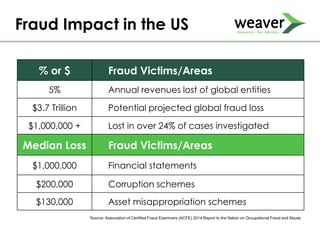
Fraud Impact in the US
% or $ Fraud Victims/Areas
5% Annual revenues lost of global entities
$3.7 Trillion Potential projected global fraud loss
$1,000,000 + Lost in over 24% of cases investigated
Median Loss Fraud Victims/Areas
$1,000,000 Financial statements
$200,000 Corruption schemes
$130,000 Asset misappropriation schemes
*Source: Association of Certified Fraud Examiners (ACFE) 2014 Report to the Nation on Occupational Fraud and Abuse
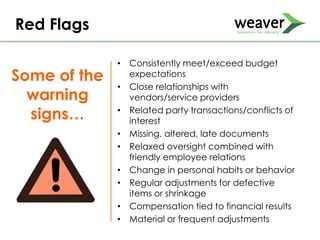
• Consistently meet/exceed budget
expectations
• Close relationships with
vendors/service providers
• Related party transactions/conflicts of
interest
• Missing, altered, late documents
• Relaxed oversight combined with
friendly employee relations
• Change in personal habits or behavior
• Regular adjustments for defective
items or shrinkage
• Compensation tied to financial results
• Material or frequent adjustments
Red Flags
Some of the
warning
signs…
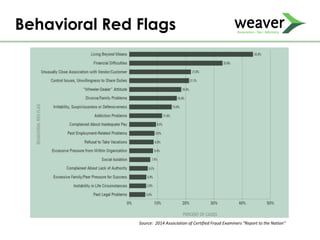
Behavioral Red Flags
Source: 2014 Association of Certified Fraud Examiners “Report to the Nation”
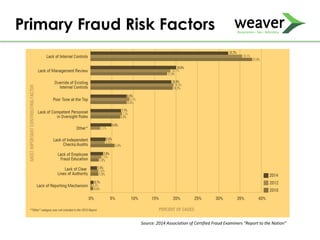
Primary Fraud Risk Factors
Source: 2014 Association of Certified Fraud Examiners “Report to the Nation”
IDENTIFYING FRAUD SCHEMES
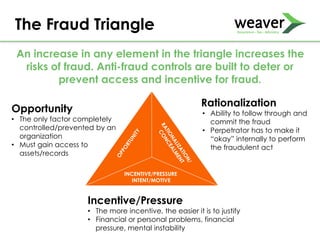
The Fraud Triangle
Opportunity
• The only factor completely
controlled/prevented by an
organization
• Must gain access to
assets/records
INCENTIVE/PRESSURE
INTENT/MOTIVE
Incentive/Pressure
• The more incentive, the easier it is to justify
• Financial or personal problems, financial
pressure, mental instability
Rationalization
• Ability to follow through and
commit the fraud
• Perpetrator has to make it
“okay” internally to perform
the fraudulent act
An increase in any element in the triangle increases the
risks of fraud. Anti-fraud controls are built to deter or
prevent access and incentive for fraud.
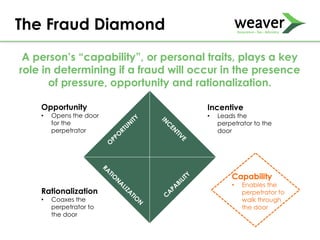
The Fraud Diamond
Incentive
• Leads the
perpetrator to the
door
Rationalization
• Coaxes the
perpetrator to
the door
Opportunity
• Opens the door
for the
perpetrator
Capability
• Enables the
perpetrator to
walk through
the door
A person’s “capability”, or personal traits, plays a key
role in determining if a fraud will occur in the presence
of pressure, opportunity and rationalization.
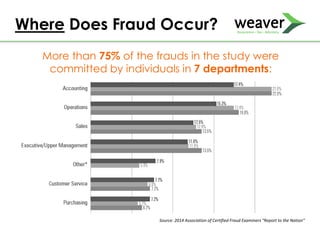
Where Does Fraud Occur?
More than 75% of the frauds in the study were
committed by individuals in 7 departments:
Source: 2014 Association of Certified Fraud Examiners “Report to the Nation”
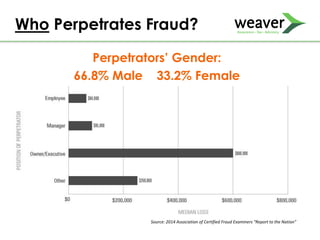
Who Perpetrates Fraud?
Perpetrators’ Gender:
66.8% Male 33.2% Female
Source: 2014 Association of Certified Fraud Examiners “Report to the Nation”
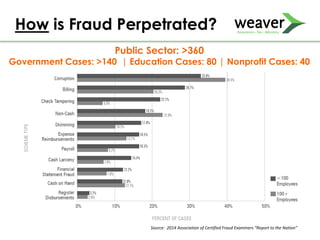
How is Fraud Perpetrated?
Public Sector: >360
Government Cases: >140 | Education Cases: 80 | Nonprofit Cases: 40
Source: 2014 Association of Certified Fraud Examiners “Report to the Nation”
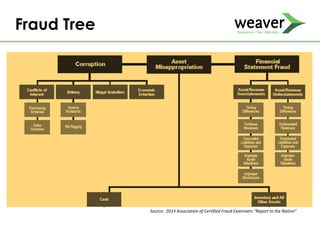
Fraud Tree
Source: 2014 Association of Certified Fraud Examiners “Report to the Nation”
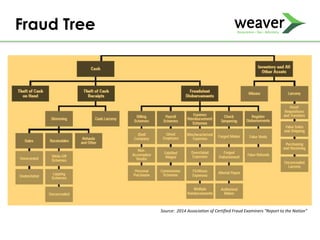
Fraud Tree
Source: 2014 Association of Certified Fraud Examiners “Report to the Nation”
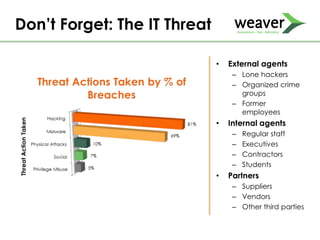
• External agents
– Lone hackers
– Organized crime
groups
– Former
employees
• Internal agents
– Regular staff
– Executives
– Contractors
– Students
• Partners
– Suppliers
– Vendors
– Other third parties
Don’t Forget: The IT Threat
HOW FRAUD THREATENS YOUR
ORGANIZATION’S EXISTENCE/CREDIBILITY
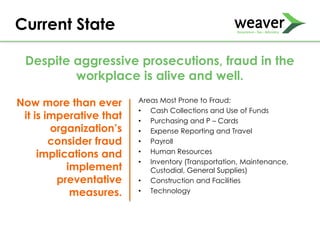
Areas Most Prone to Fraud:
• Cash Collections and Use of Funds
• Purchasing and P – Cards
• Expense Reporting and Travel
• Payroll
• Human Resources
• Inventory (Transportation, Maintenance,
Custodial, General Supplies)
• Construction and Facilities
• Technology
Current State
Despite aggressive prosecutions, fraud in the
workplace is alive and well.
Now more than ever
it is imperative that
organization’s
consider fraud
implications and
implement
preventative
measures.
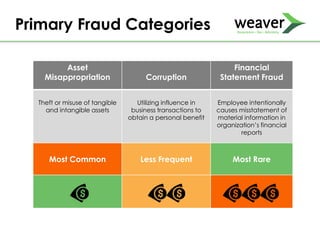
Primary Fraud Categories
Asset
Misappropriation Corruption
Financial
Statement Fraud
Theft or misuse of tangible
and intangible assets
Utilizing influence in
business transactions to
obtain a personal benefit
Employee intentionally
causes misstatement of
material information in
organization’s financial
reports
Most Common Less Frequent Most Rare
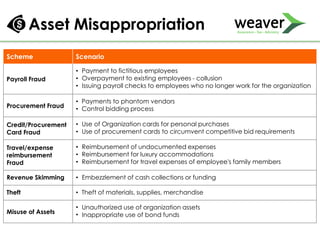
Asset Misappropriation
Scheme Scenario
Payroll Fraud
• Payment to fictitious employees
• Overpayment to existing employees - collusion
• Issuing payroll checks to employees who no longer work for the organization
Procurement Fraud
• Payments to phantom vendors
• Control bidding process
Credit/Procurement
Card Fraud
• Use of Organization cards for personal purchases
• Use of procurement cards to circumvent competitive bid requirements
Travel/expense
reimbursement
Fraud
• Reimbursement of undocumented expenses
• Reimbursement for luxury accommodations
• Reimbursement for travel expenses of employee's family members
Revenue Skimming • Embezzlement of cash collections or funding
Theft • Theft of materials, supplies, merchandise
Misuse of Assets
• Unauthorized use of organization assets
• Inappropriate use of bond funds
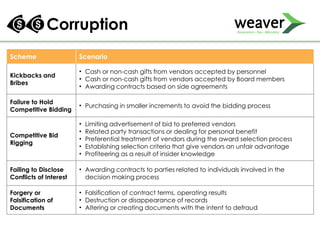
Corruption
Scheme Scenario
Kickbacks and
Bribes
• Cash or non-cash gifts from vendors accepted by personnel
• Cash or non-cash gifts from vendors accepted by Board members
• Awarding contracts based on side agreements
Failure to Hold
Competitive Bidding
• Purchasing in smaller increments to avoid the bidding process
Competitive Bid
Rigging
• Limiting advertisement of bid to preferred vendors
• Related party transactions or dealing for personal benefit
• Preferential treatment of vendors during the award selection process
• Establishing selection criteria that give vendors an unfair advantage
• Profiteering as a result of insider knowledge
Failing to Disclose
Conflicts of Interest
• Awarding contracts to parties related to individuals involved in the
decision making process
Forgery or
Falsification of
Documents
• Falsification of contract terms, operating results
• Destruction or disappearance of records
• Altering or creating documents with the intent to defraud
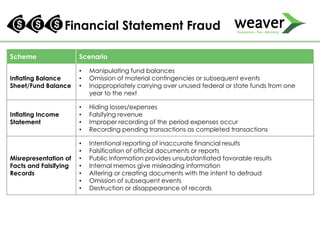
Financial Statement Fraud
Scheme Scenario
Inflating Balance
Sheet/Fund Balance
• Manipulating fund balances
• Omission of material contingencies or subsequent events
• Inappropriately carrying over unused federal or state funds from one
year to the next
Inflating Income
Statement
• Hiding losses/expenses
• Falsifying revenue
• Improper recording of the period expenses occur
• Recording pending transactions as completed transactions
Misrepresentation of
Facts and Falsifying
Records
• Intentional reporting of inaccurate financial results
• Falsification of official documents or reports
• Public Information provides unsubstantiated favorable results
• Internal memos give misleading information
• Altering or creating documents with the intent to defraud
• Omission of subsequent events
• Destruction or disappearance of records
EFFECTIVE ELEMENTS OF FRAUD
PREVENTION & DETECTION
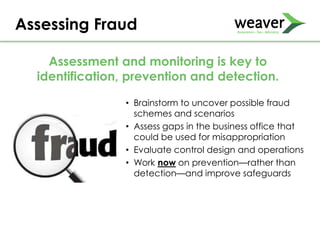
Assessing Fraud
Assessment and monitoring is key to
identification, prevention and detection.
• Brainstorm to uncover possible fraud
schemes and scenarios
• Assess gaps in the business office that
could be used for misappropriation
• Evaluate control design and operations
• Work now on prevention—rather than
detection—and improve safeguards
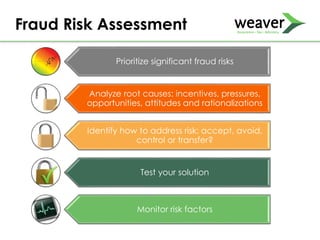
Fraud Risk Assessment
Prioritize significant fraud risks
Analyze root causes: incentives, pressures,
opportunities, attitudes and rationalizations
Identify how to address risk: accept, avoid,
control or transfer?
Test your solution
Monitor risk factors
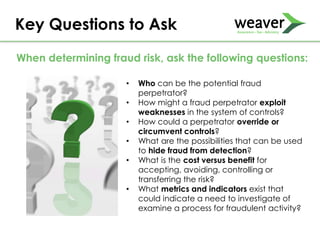
Key Questions to Ask
• Who can be the potential fraud
perpetrator?
• How might a fraud perpetrator exploit
weaknesses in the system of controls?
• How could a perpetrator override or
circumvent controls?
• What are the possibilities that can be used
to hide fraud from detection?
• What is the cost versus benefit for
accepting, avoiding, controlling or
transferring the risk?
• What metrics and indicators exist that
could indicate a need to investigate of
examine a process for fraudulent activity?
When determining fraud risk, ask the following questions:
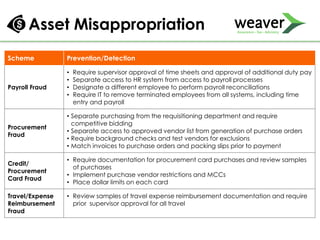
Asset Misappropriation
Scheme Prevention/Detection
Payroll Fraud
• Require supervisor approval of time sheets and approval of additional duty pay
• Separate access to HR system from access to payroll processes
• Designate a different employee to perform payroll reconciliations
• Require IT to remove terminated employees from all systems, including time
entry and payroll
Procurement
Fraud
• Separate purchasing from the requisitioning department and require
competitive bidding
• Separate access to approved vendor list from generation of purchase orders
• Require background checks and test vendors for exclusions
• Match invoices to purchase orders and packing slips prior to payment
Credit/
Procurement
Card Fraud
• Require documentation for procurement card purchases and review samples
of purchases
• Implement purchase vendor restrictions and MCCs
• Place dollar limits on each card
Travel/Expense
Reimbursement
Fraud
• Review samples of travel expense reimbursement documentation and require
prior supervisor approval for all travel
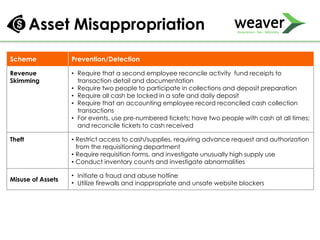
Asset Misappropriation
Scheme Prevention/Detection
Revenue
Skimming
• Require that a second employee reconcile activity fund receipts to
transaction detail and documentation
• Require two people to participate in collections and deposit preparation
• Require all cash be locked in a safe and daily deposit
• Require that an accounting employee record reconciled cash collection
transactions
• For events, use pre-numbered tickets; have two people with cash at all times;
and reconcile tickets to cash received
Theft • Restrict access to cash/supplies, requiring advance request and authorization
from the requisitioning department
• Require requisition forms, and investigate unusually high supply use
• Conduct inventory counts and investigate abnormalities
Misuse of Assets
• Initiate a fraud and abuse hotline
• Utilize firewalls and inappropriate and unsafe website blockers
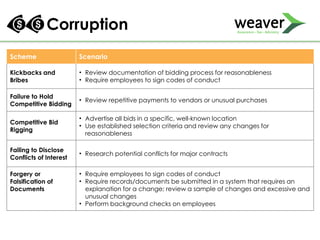
Corruption
Scheme Scenario
Kickbacks and
Bribes
• Review documentation of bidding process for reasonableness
• Require employees to sign codes of conduct
Failure to Hold
Competitive Bidding
• Review repetitive payments to vendors or unusual purchases
Competitive Bid
Rigging
• Advertise all bids in a specific, well-known location
• Use established selection criteria and review any changes for
reasonableness
Failing to Disclose
Conflicts of Interest
• Research potential conflicts for major contracts
Forgery or
Falsification of
Documents
• Require employees to sign codes of conduct
• Require records/documents be submitted in a system that requires an
explanation for a change; review a sample of changes and excessive and
unusual changes
• Perform background checks on employees
Financial Statement Fraud
Scheme Scenario
Inflating Balance
Sheet/Fund Balance
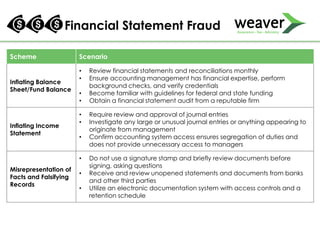
• Review financial statements and reconciliations monthly
• Ensure accounting management has financial expertise, perform
background checks, and verify credentials
• Become familiar with guidelines for federal and state funding
• Obtain a financial statement audit from a reputable firm
Inflating Income
Statement
• Require review and approval of journal entries
• Investigate any large or unusual journal entries or anything appearing to
originate from management
• Confirm accounting system access ensures segregation of duties and
does not provide unnecessary access to managers
Misrepresentation of
Facts and Falsifying
Records
• Do not use a signature stamp and briefly review documents before
signing, asking questions
• Receive and review unopened statements and documents from banks
and other third parties
• Utilize an electronic documentation system with access controls and a
retention schedule
Asset Misappropriation
Example – Payroll Fraud
Fraud Scenario
•A Payroll Manager was routing checks for terminated employees to
her own bank account. Internal Audit identified approximately
$50,000 in fraudulent payroll disbursements to this employee’s
account.
•Payroll was segregated from HR, however, the payroll manager had
access to modify employee profiles within the software. Additionally,
the payroll manager was responsible for approving the payroll
calculation and processing the check run, allowing for management
override of controls.
•No processes were in place to ensure segregation of duties. There was no
independent disbursement count, and the payroll manager was in
charge of reconciling the calculation to the approved hours and payroll
expense for each department.
Key Risks and Exposures
Asset Misappropriation
Example – Payroll Fraud
Lessons Learned
•The Payroll Manager was unwilling to change the existing process and
implement internal audit recommendations to segregate her
responsibilities for processing payroll.
•Auditor learned through interviewing HR personnel that the Benefits
Specialist had identified irregular transactions in the payroll system that
were entered by the Payroll Manager.
Necessary Controls
• An employee who is able to make changes to the employee master
file (add or delete employees or change compensation) should not
also be involved in the payroll process, including having access to the
payroll system or generating or distributing checks. A separate
employee should have been assigned this duty.
Corruption
Example – Kickback Arrangement
Fraud Scenario
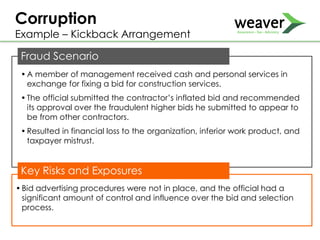
•A member of management received cash and personal services in
exchange for fixing a bid for construction services.
•The official submitted the contractor’s inflated bid and recommended
its approval over the fraudulent higher bids he submitted to appear to
be from other contractors.
•Resulted in financial loss to the organization, inferior work product, and
taxpayer mistrust.
•Bid advertising procedures were not in place, and the official had a
significant amount of control and influence over the bid and selection
process.
Key Risks and Exposures
Lessons Learned
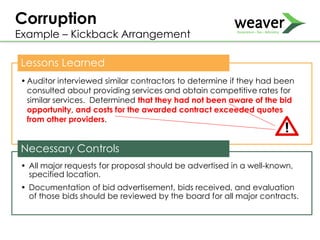
•Auditor interviewed similar contractors to determine if they had been
consulted about providing services and obtain competitive rates for
similar services. Determined that they had not been aware of the bid
opportunity, and costs for the awarded contract exceeded quotes
from other providers.
Necessary Controls
• All major requests for proposal should be advertised in a well-known,
specified location.
• Documentation of bid advertisement, bids received, and evaluation
of those bids should be reviewed by the board for all major contracts.
Corruption
Example – Kickback Arrangement
Financial Statement Fraud
Example – Understated Expenses
Fraud Scenario
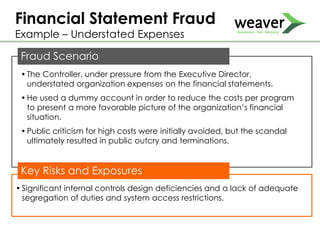
•The Controller, under pressure from the Executive Director,
understated organization expenses on the financial statements.
•He used a dummy account in order to reduce the costs per program
to present a more favorable picture of the organization’s financial
situation.
•Public criticism for high costs were initially avoided, but the scandal
ultimately resulted in public outcry and terminations.
•Significant internal controls design deficiencies and a lack of adequate
segregation of duties and system access restrictions.
Key Risks and Exposures
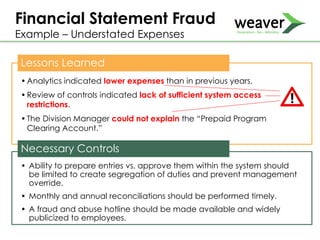
Lessons Learned
•Analytics indicated lower expenses than in previous years.
•Review of controls indicated lack of sufficient system access
restrictions.
•The Division Manager could not explain the “Prepaid Program
Clearing Account.”
•.
Necessary Controls
• Ability to prepare entries vs. approve them within the system should
be limited to create segregation of duties and prevent management
override.
• Monthly and annual reconciliations should be performed timely.
• A fraud and abuse hotline should be made available and widely
publicized to employees.
Financial Statement Fraud
Example – Understated Expenses
MITIGATING FRAUD RISK
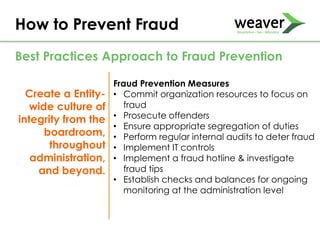
Create a Entity-
wide culture of
integrity from the
boardroom,
throughout
administration,
and beyond.
Fraud Prevention Measures
• Commit organization resources to focus on
fraud
• Prosecute offenders
• Ensure appropriate segregation of duties
• Perform regular internal audits to deter fraud
• Implement IT controls
• Implement a fraud hotline & investigate
fraud tips
• Establish checks and balances for ongoing
monitoring at the administration level
How to Prevent Fraud
Best Practices Approach to Fraud Prevention
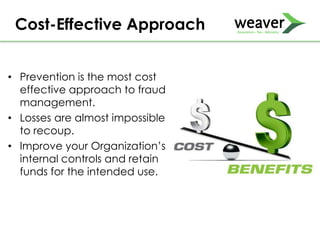
• Prevention is the most cost
effective approach to fraud
management.
• Losses are almost impossible
to recoup.
• Improve your Organization’s
internal controls and retain
funds for the intended use.
Cost-Effective Approach
• Segregation of duties
– Foundational element of prevention
– Establishes natural checks and balances
– Reduces errors
– Includes IT controls, access and
management
• Perceived opportunity is a common
driver
– Tone at the top
– Use a hotline - Investigate tips
– Segregation Of Duties is “built in”
– Fraud prevention as part of code of ethics
Key Internal Controls
Effective Fraud Detection
The Six Elements
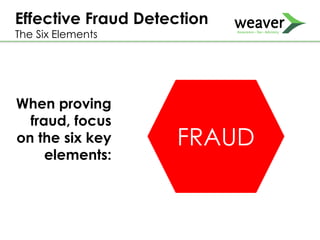
INTENT
MOTIVE
OPPORTUNITY
CONCEALMENT
REPETITIVE ACTS
COMPETENCYFRAUD
When proving
fraud, focus
on the six key
elements:
An increase in any
element in the fraud
triangle (or diamond)
increases the risks of
fraud.
Anti-fraud controls are
built to deter or prevent
the ability, incentive,
and opportunity to
commit fraud.
Fraud Risks
• The financial costs alone are staggering and a waste of
taxpayer money
– Fraud/theft of funds or other assets
– Cost of investigation
– Increase in accounting fees/audit fees/legal fees
– Court costs
• Long-term loss of confidence and trust in the organization,
officials, and board of directors
– Conveys the wrong message to employees and the public
– Economic impact to programs
• Unanticipated terminations
– Loss of employees
– Potential termination of officials
– Potential removal of members of the Board of Directors
• Loss of public investment and community funding
Impact on Organizations
Lack of proactive fraud management could threaten
your organization’s long-term goals:
• Being accountable for taxpayer dollars
• Maintaining public confidence and trust
• Managing growth
• Providing a positive learning environment for
students
• Providing a high-integrity work environment for
personnel
• Safeguarding the assets of the organization
• Protecting the reputation of the organization
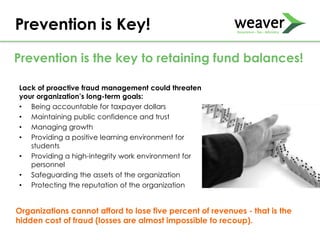
Prevention is Key!
Prevention is the key to retaining fund balances!
Organizations cannot afford to lose five percent of revenues - that is the
hidden cost of fraud (losses are almost impossible to recoup).
51
QUESTIONS?
Alyssa G. Martin, CPA, MBA | Partner, Risk Advisory Services
972.448.6975 | alyssa.martin@weaver.com

Fraud Risk and Control

  • 1.
    FRAUD RISK AND CONTROL Recognizingthe Prevalence of Risk and the Importance of Prevention
  • 2.
    Stop Fraud inits Tracks “Don’t wait until you are working on fraud detection within business operations.”
  • 3.
    • Partner-in-Charge ofWeaver’s Risk Advisory Services • 25+ years of experience in public accounting, including 17+ years of internal control process and risk management experience • Specializes in – Internal control compliance and monitoring – Risk and business management consulting – Fraud Prevention – Technology consulting – Operational analysis – Internal audit – IT audit Speaker Profile Alyssa G. Martin, CPA, MBA
  • 4.
    Session Agenda • Definitionof Fraud • Identifying Fraud Schemes • How Fraud Threatens Your Organization’s Existence/Credibility • Effective Elements of Fraud Prevention & Detection • Mitigating Fraud Risk
  • 5.
  • 6.
    “… any illegalact characterized by deceit, concealment, or violation of trust. What is Fraud? These acts are not dependent upon the threat of violence or physical force. Frauds are perpetrated by parties and organizations to obtain money, property, or services; to avoid payment or loss of services; or to secure personal or business advantage.” Fraud is defined as:
  • 7.
    • Intentional actvs. error or mistake • Ingenious schemes, limited only by human imagination • Gaining an advantage through false suggestions and suppression of truth • Using surprises, tricks or cunning, or any other unfair means The Nature of Fraud
  • 8.
    Fraud is a breachof trust, not an accident! • Fraud is an “intentional” act often involving detailed planning and concealment • Crooks “anticipate” the routine procedures; evidence is often fabricated • Exploits weaknesses in routine procedures or internal controls Not an Accident
  • 9.
    Fraudulent schemes are “engineered” (meticulouslydesigned) to perpetrate and conceal the theft, including an exit strategy complete with “fall guys” and “alibis” Fraud Engineering
  • 10.
    Fraud Impact inthe US % or $ Fraud Victims/Areas 5% Annual revenues lost of global entities $3.7 Trillion Potential projected global fraud loss $1,000,000 + Lost in over 24% of cases investigated Median Loss Fraud Victims/Areas $1,000,000 Financial statements $200,000 Corruption schemes $130,000 Asset misappropriation schemes *Source: Association of Certified Fraud Examiners (ACFE) 2014 Report to the Nation on Occupational Fraud and Abuse
  • 11.
    • Consistently meet/exceedbudget expectations • Close relationships with vendors/service providers • Related party transactions/conflicts of interest • Missing, altered, late documents • Relaxed oversight combined with friendly employee relations • Change in personal habits or behavior • Regular adjustments for defective items or shrinkage • Compensation tied to financial results • Material or frequent adjustments Red Flags Some of the warning signs…
  • 12.
    Behavioral Red Flags Source:2014 Association of Certified Fraud Examiners “Report to the Nation”
  • 13.
    Primary Fraud RiskFactors Source: 2014 Association of Certified Fraud Examiners “Report to the Nation”
  • 14.
  • 15.
    The Fraud Triangle Opportunity •The only factor completely controlled/prevented by an organization • Must gain access to assets/records INCENTIVE/PRESSURE INTENT/MOTIVE Incentive/Pressure • The more incentive, the easier it is to justify • Financial or personal problems, financial pressure, mental instability Rationalization • Ability to follow through and commit the fraud • Perpetrator has to make it “okay” internally to perform the fraudulent act An increase in any element in the triangle increases the risks of fraud. Anti-fraud controls are built to deter or prevent access and incentive for fraud.
  • 16.
    The Fraud Diamond Incentive •Leads the perpetrator to the door Rationalization • Coaxes the perpetrator to the door Opportunity • Opens the door for the perpetrator Capability • Enables the perpetrator to walk through the door A person’s “capability”, or personal traits, plays a key role in determining if a fraud will occur in the presence of pressure, opportunity and rationalization.
  • 17.
    Where Does FraudOccur? More than 75% of the frauds in the study were committed by individuals in 7 departments: Source: 2014 Association of Certified Fraud Examiners “Report to the Nation”
  • 18.
    Who Perpetrates Fraud? Perpetrators’Gender: 66.8% Male 33.2% Female Source: 2014 Association of Certified Fraud Examiners “Report to the Nation”
  • 19.
    How is FraudPerpetrated? Public Sector: >360 Government Cases: >140 | Education Cases: 80 | Nonprofit Cases: 40 Source: 2014 Association of Certified Fraud Examiners “Report to the Nation”
  • 20.
    Fraud Tree Source: 2014Association of Certified Fraud Examiners “Report to the Nation”
  • 21.
    Fraud Tree Source: 2014Association of Certified Fraud Examiners “Report to the Nation”
  • 22.
    • External agents –Lone hackers – Organized crime groups – Former employees • Internal agents – Regular staff – Executives – Contractors – Students • Partners – Suppliers – Vendors – Other third parties Don’t Forget: The IT Threat
  • 23.
    HOW FRAUD THREATENSYOUR ORGANIZATION’S EXISTENCE/CREDIBILITY
  • 24.
    Areas Most Proneto Fraud: • Cash Collections and Use of Funds • Purchasing and P – Cards • Expense Reporting and Travel • Payroll • Human Resources • Inventory (Transportation, Maintenance, Custodial, General Supplies) • Construction and Facilities • Technology Current State Despite aggressive prosecutions, fraud in the workplace is alive and well. Now more than ever it is imperative that organization’s consider fraud implications and implement preventative measures.
  • 25.
    Primary Fraud Categories Asset MisappropriationCorruption Financial Statement Fraud Theft or misuse of tangible and intangible assets Utilizing influence in business transactions to obtain a personal benefit Employee intentionally causes misstatement of material information in organization’s financial reports Most Common Less Frequent Most Rare
  • 26.
    Asset Misappropriation Scheme Scenario PayrollFraud • Payment to fictitious employees • Overpayment to existing employees - collusion • Issuing payroll checks to employees who no longer work for the organization Procurement Fraud • Payments to phantom vendors • Control bidding process Credit/Procurement Card Fraud • Use of Organization cards for personal purchases • Use of procurement cards to circumvent competitive bid requirements Travel/expense reimbursement Fraud • Reimbursement of undocumented expenses • Reimbursement for luxury accommodations • Reimbursement for travel expenses of employee's family members Revenue Skimming • Embezzlement of cash collections or funding Theft • Theft of materials, supplies, merchandise Misuse of Assets • Unauthorized use of organization assets • Inappropriate use of bond funds
  • 27.
    Corruption Scheme Scenario Kickbacks and Bribes •Cash or non-cash gifts from vendors accepted by personnel • Cash or non-cash gifts from vendors accepted by Board members • Awarding contracts based on side agreements Failure to Hold Competitive Bidding • Purchasing in smaller increments to avoid the bidding process Competitive Bid Rigging • Limiting advertisement of bid to preferred vendors • Related party transactions or dealing for personal benefit • Preferential treatment of vendors during the award selection process • Establishing selection criteria that give vendors an unfair advantage • Profiteering as a result of insider knowledge Failing to Disclose Conflicts of Interest • Awarding contracts to parties related to individuals involved in the decision making process Forgery or Falsification of Documents • Falsification of contract terms, operating results • Destruction or disappearance of records • Altering or creating documents with the intent to defraud
  • 28.
    Financial Statement Fraud SchemeScenario Inflating Balance Sheet/Fund Balance • Manipulating fund balances • Omission of material contingencies or subsequent events • Inappropriately carrying over unused federal or state funds from one year to the next Inflating Income Statement • Hiding losses/expenses • Falsifying revenue • Improper recording of the period expenses occur • Recording pending transactions as completed transactions Misrepresentation of Facts and Falsifying Records • Intentional reporting of inaccurate financial results • Falsification of official documents or reports • Public Information provides unsubstantiated favorable results • Internal memos give misleading information • Altering or creating documents with the intent to defraud • Omission of subsequent events • Destruction or disappearance of records
  • 29.
    EFFECTIVE ELEMENTS OFFRAUD PREVENTION & DETECTION
  • 30.
    Assessing Fraud Assessment andmonitoring is key to identification, prevention and detection. • Brainstorm to uncover possible fraud schemes and scenarios • Assess gaps in the business office that could be used for misappropriation • Evaluate control design and operations • Work now on prevention—rather than detection—and improve safeguards
  • 31.
    Fraud Risk Assessment Prioritizesignificant fraud risks Analyze root causes: incentives, pressures, opportunities, attitudes and rationalizations Identify how to address risk: accept, avoid, control or transfer? Test your solution Monitor risk factors
  • 32.
    Key Questions toAsk • Who can be the potential fraud perpetrator? • How might a fraud perpetrator exploit weaknesses in the system of controls? • How could a perpetrator override or circumvent controls? • What are the possibilities that can be used to hide fraud from detection? • What is the cost versus benefit for accepting, avoiding, controlling or transferring the risk? • What metrics and indicators exist that could indicate a need to investigate of examine a process for fraudulent activity? When determining fraud risk, ask the following questions:
  • 33.
    Asset Misappropriation Scheme Prevention/Detection PayrollFraud • Require supervisor approval of time sheets and approval of additional duty pay • Separate access to HR system from access to payroll processes • Designate a different employee to perform payroll reconciliations • Require IT to remove terminated employees from all systems, including time entry and payroll Procurement Fraud • Separate purchasing from the requisitioning department and require competitive bidding • Separate access to approved vendor list from generation of purchase orders • Require background checks and test vendors for exclusions • Match invoices to purchase orders and packing slips prior to payment Credit/ Procurement Card Fraud • Require documentation for procurement card purchases and review samples of purchases • Implement purchase vendor restrictions and MCCs • Place dollar limits on each card Travel/Expense Reimbursement Fraud • Review samples of travel expense reimbursement documentation and require prior supervisor approval for all travel
  • 34.
    Asset Misappropriation Scheme Prevention/Detection Revenue Skimming •Require that a second employee reconcile activity fund receipts to transaction detail and documentation • Require two people to participate in collections and deposit preparation • Require all cash be locked in a safe and daily deposit • Require that an accounting employee record reconciled cash collection transactions • For events, use pre-numbered tickets; have two people with cash at all times; and reconcile tickets to cash received Theft • Restrict access to cash/supplies, requiring advance request and authorization from the requisitioning department • Require requisition forms, and investigate unusually high supply use • Conduct inventory counts and investigate abnormalities Misuse of Assets • Initiate a fraud and abuse hotline • Utilize firewalls and inappropriate and unsafe website blockers
  • 35.
    Corruption Scheme Scenario Kickbacks and Bribes •Review documentation of bidding process for reasonableness • Require employees to sign codes of conduct Failure to Hold Competitive Bidding • Review repetitive payments to vendors or unusual purchases Competitive Bid Rigging • Advertise all bids in a specific, well-known location • Use established selection criteria and review any changes for reasonableness Failing to Disclose Conflicts of Interest • Research potential conflicts for major contracts Forgery or Falsification of Documents • Require employees to sign codes of conduct • Require records/documents be submitted in a system that requires an explanation for a change; review a sample of changes and excessive and unusual changes • Perform background checks on employees
  • 36.
    Financial Statement Fraud SchemeScenario Inflating Balance Sheet/Fund Balance • Review financial statements and reconciliations monthly • Ensure accounting management has financial expertise, perform background checks, and verify credentials • Become familiar with guidelines for federal and state funding • Obtain a financial statement audit from a reputable firm Inflating Income Statement • Require review and approval of journal entries • Investigate any large or unusual journal entries or anything appearing to originate from management • Confirm accounting system access ensures segregation of duties and does not provide unnecessary access to managers Misrepresentation of Facts and Falsifying Records • Do not use a signature stamp and briefly review documents before signing, asking questions • Receive and review unopened statements and documents from banks and other third parties • Utilize an electronic documentation system with access controls and a retention schedule
  • 37.
    Asset Misappropriation Example –Payroll Fraud Fraud Scenario •A Payroll Manager was routing checks for terminated employees to her own bank account. Internal Audit identified approximately $50,000 in fraudulent payroll disbursements to this employee’s account. •Payroll was segregated from HR, however, the payroll manager had access to modify employee profiles within the software. Additionally, the payroll manager was responsible for approving the payroll calculation and processing the check run, allowing for management override of controls. •No processes were in place to ensure segregation of duties. There was no independent disbursement count, and the payroll manager was in charge of reconciling the calculation to the approved hours and payroll expense for each department. Key Risks and Exposures
  • 38.
    Asset Misappropriation Example –Payroll Fraud Lessons Learned •The Payroll Manager was unwilling to change the existing process and implement internal audit recommendations to segregate her responsibilities for processing payroll. •Auditor learned through interviewing HR personnel that the Benefits Specialist had identified irregular transactions in the payroll system that were entered by the Payroll Manager. Necessary Controls • An employee who is able to make changes to the employee master file (add or delete employees or change compensation) should not also be involved in the payroll process, including having access to the payroll system or generating or distributing checks. A separate employee should have been assigned this duty.
  • 39.
    Corruption Example – KickbackArrangement Fraud Scenario •A member of management received cash and personal services in exchange for fixing a bid for construction services. •The official submitted the contractor’s inflated bid and recommended its approval over the fraudulent higher bids he submitted to appear to be from other contractors. •Resulted in financial loss to the organization, inferior work product, and taxpayer mistrust. •Bid advertising procedures were not in place, and the official had a significant amount of control and influence over the bid and selection process. Key Risks and Exposures
  • 40.
    Lessons Learned •Auditor interviewedsimilar contractors to determine if they had been consulted about providing services and obtain competitive rates for similar services. Determined that they had not been aware of the bid opportunity, and costs for the awarded contract exceeded quotes from other providers. Necessary Controls • All major requests for proposal should be advertised in a well-known, specified location. • Documentation of bid advertisement, bids received, and evaluation of those bids should be reviewed by the board for all major contracts. Corruption Example – Kickback Arrangement
  • 41.
    Financial Statement Fraud Example– Understated Expenses Fraud Scenario •The Controller, under pressure from the Executive Director, understated organization expenses on the financial statements. •He used a dummy account in order to reduce the costs per program to present a more favorable picture of the organization’s financial situation. •Public criticism for high costs were initially avoided, but the scandal ultimately resulted in public outcry and terminations. •Significant internal controls design deficiencies and a lack of adequate segregation of duties and system access restrictions. Key Risks and Exposures
  • 42.
    Lessons Learned •Analytics indicatedlower expenses than in previous years. •Review of controls indicated lack of sufficient system access restrictions. •The Division Manager could not explain the “Prepaid Program Clearing Account.” •. Necessary Controls • Ability to prepare entries vs. approve them within the system should be limited to create segregation of duties and prevent management override. • Monthly and annual reconciliations should be performed timely. • A fraud and abuse hotline should be made available and widely publicized to employees. Financial Statement Fraud Example – Understated Expenses
  • 43.
  • 44.
    Create a Entity- wideculture of integrity from the boardroom, throughout administration, and beyond. Fraud Prevention Measures • Commit organization resources to focus on fraud • Prosecute offenders • Ensure appropriate segregation of duties • Perform regular internal audits to deter fraud • Implement IT controls • Implement a fraud hotline & investigate fraud tips • Establish checks and balances for ongoing monitoring at the administration level How to Prevent Fraud Best Practices Approach to Fraud Prevention
  • 45.
    • Prevention isthe most cost effective approach to fraud management. • Losses are almost impossible to recoup. • Improve your Organization’s internal controls and retain funds for the intended use. Cost-Effective Approach
  • 46.
    • Segregation ofduties – Foundational element of prevention – Establishes natural checks and balances – Reduces errors – Includes IT controls, access and management • Perceived opportunity is a common driver – Tone at the top – Use a hotline - Investigate tips – Segregation Of Duties is “built in” – Fraud prevention as part of code of ethics Key Internal Controls
  • 47.
    Effective Fraud Detection TheSix Elements INTENT MOTIVE OPPORTUNITY CONCEALMENT REPETITIVE ACTS COMPETENCYFRAUD When proving fraud, focus on the six key elements:
  • 48.
    An increase inany element in the fraud triangle (or diamond) increases the risks of fraud. Anti-fraud controls are built to deter or prevent the ability, incentive, and opportunity to commit fraud. Fraud Risks
  • 49.
    • The financialcosts alone are staggering and a waste of taxpayer money – Fraud/theft of funds or other assets – Cost of investigation – Increase in accounting fees/audit fees/legal fees – Court costs • Long-term loss of confidence and trust in the organization, officials, and board of directors – Conveys the wrong message to employees and the public – Economic impact to programs • Unanticipated terminations – Loss of employees – Potential termination of officials – Potential removal of members of the Board of Directors • Loss of public investment and community funding Impact on Organizations
  • 50.
    Lack of proactivefraud management could threaten your organization’s long-term goals: • Being accountable for taxpayer dollars • Maintaining public confidence and trust • Managing growth • Providing a positive learning environment for students • Providing a high-integrity work environment for personnel • Safeguarding the assets of the organization • Protecting the reputation of the organization Prevention is Key! Prevention is the key to retaining fund balances! Organizations cannot afford to lose five percent of revenues - that is the hidden cost of fraud (losses are almost impossible to recoup).
  • 51.
    51 QUESTIONS? Alyssa G. Martin,CPA, MBA | Partner, Risk Advisory Services 972.448.6975 | alyssa.martin@weaver.com