
COMMERCIAL LAW
BUSINESS LAW
CORPORATE LAW
TRADE LAW
MADE BY:-
CHANDAN MISHRA
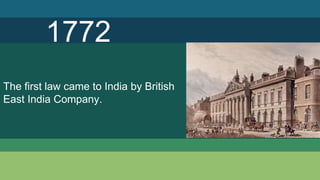
1772
The first law came to India by British
East India Company.
INTRODUCTION
Law is a system of rules that are created and enforced
through social or governmental institutions to
regulate behaviour. Law as a system helps regulate
and ensure that a community show respect, and
equality amongst themselves.
LAW OF
CONTRACT
1
DEFINITION
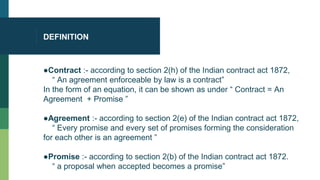
●Contract :- according to section 2(h) of the Indian contract act 1872,
“ An agreement enforceable by law is a contract”
In the form of an equation, it can be shown as under “ Contract = An
Agreement + Promise ”
●Agreement :- according to section 2(e) of the Indian contract act 1872,
“ Every promise and every set of promises forming the consideration
for each other is an agreement ”
●Promise :- according to section 2(b) of the Indian contract act 1872.
“ a proposal when accepted becomes a promise”
ESSENTIAL OF VALID
CONTRACT
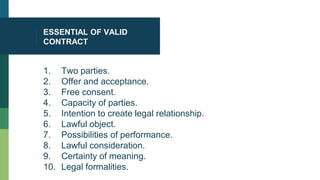
1. Two parties.
2. Offer and acceptance.
3. Free consent.
4. Capacity of parties.
5. Intention to create legal relationship.
6. Lawful object.
7. Possibilities of performance.
8. Lawful consideration.
9. Certainty of meaning.
10. Legal formalities.
TYPES OF
CONTARCT
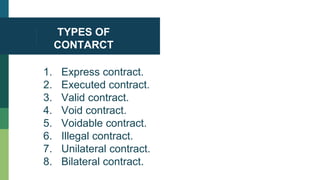
1. Express contract.
2. Executed contract.
3. Valid contract.
4. Void contract.
5. Voidable contract.
6. Illegal contract.
7. Unilateral contract.
8. Bilateral contract.
CONSEDERATION
[SECTION 2D]
●Consideration means quid-pro-quo i.e.
something in return.
●Something of value given by both parties to a
contract that induces them to enter into the
agreement to exchange mutual performances.
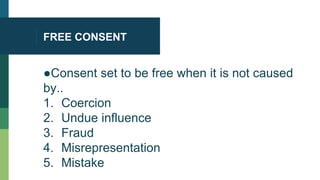
FREE CONSENT
●Consent set to be free when it is not caused
by..
1. Coercion
2. Undue influence
3. Fraud
4. Misrepresentation
5. Mistake
SPECIAL
CONTRACT
2
“LAW HAS NO EXCUSE’’
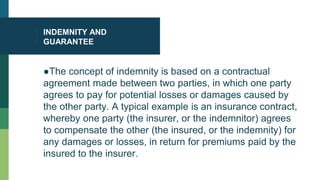
INDEMNITY AND
GUARANTEE
●The concept of indemnity is based on a contractual
agreement made between two parties, in which one party
agrees to pay for potential losses or damages caused by
the other party. A typical example is an insurance contract,
whereby one party (the insurer, or the indemnitor) agrees
to compensate the other (the insured, or the indemnity) for
any damages or losses, in return for premiums paid by the
insured to the insurer.
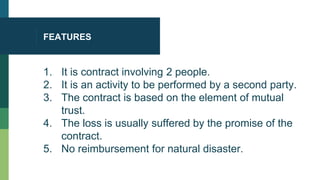
FEATURES
1. It is contract involving 2 people.
2. It is an activity to be performed by a second party.
3. The contract is based on the element of mutual
trust.
4. The loss is usually suffered by the promise of the
contract.
5. No reimbursement for natural disaster.
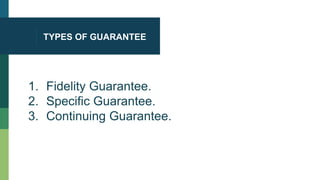
TYPES OF GUARANTEE
1. Fidelity Guarantee.
2. Specific Guarantee.
3. Continuing Guarantee.
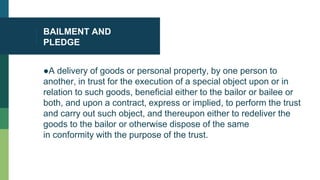
BAILMENT AND
PLEDGE
●A delivery of goods or personal property, by one person to
another, in trust for the execution of a special object upon or in
relation to such goods, beneficial either to the bailor or bailee or
both, and upon a contract, express or implied, to perform the trust
and carry out such object, and thereupon either to redeliver the
goods to the bailor or otherwise dispose of the same
in conformity with the purpose of the trust.
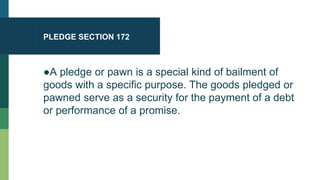
PLEDGE SECTION 172
●A pledge or pawn is a special kind of bailment of
goods with a specific purpose. The goods pledged or
pawned serve as a security for the payment of a debt
or performance of a promise.
SALE OF
GOODS ACT,
19303
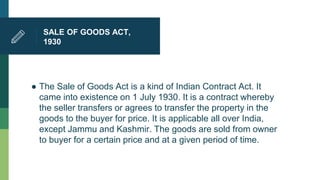
SALE OF GOODS ACT,
1930
● The Sale of Goods Act is a kind of Indian Contract Act. It
came into existence on 1 July 1930. It is a contract whereby
the seller transfers or agrees to transfer the property in the
goods to the buyer for price. It is applicable all over India,
except Jammu and Kashmir. The goods are sold from owner
to buyer for a certain price and at a given period of time.
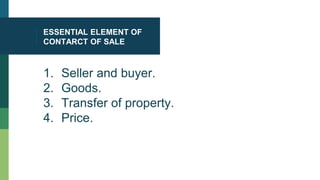
ESSENTIAL ELEMENT OF
CONTARCT OF SALE
1. Seller and buyer.
2. Goods.
3. Transfer of property.
4. Price.
GOODS AND THEIR
CLASSIFICATION
1. Existing goods.
2. Future goods.
3. Contingent goods.
CONDITION AND
WARRANTIES
●In a contract of sale, the subject matter is ‘goods’.
There are millions of sale transactions which occur in the
normal course, all around the world. There are certain
provisions which need to be fulfilled because it is
demanded by the contract. These prerequisites can
either be a condition or warranty.
● The condition is the fundamental stipulation of the
contract of sale whereas Warranty is an additional
stipulation.
PERFORMANCE OF
CONTRACT OF SALE
●Delivery of goods.
oActual.
oSymbolic.
AUCTION SALE
[SECTION 64]
(1) Where goods are put up for sale in lots, each lot is prima facie
deemed to be the subject of a separate contract of sale.
(2) The sale is complete when the auctioneer announces its completion
by the fall of the hammer or in other customary manner, and, until such
announcement is made, any bidder may retract his bid.
(3) A right to bid may be reserved expressly by or on behalf of the seller
and, where such rights is expressly so reserved, but not otherwise, the
seller or any one person on his behalf may, subject to the provisions
hereinafter contained, bid at the auction.
THE
CONSUMER
PROTECTION
ACT, 1986
4
THE CONSUMER
PROTECTION ACT, 1986
●Consumer Protection Act, 1986 is an Act of
the Parliament of India enacted in 1986 to protect the
interests of consumers in India. It makes provision for
the establishment of consumer councils and other
authorities for the settlement of consumers' disputes.
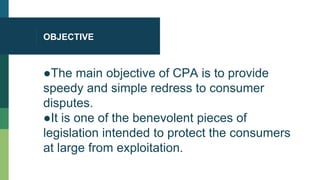
OBJECTIVE
●The main objective of CPA is to provide
speedy and simple redress to consumer
disputes.
●It is one of the benevolent pieces of
legislation intended to protect the consumers
at large from exploitation.
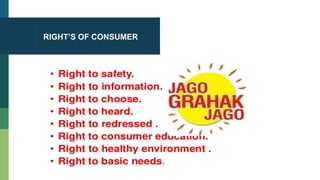
RIGHT’S OF CONSUMER
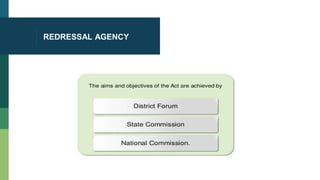
REDRESSAL AGENCY
PARTNERSHIP
ACT, 1932
5
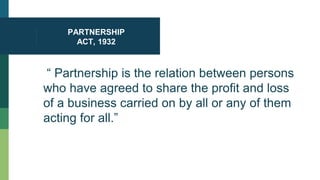
PARTNERSHIP
ACT, 1932
“ Partnership is the relation between persons
who have agreed to share the profit and loss
of a business carried on by all or any of them
acting for all.”
RIGHTS OF PARTNERS
1. Right to take part in management.
2. Right to express opinion.
3. Right to share profits.
4. Right in emergency.
5. Right to retirement.
DISSOLUTION OF
PARTNERSHIP
●The dissolution of a partnership is the process during
which the affairs of the partnership are wound up
(where the ongoing nature of the partnership relation
terminates). This should not be confused with the term
dissolution when applied to a limited company, which
is the event that marks the conclusion of the winding-
up.
THANK YOU
Any questions?

Commercial law

  • 1.
  • 2.
    BUSINESS LAW CORPORATE LAW TRADELAW MADE BY:- CHANDAN MISHRA
  • 3.
    1772 The first lawcame to India by British East India Company.
  • 5.
    INTRODUCTION Law is asystem of rules that are created and enforced through social or governmental institutions to regulate behaviour. Law as a system helps regulate and ensure that a community show respect, and equality amongst themselves.
  • 6.
  • 7.
    DEFINITION ●Contract :- accordingto section 2(h) of the Indian contract act 1872, “ An agreement enforceable by law is a contract” In the form of an equation, it can be shown as under “ Contract = An Agreement + Promise ” ●Agreement :- according to section 2(e) of the Indian contract act 1872, “ Every promise and every set of promises forming the consideration for each other is an agreement ” ●Promise :- according to section 2(b) of the Indian contract act 1872. “ a proposal when accepted becomes a promise”
  • 8.
    ESSENTIAL OF VALID CONTRACT 1.Two parties. 2. Offer and acceptance. 3. Free consent. 4. Capacity of parties. 5. Intention to create legal relationship. 6. Lawful object. 7. Possibilities of performance. 8. Lawful consideration. 9. Certainty of meaning. 10. Legal formalities.
  • 9.
    TYPES OF CONTARCT 1. Expresscontract. 2. Executed contract. 3. Valid contract. 4. Void contract. 5. Voidable contract. 6. Illegal contract. 7. Unilateral contract. 8. Bilateral contract.
  • 10.
    CONSEDERATION [SECTION 2D] ●Consideration meansquid-pro-quo i.e. something in return. ●Something of value given by both parties to a contract that induces them to enter into the agreement to exchange mutual performances.
  • 11.
    FREE CONSENT ●Consent setto be free when it is not caused by.. 1. Coercion 2. Undue influence 3. Fraud 4. Misrepresentation 5. Mistake
  • 12.
  • 13.
    “LAW HAS NOEXCUSE’’
  • 14.
    INDEMNITY AND GUARANTEE ●The conceptof indemnity is based on a contractual agreement made between two parties, in which one party agrees to pay for potential losses or damages caused by the other party. A typical example is an insurance contract, whereby one party (the insurer, or the indemnitor) agrees to compensate the other (the insured, or the indemnity) for any damages or losses, in return for premiums paid by the insured to the insurer.
  • 15.
    FEATURES 1. It iscontract involving 2 people. 2. It is an activity to be performed by a second party. 3. The contract is based on the element of mutual trust. 4. The loss is usually suffered by the promise of the contract. 5. No reimbursement for natural disaster.
  • 16.
    TYPES OF GUARANTEE 1.Fidelity Guarantee. 2. Specific Guarantee. 3. Continuing Guarantee.
  • 17.
    BAILMENT AND PLEDGE ●A deliveryof goods or personal property, by one person to another, in trust for the execution of a special object upon or in relation to such goods, beneficial either to the bailor or bailee or both, and upon a contract, express or implied, to perform the trust and carry out such object, and thereupon either to redeliver the goods to the bailor or otherwise dispose of the same in conformity with the purpose of the trust.
  • 18.
    PLEDGE SECTION 172 ●Apledge or pawn is a special kind of bailment of goods with a specific purpose. The goods pledged or pawned serve as a security for the payment of a debt or performance of a promise.
  • 19.
  • 20.
    SALE OF GOODSACT, 1930 ● The Sale of Goods Act is a kind of Indian Contract Act. It came into existence on 1 July 1930. It is a contract whereby the seller transfers or agrees to transfer the property in the goods to the buyer for price. It is applicable all over India, except Jammu and Kashmir. The goods are sold from owner to buyer for a certain price and at a given period of time.
  • 21.
    ESSENTIAL ELEMENT OF CONTARCTOF SALE 1. Seller and buyer. 2. Goods. 3. Transfer of property. 4. Price.
  • 22.
    GOODS AND THEIR CLASSIFICATION 1.Existing goods. 2. Future goods. 3. Contingent goods.
  • 23.
    CONDITION AND WARRANTIES ●In acontract of sale, the subject matter is ‘goods’. There are millions of sale transactions which occur in the normal course, all around the world. There are certain provisions which need to be fulfilled because it is demanded by the contract. These prerequisites can either be a condition or warranty. ● The condition is the fundamental stipulation of the contract of sale whereas Warranty is an additional stipulation.
  • 24.
    PERFORMANCE OF CONTRACT OFSALE ●Delivery of goods. oActual. oSymbolic.
  • 25.
    AUCTION SALE [SECTION 64] (1)Where goods are put up for sale in lots, each lot is prima facie deemed to be the subject of a separate contract of sale. (2) The sale is complete when the auctioneer announces its completion by the fall of the hammer or in other customary manner, and, until such announcement is made, any bidder may retract his bid. (3) A right to bid may be reserved expressly by or on behalf of the seller and, where such rights is expressly so reserved, but not otherwise, the seller or any one person on his behalf may, subject to the provisions hereinafter contained, bid at the auction.
  • 26.
  • 27.
    THE CONSUMER PROTECTION ACT,1986 ●Consumer Protection Act, 1986 is an Act of the Parliament of India enacted in 1986 to protect the interests of consumers in India. It makes provision for the establishment of consumer councils and other authorities for the settlement of consumers' disputes.
  • 28.
    OBJECTIVE ●The main objectiveof CPA is to provide speedy and simple redress to consumer disputes. ●It is one of the benevolent pieces of legislation intended to protect the consumers at large from exploitation.
  • 29.
  • 30.
  • 31.
  • 32.
    PARTNERSHIP ACT, 1932 “ Partnershipis the relation between persons who have agreed to share the profit and loss of a business carried on by all or any of them acting for all.”
  • 33.
    RIGHTS OF PARTNERS 1.Right to take part in management. 2. Right to express opinion. 3. Right to share profits. 4. Right in emergency. 5. Right to retirement.
  • 34.
    DISSOLUTION OF PARTNERSHIP ●The dissolutionof a partnership is the process during which the affairs of the partnership are wound up (where the ongoing nature of the partnership relation terminates). This should not be confused with the term dissolution when applied to a limited company, which is the event that marks the conclusion of the winding- up.
  • 35.