Artificial Intelligence during
COVID-19
Dr. Shazia Iqbal
Assistant Professor
Director of Medical Education Unit
Vision college of medicine Riyadh
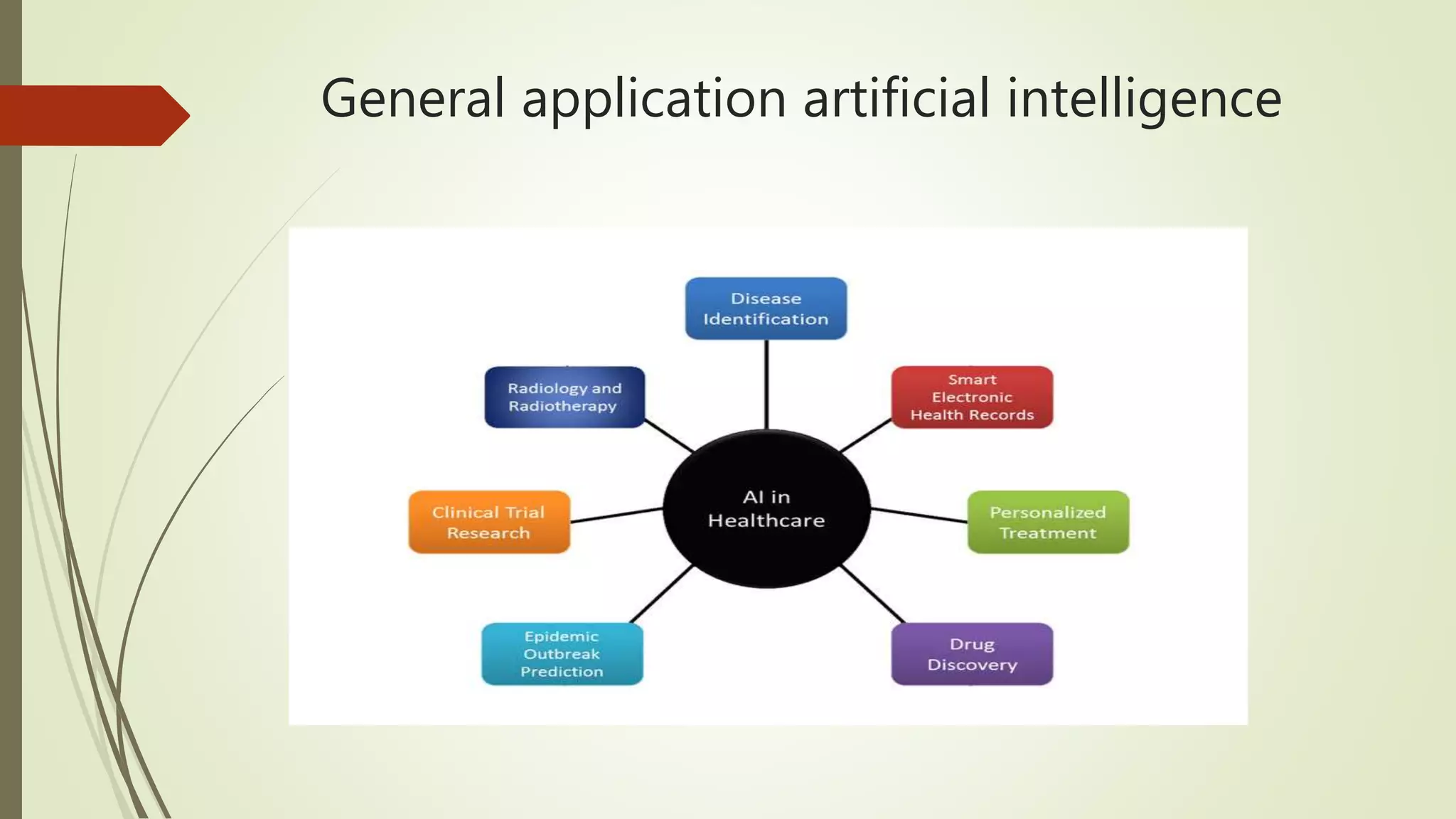
General application artificial intelligence
INTRODUCTION
 The world has been coping with stressful times and Artificial
Intelligence technology is a ray of hope that would help us to fight
the pandemic with high spirits.
 The measures, if taken seriously, can do wonders while coming out of
the bright side of the tunnel.
 This might turn out to be a revolutionizing moment in the field of
Artificial Intelligence (AI )technology as its implications in these times
might result in excessive use of it and thus, furthering the increase of
career scope in this domain.
Covid -19 and artificial intelligence
 There are six areas where AI can contribute to the fight against
COVID-19:
 i) early warnings and alerts
 ii) tracking and prediction
 iii) data dashboards
 iv) diagnosis and prognosis
 v) treatments, and cures
 vi) social control.
Development of drugs and vaccines:
 Artificial Intelligence (AI) is used for drug research by analyzing the available
data on COVID-19.
 It is useful for drug delivery design and development.
 This technology is used in speeding up drug testing in real-time, where
standard testing takes plenty of time and hence helps to accelerate this
process significantly, which may not be possible by a human .
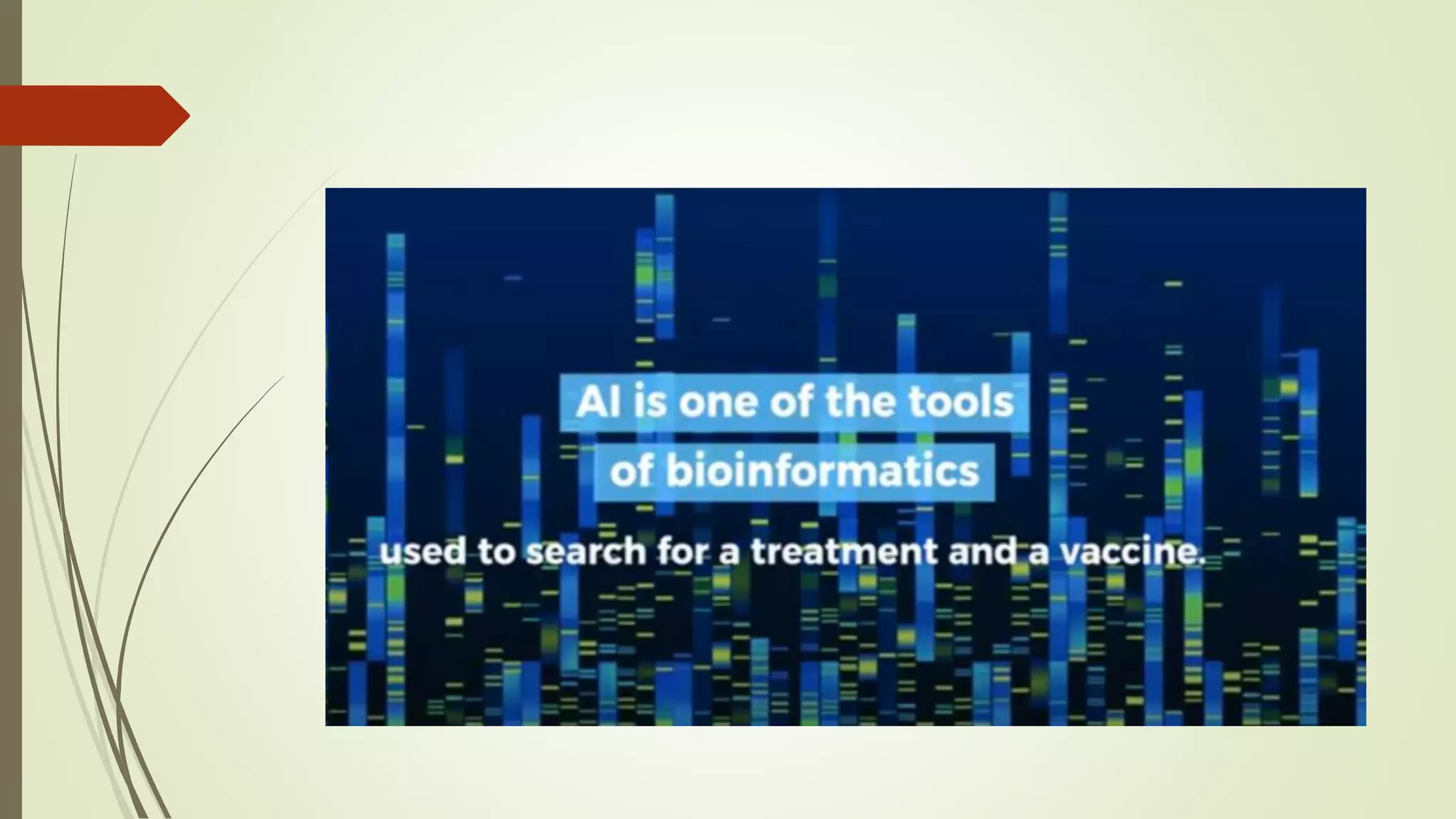
 It can help to identify useful drugs for the treatment of COVID-19 patients. It
has become a powerful tool for diagnostic test designs and vaccination
development .
 AI helps in developing vaccines and treatments at much of faster rate than
usual and is also helpful for clinical trials during the development of the
vaccine.
Disease Monitoring
 Since the virus is crucial enough to be spread through human contact
and migration, it has become imperative that we keep surveillance
around the world.
 Artificial Intelligence (AI )can build an intelligent platform for
automatic monitoring and prediction of the spread of this virus.
 A neural network can also be developed to extract the visual features
of this disease, and this would help in proper monitoring and
treatment of the affected individuals .
 It has the capability of providing day-to-day updates of the patients
and also to provide solutions to be followed in COVID-19 pandemic.
Contact tracing of the individuals
 Artificial Intelligence (AI) can help analyze the level of infection by this virus
identifying the clusters and ‘hot spots’ and can successfully do the contact
tracing of the individuals and also to monitor them. It can predict the future
course of this disease and likely reappearance.
Projection of cases and mortality
 This technology can track and forecast the nature of the virus from the
available data, social media and media platforms, about the risks of the
infection and its likely spread. Further, it can predict the number of positive
cases and death in any region. Artificial Intelligence (AI )can help identify the
most vulnerable regions, people and countries and take measures
accordingly.
Reducing the workload of healthcare
workers
 Due to a sudden and massive increase in the numbers of patients during
COVID-19 pandemic, healthcare professionals have a very high workload.
Here, Artificial Intelligence (AI )is used to reduce the workload of healthcare
workers .
 It helps in early diagnosis and providing treatment at an early stage using
digital approaches and decision science, offers the best training to students
and doctors regarding this new disease .
 Artificial Intelligence (AI) can impact future patient care and address more
potential challenges which reduce the workload of the doctors.
Deployment of Robots and Drones
 One of the important revelations of AI has been the
manufacturing of robots and drones.
 The drones are also used to keep a check on the larger
audience and to disinfect public places.
 Robots have been deployed for facilitating food and
medication deliveries.
 This has been helpful in providing risk-free medical care
for healthcare workers and to contain the spread of virus
amongst humans.
Curative Drug Research
 Artificial Intelligence has marked a difference by using the algorithms
to develop the molecular structure to prepare curable drugs for
fighting COVID-19 in the coming future.
 artificial intelligence (AI)can be helpful in the manufacturing of
antibodies and vaccines.
 Google’s artificial intelligence (AI )company, DeepMind has initiated
to process out the structural models of proteins in order to be of
assistance in the understanding of the nitty-gritty of the virus.
Video 1
Summary
 artificial intelligence (AI )is being successfully used
 identification of disease clusters
 monitoring of cases
 prediction of the future outbreaks
 mortality risk
 diagnosis of COVID-19
 disease management by resource allocation
 Facilitating training, record maintenance and pattern recognition for
studying the disease trend.
Video 2
Conclusion
 1-Artificial Intelligence is an upcoming and useful tool to identify early infections
due to coronavirus and also helps in monitoring the condition of the infected
patients.
 2- It can significantly improve treatment consistency and decision making by
developing useful algorithms.
 3- Artificial Intelligence (AI )is not only helpful in the treatment of COVID-
19infected patients but also for their proper health monitoring. It can track the
crisis of COVID-19 at different scales such as medical, molecular and
epidemiological applications.
 4-It is also helpful to facilitate the research on this virus using analyzing the
available data.
 5-Artificial Intelligence (AI) can help in developing proper treatment regimens,
prevention strategies, drug and vaccine development.
REFFERENCES
 1-Artificial Intelligence (AI) applications for COVID-19 pandemic. Raju
Vaishya a, Mohd Javaid b, *, Ibrahim Haleem Khan c, Abid Haleem .Diabetes
& Metabolic Syndrome: Clinical Research & Reviews Volume 14, Issue 4, July–
August 2020, Pages 337-339
 2-Application of Artificial Intelligence in COVID-19 drug repurposing Sweta
Mohanty a, Md Harun AI Rashid b, Mayank Mridul c, Chandana Mohanty a, *,
Swati Swayamsiddha d. Diabetes & Metabolic Syndrome: Clinical Research &
Reviews Volume 14, Issue 5, September–October 2020, Pages 1027-1031
 3-Applications of machine learning and artificial intelligence for Covid-19 (SARS-
CoV-2) pandemic: A review Samuel Lalmuanawmaa,∗, Jamal Hussaina , Lalrinfela
Chhakchhuak b. Chaos, Solitons & FractalsVolume 139, October 2020, 110059.
 4-The role of artificial intelligence in tackling COVID-19. Neelima Arora*,1, Amit K
Banerjee2 & Mangamoori L Narasu1. 10.2217/fvl-2020-0130 C 2020 Future
Medicine Ltd.
 5-Approaches Based on Artificial Intelligence and the Internet of Intelligent
Things to Prevent the Spread of COVID-19: Scoping Review. Aya Sedky Adly, MSc,
PhD,1 Afnan Sedky Adly, MSc,2,3 and Mahmoud Sedky Adly, DDS, MSc, HDD. J
Med Internet Res. 2020 Aug; 22(8): e19104.
THANK
YOU

Artificial intelligence during covid 19 April 2021

  • 1.
    Artificial Intelligence during COVID-19 Dr.Shazia Iqbal Assistant Professor Director of Medical Education Unit Vision college of medicine Riyadh
  • 3.
  • 4.
    INTRODUCTION  The worldhas been coping with stressful times and Artificial Intelligence technology is a ray of hope that would help us to fight the pandemic with high spirits.  The measures, if taken seriously, can do wonders while coming out of the bright side of the tunnel.  This might turn out to be a revolutionizing moment in the field of Artificial Intelligence (AI )technology as its implications in these times might result in excessive use of it and thus, furthering the increase of career scope in this domain.
  • 5.
    Covid -19 andartificial intelligence  There are six areas where AI can contribute to the fight against COVID-19:  i) early warnings and alerts  ii) tracking and prediction  iii) data dashboards  iv) diagnosis and prognosis  v) treatments, and cures  vi) social control.
  • 7.
    Development of drugsand vaccines:  Artificial Intelligence (AI) is used for drug research by analyzing the available data on COVID-19.  It is useful for drug delivery design and development.  This technology is used in speeding up drug testing in real-time, where standard testing takes plenty of time and hence helps to accelerate this process significantly, which may not be possible by a human .  It can help to identify useful drugs for the treatment of COVID-19 patients. It has become a powerful tool for diagnostic test designs and vaccination development .  AI helps in developing vaccines and treatments at much of faster rate than usual and is also helpful for clinical trials during the development of the vaccine.
  • 8.
    Disease Monitoring  Sincethe virus is crucial enough to be spread through human contact and migration, it has become imperative that we keep surveillance around the world.  Artificial Intelligence (AI )can build an intelligent platform for automatic monitoring and prediction of the spread of this virus.  A neural network can also be developed to extract the visual features of this disease, and this would help in proper monitoring and treatment of the affected individuals .  It has the capability of providing day-to-day updates of the patients and also to provide solutions to be followed in COVID-19 pandemic.
  • 9.
    Contact tracing ofthe individuals  Artificial Intelligence (AI) can help analyze the level of infection by this virus identifying the clusters and ‘hot spots’ and can successfully do the contact tracing of the individuals and also to monitor them. It can predict the future course of this disease and likely reappearance.
  • 11.
    Projection of casesand mortality  This technology can track and forecast the nature of the virus from the available data, social media and media platforms, about the risks of the infection and its likely spread. Further, it can predict the number of positive cases and death in any region. Artificial Intelligence (AI )can help identify the most vulnerable regions, people and countries and take measures accordingly.
  • 12.
    Reducing the workloadof healthcare workers  Due to a sudden and massive increase in the numbers of patients during COVID-19 pandemic, healthcare professionals have a very high workload. Here, Artificial Intelligence (AI )is used to reduce the workload of healthcare workers .  It helps in early diagnosis and providing treatment at an early stage using digital approaches and decision science, offers the best training to students and doctors regarding this new disease .  Artificial Intelligence (AI) can impact future patient care and address more potential challenges which reduce the workload of the doctors.
  • 13.
    Deployment of Robotsand Drones  One of the important revelations of AI has been the manufacturing of robots and drones.  The drones are also used to keep a check on the larger audience and to disinfect public places.  Robots have been deployed for facilitating food and medication deliveries.  This has been helpful in providing risk-free medical care for healthcare workers and to contain the spread of virus amongst humans.
  • 14.
    Curative Drug Research Artificial Intelligence has marked a difference by using the algorithms to develop the molecular structure to prepare curable drugs for fighting COVID-19 in the coming future.  artificial intelligence (AI)can be helpful in the manufacturing of antibodies and vaccines.  Google’s artificial intelligence (AI )company, DeepMind has initiated to process out the structural models of proteins in order to be of assistance in the understanding of the nitty-gritty of the virus.
  • 15.
  • 18.
    Summary  artificial intelligence(AI )is being successfully used  identification of disease clusters  monitoring of cases  prediction of the future outbreaks  mortality risk  diagnosis of COVID-19  disease management by resource allocation  Facilitating training, record maintenance and pattern recognition for studying the disease trend.
  • 19.
  • 20.
    Conclusion  1-Artificial Intelligenceis an upcoming and useful tool to identify early infections due to coronavirus and also helps in monitoring the condition of the infected patients.  2- It can significantly improve treatment consistency and decision making by developing useful algorithms.  3- Artificial Intelligence (AI )is not only helpful in the treatment of COVID- 19infected patients but also for their proper health monitoring. It can track the crisis of COVID-19 at different scales such as medical, molecular and epidemiological applications.  4-It is also helpful to facilitate the research on this virus using analyzing the available data.  5-Artificial Intelligence (AI) can help in developing proper treatment regimens, prevention strategies, drug and vaccine development.
  • 21.
    REFFERENCES  1-Artificial Intelligence(AI) applications for COVID-19 pandemic. Raju Vaishya a, Mohd Javaid b, *, Ibrahim Haleem Khan c, Abid Haleem .Diabetes & Metabolic Syndrome: Clinical Research & Reviews Volume 14, Issue 4, July– August 2020, Pages 337-339  2-Application of Artificial Intelligence in COVID-19 drug repurposing Sweta Mohanty a, Md Harun AI Rashid b, Mayank Mridul c, Chandana Mohanty a, *, Swati Swayamsiddha d. Diabetes & Metabolic Syndrome: Clinical Research & Reviews Volume 14, Issue 5, September–October 2020, Pages 1027-1031
  • 22.
     3-Applications ofmachine learning and artificial intelligence for Covid-19 (SARS- CoV-2) pandemic: A review Samuel Lalmuanawmaa,∗, Jamal Hussaina , Lalrinfela Chhakchhuak b. Chaos, Solitons & FractalsVolume 139, October 2020, 110059.  4-The role of artificial intelligence in tackling COVID-19. Neelima Arora*,1, Amit K Banerjee2 & Mangamoori L Narasu1. 10.2217/fvl-2020-0130 C 2020 Future Medicine Ltd.  5-Approaches Based on Artificial Intelligence and the Internet of Intelligent Things to Prevent the Spread of COVID-19: Scoping Review. Aya Sedky Adly, MSc, PhD,1 Afnan Sedky Adly, MSc,2,3 and Mahmoud Sedky Adly, DDS, MSc, HDD. J Med Internet Res. 2020 Aug; 22(8): e19104.
  • 23.