METHODS OF CONTRACEPTION
HORMONAL CONTRACEPTION
• Combined hormonal contraception
• Progesterone only contraceptives
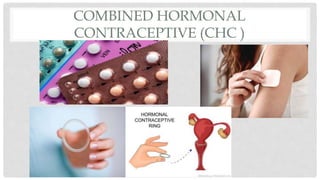
COMBINED HORMONAL
CONTRACEPTIVE (CHC )
COMBINED HORMONAL CONTRACEPTION
• Contain two hormones: an oestrogen and a progestogen
• Available as oral pills, a transdermal patch and as a vaginal ring.
• Work by inhibition of ovulation via negative feedback of oestrogen
and progestogen by suppression of follicle-stimulating hormone (FSH)
and luteinizing hormone (LH).
COMBINED HORMONAL CONTRACEPTION
COCPs
• are ‘low dose’ and contain ethinyle oestradiol in a dose of 15–35 μg
• 21 pills followed by a 7-day pill-free interval
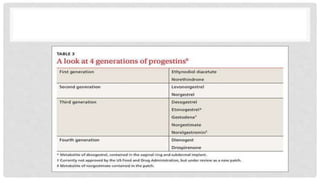
• The progestogens that are used in currently available pills are often referred to
as 2nd-generation, 3rd-generation and 4th-generation progestogens
• Third and fourth generation are associated with a higher risk of venous
thrombosis than pills containing second-generation progestogens.
COMBINED HORMONAL CONTRACEPTION
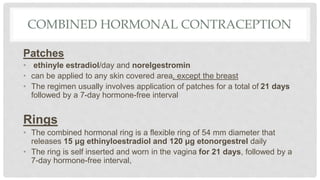
Patches
• ethinyle estradiol/day and norelgestromin
• can be applied to any skin covered area, except the breast
• The regimen usually involves application of patches for a total of 21 days
followed by a 7-day hormone-free interval
Rings
• The combined hormonal ring is a flexible ring of 54 mm diameter that
releases 15 μg ethinyloestradiol and 120 μg etonorgestrel daily
• The ring is self inserted and worn in the vagina for 21 days, followed by a
7-day hormone-free interval,
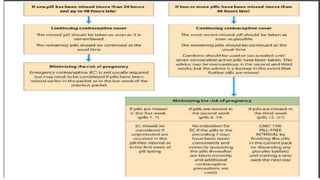
A MISSED PILL !
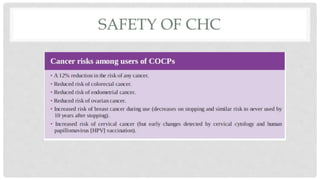
SAFETY OF CHC
• CHC (pill, patch and ring) increases the tendency to thrombosis in both the
venous and arterial circulation.
• The adverse effect on venous thrombosis is related to the dose of
oestrogen and appears less with combined pills (greatest during the first
year of use)
• Arterial disease is much less common but more serious. It is related to age,
and the risk is strongly influenced by smoking.
SAFETY OF CHC
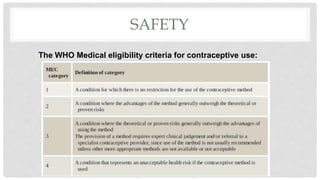
SAFETY
The WHO Medical eligibility criteria for contraceptive use:
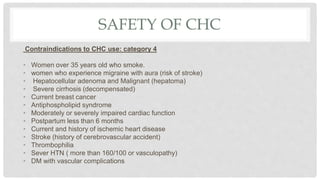
SAFETY OF CHC
Contraindications to CHC use: category 4
• Women over 35 years old who smoke.
• women who experience migraine with aura (risk of stroke)
• Hepatocellular adenoma and Malignant (hepatoma)
• Severe cirrhosis (decompensated)
• Current breast cancer
• Antiphospholipid syndrome
• Moderately or severely impaired cardiac function
• Postpartum less than 6 months
• Current and history of ischemic heart disease
• Stroke (history of cerebrovascular accident)
• Thrombophilia
• Sever HTN ( more than 160/100 or vasculopathy)
• DM with vascular complications
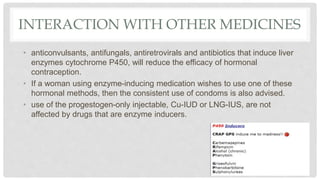
INTERACTION WITH OTHER MEDICINES
• anticonvulsants, antifungals, antiretrovirals and antibiotics that induce liver
enzymes cytochrome P450, will reduce the efficacy of hormonal
contraception.
• If a woman using enzyme-inducing medication wishes to use one of these
hormonal methods, then the consistent use of condoms is also advised.
• use of the progestogen-only injectable, Cu-IUD or LNG-IUS, are not
affected by drugs that are enzyme inducers.
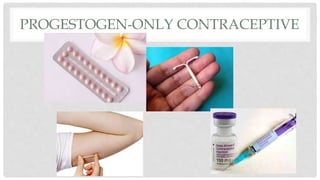
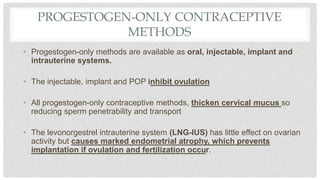
PROGESTOGEN-ONLY CONTRACEPTIVE
METHODS
• Progestogen-only methods are available as oral, injectable, implant and
intrauterine systems.
• The injectable, implant and POP inhibit ovulation
• All progestogen-only contraceptive methods, thicken cervical mucus so
reducing sperm penetrability and transport
• The levonorgestrel intrauterine system (LNG-IUS) has little effect on ovarian
activity but causes marked endometrial atrophy, which prevents
implantation if ovulation and fertilization occur.
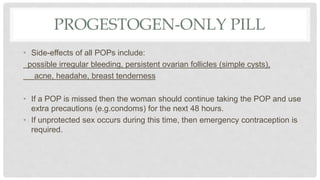
PROGESTOGEN-ONLY PILL
• Side-effects of all POPs include:
possible irregular bleeding, persistent ovarian follicles (simple cysts),
acne, headahe, breast tenderness
• If a POP is missed then the woman should continue taking the POP and use
extra precautions (e.g.condoms) for the next 48 hours.
• If unprotected sex occurs during this time, then emergency contraception is
required.
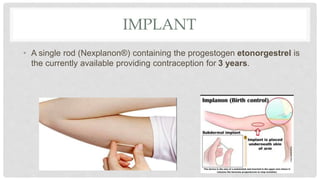
IMPLANT
• A single rod (Nexplanon®) containing the progestogen etonorgestrel is
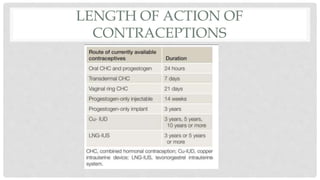
the currently available providing contraception for 3 years.
PROGESTOGEN-ONLY INJECTABLE
• The most commonly used injectable worldwide is a depot injection of
medroxyprogesterone acetate (IM)
• inhibition of ovulation
• injection interval every 12–14 weeks
• over 50% amenorrhoea rates at 1 year
• Intermenstrual spotting
• Risk of decrease bone density *
• Delay of fertility**
PROGESTOGEN-ONLY INJECTABLE
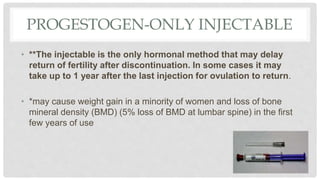
• **The injectable is the only hormonal method that may delay
return of fertility after discontinuation. In some cases it may
take up to 1 year after the last injection for ovulation to return.
• *may cause weight gain in a minority of women and loss of bone
mineral density (BMD) (5% loss of BMD at lumbar spine) in the first
few years of use
PROGESTOGEN-RELEASING INTRAUTERINE
SYSTEM
• Release the progestogen levonorgestrel into the uterus
• Licensed for 5 years for contraceptive use
• Works by endometrial thinning and prevent implantation.
• Its progestogenic effect on thickening the cervical mucus also impedes
entry of sperm.
• Does not prevent ovulation.
• Many women experience unpredictable bleeding
(non contraceptive benefits )
Effective for treating dysmenorrhoea, pain associated with endometriosis and
adenomyosis and protecting the endometrium against hyperplasia.
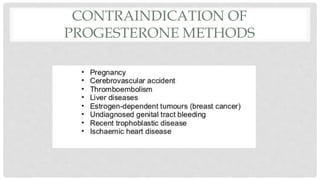
CONTRAINDICATION OF
PROGESTERONE METHODS
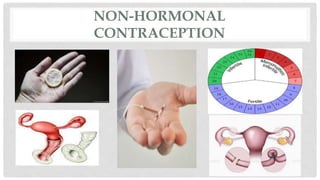
NON-HORMONAL
CONTRACEPTION
INTRAUTERINE CONTRACEPTION
• Intrauterine methods of contraception include the copper intrauterine device
Cu-IUD and the LNG-IUS
• The Cu-IUD duration of use is between 3 and 10 years.
• IUDs stimulate an inflammatory reaction in the uterus….toxic to both
sperm and egg.
BLEEDING PATTERN WITH IUD
• women with the LNG-IUS tend to experience lighter, less painful menses,
women using the Cu-IUD may experience more painful or heavier
menses
Pregnancy on top of IUCD
• If women become pregnant with an IUD in situ, an ultrasound scan should
be conducted to exclude ectopic pregnancy.
• IUDs should be removed before 12 weeks’ gestation (thread is seen )
• There’s greater risk of miscarriage, preterm delivery, septic abortion and
chorioamnionitis if the device is left in situ
INSERTION OF IUD
Insertion is associated with the following risks:
1. Perforation
2. Expulsion
3. Infection
4. Missing’ threads.
CONTRAINDICATIONS TO IUCD
BARRIER CONTRACEPTION
Condoms
• They protect against STIs including HIV
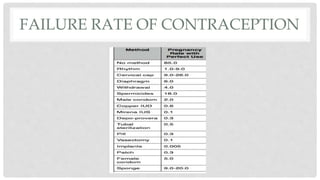
• Typical failure rates 24%
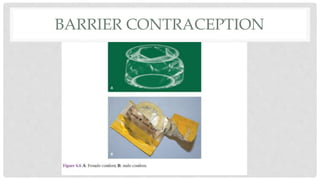
• The female condom is a lubricated polyurethane condom that is inserted
into the vagina. It also protects against STIs
BARRIER CONTRACEPTION
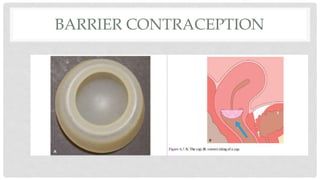
• Diaphragm and cap
• These are latex or non-latex devices that are inserted into the vagina to
prevent passage of sperm to the cervix
• Often used in conjunction with a spermicide
• Typical failure rates in the region of 18%
• Associated with increased vaginal discharge and urinary tract infections
BARRIER CONTRACEPTION
FEMALE STERILIZATION
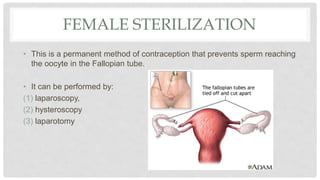
• This is a permanent method of contraception that prevents sperm reaching
the oocyte in the Fallopian tube.
• It can be performed by:
(1) laparoscopy,
(2) hysteroscopy
(3) laparotomy
FEMALE STERILIZATION
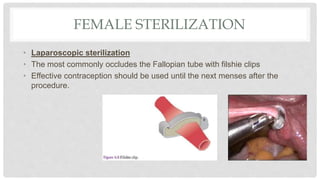
• Laparoscopic sterilization
• The most commonly occludes the Fallopian tube with filshie clips
• Effective contraception should be used until the next menses after the
procedure.
FEMALE STERILIZATION
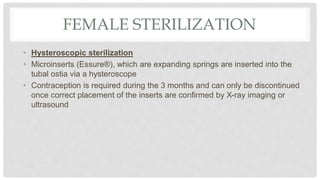
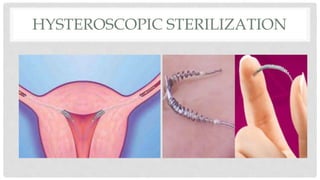
• Hysteroscopic sterilization
• Microinserts (Essure®), which are expanding springs are inserted into the
tubal ostia via a hysteroscope
• Contraception is required during the 3 months and can only be discontinued
once correct placement of the inserts are confirmed by X-ray imaging or
ultrasound
HYSTEROSCOPIC STERILIZATION
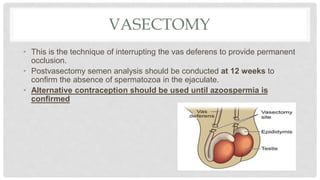
VASECTOMY
• This is the technique of interrupting the vas deferens to provide permanent
occlusion.
• Postvasectomy semen analysis should be conducted at 12 weeks to
confirm the absence of spermatozoa in the ejaculate.
• Alternative contraception should be used until azoospermia is
confirmed
FERTILITY AWARENESS-BASED METHODS
(FAB)
• Formerly known as ‘natural family planning’,
• FAB rely on the signs and symptoms of menstrual cycle that define the
fertile period, with avoidance of intercourse at that time.
• Typical failure rates are high.
• Types:
1. Calendar or rhythm method
2. Temperature method
3. Cervical mucus method
4. Cervical palpation
5. Personal fertility monitor
LACTATIONAL AMENORRHOEA
• If a mother is within the first 6 months postpartum, is amenorrhoeic and
is fully or nearly fully breastfeeding,
• the risk of pregnancy is about 2%. (98 % prevention)
• After 6 months, or if menses occur or breastfeeding reduced, then another
method of contraception must be used.
LENGTH OF ACTION OF
CONTRACEPTIONS
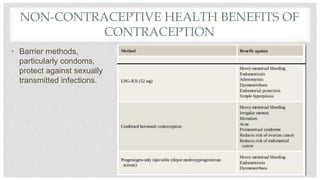
NON-CONTRACEPTIVE HEALTH BENEFITS OF
CONTRACEPTION
• Barrier methods,
particularly condoms,
protect against sexually
transmitted infections.
FAILURE RATE OF CONTRACEPTION
EMERGENCY CONTRACEPTION
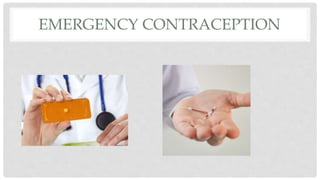
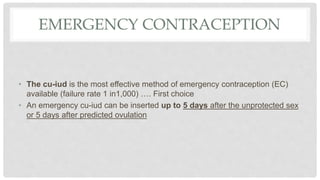
• The cu-iud is the most effective method of emergency contraception (EC)
available (failure rate 1 in1,000) …. First choice
• An emergency cu-iud can be inserted up to 5 days after the unprotected sex
or 5 days after predicted ovulation
EMERGENCY CONTRACEPTION
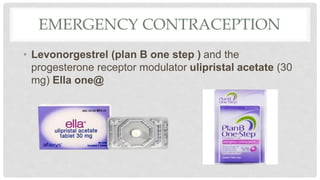
• Levonorgestrel (plan B one step ) and the
progesterone receptor modulator ulipristal acetate (30
mg) Ella one@
EMERGENCY CONTRACEPTION
• LNG appears effective up to 96 hours after unprotected
sex
• Ulipristal acetate for up to 120 hours
• Both methods work by delaying ovulation

L41 Methods of Contraception

  • 1.
  • 2.
    HORMONAL CONTRACEPTION • Combinedhormonal contraception • Progesterone only contraceptives
  • 3.
  • 4.
    COMBINED HORMONAL CONTRACEPTION •Contain two hormones: an oestrogen and a progestogen • Available as oral pills, a transdermal patch and as a vaginal ring. • Work by inhibition of ovulation via negative feedback of oestrogen and progestogen by suppression of follicle-stimulating hormone (FSH) and luteinizing hormone (LH).
  • 5.
    COMBINED HORMONAL CONTRACEPTION COCPs •are ‘low dose’ and contain ethinyle oestradiol in a dose of 15–35 μg • 21 pills followed by a 7-day pill-free interval • The progestogens that are used in currently available pills are often referred to as 2nd-generation, 3rd-generation and 4th-generation progestogens • Third and fourth generation are associated with a higher risk of venous thrombosis than pills containing second-generation progestogens.
  • 7.
    COMBINED HORMONAL CONTRACEPTION Patches •ethinyle estradiol/day and norelgestromin • can be applied to any skin covered area, except the breast • The regimen usually involves application of patches for a total of 21 days followed by a 7-day hormone-free interval Rings • The combined hormonal ring is a flexible ring of 54 mm diameter that releases 15 μg ethinyloestradiol and 120 μg etonorgestrel daily • The ring is self inserted and worn in the vagina for 21 days, followed by a 7-day hormone-free interval,
  • 8.
  • 10.
    SAFETY OF CHC •CHC (pill, patch and ring) increases the tendency to thrombosis in both the venous and arterial circulation. • The adverse effect on venous thrombosis is related to the dose of oestrogen and appears less with combined pills (greatest during the first year of use) • Arterial disease is much less common but more serious. It is related to age, and the risk is strongly influenced by smoking.
  • 11.
  • 12.
    SAFETY The WHO Medicaleligibility criteria for contraceptive use:
  • 13.
    SAFETY OF CHC Contraindicationsto CHC use: category 4 • Women over 35 years old who smoke. • women who experience migraine with aura (risk of stroke) • Hepatocellular adenoma and Malignant (hepatoma) • Severe cirrhosis (decompensated) • Current breast cancer • Antiphospholipid syndrome • Moderately or severely impaired cardiac function • Postpartum less than 6 months • Current and history of ischemic heart disease • Stroke (history of cerebrovascular accident) • Thrombophilia • Sever HTN ( more than 160/100 or vasculopathy) • DM with vascular complications
  • 14.
    INTERACTION WITH OTHERMEDICINES • anticonvulsants, antifungals, antiretrovirals and antibiotics that induce liver enzymes cytochrome P450, will reduce the efficacy of hormonal contraception. • If a woman using enzyme-inducing medication wishes to use one of these hormonal methods, then the consistent use of condoms is also advised. • use of the progestogen-only injectable, Cu-IUD or LNG-IUS, are not affected by drugs that are enzyme inducers.
  • 15.
  • 16.
    PROGESTOGEN-ONLY CONTRACEPTIVE METHODS • Progestogen-onlymethods are available as oral, injectable, implant and intrauterine systems. • The injectable, implant and POP inhibit ovulation • All progestogen-only contraceptive methods, thicken cervical mucus so reducing sperm penetrability and transport • The levonorgestrel intrauterine system (LNG-IUS) has little effect on ovarian activity but causes marked endometrial atrophy, which prevents implantation if ovulation and fertilization occur.
  • 17.
    PROGESTOGEN-ONLY PILL • Side-effectsof all POPs include: possible irregular bleeding, persistent ovarian follicles (simple cysts), acne, headahe, breast tenderness • If a POP is missed then the woman should continue taking the POP and use extra precautions (e.g.condoms) for the next 48 hours. • If unprotected sex occurs during this time, then emergency contraception is required.
  • 18.
    IMPLANT • A singlerod (Nexplanon®) containing the progestogen etonorgestrel is the currently available providing contraception for 3 years.
  • 19.
    PROGESTOGEN-ONLY INJECTABLE • Themost commonly used injectable worldwide is a depot injection of medroxyprogesterone acetate (IM) • inhibition of ovulation • injection interval every 12–14 weeks • over 50% amenorrhoea rates at 1 year • Intermenstrual spotting • Risk of decrease bone density * • Delay of fertility**
  • 20.
    PROGESTOGEN-ONLY INJECTABLE • **Theinjectable is the only hormonal method that may delay return of fertility after discontinuation. In some cases it may take up to 1 year after the last injection for ovulation to return. • *may cause weight gain in a minority of women and loss of bone mineral density (BMD) (5% loss of BMD at lumbar spine) in the first few years of use
  • 21.
    PROGESTOGEN-RELEASING INTRAUTERINE SYSTEM • Releasethe progestogen levonorgestrel into the uterus • Licensed for 5 years for contraceptive use • Works by endometrial thinning and prevent implantation. • Its progestogenic effect on thickening the cervical mucus also impedes entry of sperm. • Does not prevent ovulation. • Many women experience unpredictable bleeding (non contraceptive benefits ) Effective for treating dysmenorrhoea, pain associated with endometriosis and adenomyosis and protecting the endometrium against hyperplasia.
  • 22.
  • 23.
  • 24.
    INTRAUTERINE CONTRACEPTION • Intrauterinemethods of contraception include the copper intrauterine device Cu-IUD and the LNG-IUS • The Cu-IUD duration of use is between 3 and 10 years. • IUDs stimulate an inflammatory reaction in the uterus….toxic to both sperm and egg.
  • 25.
    BLEEDING PATTERN WITHIUD • women with the LNG-IUS tend to experience lighter, less painful menses, women using the Cu-IUD may experience more painful or heavier menses Pregnancy on top of IUCD • If women become pregnant with an IUD in situ, an ultrasound scan should be conducted to exclude ectopic pregnancy. • IUDs should be removed before 12 weeks’ gestation (thread is seen ) • There’s greater risk of miscarriage, preterm delivery, septic abortion and chorioamnionitis if the device is left in situ
  • 26.
    INSERTION OF IUD Insertionis associated with the following risks: 1. Perforation 2. Expulsion 3. Infection 4. Missing’ threads.
  • 27.
  • 28.
    BARRIER CONTRACEPTION Condoms • Theyprotect against STIs including HIV • Typical failure rates 24% • The female condom is a lubricated polyurethane condom that is inserted into the vagina. It also protects against STIs
  • 29.
  • 30.
    BARRIER CONTRACEPTION • Diaphragmand cap • These are latex or non-latex devices that are inserted into the vagina to prevent passage of sperm to the cervix • Often used in conjunction with a spermicide • Typical failure rates in the region of 18% • Associated with increased vaginal discharge and urinary tract infections
  • 31.
  • 32.
    FEMALE STERILIZATION • Thisis a permanent method of contraception that prevents sperm reaching the oocyte in the Fallopian tube. • It can be performed by: (1) laparoscopy, (2) hysteroscopy (3) laparotomy
  • 33.
    FEMALE STERILIZATION • Laparoscopicsterilization • The most commonly occludes the Fallopian tube with filshie clips • Effective contraception should be used until the next menses after the procedure.
  • 34.
    FEMALE STERILIZATION • Hysteroscopicsterilization • Microinserts (Essure®), which are expanding springs are inserted into the tubal ostia via a hysteroscope • Contraception is required during the 3 months and can only be discontinued once correct placement of the inserts are confirmed by X-ray imaging or ultrasound
  • 35.
  • 36.
    VASECTOMY • This isthe technique of interrupting the vas deferens to provide permanent occlusion. • Postvasectomy semen analysis should be conducted at 12 weeks to confirm the absence of spermatozoa in the ejaculate. • Alternative contraception should be used until azoospermia is confirmed
  • 37.
    FERTILITY AWARENESS-BASED METHODS (FAB) •Formerly known as ‘natural family planning’, • FAB rely on the signs and symptoms of menstrual cycle that define the fertile period, with avoidance of intercourse at that time. • Typical failure rates are high. • Types: 1. Calendar or rhythm method 2. Temperature method 3. Cervical mucus method 4. Cervical palpation 5. Personal fertility monitor
  • 38.
    LACTATIONAL AMENORRHOEA • Ifa mother is within the first 6 months postpartum, is amenorrhoeic and is fully or nearly fully breastfeeding, • the risk of pregnancy is about 2%. (98 % prevention) • After 6 months, or if menses occur or breastfeeding reduced, then another method of contraception must be used.
  • 39.
    LENGTH OF ACTIONOF CONTRACEPTIONS
  • 40.
    NON-CONTRACEPTIVE HEALTH BENEFITSOF CONTRACEPTION • Barrier methods, particularly condoms, protect against sexually transmitted infections.
  • 41.
    FAILURE RATE OFCONTRACEPTION
  • 42.
  • 43.
    EMERGENCY CONTRACEPTION • Thecu-iud is the most effective method of emergency contraception (EC) available (failure rate 1 in1,000) …. First choice • An emergency cu-iud can be inserted up to 5 days after the unprotected sex or 5 days after predicted ovulation
  • 44.
    EMERGENCY CONTRACEPTION • Levonorgestrel(plan B one step ) and the progesterone receptor modulator ulipristal acetate (30 mg) Ella one@
  • 45.
    EMERGENCY CONTRACEPTION • LNGappears effective up to 96 hours after unprotected sex • Ulipristal acetate for up to 120 hours • Both methods work by delaying ovulation