Birth Control Methods
Contraceptive
Done by: Dr JASIM MAKI (R1)
- There are many types of contraception widely used now days for
family planning purposes.
- The Centers for Disease Control and Prevention recommends that
all women be counseled about her full range and effectiveness of
contraceptive methods for which they are medically eligible.
- No method of contraception is perfect, each woman must balance
the advantages of each method against the disadvantages and
side effects, and decide which method she prefers.
Benefits of family planning / contraception
- Preventing pregnancy-related health risks in women
- Helping to prevent HIV/AIDS
- Reducing infant mortality
- Empowering people and Enhancing education
- Reducing adolescent pregnancies
- Slowing population growth
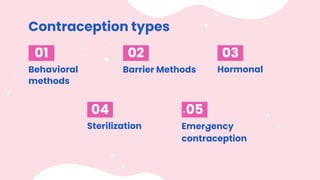
Contraception types
01 02
04
03
05
Behavioral
methods
Barrier Methods Hormonal
Sterilization Emergency
contraception
Behavioral
methods
01
METHODS BASED ON INFORMATION
Withdrawal
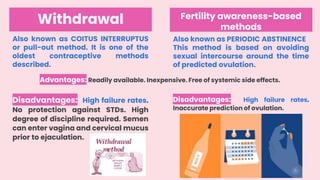
Also known as COITUS INTERRUPTUS
or pull-out method. It is one of the
oldest contraceptive methods
described.
Advantages: Readily available. Inexpensive. Free of systemic side effects.
Fertility awareness-based
methods
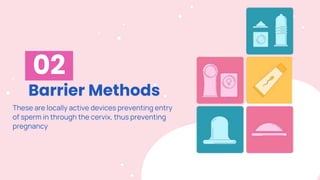
Also known as PERIODIC ABSTINENCE
This method is based on avoiding
sexual intercourse around the time
of predicted ovulation.
Disadvantages: High failure rates.
Inaccurate prediction of ovulation.
Disadvantages: High failure rates.
No protection against STDs. High
degree of discipline required. Semen
can enter vagina and cervical mucus
prior to ejaculation.
Barrier Methods
02
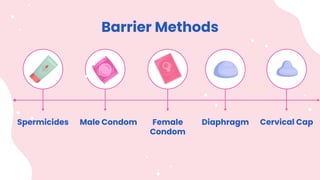
These are locally active devices preventing entry
of sperm in through the cervix, thus preventing
pregnancy
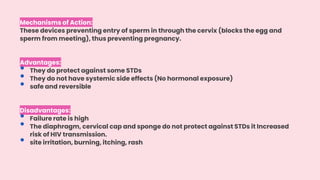
Spermicides Male Condom Female
Condom
Diaphragm
Barrier Methods
Cervical Cap
Mechanisms of Action:
These devices preventing entry of sperm in through the cervix (blocks the egg and
sperm from meeting), thus preventing pregnancy.
Advantages:
• They do protect against some STDs
• They do not have systemic side effects (No hormonal exposure)
• safe and reversible
Disadvantages:
• Failure rate is high
• The diaphragm, cervical cap and sponge do not protect against STDs it Increased
risk of HIV transmission.
• site irritation, burning, itching, rash
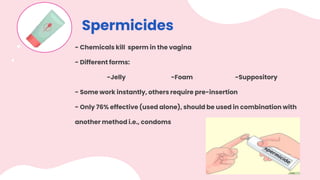
Spermicides
- Chemicals kill sperm in the vagina
- Different forms:
-Jelly -Foam -Suppository
- Some work instantly, others require pre-insertion
- Only 76% effective (used alone), should be used in combination with
another method i.e., condoms
Male Condom
They are the most common and effective barrier contraceptive
method when used properly
➢ Latex is the most common used type worldwide
➢ Condom the only method decrease the risk of STDs and the most
protective type is High-quality latex condoms.
➢ A new condom must be used each time a couple has intercourse.
➢ Male condoms can also help to prevent early ejaculation.
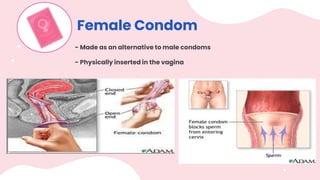
Female Condom
- Made as an alternative to male condoms
- Physically inserted in the vagina
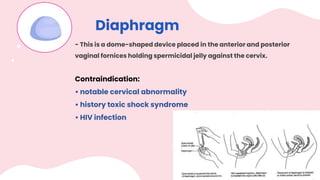
Diaphragm
- This is a dome-shaped device placed in the anterior and posterior
vaginal fornices holding spermicidal jelly against the cervix.
Contraindication:
• notable cervical abnormality
• history toxic shock syndrome
• HIV infection
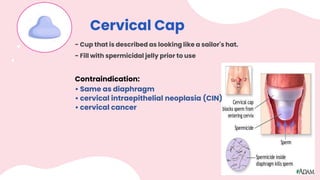
Cervical Cap
- Cup that is described as looking like a sailor's hat.
- Fill with spermicidal jelly prior to use
Contraindication:
• Same as diaphragm
• cervical intraepithelial neoplasia (CIN)
• cervical cancer
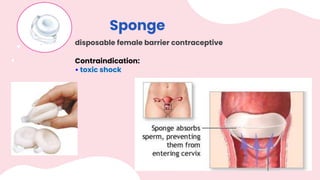
Sponge
disposable female barrier contraceptive
Contraindication:
• toxic shock
Hormonal
Contraceptive
03
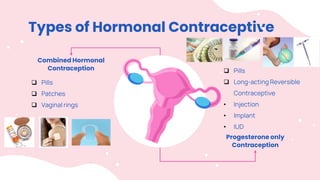
Types of Hormonal Contraceptive
Combined Hormonal
Contraception
 Pills
 Patches
 Vaginal rings
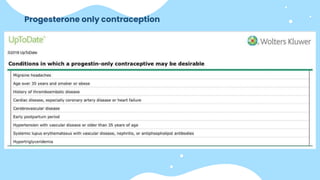
Progesterone only
Contraception
 Pills
 Long-acting Reversible
Contraceptive
• Injection
• Implant
• IUD
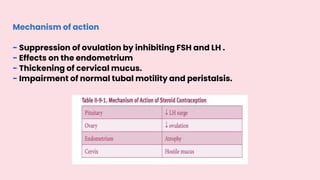
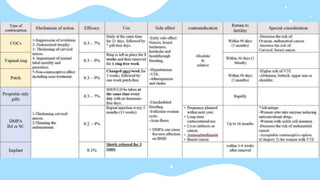
Mechanism of action
- Suppression of ovulation by inhibiting FSH and LH .
- Effects on the endometrium
- Thickening of cervical mucus.
- Impairment of normal tubal motility and peristalsis.
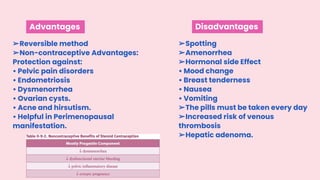
➢Reversible method
➢Non-contraceptive Advantages:
Protection against:
• Pelvic pain disorders
• Endometriosis
• Dysmenorrhea
• Ovarian cysts.
• Acne and hirsutism.
• Helpful in Perimenopausal
manifestation.
Advantages
➢Spotting
➢Amenorrhea
➢Hormonal side Effect
• Mood change
• Breast tenderness
• Nausea
• Vomiting
➢The pills must be taken every day
➢Increased risk of venous
thrombosis
➢Hepatic adenoma.
Disadvantages
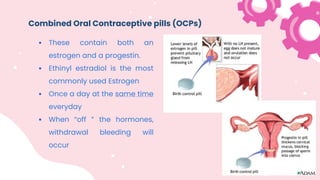
Combined Oral Contraceptive pills (OCPs)
 These contain both an
estrogen and a progestin.
 Ethinyl estradiol is the most
commonly used Estrogen
 Once a day at the same time
everyday
 When “off ” the hormones,
withdrawal bleeding will
occur
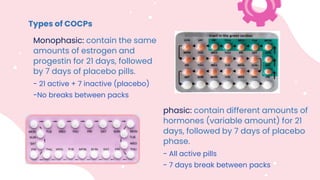
Types of COCPs
Monophasic: contain the same
amounts of estrogen and
progestin for 21 days, followed
by 7 days of placebo pills.
- 21 active + 7 inactive (placebo)
-No breaks between packs
phasic: contain different amounts of
hormones (variable amount) for 21
days, followed by 7 days of placebo
phase.
- All active pills
- 7 days break between packs
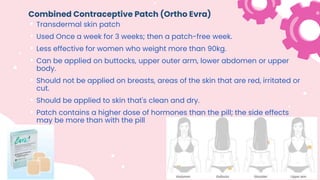
Combined Contraceptive Patch (Ortho Evra)
• Transdermal skin patch
• Used Once a week for 3 weeks; then a patch-free week.
• Less effective for women who weight more than 90kg.
• Can be applied on buttocks, upper outer arm, lower abdomen or upper
body.
• Should not be applied on breasts, areas of the skin that are red, irritated or
cut.
• Should be applied to skin that's clean and dry.
• Patch contains a higher dose of hormones than the pill; the side effects
may be more than with the pill
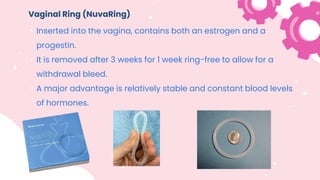
Vaginal Ring (NuvaRing)
• Inserted into the vagina, contains both an estrogen and a
progestin.
• It is removed after 3 weeks for 1 week ring-free to allow for a
withdrawal bleed.
• A major advantage is relatively stable and constant blood levels
of hormones.
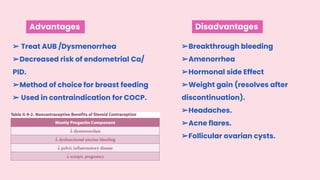
Progesterone only contraception
➢ Treat AUB /Dysmenorrhea
➢Decreased risk of endometrial Ca/
PID.
➢Method of choice for breast feeding
➢ Used in contraindication for COCP.
Advantages
➢Breakthrough bleeding
➢Amenorrhea
➢Hormonal side Effect
➢Weight gain (resolves after
discontinuation).
➢Headaches.
➢Acne flares.
➢Follicular ovarian cysts.
Disadvantages
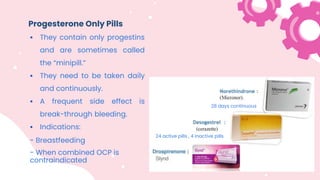
Progesterone Only Pills
 They contain only progestins
and are sometimes called
the “minipill.”
 They need to be taken daily
and continuously.
 A frequent side effect is
break-through bleeding.
 Indications:
- Breastfeeding
- When combined OCP is
contraindicated
28 days continuous
24 active pills , 4 inactive pills
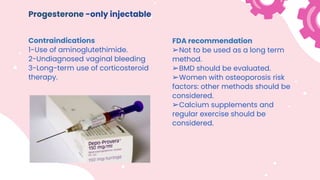
Progesterone -only injectable
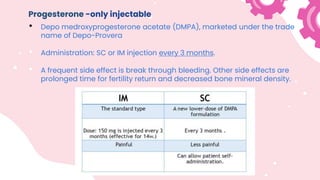
• Depo medroxyprogesterone acetate (DMPA), marketed under the trade
name of Depo-Provera
• Administration: SC or IM injection every 3 months.
• A frequent side effect is break through bleeding. Other side effects are
prolonged time for fertility return and decreased bone mineral density.
Progesterone -only injectable
Contraindications
1-Use of aminoglutethimide.
2-Undiagnosed vaginal bleeding
3-Long-term use of corticosteroid
therapy.
FDA recommendation
➢Not to be used as a long term
method.
➢BMD should be evaluated.
➢Women with osteoporosis risk
factors: other methods should be
considered.
➢Calcium supplements and
regular exercise should be
considered.
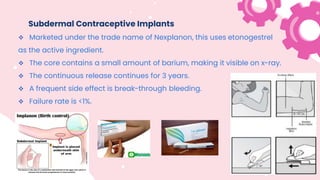
Subdermal Contraceptive Implants
 Marketed under the trade name of Nexplanon, this uses etonogestrel
as the active ingredient.
 The core contains a small amount of barium, making it visible on x-ray.
 The continuous release continues for 3 years.
 A frequent side effect is break-through bleeding.
 Failure rate is <1%.
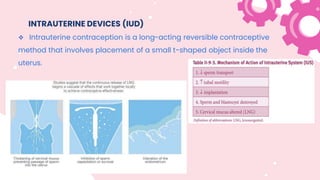
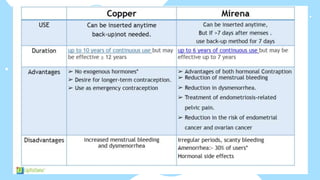
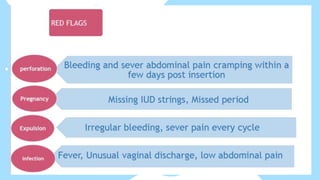
INTRAUTERINE DEVICES (IUD)
 Intrauterine contraception is a long-acting reversible contraceptive
method that involves placement of a small t-shaped object inside the
uterus.
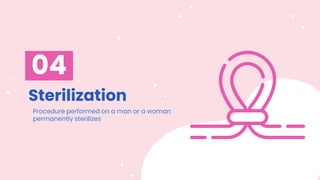
Sterilization
04
Procedure performed on a man or a woman
permanently sterilizes
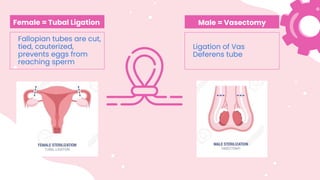
Female = Tubal Ligation
Fallopian tubes are cut,
tied, cauterized,
prevents eggs from
reaching sperm
Male = Vasectomy
Ligation of Vas
Deferens tube
Emergency
contraception
ECP
05
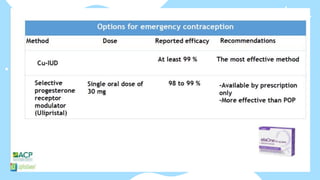
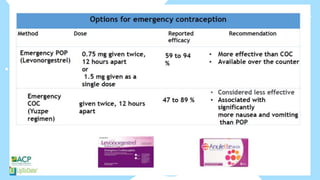
➢Indicated after unprotected intercourse or suspected contraceptive
failure within the previous 120 hours (5 days).
➢Should be initiated ASAP as efficacy declines with increasing delay
between intercourse and treatment
➢Must receive ECP from a physician
➢No clinical exam, testing or follow up is required.
➢Can be used in women with underlying medical conditions (USMEC
category 1l2 ) There are no medical contraindication to the use of ECPs ,
other than allergy or hypersensitivity to the pill components.
- Floods the ovaries with high amount of hormone and prevents
ovulation
- Alters the environment of the uterus, making it disruptive to the
egg and sperm
- The incidence and severity of nausea and vomiting decrease
when antiemetic agents are taken one hour before the first
contraceptive dose.
- pregnancy test should be done if there is no withdrawal bleed
within 3 weeks.
References
Thank you

Contraceptive and birth control presentation

  • 1.
  • 2.
    - There aremany types of contraception widely used now days for family planning purposes. - The Centers for Disease Control and Prevention recommends that all women be counseled about her full range and effectiveness of contraceptive methods for which they are medically eligible. - No method of contraception is perfect, each woman must balance the advantages of each method against the disadvantages and side effects, and decide which method she prefers.
  • 3.
    Benefits of familyplanning / contraception - Preventing pregnancy-related health risks in women - Helping to prevent HIV/AIDS - Reducing infant mortality - Empowering people and Enhancing education - Reducing adolescent pregnancies - Slowing population growth
  • 4.
    Contraception types 01 02 04 03 05 Behavioral methods BarrierMethods Hormonal Sterilization Emergency contraception
  • 6.
  • 7.
    Withdrawal Also known asCOITUS INTERRUPTUS or pull-out method. It is one of the oldest contraceptive methods described. Advantages: Readily available. Inexpensive. Free of systemic side effects. Fertility awareness-based methods Also known as PERIODIC ABSTINENCE This method is based on avoiding sexual intercourse around the time of predicted ovulation. Disadvantages: High failure rates. Inaccurate prediction of ovulation. Disadvantages: High failure rates. No protection against STDs. High degree of discipline required. Semen can enter vagina and cervical mucus prior to ejaculation.
  • 8.
    Barrier Methods 02 These arelocally active devices preventing entry of sperm in through the cervix, thus preventing pregnancy
  • 9.
    Spermicides Male CondomFemale Condom Diaphragm Barrier Methods Cervical Cap
  • 10.
    Mechanisms of Action: Thesedevices preventing entry of sperm in through the cervix (blocks the egg and sperm from meeting), thus preventing pregnancy. Advantages: • They do protect against some STDs • They do not have systemic side effects (No hormonal exposure) • safe and reversible Disadvantages: • Failure rate is high • The diaphragm, cervical cap and sponge do not protect against STDs it Increased risk of HIV transmission. • site irritation, burning, itching, rash
  • 11.
    Spermicides - Chemicals killsperm in the vagina - Different forms: -Jelly -Foam -Suppository - Some work instantly, others require pre-insertion - Only 76% effective (used alone), should be used in combination with another method i.e., condoms
  • 12.
    Male Condom They arethe most common and effective barrier contraceptive method when used properly ➢ Latex is the most common used type worldwide ➢ Condom the only method decrease the risk of STDs and the most protective type is High-quality latex condoms. ➢ A new condom must be used each time a couple has intercourse. ➢ Male condoms can also help to prevent early ejaculation.
  • 13.
    Female Condom - Madeas an alternative to male condoms - Physically inserted in the vagina
  • 14.
    Diaphragm - This isa dome-shaped device placed in the anterior and posterior vaginal fornices holding spermicidal jelly against the cervix. Contraindication: • notable cervical abnormality • history toxic shock syndrome • HIV infection
  • 15.
    Cervical Cap - Cupthat is described as looking like a sailor's hat. - Fill with spermicidal jelly prior to use Contraindication: • Same as diaphragm • cervical intraepithelial neoplasia (CIN) • cervical cancer
  • 16.
    Sponge disposable female barriercontraceptive Contraindication: • toxic shock
  • 17.
  • 18.
    Types of HormonalContraceptive Combined Hormonal Contraception  Pills  Patches  Vaginal rings Progesterone only Contraception  Pills  Long-acting Reversible Contraceptive • Injection • Implant • IUD
  • 19.
    Mechanism of action -Suppression of ovulation by inhibiting FSH and LH . - Effects on the endometrium - Thickening of cervical mucus. - Impairment of normal tubal motility and peristalsis.
  • 20.
    ➢Reversible method ➢Non-contraceptive Advantages: Protectionagainst: • Pelvic pain disorders • Endometriosis • Dysmenorrhea • Ovarian cysts. • Acne and hirsutism. • Helpful in Perimenopausal manifestation. Advantages ➢Spotting ➢Amenorrhea ➢Hormonal side Effect • Mood change • Breast tenderness • Nausea • Vomiting ➢The pills must be taken every day ➢Increased risk of venous thrombosis ➢Hepatic adenoma. Disadvantages
  • 22.
    Combined Oral Contraceptivepills (OCPs)  These contain both an estrogen and a progestin.  Ethinyl estradiol is the most commonly used Estrogen  Once a day at the same time everyday  When “off ” the hormones, withdrawal bleeding will occur
  • 23.
    Types of COCPs Monophasic:contain the same amounts of estrogen and progestin for 21 days, followed by 7 days of placebo pills. - 21 active + 7 inactive (placebo) -No breaks between packs phasic: contain different amounts of hormones (variable amount) for 21 days, followed by 7 days of placebo phase. - All active pills - 7 days break between packs
  • 25.
    Combined Contraceptive Patch(Ortho Evra) • Transdermal skin patch • Used Once a week for 3 weeks; then a patch-free week. • Less effective for women who weight more than 90kg. • Can be applied on buttocks, upper outer arm, lower abdomen or upper body. • Should not be applied on breasts, areas of the skin that are red, irritated or cut. • Should be applied to skin that's clean and dry. • Patch contains a higher dose of hormones than the pill; the side effects may be more than with the pill
  • 26.
    Vaginal Ring (NuvaRing) •Inserted into the vagina, contains both an estrogen and a progestin. • It is removed after 3 weeks for 1 week ring-free to allow for a withdrawal bleed. • A major advantage is relatively stable and constant blood levels of hormones.
  • 27.
  • 28.
    ➢ Treat AUB/Dysmenorrhea ➢Decreased risk of endometrial Ca/ PID. ➢Method of choice for breast feeding ➢ Used in contraindication for COCP. Advantages ➢Breakthrough bleeding ➢Amenorrhea ➢Hormonal side Effect ➢Weight gain (resolves after discontinuation). ➢Headaches. ➢Acne flares. ➢Follicular ovarian cysts. Disadvantages
  • 29.
    Progesterone Only Pills They contain only progestins and are sometimes called the “minipill.”  They need to be taken daily and continuously.  A frequent side effect is break-through bleeding.  Indications: - Breastfeeding - When combined OCP is contraindicated 28 days continuous 24 active pills , 4 inactive pills
  • 30.
    Progesterone -only injectable •Depo medroxyprogesterone acetate (DMPA), marketed under the trade name of Depo-Provera • Administration: SC or IM injection every 3 months. • A frequent side effect is break through bleeding. Other side effects are prolonged time for fertility return and decreased bone mineral density.
  • 31.
    Progesterone -only injectable Contraindications 1-Useof aminoglutethimide. 2-Undiagnosed vaginal bleeding 3-Long-term use of corticosteroid therapy. FDA recommendation ➢Not to be used as a long term method. ➢BMD should be evaluated. ➢Women with osteoporosis risk factors: other methods should be considered. ➢Calcium supplements and regular exercise should be considered.
  • 32.
    Subdermal Contraceptive Implants Marketed under the trade name of Nexplanon, this uses etonogestrel as the active ingredient.  The core contains a small amount of barium, making it visible on x-ray.  The continuous release continues for 3 years.  A frequent side effect is break-through bleeding.  Failure rate is <1%.
  • 34.
    INTRAUTERINE DEVICES (IUD) Intrauterine contraception is a long-acting reversible contraceptive method that involves placement of a small t-shaped object inside the uterus.
  • 39.
    Sterilization 04 Procedure performed ona man or a woman permanently sterilizes
  • 40.
    Female = TubalLigation Fallopian tubes are cut, tied, cauterized, prevents eggs from reaching sperm Male = Vasectomy Ligation of Vas Deferens tube
  • 41.
  • 42.
    ➢Indicated after unprotectedintercourse or suspected contraceptive failure within the previous 120 hours (5 days). ➢Should be initiated ASAP as efficacy declines with increasing delay between intercourse and treatment ➢Must receive ECP from a physician ➢No clinical exam, testing or follow up is required. ➢Can be used in women with underlying medical conditions (USMEC category 1l2 ) There are no medical contraindication to the use of ECPs , other than allergy or hypersensitivity to the pill components.
  • 43.
    - Floods theovaries with high amount of hormone and prevents ovulation - Alters the environment of the uterus, making it disruptive to the egg and sperm - The incidence and severity of nausea and vomiting decrease when antiemetic agents are taken one hour before the first contraceptive dose. - pregnancy test should be done if there is no withdrawal bleed within 3 weeks.
  • 46.
  • 47.