Dr. Shazia Iqbal
Assistant Professor (Obstetrics & Gynaecology)
Director of Medical Education Unit
VisionCollege of Medicine, Riyadh
Objectives
▶Prevalence and Incidence of Urinary
Incontinence and Pelvic Organ Prolapse
(POP)
▶Different types of Urinary Incontinence
▶Recognized and diagnosed POP
▶Work up, treatment algorithm
▶Treatments available: surgical and non
surgical
▶ The accidental leakage of urine
▶ Affects millions of Americans, the majority
of them women
▶ 1 out of 3 women over the age of 45
• Several types
• Very common
• Embarrassment
• Think it is just part of getting older
• Are not aware that there are
treatments
• Affects both men & woman
• Treated differently
• ▶ Bladder stores the urine
• ▶ Sphincter muscle holds the urine
in the bladder
• ▶ Urethra is the tube in which
urine is passed out of the body
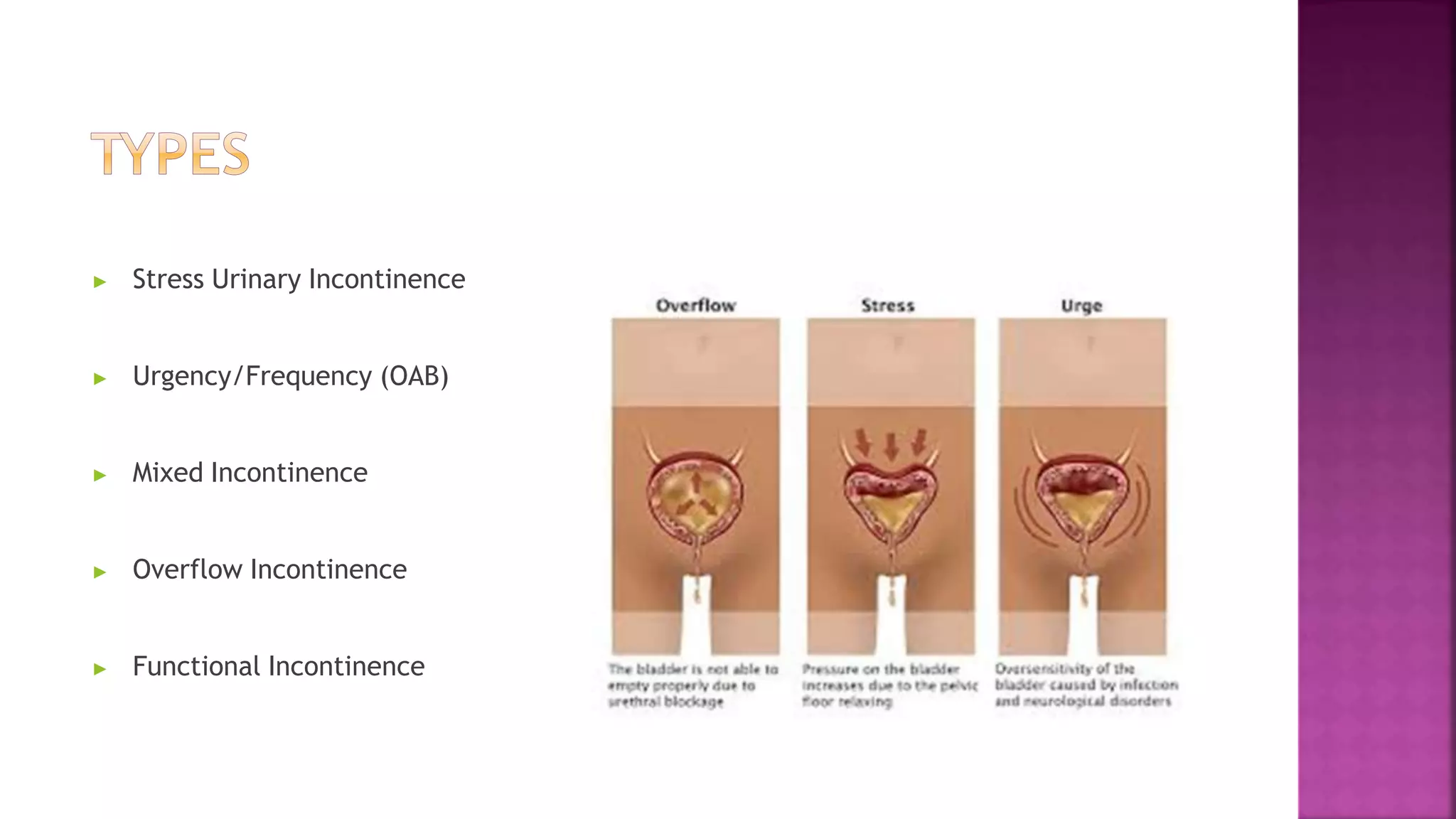
▶ Stress Urinary Incontinence
▶ Urgency/Frequency (OAB(
▶ Mixed Incontinence
▶ Overflow Incontinence
▶ Functional Incontinence
▶ History
▶ Physical exam
▶ Voiding Diary
▶ Urinalysis
▶ Weighted Pad Test
▶ Cough Stress Test – supine and standing
▶ Bladder Scan – post-residual volume (PVR)
▶ Urodynamic Study (UDS(
• Stress Urinary Incontinence (SUI(
▶Behavioral modification
▶Lose weight
▶Stop smoking
▶Kegel Exercises
▶Biofeedback
▶Injectables
▶Surgery
▶ Collagen, Contigen, Macroplastique, Durasphere
▶ Injection into periurethral tissues
▶ Often need repeat treatments
▶ Durability not long-term
▶ Best candidates = elderly, poor surgical
candidates
▶ Autologous fat, future applications MSC
Treatment Options
• ▶Bulking Agents – indicated for
ISD
Support the urethra and restore normal anatomical angle
Documented clinical success rates for a retropubic slings
is approximatley 90%- 5 years
▶No FDA approved drug
▶Duloxetine-selective
norepinephrine/serotonin dual reuptake
inhibitor
▶Used for depression
▶Available in Europe
▶Increases urethral closure
▶Effectiveness proven
Overative Bladder syndrome
Urge Incontinence
▶Strong urge to urinate with little
warning
▶Difficulty postponing urination
▶May or may not leak
▶ Idiopathic
▶ Rule out other pathology for Refractory OAB
▶Damage to the bladder nerves, the nervous system, Damage to the
muscles
▶ MS, Parkinson’s, DM, and stroke
▶ Bladder infections, bladder stones, cancer
▶ Enlarged prostate
▶ Pelvic Organ Prolapse
▶ Aggravated by dietary factors
▶ Timed voiding and bladder training
▶ Biofeedback
▶ Anticholinergics/Antimuscarinics
▶ Medications to inhibit contractions of an overactive
bladder
▶ β3-adrenoceptor Agonists - Myrbetriq (mirabegron) – works by
stimulating the β3 receptors in the detrusor muscle of the bladder,
causing relaxation of the bladder muscle during the storage phase of
micturition cycle
Transient Incontinence
▶ DIAPPERS
Delirium
Infection of urinary tract
Atrophic vaginitis
Pharmaceuticals
Psychological
Excessive urine output (CHF
,
hyperglycemia)
Restricted mobility
Stool impaction
▶ Weakened or damaged pelvic muscles and ligaments can
cause pelvic organ prolapse.
▶ Loss of muscle tone
▶ Menopause and estrogen loss
▶ Multiple vaginal deliveries
▶ Obesity
▶ Family history/Genetics
▶ Pelvic trauma or previous surgery
▶ Chronic Coughing
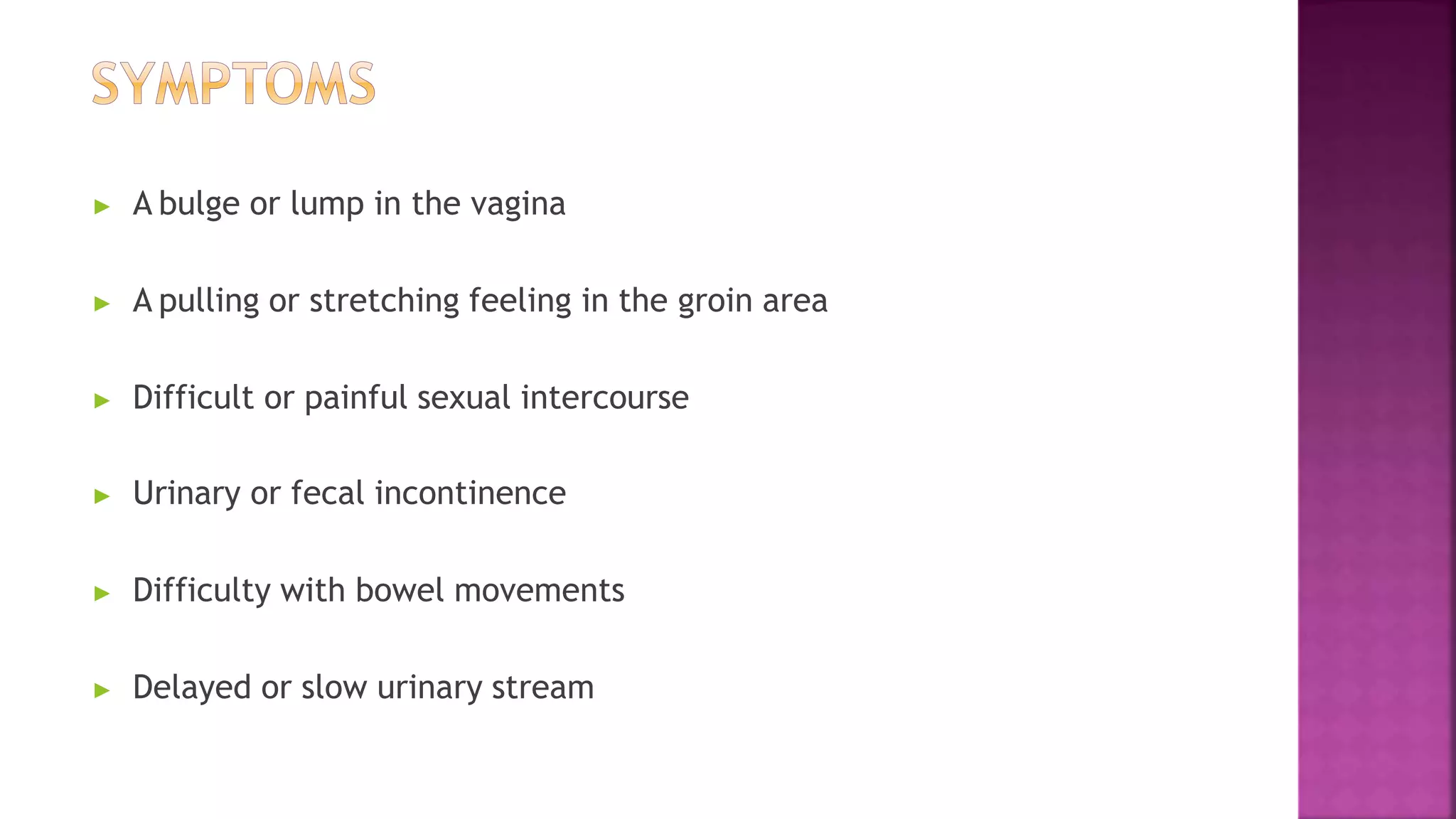
▶ A bulge or lump in the vagina
▶ A pulling or stretching feeling in the groin area
▶ Difficult or painful sexual intercourse
▶ Urinary or fecal incontinence
▶ Difficulty with bowel movements
▶ Delayed or slow urinary stream
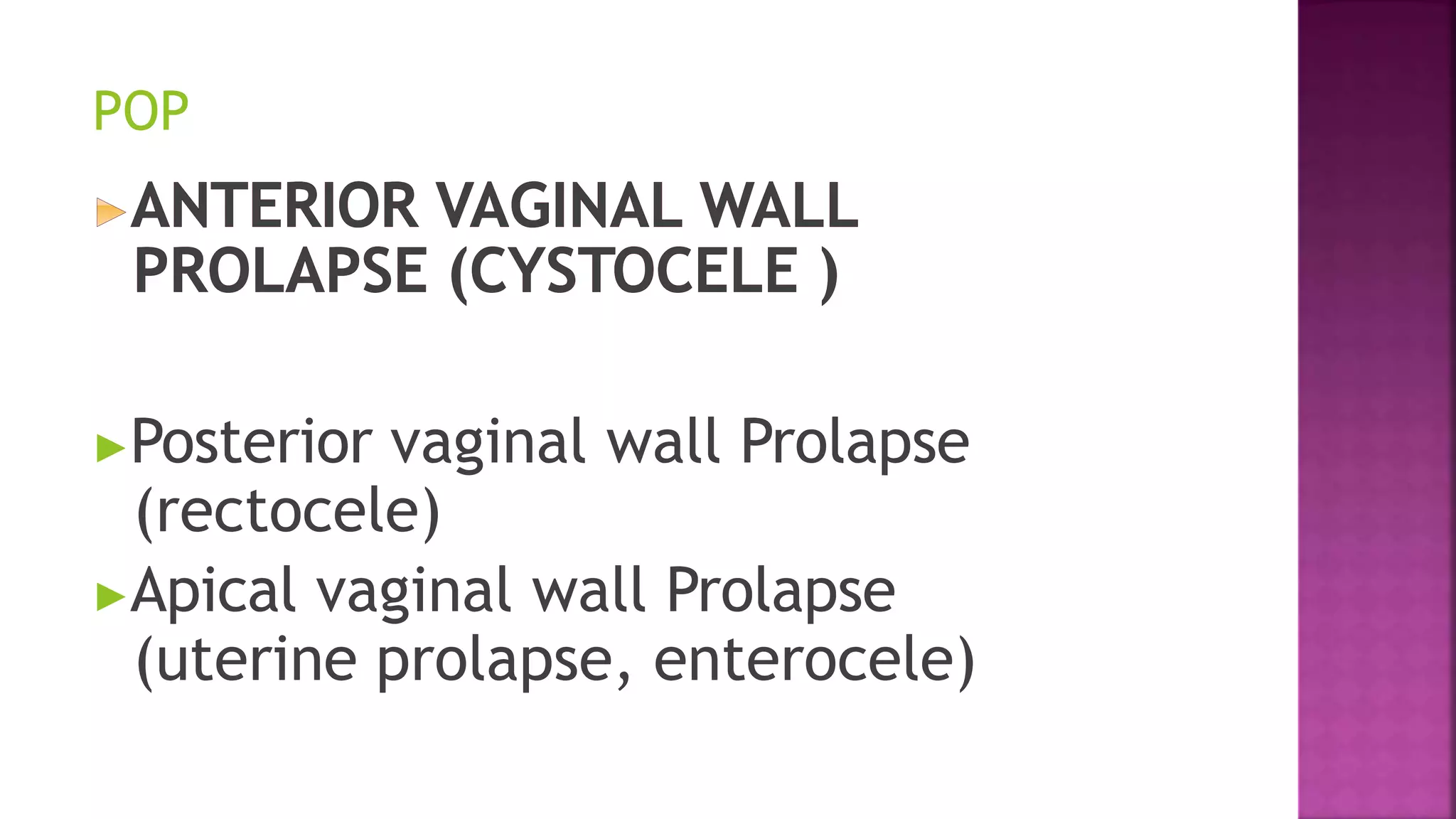
POP
▶Posterior vaginal wall Prolapse
(rectocele)
▶Apical vaginal wall Prolapse
(uterine prolapse, enterocele)
▶ Should be done with maximum straining such as a very strong cough or
Valsalva
▶ Stage 0 – no prolapse
▶ Stage 1 –most distal prolapse is more than 1 cm above hymen
▶ Stage 2 – most distal prolapse is between 1 cm above the 1 cm below
hymen
▶ Stage 3 – most distal prolapse is more than 1 cm below the hymen but
no further than 2 cm less than TVL
▶ Stage 4 – represents complete procidentia or vault eversion
▶U.S. 13 % lifetime risk of undergoing
surgery for POP
▶Peak age – 70 to 80
▶By 2050, POP will have increased by
50%
▶Only physical is needed
▶Prolapse is beyond the hymen or patient
has voiding problem – should have post-void
residual done
▶Patient with urgency and frequency- UA and
Urine culture
▶Urodynamics if surgical planning
Non-surgical treatments
▶ Kegel exercises help strengthen pelvic floor muscles and may help relieve
some symptoms of minor prolapse. These exercises involve identifying the
pelvic floor muscles that purposely interrupt the flow of urine in midstream,
and then tightening these
▶ Vaginal pessary device placed into the vagina to support surrounding
structures
Surgical treatments
▶ Vaginal vs abdominal approach
▶ Sacralcolpopexy
▶ Uterosacral ligament suspension
▶ Sacrospinous fixation
▶ McCall culdoplasty
▶ Colpocleisis
▶ Cystocele /Rectocele
▶Vaginal (unless concomitant apical)
▶Stop Smoking
▶Obesity contributes to urinary leakage
▶Avoid Constipation
▶Alcohol & caffeinated beverages can
aggravate your “gotta go” problem
▶If you are a Diabetic, watch your diet &
control your fingerstick glucose levels
▶ MUI>OAB>SUI - highly prevalent
▶ Most patients treated for OAB visit their PCP first
▶ Patients often “suffer in silence” and adapt their
behavior/lifestyle around the condition
▶ Adaptations have the potential to be detrimental
to the patient’s health and quality of life
 https://pubmed.ncbi.nlm.nih.gov/?term=UROGENITAL+PROL
APES+AND+URINARY+INCONTENENCE
Urogenital prolapse and urinary incontinence 22.04.2021

Urogenital prolapse and urinary incontinence 22.04.2021

  • 1.
    Dr. Shazia Iqbal AssistantProfessor (Obstetrics & Gynaecology) Director of Medical Education Unit VisionCollege of Medicine, Riyadh
  • 2.
    Objectives ▶Prevalence and Incidenceof Urinary Incontinence and Pelvic Organ Prolapse (POP) ▶Different types of Urinary Incontinence ▶Recognized and diagnosed POP ▶Work up, treatment algorithm ▶Treatments available: surgical and non surgical
  • 3.
    ▶ The accidentalleakage of urine ▶ Affects millions of Americans, the majority of them women ▶ 1 out of 3 women over the age of 45
  • 4.
    • Several types •Very common • Embarrassment • Think it is just part of getting older • Are not aware that there are treatments • Affects both men & woman • Treated differently
  • 5.
    • ▶ Bladderstores the urine • ▶ Sphincter muscle holds the urine in the bladder • ▶ Urethra is the tube in which urine is passed out of the body
  • 6.
    ▶ Stress UrinaryIncontinence ▶ Urgency/Frequency (OAB( ▶ Mixed Incontinence ▶ Overflow Incontinence ▶ Functional Incontinence
  • 7.
    ▶ History ▶ Physicalexam ▶ Voiding Diary ▶ Urinalysis ▶ Weighted Pad Test ▶ Cough Stress Test – supine and standing ▶ Bladder Scan – post-residual volume (PVR) ▶ Urodynamic Study (UDS(
  • 8.
    • Stress UrinaryIncontinence (SUI( ▶Behavioral modification ▶Lose weight ▶Stop smoking ▶Kegel Exercises ▶Biofeedback ▶Injectables ▶Surgery
  • 11.
    ▶ Collagen, Contigen,Macroplastique, Durasphere ▶ Injection into periurethral tissues ▶ Often need repeat treatments ▶ Durability not long-term ▶ Best candidates = elderly, poor surgical candidates ▶ Autologous fat, future applications MSC
  • 12.
    Treatment Options • ▶BulkingAgents – indicated for ISD
  • 14.
    Support the urethraand restore normal anatomical angle Documented clinical success rates for a retropubic slings is approximatley 90%- 5 years
  • 15.
    ▶No FDA approveddrug ▶Duloxetine-selective norepinephrine/serotonin dual reuptake inhibitor ▶Used for depression ▶Available in Europe ▶Increases urethral closure ▶Effectiveness proven
  • 16.
    Overative Bladder syndrome UrgeIncontinence ▶Strong urge to urinate with little warning ▶Difficulty postponing urination ▶May or may not leak
  • 18.
    ▶ Idiopathic ▶ Ruleout other pathology for Refractory OAB ▶Damage to the bladder nerves, the nervous system, Damage to the muscles ▶ MS, Parkinson’s, DM, and stroke ▶ Bladder infections, bladder stones, cancer ▶ Enlarged prostate ▶ Pelvic Organ Prolapse ▶ Aggravated by dietary factors
  • 19.
    ▶ Timed voidingand bladder training ▶ Biofeedback
  • 20.
    ▶ Anticholinergics/Antimuscarinics ▶ Medicationsto inhibit contractions of an overactive bladder
  • 21.
    ▶ β3-adrenoceptor Agonists- Myrbetriq (mirabegron) – works by stimulating the β3 receptors in the detrusor muscle of the bladder, causing relaxation of the bladder muscle during the storage phase of micturition cycle
  • 25.
    Transient Incontinence ▶ DIAPPERS Delirium Infectionof urinary tract Atrophic vaginitis Pharmaceuticals Psychological Excessive urine output (CHF , hyperglycemia) Restricted mobility Stool impaction
  • 28.
    ▶ Weakened ordamaged pelvic muscles and ligaments can cause pelvic organ prolapse. ▶ Loss of muscle tone ▶ Menopause and estrogen loss ▶ Multiple vaginal deliveries ▶ Obesity ▶ Family history/Genetics ▶ Pelvic trauma or previous surgery ▶ Chronic Coughing
  • 29.
    ▶ A bulgeor lump in the vagina ▶ A pulling or stretching feeling in the groin area ▶ Difficult or painful sexual intercourse ▶ Urinary or fecal incontinence ▶ Difficulty with bowel movements ▶ Delayed or slow urinary stream
  • 30.
    POP ▶Posterior vaginal wallProlapse (rectocele) ▶Apical vaginal wall Prolapse (uterine prolapse, enterocele)
  • 34.
    ▶ Should bedone with maximum straining such as a very strong cough or Valsalva ▶ Stage 0 – no prolapse ▶ Stage 1 –most distal prolapse is more than 1 cm above hymen ▶ Stage 2 – most distal prolapse is between 1 cm above the 1 cm below hymen ▶ Stage 3 – most distal prolapse is more than 1 cm below the hymen but no further than 2 cm less than TVL ▶ Stage 4 – represents complete procidentia or vault eversion
  • 36.
    ▶U.S. 13 %lifetime risk of undergoing surgery for POP ▶Peak age – 70 to 80 ▶By 2050, POP will have increased by 50%
  • 37.
    ▶Only physical isneeded ▶Prolapse is beyond the hymen or patient has voiding problem – should have post-void residual done ▶Patient with urgency and frequency- UA and Urine culture ▶Urodynamics if surgical planning
  • 38.
    Non-surgical treatments ▶ Kegelexercises help strengthen pelvic floor muscles and may help relieve some symptoms of minor prolapse. These exercises involve identifying the pelvic floor muscles that purposely interrupt the flow of urine in midstream, and then tightening these ▶ Vaginal pessary device placed into the vagina to support surrounding structures Surgical treatments ▶ Vaginal vs abdominal approach
  • 39.
    ▶ Sacralcolpopexy ▶ Uterosacralligament suspension ▶ Sacrospinous fixation ▶ McCall culdoplasty ▶ Colpocleisis ▶ Cystocele /Rectocele ▶Vaginal (unless concomitant apical)
  • 40.
    ▶Stop Smoking ▶Obesity contributesto urinary leakage ▶Avoid Constipation ▶Alcohol & caffeinated beverages can aggravate your “gotta go” problem ▶If you are a Diabetic, watch your diet & control your fingerstick glucose levels
  • 41.
    ▶ MUI>OAB>SUI -highly prevalent ▶ Most patients treated for OAB visit their PCP first ▶ Patients often “suffer in silence” and adapt their behavior/lifestyle around the condition ▶ Adaptations have the potential to be detrimental to the patient’s health and quality of life
  • 42.