What does CCE meant for?
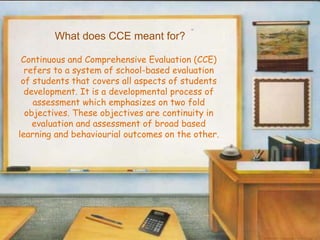
Continuous and Comprehensive Evaluation (CCE)
refers to a system of school-based evaluation
of students that covers all aspects of students
development. It is a developmental process of
assessment which emphasizes on two fold
objectives. These objectives are continuity in
evaluation and assessment of broad based
learning and behaviourial outcomes on the other.
• To help develop cognitive, psychomotor and
affective skills
• To lay emphasis on thought process and de-
emphasize memorization
• To make evaluation an integral part of teaching-
learning process
• To use evaluation as a quality control device to
maintain desired standard of performance
To make the process of teaching and learning a
learner-centered activity
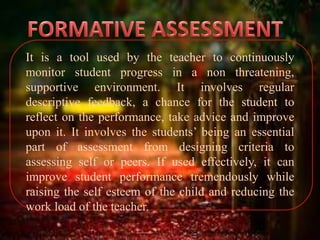
It is a tool used by the teacher to continuously
monitor student progress in a non threatening,
supportive environment. It involves regular
descriptive feedback, a chance for the student to
reflect on the performance, take advice and improve
upon it. It involves the students’ being an essential
part of assessment from designing criteria to
assessing self or peers. If used effectively, it can
improve student performance tremendously while
raising the self esteem of the child and reducing the
work load of the teacher.
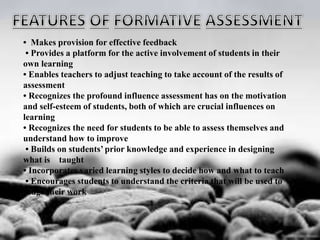
• Makes provision for effective feedback
• Provides a platform for the active involvement of students in their
own learning
• Enables teachers to adjust teaching to take account of the results of
assessment
• Recognizes the profound influence assessment has on the motivation
and self-esteem of students, both of which are crucial influences on
learning
• Recognizes the need for students to be able to assess themselves and
understand how to improve
• Builds on students’ prior knowledge and experience in designing
what is taught
• Incorporates varied learning styles to decide how and what to teach
• Encourages students to understand the criteria that will be used to
judge their work
It is carried out at the end of a course of learning. It measures or
Sums-up, how much a student has learned from the course. It is
usually a graded test, i.e it is marked according to a scale or set of
grades. Assessment that is predominantly of summative nature will
not by itself be able to yield a valid measure of the growth and
development of the student. It, at best, certifies the level of
achievement only at a given point of time. The paper pencil tests
are basically a one time mode of assessment and to exclusively
rely on it to decide about the development of a student is not only
unfair but also unscientific.
• Assessment of learning
• Generally taken by students at
the end of a unit or semester to
demonstrate the “sum” of what
they have or have not learned
• Summative assessment
methods are the most traditional
way of evaluating student work
CONCLUSION
One of the major objectives of the school education is to prepare a
student for life. For realizing this objective CCE stress on the
development of Scholastic and co-scholastic areas of the child. CCE
aims at creating good citizens possessing sound health, appropriate skills
and desirable qualities besides excellence. For that it is important to
equip teachers with required skills and competencies of evaluation well
with the teaching – learning process. The CCE system demands
continuous and comprehensive assessment of both scholastic and co-
scholastic aspects of the child. Assessment in co-scholastic areas need to
be done systematically and methodologically by using specific
observable and measurable indicators and finding grade points resulting
into grades.
continuos and comprehensive evaluation

continuos and comprehensive evaluation

  • 2.
    What does CCEmeant for? Continuous and Comprehensive Evaluation (CCE) refers to a system of school-based evaluation of students that covers all aspects of students development. It is a developmental process of assessment which emphasizes on two fold objectives. These objectives are continuity in evaluation and assessment of broad based learning and behaviourial outcomes on the other.
  • 3.
    • To helpdevelop cognitive, psychomotor and affective skills • To lay emphasis on thought process and de- emphasize memorization • To make evaluation an integral part of teaching- learning process • To use evaluation as a quality control device to maintain desired standard of performance To make the process of teaching and learning a learner-centered activity
  • 4.
    It is atool used by the teacher to continuously monitor student progress in a non threatening, supportive environment. It involves regular descriptive feedback, a chance for the student to reflect on the performance, take advice and improve upon it. It involves the students’ being an essential part of assessment from designing criteria to assessing self or peers. If used effectively, it can improve student performance tremendously while raising the self esteem of the child and reducing the work load of the teacher.
  • 5.
    • Makes provisionfor effective feedback • Provides a platform for the active involvement of students in their own learning • Enables teachers to adjust teaching to take account of the results of assessment • Recognizes the profound influence assessment has on the motivation and self-esteem of students, both of which are crucial influences on learning • Recognizes the need for students to be able to assess themselves and understand how to improve • Builds on students’ prior knowledge and experience in designing what is taught • Incorporates varied learning styles to decide how and what to teach • Encourages students to understand the criteria that will be used to judge their work
  • 6.
    It is carriedout at the end of a course of learning. It measures or Sums-up, how much a student has learned from the course. It is usually a graded test, i.e it is marked according to a scale or set of grades. Assessment that is predominantly of summative nature will not by itself be able to yield a valid measure of the growth and development of the student. It, at best, certifies the level of achievement only at a given point of time. The paper pencil tests are basically a one time mode of assessment and to exclusively rely on it to decide about the development of a student is not only unfair but also unscientific.
  • 7.
    • Assessment oflearning • Generally taken by students at the end of a unit or semester to demonstrate the “sum” of what they have or have not learned • Summative assessment methods are the most traditional way of evaluating student work
  • 8.
    CONCLUSION One of themajor objectives of the school education is to prepare a student for life. For realizing this objective CCE stress on the development of Scholastic and co-scholastic areas of the child. CCE aims at creating good citizens possessing sound health, appropriate skills and desirable qualities besides excellence. For that it is important to equip teachers with required skills and competencies of evaluation well with the teaching – learning process. The CCE system demands continuous and comprehensive assessment of both scholastic and co- scholastic aspects of the child. Assessment in co-scholastic areas need to be done systematically and methodologically by using specific observable and measurable indicators and finding grade points resulting into grades.