



CONTINUOUS AND
COMPREHENSIVE EVALUATION
Mrs. Dimple Anil,
Gold Medalist, MA(Eng Lit), M.Ed, M.Sc (Eco and Env)
1
2
41 School Boards in India
3 National Boards
• 2 formal education sector
• 1 non formal education sector
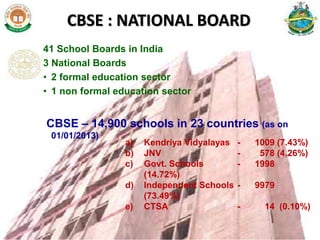
CBSE – 14,900 schools in 23 countries (as on
01/01/2013)
CBSE : NATIONAL BOARD
a) Kendriya Vidyalayas - 1009 (7.43%)
b) JNV - 578 (4.26%)
c) Govt. Schools - 1998
(14.72%)
d) Independent Schools - 9979
(73.49%)
e) CTSA - 14 (0.10%)
4
852
640
761
3985
111
195
1086
401
252
1665
511
238
401
193
338
199
525
101
1
488
56
22
30
189
389
31
269
12
11
13
1909
152
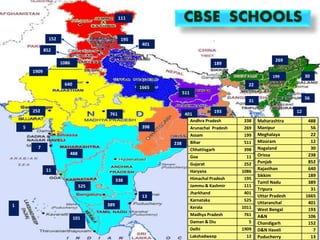
CBSE SCHOOLS
4
106
Andhra Pradesh 338
Arunachal Pradesh 269
Assam 199
Bihar 511
Chhattisgarh 398
Goa 11
Gujarat 252
Haryana 1086
Himachal Pradesh 195
Jammu & Kashmir 111
Jharkhand 401
Karnataka 525
Kerala 1011
Madhya Pradesh 761
Daman & Diu 5
Delhi 1909
Lakshadweep 12
Maharashtra 488
Manipur 56
Meghalaya 22
Mizoram 12
Nagaland 30
Orissa 238
Punjab 852
Rajasthan 640
Sikkim 189
Tamil Nadu 389
Tripura 31
Uttar Pradesh 1665
Uttaranchal 401
West Bengal 193
A&N 106
Chandigarh 152
D&N Haveli 7
Puducherry 13
1
2
7
5
SCHOOLS ABROAD
Japan
BANGLADESH 01
BAHRAIN 06
BURMA 01
ETHIOPIA 02
IRAN 01
SAUDI ARABIA 35
KUWAIT 17
LIBYA 02
OMAN 12
NEPAL 14
QATAR 08
TANZANIA 01
NIGERIA 01
THAILAND 01
UGANDA 01
MALAYSIA 03
JAPAN 02
WEST AFRICA 02
U.S.S.R. 01
YEMEN 01
INDONESIA 01
SINGAPORE 04
UNITED ARAB
EMIRATES
59
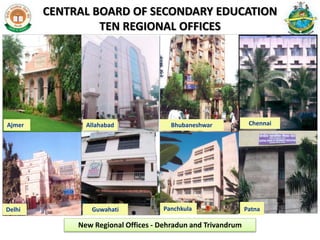
BhubaneshwarAjmer Allahabad
Delhi PanchkulaGuwahati Patna
Chennai
CENTRAL BOARD OF SECONDARY EDUCATION
TEN REGIONAL OFFICES
New Regional Offices - Dehradun and Trivandrum
WEBSITES FOR DISSEMNATING INFORMATION
(www.cbse.nic.in, www.cbseacademic.in)
What will we gain from this workshop?
 Rationalize the need for a shift from impression based
assessment to evidence generated assessment
 Appreciate the role of formative and summative
assessment in learning
 Knowledge about Continuous and Comprehensive
Evaluation in both Scholastic and Co-Scholastic
Areas.
 Understand the terms used in CCE
 Effective implementation of CCE for greater student
learning and achievement.
8
What do we mean by Scholastic
and Co-Scholastic?
9
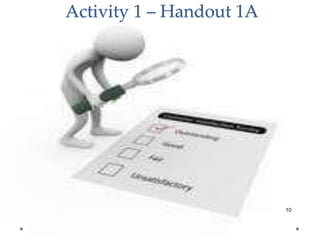
Activity 1 – Handout 1A
10
Answers for Handout 1A
11
1.D 2. C 3. A 4. B 5. D
6. A 7. B 8. B 9. C 10. D
11.D 12. A 13. B 14. D 15. C
16. B 17. D 18. D 19. B 20. B
21. B 22. C 23. B 24. D 25. A
Traditional thinking is all about ‘what
is’.
Future thinking will also need to be
‘what can be’ .
- Edward de Bono
Do I ‘assess’ or ‘evaluate’ ?
 ASSESSMENT: An ongoing process of systematic
collection of information (evidence) relative to a
learning outcome & its analysis to inform teaching-
learning practices
 EVALUATION: The culminating act of interpreting
information gathered for the purpose of making
decision or judgment.
Why is assessment important?
 It informs where a student is.
 It informs how a student is progressing.
 It informs teaching-learning practices for improved
student learning.
How do
I assess my
students?
Understanding Teacher’s Decisions
• Should I ‘assess’ or ‘evaluate’?
• ‘Why’ should I assess ?
• ‘What’ should I assess ?
• ‘How’ should I assess ?
• ‘When’ should I assess ?
• How would I ‘use’ the assessment results
?
17
Continuous and
Comprehensive Evaluation
Meaning, Features and Concept
18
The Paradigm Shift
From Term End Examination
To
Continuous Assessment
Do you think it is
useful?
WHY?
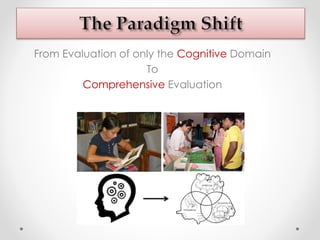
The Paradigm Shift
From Evaluation of only the Cognitive Domain
To
Comprehensive Evaluation
The Paradigm Shift
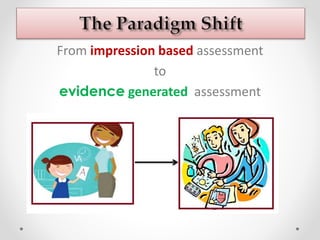
From impression based assessment
to
evidence generated assessment
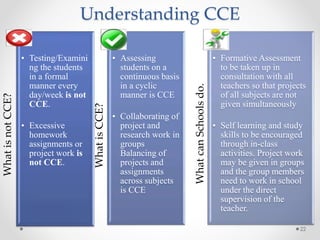
Understanding CCEWhatisnotCCE?
• Testing/Examini
ng the students
in a formal
manner every
day/week is not
CCE.
• Excessive
homework
assignments or
project work is
not CCE.
WhatisCCE?
• Assessing
students on a
continuous basis
in a cyclic
manner is CCE
• Collaborating of
project and
research work in
groups
Balancing of
projects and
assignments
across subjects
is CCE
WhatcanSchoolsdo.
• Formative Assessment
to be taken up in
consultation with all
teachers so that projects
of all subjects are not
given simultaneously
• Self learning and study
skills to be encouraged
through in-class
activities. Project work
may be given in groups
and the group members
need to work in school
under the direct
supervision of the
teacher.
22
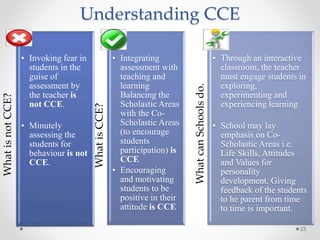
Understanding CCEWhatisnotCCE?
• Invoking fear in
students in the
guise of
assessment by
the teacher is
not CCE.
• Minutely
assessing the
students for
behaviour is not
CCE.
WhatisCCE?
• Integrating
assessment with
teaching and
learning
Balancing the
Scholastic Areas
with the Co-
Scholastic Areas
(to encourage
students
participation) is
CCE
• Encouraging
and motivating
students to be
positive in their
attitude is CCE
WhatcanSchoolsdo.
• Through an interactive
classroom, the teacher
must engage students in
exploring,
experimenting and
experiencing learning
• School may lay
emphasis on Co-
Scholastic Areas i.e.
Life Skills, Attitudes
and Values for
personality
development. Giving
feedback of the students
to he parent from time
to time is important.
23
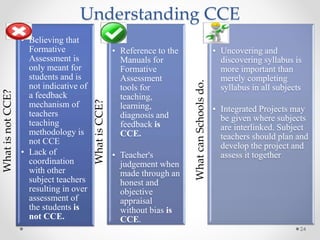
Understanding CCEWhatisnotCCE?
• Believing that
Formative
Assessment is
only meant for
students and is
not indicative of
a feedback
mechanism of
teachers
teaching
methodology is
not CCE
• Lack of
coordination
with other
subject teachers
resulting in over
assessment of
the students is
not CCE.
WhatisCCE?
• Reference to the
Manuals for
Formative
Assessment
tools for
teaching,
learning,
diagnosis and
feedback is
CCE.
• Teacher's
judgement when
made through an
honest and
objective
appraisal
without bias is
CCE.
WhatcanSchoolsdo.
• Uncovering and
discovering syllabus is
more important than
merely completing
syllabus in all subjects
• Integrated Projects may
be given where subjects
are interlinked. Subject
teachers should plan and
develop the project and
assess it together
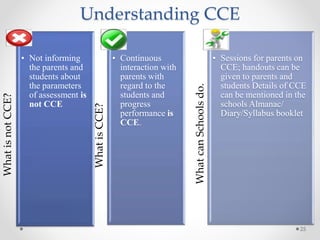
24
Understanding CCEWhatisnotCCE?
• Not informing
the parents and
students about
the parameters
of assessment is
not CCE WhatisCCE?
• Continuous
interaction with
parents with
regard to the
students and
progress
performance is
CCE.
WhatcanSchoolsdo.
• Sessions for parents on
CCE; handouts can be
given to parents and
students Details of CCE
can be mentioned in the
schools Almanac/
Diary/Syllabus booklet
25
Functions of School Based Continuous and
Comprehensive Evaluation System
 Reduces Stress on children
 Makes Evaluation Comprehensive and Regular
 Provides space to the Teacher for Creative Teaching
 Provides a Tool of Diagnosis and Remedial Action
 Produces Learners with Greater Skill
o Position Paper on Aims of Education – NCF 2005, NCERT
How would the CCE Scheme help?
CCE scheme would help to
 reduce stress and anxiety
 reduce the dropout rate
 do away with practice to finish the entire syllabus and follow it up
with Pre-Board(s) and study leave
 lay greater focus on learning rather than teaching to the test.
 emphasize conceptual clarification through experiential learning
 make more time available for transaction of curriculum.
How would the CCE Scheme Help?
 help the learners to develop holistically in terms of personality
 focus on the co-scholastic aspects
 prepare the students for life
 making students physically fit, mentally alert and emotionally
balanced.
 more time on their hands to develop their interests, hobbies and
personalities.
 enable the students, parents and teachers to make an informed choice
about subjects in Class XI.
 motivate learning in a friendly environment
 equip students with Life Skills especially Creative and Critical
thinking skills, Social skills and Coping skills
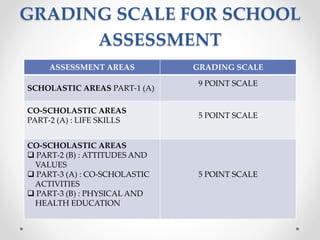
GRADING SCALE FOR SCHOOL
ASSESSMENT
ASSESSMENT AREAS GRADING SCALE
SCHOLASTIC AREAS PART-1 (A)
9 POINT SCALE
CO-SCHOLASTIC AREAS
PART-2 (A) : LIFE SKILLS
5 POINT SCALE
CO-SCHOLASTIC AREAS
 PART-2 (B) : ATTITUDES AND
VALUES
 PART-3 (A) : CO-SCHOLASTIC
ACTIVITIES
 PART-3 (B) : PHYSICAL AND
HEALTH EDUCATION
5 POINT SCALE
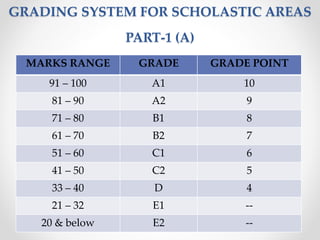
GRADING SYSTEM FOR SCHOLASTIC AREAS
PART-1 (A)
MARKS RANGE GRADE GRADE POINT
91 – 100 A1 10
81 – 90 A2 9
71 – 80 B1 8
61 – 70 B2 7
51 – 60 C1 6
41 – 50 C2 5
33 – 40 D 4
21 – 32 E1 --
20 & below E2 --
Keys to Quality Classroom Assessment
Key 1 — Why assess?
 What’s the purpose?
Key 2 — Assess what?
 What are the learning outcomes?
 Are they clear?
Key 3 — Assess how?
 What method and manner?
Key 4 — Communicate how?
 How do we gather and record information?
 How do we utilize information?
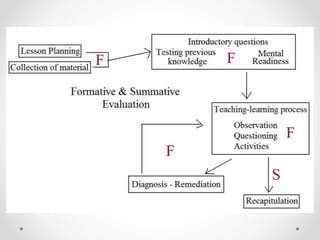
Formative Assessment?
32
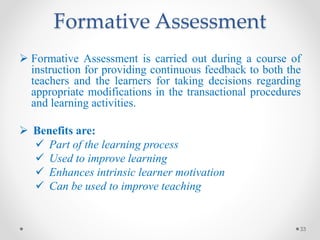
Formative Assessment
 Formative Assessment is carried out during a course of
instruction for providing continuous feedback to both the
teachers and the learners for taking decisions regarding
appropriate modifications in the transactional procedures
and learning activities.
 Benefits are:
 Part of the learning process
 Used to improve learning
 Enhances intrinsic learner motivation
 Can be used to improve teaching
33
• Is Formative Assessment something
new?
• What Makes an Assessment Formative?
• Is Formative Assessment a Teaching
Strategy?
• Can Formative Assessment Bridge
Learning Gaps?
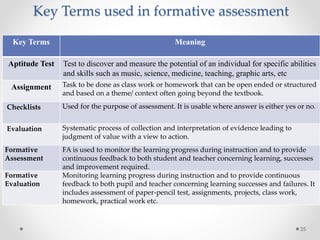
Key Terms used in formative assessment
35
Key Terms Meaning
Aptitude Test Test to discover and measure the potential of an individual for specific abilities
and skills such as music, science, medicine, teaching, graphic arts, etc
Assignment Task to be done as class work or homework that can be open ended or structured
and based on a theme/ context often going beyond the textbook.
Checklists Used for the purpose of assessment. It is usable where answer is either yes or no.
Evaluation Systematic process of collection and interpretation of evidence leading to
judgment of value with a view to action.
Formative
Assessment
FA is used to monitor the learning progress during instruction and to provide
continuous feedback to both student and teacher concerning learning, successes
and improvement required.
Formative
Evaluation
Monitoring learning progress during instruction and to provide continuous
feedback to both pupil and teacher concerning learning successes and failures. It
includes assessment of paper-pencil test, assignments, projects, class work,
homework, practical work etc.
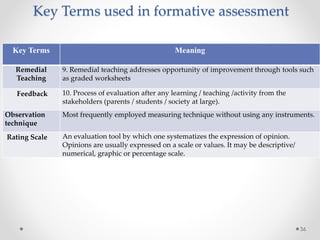
Key Terms used in formative assessment
36
Key Terms Meaning
Remedial
Teaching
9. Remedial teaching addresses opportunity of improvement through tools such
as graded worksheets
Feedback 10. Process of evaluation after any learning / teaching /activity from the
stakeholders (parents / students / society at large).
Observation
technique
Most frequently employed measuring technique without using any instruments.
Rating Scale An evaluation tool by which one systematizes the expression of opinion.
Opinions are usually expressed on a scale or values. It may be descriptive/
numerical, graphic or percentage scale.
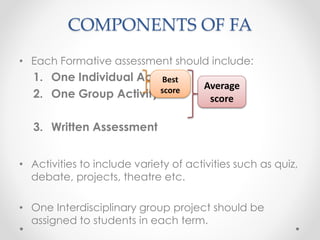
COMPONENTS OF FA
• Each Formative assessment should include:
1. One Individual Activity
2. One Group Activity
3. Written Assessment
• Activities to include variety of activities such as quiz,
debate, projects, theatre etc.
• One Interdisciplinary group project should be
assigned to students in each term.
Best
score Average
score
Activity 2 – Handout 2C, 2C(ii),
2C(iii)
38
Class room Scenario
39
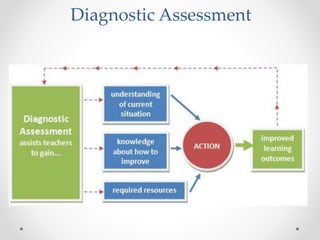
Diagnostic Assessment
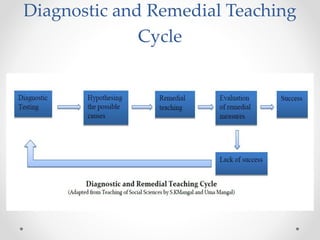
Diagnostic and Remedial Teaching
Cycle
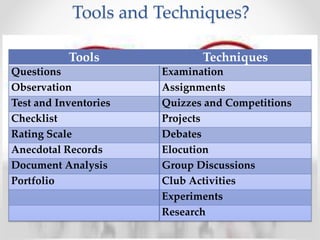
Tools and Techniques?
42
Tools Techniques
Questions Examination
Observation Assignments
Test and Inventories Quizzes and Competitions
Checklist Projects
Rating Scale Debates
Anecdotal Records Elocution
Document Analysis Group Discussions
Portfolio Club Activities
Experiments
Research
Reflect,
before we go Ahead!
• We do give Date Sheet to hold Formative
Assessments in our Schools.
• We have fixed number of tasks/activities to be
covered under Formative Assessment
• We use variety of tasks to assess students
performance.
Summative Assessment?
44
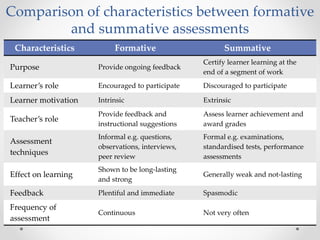
Comparison of characteristics between formative
and summative assessments
Characteristics Formative Summative
Purpose Provide ongoing feedback
Certify learner learning at the
end of a segment of work
Learner’s role Encouraged to participate Discouraged to participate
Learner motivation Intrinsic Extrinsic
Teacher’s role
Provide feedback and
instructional suggestions
Assess learner achievement and
award grades
Assessment
techniques
Informal e.g. questions,
observations, interviews,
peer review
Formal e.g. examinations,
standardised tests, performance
assessments
Effect on learning
Shown to be long-lasting
and strong
Generally weak and not-lasting
Feedback Plentiful and immediate Spasmodic
Frequency of
assessment
Continuous Not very often
Role Play
Modern Assessment?
48
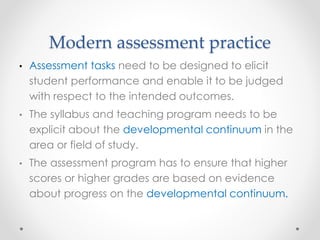
Modern assessment practice
• Assessment tasks need to be designed to elicit
student performance and enable it to be judged
with respect to the intended outcomes.
• The syllabus and teaching program needs to be
explicit about the developmental continuum in the
area or field of study.
• The assessment program has to ensure that higher
scores or higher grades are based on evidence
about progress on the developmental continuum.
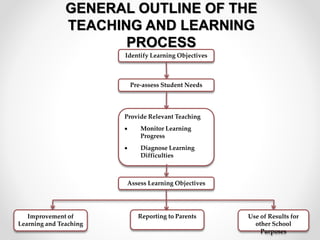
Identify Learning Objectives
Pre-assess Student Needs
Provide Relevant Teaching
 Monitor Learning
Progress
 Diagnose Learning
Difficulties
Assess Learning Objectives
Improvement of
Learning and Teaching
Reporting to Parents Use of Results for
other School
Purposes
GENERAL OUTLINE OF THE
TEACHING AND LEARNING
PROCESS
A new way of thinking about
assessment
• Assessment is viewed as the process of monitoring a
child’s progress along a developmental continuum.
• The focus shifts from comparing one individual with
another, towards monitoring what students know
and can do.
• It is a model based on growth.
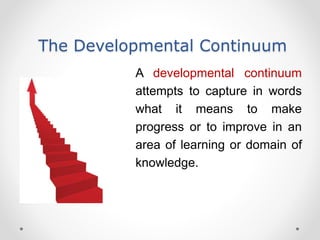
The Developmental Continuum
A developmental continuum
attempts to capture in words
what it means to make
progress or to improve in an
area of learning or domain of
knowledge.
A Summary
• The items, questions and tasks should match the
learning objectives in the syllabus.
• The items, questions and tasks that are developed
should enable students at different stages in their
learning to demonstrate what they actually know
and can do.
• A range of different item types should be used to
generate a reliable and valid estimate of the
student’s location along the developmental
continuum.
Our Vision…
Enable Schools and Teachers to
play a defining role
in
preparing humans for life,
rooted in universal values and
high achievement.
Provide opportunities for
Professional Development
to Teachers enabling them to
reinvent themselves
and their profession to meet the
challenges of the 21st century learners.
Our Mision…
KEY LEARNING
The participants have arrived at:
• examining their knowledge and
understanding of the terms used in
CCE.
• rationalizing the need for a shift from
impression based assessment to
evidence generated assessment
• appreciating the role of formative and
summative assessment in learning.
If you have further questions, please feel free to email me at
dimpleanil@gmail.com or call me at 09419185085
57

CCE_DimpleAnil_Final

  • 1.
    CONTINUOUS AND COMPREHENSIVE EVALUATION Mrs.Dimple Anil, Gold Medalist, MA(Eng Lit), M.Ed, M.Sc (Eco and Env) 1
  • 2.
  • 3.
    41 School Boardsin India 3 National Boards • 2 formal education sector • 1 non formal education sector CBSE – 14,900 schools in 23 countries (as on 01/01/2013) CBSE : NATIONAL BOARD a) Kendriya Vidyalayas - 1009 (7.43%) b) JNV - 578 (4.26%) c) Govt. Schools - 1998 (14.72%) d) Independent Schools - 9979 (73.49%) e) CTSA - 14 (0.10%)
  • 4.
    4 852 640 761 3985 111 195 1086 401 252 1665 511 238 401 193 338 199 525 101 1 488 56 22 30 189 389 31 269 12 11 13 1909 152 CBSE SCHOOLS 4 106 Andhra Pradesh338 Arunachal Pradesh 269 Assam 199 Bihar 511 Chhattisgarh 398 Goa 11 Gujarat 252 Haryana 1086 Himachal Pradesh 195 Jammu & Kashmir 111 Jharkhand 401 Karnataka 525 Kerala 1011 Madhya Pradesh 761 Daman & Diu 5 Delhi 1909 Lakshadweep 12 Maharashtra 488 Manipur 56 Meghalaya 22 Mizoram 12 Nagaland 30 Orissa 238 Punjab 852 Rajasthan 640 Sikkim 189 Tamil Nadu 389 Tripura 31 Uttar Pradesh 1665 Uttaranchal 401 West Bengal 193 A&N 106 Chandigarh 152 D&N Haveli 7 Puducherry 13 1 2 7
  • 5.
    5 SCHOOLS ABROAD Japan BANGLADESH 01 BAHRAIN06 BURMA 01 ETHIOPIA 02 IRAN 01 SAUDI ARABIA 35 KUWAIT 17 LIBYA 02 OMAN 12 NEPAL 14 QATAR 08 TANZANIA 01 NIGERIA 01 THAILAND 01 UGANDA 01 MALAYSIA 03 JAPAN 02 WEST AFRICA 02 U.S.S.R. 01 YEMEN 01 INDONESIA 01 SINGAPORE 04 UNITED ARAB EMIRATES 59
  • 6.
    BhubaneshwarAjmer Allahabad Delhi PanchkulaGuwahatiPatna Chennai CENTRAL BOARD OF SECONDARY EDUCATION TEN REGIONAL OFFICES New Regional Offices - Dehradun and Trivandrum
  • 7.
    WEBSITES FOR DISSEMNATINGINFORMATION (www.cbse.nic.in, www.cbseacademic.in)
  • 8.
    What will wegain from this workshop?  Rationalize the need for a shift from impression based assessment to evidence generated assessment  Appreciate the role of formative and summative assessment in learning  Knowledge about Continuous and Comprehensive Evaluation in both Scholastic and Co-Scholastic Areas.  Understand the terms used in CCE  Effective implementation of CCE for greater student learning and achievement. 8
  • 9.
    What do wemean by Scholastic and Co-Scholastic? 9
  • 10.
    Activity 1 –Handout 1A 10
  • 11.
    Answers for Handout1A 11 1.D 2. C 3. A 4. B 5. D 6. A 7. B 8. B 9. C 10. D 11.D 12. A 13. B 14. D 15. C 16. B 17. D 18. D 19. B 20. B 21. B 22. C 23. B 24. D 25. A
  • 12.
    Traditional thinking isall about ‘what is’. Future thinking will also need to be ‘what can be’ . - Edward de Bono
  • 13.
    Do I ‘assess’or ‘evaluate’ ?  ASSESSMENT: An ongoing process of systematic collection of information (evidence) relative to a learning outcome & its analysis to inform teaching- learning practices  EVALUATION: The culminating act of interpreting information gathered for the purpose of making decision or judgment.
  • 14.
    Why is assessmentimportant?  It informs where a student is.  It informs how a student is progressing.  It informs teaching-learning practices for improved student learning.
  • 15.
    How do I assessmy students?
  • 16.
    Understanding Teacher’s Decisions •Should I ‘assess’ or ‘evaluate’? • ‘Why’ should I assess ? • ‘What’ should I assess ? • ‘How’ should I assess ? • ‘When’ should I assess ? • How would I ‘use’ the assessment results ?
  • 17.
  • 18.
  • 19.
    The Paradigm Shift FromTerm End Examination To Continuous Assessment Do you think it is useful? WHY?
  • 20.
    The Paradigm Shift FromEvaluation of only the Cognitive Domain To Comprehensive Evaluation
  • 21.
    The Paradigm Shift Fromimpression based assessment to evidence generated assessment
  • 22.
    Understanding CCEWhatisnotCCE? • Testing/Examini ngthe students in a formal manner every day/week is not CCE. • Excessive homework assignments or project work is not CCE. WhatisCCE? • Assessing students on a continuous basis in a cyclic manner is CCE • Collaborating of project and research work in groups Balancing of projects and assignments across subjects is CCE WhatcanSchoolsdo. • Formative Assessment to be taken up in consultation with all teachers so that projects of all subjects are not given simultaneously • Self learning and study skills to be encouraged through in-class activities. Project work may be given in groups and the group members need to work in school under the direct supervision of the teacher. 22
  • 23.
    Understanding CCEWhatisnotCCE? • Invokingfear in students in the guise of assessment by the teacher is not CCE. • Minutely assessing the students for behaviour is not CCE. WhatisCCE? • Integrating assessment with teaching and learning Balancing the Scholastic Areas with the Co- Scholastic Areas (to encourage students participation) is CCE • Encouraging and motivating students to be positive in their attitude is CCE WhatcanSchoolsdo. • Through an interactive classroom, the teacher must engage students in exploring, experimenting and experiencing learning • School may lay emphasis on Co- Scholastic Areas i.e. Life Skills, Attitudes and Values for personality development. Giving feedback of the students to he parent from time to time is important. 23
  • 24.
    Understanding CCEWhatisnotCCE? • Believingthat Formative Assessment is only meant for students and is not indicative of a feedback mechanism of teachers teaching methodology is not CCE • Lack of coordination with other subject teachers resulting in over assessment of the students is not CCE. WhatisCCE? • Reference to the Manuals for Formative Assessment tools for teaching, learning, diagnosis and feedback is CCE. • Teacher's judgement when made through an honest and objective appraisal without bias is CCE. WhatcanSchoolsdo. • Uncovering and discovering syllabus is more important than merely completing syllabus in all subjects • Integrated Projects may be given where subjects are interlinked. Subject teachers should plan and develop the project and assess it together 24
  • 25.
    Understanding CCEWhatisnotCCE? • Notinforming the parents and students about the parameters of assessment is not CCE WhatisCCE? • Continuous interaction with parents with regard to the students and progress performance is CCE. WhatcanSchoolsdo. • Sessions for parents on CCE; handouts can be given to parents and students Details of CCE can be mentioned in the schools Almanac/ Diary/Syllabus booklet 25
  • 26.
    Functions of SchoolBased Continuous and Comprehensive Evaluation System  Reduces Stress on children  Makes Evaluation Comprehensive and Regular  Provides space to the Teacher for Creative Teaching  Provides a Tool of Diagnosis and Remedial Action  Produces Learners with Greater Skill o Position Paper on Aims of Education – NCF 2005, NCERT
  • 27.
    How would theCCE Scheme help? CCE scheme would help to  reduce stress and anxiety  reduce the dropout rate  do away with practice to finish the entire syllabus and follow it up with Pre-Board(s) and study leave  lay greater focus on learning rather than teaching to the test.  emphasize conceptual clarification through experiential learning  make more time available for transaction of curriculum.
  • 28.
    How would theCCE Scheme Help?  help the learners to develop holistically in terms of personality  focus on the co-scholastic aspects  prepare the students for life  making students physically fit, mentally alert and emotionally balanced.  more time on their hands to develop their interests, hobbies and personalities.  enable the students, parents and teachers to make an informed choice about subjects in Class XI.  motivate learning in a friendly environment  equip students with Life Skills especially Creative and Critical thinking skills, Social skills and Coping skills
  • 29.
    GRADING SCALE FORSCHOOL ASSESSMENT ASSESSMENT AREAS GRADING SCALE SCHOLASTIC AREAS PART-1 (A) 9 POINT SCALE CO-SCHOLASTIC AREAS PART-2 (A) : LIFE SKILLS 5 POINT SCALE CO-SCHOLASTIC AREAS  PART-2 (B) : ATTITUDES AND VALUES  PART-3 (A) : CO-SCHOLASTIC ACTIVITIES  PART-3 (B) : PHYSICAL AND HEALTH EDUCATION 5 POINT SCALE
  • 30.
    GRADING SYSTEM FORSCHOLASTIC AREAS PART-1 (A) MARKS RANGE GRADE GRADE POINT 91 – 100 A1 10 81 – 90 A2 9 71 – 80 B1 8 61 – 70 B2 7 51 – 60 C1 6 41 – 50 C2 5 33 – 40 D 4 21 – 32 E1 -- 20 & below E2 --
  • 31.
    Keys to QualityClassroom Assessment Key 1 — Why assess?  What’s the purpose? Key 2 — Assess what?  What are the learning outcomes?  Are they clear? Key 3 — Assess how?  What method and manner? Key 4 — Communicate how?  How do we gather and record information?  How do we utilize information?
  • 32.
  • 33.
    Formative Assessment  FormativeAssessment is carried out during a course of instruction for providing continuous feedback to both the teachers and the learners for taking decisions regarding appropriate modifications in the transactional procedures and learning activities.  Benefits are:  Part of the learning process  Used to improve learning  Enhances intrinsic learner motivation  Can be used to improve teaching 33
  • 34.
    • Is FormativeAssessment something new? • What Makes an Assessment Formative? • Is Formative Assessment a Teaching Strategy? • Can Formative Assessment Bridge Learning Gaps?
  • 35.
    Key Terms usedin formative assessment 35 Key Terms Meaning Aptitude Test Test to discover and measure the potential of an individual for specific abilities and skills such as music, science, medicine, teaching, graphic arts, etc Assignment Task to be done as class work or homework that can be open ended or structured and based on a theme/ context often going beyond the textbook. Checklists Used for the purpose of assessment. It is usable where answer is either yes or no. Evaluation Systematic process of collection and interpretation of evidence leading to judgment of value with a view to action. Formative Assessment FA is used to monitor the learning progress during instruction and to provide continuous feedback to both student and teacher concerning learning, successes and improvement required. Formative Evaluation Monitoring learning progress during instruction and to provide continuous feedback to both pupil and teacher concerning learning successes and failures. It includes assessment of paper-pencil test, assignments, projects, class work, homework, practical work etc.
  • 36.
    Key Terms usedin formative assessment 36 Key Terms Meaning Remedial Teaching 9. Remedial teaching addresses opportunity of improvement through tools such as graded worksheets Feedback 10. Process of evaluation after any learning / teaching /activity from the stakeholders (parents / students / society at large). Observation technique Most frequently employed measuring technique without using any instruments. Rating Scale An evaluation tool by which one systematizes the expression of opinion. Opinions are usually expressed on a scale or values. It may be descriptive/ numerical, graphic or percentage scale.
  • 37.
    COMPONENTS OF FA •Each Formative assessment should include: 1. One Individual Activity 2. One Group Activity 3. Written Assessment • Activities to include variety of activities such as quiz, debate, projects, theatre etc. • One Interdisciplinary group project should be assigned to students in each term. Best score Average score
  • 38.
    Activity 2 –Handout 2C, 2C(ii), 2C(iii) 38 Class room Scenario
  • 39.
  • 40.
  • 41.
  • 42.
    Tools and Techniques? 42 ToolsTechniques Questions Examination Observation Assignments Test and Inventories Quizzes and Competitions Checklist Projects Rating Scale Debates Anecdotal Records Elocution Document Analysis Group Discussions Portfolio Club Activities Experiments Research
  • 43.
    Reflect, before we goAhead! • We do give Date Sheet to hold Formative Assessments in our Schools. • We have fixed number of tasks/activities to be covered under Formative Assessment • We use variety of tasks to assess students performance.
  • 44.
  • 45.
    Comparison of characteristicsbetween formative and summative assessments Characteristics Formative Summative Purpose Provide ongoing feedback Certify learner learning at the end of a segment of work Learner’s role Encouraged to participate Discouraged to participate Learner motivation Intrinsic Extrinsic Teacher’s role Provide feedback and instructional suggestions Assess learner achievement and award grades Assessment techniques Informal e.g. questions, observations, interviews, peer review Formal e.g. examinations, standardised tests, performance assessments Effect on learning Shown to be long-lasting and strong Generally weak and not-lasting Feedback Plentiful and immediate Spasmodic Frequency of assessment Continuous Not very often
  • 46.
  • 48.
  • 49.
    Modern assessment practice •Assessment tasks need to be designed to elicit student performance and enable it to be judged with respect to the intended outcomes. • The syllabus and teaching program needs to be explicit about the developmental continuum in the area or field of study. • The assessment program has to ensure that higher scores or higher grades are based on evidence about progress on the developmental continuum.
  • 50.
    Identify Learning Objectives Pre-assessStudent Needs Provide Relevant Teaching  Monitor Learning Progress  Diagnose Learning Difficulties Assess Learning Objectives Improvement of Learning and Teaching Reporting to Parents Use of Results for other School Purposes GENERAL OUTLINE OF THE TEACHING AND LEARNING PROCESS
  • 51.
    A new wayof thinking about assessment • Assessment is viewed as the process of monitoring a child’s progress along a developmental continuum. • The focus shifts from comparing one individual with another, towards monitoring what students know and can do. • It is a model based on growth.
  • 52.
    The Developmental Continuum Adevelopmental continuum attempts to capture in words what it means to make progress or to improve in an area of learning or domain of knowledge.
  • 53.
    A Summary • Theitems, questions and tasks should match the learning objectives in the syllabus. • The items, questions and tasks that are developed should enable students at different stages in their learning to demonstrate what they actually know and can do. • A range of different item types should be used to generate a reliable and valid estimate of the student’s location along the developmental continuum.
  • 54.
    Our Vision… Enable Schoolsand Teachers to play a defining role in preparing humans for life, rooted in universal values and high achievement.
  • 55.
    Provide opportunities for ProfessionalDevelopment to Teachers enabling them to reinvent themselves and their profession to meet the challenges of the 21st century learners. Our Mision…
  • 56.
    KEY LEARNING The participantshave arrived at: • examining their knowledge and understanding of the terms used in CCE. • rationalizing the need for a shift from impression based assessment to evidence generated assessment • appreciating the role of formative and summative assessment in learning.
  • 57.
    If you havefurther questions, please feel free to email me at dimpleanil@gmail.com or call me at 09419185085 57

Editor's Notes