Assessment &
Evaluation
Dr.G.Jaganmohana Rao
Faculty of Education
MITE, Kohima
Assessment:
Assessment is the process of gathering information to monitor
progress and make educational decisions if necessary. An assessment
may include a test, but, also includes methods such as observations,
interviews, behaviours, monitoring, etc. Assessment is a process by
which information is obtained relative to some known objective or goal.
Assessment is an ongoing process aimed at understanding and
improving student learning. It involves making expectations explicit and
public; setting appropriate criteria and high standards for learning quality;
systematically gathering, analyzing, and interpreting evidence to
determine how well performance matches those expectations and
standards, and using the resulting information to document, explain, and
improve performance.
Objectives of Educational Assessment:
1. To prepare students for the new pattern of competency-based
teaching and competency based assessment.
2. To make assessment an integral part of teaching-learning
process.
3. To make assessment in a cooperative and democratic
process
4. To collect more valid and reliable evidences about total
development of the learners.
5. To take timely decisions about learners’ instructions and
learning environments.
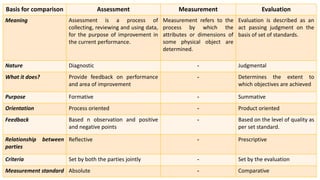
Basis for comparison Assessment Measurement Evaluation
Meaning Assessment is a process of
collecting, reviewing and using data,
for the purpose of improvement in
the current performance.
Measurement refers to the
process by which the
attributes or dimensions of
some physical object are
determined.
Evaluation is described as an
act passing judgment on the
basis of set of standards.
Nature Diagnostic - Judgmental
What it does? Provide feedback on performance
and area of improvement
- Determines the extent to
which objectives are achieved
Purpose Formative - Summative
Orientation Process oriented - Product oriented
Feedback Based n observation and positive
and negative points
- Based on the level of quality as
per set standard.
Relationship between
parties
Reflective - Prescriptive
Criteria Set by both the parties jointly - Set by the evaluation
Measurement standard Absolute - Comparative
Purpose of Assessment:
(For Learners)
To identify the strengths and weakness of the students
To motivating and directing learning (Lerner)
To providing feedback to student on their performance
To ensuring standards of progression are met
To segregate the class as per the abilities of the child (Individual Differences)
For Teachers:
 To what extent are my students achieving the stated goals?
 How should I allocate class time for the current topic?
 Can I teach this topic in a more efficient or effective way?
 What parts of this course/unit are my students finding most valuable?
 How will I change this course/unit the next time I teach it?
 Which method/technique is suitable for this unit?

Assessment & Evaluation

  • 1.
  • 2.
    Assessment: Assessment is theprocess of gathering information to monitor progress and make educational decisions if necessary. An assessment may include a test, but, also includes methods such as observations, interviews, behaviours, monitoring, etc. Assessment is a process by which information is obtained relative to some known objective or goal. Assessment is an ongoing process aimed at understanding and improving student learning. It involves making expectations explicit and public; setting appropriate criteria and high standards for learning quality; systematically gathering, analyzing, and interpreting evidence to determine how well performance matches those expectations and standards, and using the resulting information to document, explain, and improve performance.
  • 3.
    Objectives of EducationalAssessment: 1. To prepare students for the new pattern of competency-based teaching and competency based assessment. 2. To make assessment an integral part of teaching-learning process. 3. To make assessment in a cooperative and democratic process 4. To collect more valid and reliable evidences about total development of the learners. 5. To take timely decisions about learners’ instructions and learning environments.
  • 4.
    Basis for comparisonAssessment Measurement Evaluation Meaning Assessment is a process of collecting, reviewing and using data, for the purpose of improvement in the current performance. Measurement refers to the process by which the attributes or dimensions of some physical object are determined. Evaluation is described as an act passing judgment on the basis of set of standards. Nature Diagnostic - Judgmental What it does? Provide feedback on performance and area of improvement - Determines the extent to which objectives are achieved Purpose Formative - Summative Orientation Process oriented - Product oriented Feedback Based n observation and positive and negative points - Based on the level of quality as per set standard. Relationship between parties Reflective - Prescriptive Criteria Set by both the parties jointly - Set by the evaluation Measurement standard Absolute - Comparative
  • 5.
    Purpose of Assessment: (ForLearners) To identify the strengths and weakness of the students To motivating and directing learning (Lerner) To providing feedback to student on their performance To ensuring standards of progression are met To segregate the class as per the abilities of the child (Individual Differences) For Teachers:  To what extent are my students achieving the stated goals?  How should I allocate class time for the current topic?  Can I teach this topic in a more efficient or effective way?  What parts of this course/unit are my students finding most valuable?  How will I change this course/unit the next time I teach it?  Which method/technique is suitable for this unit?