Assessment
Howtolinkcurriculumtoassessment?
Curriculum, standards and
assessment join together to
help teachers provide the
best learning experiences for
students.
How does assessment inform children’s outcomes?
Outcomes are the recorded results of a well-
balanced review of children’s skill development,
based on teachers’ assessments. Teachers use
reliable and valid assessment instruments to
guide their collection and documentation of
children’s progress for reporting.
Should assessment match up with curriculum?
It is important to assess children
on the information you are providing
through assessment.
Example
Day-to-day Assessment
Day-to-day assessment
is an essential aspect of
effective teaching. It involves
the teacher or practitioner
focusing on how learning is
progressing during the lesson,
determining where
improvements can be made
and identifying the next steps.
To carry out this successful assessment,
Learning Objectives
- shared understanding of what is to be learned
Can you differentiate this two in
your own words?
Learning Outcomes
- what we expect the students to be able to
do after they have learned it
Summative Assessment
• given periodically to determine at a
particular point in time what students
know and do not know.
Examples of summative assessments:
- State assessments
- District benchmark or interim assessments
- End-of-unit or chapter tests
- End-of-term or semester exams
- Scores that are used for accountability for
schools (AYP) and students (report card grades)
Formative Assessment
• part of the instructional process
• provides the information needed to adjust
teaching and learning while they are
happening
Can you give some distinct ways
to distinguish formative from
summative assessments?
Some distinct ways to distinguish
formative from summative assessments:
• think formative assessment as "practice“
• students need to be involved both as assessors
of their own learning and as resources to other
students
• providing students with descriptive feedback as
they learn
• teachers use sound instructional practice for the
purpose of gathering information on student
learning
Instructional strategies that can be
used formatively:
1. Criteria and goal setting
Students need to understand and
know the learning target/goal and the
criteria for reaching it. Establishing and
defining quality work together, and
asking students to participate in
establishing norm behaviors for
classroom culture are all examples of
this strategy.
2. Observations
Observations assist teachers in gathering
evidence of student learning to inform instructional
planning.
3. Questioning strategies
Asking better questions allows an
opportunity for deeper thinking and provides
teachers with significant insight into the degree
and depth of understanding.
 “exit slip”
 “thumbs up/down”
 “red/green" (stop/go) cards
4. Self and peer assessment
With peer evaluation, students see each other
as resources for understanding and checking for
quality work against previously established criteria.
5. Student record keeping
This process of students keeping ongoing
records of their work not only engages students, it
also helps them, beyond a "grade,"
to see where they started and
the progress they are making
toward the learning goal.
When a comprehensive assessment program
at the classroom level balances formative and
summative student learning/achievement
information, a clear picture emerges of where a
student is relative to learning targets and standards.
Balancing Assessment
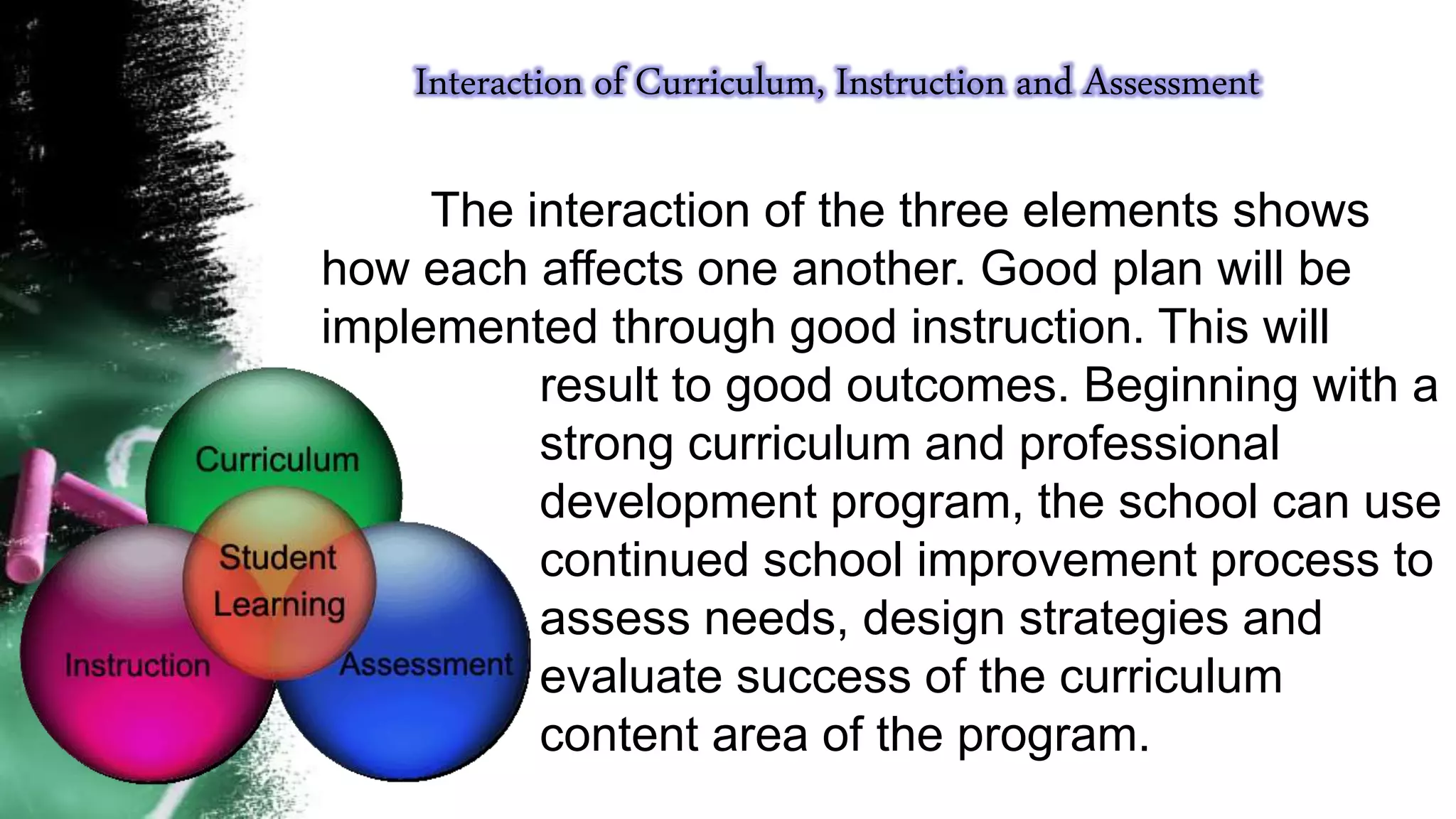
Interaction of Curriculum, Instruction and Assessment
The interaction of the three elements shows
how each affects one another. Good plan will be
implemented through good instruction. This will
result to good outcomes. Beginning with a
strong curriculum and professional
development program, the school can use
continued school improvement process to
assess needs, design strategies and
evaluate success of the curriculum
content area of the program.
Using assessment to Support the Curriculum
Presented by:
Mark Rommiel Medalla
and
Erwin Mapalad

Using assessment to support the curriculum

  • 2.
  • 3.
    Howtolinkcurriculumtoassessment? Curriculum, standards and assessmentjoin together to help teachers provide the best learning experiences for students.
  • 4.
    How does assessmentinform children’s outcomes? Outcomes are the recorded results of a well- balanced review of children’s skill development, based on teachers’ assessments. Teachers use reliable and valid assessment instruments to guide their collection and documentation of children’s progress for reporting.
  • 5.
    Should assessment matchup with curriculum? It is important to assess children on the information you are providing through assessment. Example
  • 6.
    Day-to-day Assessment Day-to-day assessment isan essential aspect of effective teaching. It involves the teacher or practitioner focusing on how learning is progressing during the lesson, determining where improvements can be made and identifying the next steps.
  • 7.
    To carry outthis successful assessment, Learning Objectives - shared understanding of what is to be learned Can you differentiate this two in your own words? Learning Outcomes - what we expect the students to be able to do after they have learned it
  • 8.
    Summative Assessment • givenperiodically to determine at a particular point in time what students know and do not know. Examples of summative assessments: - State assessments - District benchmark or interim assessments - End-of-unit or chapter tests - End-of-term or semester exams - Scores that are used for accountability for schools (AYP) and students (report card grades)
  • 9.
    Formative Assessment • partof the instructional process • provides the information needed to adjust teaching and learning while they are happening Can you give some distinct ways to distinguish formative from summative assessments?
  • 10.
    Some distinct waysto distinguish formative from summative assessments: • think formative assessment as "practice“ • students need to be involved both as assessors of their own learning and as resources to other students • providing students with descriptive feedback as they learn • teachers use sound instructional practice for the purpose of gathering information on student learning
  • 11.
    Instructional strategies thatcan be used formatively: 1. Criteria and goal setting Students need to understand and know the learning target/goal and the criteria for reaching it. Establishing and defining quality work together, and asking students to participate in establishing norm behaviors for classroom culture are all examples of this strategy.
  • 12.
    2. Observations Observations assistteachers in gathering evidence of student learning to inform instructional planning. 3. Questioning strategies Asking better questions allows an opportunity for deeper thinking and provides teachers with significant insight into the degree and depth of understanding.  “exit slip”  “thumbs up/down”  “red/green" (stop/go) cards
  • 13.
    4. Self andpeer assessment With peer evaluation, students see each other as resources for understanding and checking for quality work against previously established criteria. 5. Student record keeping This process of students keeping ongoing records of their work not only engages students, it also helps them, beyond a "grade," to see where they started and the progress they are making toward the learning goal.
  • 14.
    When a comprehensiveassessment program at the classroom level balances formative and summative student learning/achievement information, a clear picture emerges of where a student is relative to learning targets and standards. Balancing Assessment
  • 15.
    Interaction of Curriculum,Instruction and Assessment The interaction of the three elements shows how each affects one another. Good plan will be implemented through good instruction. This will result to good outcomes. Beginning with a strong curriculum and professional development program, the school can use continued school improvement process to assess needs, design strategies and evaluate success of the curriculum content area of the program.
  • 17.
    Using assessment toSupport the Curriculum Presented by: Mark Rommiel Medalla and Erwin Mapalad