EPIDEMIOLOGY
By;
Mr. Manulal .V.S
Lecturer
Government College of Nursing
Government Medical College
Thiruvananthapuram.
EPIDEMIOLOGY…..Definition
The study of the distribution and determinants
of health related states or events in specified
populations and the application of this study to
control the health problems.
By,
John . M. Last in 1988.
Aims of Epidemiology
• To describe the health status of the population.
• To explain the etiology of the disease.
• Predict the disease occurrence.
• Control the disease distribution.
• To eliminate or reduce the health problem or its
consequences.
• To promote health and well being of the society.
TERMS TO KNOW
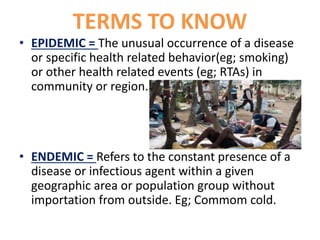
• EPIDEMIC = The unusual occurrence of a disease
or specific health related behavior(eg; smoking)
or other health related events (eg; RTAs) in
community or region.
• ENDEMIC = Refers to the constant presence of a
disease or infectious agent within a given
geographic area or population group without
importation from outside. Eg; Commom cold.
TERMS TO KNOW
• SPORADIC = Means, Scattered about. The
cases occur irregularly, haphazardly from time
to time and generally infreequently. The cases
are few and show little or no connection with
each other. Eg; Polio, Tetanus.
• PANDEMIC = An epidemic usually affecting a
large proportion of the population, occuring
over a wide geographic area such as a section
of a nation, the entire nation, a continent or
the world.
TERMS TO KNOW
• EXOTIC .= Diseases which are imported into a
country in which they do not otherwise occur.
Eg; Rabies in U.K.
• ZOONOSIS .= An infection or infectious
disease under natural conditions, transmit
from animals to man.
• EPORNITHIC. = An outbreak (Epidemic) of
disease in a bird population.
Strategies or approaches in
epidemiology
• Asking questions
(What is the problem, what is the magnitude,
where did it happen, when did it happen, who
are affected, why did it happen, how it
happened.)
• Making comparisons.
(ie; Make comparison b/w study group and
control group.).
USES OF EPIDEMIOLOGY
• To evaluate prognosis.
• To get cut-off value , eg; value of normal BP.
• To study occurrence and distribution of diseases in
the community.
• Identify the determinants of diseases.
• Estimate statistically the probability of disease,
accidents, and disabilities and the chances of avoiding
them.
• Helps to plan need based health care services and
prevention and control programmes for various
diseases identified and studied epidemiologically.
Epidemiology ---Process
• Define the problem.
• State hypothesis.
• Test the hypothesis.
• Interpret findings.
METHODS IN EPIDEMIOLOGY.
I) DESCRIPTIVE EPIDEMIOLOGY.
-Asking questions and finding answers.
-We used to describe in terms of time, place, and person.
 Case studies
 Case series
 Prevalent study (Cross sectional study) = Studying
cross- sectionally. We can study the place and person
distribution, not the time distribution. It is like a
Photograph. Studying the population at one point of
time.
METHODS IN EPIDEMIOLOGY………
I) DESCRIPTIVE EPIDEMIOLOGY.
• Longitudinal Study. = Here we can study
person, place , and time distribution. It is
like a cine film. These type of studies are
done when repeated observations are
needed in the same population over a
prolonged period of time.
METHODS IN EPIDEMIOLOGY…….
II) ANALYTICAL EPIDEMIOLOGY.
Here we will make comparisons.
• Experimental Study , Eg; RCT
• Observational Study.
- Cohort study = Proceeds from exposure to outcome.
- Case control study = Proceeds from outcome to
exposure.
- Meta analysis = Study of studies. ie; if one study
having tw different results , we will do meta analysis.
DESCRIPTIVE EPIDEMIOLOGY---
STEPS
1) Define the population.
• The descriptive studies are investigations of
populations, not individuals.
• The population can be a whole population in a
geographic area, or a representative sample
from it, like; occupational groups, age and sex
groups, small communities, school children etc.
• The defined population (population at risk)
forms the denominator of the study, it should be
large enough for generalization.
DESCRIPTIVE EPIDEMIOLOGY---
STEPS
2) Define the disease under study.
An operational definition spells out clearly the
criteria by which the disease can be
measured. It should be precise and valid.
3) Describing the disease.= Describe in terms of
time, place and ,person.
DESCRIPTIVE EPIDEMIOLOGY---
STEPS
3) Describing the disease
• Time distribution
a) Short term fluctuations. Eg; Epidemic.
-Common source epidemic. Eg; common well
-Single source epidemic. Eg; food from a
marriage
-Propagated epidemic. Eg; from one person
to another through vector or anthropod.
-Slow epidemic.
DESCRIPTIVE EPIDEMIOLOGY---
STEPS
3) Describing the disease
b) Seasonal diseases.
c) Long term or secular trend.
• Place distribution. ( International variations,
national, hilly-costal, industrial)
-Prepare Spot Map in-order to identify place
distribution.
• Person distribution. ( Age, sex, ethnicity,
occupation etc.)
DESCRIPTIVE EPIDEMIOLOGY---
STEPS
4) Measurement of disease.
- It is mandatory to have a clear picture of the
amount of disease ( disease load) in the
population. It should be available in terms of
mortality, morbidity and disability.
- Measurement of morbidity has two aspects;
Incidence (obtained from Longitudinal
studies) and Prevalence (obtained from Cross
sectional Studies.)
DESCRIPTIVE EPIDEMIOLOGY---
STEPS
5) Comparing with known indices.
By making comparisons between different,
and subgroups of the same population, it is
possible to arrive at clues to disease etiology.
We can also identify or define groups who are
at increased risk for certain diseases.
DESCRIPTIVE EPIDEMIOLOGY---
STEPS
5) Formulation of Hypothesis
A hypothesis is a supposition, arrived at from
observation or reflection. It can be accepted or
rejected, using the techniques o analytical
epidemiology.
• Eg; Cigarette smoking causes lung cancer (wrong)
• The smoking of 30-40 cigarettes per day
causes lung cancer in10% of smokers after 20
years of exposure. ( Correct.)
METHODS IN EPIDEMIOLOGY.
II) ANALYTICAL EPIDEMIOLOGY.
• These studies are based on the clues obtained
from the descriptive studies. They attempt to
determine causal factors of diseases.
• Here the subject of interest is individual
within the population.
Analytical studies comprises of two distinct
types of observational studies;
a) Case control study and b) Cohort study.
II) ANALYTICAL EPIDEMIOLOGY.
(-a) OBSERVATIONAL STUDY)
1. Case control study
• Also called as Retrospective studies, because
the study starts from outcome to exposure.
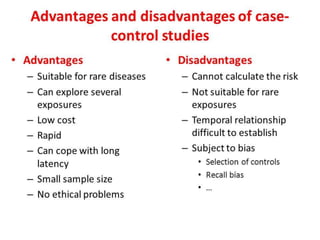
• It is a fantastic study , if outcome is rare (rare
disease). This study has three distinct features
-Study proceeds backwards from effect to cause
-Both exposure and outcome have occurred
before the start of the study.
-It uses a control or comparison group to
support an inference.
1. Case control study
• Case control studies are basically comparison
studies.
• Cases and controls must be comparable with
respect to known confounding variables like;
age, sex, occupation, social status etc.
• Analysis of case control study is mainly done
by Odd’s Ratio.
• Odds means; probability of an event or
disease to occur.
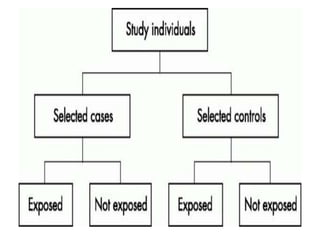
1. Case control study
BASIC STEPS IN CASE CONTROL STUDY
1) Selection of cases and controls.
a) Selection of cases = it is by definition of case
by using diagnostic criteria and eligibility
criteria & Sources cases.
b) Selection of controls.= They must be free
from diseases under study. Must be similar to
the cases as possible.
BASIC STEPS IN CASE CONTROL STUDY
2) Matching.
Matching is the process by which we
select controls in such a way that they are
similar to cases with regard to certain
pertinent selected variables (Eg: Age, Sex)
which are known to influence the outcome .
Types = - Group Matching.
- Pair Matching.
BASIC STEPS IN CASE CONTROL STUDY
3) Measurement of Exposure.
This may be obtained by interviews,
questionnaires or by studying past records etc.
4) Analysis and interpretation.
This step is to Find out;
Exposure rate among cases and controls to
suspected factor.
Estimation of disease risk associated with
exposure.
BASIC STEPS IN CASE CONTROL STUDY
The estimation of disease risk associated with
exposure is obtained by an index known as
Relative Risk (R.R) or Risk Ratio, which is
defined as the ratio between the incidence of
disease among exposed persons and incidence
among non-exposed persons.
If RR is 1 = No Association.
If RR is more than 1 = Risk.
If RR is less than 1 = Protective.
BASIC STEPS IN CASE CONTROL STUDY
Odds Ratio (OR)
Odds ratio is a measure of strength of
the association between the risk factor and
outcome. Odds ratio is the key parameter in
the analysis of case control studies.
It is also known as Cross product
ratio. (ad/bc.).
II) ANALYTICAL EPIDEMIOLOGY.
(-a) OBSERVATIONAL STUDY)
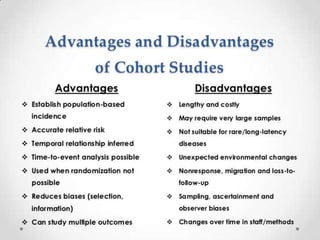
2) Cohort Study
• Also known as forward looking study,
Prospective study, longitudinal study,
incidence study. Study proceeds foreward
from cause to effect.
• The word meaning of ‘Cohort’ is a group of
people who share a common characteristic or
experience within a defined time period.
2) Cohort Study
The outcome of Cohort study is Relative Risk .
If RR is 1 = No Association / No significance of
study.
If RR is more than 1 = Risk Exposure is there.
If RR is less than 1 = Protective.
Cohort Study…….
TYPES
a) Prospective Cohort study.
b) Retrospective cohort study.
c) Combination of prospective and retrospective
cohort studies.
Cohort Study…….
Elements or Steps.
1) Selection of study subjects .
It is mainly from General population or from
Special groups.
2) Obtaining data on exposure.
By personal interviews, questionnaires, medical
examination, records, surveys etc.
3) Selection of comparison groups.
Ways of selecting comparison groups include;
internal comparisons, external comparisons,
comparisonn with general population rates.
Cohort Study…….
Elements or Steps.
4) Follow up.
Must be needed in cohort studies.
5) Analysis.
Analyzed for identifying incidence rates of
outcome among exposed and non-exposed
and for estimation of risk.
- Attributable Risk.
- Population attributable Risk.
II) ANALYTICAL EPIDEMIOLOGY.
(-b) Experimental study)
• It is an experimental study.
• Helps to prove hypothesis.
• Mainly used in drug studies.
• In modern usage, experimental epidemiology
is often equated with Randomized Control
Trials. (RCT.).
• For new programmes or new therapies, the
RCT is the number one method of evaluation.
II) ANALYTICAL EPIDEMIOLOGY.
(-b) Experimental study)
Basic Steps in Conducting RCT.
1. Drawing up a protocol.
2. Screening reference and experimental
populations.
3. Randomization.
4. Manipulation or Intervention.
5. Follow Up.
6. Assessment of outcome.
INVESTIGATION OF AN EPIDEMIC.
Objectives.
To define the magnitude of the epidemic outbreak
or involvement in terms of time, place, and person.
To determine the factors responsible for the
occurrence of the epidemic.
To identify the cause, source of infection, and
modes of transmission to determine measures
necessary to control the epidemic.
To make recommendations to prevent further
recurrence.
INVESTIGATION OF AN EPIDEMIC……..
STEPS
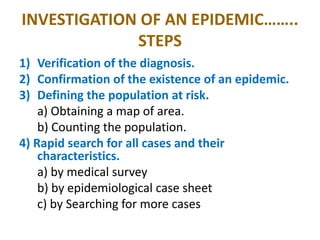
1) Verification of the diagnosis.
2) Confirmation of the existence of an epidemic.
3) Defining the population at risk.
a) Obtaining a map of area.
b) Counting the population.
4) Rapid search for all cases and their
characteristics.
a) by medical survey
b) by epidemiological case sheet
c) by Searching for more cases
INVESTIGATION OF AN EPIDEMIC……..
STEPS
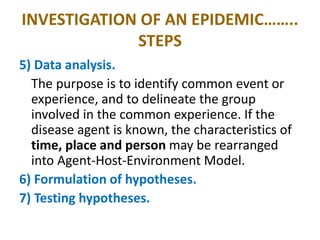
5) Data analysis.
The purpose is to identify common event or
experience, and to delineate the group
involved in the common experience. If the
disease agent is known, the characteristics of
time, place and person may be rearranged
into Agent-Host-Environment Model.
6) Formulation of hypotheses.
7) Testing hypotheses.
INVESTIGATION OF AN EPIDEMIC……..
STEPS
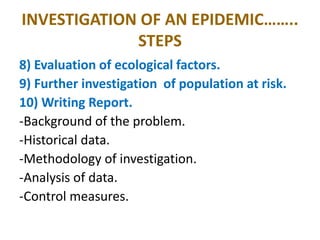
8) Evaluation of ecological factors.
9) Further investigation of population at risk.
10) Writing Report.
-Background of the problem.
-Historical data.
-Methodology of investigation.
-Analysis of data.
-Control measures.

Epidemiology Concepts

  • 1.
    EPIDEMIOLOGY By; Mr. Manulal .V.S Lecturer GovernmentCollege of Nursing Government Medical College Thiruvananthapuram.
  • 2.
    EPIDEMIOLOGY…..Definition The study ofthe distribution and determinants of health related states or events in specified populations and the application of this study to control the health problems. By, John . M. Last in 1988.
  • 3.
    Aims of Epidemiology •To describe the health status of the population. • To explain the etiology of the disease. • Predict the disease occurrence. • Control the disease distribution. • To eliminate or reduce the health problem or its consequences. • To promote health and well being of the society.
  • 4.
    TERMS TO KNOW •EPIDEMIC = The unusual occurrence of a disease or specific health related behavior(eg; smoking) or other health related events (eg; RTAs) in community or region. • ENDEMIC = Refers to the constant presence of a disease or infectious agent within a given geographic area or population group without importation from outside. Eg; Commom cold.
  • 5.
    TERMS TO KNOW •SPORADIC = Means, Scattered about. The cases occur irregularly, haphazardly from time to time and generally infreequently. The cases are few and show little or no connection with each other. Eg; Polio, Tetanus. • PANDEMIC = An epidemic usually affecting a large proportion of the population, occuring over a wide geographic area such as a section of a nation, the entire nation, a continent or the world.
  • 6.
    TERMS TO KNOW •EXOTIC .= Diseases which are imported into a country in which they do not otherwise occur. Eg; Rabies in U.K. • ZOONOSIS .= An infection or infectious disease under natural conditions, transmit from animals to man. • EPORNITHIC. = An outbreak (Epidemic) of disease in a bird population.
  • 7.
    Strategies or approachesin epidemiology • Asking questions (What is the problem, what is the magnitude, where did it happen, when did it happen, who are affected, why did it happen, how it happened.) • Making comparisons. (ie; Make comparison b/w study group and control group.).
  • 8.
    USES OF EPIDEMIOLOGY •To evaluate prognosis. • To get cut-off value , eg; value of normal BP. • To study occurrence and distribution of diseases in the community. • Identify the determinants of diseases. • Estimate statistically the probability of disease, accidents, and disabilities and the chances of avoiding them. • Helps to plan need based health care services and prevention and control programmes for various diseases identified and studied epidemiologically.
  • 9.
    Epidemiology ---Process • Definethe problem. • State hypothesis. • Test the hypothesis. • Interpret findings.
  • 10.
    METHODS IN EPIDEMIOLOGY. I)DESCRIPTIVE EPIDEMIOLOGY. -Asking questions and finding answers. -We used to describe in terms of time, place, and person.  Case studies  Case series  Prevalent study (Cross sectional study) = Studying cross- sectionally. We can study the place and person distribution, not the time distribution. It is like a Photograph. Studying the population at one point of time.
  • 11.
    METHODS IN EPIDEMIOLOGY……… I)DESCRIPTIVE EPIDEMIOLOGY. • Longitudinal Study. = Here we can study person, place , and time distribution. It is like a cine film. These type of studies are done when repeated observations are needed in the same population over a prolonged period of time.
  • 12.
    METHODS IN EPIDEMIOLOGY……. II)ANALYTICAL EPIDEMIOLOGY. Here we will make comparisons. • Experimental Study , Eg; RCT • Observational Study. - Cohort study = Proceeds from exposure to outcome. - Case control study = Proceeds from outcome to exposure. - Meta analysis = Study of studies. ie; if one study having tw different results , we will do meta analysis.
  • 13.
    DESCRIPTIVE EPIDEMIOLOGY--- STEPS 1) Definethe population. • The descriptive studies are investigations of populations, not individuals. • The population can be a whole population in a geographic area, or a representative sample from it, like; occupational groups, age and sex groups, small communities, school children etc. • The defined population (population at risk) forms the denominator of the study, it should be large enough for generalization.
  • 14.
    DESCRIPTIVE EPIDEMIOLOGY--- STEPS 2) Definethe disease under study. An operational definition spells out clearly the criteria by which the disease can be measured. It should be precise and valid. 3) Describing the disease.= Describe in terms of time, place and ,person.
  • 15.
    DESCRIPTIVE EPIDEMIOLOGY--- STEPS 3) Describingthe disease • Time distribution a) Short term fluctuations. Eg; Epidemic. -Common source epidemic. Eg; common well -Single source epidemic. Eg; food from a marriage -Propagated epidemic. Eg; from one person to another through vector or anthropod. -Slow epidemic.
  • 16.
    DESCRIPTIVE EPIDEMIOLOGY--- STEPS 3) Describingthe disease b) Seasonal diseases. c) Long term or secular trend. • Place distribution. ( International variations, national, hilly-costal, industrial) -Prepare Spot Map in-order to identify place distribution. • Person distribution. ( Age, sex, ethnicity, occupation etc.)
  • 17.
    DESCRIPTIVE EPIDEMIOLOGY--- STEPS 4) Measurementof disease. - It is mandatory to have a clear picture of the amount of disease ( disease load) in the population. It should be available in terms of mortality, morbidity and disability. - Measurement of morbidity has two aspects; Incidence (obtained from Longitudinal studies) and Prevalence (obtained from Cross sectional Studies.)
  • 18.
    DESCRIPTIVE EPIDEMIOLOGY--- STEPS 5) Comparingwith known indices. By making comparisons between different, and subgroups of the same population, it is possible to arrive at clues to disease etiology. We can also identify or define groups who are at increased risk for certain diseases.
  • 19.
    DESCRIPTIVE EPIDEMIOLOGY--- STEPS 5) Formulationof Hypothesis A hypothesis is a supposition, arrived at from observation or reflection. It can be accepted or rejected, using the techniques o analytical epidemiology. • Eg; Cigarette smoking causes lung cancer (wrong) • The smoking of 30-40 cigarettes per day causes lung cancer in10% of smokers after 20 years of exposure. ( Correct.)
  • 20.
    METHODS IN EPIDEMIOLOGY. II)ANALYTICAL EPIDEMIOLOGY. • These studies are based on the clues obtained from the descriptive studies. They attempt to determine causal factors of diseases. • Here the subject of interest is individual within the population. Analytical studies comprises of two distinct types of observational studies; a) Case control study and b) Cohort study.
  • 21.
    II) ANALYTICAL EPIDEMIOLOGY. (-a)OBSERVATIONAL STUDY) 1. Case control study • Also called as Retrospective studies, because the study starts from outcome to exposure. • It is a fantastic study , if outcome is rare (rare disease). This study has three distinct features -Study proceeds backwards from effect to cause -Both exposure and outcome have occurred before the start of the study. -It uses a control or comparison group to support an inference.
  • 22.
    1. Case controlstudy • Case control studies are basically comparison studies. • Cases and controls must be comparable with respect to known confounding variables like; age, sex, occupation, social status etc. • Analysis of case control study is mainly done by Odd’s Ratio. • Odds means; probability of an event or disease to occur.
  • 23.
    1. Case controlstudy BASIC STEPS IN CASE CONTROL STUDY 1) Selection of cases and controls. a) Selection of cases = it is by definition of case by using diagnostic criteria and eligibility criteria & Sources cases. b) Selection of controls.= They must be free from diseases under study. Must be similar to the cases as possible.
  • 25.
    BASIC STEPS INCASE CONTROL STUDY 2) Matching. Matching is the process by which we select controls in such a way that they are similar to cases with regard to certain pertinent selected variables (Eg: Age, Sex) which are known to influence the outcome . Types = - Group Matching. - Pair Matching.
  • 26.
    BASIC STEPS INCASE CONTROL STUDY 3) Measurement of Exposure. This may be obtained by interviews, questionnaires or by studying past records etc. 4) Analysis and interpretation. This step is to Find out; Exposure rate among cases and controls to suspected factor. Estimation of disease risk associated with exposure.
  • 27.
    BASIC STEPS INCASE CONTROL STUDY The estimation of disease risk associated with exposure is obtained by an index known as Relative Risk (R.R) or Risk Ratio, which is defined as the ratio between the incidence of disease among exposed persons and incidence among non-exposed persons. If RR is 1 = No Association. If RR is more than 1 = Risk. If RR is less than 1 = Protective.
  • 28.
    BASIC STEPS INCASE CONTROL STUDY Odds Ratio (OR) Odds ratio is a measure of strength of the association between the risk factor and outcome. Odds ratio is the key parameter in the analysis of case control studies. It is also known as Cross product ratio. (ad/bc.).
  • 30.
    II) ANALYTICAL EPIDEMIOLOGY. (-a)OBSERVATIONAL STUDY) 2) Cohort Study • Also known as forward looking study, Prospective study, longitudinal study, incidence study. Study proceeds foreward from cause to effect. • The word meaning of ‘Cohort’ is a group of people who share a common characteristic or experience within a defined time period.
  • 31.
    2) Cohort Study Theoutcome of Cohort study is Relative Risk . If RR is 1 = No Association / No significance of study. If RR is more than 1 = Risk Exposure is there. If RR is less than 1 = Protective.
  • 32.
    Cohort Study……. TYPES a) ProspectiveCohort study. b) Retrospective cohort study. c) Combination of prospective and retrospective cohort studies.
  • 33.
    Cohort Study……. Elements orSteps. 1) Selection of study subjects . It is mainly from General population or from Special groups. 2) Obtaining data on exposure. By personal interviews, questionnaires, medical examination, records, surveys etc. 3) Selection of comparison groups. Ways of selecting comparison groups include; internal comparisons, external comparisons, comparisonn with general population rates.
  • 34.
    Cohort Study……. Elements orSteps. 4) Follow up. Must be needed in cohort studies. 5) Analysis. Analyzed for identifying incidence rates of outcome among exposed and non-exposed and for estimation of risk. - Attributable Risk. - Population attributable Risk.
  • 36.
    II) ANALYTICAL EPIDEMIOLOGY. (-b)Experimental study) • It is an experimental study. • Helps to prove hypothesis. • Mainly used in drug studies. • In modern usage, experimental epidemiology is often equated with Randomized Control Trials. (RCT.). • For new programmes or new therapies, the RCT is the number one method of evaluation.
  • 37.
    II) ANALYTICAL EPIDEMIOLOGY. (-b)Experimental study) Basic Steps in Conducting RCT. 1. Drawing up a protocol. 2. Screening reference and experimental populations. 3. Randomization. 4. Manipulation or Intervention. 5. Follow Up. 6. Assessment of outcome.
  • 38.
    INVESTIGATION OF ANEPIDEMIC. Objectives. To define the magnitude of the epidemic outbreak or involvement in terms of time, place, and person. To determine the factors responsible for the occurrence of the epidemic. To identify the cause, source of infection, and modes of transmission to determine measures necessary to control the epidemic. To make recommendations to prevent further recurrence.
  • 39.
    INVESTIGATION OF ANEPIDEMIC…….. STEPS 1) Verification of the diagnosis. 2) Confirmation of the existence of an epidemic. 3) Defining the population at risk. a) Obtaining a map of area. b) Counting the population. 4) Rapid search for all cases and their characteristics. a) by medical survey b) by epidemiological case sheet c) by Searching for more cases
  • 40.
    INVESTIGATION OF ANEPIDEMIC…….. STEPS 5) Data analysis. The purpose is to identify common event or experience, and to delineate the group involved in the common experience. If the disease agent is known, the characteristics of time, place and person may be rearranged into Agent-Host-Environment Model. 6) Formulation of hypotheses. 7) Testing hypotheses.
  • 41.
    INVESTIGATION OF ANEPIDEMIC…….. STEPS 8) Evaluation of ecological factors. 9) Further investigation of population at risk. 10) Writing Report. -Background of the problem. -Historical data. -Methodology of investigation. -Analysis of data. -Control measures.