PERINEAL TEARS
DEFINITIONS
• PERINEUM: The perineum in humans is the space between the anus
and scrotum in the male, or frenulum labiorum pudendi and anus in
the female.
• LACERATION:A laceration is a wound that is produced by the tearing
of soft body tissue.
• EPISIOTOMY: also known as perineotomy, is a surgical incision of the
perineum and the posterior vaginal wall. It is done deliberately by the
midwife or obstetrician
• Lacerations of perineum are the result of overstreching or too rapid
streching of the tissues, especially if they are poorly extensile (capable
of being protruded or stretched) and rigid.
• Perineal injuries are more common in primigravida than multigravida.
Introduction
• A perineal tear is a laceration of the skin and other soft tissue structures
which, in women, separate the vagina from the anus. Perineal tears mainly
occur in women as a result of vaginal childbirth, which strains the
perineum. It is the most common form of obstetric injury.
• The morbidity associated with perineal injury related to child-birth is a
major health problem that affects thousands of women.
As many as 91% of women report at least one new persistent
symptom 8 weeks after delivery. Over 60% of women suffer peri-
neal injury (either perineal tear or episiotomy) following sponta-
neous vaginal delivery and approximately 1000 women per day
require perineal repair following vaginal birth.
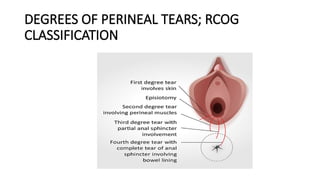
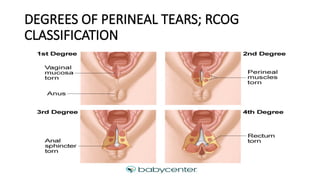
DEGREES OF PERINEAL TEARS; RCOG
CLASSIFICATION
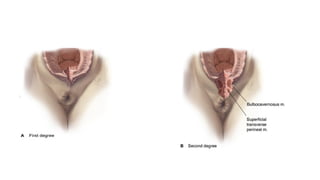
• 1st degree: tears involving only the skin, fourchette, vaginal mucous membrane
• 2nd degree: tears involving the skin, underlying fascia and the perineal muscles
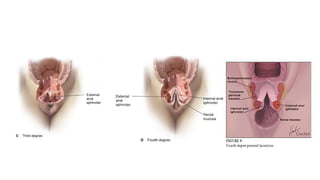
• 3rd degree: Tears involving the anal sphincter. Maybe 3a: involving <50%
EAS .3b: >50% EAS 3C: Involving both EAS & IAS
• Fourth Degree: Involving the rectal mucosa.
NB: 3rd and 4th degree tears are collectively referred as Obstetric anal sphincter
injuries (OASI)
• Buttonhole tear: A rare variant, isolated rectal mucosa tear without involvement
of the anal sphincter.
DEGREES OF PERINEAL TEARS; RCOG
CLASSIFICATION
DEGREES OF PERINEAL TEARS; RCOG
CLASSIFICATION
Risk factors of perineal tears
• NON OBSTETRIC:
A. RAPE
B. MOLESTATION
C. FALLS
D. ROAD TRAFFIC ACCIDENTS
E. BULL HORN INJURIES
Risk factors of perineal tears
• OBSTETRIC RISK FACTOR: MATERNAL OR FETAL
1. FETAL:
FETAL MACROSOMIA
MALPRESENTATIONS AS BREECH
PERSISTENT OCCIPITO-POSTERIOR POSITION
MACROCEPHALY AND HYDROCEPHALUS
SHOULDER DYSTOCIA
PRECIPITATE LABOR
INSTRUMENTAL DELIVERIES (FORCEPS OR VACUUM)
RISK FACTORS CONTD
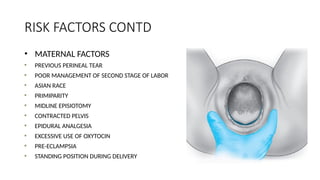
• MATERNAL FACTORS
PREVIOUS PERINEAL TEAR
POOR MANAGEMENT OF SECOND STAGE OF LABOR
ASIAN RACE
PRIMIPARITY
MIDLINE EPISIOTOMY
CONTRACTED PELVIS
EPIDURAL ANALGESIA
EXCESSIVE USE OF OXYTOCIN
PRE-ECLAMPSIA
STANDING POSITION DURING DELIVERY
CLINICAL PICTURE: SYMPTOMS & SIGNS
• IMMEDIATE
POST-PARTUM HEMORRHAGE- HEMORRAHGIC SHOCK
PERINEAL PAIN
PERINEAL HEMATOMA
URINARY RETENTION DUE TO PAINFUL PERINEUM
URINARY INCONTINENCE
ANORECTAL DYSFUNCTIONS LIKE FECAL INCONTINENCE
• DELAYED
INFECTED PERINEUM- PERINEAL ABSCESS
UTEROVAGINAL PROLAPSE
URINARY INCONTINENCE (STRESS & FISTULA)
FECAL INCONTINENCE (RECTOVAGINAL FISTULA)
DYSPAREUNIA
CLINICAL PICTURE: SYMPTOMS & SIGNS
• DELAYED
INFECTED PERINEUM- PERINEAL ABSCESS
UTEROVAGINAL PROLAPSE
URINARY INCONTINENCE (STRESS & FISTULA)
FECAL INCONTINENCE (RECTOVAGINAL FISTULA)
DYSPAREUNIA
ON EXAMINATION: how to assess perineal
tears?
• Put the patient in extended lithotomy position
• Arrange for a proper spotless bright light
• Vulva should be examined stepwise right from the clitoris
to the anus downwards, laterally paraclitoral, paraurethral,
paravaginal and pararectal skin and muscles in every case
after delivery
• Perineal tears maybe associated with high vaginal circular
tears in the fornix and cervix
ON EXAMINATION: how to assess perineal
tears? ctdn
• Suspicion of perineal tears is made when PPH even after complete
delivery of placenta and uterus is contracted and retracted.
• Identification of sphincter injury is very essential, a consent for rectal
examination should be taken before proceeding. Observe the anus
for the absence of puckering which maybe indicative for external
anal sphincter injury
• The index finger of the examiner should be inserted into the patients
rectum and she’s asked to squeeze. If the EAS is damaged the
separated ends are seen to retract backwards towards the ischio-
rectal fossa. A deficit may be observed or palpated anteriorly.
COMPLICATIONS
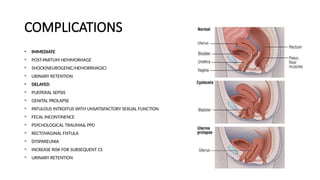
• IMMEDIATE
POST-PARTUM HEMMORHAGE
SHOCK(NEUROGENIC/HEMORRHAGIC)
URINARY RETENTION
• DELAYED
PUEPERAL SEPSIS
GENITAL PROLAPSE
PATULOUS INTROITUS WITH UNSATISFACTORY SEXUAL FUNCTION
FECAL INCONTINENCE
PSYCHOLOGICAL TRAUMA& PPD
RECTOVAGINAL FISTULA
DYSPAREUNIA
INCREASE RISK FOR SUBSEQUENT CS
URINARY RETENTION
HOW DO PERINEAL TEARS AFFECT
SUBSEQUENT PREGNANCIES?
• A study done by the RCOG showed that the risk of severe perineal tear is
increased five fold in women who had a previous third or fourth degree
perineal tear in past pregnancies.
• However, vaginal birth may be allowed in women with past 1st or 2nd degree
tear, especially if there are minimal or no risk factors for a new tear.
• The risks of an elective cesarean section and decisions about subsequent
mode of delivery in women who had a severe perineal tear in earlier
pregnancies must be weighed against the clinical and psychological impacts of
severe perineal tearing.
• Therefore, most 3rd and 4th degree perineal tears will benefit most from an
elective cesarean section.
Prevention of perineal tears: antenatal, natal
& post-natal
Ante-natal
• Early antenatal booking
• Recognition of risk factors: Maternal obesity and GDM
• Pre-natal diagnosis of fetal congenital anomalies
• Early planning of mode of delivery
• Education of mothers on modifiable risk factors
Post-Natal
• Proper inter-pregnancy spacing
• Encouraging proper perineal hygiene
• Proper antibiotics and analgesics after delivery
How to prevent perineal tears: natal
• SAFE PASSAGES PROTOCOL
S- START PERINEAL MASSAGE AT 36
WEEKS
A-ALLEVIATE FEAR AND ANXIETY
F- FACILITATE OCCIPITO-ANTERIOR
POSITIONS
E-ELIMINATE MIDLINE EPISIOTOMY
P-PLACE A WARM COMPRESS IN LATE
2ND STAGE
A-ADDUCT THE THIGHS AT DELIVERY- 90
DEGRESS/<
S-STRAIGHTEN THE LEGS AFTER DELIVERY
S- SUPPORT THE PERINEUM
A-AIM LATERAL IF EPISIOTOMY IS
NEEDED
G-GO SLOW, CONTROL THE HEAD,
DELIVER AFTER CONTRACTION
E-EXCEL AT OPERATIVE DELIVERY
S-SUPERB REPAIR TECHNIQUE
MANAGEMENT OF PERINEAL TEARS
The principles of management are as follows.
• Recognition and proper classification are important.
Perineal injury should be examined under adequate analgesia
and light.
• A combined vaginal and rectal examination is needed to
exclude associated anal sphincter injury.
• Immediate repair of perineal injury rather than delayed repair
is advisable, as immediate repair reduces the bleeding and pain
associated with the injury, which may otherwise impair early
breast-feeding and bonding. Immediate repair also prevents the
development of oedema, which may affect subsequent recogni-
tion of the structures involved, and reduces the risk of infection.
• If there is any doubt about the extent of the injury, a second
opinion must be sought.
• The presence of an experienced person during the assess-
ment of perineal injury has increased the rate of detection of anal
sphincter injury.
• The labia, clitoris and urethra should also be examined.
CHOICE OF SUTURE MATERIAL
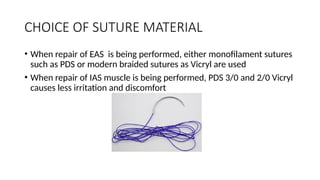
• When repair of EAS is being performed, either monofilament sutures
such as PDS or modern braided sutures as Vicryl are used
• When repair of IAS muscle is being performed, PDS 3/0 and 2/0 Vicryl
causes less irritation and discomfort
Management of 1st & 2nd degree perineal
tears (including episiotomy)
• Pre-requisites:
Proper light with good exposure
Good analgesia
Good assistance
Chromic cat-gut 2/0
Vicryl/Dexon sutures
• Non-suturing of first and second degree perineal tears have been described. But based on current
evidence, non-suturing is only recommended for 1st degree perineal tears that are not actively
bleeding and have regular well approximated wound edges.
• 2nd degree tears and episiotomies are conventionally sutured in 3 stages. The traditional
interrupted suturing technique include
Management of 1st & 2nd degree perineal
tears (including episiotomy)
A continuous locking suture in the vagina commencing from the apex and finishing at the level of
fourchette with a loop knot.
Re-approximation of the deep and superficial perineal muscles with three or four interrupted sutures.
Skin suturing with continuous subcutaneous or interrupted transcutaneous sutures
• Another method for repair is Fleming technique which is a continuous non-locking suture used to
approximate the vagina and the superficial and deep muscles without tension. Skin edges are apposed
with a subcutaneous suture.
• A recent RCT involving 1542 women showed that the continuous non-locking suture is associated with
significant reduction in short and long term perineal pain and less frequent need for suture removal.
• When repair is complete, rectal examination should be performed to exclude accidental suture
involvement of the rectum and anal canal.
• A full count of instruments, swabs, needles is mandatory and must be recorded. Retention of swabs is a
common cause of litigation. A detailed operative note should be done.
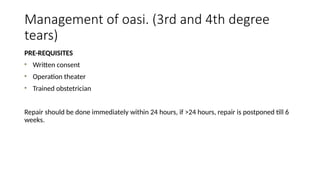
Management of oasi. (3rd and 4th degree
tears)
PRE-REQUISITES
Written consent
Operation theater
Trained obstetrician
Repair should be done immediately within 24 hours, if >24 hours, repair is postponed till 6
weeks.
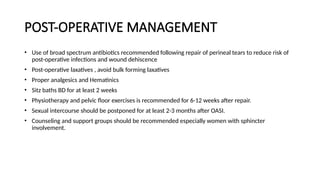
POST-OPERATIVE MANAGEMENT
• Use of broad spectrum antibiotics recommended following repair of perineal tears to reduce risk of
post-operative infections and wound dehiscence
• Post-operative laxatives , avoid bulk forming laxatives
• Proper analgesics and Hematinics
• Sitz baths BD for at least 2 weeks
• Physiotherapy and pelvic floor exercises is recommended for 6-12 weeks after repair.
• Sexual intercourse should be postponed for at least 2-3 months after OASI.
• Counseling and support groups should be recommended especially women with sphincter
involvement.
POST-OPERATIVE MANAGEMENT
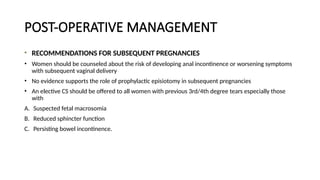
RECOMMENDATIONS FOR SUBSEQUENT PREGNANCIES
• Women should be counseled about the risk of developing anal incontinence or worsening symptoms
with subsequent vaginal delivery
• No evidence supports the role of prophylactic episiotomy in subsequent pregnancies
• An elective CS should be offered to all women with previous 3rd/4th degree tears especially those
with
A. Suspected fetal macrosomia
B. Reduced sphincter function
C. Persisting bowel incontinence.
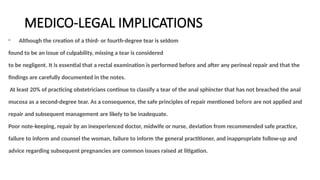
MEDICO-LEGAL IMPLICATIONS
Although the creation of a third- or fourth-degree tear is seldom
found to be an issue of culpability, missing a tear is considered
to be negligent. It is essential that a rectal examination is performed before and after any perineal repair and that the
findings are carefully documented in the notes.
At least 20% of practicing obstetricians continue to classify a tear of the anal sphincter that has not breached the anal
mucosa as a second-degree tear. As a consequence, the safe principles of repair mentioned before are not applied and
repair and subsequent management are likely to be inadequate.
Poor note-keeping, repair by an inexperienced doctor, midwife or nurse, deviation from recommended safe practice,
failure to inform and counsel the woman, failure to inform the general practitioner, and inappropriate follow-up and
advice regarding subsequent pregnancies are common issues raised at litigation.
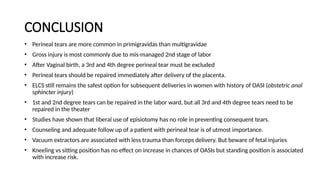
CONCLUSION
• Perineal tears are more common in primigravidas than multigravidae
• Gross injury is most commonly due to mis-managed 2nd stage of labor
• After Vaginal birth, a 3rd and 4th degree perineal tear must be excluded
• Perineal tears should be repaired immediately after delivery of the placenta.
• ELCS still remains the safest option for subsequent deliveries in women with history of OASI (obstetric anal
sphincter injury)
• 1st and 2nd degree tears can be repaired in the labor ward, but all 3rd and 4th degree tears need to be
repaired in the theater
• Studies have shown that liberal use of episiotomy has no role in preventing consequent tears.
• Counseling and adequate follow up of a patient with perineal tear is of utmost importance.
• Vacuum extractors are associated with less trauma than forceps delivery. But beware of fetal injuries
• Kneeling vs sitting position has no effect on increase in chances of OASIs but standing position is associated
with increase risk.

PERINEAL TEARS classification and management

  • 1.
  • 2.
    DEFINITIONS • PERINEUM: Theperineum in humans is the space between the anus and scrotum in the male, or frenulum labiorum pudendi and anus in the female. • LACERATION:A laceration is a wound that is produced by the tearing of soft body tissue. • EPISIOTOMY: also known as perineotomy, is a surgical incision of the perineum and the posterior vaginal wall. It is done deliberately by the midwife or obstetrician
  • 3.
    • Lacerations ofperineum are the result of overstreching or too rapid streching of the tissues, especially if they are poorly extensile (capable of being protruded or stretched) and rigid. • Perineal injuries are more common in primigravida than multigravida.
  • 4.
    Introduction • A perinealtear is a laceration of the skin and other soft tissue structures which, in women, separate the vagina from the anus. Perineal tears mainly occur in women as a result of vaginal childbirth, which strains the perineum. It is the most common form of obstetric injury. • The morbidity associated with perineal injury related to child-birth is a major health problem that affects thousands of women. As many as 91% of women report at least one new persistent symptom 8 weeks after delivery. Over 60% of women suffer peri- neal injury (either perineal tear or episiotomy) following sponta- neous vaginal delivery and approximately 1000 women per day require perineal repair following vaginal birth.
  • 5.
    DEGREES OF PERINEALTEARS; RCOG CLASSIFICATION • 1st degree: tears involving only the skin, fourchette, vaginal mucous membrane • 2nd degree: tears involving the skin, underlying fascia and the perineal muscles • 3rd degree: Tears involving the anal sphincter. Maybe 3a: involving <50% EAS .3b: >50% EAS 3C: Involving both EAS & IAS • Fourth Degree: Involving the rectal mucosa. NB: 3rd and 4th degree tears are collectively referred as Obstetric anal sphincter injuries (OASI) • Buttonhole tear: A rare variant, isolated rectal mucosa tear without involvement of the anal sphincter.
  • 6.
    DEGREES OF PERINEALTEARS; RCOG CLASSIFICATION
  • 7.
    DEGREES OF PERINEALTEARS; RCOG CLASSIFICATION
  • 10.
    Risk factors ofperineal tears • NON OBSTETRIC: A. RAPE B. MOLESTATION C. FALLS D. ROAD TRAFFIC ACCIDENTS E. BULL HORN INJURIES
  • 11.
    Risk factors ofperineal tears • OBSTETRIC RISK FACTOR: MATERNAL OR FETAL 1. FETAL: FETAL MACROSOMIA MALPRESENTATIONS AS BREECH PERSISTENT OCCIPITO-POSTERIOR POSITION MACROCEPHALY AND HYDROCEPHALUS SHOULDER DYSTOCIA PRECIPITATE LABOR INSTRUMENTAL DELIVERIES (FORCEPS OR VACUUM)
  • 12.
    RISK FACTORS CONTD •MATERNAL FACTORS PREVIOUS PERINEAL TEAR POOR MANAGEMENT OF SECOND STAGE OF LABOR ASIAN RACE PRIMIPARITY MIDLINE EPISIOTOMY CONTRACTED PELVIS EPIDURAL ANALGESIA EXCESSIVE USE OF OXYTOCIN PRE-ECLAMPSIA STANDING POSITION DURING DELIVERY
  • 13.
    CLINICAL PICTURE: SYMPTOMS& SIGNS • IMMEDIATE POST-PARTUM HEMORRHAGE- HEMORRAHGIC SHOCK PERINEAL PAIN PERINEAL HEMATOMA URINARY RETENTION DUE TO PAINFUL PERINEUM URINARY INCONTINENCE ANORECTAL DYSFUNCTIONS LIKE FECAL INCONTINENCE • DELAYED INFECTED PERINEUM- PERINEAL ABSCESS UTEROVAGINAL PROLAPSE URINARY INCONTINENCE (STRESS & FISTULA) FECAL INCONTINENCE (RECTOVAGINAL FISTULA) DYSPAREUNIA
  • 14.
    CLINICAL PICTURE: SYMPTOMS& SIGNS • DELAYED INFECTED PERINEUM- PERINEAL ABSCESS UTEROVAGINAL PROLAPSE URINARY INCONTINENCE (STRESS & FISTULA) FECAL INCONTINENCE (RECTOVAGINAL FISTULA) DYSPAREUNIA
  • 15.
    ON EXAMINATION: howto assess perineal tears? • Put the patient in extended lithotomy position • Arrange for a proper spotless bright light • Vulva should be examined stepwise right from the clitoris to the anus downwards, laterally paraclitoral, paraurethral, paravaginal and pararectal skin and muscles in every case after delivery • Perineal tears maybe associated with high vaginal circular tears in the fornix and cervix
  • 16.
    ON EXAMINATION: howto assess perineal tears? ctdn • Suspicion of perineal tears is made when PPH even after complete delivery of placenta and uterus is contracted and retracted. • Identification of sphincter injury is very essential, a consent for rectal examination should be taken before proceeding. Observe the anus for the absence of puckering which maybe indicative for external anal sphincter injury • The index finger of the examiner should be inserted into the patients rectum and she’s asked to squeeze. If the EAS is damaged the separated ends are seen to retract backwards towards the ischio- rectal fossa. A deficit may be observed or palpated anteriorly.
  • 17.
    COMPLICATIONS • IMMEDIATE POST-PARTUM HEMMORHAGE SHOCK(NEUROGENIC/HEMORRHAGIC) URINARYRETENTION • DELAYED PUEPERAL SEPSIS GENITAL PROLAPSE PATULOUS INTROITUS WITH UNSATISFACTORY SEXUAL FUNCTION FECAL INCONTINENCE PSYCHOLOGICAL TRAUMA& PPD RECTOVAGINAL FISTULA DYSPAREUNIA INCREASE RISK FOR SUBSEQUENT CS URINARY RETENTION
  • 18.
    HOW DO PERINEALTEARS AFFECT SUBSEQUENT PREGNANCIES? • A study done by the RCOG showed that the risk of severe perineal tear is increased five fold in women who had a previous third or fourth degree perineal tear in past pregnancies. • However, vaginal birth may be allowed in women with past 1st or 2nd degree tear, especially if there are minimal or no risk factors for a new tear. • The risks of an elective cesarean section and decisions about subsequent mode of delivery in women who had a severe perineal tear in earlier pregnancies must be weighed against the clinical and psychological impacts of severe perineal tearing. • Therefore, most 3rd and 4th degree perineal tears will benefit most from an elective cesarean section.
  • 19.
    Prevention of perinealtears: antenatal, natal & post-natal Ante-natal • Early antenatal booking • Recognition of risk factors: Maternal obesity and GDM • Pre-natal diagnosis of fetal congenital anomalies • Early planning of mode of delivery • Education of mothers on modifiable risk factors Post-Natal • Proper inter-pregnancy spacing • Encouraging proper perineal hygiene • Proper antibiotics and analgesics after delivery
  • 20.
    How to preventperineal tears: natal • SAFE PASSAGES PROTOCOL S- START PERINEAL MASSAGE AT 36 WEEKS A-ALLEVIATE FEAR AND ANXIETY F- FACILITATE OCCIPITO-ANTERIOR POSITIONS E-ELIMINATE MIDLINE EPISIOTOMY P-PLACE A WARM COMPRESS IN LATE 2ND STAGE A-ADDUCT THE THIGHS AT DELIVERY- 90 DEGRESS/< S-STRAIGHTEN THE LEGS AFTER DELIVERY S- SUPPORT THE PERINEUM A-AIM LATERAL IF EPISIOTOMY IS NEEDED G-GO SLOW, CONTROL THE HEAD, DELIVER AFTER CONTRACTION E-EXCEL AT OPERATIVE DELIVERY S-SUPERB REPAIR TECHNIQUE
  • 21.
    MANAGEMENT OF PERINEALTEARS The principles of management are as follows. • Recognition and proper classification are important. Perineal injury should be examined under adequate analgesia and light. • A combined vaginal and rectal examination is needed to exclude associated anal sphincter injury. • Immediate repair of perineal injury rather than delayed repair is advisable, as immediate repair reduces the bleeding and pain associated with the injury, which may otherwise impair early breast-feeding and bonding. Immediate repair also prevents the development of oedema, which may affect subsequent recogni- tion of the structures involved, and reduces the risk of infection.
  • 22.
    • If thereis any doubt about the extent of the injury, a second opinion must be sought. • The presence of an experienced person during the assess- ment of perineal injury has increased the rate of detection of anal sphincter injury. • The labia, clitoris and urethra should also be examined.
  • 23.
    CHOICE OF SUTUREMATERIAL • When repair of EAS is being performed, either monofilament sutures such as PDS or modern braided sutures as Vicryl are used • When repair of IAS muscle is being performed, PDS 3/0 and 2/0 Vicryl causes less irritation and discomfort
  • 24.
    Management of 1st& 2nd degree perineal tears (including episiotomy) • Pre-requisites: Proper light with good exposure Good analgesia Good assistance Chromic cat-gut 2/0 Vicryl/Dexon sutures • Non-suturing of first and second degree perineal tears have been described. But based on current evidence, non-suturing is only recommended for 1st degree perineal tears that are not actively bleeding and have regular well approximated wound edges. • 2nd degree tears and episiotomies are conventionally sutured in 3 stages. The traditional interrupted suturing technique include
  • 25.
    Management of 1st& 2nd degree perineal tears (including episiotomy) A continuous locking suture in the vagina commencing from the apex and finishing at the level of fourchette with a loop knot. Re-approximation of the deep and superficial perineal muscles with three or four interrupted sutures. Skin suturing with continuous subcutaneous or interrupted transcutaneous sutures • Another method for repair is Fleming technique which is a continuous non-locking suture used to approximate the vagina and the superficial and deep muscles without tension. Skin edges are apposed with a subcutaneous suture. • A recent RCT involving 1542 women showed that the continuous non-locking suture is associated with significant reduction in short and long term perineal pain and less frequent need for suture removal. • When repair is complete, rectal examination should be performed to exclude accidental suture involvement of the rectum and anal canal. • A full count of instruments, swabs, needles is mandatory and must be recorded. Retention of swabs is a common cause of litigation. A detailed operative note should be done.
  • 26.
    Management of oasi.(3rd and 4th degree tears) PRE-REQUISITES Written consent Operation theater Trained obstetrician Repair should be done immediately within 24 hours, if >24 hours, repair is postponed till 6 weeks.
  • 27.
    POST-OPERATIVE MANAGEMENT • Useof broad spectrum antibiotics recommended following repair of perineal tears to reduce risk of post-operative infections and wound dehiscence • Post-operative laxatives , avoid bulk forming laxatives • Proper analgesics and Hematinics • Sitz baths BD for at least 2 weeks • Physiotherapy and pelvic floor exercises is recommended for 6-12 weeks after repair. • Sexual intercourse should be postponed for at least 2-3 months after OASI. • Counseling and support groups should be recommended especially women with sphincter involvement.
  • 28.
    POST-OPERATIVE MANAGEMENT RECOMMENDATIONS FORSUBSEQUENT PREGNANCIES • Women should be counseled about the risk of developing anal incontinence or worsening symptoms with subsequent vaginal delivery • No evidence supports the role of prophylactic episiotomy in subsequent pregnancies • An elective CS should be offered to all women with previous 3rd/4th degree tears especially those with A. Suspected fetal macrosomia B. Reduced sphincter function C. Persisting bowel incontinence.
  • 29.
    MEDICO-LEGAL IMPLICATIONS Although thecreation of a third- or fourth-degree tear is seldom found to be an issue of culpability, missing a tear is considered to be negligent. It is essential that a rectal examination is performed before and after any perineal repair and that the findings are carefully documented in the notes. At least 20% of practicing obstetricians continue to classify a tear of the anal sphincter that has not breached the anal mucosa as a second-degree tear. As a consequence, the safe principles of repair mentioned before are not applied and repair and subsequent management are likely to be inadequate. Poor note-keeping, repair by an inexperienced doctor, midwife or nurse, deviation from recommended safe practice, failure to inform and counsel the woman, failure to inform the general practitioner, and inappropriate follow-up and advice regarding subsequent pregnancies are common issues raised at litigation.
  • 30.
    CONCLUSION • Perineal tearsare more common in primigravidas than multigravidae • Gross injury is most commonly due to mis-managed 2nd stage of labor • After Vaginal birth, a 3rd and 4th degree perineal tear must be excluded • Perineal tears should be repaired immediately after delivery of the placenta. • ELCS still remains the safest option for subsequent deliveries in women with history of OASI (obstetric anal sphincter injury) • 1st and 2nd degree tears can be repaired in the labor ward, but all 3rd and 4th degree tears need to be repaired in the theater • Studies have shown that liberal use of episiotomy has no role in preventing consequent tears. • Counseling and adequate follow up of a patient with perineal tear is of utmost importance. • Vacuum extractors are associated with less trauma than forceps delivery. But beware of fetal injuries • Kneeling vs sitting position has no effect on increase in chances of OASIs but standing position is associated with increase risk.