Consumer Learning 
1 
PPRREESSEENNTTEEDD BBYY:: 
RREEKKAA AASSIIFF 
RRIIZZWWAANN ZZIIAA 
RRUUKKHHSSAARR CCHHAAUUDDHHAARRYY 
RRAAMMEEEEZZ FFAATTIIMMAA 
SSAAAADD MMOOHHOOMMMMAADD
Consumer Learning 
2 
A process by which individuals acquire the 
purchase and consumption knowledge and 
experience that they apply to future related 
behavior.
Learning Processes 
 Intentional 
 Learning acquired as a result of a careful 
search for information 
3 
 Incidental 
 Learning acquired by accident or without much 
effort
Importance of Learning 
 Marketers must teach consumers: 
where to buy 
how to use 
how to maintain 
how to dispose of products 
4
Learning Theories 
 Behavioral Theories: 
Theories based on the 
premise that learning 
takes place as the 
result of observable 
responses to external 
stimuli. Also known as 
stimulus response 
theory. 
5 
 Cognitive Theories: 
A theory of learning 
based on mental 
information processing, 
often in response to 
problem solving.
Elements of Learning Theories 
 Motivation 
 Cues 
 Response 
 Reinforcement 
6
Reinforcement 
 A positive or negative outcome that 
influences the likelihood that a specific 
behavior will be repeated in the future in 
response to a particular cue or stimulus. 
7
Behavioral Learning Theories 
 Classical Conditioning 
 Instrumental Conditioning 
 Modeling or Observational Learning 
8
Classical Conditioning 
9 
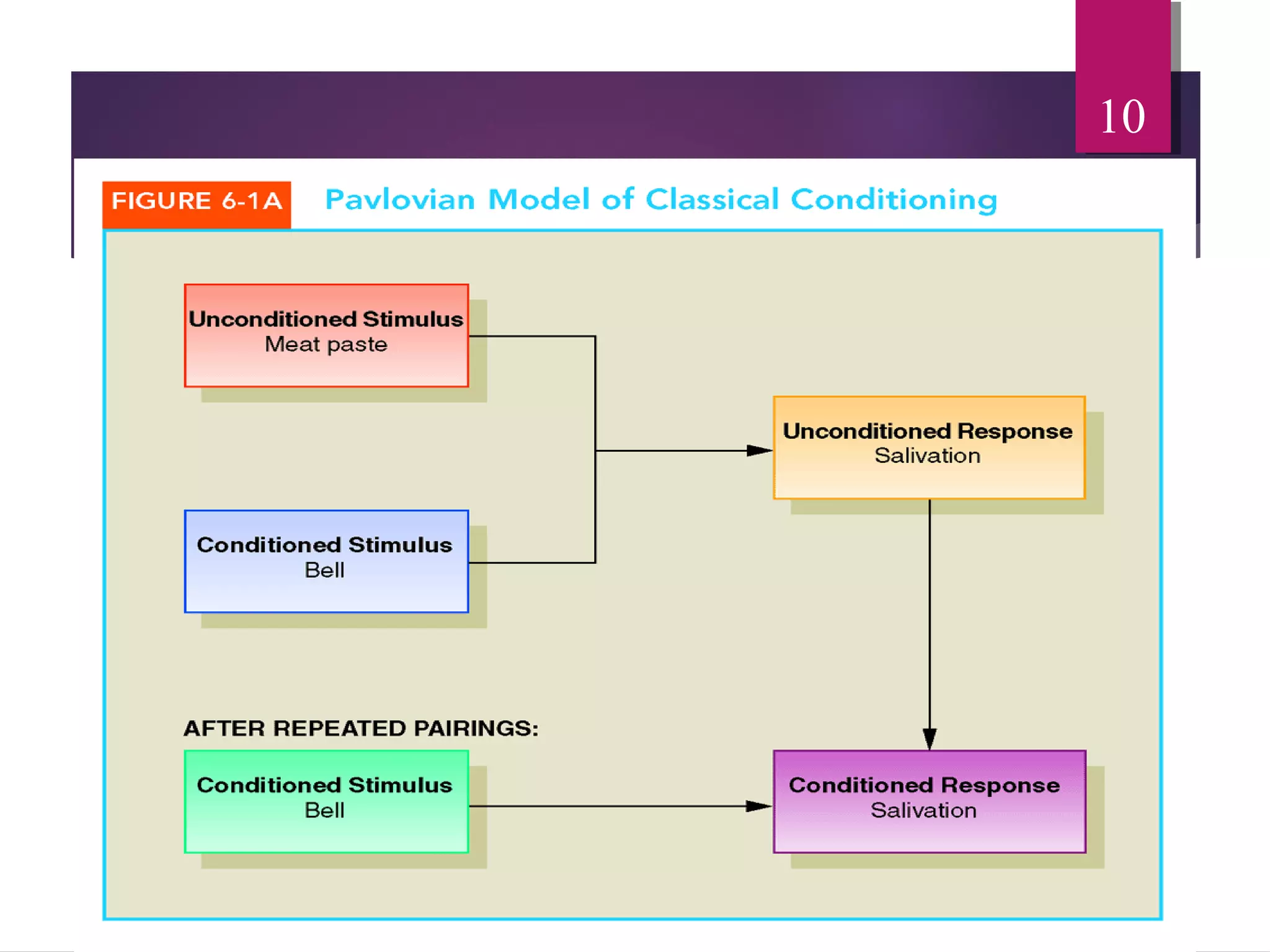
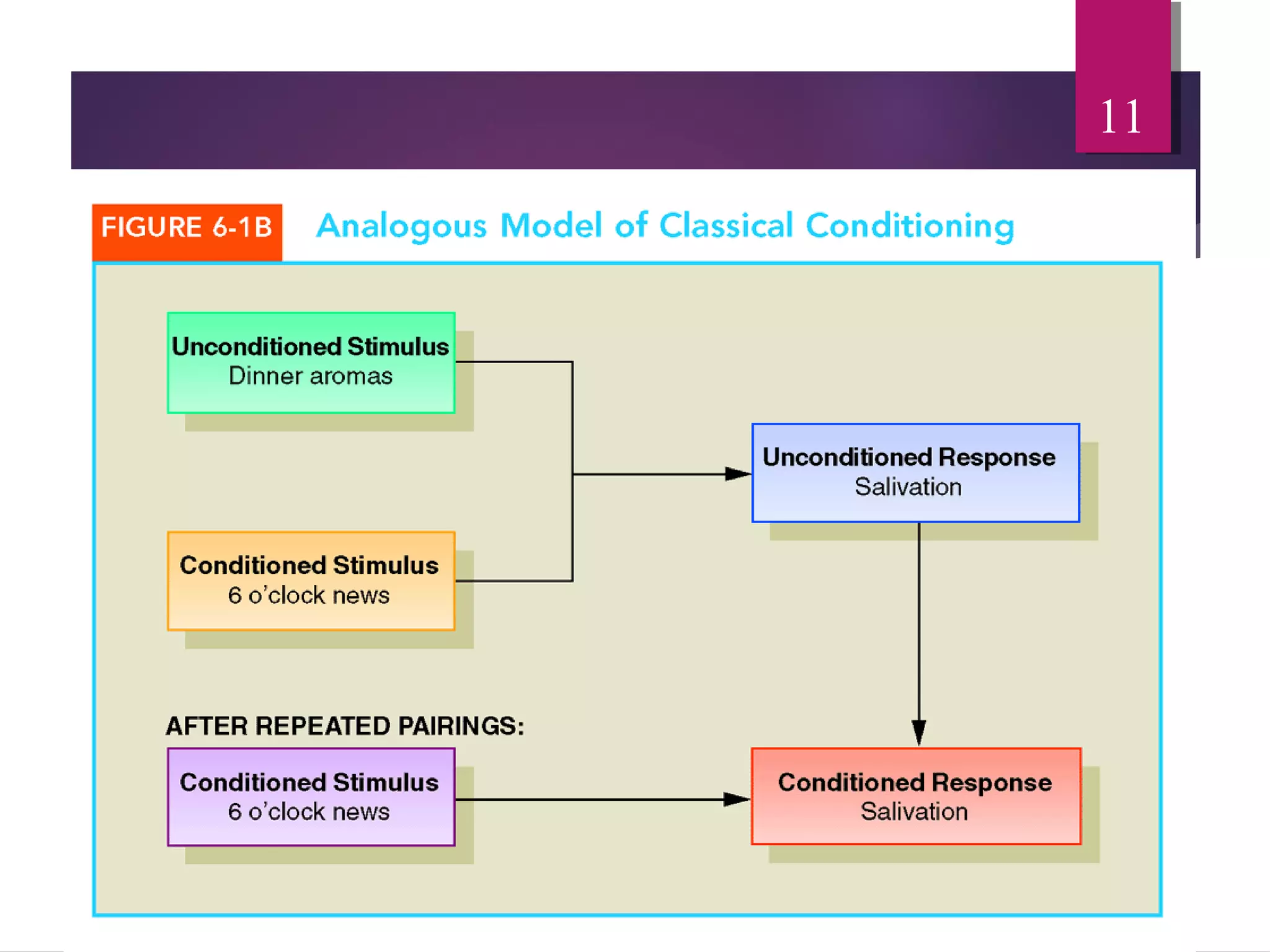
 Pairing a stimulus with another stimulus that 
elicits a known response to produce the same 
response when used alone. 
 http://almaz.com/nobel/medicine/1904a.html
10
11
Classical conditioning – cont’d 
12 
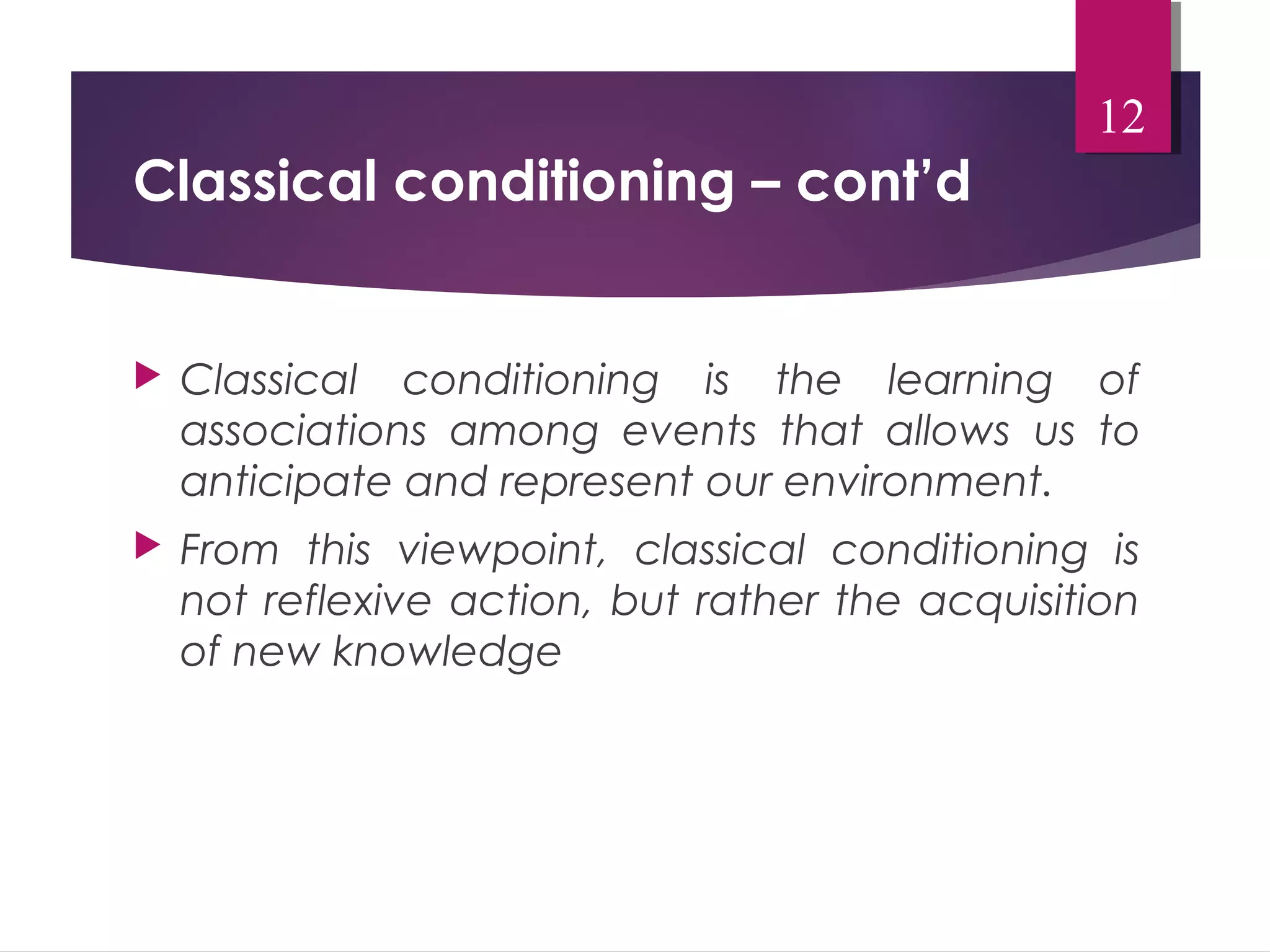
 Classical conditioning is the learning of 
associations among events that allows us to 
anticipate and represent our environment. 
 From this viewpoint, classical conditioning is 
not reflexive action, but rather the acquisition 
of new knowledge
Instrumental (Operant) 
Conditioning 
13 
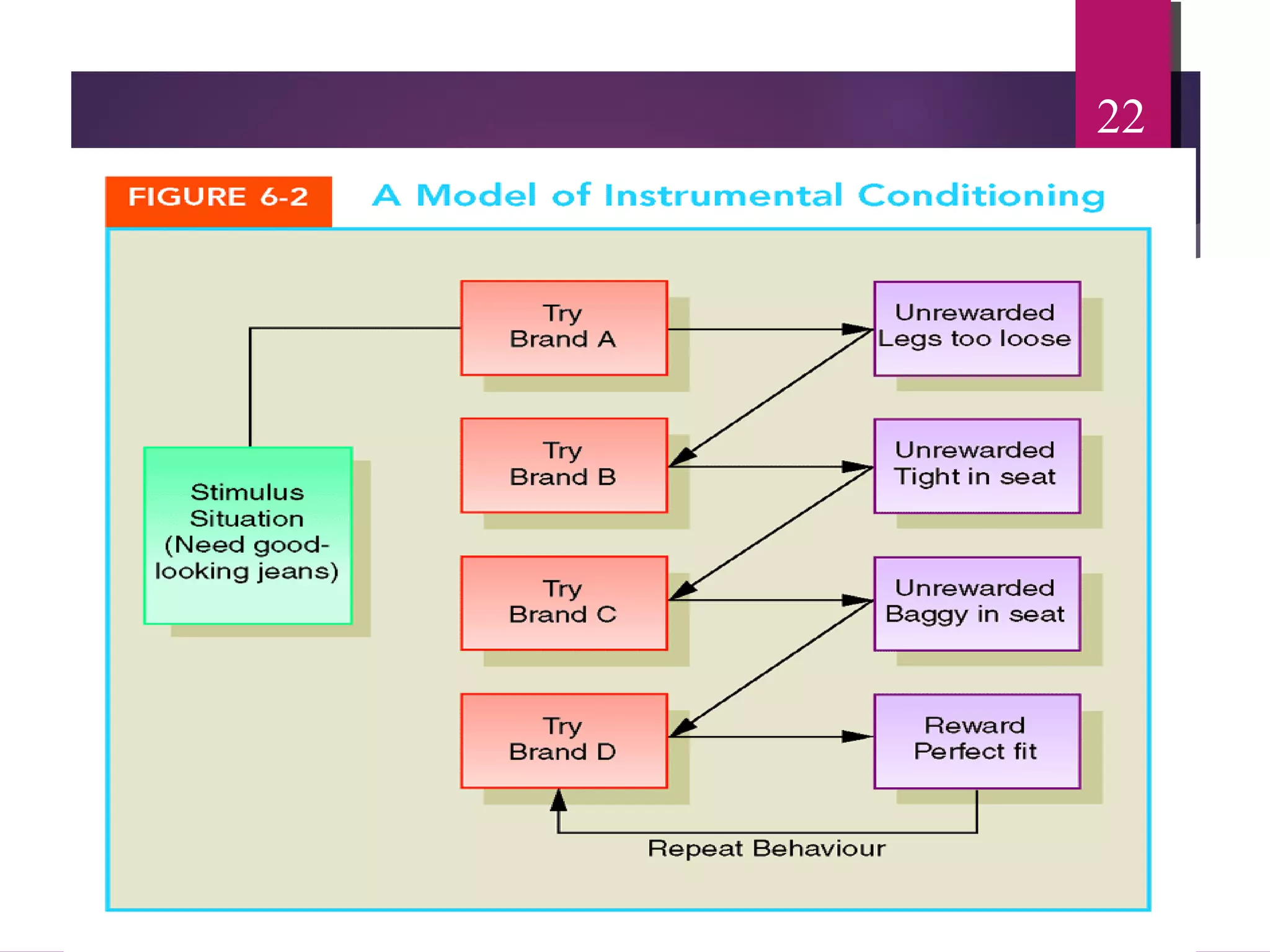
 Learning based on a trial-and-error process, 
with habits forced as the result of positive 
experiences (reinforcement)
Neo-Pavlovian Conditioning 
14 
 Forward Conditioning (CS Precedes US) 
 Repeated Pairings of CS and US 
 A CS and US that Logically Belong to Each 
Other 
 A CS that is Novel and Unfamiliar 
 A US that is Biologically or Symbolically Salient
Strategic Applications of 
Classical Conditioning 
 Repetition 
 Stimulus Generalization 
 The inability to perceive differences 
between slightly dissimilar stimuli. 
 Stimulus Discrimination 
15
Repetition 
 Repetition increases strength of associations 
and slows forgetting 
 But over time may result in advertising 
wearout. 
 Cosmetic variations reduce satiation. 
16
Three-Hit Theory 
17 
 Repetition is the basis for the idea that three 
exposures to an ad are necessary for the ad to 
be effective 
 The number of actual repetitions to equal 
three exposures is in question.
Stimulus Generalization 
18 
 The inability to perceive differences between 
slightly dissimilar stimuli. 
 Marketing applications: 
 Product Line, Form and Category Extensions 
 Family Branding 
 Licensing 
Generalizing Usage Situations
Stimulus Discrimination 
19 
 The ability to select a specific stimulus from 
among similar stimuli because of perceived 
differences.
Classical Conditioning and 
Marketing Strategy 
 Identify and pair product with a known, well-liked 
stimulus 
More attention 
More favourable attitudes 
Greater intention to buy the product 
 Learning of key attributes 
 Use stimulus generalization effectively 
20
Classical Conditioning and 
Marketing Strategy – cont’d 
 Distinguish the product through effective use 
of stimulus discrimination 
21
22
Instrumental Conditioning 
23 
 Consumers learn by means of trial and error 
process in which some purchase behaviors 
result in more favorable outcomes (rewards) 
than other purchase behaviors. 
 A favorable experience is instrumental in 
teaching the individual to repeat a specific 
behavior.
Reinforcement 
 Positive 
Reinforcement: 
Positive outcomes that 
strengthen the 
likelihood of a specific 
response 
 Example: Ad showing 
beautiful hair as a 
reinforcement to buy 
shampoo 
24 
 Negative 
Reinforcement: 
Unpleasant or 
negative outcomes 
that serve to 
encourage a specific 
behavior. 
 Example: Ad showing 
wrinkled skin as 
reinforcement to buy 
skin cream
Other Concepts in 
Reinforcement 
 Punishment 
 Choose reinforcement rather than punishment 
 Extinction 
 Combat with consumer satisfaction 
 Forgetting 
 Combat with repetition 
25
Instrumental Conditioning and 
Marketing 
 Make the product the ultimate reward 
 Provide samples and free trials 
 Provide non-product rewards 
 Practice relationship marketing 
 Reinforcement Schedules 
 Shaping 
 Massed versus Distributed Learning 
26
Cognitive Learning Theory 
 Learning through problem solving, which 
enables individuals to gain some control over 
their environment. 
 Three types: 
Observational learning 
Rote Learning 
Reasoning 
27
Observational Learning 
28 
 Individuals learn by observing the behavior of 
others, and consequences of such behavior. 
 Also known as Modeling or Vicarious learning.
Iconic Rote Learning 
 Learning concepts through simple repetition 
29 
 Repeated ads teach consumers about a 
product’s attributes
Reasoning 
30 
 Highest level of cognitive learning 
 Involves creative thinking 
 Depends on how information is processed 
and stored
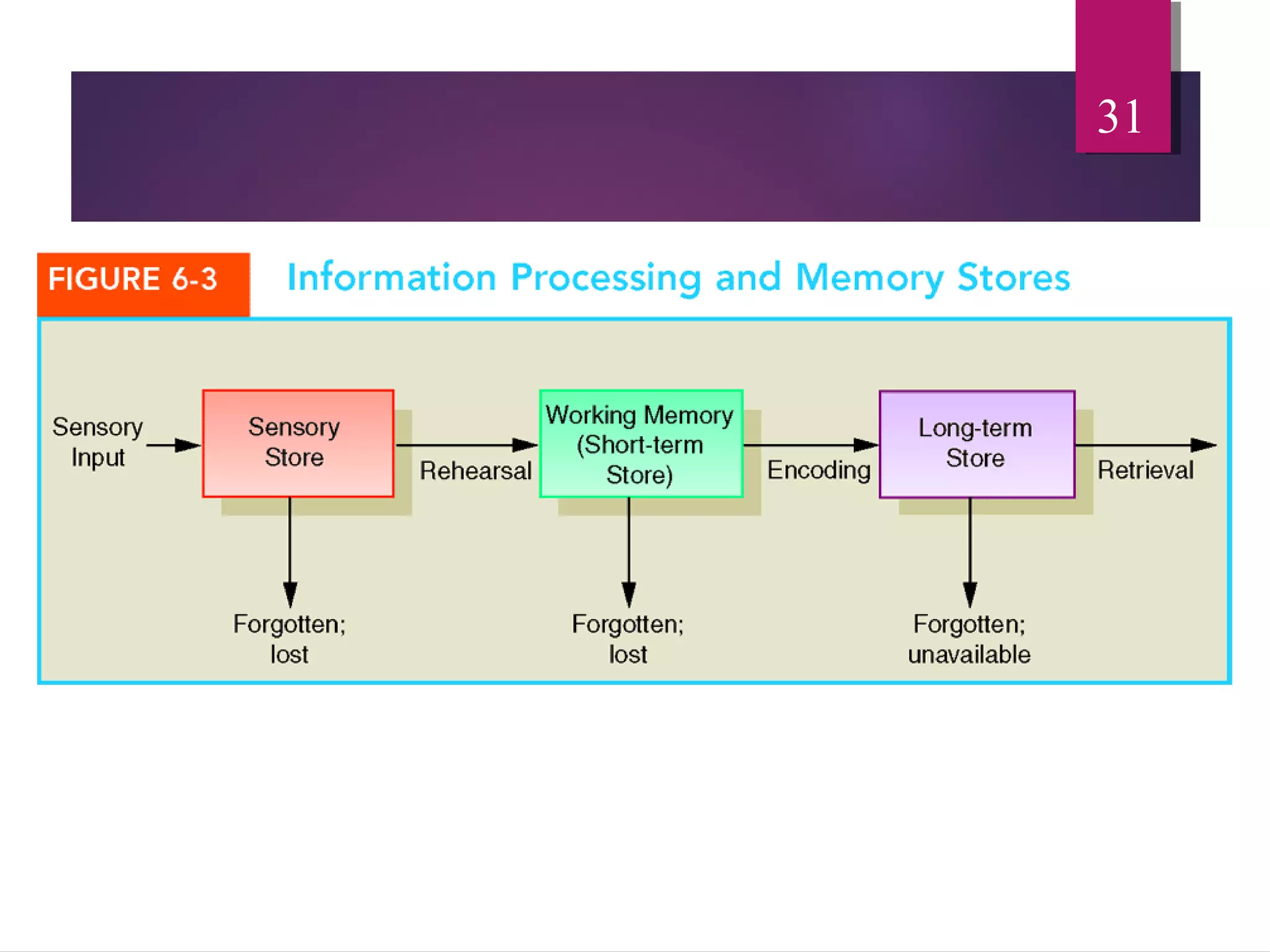
31
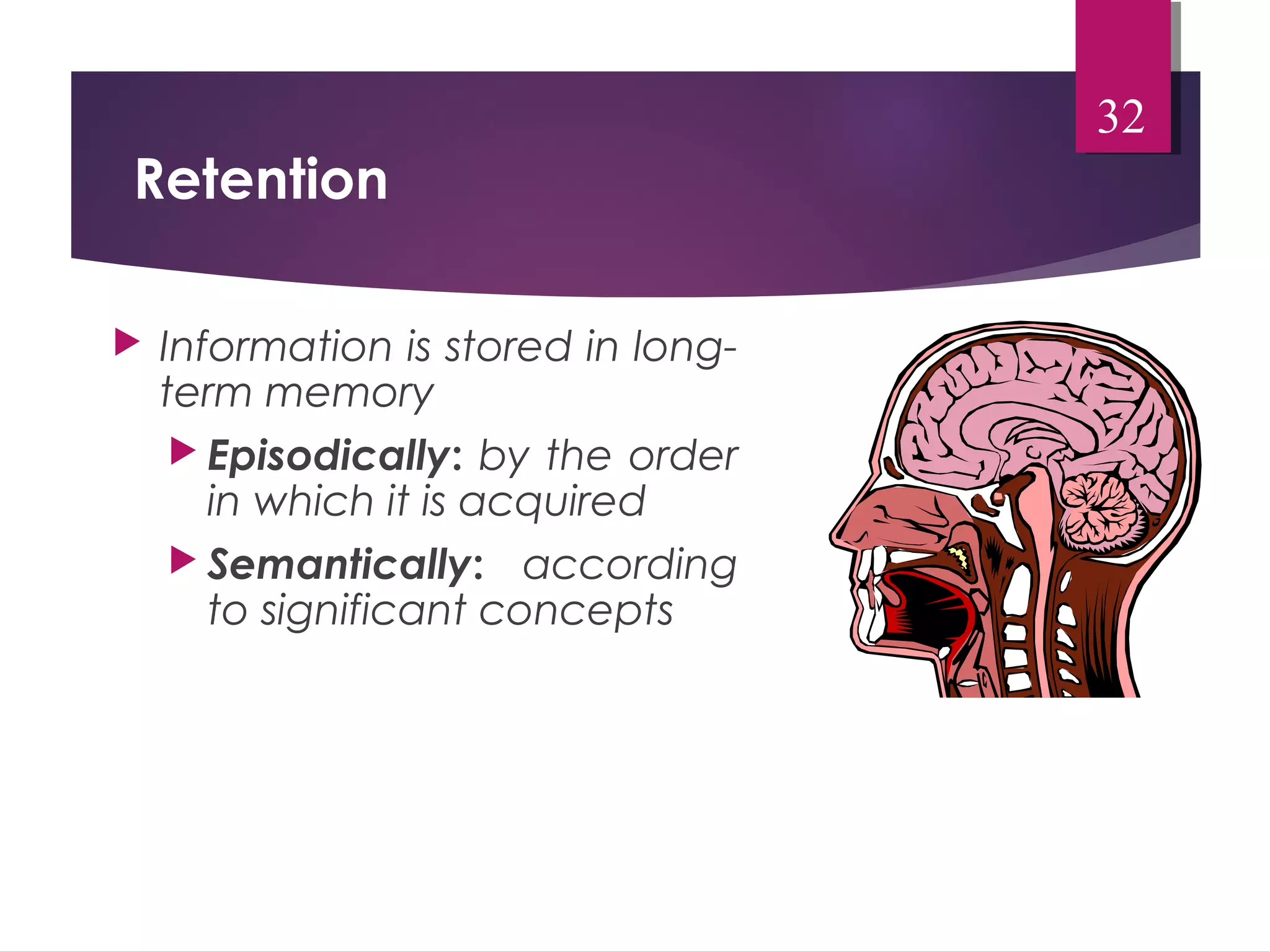
Retention 
 Information is stored in long-term 
memory 
 Episodically: by the order 
in which it is acquired 
 Semantically: according 
to significant concepts 
32
Information processing and 
Involvement Theory 
33 
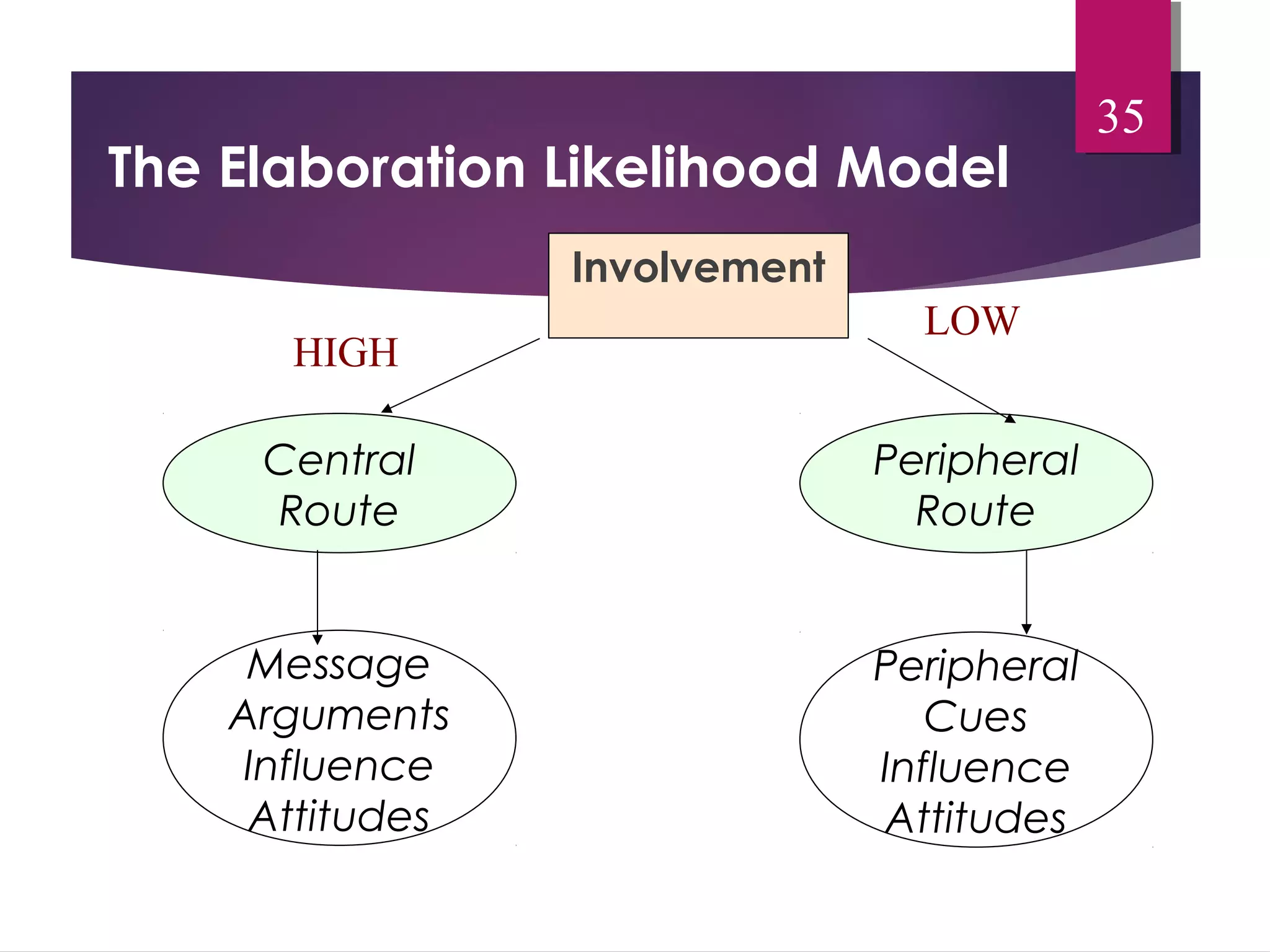
 Central and Peripheral Routes to 
Persuasion 
 Highly involved consumers are best reached 
through ads that focus on the specific 
attributes of the product (the central route) 
 Uninvolved consumers can be attracted 
through peripheral advertising cues such as 
the model or the setting (the peripheral 
route).
Elaboration Likelihood Model 
(ELM) 
34 
 A person’s level of involvement during 
message processing determines which route 
to persuasion is likely to be effective
The Elaboration Likelihood Model 
Involvement 
Central 
Route 
Peripheral 
Route 
Message 
Arguments 
Influence 
Attitudes 
Peripheral 
Cues 
Influence 
Attitudes 
HIGH 
LOW 
35
Cognitive Learning and Marketing 
Strategy 
36 
 Use rote learning to teach consumers about 
the brand 
 Use reasoning or problem solving for complex 
or high-involvement products 
 Use modelling to extinguish negative 
behaviour 
 Use knowledge of information processing to 
help consumers store, retain and retrieve 
messages.
Measures of Consumer 
Learning 
 Recognition and Recall Measures 
 Aided and Unaided Recall 
37 
 Cognitive Responses to Advertising 
 Copy-testing Measures 
 Attitudinal and Behavioral Measures of Brand 
Loyalty

Cb ppt

  • 1.
    Consumer Learning 1 PPRREESSEENNTTEEDD BBYY:: RREEKKAA AASSIIFF RRIIZZWWAANN ZZIIAA RRUUKKHHSSAARR CCHHAAUUDDHHAARRYY RRAAMMEEEEZZ FFAATTIIMMAA SSAAAADD MMOOHHOOMMMMAADD
  • 2.
    Consumer Learning 2 A process by which individuals acquire the purchase and consumption knowledge and experience that they apply to future related behavior.
  • 3.
    Learning Processes Intentional  Learning acquired as a result of a careful search for information 3  Incidental  Learning acquired by accident or without much effort
  • 4.
    Importance of Learning  Marketers must teach consumers: where to buy how to use how to maintain how to dispose of products 4
  • 5.
    Learning Theories Behavioral Theories: Theories based on the premise that learning takes place as the result of observable responses to external stimuli. Also known as stimulus response theory. 5  Cognitive Theories: A theory of learning based on mental information processing, often in response to problem solving.
  • 6.
    Elements of LearningTheories  Motivation  Cues  Response  Reinforcement 6
  • 7.
    Reinforcement  Apositive or negative outcome that influences the likelihood that a specific behavior will be repeated in the future in response to a particular cue or stimulus. 7
  • 8.
    Behavioral Learning Theories  Classical Conditioning  Instrumental Conditioning  Modeling or Observational Learning 8
  • 9.
    Classical Conditioning 9  Pairing a stimulus with another stimulus that elicits a known response to produce the same response when used alone.  http://almaz.com/nobel/medicine/1904a.html
  • 10.
  • 11.
  • 12.
    Classical conditioning –cont’d 12  Classical conditioning is the learning of associations among events that allows us to anticipate and represent our environment.  From this viewpoint, classical conditioning is not reflexive action, but rather the acquisition of new knowledge
  • 13.
    Instrumental (Operant) Conditioning 13  Learning based on a trial-and-error process, with habits forced as the result of positive experiences (reinforcement)
  • 14.
    Neo-Pavlovian Conditioning 14  Forward Conditioning (CS Precedes US)  Repeated Pairings of CS and US  A CS and US that Logically Belong to Each Other  A CS that is Novel and Unfamiliar  A US that is Biologically or Symbolically Salient
  • 15.
    Strategic Applications of Classical Conditioning  Repetition  Stimulus Generalization  The inability to perceive differences between slightly dissimilar stimuli.  Stimulus Discrimination 15
  • 16.
    Repetition  Repetitionincreases strength of associations and slows forgetting  But over time may result in advertising wearout.  Cosmetic variations reduce satiation. 16
  • 17.
    Three-Hit Theory 17  Repetition is the basis for the idea that three exposures to an ad are necessary for the ad to be effective  The number of actual repetitions to equal three exposures is in question.
  • 18.
    Stimulus Generalization 18  The inability to perceive differences between slightly dissimilar stimuli.  Marketing applications:  Product Line, Form and Category Extensions  Family Branding  Licensing Generalizing Usage Situations
  • 19.
    Stimulus Discrimination 19  The ability to select a specific stimulus from among similar stimuli because of perceived differences.
  • 20.
    Classical Conditioning and Marketing Strategy  Identify and pair product with a known, well-liked stimulus More attention More favourable attitudes Greater intention to buy the product  Learning of key attributes  Use stimulus generalization effectively 20
  • 21.
    Classical Conditioning and Marketing Strategy – cont’d  Distinguish the product through effective use of stimulus discrimination 21
  • 22.
  • 23.
    Instrumental Conditioning 23  Consumers learn by means of trial and error process in which some purchase behaviors result in more favorable outcomes (rewards) than other purchase behaviors.  A favorable experience is instrumental in teaching the individual to repeat a specific behavior.
  • 24.
    Reinforcement  Positive Reinforcement: Positive outcomes that strengthen the likelihood of a specific response  Example: Ad showing beautiful hair as a reinforcement to buy shampoo 24  Negative Reinforcement: Unpleasant or negative outcomes that serve to encourage a specific behavior.  Example: Ad showing wrinkled skin as reinforcement to buy skin cream
  • 25.
    Other Concepts in Reinforcement  Punishment  Choose reinforcement rather than punishment  Extinction  Combat with consumer satisfaction  Forgetting  Combat with repetition 25
  • 26.
    Instrumental Conditioning and Marketing  Make the product the ultimate reward  Provide samples and free trials  Provide non-product rewards  Practice relationship marketing  Reinforcement Schedules  Shaping  Massed versus Distributed Learning 26
  • 27.
    Cognitive Learning Theory  Learning through problem solving, which enables individuals to gain some control over their environment.  Three types: Observational learning Rote Learning Reasoning 27
  • 28.
    Observational Learning 28  Individuals learn by observing the behavior of others, and consequences of such behavior.  Also known as Modeling or Vicarious learning.
  • 29.
    Iconic Rote Learning  Learning concepts through simple repetition 29  Repeated ads teach consumers about a product’s attributes
  • 30.
    Reasoning 30 Highest level of cognitive learning  Involves creative thinking  Depends on how information is processed and stored
  • 31.
  • 32.
    Retention  Informationis stored in long-term memory  Episodically: by the order in which it is acquired  Semantically: according to significant concepts 32
  • 33.
    Information processing and Involvement Theory 33  Central and Peripheral Routes to Persuasion  Highly involved consumers are best reached through ads that focus on the specific attributes of the product (the central route)  Uninvolved consumers can be attracted through peripheral advertising cues such as the model or the setting (the peripheral route).
  • 34.
    Elaboration Likelihood Model (ELM) 34  A person’s level of involvement during message processing determines which route to persuasion is likely to be effective
  • 35.
    The Elaboration LikelihoodModel Involvement Central Route Peripheral Route Message Arguments Influence Attitudes Peripheral Cues Influence Attitudes HIGH LOW 35
  • 36.
    Cognitive Learning andMarketing Strategy 36  Use rote learning to teach consumers about the brand  Use reasoning or problem solving for complex or high-involvement products  Use modelling to extinguish negative behaviour  Use knowledge of information processing to help consumers store, retain and retrieve messages.
  • 37.
    Measures of Consumer Learning  Recognition and Recall Measures  Aided and Unaided Recall 37  Cognitive Responses to Advertising  Copy-testing Measures  Attitudinal and Behavioral Measures of Brand Loyalty