


Consumer Learning
Consumer Learning
Consumer Learning
 Learning is the process by which individuals
acquire the purchase & consumption knowledge &
experience that they apply to future related
behavior.

Learning takes place if an individual behaves,
reacts or responds as a result of experience in a
manner different from the way the person formerly
behaved.
Elements of Learning
 Motivation- is the driving force that impels individuals to
action.
 If a consumer has motivation to learn something, there is
increased likelihood that learning will take place.

 Example Bicycle riding for fitness.
 Cues- are relatively small stimuli , not strong enough to
arouse consumers but have the potential of providing
direction to motivated activity.
Elements of Learning
 An advertisement for an exotic trip that
includes bike riding may serve as a cue for bike
riders.

Cues serve to direct consumer drives when they
are consistent with the consumer expectations.
Marketers must be careful to provide cues that
do not upset those expectations.
Elements of Learning
 Response- The way an individual reacts to a cue
or stimuli is the response leading to learning.
 The automobile producer that provides consistent
cues to consumers may not always succeed in
stimulating a purchase.
 But if the maker has been able to form a
favorable image of the product in consumers
mind then it is likely that the consumer will
consider that make.
Elements of Learning
Reinforcement- increases the likelihood that a
specific response will occur in the future as the
result of particular cues.

 If the consumer have positive experiences about a
product there is likelihood that the repurchase will
take place.
 For example the cream to fight acne or pimples.
Behavioral learning theories
 There are two behavioral theories with great
relevance to marketing are
Classical Conditioning
Instrumental Conditioning
Classical Conditioning
Conditioning refers to a kind of automatic
response to something as a result of repeated
exposure to it.

For an example if a child gets excited every time
she/he thinks of going to McDonalds , the
reaction may be conditioned from many
pleasant visits to the restaurant.
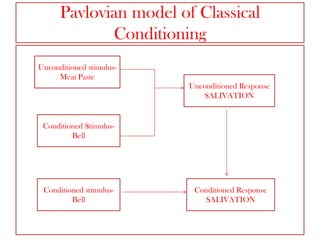
Pavlovian model of Classical
Conditioning
Unconditioned stimulusMeat Paste
Unconditioned Response
SALIVATION

Conditioned StimulusBell

Conditioned stimulusBell

Conditioned Response
SALIVATION
Strategic application of classical
conditioning
 Repetition- The consumers have a tendency to
forget & one proven method of increasing
retention of learning is repetition.
Although the principle of repetition is well
established among advertisers, not every ne agrees
how much repetition is required.
The experts believe that three exposures to an
advertisement are needed.
Strategic application of classical
conditioning
 The effectiveness of repetition is dependent on
the amount of competing advertising to which the
consumer is exposed.

The higher the level of competing ads, the greater
the likelihood that interference would occur ,
causing consumers to forget previous learning that
resulted from repetition.
Strategic application of classical
conditioning
 Stimulus Generalization- Learning depends not
only on repetition but also on ability of individuals
to generalize it.
 The dog could learn to salivate not only to the
sound of bell but also to somewhat similar sounds.
 Stimulus Generalization explains why sometimes
imitative me too products succeed in the market
place.
Strategic application of classical
conditioning
 Consumers confuse them with the original
product they have seen advertised.

 It also explains why the private label brands try to
make their packaging closely resemble the national
brand leaders.
Strategic application of classical
conditioning
 Product Line form and Category extensions- The
principle of stimulus generalization is adopted by
marketers to product line, form & category
extensions.

 In line extensions the marketers add related
products to an already established brand, knowing
the new products are more likely to be adopted
when they are associated with a known & trusted
brand name.
Strategic application of classical
conditioning
 The Stimulus generalization is frequently used
in family branding by the marketers.
 Stimulus Discrimination- is the opposite of
stimulus generalization & results in the selection
of a specific stimulus from among similar
stimuli.
Stimulus discrimination is widely used in
positioning strategy of the companies.
Instrumental Conditioning
Instrumental Conditioning theory says that
learning occurs through a trial & error method.
In Instrumental conditioning the stimulus that
results in most satisfactory response is the one
that is learned.

For example the consumers are likely to
patronize only that store that carries clothing
that meets their needs.
Instrumental Conditioning
This theory says that the consumers learn
through the trial & error process in which some
purchase behavior results in more favorable
outcomes than other purchase behaviors.
Reinforcement of behavior
 Reinforcement is anything that increases the
strength of response & tends to induce the
repetition of behavior. Reinforcement can be
positive as well as negative.
 Positive reinforcement consists of events that
strengthen the likelihood of a specific response.
Using a shampoo that leaves the hair silky &
soft is likely to result in the repeat purchase of
the product.
Reinforcement of behavior
 Negative reinforcement is an unpleasant or
negative outcome that also serves to encourage
a specific behavior.
An ad that shows a model with wrinkled skin is
designed to encourage consumers to buy & use
the advertised cream.
Many insurance companies also use this theory
to propel the sale of their products.
Strategic applications of Instrumental
Conditioning
 Marketers effectively utilize the concepts of
consumer instrument learning when they
provide positive reinforcement by assuring
customer satisfaction with the product, service
& total buying experience.
Marketers must be certain to provide the best
possible product for money & avoid raising the
consumer
expectations
for
product
performance beyond what a product can
deliver.
Consumer learning
Consumer learning
Consumer learning

Consumer learning

  • 1.
  • 2.
  • 3.
    Consumer Learning  Learningis the process by which individuals acquire the purchase & consumption knowledge & experience that they apply to future related behavior. Learning takes place if an individual behaves, reacts or responds as a result of experience in a manner different from the way the person formerly behaved.
  • 4.
    Elements of Learning Motivation- is the driving force that impels individuals to action.  If a consumer has motivation to learn something, there is increased likelihood that learning will take place.  Example Bicycle riding for fitness.  Cues- are relatively small stimuli , not strong enough to arouse consumers but have the potential of providing direction to motivated activity.
  • 5.
    Elements of Learning An advertisement for an exotic trip that includes bike riding may serve as a cue for bike riders. Cues serve to direct consumer drives when they are consistent with the consumer expectations. Marketers must be careful to provide cues that do not upset those expectations.
  • 6.
    Elements of Learning Response- The way an individual reacts to a cue or stimuli is the response leading to learning.  The automobile producer that provides consistent cues to consumers may not always succeed in stimulating a purchase.  But if the maker has been able to form a favorable image of the product in consumers mind then it is likely that the consumer will consider that make.
  • 7.
    Elements of Learning Reinforcement-increases the likelihood that a specific response will occur in the future as the result of particular cues.  If the consumer have positive experiences about a product there is likelihood that the repurchase will take place.  For example the cream to fight acne or pimples.
  • 8.
    Behavioral learning theories There are two behavioral theories with great relevance to marketing are Classical Conditioning Instrumental Conditioning
  • 9.
    Classical Conditioning Conditioning refersto a kind of automatic response to something as a result of repeated exposure to it. For an example if a child gets excited every time she/he thinks of going to McDonalds , the reaction may be conditioned from many pleasant visits to the restaurant.
  • 10.
    Pavlovian model ofClassical Conditioning Unconditioned stimulusMeat Paste Unconditioned Response SALIVATION Conditioned StimulusBell Conditioned stimulusBell Conditioned Response SALIVATION
  • 11.
    Strategic application ofclassical conditioning  Repetition- The consumers have a tendency to forget & one proven method of increasing retention of learning is repetition. Although the principle of repetition is well established among advertisers, not every ne agrees how much repetition is required. The experts believe that three exposures to an advertisement are needed.
  • 12.
    Strategic application ofclassical conditioning  The effectiveness of repetition is dependent on the amount of competing advertising to which the consumer is exposed. The higher the level of competing ads, the greater the likelihood that interference would occur , causing consumers to forget previous learning that resulted from repetition.
  • 13.
    Strategic application ofclassical conditioning  Stimulus Generalization- Learning depends not only on repetition but also on ability of individuals to generalize it.  The dog could learn to salivate not only to the sound of bell but also to somewhat similar sounds.  Stimulus Generalization explains why sometimes imitative me too products succeed in the market place.
  • 14.
    Strategic application ofclassical conditioning  Consumers confuse them with the original product they have seen advertised.  It also explains why the private label brands try to make their packaging closely resemble the national brand leaders.
  • 15.
    Strategic application ofclassical conditioning  Product Line form and Category extensions- The principle of stimulus generalization is adopted by marketers to product line, form & category extensions.  In line extensions the marketers add related products to an already established brand, knowing the new products are more likely to be adopted when they are associated with a known & trusted brand name.
  • 16.
    Strategic application ofclassical conditioning  The Stimulus generalization is frequently used in family branding by the marketers.  Stimulus Discrimination- is the opposite of stimulus generalization & results in the selection of a specific stimulus from among similar stimuli. Stimulus discrimination is widely used in positioning strategy of the companies.
  • 17.
    Instrumental Conditioning Instrumental Conditioningtheory says that learning occurs through a trial & error method. In Instrumental conditioning the stimulus that results in most satisfactory response is the one that is learned. For example the consumers are likely to patronize only that store that carries clothing that meets their needs.
  • 18.
    Instrumental Conditioning This theorysays that the consumers learn through the trial & error process in which some purchase behavior results in more favorable outcomes than other purchase behaviors.
  • 19.
    Reinforcement of behavior Reinforcement is anything that increases the strength of response & tends to induce the repetition of behavior. Reinforcement can be positive as well as negative.  Positive reinforcement consists of events that strengthen the likelihood of a specific response. Using a shampoo that leaves the hair silky & soft is likely to result in the repeat purchase of the product.
  • 20.
    Reinforcement of behavior Negative reinforcement is an unpleasant or negative outcome that also serves to encourage a specific behavior. An ad that shows a model with wrinkled skin is designed to encourage consumers to buy & use the advertised cream. Many insurance companies also use this theory to propel the sale of their products.
  • 21.
    Strategic applications ofInstrumental Conditioning  Marketers effectively utilize the concepts of consumer instrument learning when they provide positive reinforcement by assuring customer satisfaction with the product, service & total buying experience. Marketers must be certain to provide the best possible product for money & avoid raising the consumer expectations for product performance beyond what a product can deliver.