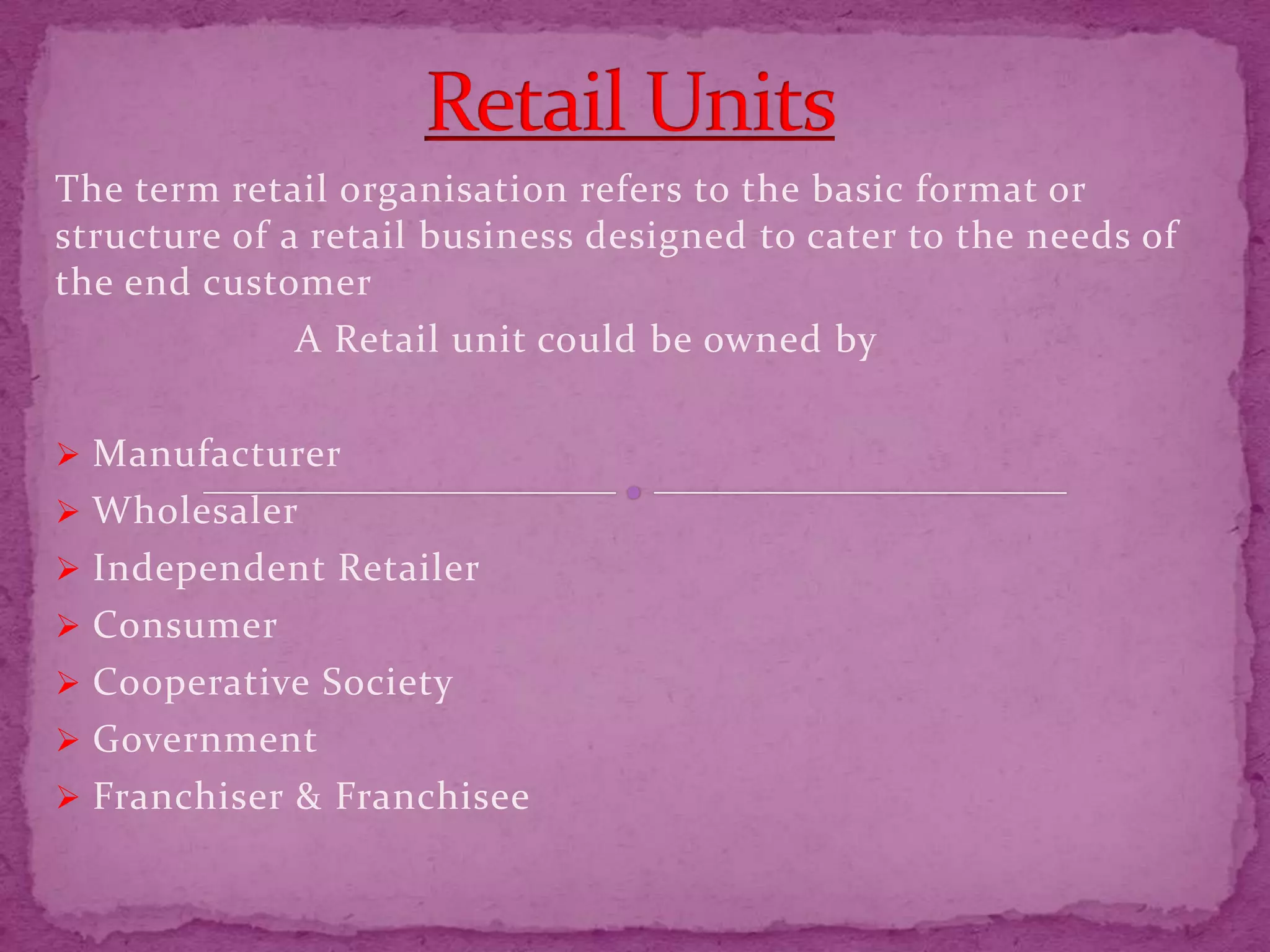

The term retail organisation refers to the basic format or
structure of a retail business designed to cater to the needs of
the end customer
A Retail unit could be owned by
 Manufacturer
 Wholesaler
 Independent Retailer
 Consumer
 Cooperative Society
 Government
 Franchiser & Franchisee
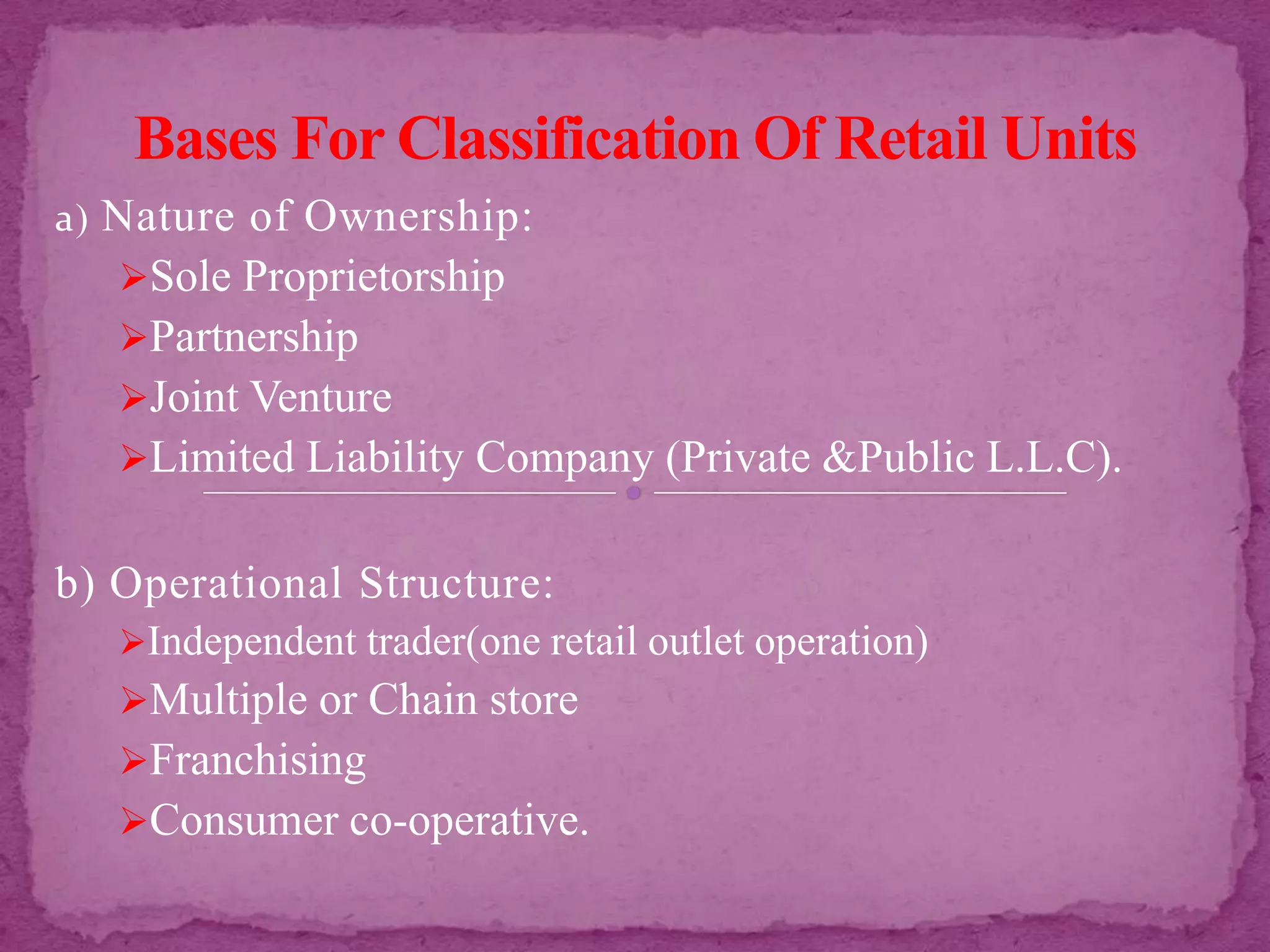
a) Nature of Ownership:
Sole Proprietorship
Partnership
Joint Venture
Limited Liability Company (Private &Public L.L.C).
b) Operational Structure:
Independent trader(one retail outlet operation)
Multiple or Chain store
Franchising
Consumer co-operative.
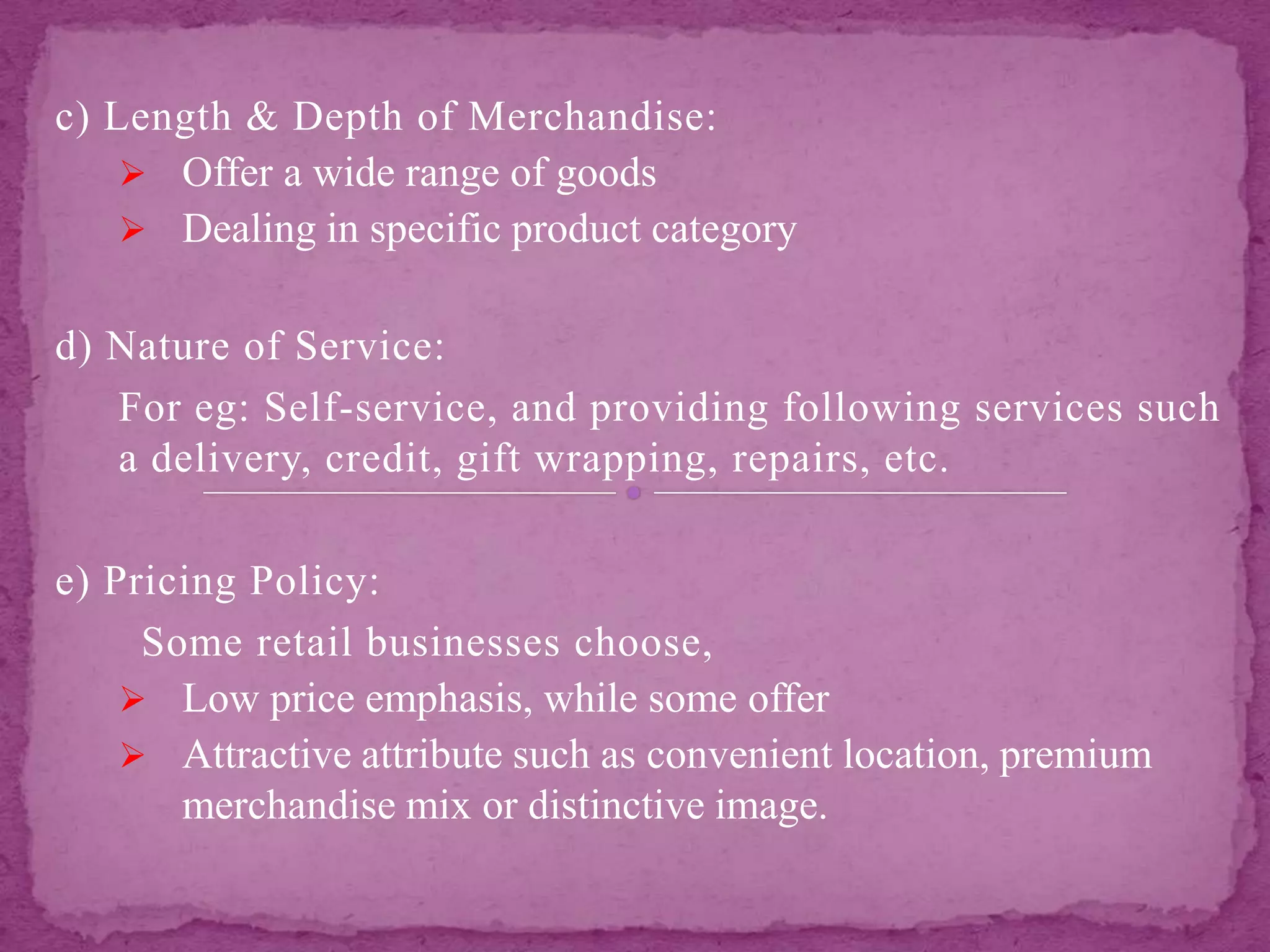
c) Length & Depth of Merchandise:
 Offer a wide range of goods
 Dealing in specific product category
d) Nature of Service:
For eg: Self-service, and providing following services such
a delivery, credit, gift wrapping, repairs, etc.
e) Pricing Policy:
Some retail businesses choose,
 Low price emphasis, while some offer
 Attractive attribute such as convenient location, premium
merchandise mix or distinctive image.
f) Retail Location:
Classified according to their store’s geographic location.
Out-of-town locations, whilst others
Locate in ‘cluster’ locations in downtown centers
g) Customer Interaction:
Retail stores facilitating face-to-face contacts.
Non-store retailing operations(mail order catalogues,
telephone selling, vending machines, door-to-door selling or
mobile vendors.)
1. Sole Proprietorship:
The characteristics of this retail format are:
It’s easy to form, less expensive to organize and the
proprietors have full control
The income generated reaches the proprietor and he can
make the ultimate decision to keep it or reinvest in business
The business is easy to dissolve, if desired
Their business and personal assets are at risk; due to
unlimited liability, they are also legally responsible for all
the debts.
Often limited to using funds from personal savings or
consumer loans, and
May have a hard time attracting high-caliber employees
The characteristics of this retail format are
Partnerships are relatively easy to establish and with
more than one owner, the ability to raise funds may be
increased.
Prospective employees may be attracted to the
business if given the incentive to become a partner and
the business usually will benefit from partners who
have complementary skills.
Partners are jointly and individually liable for the
actions of the other partners.
Since decisions and profits are shared, disagreements
can occur.
A joint venture is not well defined in the law.
Unless incorporated or established as a firm as evidenced by
a deed, joint ventures may be taxed like association of persons,
sometimes at maximum marginal rates.
It acts like a general partnership, but is clearly for a limited
period of time or a single project.
LLC’s must not have more than two of the four characteristics
that define corporations i.e.
Limited liability to the extent of assets; continuity of
life; centralization of management; and free
transferability of ownership interests.
It is designed to provide the limited liability features of a
corporation, tax efficiencies and operational flexibility of a
partnership. Yet formation is more complex and formal than
that of a general partnership.
1. Independent Trader:
 Generally operates one outlet and offers personalized
service, a convenient location and close customer contact.
 Roughly 98% of all the retail businesses in India, are
managed and run by independents, including barber shops,
dry cleaners, furniture stores,bookshops,LPG Gas Agencies
and neighborhood stores.
 This is due to the fact that into retailing is easy and it
requires low investment and little technical knowledge.
This obviously results in a high degree of competition..
 Most independent retailers fail because of the ease of
entry, poor management skills and inadequate resources.
It involves common ownership of multiple units. In such
units, the purchasing and decision making are centralized. It
includes specialization, standardization and elaborate control-
systems.
 Chain stores have been successful, mainly because they have
the opportunity to take advantage of “economies of scale” in
buying and selling goods.
 Examples : Shoppers stop; West side and IOC, convenience
stores at select petrol filling stations.
2. Multiple Or Chain Store
Is a contractual arrangement between a “franchiser”
and a “franchisee”.
 It is a certain form of business under an established
name and according to a specific set of rules.
 In exchange for fees, royalties and a share of the
profits, the franchiser offers assistance and very often
supplies as well.
 Examples; McDonalds, Pizza Hut and Nirulas.
A retail cooperative is a group of independent
retailers, that have combined their financial resources
and their expertise in order to effectively control their
wholesaling needs.
 They share purchases, storage, shopping facilities,
advertising planning and other functions. .
 Example : Amul
It refers to department in a retail store that are rented
to an outside party.
Usually this is done in case of department and
speciality stores and also at times, in discount stores.
The proprietor of a leased department is usually
responsible for all aspects of its business and normally
pays the store a percentage of sales as rent.
Example : store beauty salon,banks,watch repair
Differentiate themselves on the basis of the range and variety
of Merchandise they maintain in their store.
Wide range of goods
Product category with a minimum range of Merchandise
within that product category
Variety of merchandise mix can be classified as follows:
Departmental stores
Discount Stores
Specialty Stores
Supermarket and Hypermarkets
Departmental stores:
A large retail store organized into number of departments
offering a broad variety and depth of merchandise;
commonly part of a retail chain Ebony, Globus, Lifestyle,
Pantaloon, Shoppers Stop and
Westside
Discount Stores:
Retailers offering a broad variety of merchandise mix,
limited or no service, and low prices. Subhiksha, Margin
Free market and outside India, Wal-Mart is a classic
example of the most successful retailer operating as a
discount centre.
Specialty Stores:
Complementary product categories and extend a high level
of service to their customers.
For e.g.: Vivek’s retailing consumer durables in Chennai,
shopper’s store housing planet m.
Supermarket and Hypermarkets:
Hypermarkets are characterized by large store size, low
operating costs and margins, low prices and comprehensive
range of merchandise.
For e.g. : Big Bazaar ,RPG owned Giant Hypermarket.
Successful international hypermarket chains include
Carrefour of France and Continent of South Africa.
Retailers are classified on the basis of level and kind of
services extended by them to their customer
These retail outlets have been converted to or built as self-
services units, and are providing services such as delivery,
credit, gift-wrapping, repairs, etc
Low price rather than the service element of their retailing
mix
They will generate business on the basis of some other
attribute such as convenient location, premium merchandise
mix or distinctive image
1. Retailers at Freestanding location:
Retailers located at site, which is not connected
to other retailers and therefore they depends on
its own drawing power and promotion to attract
customers, classified as neighborhood or
highway stores.
For e.g. : McDonalds outlet in Delhi- Ludhiana highway.
Retailers in Business Associated location: who located their
store where a group of retail outlets offering a variety of
merchandise, work together to attract customers to their retail
area, but also compete against each other for the same
customers, classified as unplanned business districts and
planned shopping centres.
For e.g. :
Trichur Round Market Place in Kerala covering garments,
grocery, jewelry, shoes, home products, confectioneries etc can
describe a planned business district .
Traditional independent retailers or chain stores particularly
prefer specialized markets .
For e.g.:
The Chowk area in Lucknow famous for its food and cotton
embroidery cloth materials.
Retailers at airports are mostly comprising of duty-free shops,
newsstands and book stores but now also seen opening food
retail chains like cafe coffee day etc.
Retail units can be classified into two groups on the basis of
the nature of interaction between retailer and customers
namely store retailers and nonstore retailers.
They operate from fixed point-of-sale location to attract a
high volume of walk-in customers
Mass media ads to attract consumers
It serve business and institutional clients
It provide after sales services, such as repair , alterations
and installation
Electronic Retailing- It is also called e-tailing and internet
retailing is a retail format in which the retailers communicate
with customers and offer products and services for sale on the
internet.
Catalog Retailing-It is a non-store retail format in which the
retail offering is communicated to a customer through a catalog
Direct-Mail Retailing-It is a non store retail in which the
offering is communicated through letters and brochures.
Direct selling : It is a retail format in which a salesperson,
frequently an independent businessperson, contacts a
customer directly in a convenient location either at the
customers house or at work and demonstrates merchandise
benefits, takes an order and delivers the merchandise to the
customer.
TV Shopping: It is a retail format in which customers watch
a TV program demonstrating merchandise and then place
orders for the merchandise by telephone
Vending machine retailing: It is a non-store format in which
merchandise or services are stored in a machine and
dispensed to customers when they deposit cash or use a
credit card.
Classification of retail units

Classification of retail units

  • 1.
    The term retailorganisation refers to the basic format or structure of a retail business designed to cater to the needs of the end customer A Retail unit could be owned by  Manufacturer  Wholesaler  Independent Retailer  Consumer  Cooperative Society  Government  Franchiser & Franchisee
  • 3.
    a) Nature ofOwnership: Sole Proprietorship Partnership Joint Venture Limited Liability Company (Private &Public L.L.C). b) Operational Structure: Independent trader(one retail outlet operation) Multiple or Chain store Franchising Consumer co-operative.
  • 4.
    c) Length &Depth of Merchandise:  Offer a wide range of goods  Dealing in specific product category d) Nature of Service: For eg: Self-service, and providing following services such a delivery, credit, gift wrapping, repairs, etc. e) Pricing Policy: Some retail businesses choose,  Low price emphasis, while some offer  Attractive attribute such as convenient location, premium merchandise mix or distinctive image.
  • 5.
    f) Retail Location: Classifiedaccording to their store’s geographic location. Out-of-town locations, whilst others Locate in ‘cluster’ locations in downtown centers g) Customer Interaction: Retail stores facilitating face-to-face contacts. Non-store retailing operations(mail order catalogues, telephone selling, vending machines, door-to-door selling or mobile vendors.)
  • 6.
    1. Sole Proprietorship: Thecharacteristics of this retail format are: It’s easy to form, less expensive to organize and the proprietors have full control The income generated reaches the proprietor and he can make the ultimate decision to keep it or reinvest in business The business is easy to dissolve, if desired Their business and personal assets are at risk; due to unlimited liability, they are also legally responsible for all the debts. Often limited to using funds from personal savings or consumer loans, and May have a hard time attracting high-caliber employees
  • 7.
    The characteristics ofthis retail format are Partnerships are relatively easy to establish and with more than one owner, the ability to raise funds may be increased. Prospective employees may be attracted to the business if given the incentive to become a partner and the business usually will benefit from partners who have complementary skills. Partners are jointly and individually liable for the actions of the other partners. Since decisions and profits are shared, disagreements can occur.
  • 8.
    A joint ventureis not well defined in the law. Unless incorporated or established as a firm as evidenced by a deed, joint ventures may be taxed like association of persons, sometimes at maximum marginal rates. It acts like a general partnership, but is clearly for a limited period of time or a single project.
  • 9.
    LLC’s must nothave more than two of the four characteristics that define corporations i.e. Limited liability to the extent of assets; continuity of life; centralization of management; and free transferability of ownership interests. It is designed to provide the limited liability features of a corporation, tax efficiencies and operational flexibility of a partnership. Yet formation is more complex and formal than that of a general partnership.
  • 10.
    1. Independent Trader: Generally operates one outlet and offers personalized service, a convenient location and close customer contact.  Roughly 98% of all the retail businesses in India, are managed and run by independents, including barber shops, dry cleaners, furniture stores,bookshops,LPG Gas Agencies and neighborhood stores.  This is due to the fact that into retailing is easy and it requires low investment and little technical knowledge. This obviously results in a high degree of competition..  Most independent retailers fail because of the ease of entry, poor management skills and inadequate resources.
  • 11.
    It involves commonownership of multiple units. In such units, the purchasing and decision making are centralized. It includes specialization, standardization and elaborate control- systems.  Chain stores have been successful, mainly because they have the opportunity to take advantage of “economies of scale” in buying and selling goods.  Examples : Shoppers stop; West side and IOC, convenience stores at select petrol filling stations. 2. Multiple Or Chain Store
  • 12.
    Is a contractualarrangement between a “franchiser” and a “franchisee”.  It is a certain form of business under an established name and according to a specific set of rules.  In exchange for fees, royalties and a share of the profits, the franchiser offers assistance and very often supplies as well.  Examples; McDonalds, Pizza Hut and Nirulas.
  • 13.
    A retail cooperativeis a group of independent retailers, that have combined their financial resources and their expertise in order to effectively control their wholesaling needs.  They share purchases, storage, shopping facilities, advertising planning and other functions. .  Example : Amul
  • 14.
    It refers todepartment in a retail store that are rented to an outside party. Usually this is done in case of department and speciality stores and also at times, in discount stores. The proprietor of a leased department is usually responsible for all aspects of its business and normally pays the store a percentage of sales as rent. Example : store beauty salon,banks,watch repair
  • 15.
    Differentiate themselves onthe basis of the range and variety of Merchandise they maintain in their store. Wide range of goods Product category with a minimum range of Merchandise within that product category
  • 16.
    Variety of merchandisemix can be classified as follows: Departmental stores Discount Stores Specialty Stores Supermarket and Hypermarkets
  • 17.
    Departmental stores: A largeretail store organized into number of departments offering a broad variety and depth of merchandise; commonly part of a retail chain Ebony, Globus, Lifestyle, Pantaloon, Shoppers Stop and Westside Discount Stores: Retailers offering a broad variety of merchandise mix, limited or no service, and low prices. Subhiksha, Margin Free market and outside India, Wal-Mart is a classic example of the most successful retailer operating as a discount centre.
  • 18.
    Specialty Stores: Complementary productcategories and extend a high level of service to their customers. For e.g.: Vivek’s retailing consumer durables in Chennai, shopper’s store housing planet m. Supermarket and Hypermarkets: Hypermarkets are characterized by large store size, low operating costs and margins, low prices and comprehensive range of merchandise. For e.g. : Big Bazaar ,RPG owned Giant Hypermarket. Successful international hypermarket chains include Carrefour of France and Continent of South Africa.
  • 19.
    Retailers are classifiedon the basis of level and kind of services extended by them to their customer These retail outlets have been converted to or built as self- services units, and are providing services such as delivery, credit, gift-wrapping, repairs, etc
  • 20.
    Low price ratherthan the service element of their retailing mix They will generate business on the basis of some other attribute such as convenient location, premium merchandise mix or distinctive image
  • 21.
    1. Retailers atFreestanding location: Retailers located at site, which is not connected to other retailers and therefore they depends on its own drawing power and promotion to attract customers, classified as neighborhood or highway stores. For e.g. : McDonalds outlet in Delhi- Ludhiana highway.
  • 22.
    Retailers in BusinessAssociated location: who located their store where a group of retail outlets offering a variety of merchandise, work together to attract customers to their retail area, but also compete against each other for the same customers, classified as unplanned business districts and planned shopping centres. For e.g. : Trichur Round Market Place in Kerala covering garments, grocery, jewelry, shoes, home products, confectioneries etc can describe a planned business district .
  • 23.
    Traditional independent retailersor chain stores particularly prefer specialized markets . For e.g.: The Chowk area in Lucknow famous for its food and cotton embroidery cloth materials.
  • 24.
    Retailers at airportsare mostly comprising of duty-free shops, newsstands and book stores but now also seen opening food retail chains like cafe coffee day etc.
  • 25.
    Retail units canbe classified into two groups on the basis of the nature of interaction between retailer and customers namely store retailers and nonstore retailers.
  • 26.
    They operate fromfixed point-of-sale location to attract a high volume of walk-in customers Mass media ads to attract consumers It serve business and institutional clients It provide after sales services, such as repair , alterations and installation
  • 27.
    Electronic Retailing- Itis also called e-tailing and internet retailing is a retail format in which the retailers communicate with customers and offer products and services for sale on the internet. Catalog Retailing-It is a non-store retail format in which the retail offering is communicated to a customer through a catalog Direct-Mail Retailing-It is a non store retail in which the offering is communicated through letters and brochures.
  • 28.
    Direct selling :It is a retail format in which a salesperson, frequently an independent businessperson, contacts a customer directly in a convenient location either at the customers house or at work and demonstrates merchandise benefits, takes an order and delivers the merchandise to the customer. TV Shopping: It is a retail format in which customers watch a TV program demonstrating merchandise and then place orders for the merchandise by telephone Vending machine retailing: It is a non-store format in which merchandise or services are stored in a machine and dispensed to customers when they deposit cash or use a credit card.