Forms of Business
  Organization

  Chapters 18 & 19
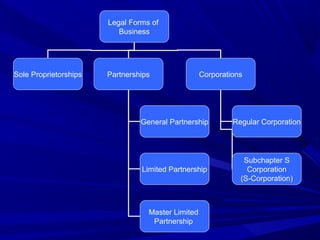
Legal Forms of
                          Business


Sole Proprietorships   Partnerships                Corporations


                                General Partnership         Regular Corporation


                                                               Subchapter S
                                Limited Partnership             Corporation
                                                              (S-Corporation)


                                  Master Limited
                                   Partnership
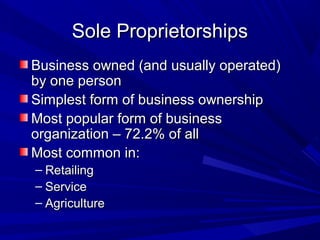
Sole Proprietorships
Business owned (and usually operated)
by one person
Simplest form of business ownership
Most popular form of business
organization – 72.2% of all
Most common in:
– Retailing
– Service
– Agriculture
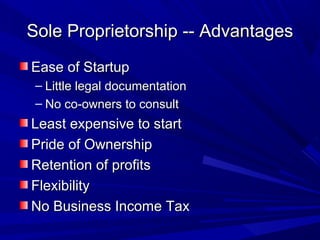
Sole Proprietorship -- Advantages
Ease of Startup
 – Little legal documentation
 – No co-owners to consult
Least expensive to start
Pride of Ownership
Retention of profits
Flexibility
No Business Income Tax
Sole Proprietorship --
         Disadvantages
Unlimited Liability
Limited Life – Business ends when owner
leaves the business
Limited Access to Start-up Capital
Limited Access to Credit
Limited Management Expertise
Difficulty in Hiring Employees
Proprietor not considered an employee
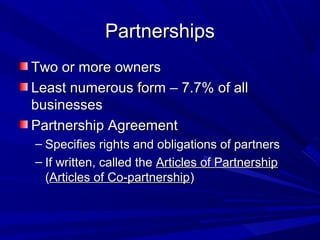
Partnerships
Two or more owners
Least numerous form – 7.7% of all
businesses
Partnership Agreement
– Specifies rights and obligations of partners
– If written, called the Articles of Partnership
  (Articles of Co-partnership)
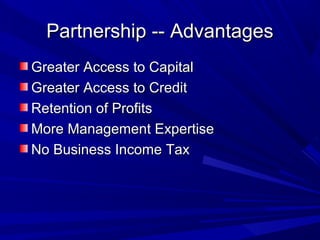
Partnership -- Advantages
Greater Access to Capital
Greater Access to Credit
Retention of Profits
More Management Expertise
No Business Income Tax
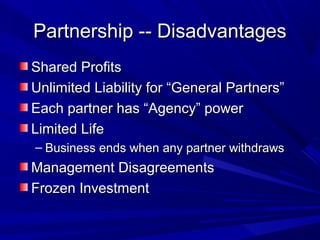
Partnership -- Disadvantages
Shared Profits
Unlimited Liability for “General Partners”
Each partner has “Agency” power
Limited Life
– Business ends when any partner withdraws
Management Disagreements
Frozen Investment
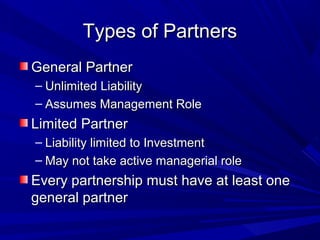
Types of Partners
General Partner
– Unlimited Liability
– Assumes Management Role
Limited Partner
– Liability limited to Investment
– May not take active managerial role
Every partnership must have at least one
general partner
Types of Partners
General Partnership
– All partners are general partners
Limited Partnership
– One or more limited partners
Master Limited Partnership
– Owned & managed like a corporation
– Taxed like a partnership
– Shares may be sold
Corporations
Generally larger than other forms (Except for S-
Corporation)
– 20.1% of all U.S. Businesses
– Account for 87.1% of all U.S. Business Income
Considered a separate legal entity
– Owners called “Stockholders” or Shareholders”
Ownership evidenced by “Stock Certificate”
Governed by “Board of Directors”
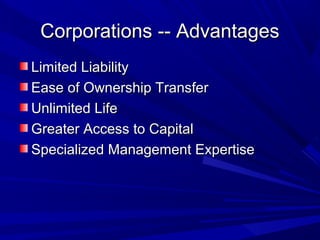
Corporations -- Advantages
Limited Liability
Ease of Ownership Transfer
Unlimited Life
Greater Access to Capital
Specialized Management Expertise
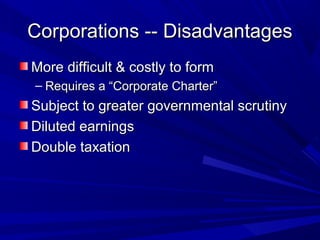
Corporations -- Disadvantages
More difficult & costly to form
– Requires a “Corporate Charter”
Subject to greater governmental scrutiny
Diluted earnings
Double taxation
Corporations vs.
         Sole Proprietorships
                SP              Corp
Income     $1,000,000      $1,000,000
Expenses      500,000          500,000
EBT          $500,000         $500,000
  (Assume Business Tax Rate = 50%)
Business Tax        0          250,000
Net Profit    $500,000       $250,000
  (Assume a 30% Personal Tax Rate)
Personal Tax 150,000           75,000
$ to Owners $350,000          $175,000
Corporate Charter
Legal Permission to Operate as a
Corporation
Issued by state
May not conduct business as a
corporation without a charter
Contents of a Corporate Charter
 Company Name & Address
 Names & addresses of Incorporators
 Purpose of the Corporation
 Maximum amount of stock & Classes of
 Stock to be issued
 Rights & Privileges of stockholders
 Length of time the corporation is to exist
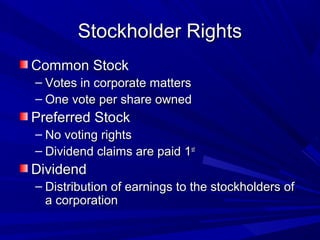
Stockholder Rights
Common Stock
– Votes in corporate matters
– One vote per share owned
Preferred Stock
– No voting rights
– Dividend claims are paid 1st
Dividend
– Distribution of earnings to the stockholders of
  a corporation
Organizational Chart
                                Owners/
                              Stockholders/
                              Shareholders


                             Chief Executive
                             Officer (CEO)


                            Board of Directors


                                President


                                 Senior
                              Vice President


Vice President     Vice President        Vice President    Vice President
   Finance           Production             Marketing     Human Resources
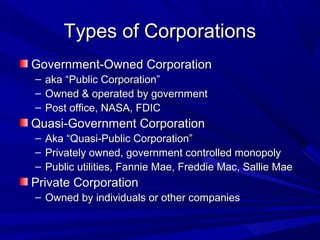
Types of Corporations
Government-Owned Corporation
–   aka “Public Corporation”
–   Owned & operated by government
–   Post office, NASA, FDIC
Quasi-Government Corporation
–   Aka “Quasi-Public Corporation”
–   Privately owned, government controlled monopoly
–   Public utilities, Fannie Mae, Freddie Mac, Sallie Mae
Private Corporation
– Owned by individuals or other companies
Types of Corporations
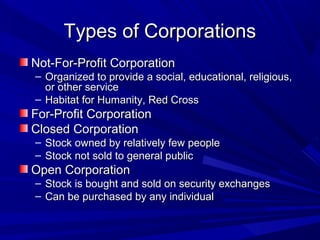
Not-For-Profit Corporation
– Organized to provide a social, educational, religious,
  or other service
– Habitat for Humanity, Red Cross
For-Profit Corporation
Closed Corporation
– Stock owned by relatively few people
– Stock not sold to general public
Open Corporation
– Stock is bought and sold on security exchanges
– Can be purchased by any individual
Types of Corporations
S-Corporation (Subchapter-S Corporation)
– Corporate structure designed for small business
– Taxed as a partnership if there are 75 or fewer
  stockholders
– No non-resident alien stockholders
– Only one class of stock
Limited-Liability Company (LLC)
– Combines the benefits of a corporation & partnership
– Not limited to 75 stockholders
Mergers & Acquisitions
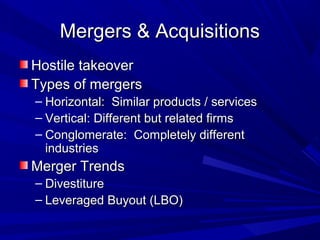
Hostile takeover
Types of mergers
– Horizontal: Similar products / services
– Vertical: Different but related firms
– Conglomerate: Completely different
  industries
Merger Trends
– Divestiture
– Leveraged Buyout (LBO)
Franchising
Franchise
– License to operate an individually owned
  business as though it were part of a chain of
  outlets or stores
– The business itself
Franchising
– Actual granting of a franchise
Franchising
Franchisor
–   Supplies a known & advertised business name
–   Supplies management skills
–   Supplies training & materials
–   Supplies method of doing business
Franchisee:
–   Supplies labor & capital
–   Operates the franchised business
–   Agrees to abide by the franchise agreement
Franchising Advantages
Franchisor
– Fast, Selective Distribution
– Motivated Franchisee
Franchisee
– Opportunity to start a business
– Business Experience of others
– Nationally recognized name
– National promotional campaigns
Franchising Disadvantages
Mainly from Franchisee’s Viewpoint:
– Franchisor’s contract can dictate every aspect
  of the business
– Pay for security
– Long hours
– Competition from same company

Business organizations

  • 1.
    Forms of Business Organization Chapters 18 & 19
  • 2.
    Legal Forms of Business Sole Proprietorships Partnerships Corporations General Partnership Regular Corporation Subchapter S Limited Partnership Corporation (S-Corporation) Master Limited Partnership
  • 3.
    Sole Proprietorships Business owned(and usually operated) by one person Simplest form of business ownership Most popular form of business organization – 72.2% of all Most common in: – Retailing – Service – Agriculture
  • 4.
    Sole Proprietorship --Advantages Ease of Startup – Little legal documentation – No co-owners to consult Least expensive to start Pride of Ownership Retention of profits Flexibility No Business Income Tax
  • 5.
    Sole Proprietorship -- Disadvantages Unlimited Liability Limited Life – Business ends when owner leaves the business Limited Access to Start-up Capital Limited Access to Credit Limited Management Expertise Difficulty in Hiring Employees Proprietor not considered an employee
  • 6.
    Partnerships Two or moreowners Least numerous form – 7.7% of all businesses Partnership Agreement – Specifies rights and obligations of partners – If written, called the Articles of Partnership (Articles of Co-partnership)
  • 7.
    Partnership -- Advantages GreaterAccess to Capital Greater Access to Credit Retention of Profits More Management Expertise No Business Income Tax
  • 8.
    Partnership -- Disadvantages SharedProfits Unlimited Liability for “General Partners” Each partner has “Agency” power Limited Life – Business ends when any partner withdraws Management Disagreements Frozen Investment
  • 9.
    Types of Partners GeneralPartner – Unlimited Liability – Assumes Management Role Limited Partner – Liability limited to Investment – May not take active managerial role Every partnership must have at least one general partner
  • 10.
    Types of Partners GeneralPartnership – All partners are general partners Limited Partnership – One or more limited partners Master Limited Partnership – Owned & managed like a corporation – Taxed like a partnership – Shares may be sold
  • 11.
    Corporations Generally larger thanother forms (Except for S- Corporation) – 20.1% of all U.S. Businesses – Account for 87.1% of all U.S. Business Income Considered a separate legal entity – Owners called “Stockholders” or Shareholders” Ownership evidenced by “Stock Certificate” Governed by “Board of Directors”
  • 12.
    Corporations -- Advantages LimitedLiability Ease of Ownership Transfer Unlimited Life Greater Access to Capital Specialized Management Expertise
  • 13.
    Corporations -- Disadvantages Moredifficult & costly to form – Requires a “Corporate Charter” Subject to greater governmental scrutiny Diluted earnings Double taxation
  • 14.
    Corporations vs. Sole Proprietorships SP Corp Income $1,000,000 $1,000,000 Expenses 500,000 500,000 EBT $500,000 $500,000 (Assume Business Tax Rate = 50%) Business Tax 0 250,000 Net Profit $500,000 $250,000 (Assume a 30% Personal Tax Rate) Personal Tax 150,000 75,000 $ to Owners $350,000 $175,000
  • 15.
    Corporate Charter Legal Permissionto Operate as a Corporation Issued by state May not conduct business as a corporation without a charter
  • 16.
    Contents of aCorporate Charter Company Name & Address Names & addresses of Incorporators Purpose of the Corporation Maximum amount of stock & Classes of Stock to be issued Rights & Privileges of stockholders Length of time the corporation is to exist
  • 17.
    Stockholder Rights Common Stock –Votes in corporate matters – One vote per share owned Preferred Stock – No voting rights – Dividend claims are paid 1st Dividend – Distribution of earnings to the stockholders of a corporation
  • 18.
    Organizational Chart Owners/ Stockholders/ Shareholders Chief Executive Officer (CEO) Board of Directors President Senior Vice President Vice President Vice President Vice President Vice President Finance Production Marketing Human Resources
  • 19.
    Types of Corporations Government-OwnedCorporation – aka “Public Corporation” – Owned & operated by government – Post office, NASA, FDIC Quasi-Government Corporation – Aka “Quasi-Public Corporation” – Privately owned, government controlled monopoly – Public utilities, Fannie Mae, Freddie Mac, Sallie Mae Private Corporation – Owned by individuals or other companies
  • 20.
    Types of Corporations Not-For-ProfitCorporation – Organized to provide a social, educational, religious, or other service – Habitat for Humanity, Red Cross For-Profit Corporation Closed Corporation – Stock owned by relatively few people – Stock not sold to general public Open Corporation – Stock is bought and sold on security exchanges – Can be purchased by any individual
  • 21.
    Types of Corporations S-Corporation(Subchapter-S Corporation) – Corporate structure designed for small business – Taxed as a partnership if there are 75 or fewer stockholders – No non-resident alien stockholders – Only one class of stock Limited-Liability Company (LLC) – Combines the benefits of a corporation & partnership – Not limited to 75 stockholders
  • 22.
    Mergers & Acquisitions Hostiletakeover Types of mergers – Horizontal: Similar products / services – Vertical: Different but related firms – Conglomerate: Completely different industries Merger Trends – Divestiture – Leveraged Buyout (LBO)
  • 23.
    Franchising Franchise – License tooperate an individually owned business as though it were part of a chain of outlets or stores – The business itself Franchising – Actual granting of a franchise
  • 24.
    Franchising Franchisor – Supplies a known & advertised business name – Supplies management skills – Supplies training & materials – Supplies method of doing business Franchisee: – Supplies labor & capital – Operates the franchised business – Agrees to abide by the franchise agreement
  • 25.
    Franchising Advantages Franchisor – Fast,Selective Distribution – Motivated Franchisee Franchisee – Opportunity to start a business – Business Experience of others – Nationally recognized name – National promotional campaigns
  • 26.
    Franchising Disadvantages Mainly fromFranchisee’s Viewpoint: – Franchisor’s contract can dictate every aspect of the business – Pay for security – Long hours – Competition from same company