Harward Sheth Model
Course:2nd Semister(M.Com)
Subject: Business Marketing
Presentation by :Syed Salman
& MD Attaullah Shariff
• Jagdesh N Sheth (born 1938) is the professor of marketing at the
Goizueta Business School of Emorh University.
• He is the member of the American Psycological Association and
founder of centre for relationship management at Emory
University and cente for telecommunications management at
University of Southern California
• In 1973, Professor Jagdish N Sheth developed the Sheth model of
Organizational Buying. This model highlights the decision-making
by two or more individuals jointly, and the psychological aspects
of the decision-making individuals in the
industrial buying behavior .
Harward Sheth Model
• The model attempts to throw light on the ‘Rational Brand
Behaviour’ shown by the buyers.
Involving situations such as:
(1) Incomplete Information of market.
(2) Limited individual capacities and abilities.
• RATIONAL BRAND BEHAVIOUR :is what the person shows while
making a choice logically & through logical reasoning.
3 Levels of decision making
• Extensive Problem Solving:
1. It is an eary stage of decision making.
2. Here the buyer has Less knowledge and Limited information
about the product.
3. Here the consumer selects the product with limited information
and less knowledge.
• Limited problem solving:
1. It is an advance stage of decision making where the buyer has
good market knowledge and product information.
2. Choice criteria is defined (where the buyer with great knowledge
of products selects the best product in the market)
3. Here the buyer is undicided about the brand example. There are
may good branded soaps available in a shop where the buyer has
to select a best brand out of all good options.
• Routinized response behaviour:
1. The choice criteria is well defined (where the buyer has strong
positioning of the particular brand )
2. Strong positioning towards one brand.
3. Little evaluation of alternatives by the buyer because of strong
brand (Positioned) or selected
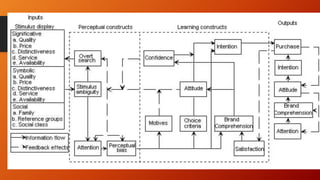
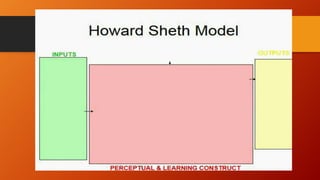
Parts of the harwad sheth model also
reffered to set of concepts or variables
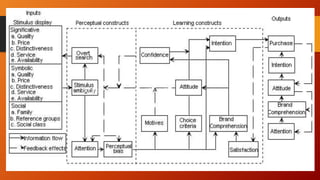
1. Input
2. Output
3. Hypothetical construct
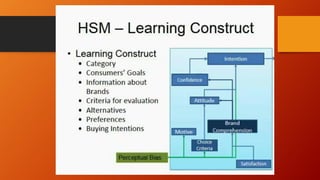
• Perceptual construct
• Learning construct
https://youtu.be/zXooX8rsHXQ
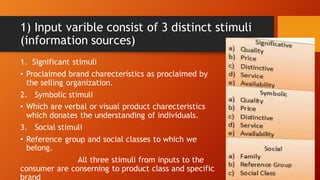
1) Input varible consist of 3 distinct stimuli
(information sources)
1. Significant stimuli
• Proclaimed brand charecteristics as proclaimed by
the selling organization.
2. Symbolic stimuli
• Which are verbal or visual product charecteristics
which donates the understanding of individuals.
3. Social stimuli
• Reference group and social classes to which we
belong.
All three stimuli from inputs to the
consumer are conserning to product class and specific
brand
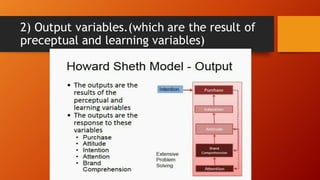
2) Output variables.(which are the result of
preceptual and learning variables)
3) Hypothetical Construct
• It is the central part of the model conserned with the consumers
decision contemplation .
• Deals with Psycological variables.
• It consists of two parts namely :
1. Perceptual construct &
2. Learning construct
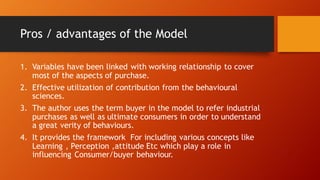
Pros / advantages of the Model
1. Variables have been linked with working relationship to cover
most of the aspects of purchase.
2. Effective utilization of contribution from the behavioural
sciences.
3. The author uses the term buyer in the model to refer industrial
purchases as well as ultimate consumers in order to understand
a great verity of behaviours.
4. It provides the framework For including various concepts like
Learning , Perception ,attitude Etc which play a role in
influencing Consumer/buyer behaviour.
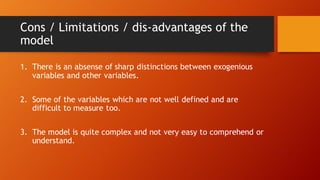
Cons / Limitations / dis-advantages of the
model
1. There is an absense of sharp distinctions between exogenious
variables and other variables.
2. Some of the variables which are not well defined and are
difficult to measure too.
3. The model is quite complex and not very easy to comprehend or
understand.
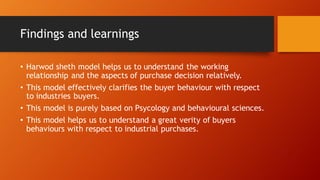
Findings and learnings
• Harwod sheth model helps us to understand the working
relationship and the aspects of purchase decision relatively.
• This model effectively clarifies the buyer behaviour with respect
to industries buyers.
• This model is purely based on Psycology and behavioural sciences.
• This model helps us to understand a great verity of buyers
behaviours with respect to industrial purchases.
Thank You

Harward sheth model

  • 1.
    Harward Sheth Model Course:2ndSemister(M.Com) Subject: Business Marketing Presentation by :Syed Salman & MD Attaullah Shariff
  • 2.
    • Jagdesh NSheth (born 1938) is the professor of marketing at the Goizueta Business School of Emorh University. • He is the member of the American Psycological Association and founder of centre for relationship management at Emory University and cente for telecommunications management at University of Southern California • In 1973, Professor Jagdish N Sheth developed the Sheth model of Organizational Buying. This model highlights the decision-making by two or more individuals jointly, and the psychological aspects of the decision-making individuals in the industrial buying behavior .
  • 4.
    Harward Sheth Model •The model attempts to throw light on the ‘Rational Brand Behaviour’ shown by the buyers. Involving situations such as: (1) Incomplete Information of market. (2) Limited individual capacities and abilities. • RATIONAL BRAND BEHAVIOUR :is what the person shows while making a choice logically & through logical reasoning.
  • 5.
    3 Levels ofdecision making • Extensive Problem Solving: 1. It is an eary stage of decision making. 2. Here the buyer has Less knowledge and Limited information about the product. 3. Here the consumer selects the product with limited information and less knowledge.
  • 6.
    • Limited problemsolving: 1. It is an advance stage of decision making where the buyer has good market knowledge and product information. 2. Choice criteria is defined (where the buyer with great knowledge of products selects the best product in the market) 3. Here the buyer is undicided about the brand example. There are may good branded soaps available in a shop where the buyer has to select a best brand out of all good options.
  • 7.
    • Routinized responsebehaviour: 1. The choice criteria is well defined (where the buyer has strong positioning of the particular brand ) 2. Strong positioning towards one brand. 3. Little evaluation of alternatives by the buyer because of strong brand (Positioned) or selected
  • 8.
    Parts of theharwad sheth model also reffered to set of concepts or variables 1. Input 2. Output 3. Hypothetical construct • Perceptual construct • Learning construct
  • 10.
  • 11.
    1) Input varibleconsist of 3 distinct stimuli (information sources) 1. Significant stimuli • Proclaimed brand charecteristics as proclaimed by the selling organization. 2. Symbolic stimuli • Which are verbal or visual product charecteristics which donates the understanding of individuals. 3. Social stimuli • Reference group and social classes to which we belong. All three stimuli from inputs to the consumer are conserning to product class and specific brand
  • 12.
    2) Output variables.(whichare the result of preceptual and learning variables)
  • 13.
    3) Hypothetical Construct •It is the central part of the model conserned with the consumers decision contemplation . • Deals with Psycological variables. • It consists of two parts namely : 1. Perceptual construct & 2. Learning construct
  • 16.
    Pros / advantagesof the Model 1. Variables have been linked with working relationship to cover most of the aspects of purchase. 2. Effective utilization of contribution from the behavioural sciences. 3. The author uses the term buyer in the model to refer industrial purchases as well as ultimate consumers in order to understand a great verity of behaviours. 4. It provides the framework For including various concepts like Learning , Perception ,attitude Etc which play a role in influencing Consumer/buyer behaviour.
  • 17.
    Cons / Limitations/ dis-advantages of the model 1. There is an absense of sharp distinctions between exogenious variables and other variables. 2. Some of the variables which are not well defined and are difficult to measure too. 3. The model is quite complex and not very easy to comprehend or understand.
  • 18.
    Findings and learnings •Harwod sheth model helps us to understand the working relationship and the aspects of purchase decision relatively. • This model effectively clarifies the buyer behaviour with respect to industries buyers. • This model is purely based on Psycology and behavioural sciences. • This model helps us to understand a great verity of buyers behaviours with respect to industrial purchases.
  • 19.