PERSPECTIVE ON
CUSTOMER BEHAVIOR
Learning Objectives:
oDiscuss why an understanding of consumer behavior is valuable
in developing advertising and promotional programs.
oDescribe the steps in the consumer decision-making process.
oExplain the influence on consumer behavior of psychological
processes like perception and motivation.
oDiscuss behavioral learning theory and cognitive learning
theory.
o Explain the influence of external factors like culture and
subculture influences.
Consumer behavior can be defined as the process and activities
people engage in when searching for, selecting, purchasing,
using, evaluating, and disposing of products and services to
satisfy their needs and desires.
Consumer behavior is all about how people behave when they
live as consumers. Such a behavior is of a complex nature that
involves the way people think, feel, and act as consumers
So, It is important to understand that this definition shows that
consumer behavior is dynamic – it is constantly changing.
Consumer behavior also involves interactions of people’s
thoughts, feelings and actions, and it also involves exchanges
between human beings, especially between buyers and sellers.
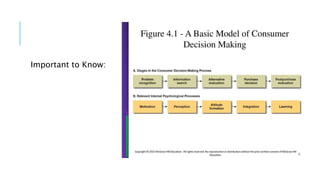
Important to Know:
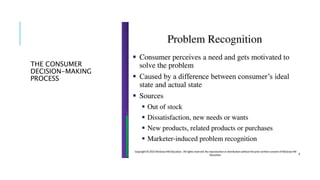
THE CONSUMER
DECISION-MAKING
PROCESS
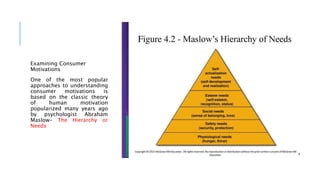
Examining Consumer
Motivations
One of the most popular
approaches to understanding
consumer motivations is
based on the classic theory
of human motivation
popularized many years ago
by psychologist Abraham
Maslow– The Hierarchy or
Needs
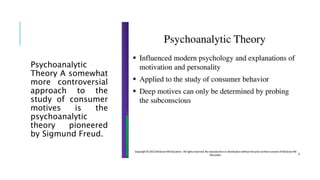
Psychoanalytic
Theory A somewhat
more controversial
approach to the
study of consumer
motives is the
psychoanalytic
theory pioneered
by Sigmund Freud.
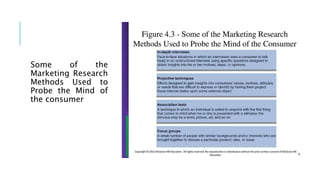
Some of the
Marketing Research
Methods Used to
Probe the Mind of
the consumer
Information Search -- >The second stage in the consumer decision-making
process is information search.
Internal search - The initial search effort often consists of an attempt to scan
information stored in memory to recall past experiences and/or knowledge
regarding various purchase alternatives.
External sources of information include:
• Internet sources, such as organic and sponsored information available
through companies’ websites, consumer postings, and organizations
postings
• Personal sources, such as friends, relatives, or co-workers.
•Marketer-controlled (commercial) sources, such as information from
advertising, salespeople, or point-of-purchase displays and
packaging.
•Public sources, including articles in magazines or newspapers and
reports on TV and so on.
•Personal experience, such as actually handling, examining, or testing
the product.
Perception  Knowledge of how consumers acquire and use
information from external sources is important to marketers in
formulating communication strategies. Marketers are particularly
interested in:
(1) how consumers sense external information,
(2) how they select and attend to various sources of information, and
(3) how this information is interpreted and given meaning.
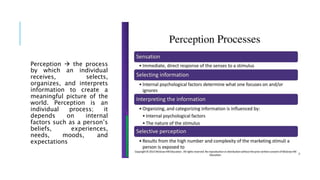
Perception  the process
by which an individual
receives, selects,
organizes, and interprets
information to create a
meaningful picture of the
world. Perception is an
individual process; it
depends on internal
factors such as a person’s
beliefs, experiences,
needs, moods, and
expectations
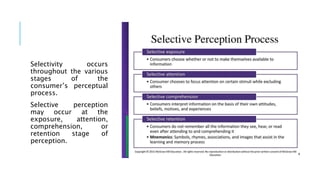
Selectivity occurs
throughout the various
stages of the
consumer’s perceptual
process.
Selective perception
may occur at the
exposure, attention,
comprehension, or
retention stage of
perception.
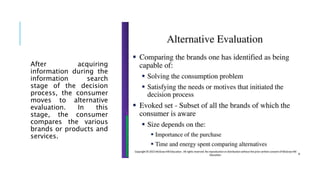
After acquiring
information during the
information search
stage of the decision
process, the consumer
moves to alternative
evaluation. In this
stage, the consumer
compares the various
brands or products and
services.
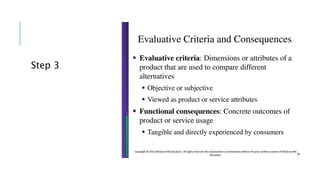
Step 3.
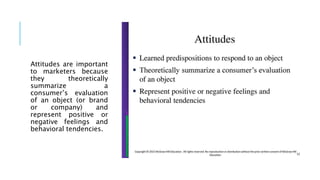
Attitudes are important
to marketers because
they theoretically
summarize a
consumer’s evaluation
of an object (or brand
or company) and
represent positive or
negative feelings and
behavioral tendencies.
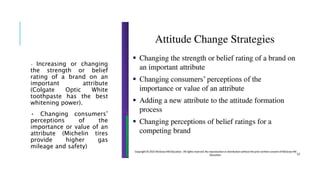
• Increasing or changing
the strength or belief
rating of a brand on an
important attribute
(Colgate Optic White
toothpaste has the best
whitening power).
• Changing consumers’
perceptions of the
importance or value of an
attribute (Michelin tires
provide higher gas
mileage and safety)
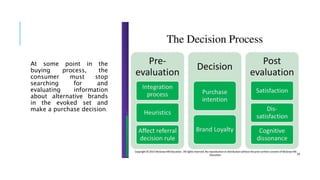
At some point in the
buying process, the
consumer must stop
searching for and
evaluating information
about alternative brands
in the evoked set and
make a purchase decision.
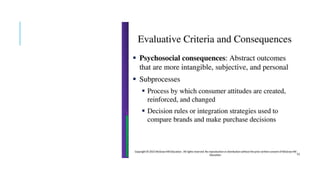
Integration processes are the way product knowledge, meanings, and
beliefs are combined to evaluate two or more alternatives.
Heuristics - Sometimes consumers make their purchase decisions
using more simplified decision rules known as heuristics. For familiar
products that are purchased frequently, consumers may use price-
based heuristics (buy the least expensive brand) or promotion-based
heuristics (choose the brand for which I can get a price reduction
through a coupon, rebate, or special deal).
The affect referral decision rule, in which consumers make a selection
on the basis of an overall impression or summary evaluation of the
various alternatives under consideration.
THE CONSUMER LEARNING
PROCESS
Consumer learning has been defined as “the process by which
individuals acquire the purchase and consumption knowledge and
experience they apply to future related behavior.
Two basic approaches to learning are the behavioral approach and
cognitive learning theory.
Behavioral Learning -> theories emphasize the role of external,
environmental stimuli in causing behavior; they minimize the
significance of internal psychological processes.
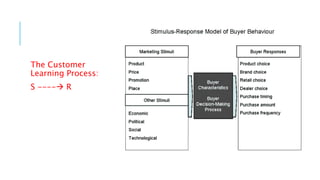
Behavioral learning theories are based on the stimulus–response
orientation (S–R), the premise that learning occurs as the result of
responses to external stimuli in the environment.
The Customer
Learning Process:
S ---- R
Classical Conditioning
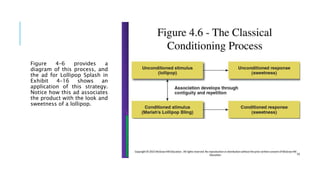
Classical conditioning assumes that learning is an associative process
with an already existing relationship between a stimulus and a
response.
Probably the best-known example of this type of learning comes
from the studies done with animals by the Russian psychologist
Pavlov
Figure 4–6 provides a
diagram of this process, and
the ad for Lollipop Splash in
Exhibit 4–16 shows an
application of this strategy.
Notice how this ad associates
the product with the look and
sweetness of a lollipop.
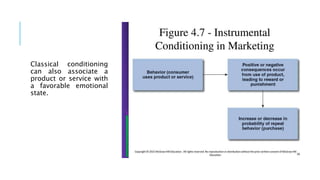
Classical conditioning
can also associate a
product or service with
a favorable emotional
state.
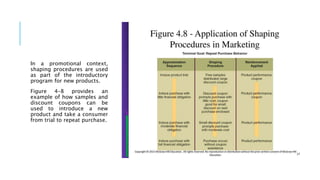
In a promotional context,
shaping procedures are used
as part of the introductory
program for new products.
Figure 4–8 provides an
example of how samples and
discount coupons can be
used to introduce a new
product and take a consumer
from trial to repeat purchase.
Cognitive Learning Theory
Behavioral learning theories have been criticized for assuming a
mechanistic view of the consumer that puts too much emphasis on
external stimulus factors. They ignore internal psychological
processes such as motivation, thinking, and perception; they assume
that the external stimulus environment will elicit fairly predictable
responses.
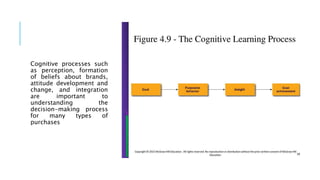
Cognitive processes such
as perception, formation
of beliefs about brands,
attitude development and
change, and integration
are important to
understanding the
decision-making process
for many types of
purchases
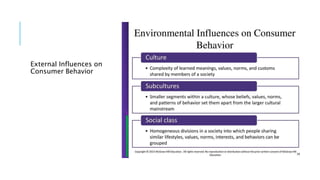
External Influences on
Consumer Behavior
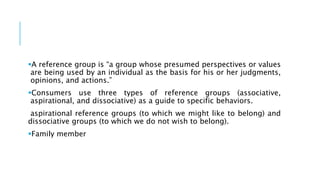
A reference group is “a group whose presumed perspectives or values
are being used by an individual as the basis for his or her judgments,
opinions, and actions.”
Consumers use three types of reference groups (associative,
aspirational, and dissociative) as a guide to specific behaviors.
aspirational reference groups (to which we might like to belong) and
dissociative groups (to which we do not wish to belong).
Family member
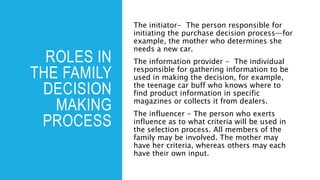
ROLES IN
THE FAMILY
DECISION
MAKING
PROCESS
The initiator- The person responsible for
initiating the purchase decision process—for
example, the mother who determines she
needs a new car.
The information provider - The individual
responsible for gathering information to be
used in making the decision, for example,
the teenage car buff who knows where to
find product information in specific
magazines or collects it from dealers.
The influencer - The person who exerts
influence as to what criteria will be used in
the selection process. All members of the
family may be involved. The mother may
have her criteria, whereas others may each
have their own input.
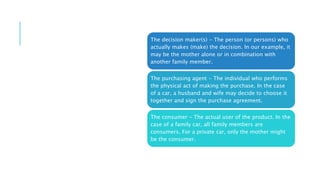
The decision maker(s) - The person (or persons) who
actually makes (make) the decision. In our example, it
may be the mother alone or in combination with
another family member.
The purchasing agent - The individual who performs
the physical act of making the purchase. In the case
of a car, a husband and wife may decide to choose it
together and sign the purchase agreement.
The consumer - The actual user of the product. In the
case of a family car, all family members are
consumers. For a private car, only the mother might
be the consumer.

Perspective on Customer Behaviourrr.pptx

  • 1.
    PERSPECTIVE ON CUSTOMER BEHAVIOR LearningObjectives: oDiscuss why an understanding of consumer behavior is valuable in developing advertising and promotional programs. oDescribe the steps in the consumer decision-making process. oExplain the influence on consumer behavior of psychological processes like perception and motivation. oDiscuss behavioral learning theory and cognitive learning theory. o Explain the influence of external factors like culture and subculture influences.
  • 2.
    Consumer behavior canbe defined as the process and activities people engage in when searching for, selecting, purchasing, using, evaluating, and disposing of products and services to satisfy their needs and desires. Consumer behavior is all about how people behave when they live as consumers. Such a behavior is of a complex nature that involves the way people think, feel, and act as consumers
  • 3.
    So, It isimportant to understand that this definition shows that consumer behavior is dynamic – it is constantly changing. Consumer behavior also involves interactions of people’s thoughts, feelings and actions, and it also involves exchanges between human beings, especially between buyers and sellers.
  • 4.
  • 5.
  • 6.
    Examining Consumer Motivations One ofthe most popular approaches to understanding consumer motivations is based on the classic theory of human motivation popularized many years ago by psychologist Abraham Maslow– The Hierarchy or Needs
  • 7.
    Psychoanalytic Theory A somewhat morecontroversial approach to the study of consumer motives is the psychoanalytic theory pioneered by Sigmund Freud.
  • 8.
    Some of the MarketingResearch Methods Used to Probe the Mind of the consumer
  • 9.
    Information Search -->The second stage in the consumer decision-making process is information search. Internal search - The initial search effort often consists of an attempt to scan information stored in memory to recall past experiences and/or knowledge regarding various purchase alternatives. External sources of information include: • Internet sources, such as organic and sponsored information available through companies’ websites, consumer postings, and organizations postings • Personal sources, such as friends, relatives, or co-workers.
  • 10.
    •Marketer-controlled (commercial) sources,such as information from advertising, salespeople, or point-of-purchase displays and packaging. •Public sources, including articles in magazines or newspapers and reports on TV and so on. •Personal experience, such as actually handling, examining, or testing the product.
  • 11.
    Perception  Knowledgeof how consumers acquire and use information from external sources is important to marketers in formulating communication strategies. Marketers are particularly interested in: (1) how consumers sense external information, (2) how they select and attend to various sources of information, and (3) how this information is interpreted and given meaning.
  • 12.
    Perception  theprocess by which an individual receives, selects, organizes, and interprets information to create a meaningful picture of the world. Perception is an individual process; it depends on internal factors such as a person’s beliefs, experiences, needs, moods, and expectations
  • 13.
    Selectivity occurs throughout thevarious stages of the consumer’s perceptual process. Selective perception may occur at the exposure, attention, comprehension, or retention stage of perception.
  • 14.
    After acquiring information duringthe information search stage of the decision process, the consumer moves to alternative evaluation. In this stage, the consumer compares the various brands or products and services.
  • 15.
  • 17.
    Attitudes are important tomarketers because they theoretically summarize a consumer’s evaluation of an object (or brand or company) and represent positive or negative feelings and behavioral tendencies.
  • 18.
    • Increasing orchanging the strength or belief rating of a brand on an important attribute (Colgate Optic White toothpaste has the best whitening power). • Changing consumers’ perceptions of the importance or value of an attribute (Michelin tires provide higher gas mileage and safety)
  • 19.
    At some pointin the buying process, the consumer must stop searching for and evaluating information about alternative brands in the evoked set and make a purchase decision.
  • 20.
    Integration processes arethe way product knowledge, meanings, and beliefs are combined to evaluate two or more alternatives. Heuristics - Sometimes consumers make their purchase decisions using more simplified decision rules known as heuristics. For familiar products that are purchased frequently, consumers may use price- based heuristics (buy the least expensive brand) or promotion-based heuristics (choose the brand for which I can get a price reduction through a coupon, rebate, or special deal). The affect referral decision rule, in which consumers make a selection on the basis of an overall impression or summary evaluation of the various alternatives under consideration.
  • 21.
    THE CONSUMER LEARNING PROCESS Consumerlearning has been defined as “the process by which individuals acquire the purchase and consumption knowledge and experience they apply to future related behavior. Two basic approaches to learning are the behavioral approach and cognitive learning theory.
  • 22.
    Behavioral Learning ->theories emphasize the role of external, environmental stimuli in causing behavior; they minimize the significance of internal psychological processes. Behavioral learning theories are based on the stimulus–response orientation (S–R), the premise that learning occurs as the result of responses to external stimuli in the environment.
  • 23.
  • 24.
    Classical Conditioning Classical conditioningassumes that learning is an associative process with an already existing relationship between a stimulus and a response. Probably the best-known example of this type of learning comes from the studies done with animals by the Russian psychologist Pavlov
  • 25.
    Figure 4–6 providesa diagram of this process, and the ad for Lollipop Splash in Exhibit 4–16 shows an application of this strategy. Notice how this ad associates the product with the look and sweetness of a lollipop.
  • 26.
    Classical conditioning can alsoassociate a product or service with a favorable emotional state.
  • 27.
    In a promotionalcontext, shaping procedures are used as part of the introductory program for new products. Figure 4–8 provides an example of how samples and discount coupons can be used to introduce a new product and take a consumer from trial to repeat purchase.
  • 28.
    Cognitive Learning Theory Behaviorallearning theories have been criticized for assuming a mechanistic view of the consumer that puts too much emphasis on external stimulus factors. They ignore internal psychological processes such as motivation, thinking, and perception; they assume that the external stimulus environment will elicit fairly predictable responses.
  • 29.
    Cognitive processes such asperception, formation of beliefs about brands, attitude development and change, and integration are important to understanding the decision-making process for many types of purchases
  • 30.
  • 31.
    A reference groupis “a group whose presumed perspectives or values are being used by an individual as the basis for his or her judgments, opinions, and actions.” Consumers use three types of reference groups (associative, aspirational, and dissociative) as a guide to specific behaviors. aspirational reference groups (to which we might like to belong) and dissociative groups (to which we do not wish to belong). Family member
  • 32.
    ROLES IN THE FAMILY DECISION MAKING PROCESS Theinitiator- The person responsible for initiating the purchase decision process—for example, the mother who determines she needs a new car. The information provider - The individual responsible for gathering information to be used in making the decision, for example, the teenage car buff who knows where to find product information in specific magazines or collects it from dealers. The influencer - The person who exerts influence as to what criteria will be used in the selection process. All members of the family may be involved. The mother may have her criteria, whereas others may each have their own input.
  • 33.
    The decision maker(s)- The person (or persons) who actually makes (make) the decision. In our example, it may be the mother alone or in combination with another family member. The purchasing agent - The individual who performs the physical act of making the purchase. In the case of a car, a husband and wife may decide to choose it together and sign the purchase agreement. The consumer - The actual user of the product. In the case of a family car, all family members are consumers. For a private car, only the mother might be the consumer.