Consumer and Innovation
Trends in Milk 2013
Fresh and ambient liquid milk, concentrated milk, powdered
milk, and milk-based beverages
Category series. Published October 2013
Consumer Insight
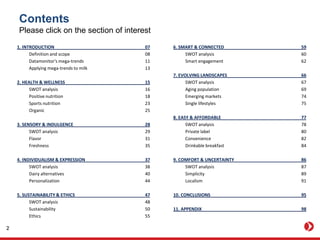
Contents
Please click on the section of interest
1. INTRODUCTION 07
Definition and scope 08
Datamonitor's mega-trends 11
Applying mega-trends to milk 13
2. HEALTH & WELLNESS 15
SWOT analysis 16
Positive nutrition 18
Sports nutrition 23
Organic 25
3. SENSORY & INDULGENCE 28
SWOT analysis 29
Flavor 31
Freshness 35
4. INDIVIDUALISM & EXPRESSION 37
SWOT analysis 38
Dairy alternatives 40
Personalization 44
5. SUSTAINABILITY & ETHICS 47
SWOT analysis 48
Sustainability 50
Ethics 55
6. SMART & CONNECTED 59
SWOT analysis 60
Smart engagement 62
7. EVOLVING LANDSCAPES 66
SWOT analysis 67
Aging population 69
Emerging markets 74
Single lifestyles 75
8. EASY & AFFORDABLE 77
SWOT analysis 78
Private label 80
Convenience 82
Drinkable breakfast 84
9. COMFORT & UNCERTAINTY 86
SWOT analysis 87
Simplicity 89
Localism 91
10. CONCLUSIONS 95
11. APPENDIX 98
2
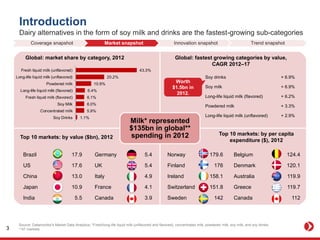
Introduction
Dairy alternatives in the form of soy milk and drinks are the fastest-growing sub-categories
Milk* represented
$135bn in global**
spending in 2012
Source: Datamonitor's Market Data Analytics; *Fresh/long-life liquid milk (unflavored and flavored), concentrated milk, powdered milk, soy milk, and soy drinks;
**47 markets
Top 10 markets: by value ($bn), 2012
Top 10 markets: by per capita
expenditure ($), 2012
Global: market share by category, 2012 Global: fastest growing categories by value,
CAGR 2012–17
Soy drinks + 6.9%
Soy milk + 6.9%
Long-life liquid milk (flavored) + 6.2%
Powdered milk + 3.3%
Long-life liquid milk (unflavored) + 2.9%
Brazil 17.9 Germany 5.4
US 17.6 UK 5.4
China 13.0 Italy 4.9
Japan 10.9 France 4.1
India 5.5 Canada 3.9
Norway 179.6 Belgium 124.4
Finland 176 Denmark 120.1
Ireland 158.1 Australia 119.9
Switzerland 151.8 Greece 119.7
Sweden 142 Canada 112
Worth
$1.5bn in
2012.
43.3%
20.2%
10.9%
6.4%
6.1%
6.0%
5.9%
1.1%
Fresh liquid milk (unflavored)
Long-life liquid milk (unflavored)
Powdered milk
Long-life liquid milk (flavored)
Fresh liquid milk (flavored)
Soy Milk
Concentrated milk
Soy Drinks
Coverage snapshot Market snapshot Innovation snapshot Trend snapshot
3
Health & Wellness
Organic innovation remains slow in the milk sector
PRICE IS A MAJOR BARRIER TO ORGANIC CONSUMPTION
Product development in organic milk has increased since 2008, but at
a very slow rate. In 2008, 10% of new milk launches were organic,
compared to 12% in 2012. Lack of innovation can be attributed to
reluctance by consumers to pay a premium for organic products,
particularly in a category characterized by habit and convenience.
More than half of dairy consumers cite "too expensive" as a major
drawback to organic products. The challenge for organic milk
producers is to convince consumers it is worth paying more for by
finding ways to add value. ShopRite organic rice milk (US), for
example, is enriched with vitamins and calcium for added health
benefits.
0%
2%
4%
6%
8%
10%
12%
14%
2008 2009 2010 2011 2012
Nature's Promise organic 2%
milk
US
ShopRite original organic rice
milk
US
Global: new milk products tagged "organic," as a
proportion of all new milk launches, 2008–12
Source: [1] Supermarket News, January 2012; Datamonitor's Product Launch Analytics
Global: dairy consumers who consider the following to be
major drawbacks of organic products, 2013
Overview Positive nutrition Low fat Sports nutrition Organic
4
Sustainability & Ethics
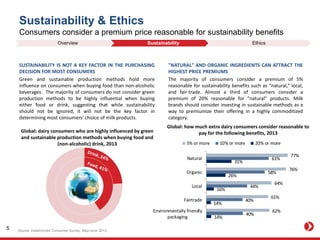
Consumers consider a premium price reasonable for sustainability benefits
SUSTAINABILITY IS NOT A KEY FACTOR IN THE PURCHASING
DECISION FOR MOST CONSUMERS
Green and sustainable production methods hold more
influence on consumers when buying food than non-alcoholic
beverages. The majority of consumers do not consider green
production methods to be highly influential when buying
either food or drink, suggesting that while sustainability
should not be ignored, it will not be the key factor in
determining most consumers' choice of milk products.
Source: Datamonitor Consumer Survey, May/June 2013
Global: dairy consumers who are highly influenced by green
and sustainable production methods when buying food and
(non-alcoholic) drink, 2013
Global: how much extra dairy consumers consider reasonable to
pay for the following benefits, 2013
77%
76%
64%
61%
62%
61%
58%
44%
40%
40%
31%
26%
16%
14%
14%
Natural
Organic
Local
Fairtrade
Environmentally friendly
packaging
5% or more 10% or more 20% or more
"NATURAL" AND ORGANIC INGREDIENTS CAN ATTRACT THE
HIGHEST PRICE PREMIUMS
The majority of consumers consider a premium of 5%
reasonable for sustainability benefits such as "natural," local,
and fair-trade. Almost a third of consumers consider a
premium of 20% reasonable for "natural" products. Milk
brands should consider investing in sustainable methods as a
way to premiumize their offering in a highly commoditized
category.
Overview Sustainability Ethics
5
Evolving Landscapes
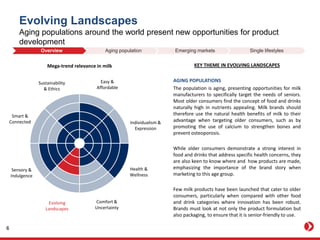
Aging populations around the world present new opportunities for product
development
KEY THEME IN EVOLVING LANDSCAPES
AGING POPULATIONS
The population is aging, presenting opportunities for milk
manufacturers to specifically target the needs of seniors.
Most older consumers find the concept of food and drinks
naturally high in nutrients appealing. Milk brands should
therefore use the natural health benefits of milk to their
advantage when targeting older consumers, such as by
promoting the use of calcium to strengthen bones and
prevent osteoporosis.
While older consumers demonstrate a strong interest in
food and drinks that address specific health concerns, they
are also keen to know where and how products are made,
emphasizing the importance of the brand story when
marketing to this age group.
Few milk products have been launched that cater to older
consumers, particularly when compared with other food
and drink categories where innovation has been robust.
Brands must look at not only the product formulation but
also packaging, to ensure that it is senior-friendly to use.
Mega-trend relevance in milk
Easy &
Affordable
Individualism &
Expression
Health &
Wellness
Comfort &
Uncertainty
Evolving
Landscapes
Sensory &
Indulgence
Smart &
Connected
Sustainability
& Ethics
Overview Aging population Emerging markets Single lifestyles
6

Consumer and Innovation Trends in Milk

  • 1.
    Consumer and Innovation Trendsin Milk 2013 Fresh and ambient liquid milk, concentrated milk, powdered milk, and milk-based beverages Category series. Published October 2013 Consumer Insight
  • 2.
    Contents Please click onthe section of interest 1. INTRODUCTION 07 Definition and scope 08 Datamonitor's mega-trends 11 Applying mega-trends to milk 13 2. HEALTH & WELLNESS 15 SWOT analysis 16 Positive nutrition 18 Sports nutrition 23 Organic 25 3. SENSORY & INDULGENCE 28 SWOT analysis 29 Flavor 31 Freshness 35 4. INDIVIDUALISM & EXPRESSION 37 SWOT analysis 38 Dairy alternatives 40 Personalization 44 5. SUSTAINABILITY & ETHICS 47 SWOT analysis 48 Sustainability 50 Ethics 55 6. SMART & CONNECTED 59 SWOT analysis 60 Smart engagement 62 7. EVOLVING LANDSCAPES 66 SWOT analysis 67 Aging population 69 Emerging markets 74 Single lifestyles 75 8. EASY & AFFORDABLE 77 SWOT analysis 78 Private label 80 Convenience 82 Drinkable breakfast 84 9. COMFORT & UNCERTAINTY 86 SWOT analysis 87 Simplicity 89 Localism 91 10. CONCLUSIONS 95 11. APPENDIX 98 2
  • 3.
    Introduction Dairy alternatives inthe form of soy milk and drinks are the fastest-growing sub-categories Milk* represented $135bn in global** spending in 2012 Source: Datamonitor's Market Data Analytics; *Fresh/long-life liquid milk (unflavored and flavored), concentrated milk, powdered milk, soy milk, and soy drinks; **47 markets Top 10 markets: by value ($bn), 2012 Top 10 markets: by per capita expenditure ($), 2012 Global: market share by category, 2012 Global: fastest growing categories by value, CAGR 2012–17 Soy drinks + 6.9% Soy milk + 6.9% Long-life liquid milk (flavored) + 6.2% Powdered milk + 3.3% Long-life liquid milk (unflavored) + 2.9% Brazil 17.9 Germany 5.4 US 17.6 UK 5.4 China 13.0 Italy 4.9 Japan 10.9 France 4.1 India 5.5 Canada 3.9 Norway 179.6 Belgium 124.4 Finland 176 Denmark 120.1 Ireland 158.1 Australia 119.9 Switzerland 151.8 Greece 119.7 Sweden 142 Canada 112 Worth $1.5bn in 2012. 43.3% 20.2% 10.9% 6.4% 6.1% 6.0% 5.9% 1.1% Fresh liquid milk (unflavored) Long-life liquid milk (unflavored) Powdered milk Long-life liquid milk (flavored) Fresh liquid milk (flavored) Soy Milk Concentrated milk Soy Drinks Coverage snapshot Market snapshot Innovation snapshot Trend snapshot 3
  • 4.
    Health & Wellness Organicinnovation remains slow in the milk sector PRICE IS A MAJOR BARRIER TO ORGANIC CONSUMPTION Product development in organic milk has increased since 2008, but at a very slow rate. In 2008, 10% of new milk launches were organic, compared to 12% in 2012. Lack of innovation can be attributed to reluctance by consumers to pay a premium for organic products, particularly in a category characterized by habit and convenience. More than half of dairy consumers cite "too expensive" as a major drawback to organic products. The challenge for organic milk producers is to convince consumers it is worth paying more for by finding ways to add value. ShopRite organic rice milk (US), for example, is enriched with vitamins and calcium for added health benefits. 0% 2% 4% 6% 8% 10% 12% 14% 2008 2009 2010 2011 2012 Nature's Promise organic 2% milk US ShopRite original organic rice milk US Global: new milk products tagged "organic," as a proportion of all new milk launches, 2008–12 Source: [1] Supermarket News, January 2012; Datamonitor's Product Launch Analytics Global: dairy consumers who consider the following to be major drawbacks of organic products, 2013 Overview Positive nutrition Low fat Sports nutrition Organic 4
  • 5.
    Sustainability & Ethics Consumersconsider a premium price reasonable for sustainability benefits SUSTAINABILITY IS NOT A KEY FACTOR IN THE PURCHASING DECISION FOR MOST CONSUMERS Green and sustainable production methods hold more influence on consumers when buying food than non-alcoholic beverages. The majority of consumers do not consider green production methods to be highly influential when buying either food or drink, suggesting that while sustainability should not be ignored, it will not be the key factor in determining most consumers' choice of milk products. Source: Datamonitor Consumer Survey, May/June 2013 Global: dairy consumers who are highly influenced by green and sustainable production methods when buying food and (non-alcoholic) drink, 2013 Global: how much extra dairy consumers consider reasonable to pay for the following benefits, 2013 77% 76% 64% 61% 62% 61% 58% 44% 40% 40% 31% 26% 16% 14% 14% Natural Organic Local Fairtrade Environmentally friendly packaging 5% or more 10% or more 20% or more "NATURAL" AND ORGANIC INGREDIENTS CAN ATTRACT THE HIGHEST PRICE PREMIUMS The majority of consumers consider a premium of 5% reasonable for sustainability benefits such as "natural," local, and fair-trade. Almost a third of consumers consider a premium of 20% reasonable for "natural" products. Milk brands should consider investing in sustainable methods as a way to premiumize their offering in a highly commoditized category. Overview Sustainability Ethics 5
  • 6.
    Evolving Landscapes Aging populationsaround the world present new opportunities for product development KEY THEME IN EVOLVING LANDSCAPES AGING POPULATIONS The population is aging, presenting opportunities for milk manufacturers to specifically target the needs of seniors. Most older consumers find the concept of food and drinks naturally high in nutrients appealing. Milk brands should therefore use the natural health benefits of milk to their advantage when targeting older consumers, such as by promoting the use of calcium to strengthen bones and prevent osteoporosis. While older consumers demonstrate a strong interest in food and drinks that address specific health concerns, they are also keen to know where and how products are made, emphasizing the importance of the brand story when marketing to this age group. Few milk products have been launched that cater to older consumers, particularly when compared with other food and drink categories where innovation has been robust. Brands must look at not only the product formulation but also packaging, to ensure that it is senior-friendly to use. Mega-trend relevance in milk Easy & Affordable Individualism & Expression Health & Wellness Comfort & Uncertainty Evolving Landscapes Sensory & Indulgence Smart & Connected Sustainability & Ethics Overview Aging population Emerging markets Single lifestyles 6