Consumer and Innovation
Trends in Carbonated Soft
Drinks 2013
Fruit-flavored beverages, cola, mixers, and other carbonated
soft drinks
Category Series. Published December 2013
Consumer Insight
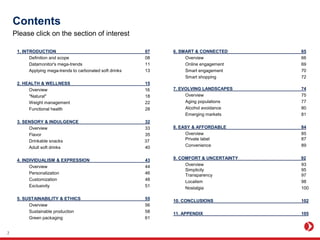
1. INTRODUCTION 07
Definition and scope 08
Datamonitor's mega-trends 11
Applying mega-trends to carbonated soft drinks 13
2. HEALTH & WELLNESS 15
Overview 16
"Natural" 18
Weight management 22
Functional health 28
3. SENSORY & INDULGENCE 32
Overview 33
Flavor 35
Drinkable snacks 37
Adult soft drinks 40
4. INDIVIDUALISM & EXPRESSION 43
Overview 44
Personalization 46
Customization 48
Exclusivity 51
5. SUSTAINABILITY & ETHICS 55
Overview 56
Sustainable production 58
Green packaging 61
6. SMART & CONNECTED 65
Overview 66
Online engagement 69
Smart engagement 70
Smart shopping 72
7. EVOLVING LANDSCAPES 74
Overview 75
Aging populations 77
Alcohol avoidance 80
Emerging markets 81
8. EASY & AFFORDABLE 84
Overview 85
Private label 87
Convenience 89
9. COMFORT & UNCERTAINTY 92
Overview 93
Simplicity 95
Transparency 97
Localism 98
Nostalgia 100
10. CONCLUSIONS 102
11. APPENDIX 105
2
Contents
Please click on the section of interest
Health & Wellness
"Natural" claims are influencing product choice for many
consumers
Carbonated soft drinks are not traditionally viewed as "healthy"
products, with many consumers concerned over the use of
artificial additives and highly processed ingredients such as high
fructose corn syrup. As consumers pay more attention to the
ingredients used in the products they buy, there is growing
demand for food and drinks made from "natural" and
recognizable ingredients. With the majority of consumers
perceiving "natural" to be more nutritious, there is strong
opportunity to improve the health image of soft drinks by making
them more "natural" and therefore better placed to compete with
other soft drinks such as juices and smoothies.
Consumers are shunning artificial ingredients in favor of "natural" formulations
Source: Datamonitor's Consumer Survey 2013; Datamonitor's Product Launch Analytics
3
70%
of consumers consider products
to be more nutritious if they are
described as "natural" (2013).
50%
of consumers choose "natural"
food and drinks "all or most of the
time" (2013)
Consumers perceive "natural" to be healthier
Global: top 10 claims for new carbonated soft
drinks, 2011–12
Natural 8.7%
No artificial color 8.4%
No preservatives 7.8%
No artificial flavor 6.5%
No caffeine 6.0%
No sugar 5.9%
Low calories 5.1%
Organic 4.9%
Vegetarian 4.6%
No calories 4.1%
"Natural" remains a key focus of innovation in carbonated
soft drinks
The top four most common product claims for new carbonated
soft drink launches between 2011 and 2012, were "natural"
attributes: "natural," "no artificial color," "no preservatives," and
"no artificial flavor." This trend towards "natural" products is
advantageous to the category as it gives a more healthy and
nutritious perception overall. However, it is comparatively
restricted in relation to formulation flexibility in terms of colorings,
flavorings, and overall taste. The "natural" trend has significant
implications for low calorie or diet variants, which have, until
recently, relied on heavily on artificial sweeteners.
Overview Natural Weight management Functional health
Sensory & Indulgence
Experiment with the sensory properties of carbonates to create "drinkable snacks"
Interest in drinkable snacks presents opportunities for carbonates
The concept of a product that comes in the form of a drinkable snack
appeals to 45% of consumers globally, with younger consumers the
most interested in the idea. PepsiCo has pinpointed this as a key area
of growth for its business going forward. Carbonated drinks could be
positioned as a snack, by using more filling and substantial ingredients:
creating a novel sensory experience and better catering to consumers
who favor on-the-go meal solutions. Carbonates should look to other
categories, such juices, for inspiration as to ways to "snackify" drinks.
Ingredients such as protein, oats, chia seeds, aloe vera pulp or fruit
pieces can add substance and texture, as well as potential functional
health benefits.
Source: Datamonitor's Consumer Survey 2013; Datamonitor's Product Launch Analytics
4
"[PepsiCo has a] whole range of products […] in
the pipeline that are value-added products that can
be snacks made into beverages […] A way to grow
the beverage business is to take foods and
drinkify them."
Indra Nooyi, CEO of PepsiCo, at Beverage Digest's
Future Smarts conference in New York, December
2012
Global: consumers who consider the concept of a product that
comes as a "drinkable snack" appealing, segmented by age and
country, 2013
China 74%
US 46%
UK 38 %
Italy 52%
Brazil 44%
Global average 45%
Mamma Chia – Chia
Squeeze
US
Chia seeds become gel-
like when mixed with
juice, creating a filling
snack.
Sapporo red grape juice
drink with aloe chunks
Japan
This carbonated drink
contains aloe pulp chunks
and red grape juice
flavoring.
Overview Flavor Drinkable snacks Adult soft drinks
Smart & Connected
"Happiness Refill" helps consumers in an emerging
market connect with Coca-Cola
Coca-Cola launched its "Happiness Refill" project at its
beachfront concept store in Rio de Janeiro in 2012. Happiness
Refill is a dispenser that gives mobile phone users, invited by
Coca-Cola, free data credits to browse the Internet using a
Coca-Cola mobile browser. The machine looks like a soda
fountain and to use it the consumer must push their phone
against the tap, which serves up free mobile Internet access
through data credits.
The project is aimed at Brazil's young emerging middle-class
consumers, who enjoy using their phones but cannot yet afford
a high data plan. The Coca-Cola browser that is loaded onto
the user's phone enables them to listen to the radio, connect to
social networks including Facebook and Twitter, and check the
weather forecast. Each data "refill" is 20 megabytes worth of
data and the users can return for more refills as they need. If
Happiness Refill is successful, it could be rolled out to other
emerging markets to enable more young consumers to get
connected online.
Coca-Cola's "Happiness Refill" helps consumers in Brazil get connected
Source: Advertising Age, March 2012
5
Overview Online engagement Smart engagement Smart shopping
Comfort & Uncertainty
Bring comfort to consumers through "retro" products that capture idyllic feelings of times past
Source: Datamonitor's Product Launch Analytics
6
Retrophilia and nostalgia
Retrophilia is a love of things from the past, and can be felt by
people who did not have the experience the first time around. It
leads to modern recreations of the past. Nostalgia, in contrast, is
the love of things from the past by those that have experienced it.
Both concepts capture how consumers are seeking refuge in
idyllic fantasies of the past, tending to glorify products and
contexts that were prevalent in prior periods and/or places. The
emotive value of food and drinks makes the theme of nostalgia all
the more pertinent. Carbonated drinks manufacturers have
capitalized on this trend through the launch of retro packing, and
bringing back old recipes or flavors.
Overview Simplicity Transparency Localism Nostalgia
Macario retro drink – lemonade
Italy
A lemonade packaged in an old-
fashioned style glass bottle, with
retro imagery on the label.
Pepsi and Mountain Dew
Throwback soda
US
PepsiCo's retro "throwback"
versions of its Pepsi and
Mountain Dew brands are
made to their original recipe
with "real sugar," rather than
the high fructose corn syrup
now used.
Big Red – retro soda
US
Big Red retro soda, "made
with real sugar" is said to have
an old-fashioned taste.

Consumer and Innovation Trends in Carbonated Soft Drinks

  • 1.
    Consumer and Innovation Trendsin Carbonated Soft Drinks 2013 Fruit-flavored beverages, cola, mixers, and other carbonated soft drinks Category Series. Published December 2013 Consumer Insight
  • 2.
    1. INTRODUCTION 07 Definitionand scope 08 Datamonitor's mega-trends 11 Applying mega-trends to carbonated soft drinks 13 2. HEALTH & WELLNESS 15 Overview 16 "Natural" 18 Weight management 22 Functional health 28 3. SENSORY & INDULGENCE 32 Overview 33 Flavor 35 Drinkable snacks 37 Adult soft drinks 40 4. INDIVIDUALISM & EXPRESSION 43 Overview 44 Personalization 46 Customization 48 Exclusivity 51 5. SUSTAINABILITY & ETHICS 55 Overview 56 Sustainable production 58 Green packaging 61 6. SMART & CONNECTED 65 Overview 66 Online engagement 69 Smart engagement 70 Smart shopping 72 7. EVOLVING LANDSCAPES 74 Overview 75 Aging populations 77 Alcohol avoidance 80 Emerging markets 81 8. EASY & AFFORDABLE 84 Overview 85 Private label 87 Convenience 89 9. COMFORT & UNCERTAINTY 92 Overview 93 Simplicity 95 Transparency 97 Localism 98 Nostalgia 100 10. CONCLUSIONS 102 11. APPENDIX 105 2 Contents Please click on the section of interest
  • 3.
    Health & Wellness "Natural"claims are influencing product choice for many consumers Carbonated soft drinks are not traditionally viewed as "healthy" products, with many consumers concerned over the use of artificial additives and highly processed ingredients such as high fructose corn syrup. As consumers pay more attention to the ingredients used in the products they buy, there is growing demand for food and drinks made from "natural" and recognizable ingredients. With the majority of consumers perceiving "natural" to be more nutritious, there is strong opportunity to improve the health image of soft drinks by making them more "natural" and therefore better placed to compete with other soft drinks such as juices and smoothies. Consumers are shunning artificial ingredients in favor of "natural" formulations Source: Datamonitor's Consumer Survey 2013; Datamonitor's Product Launch Analytics 3 70% of consumers consider products to be more nutritious if they are described as "natural" (2013). 50% of consumers choose "natural" food and drinks "all or most of the time" (2013) Consumers perceive "natural" to be healthier Global: top 10 claims for new carbonated soft drinks, 2011–12 Natural 8.7% No artificial color 8.4% No preservatives 7.8% No artificial flavor 6.5% No caffeine 6.0% No sugar 5.9% Low calories 5.1% Organic 4.9% Vegetarian 4.6% No calories 4.1% "Natural" remains a key focus of innovation in carbonated soft drinks The top four most common product claims for new carbonated soft drink launches between 2011 and 2012, were "natural" attributes: "natural," "no artificial color," "no preservatives," and "no artificial flavor." This trend towards "natural" products is advantageous to the category as it gives a more healthy and nutritious perception overall. However, it is comparatively restricted in relation to formulation flexibility in terms of colorings, flavorings, and overall taste. The "natural" trend has significant implications for low calorie or diet variants, which have, until recently, relied on heavily on artificial sweeteners. Overview Natural Weight management Functional health
  • 4.
    Sensory & Indulgence Experimentwith the sensory properties of carbonates to create "drinkable snacks" Interest in drinkable snacks presents opportunities for carbonates The concept of a product that comes in the form of a drinkable snack appeals to 45% of consumers globally, with younger consumers the most interested in the idea. PepsiCo has pinpointed this as a key area of growth for its business going forward. Carbonated drinks could be positioned as a snack, by using more filling and substantial ingredients: creating a novel sensory experience and better catering to consumers who favor on-the-go meal solutions. Carbonates should look to other categories, such juices, for inspiration as to ways to "snackify" drinks. Ingredients such as protein, oats, chia seeds, aloe vera pulp or fruit pieces can add substance and texture, as well as potential functional health benefits. Source: Datamonitor's Consumer Survey 2013; Datamonitor's Product Launch Analytics 4 "[PepsiCo has a] whole range of products […] in the pipeline that are value-added products that can be snacks made into beverages […] A way to grow the beverage business is to take foods and drinkify them." Indra Nooyi, CEO of PepsiCo, at Beverage Digest's Future Smarts conference in New York, December 2012 Global: consumers who consider the concept of a product that comes as a "drinkable snack" appealing, segmented by age and country, 2013 China 74% US 46% UK 38 % Italy 52% Brazil 44% Global average 45% Mamma Chia – Chia Squeeze US Chia seeds become gel- like when mixed with juice, creating a filling snack. Sapporo red grape juice drink with aloe chunks Japan This carbonated drink contains aloe pulp chunks and red grape juice flavoring. Overview Flavor Drinkable snacks Adult soft drinks
  • 5.
    Smart & Connected "HappinessRefill" helps consumers in an emerging market connect with Coca-Cola Coca-Cola launched its "Happiness Refill" project at its beachfront concept store in Rio de Janeiro in 2012. Happiness Refill is a dispenser that gives mobile phone users, invited by Coca-Cola, free data credits to browse the Internet using a Coca-Cola mobile browser. The machine looks like a soda fountain and to use it the consumer must push their phone against the tap, which serves up free mobile Internet access through data credits. The project is aimed at Brazil's young emerging middle-class consumers, who enjoy using their phones but cannot yet afford a high data plan. The Coca-Cola browser that is loaded onto the user's phone enables them to listen to the radio, connect to social networks including Facebook and Twitter, and check the weather forecast. Each data "refill" is 20 megabytes worth of data and the users can return for more refills as they need. If Happiness Refill is successful, it could be rolled out to other emerging markets to enable more young consumers to get connected online. Coca-Cola's "Happiness Refill" helps consumers in Brazil get connected Source: Advertising Age, March 2012 5 Overview Online engagement Smart engagement Smart shopping
  • 6.
    Comfort & Uncertainty Bringcomfort to consumers through "retro" products that capture idyllic feelings of times past Source: Datamonitor's Product Launch Analytics 6 Retrophilia and nostalgia Retrophilia is a love of things from the past, and can be felt by people who did not have the experience the first time around. It leads to modern recreations of the past. Nostalgia, in contrast, is the love of things from the past by those that have experienced it. Both concepts capture how consumers are seeking refuge in idyllic fantasies of the past, tending to glorify products and contexts that were prevalent in prior periods and/or places. The emotive value of food and drinks makes the theme of nostalgia all the more pertinent. Carbonated drinks manufacturers have capitalized on this trend through the launch of retro packing, and bringing back old recipes or flavors. Overview Simplicity Transparency Localism Nostalgia Macario retro drink – lemonade Italy A lemonade packaged in an old- fashioned style glass bottle, with retro imagery on the label. Pepsi and Mountain Dew Throwback soda US PepsiCo's retro "throwback" versions of its Pepsi and Mountain Dew brands are made to their original recipe with "real sugar," rather than the high fructose corn syrup now used. Big Red – retro soda US Big Red retro soda, "made with real sugar" is said to have an old-fashioned taste.