Consumer and Innovation
Trends in Juices and
Smoothies 2013
Fruit and vegetable juices, nectars and smoothies
Category series. Last updated December 2013
Consumer Insight
Contents
Please click on the section of interest
1. INTRODUCTION 07
Definition and scope 08
Datamonitor's mega-trends 11
Applying mega-trends to juices and smoothies 13
2. HEALTH & WELLNESS 16
SWOT analysis 17
Positive nutrition 19
Low sugar 23
Fresh & Natural 24
3. SENSORY & INDULGENCE 30
SWOT analysis 31
Flavor 33
Vegetable Juice 36
Drinkable Snacks 37
4. INDIVIDUALISM & EXPRESSION 42
SWOT analysis 43
Personalization 45
Customization 48
5. SUSTAINABILITY & ETHICS 50
SWOT analysis 51
Sustainable Production 53
Green Packaging 57
6. SMART & CONNECTED 60
SWOT analysis 61
Online engagement 63
7. EVOLVING LANDSCAPES 66
SWOT analysis 67
Aging populations 69
Single Lifestyles 73
Emerging Markets 74
8. EASY & AFFORDABLE 77
SWOT analysis 78
Private Label 88
Convenience 82
9. COMFORT & UNCERTAINTY 86
SWOT analysis 87
Trust & Transparency 89
Simplicity 90
Localism 92
10. CONCLUSIONS 95
11. APPENDIX 98
2
Global: consumers who agree with the statement "I am
more interested in hearing about what TO eat, rather than
what NOT to eat," by gender, 2010 and 2013
CONSUMERS ARE FOCUSING ON THE POSITIVE
Messages of healthy eating have traditionally focused on
limiting consumption of certain "food villains" e.g. sugar,
calories and fat. Not only can such an approach detract from
enjoyment, but the effectiveness of such messages is
debatable given the rising rates of lifestyle-related diseases
such as diabetes and heart disease. Consumers are
increasingly expressing interest in knowing what they should
be eating in order to live a healthier lifestyle.
Source: Datamonitor Consumer Survey, May/June 2013; Datamonitor's Product Launch Analytics; [1] freshplaza.com
POSITIVE MESSAGES ARE LAGGING BEHIND IN JUICE AND
SMOOTHIE INNOVATION
While consumers increasingly want to hear positive health
messages, new juice and smoothie launches remain focused on
avoidance claims such as “no preservatives” and “no added sugar.”
The claim “high vitamins” is one of few positive claims appearing in
a significant proportion of new launches (18%). The challenge for
juice manufacturers is to make positive health claims amid a
toughening regulatory environment which is making it harder to
make health claims, particularly for natural ingredients such as fruit
and vegetables where nutrient composition can be inconsistent.1
Claim
Proportion of new juice & smoothie
launches with claim
No Preservatives 18.2%
High Vitamins 18.1%
No Added Sugar 15.2%
No Artificial Color 10.9%
No Artificial Flavor 7.4%
Low Calories 3.1%
High Antioxidants 2.9%
No Gluten 2.4%
No Additives 2.4%
High Fruit 2.3%
Global: top health-related claims on new juice and smoothie
products, as a proportion of total launches, 2011-2012
3
Overview Positive Nutrition Low Sugar Fresh & Natural Organic
Health & Wellness
Consumers are seeking products with positive health messages
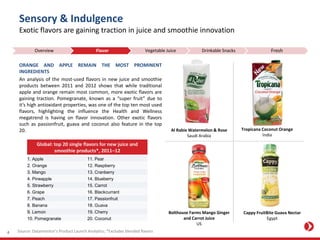
ORANGE AND APPLE REMAIN THE MOST PROMINENT
INGREDIENTS
An analysis of the most-used flavors in new juice and smoothie
products between 2011 and 2012 shows that while traditional
apple and orange remain most common, more exotic flavors are
gaining traction. Pomegranate, known as a “super fruit” due to
it’s high antioxidant properties, was one of the top ten most used
flavors, highlighting the influence the Health and Wellness
megatrend is having on flavor innovation. Other exotic flavors
such as passionfruit, guava and coconut also feature in the top
20. Al Rabie Watermelon & Rose
Saudi Arabia
Tropicana Coconut Orange
India
Global: top 20 single flavors for new juice and
smoothie products*, 2011–12
1. Apple 11. Pear
2. Orange 12. Raspberry
3. Mango 13. Cranberry
4. Pineapple 14. Blueberry
5. Strawberry 15. Carrot
6. Grape 16. Blackcurrant
7. Peach 17. Passionfruit
8. Banana 18. Guava
9. Lemon 19. Cherry
10. Pomegranate 20. Coconut
Source: Datamonitor's Product Launch Analytics; *Excludes blended flavors4
Overview Flavor Vegetable Juice Drinkable Snacks Fresh
Sensory & Indulgence
Exotic flavors are gaining traction in juice and smoothie innovation
Bolthouse Farms Mango Ginger
and Carrot Juice
US
Cappy FruitBite Guava Nectar
Egypt
Source: Datamonitor (2013) “Foresights: Coffeefruit,” April 2013; [1] beveragedaily.com
A “super-fruit” with sustainability benefitsWhat?
• Coffeefruit is the berry which surrounds the coffee bean, and is usually
discarded during coffee production, once the beans are extracted.
• It is a "superfruit" that is extremely high in antioxidants, helping to promote
good health and fight disease. It is said to have 30-40 times the antioxidant
content of the pomegranate.
• Its mild flavor makes it highly versatile, meaning it can be easily blended
with other fruits in juices and smoothies.
Utilizing a waste product of coffee productionWhy?
• Coffee fruit has the potential to be one of the most sustainably produced
super foods in the world, by utilizing the waste product from coffee
production.
Take-out
• As the industry is under increasing pressure to improve sustainability
initiatives, coffee fruit can be promoted for its advantages for both health
and sustainability.
• Bai5 is one of just a handful of juice brands currently using coffeefruit, and
are achieving significant success in the US. The brand was founded in 2009
and annual sales are predicted to reach $20m in 2013.1
Use coffeefruit in juices and smoothies to boost
health and sustainability credentials of your brand
Ben Weiss, CEO and founder of Bai (via
beveragedaily.com)
"The fruit literally will get thrown away […] So I had
this idea to take a byproduct of the coffee harvest
and use it as a functional ingredient. Although
coffeefruit is an irrelevant part of coffee harvest, it
was a very relevant idea."
Bai5 Antioxidant Infusions
US
Juice drink range which is a
blend of coffeefruit extract,
water & other juices such as
blueberry and pear. The
drinks contain only 5
calories, and use natural
sweeteners.
5
Overview Sustainable Production Green Packaging
Sustainability & Ethics
Case study: Coffeefruit offers health and sustainability benefits for juice and smoothie
manufacturers
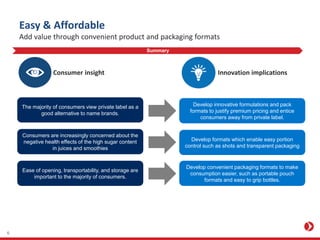
Develop convenient packaging formats to make
consumption easier, such as portable pouch
formats and easy to grip bottles.
The majority of consumers view private label as a
good alternative to name brands.
Consumers are increasingly concerned about the
negative health effects of the high sugar content
in juices and smoothies
Ease of opening, transportability, and storage are
important to the majority of consumers.
Consumer insight Innovation implications
Develop innovative formulations and pack
formats to justify premium pricing and entice
consumers away from private label.
Develop formats which enable easy portion
control such as shots and transparent packaging
Easy & Affordable
Add value through convenient product and packaging formats
Summary
6

Consumer and Innovation Trends in Juices and Smoothies

  • 1.
    Consumer and Innovation Trendsin Juices and Smoothies 2013 Fruit and vegetable juices, nectars and smoothies Category series. Last updated December 2013 Consumer Insight
  • 2.
    Contents Please click onthe section of interest 1. INTRODUCTION 07 Definition and scope 08 Datamonitor's mega-trends 11 Applying mega-trends to juices and smoothies 13 2. HEALTH & WELLNESS 16 SWOT analysis 17 Positive nutrition 19 Low sugar 23 Fresh & Natural 24 3. SENSORY & INDULGENCE 30 SWOT analysis 31 Flavor 33 Vegetable Juice 36 Drinkable Snacks 37 4. INDIVIDUALISM & EXPRESSION 42 SWOT analysis 43 Personalization 45 Customization 48 5. SUSTAINABILITY & ETHICS 50 SWOT analysis 51 Sustainable Production 53 Green Packaging 57 6. SMART & CONNECTED 60 SWOT analysis 61 Online engagement 63 7. EVOLVING LANDSCAPES 66 SWOT analysis 67 Aging populations 69 Single Lifestyles 73 Emerging Markets 74 8. EASY & AFFORDABLE 77 SWOT analysis 78 Private Label 88 Convenience 82 9. COMFORT & UNCERTAINTY 86 SWOT analysis 87 Trust & Transparency 89 Simplicity 90 Localism 92 10. CONCLUSIONS 95 11. APPENDIX 98 2
  • 3.
    Global: consumers whoagree with the statement "I am more interested in hearing about what TO eat, rather than what NOT to eat," by gender, 2010 and 2013 CONSUMERS ARE FOCUSING ON THE POSITIVE Messages of healthy eating have traditionally focused on limiting consumption of certain "food villains" e.g. sugar, calories and fat. Not only can such an approach detract from enjoyment, but the effectiveness of such messages is debatable given the rising rates of lifestyle-related diseases such as diabetes and heart disease. Consumers are increasingly expressing interest in knowing what they should be eating in order to live a healthier lifestyle. Source: Datamonitor Consumer Survey, May/June 2013; Datamonitor's Product Launch Analytics; [1] freshplaza.com POSITIVE MESSAGES ARE LAGGING BEHIND IN JUICE AND SMOOTHIE INNOVATION While consumers increasingly want to hear positive health messages, new juice and smoothie launches remain focused on avoidance claims such as “no preservatives” and “no added sugar.” The claim “high vitamins” is one of few positive claims appearing in a significant proportion of new launches (18%). The challenge for juice manufacturers is to make positive health claims amid a toughening regulatory environment which is making it harder to make health claims, particularly for natural ingredients such as fruit and vegetables where nutrient composition can be inconsistent.1 Claim Proportion of new juice & smoothie launches with claim No Preservatives 18.2% High Vitamins 18.1% No Added Sugar 15.2% No Artificial Color 10.9% No Artificial Flavor 7.4% Low Calories 3.1% High Antioxidants 2.9% No Gluten 2.4% No Additives 2.4% High Fruit 2.3% Global: top health-related claims on new juice and smoothie products, as a proportion of total launches, 2011-2012 3 Overview Positive Nutrition Low Sugar Fresh & Natural Organic Health & Wellness Consumers are seeking products with positive health messages
  • 4.
    ORANGE AND APPLEREMAIN THE MOST PROMINENT INGREDIENTS An analysis of the most-used flavors in new juice and smoothie products between 2011 and 2012 shows that while traditional apple and orange remain most common, more exotic flavors are gaining traction. Pomegranate, known as a “super fruit” due to it’s high antioxidant properties, was one of the top ten most used flavors, highlighting the influence the Health and Wellness megatrend is having on flavor innovation. Other exotic flavors such as passionfruit, guava and coconut also feature in the top 20. Al Rabie Watermelon & Rose Saudi Arabia Tropicana Coconut Orange India Global: top 20 single flavors for new juice and smoothie products*, 2011–12 1. Apple 11. Pear 2. Orange 12. Raspberry 3. Mango 13. Cranberry 4. Pineapple 14. Blueberry 5. Strawberry 15. Carrot 6. Grape 16. Blackcurrant 7. Peach 17. Passionfruit 8. Banana 18. Guava 9. Lemon 19. Cherry 10. Pomegranate 20. Coconut Source: Datamonitor's Product Launch Analytics; *Excludes blended flavors4 Overview Flavor Vegetable Juice Drinkable Snacks Fresh Sensory & Indulgence Exotic flavors are gaining traction in juice and smoothie innovation Bolthouse Farms Mango Ginger and Carrot Juice US Cappy FruitBite Guava Nectar Egypt
  • 5.
    Source: Datamonitor (2013)“Foresights: Coffeefruit,” April 2013; [1] beveragedaily.com A “super-fruit” with sustainability benefitsWhat? • Coffeefruit is the berry which surrounds the coffee bean, and is usually discarded during coffee production, once the beans are extracted. • It is a "superfruit" that is extremely high in antioxidants, helping to promote good health and fight disease. It is said to have 30-40 times the antioxidant content of the pomegranate. • Its mild flavor makes it highly versatile, meaning it can be easily blended with other fruits in juices and smoothies. Utilizing a waste product of coffee productionWhy? • Coffee fruit has the potential to be one of the most sustainably produced super foods in the world, by utilizing the waste product from coffee production. Take-out • As the industry is under increasing pressure to improve sustainability initiatives, coffee fruit can be promoted for its advantages for both health and sustainability. • Bai5 is one of just a handful of juice brands currently using coffeefruit, and are achieving significant success in the US. The brand was founded in 2009 and annual sales are predicted to reach $20m in 2013.1 Use coffeefruit in juices and smoothies to boost health and sustainability credentials of your brand Ben Weiss, CEO and founder of Bai (via beveragedaily.com) "The fruit literally will get thrown away […] So I had this idea to take a byproduct of the coffee harvest and use it as a functional ingredient. Although coffeefruit is an irrelevant part of coffee harvest, it was a very relevant idea." Bai5 Antioxidant Infusions US Juice drink range which is a blend of coffeefruit extract, water & other juices such as blueberry and pear. The drinks contain only 5 calories, and use natural sweeteners. 5 Overview Sustainable Production Green Packaging Sustainability & Ethics Case study: Coffeefruit offers health and sustainability benefits for juice and smoothie manufacturers
  • 6.
    Develop convenient packagingformats to make consumption easier, such as portable pouch formats and easy to grip bottles. The majority of consumers view private label as a good alternative to name brands. Consumers are increasingly concerned about the negative health effects of the high sugar content in juices and smoothies Ease of opening, transportability, and storage are important to the majority of consumers. Consumer insight Innovation implications Develop innovative formulations and pack formats to justify premium pricing and entice consumers away from private label. Develop formats which enable easy portion control such as shots and transparent packaging Easy & Affordable Add value through convenient product and packaging formats Summary 6