Consumer Insight
Consumer and Innovation
Trends in Healthy Snacks
How the snacking industry can address the needs of health-
conscious consumers
Published: November 2013
Contents
1. Introduction
1. Definition and scope
2. Drivers and inhibitors
2. Weight Management
1. Chia seeds
2. Portion control
3. High protein
3. Moderation & Avoidance
1. Ingredient consciousness
2. The health/taste paradox
3. Allergen-free
4. Fresh & Natural
1. Clean labels
2. Snacking on fruits and vegetables
5. Guided Health
1. Functional foods
2. Digital lifestyles
6. Disease Management
1. "Pharma" foods
2. Snacks for diabetics
7. Right-For-Me
1. Targeting children
Please click on the section of interest
07
10
13
14
18
19
21
22
24
25
27
29
31
33
35
39
41
42
45
46
48
50
2
9. Vitality & Balance
1. Energy-boosting foods
2. Daily dosing
10. Aging Populations
1. Targeting cognitive health
2. Packaging for seniors
11. Efficient & Effective
1. Fortification
2. Drinkable snacks
12. Sterilized Society
1. Food safety
2. Smart packaging innovation
13. Ethical Wellbeing
1. Combining health and ethics
14. Made-For-Me
1. Customization
15. Conclusion
16. Appendix
52
54
56
57
59
60
61
63
64
65
67
68
69
71
73
75
76
80
Weight Management
Introduction
Source: Datamonitor analysis3
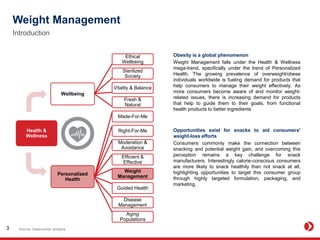
Obesity is a global phenomenon
Weight Management falls under the Health & Wellness
mega-trend, specifically under the trend of Personalized
Health. The growing prevalence of overweight/obese
individuals worldwide is fueling demand for products that
help consumers to manage their weight effectively. As
more consumers become aware of and monitor weight-
related issues, there is increasing demand for products
that help to guide them to their goals, from functional
health products to better ingredients
Opportunities exist for snacks to aid consumers'
weight-loss efforts
Consumers commonly make the connection between
snacking and potential weight gain, and overcoming this
perception remains a key challenge for snack
manufacturers. Interestingly calorie-conscious consumers
are more likely to snack healthily than not snack at all,
highlighting opportunities to target this consumer group
through highly targeted formulation, packaging, and
marketing.
Health &
Wellness
Wellbeing
Personalized
Health
Vitality & Balance
Disease
Management
Weight
Management
Moderation &
Avoidance
Ethical
Wellbeing
Sterilized
Society
Fresh &
Natural
Made-For-Me
Right-For-Me
Efficient &
Effective
Guided Health
Aging
Populations
Fresh & Natural
A growing bias against processed foods is driving the "natural" and "clean label" opportunity
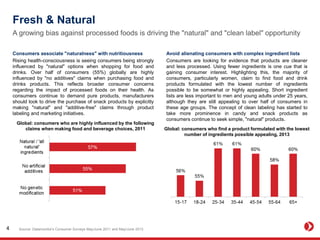
Avoid alienating consumers with complex ingredient lists
Consumers are looking for evidence that products are cleaner
and less processed. Using fewer ingredients is one cue that is
gaining consumer interest. Highlighting this, the majority of
consumers, particularly women, claim to find food and drink
products formulated with the lowest number of ingredients
possible to be somewhat or highly appealing. Short ingredient
lists are less important to men and young adults under 25 years,
although they are still appealing to over half of consumers in
these age groups. The concept of clean labeling has started to
take more prominence in candy and snack products as
consumers continue to seek simple, "natural" products.
Consumers associate "naturalness" with nutritiousness
Rising health-consciousness is seeing consumers being strongly
influenced by "natural" options when shopping for food and
drinks. Over half of consumers (55%) globally are highly
influenced by "no additives" claims when purchasing food and
drinks products. This reflects broader consumer concerns
regarding the impact of processed foods on their health. As
consumers continue to demand pure products, manufacturers
should look to drive the purchase of snack products by explicitly
making "natural" and "additive-free" claims through product
labeling and marketing initiatives.
Source: Datamonitor's Consumer Surveys May/June 2011 and May/June 20134
Global: consumers who are highly influenced by the following
claims when making food and beverage choices, 2011 Global: consumers who find a product formulated with the lowest
number of ingredients possible appealing, 2013
Guided Health
Encourage your brand to become a healthy habit
22 Days is a brand of vegan protein nutrition bars that claim to
provide optimal nutrition to help consumers live a healthier and more
energetic lifestyle. According to the company's website:
"Psychologists have discovered that it takes 21 days to make or
break a habit." It applied this principal to its brand, hence the name
"22 Days," and created the "22 Days Challenge" to consume a bar
daily until the 22nd day is reached, by which time a daily habit should
have formed that the consumer will hopefully continue. The bars
come in different flavors such as Nut Butter Buddha, each with
organic, raw, "natural" ingredients, including "superfoods" such as
goji berries and hemp seeds.
Incorporate functional benefits in high-indulgence snacks to
overcome the guilt factor
Ohso chocolate bars offer consumers a new alternative to probiotic
yogurts. The dairy-free chocolates have been clinically proven1 to be
three times more effective than "most dairy drinks that contain
'friendly bacteria' at delivering good bacteria to your intestine."
Available in seven-bar weekly packs, each 13.5g individual Ohso bar
contains a "billion Lactobacillus and Bifidobacterium" to help restore
bacteria flora in the gut and improve digestive health.
Examples we like: "on-trend" product and marketing innovation
Source: 22daynutrition.com; [1] FDIN, December 20115
Aging Populations
Snack manufacturers are responding to the needs of senior consumers through packaging
Add value through packaging enhancements that address the needs
of seniors
To meet the needs of an aging population, snack manufacturers must
ensure that their products are packaged with the needs of this market in
mind. Senior-friendly features can add value in the eyes of the consumer,
and can therefore justify a premium price point. There are four key
functions that deteriorate, to varying degrees, in old age, which snack
manufacturers can address through packaging enhancements:
Source: For more info see Datamonitor's Packaging for an Aging Population (April 2013 , CM00234-016); [1] Wall Street Journal (2011)6
Suggested areas for snack manufacturers to add value by making
packaging more senior-friendly
Making "age-friendly" ergonomics a subtle
component of packaging design
To address the reduced agility of aging baby boomers'
hands, Diamond Foods reengineered the packaging of
its Emerald snack nut line, to make it easy to open and
use. Some of the changes that the Emerald brand
made included indenting the sides of the canisters to
make them easier and more comfortable to hold, and
incorporating some grooves to make the lids easier to
grip¹. What is more, Emerald shortened the rotation
required to open the cap, after noticing that arthritic
users struggled to twist the cap into place.
Interestingly, none of the age-friendly packaging
features are explicitly promoted to seniors on pack.
Indeed, this hints of a more stealthy and subtle
approach to NPD being adopted by manufacturers that
are looking to target today's older demographics.
Senior-
friendly
packaging
Strength
DexterityVision
• Consumers require
lighter packs and
easier-to-grip/open
bottles, cans, and
cartons.
• Innovations such as
flip-top lids and easy
peel freshness seals
are a necessity.
• Larger print text and
product
differentiation
through symbols and
shapes instead of
color can help
seniors.

Consumer and Innovation Trends in Healthy Snacks

  • 1.
    Consumer Insight Consumer andInnovation Trends in Healthy Snacks How the snacking industry can address the needs of health- conscious consumers Published: November 2013
  • 2.
    Contents 1. Introduction 1. Definitionand scope 2. Drivers and inhibitors 2. Weight Management 1. Chia seeds 2. Portion control 3. High protein 3. Moderation & Avoidance 1. Ingredient consciousness 2. The health/taste paradox 3. Allergen-free 4. Fresh & Natural 1. Clean labels 2. Snacking on fruits and vegetables 5. Guided Health 1. Functional foods 2. Digital lifestyles 6. Disease Management 1. "Pharma" foods 2. Snacks for diabetics 7. Right-For-Me 1. Targeting children Please click on the section of interest 07 10 13 14 18 19 21 22 24 25 27 29 31 33 35 39 41 42 45 46 48 50 2 9. Vitality & Balance 1. Energy-boosting foods 2. Daily dosing 10. Aging Populations 1. Targeting cognitive health 2. Packaging for seniors 11. Efficient & Effective 1. Fortification 2. Drinkable snacks 12. Sterilized Society 1. Food safety 2. Smart packaging innovation 13. Ethical Wellbeing 1. Combining health and ethics 14. Made-For-Me 1. Customization 15. Conclusion 16. Appendix 52 54 56 57 59 60 61 63 64 65 67 68 69 71 73 75 76 80
  • 3.
    Weight Management Introduction Source: Datamonitoranalysis3 Obesity is a global phenomenon Weight Management falls under the Health & Wellness mega-trend, specifically under the trend of Personalized Health. The growing prevalence of overweight/obese individuals worldwide is fueling demand for products that help consumers to manage their weight effectively. As more consumers become aware of and monitor weight- related issues, there is increasing demand for products that help to guide them to their goals, from functional health products to better ingredients Opportunities exist for snacks to aid consumers' weight-loss efforts Consumers commonly make the connection between snacking and potential weight gain, and overcoming this perception remains a key challenge for snack manufacturers. Interestingly calorie-conscious consumers are more likely to snack healthily than not snack at all, highlighting opportunities to target this consumer group through highly targeted formulation, packaging, and marketing. Health & Wellness Wellbeing Personalized Health Vitality & Balance Disease Management Weight Management Moderation & Avoidance Ethical Wellbeing Sterilized Society Fresh & Natural Made-For-Me Right-For-Me Efficient & Effective Guided Health Aging Populations
  • 4.
    Fresh & Natural Agrowing bias against processed foods is driving the "natural" and "clean label" opportunity Avoid alienating consumers with complex ingredient lists Consumers are looking for evidence that products are cleaner and less processed. Using fewer ingredients is one cue that is gaining consumer interest. Highlighting this, the majority of consumers, particularly women, claim to find food and drink products formulated with the lowest number of ingredients possible to be somewhat or highly appealing. Short ingredient lists are less important to men and young adults under 25 years, although they are still appealing to over half of consumers in these age groups. The concept of clean labeling has started to take more prominence in candy and snack products as consumers continue to seek simple, "natural" products. Consumers associate "naturalness" with nutritiousness Rising health-consciousness is seeing consumers being strongly influenced by "natural" options when shopping for food and drinks. Over half of consumers (55%) globally are highly influenced by "no additives" claims when purchasing food and drinks products. This reflects broader consumer concerns regarding the impact of processed foods on their health. As consumers continue to demand pure products, manufacturers should look to drive the purchase of snack products by explicitly making "natural" and "additive-free" claims through product labeling and marketing initiatives. Source: Datamonitor's Consumer Surveys May/June 2011 and May/June 20134 Global: consumers who are highly influenced by the following claims when making food and beverage choices, 2011 Global: consumers who find a product formulated with the lowest number of ingredients possible appealing, 2013
  • 5.
    Guided Health Encourage yourbrand to become a healthy habit 22 Days is a brand of vegan protein nutrition bars that claim to provide optimal nutrition to help consumers live a healthier and more energetic lifestyle. According to the company's website: "Psychologists have discovered that it takes 21 days to make or break a habit." It applied this principal to its brand, hence the name "22 Days," and created the "22 Days Challenge" to consume a bar daily until the 22nd day is reached, by which time a daily habit should have formed that the consumer will hopefully continue. The bars come in different flavors such as Nut Butter Buddha, each with organic, raw, "natural" ingredients, including "superfoods" such as goji berries and hemp seeds. Incorporate functional benefits in high-indulgence snacks to overcome the guilt factor Ohso chocolate bars offer consumers a new alternative to probiotic yogurts. The dairy-free chocolates have been clinically proven1 to be three times more effective than "most dairy drinks that contain 'friendly bacteria' at delivering good bacteria to your intestine." Available in seven-bar weekly packs, each 13.5g individual Ohso bar contains a "billion Lactobacillus and Bifidobacterium" to help restore bacteria flora in the gut and improve digestive health. Examples we like: "on-trend" product and marketing innovation Source: 22daynutrition.com; [1] FDIN, December 20115
  • 6.
    Aging Populations Snack manufacturersare responding to the needs of senior consumers through packaging Add value through packaging enhancements that address the needs of seniors To meet the needs of an aging population, snack manufacturers must ensure that their products are packaged with the needs of this market in mind. Senior-friendly features can add value in the eyes of the consumer, and can therefore justify a premium price point. There are four key functions that deteriorate, to varying degrees, in old age, which snack manufacturers can address through packaging enhancements: Source: For more info see Datamonitor's Packaging for an Aging Population (April 2013 , CM00234-016); [1] Wall Street Journal (2011)6 Suggested areas for snack manufacturers to add value by making packaging more senior-friendly Making "age-friendly" ergonomics a subtle component of packaging design To address the reduced agility of aging baby boomers' hands, Diamond Foods reengineered the packaging of its Emerald snack nut line, to make it easy to open and use. Some of the changes that the Emerald brand made included indenting the sides of the canisters to make them easier and more comfortable to hold, and incorporating some grooves to make the lids easier to grip¹. What is more, Emerald shortened the rotation required to open the cap, after noticing that arthritic users struggled to twist the cap into place. Interestingly, none of the age-friendly packaging features are explicitly promoted to seniors on pack. Indeed, this hints of a more stealthy and subtle approach to NPD being adopted by manufacturers that are looking to target today's older demographics. Senior- friendly packaging Strength DexterityVision • Consumers require lighter packs and easier-to-grip/open bottles, cans, and cartons. • Innovations such as flip-top lids and easy peel freshness seals are a necessity. • Larger print text and product differentiation through symbols and shapes instead of color can help seniors.