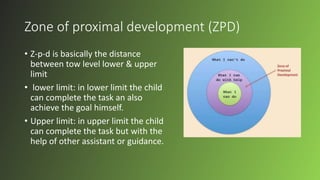
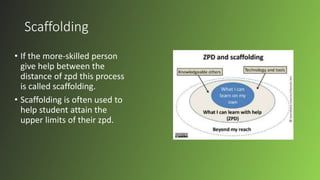
Vygotsky's social development theory proposes that cognitive development is shaped by social and cultural contexts. The theory emphasizes how children learn from society and focuses on the zone of proximal development (ZPD), defined as the difference between what a child can do independently and with guidance. Within the ZPD, scaffolding from a more skilled peer or adult can help a child develop skills and reach higher levels of understanding. Vygotsky also believed that language and thoughts initially develop separately but later merge during childhood.