 
Michelle Palaro
CJUS 2360
Fall 2015
Chapter 13
The Remaining
Amendments and a
Return to the Constitution
 The Constitution affects every American’s life
 There will continue to be constitutional cases,
analysis and research
 The most well-known amendments have been
discussed thus far
 There are four remaining amendments in the
Bill of Rights that will be looked at in this
chapter: the 3rd, the 7th, the 9th, and the
10th
 3rd Amendment
o Prohibits housing soldiers in private homes
during peacetime without the owner’s
consent and during the wartime without legal
process
o This amendment has never been subjected
to Supreme Court review
o It holds historical relevance and stands for
the general principle that government is to
leave people alone without compelling cause
 7th Amendment
o This amendment establishes the right to a federal
jury trial for all suits at common law if the value is
more than $20
• Legal controversies arising out of civil law rather than
criminal law
o Extends the right to a jury trial to civil proceedings
o To determine whether this amendment is a right to a
federal jury trial is based on whether a suit involves
legal issues similar to issues raised in cases for
which federal jury trial were granted by common law
 9th Amendment
o Established that the rights of U.S. citizens extend
beyond those listed in the Constitution
o This amendment is largely historical
o Rights not specifically listed in the Bill of Rights were
known as unenumerated rights
• Right to privacy, right to interstate and international travel,
right to vote and freedom of association
• The right to privacy has been referred to by the Supreme
Court and has been used to infer such a right, but the 9th
Amendment does not guarantee this right
Griswold v. Connecticut
 Facts: Connecticut law prohibited the use of contraceptives
 Issues: Does the Constitution protect the right of marital
privacy against state restrictions on a couple's ability to be
counseled in the use of contraceptives?
 Holding: Yes
 Rationale: Considered to be the first case in which the
Supreme Court addressed the 9th Amendment, which “shows
a belief of the Constitution’s authors that fundamental rights
exist that are not expressly enumerated in the first eight
amendments and an intent that the lists of rights… not be
exhaustive.” There are certain zones of privacy into which
the government may not intrude
 10th Amendment
o This amendment embodies the principle of
federalism
• A principle whereby power is shared by the national
government and the states
• The powers not delegated to the United States by the
Constitution, nor prohibited by the States, are reserved
to the States respectively, or to the people
• Seeks to ensure to all people that the federal
government will not get too powerful
 Delegated powers
o Powers of the national government, both
enumerated and implied by legal authority
o They were delegated or entrusted to the national
government by the states and the people
 Reserve powers
o Powers retained by the states
• Primary reserve power is police power
McCulloch v. Maryland
 Issues: Does Congress have the power to
incorporate a bank and does the State of
Maryland have the power to tax it?
 Holding: Congress has power under the
Constitution to incorporate a bank pursuant to
the Necessary and Proper clause (Article I,
section 8)
o The State of Maryland does not have the power to
tax an institution created by Congress pursuant to its
powers under the Constitution
United States v. Lopez
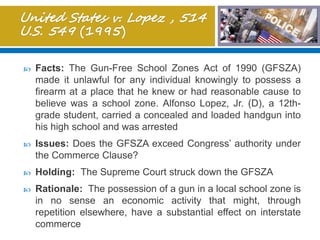
 Facts: The Gun-Free School Zones Act of 1990 (GFSZA)
made it unlawful for any individual knowingly to possess a
firearm at a place that he knew or had reasonable cause to
believe was a school zone. Alfonso Lopez, Jr. (D), a 12th-
grade student, carried a concealed and loaded handgun into
his high school and was arrested
 Issues: Does the GFSZA exceed Congress’ authority under
the Commerce Clause?
 Holding: The Supreme Court struck down the GFSZA
 Rationale: The possession of a gun in a local school zone is
in no sense an economic activity that might, through
repetition elsewhere, have a substantial effect on interstate
commerce
 Facts: The Brady Handgun Violence Prevention Act (Brady Bill)
required "local chief law enforcement officers" (CLEOs) to
perform background-checks on prospective handgun purchasers
 Issues: Using the Necessary and Proper Clause of Article I as
justification, can Congress temporarily require state CLEOs to
regulate handgun purchases by performing those duties called
for by the Brady Bill's handgun applicant background-checks?
 Holding: Supreme Court ruled that the federal government was
not empowered to require state or local law enforcement
agencies to run background checks on prospective gun buyers
 Rationale: According to the Court, the background check
provision violated the principle of separate state sovereignty
 http://en.wikipedia.org/wiki/Printz_v._United_States
 Additional amendments have come and gone
o Proof that the Constitution possesses the ability to
respond to America’s needs
 11th Amendment (1795)
o This amendment is the only one that deals with the
judicial power of the federal government and is
actually more an administrative directive
o It was introduced the day after the high court ruled
that a citizen of one state had the right to sue
another
 13th Amendment (1865)
o Abolished slavery
o This amendment overturned the Supreme Court’s
Dred Scott decision
o Using an amendment to overturn a specific Supreme
Court decision is rare, dramatic, and a good
illustration of the checks and balances in the U.S.
government
Dred Scott
 Facts: Dred Scott was a slave in Missouri. From 1833 to 1843,
he resided in Illinois (a free state) and in an area of the
Louisiana Territory, where slavery was forbidden by the Missouri
Compromise of 1820. After returning to Missouri, Scott sued
unsuccessfully in the Missouri courts for his freedom, claiming
that his residence in free territory made him a free man
 Issues: Was Dred Scott free or slave?
 Holding: He was a slave
 Rationale: Under Articles III and IV, the Court ruled no one but
a citizen of the United States could be a citizen of a state, and
that only Congress could confer national citizenship. Taney
reached the conclusion that no person descended from an
American slave had ever been a citizen for Article III purposes
 14th Amendment (1868)
o Due process
o Equal protection of the law
o The Supreme Court has chosen, through case law
and common law, to selectively apply certain
amendments to both federal and state governments
through selective incorporation
 Selective incorporation- Provisions of the Bill
of Rights are applied to the states through the
Due Process Clause
 Not all amendments and other portions of
the Constitution deal directly with specific
rights and liberties
 Seven amendments deal in detail with
numerous matters related to how the
federal government is to be structured
and its officials elected
 12th Amendment (1804)
o Established the electoral system
 14th Amendment (1868)
o Established how representatives are apportioned
and what their qualification are
 17th Amendment (1913)
o Describes how the U.S. Senate is to be composed,
the qualifications required, and how vacancies are to
be filled
 Facts: The Florida Supreme Court ordered hand counting of
contested ballots in Miami-Dade County during the 2000
Presidential Election. Then-Governor Bush requested a stay
of the Florida Supreme Court’s decision
 Issues: Did the Florida Supreme Court violate Article II
Section 1 Clause 2 of the U.S. Constitution by making new
election law?
 Holding: Yes, in a 5-4 decision
 Rationale: Different standards were applied from ballot to
ballot, precinct to precinct, and county to county so the
recount was arbitrary and disparate. Dissent argued the
Constitution requires that every vote counted and the Court
should defer to the Florida’s fundamentally right decision
 20th Amendment (1933)
o Established the term of the president and vice-
president end at noon on the 20th day of January,
and the terms of senator and representatives end at
noon on the 3rd day of January
o Also established how often Congress meets and the
chain of succession if the president is no longer able
to carry out the responsibilities of the office
Bush v. Gore
 22nd Amendment (1951)
o Restricted the term of presidency to two terms
 23rd Amendment (1961)
o Gave representation to the district that constitutes
the seat of government of the United States; that is
to the District of Columbia
 25th Amendment (1967)
o Established procedures for filling vacancies and for
actions to take should the President be unable to
discharge the powers and duties of the office
 27th Amendment (1992)
o To prevent Congress from setting its own
salary because of the apparent conflict of
interest
o Congress has continued to give itself cost-of-
living raises which has not been considered
the same as an actual raise
 15th Amendment (1870)
o Required that the right to vote shall not be denied
because of race, color, or previous condition of
servitude
o Black males were given to the right to vote
 19th Amendment (1920)
o Required that the right to vote should not be denied on
account of sex
o Women get the right to vote 50 years after black males
o This amendment exists because of officials’ deliberate
indifference
 24th Amendment (1964)
o Requires that the right to vote should not be
denied by reason of failure to pay any poll tax
or other tax
 26th Amendment (1971)
o Lowered voting age, giving the vote to U.S.
citizens 18 years of age and older
 16th Amendment (1913)
o Established the federal income tax
o Congress has the power to lay and collect
taxes on incomes
 18th Amendment (1919)
o Prohibited the sale and purchase of
intoxicating liquors
• Enforcement was seen as hopeless because it is
not what the people wanted
 21st Amendment (1933)
o Repeals the 18th amendment to the
Constitution
 Various amendments have been proposed
 Congress has considered amendments
prohibiting the burning of the American flag and
amendments establishing victim’s rights
 In 2003, a Senate subcommittee approved a
proposal to amend the Constitution to
guarantee rights to crime victims
 Overall, Congress is reluctant to make
significant changes by adding amendments

Constitutional Issues - Chapter 13

  • 1.
      Michelle Palaro CJUS2360 Fall 2015 Chapter 13 The Remaining Amendments and a Return to the Constitution
  • 2.
     The Constitutionaffects every American’s life  There will continue to be constitutional cases, analysis and research  The most well-known amendments have been discussed thus far  There are four remaining amendments in the Bill of Rights that will be looked at in this chapter: the 3rd, the 7th, the 9th, and the 10th
  • 3.
     3rd Amendment oProhibits housing soldiers in private homes during peacetime without the owner’s consent and during the wartime without legal process o This amendment has never been subjected to Supreme Court review o It holds historical relevance and stands for the general principle that government is to leave people alone without compelling cause
  • 4.
     7th Amendment oThis amendment establishes the right to a federal jury trial for all suits at common law if the value is more than $20 • Legal controversies arising out of civil law rather than criminal law o Extends the right to a jury trial to civil proceedings o To determine whether this amendment is a right to a federal jury trial is based on whether a suit involves legal issues similar to issues raised in cases for which federal jury trial were granted by common law
  • 5.
     9th Amendment oEstablished that the rights of U.S. citizens extend beyond those listed in the Constitution o This amendment is largely historical o Rights not specifically listed in the Bill of Rights were known as unenumerated rights • Right to privacy, right to interstate and international travel, right to vote and freedom of association • The right to privacy has been referred to by the Supreme Court and has been used to infer such a right, but the 9th Amendment does not guarantee this right
  • 6.
  • 7.
     Facts: Connecticutlaw prohibited the use of contraceptives  Issues: Does the Constitution protect the right of marital privacy against state restrictions on a couple's ability to be counseled in the use of contraceptives?  Holding: Yes  Rationale: Considered to be the first case in which the Supreme Court addressed the 9th Amendment, which “shows a belief of the Constitution’s authors that fundamental rights exist that are not expressly enumerated in the first eight amendments and an intent that the lists of rights… not be exhaustive.” There are certain zones of privacy into which the government may not intrude
  • 8.
     10th Amendment oThis amendment embodies the principle of federalism • A principle whereby power is shared by the national government and the states • The powers not delegated to the United States by the Constitution, nor prohibited by the States, are reserved to the States respectively, or to the people • Seeks to ensure to all people that the federal government will not get too powerful
  • 9.
     Delegated powers oPowers of the national government, both enumerated and implied by legal authority o They were delegated or entrusted to the national government by the states and the people  Reserve powers o Powers retained by the states • Primary reserve power is police power
  • 10.
  • 11.
     Issues: DoesCongress have the power to incorporate a bank and does the State of Maryland have the power to tax it?  Holding: Congress has power under the Constitution to incorporate a bank pursuant to the Necessary and Proper clause (Article I, section 8) o The State of Maryland does not have the power to tax an institution created by Congress pursuant to its powers under the Constitution
  • 12.
  • 13.
     Facts: TheGun-Free School Zones Act of 1990 (GFSZA) made it unlawful for any individual knowingly to possess a firearm at a place that he knew or had reasonable cause to believe was a school zone. Alfonso Lopez, Jr. (D), a 12th- grade student, carried a concealed and loaded handgun into his high school and was arrested  Issues: Does the GFSZA exceed Congress’ authority under the Commerce Clause?  Holding: The Supreme Court struck down the GFSZA  Rationale: The possession of a gun in a local school zone is in no sense an economic activity that might, through repetition elsewhere, have a substantial effect on interstate commerce
  • 14.
     Facts: TheBrady Handgun Violence Prevention Act (Brady Bill) required "local chief law enforcement officers" (CLEOs) to perform background-checks on prospective handgun purchasers  Issues: Using the Necessary and Proper Clause of Article I as justification, can Congress temporarily require state CLEOs to regulate handgun purchases by performing those duties called for by the Brady Bill's handgun applicant background-checks?  Holding: Supreme Court ruled that the federal government was not empowered to require state or local law enforcement agencies to run background checks on prospective gun buyers  Rationale: According to the Court, the background check provision violated the principle of separate state sovereignty  http://en.wikipedia.org/wiki/Printz_v._United_States
  • 15.
     Additional amendmentshave come and gone o Proof that the Constitution possesses the ability to respond to America’s needs  11th Amendment (1795) o This amendment is the only one that deals with the judicial power of the federal government and is actually more an administrative directive o It was introduced the day after the high court ruled that a citizen of one state had the right to sue another
  • 16.
     13th Amendment(1865) o Abolished slavery o This amendment overturned the Supreme Court’s Dred Scott decision o Using an amendment to overturn a specific Supreme Court decision is rare, dramatic, and a good illustration of the checks and balances in the U.S. government
  • 17.
  • 18.
     Facts: DredScott was a slave in Missouri. From 1833 to 1843, he resided in Illinois (a free state) and in an area of the Louisiana Territory, where slavery was forbidden by the Missouri Compromise of 1820. After returning to Missouri, Scott sued unsuccessfully in the Missouri courts for his freedom, claiming that his residence in free territory made him a free man  Issues: Was Dred Scott free or slave?  Holding: He was a slave  Rationale: Under Articles III and IV, the Court ruled no one but a citizen of the United States could be a citizen of a state, and that only Congress could confer national citizenship. Taney reached the conclusion that no person descended from an American slave had ever been a citizen for Article III purposes
  • 19.
     14th Amendment(1868) o Due process o Equal protection of the law o The Supreme Court has chosen, through case law and common law, to selectively apply certain amendments to both federal and state governments through selective incorporation  Selective incorporation- Provisions of the Bill of Rights are applied to the states through the Due Process Clause
  • 20.
     Not allamendments and other portions of the Constitution deal directly with specific rights and liberties  Seven amendments deal in detail with numerous matters related to how the federal government is to be structured and its officials elected
  • 21.
     12th Amendment(1804) o Established the electoral system  14th Amendment (1868) o Established how representatives are apportioned and what their qualification are  17th Amendment (1913) o Describes how the U.S. Senate is to be composed, the qualifications required, and how vacancies are to be filled
  • 22.
     Facts: TheFlorida Supreme Court ordered hand counting of contested ballots in Miami-Dade County during the 2000 Presidential Election. Then-Governor Bush requested a stay of the Florida Supreme Court’s decision  Issues: Did the Florida Supreme Court violate Article II Section 1 Clause 2 of the U.S. Constitution by making new election law?  Holding: Yes, in a 5-4 decision  Rationale: Different standards were applied from ballot to ballot, precinct to precinct, and county to county so the recount was arbitrary and disparate. Dissent argued the Constitution requires that every vote counted and the Court should defer to the Florida’s fundamentally right decision
  • 23.
     20th Amendment(1933) o Established the term of the president and vice- president end at noon on the 20th day of January, and the terms of senator and representatives end at noon on the 3rd day of January o Also established how often Congress meets and the chain of succession if the president is no longer able to carry out the responsibilities of the office
  • 24.
  • 25.
     22nd Amendment(1951) o Restricted the term of presidency to two terms  23rd Amendment (1961) o Gave representation to the district that constitutes the seat of government of the United States; that is to the District of Columbia  25th Amendment (1967) o Established procedures for filling vacancies and for actions to take should the President be unable to discharge the powers and duties of the office
  • 26.
     27th Amendment(1992) o To prevent Congress from setting its own salary because of the apparent conflict of interest o Congress has continued to give itself cost-of- living raises which has not been considered the same as an actual raise
  • 27.
     15th Amendment(1870) o Required that the right to vote shall not be denied because of race, color, or previous condition of servitude o Black males were given to the right to vote  19th Amendment (1920) o Required that the right to vote should not be denied on account of sex o Women get the right to vote 50 years after black males o This amendment exists because of officials’ deliberate indifference
  • 28.
     24th Amendment(1964) o Requires that the right to vote should not be denied by reason of failure to pay any poll tax or other tax  26th Amendment (1971) o Lowered voting age, giving the vote to U.S. citizens 18 years of age and older
  • 29.
     16th Amendment(1913) o Established the federal income tax o Congress has the power to lay and collect taxes on incomes
  • 30.
     18th Amendment(1919) o Prohibited the sale and purchase of intoxicating liquors • Enforcement was seen as hopeless because it is not what the people wanted  21st Amendment (1933) o Repeals the 18th amendment to the Constitution
  • 31.
     Various amendmentshave been proposed  Congress has considered amendments prohibiting the burning of the American flag and amendments establishing victim’s rights  In 2003, a Senate subcommittee approved a proposal to amend the Constitution to guarantee rights to crime victims  Overall, Congress is reluctant to make significant changes by adding amendments

Editor's Notes

  • #8 Opinion at http://supreme.justia.com/cases/federal/us/381/479/case.html Oral arguments at http://www.oyez.org/cases/1960-1969/1964/1964_496
  • #12 Opinion at http://supreme.justia.com/cases/federal/us/17/316/case.html
  • #14 Opinion at
  • #15 Opinion at http://www.law.cornell.edu/supct/html/95-1478.ZS.html Oral argument at http://www.oyez.org/cases/1990-1999/1996/1996_95_1478/
  • #19 Opinion at http://supreme.justia.com/cases/federal/us/60/393/case.html
  • #23 Oral argument http://www.oyez.org/cases/2000-2009/2000/2000_00_949