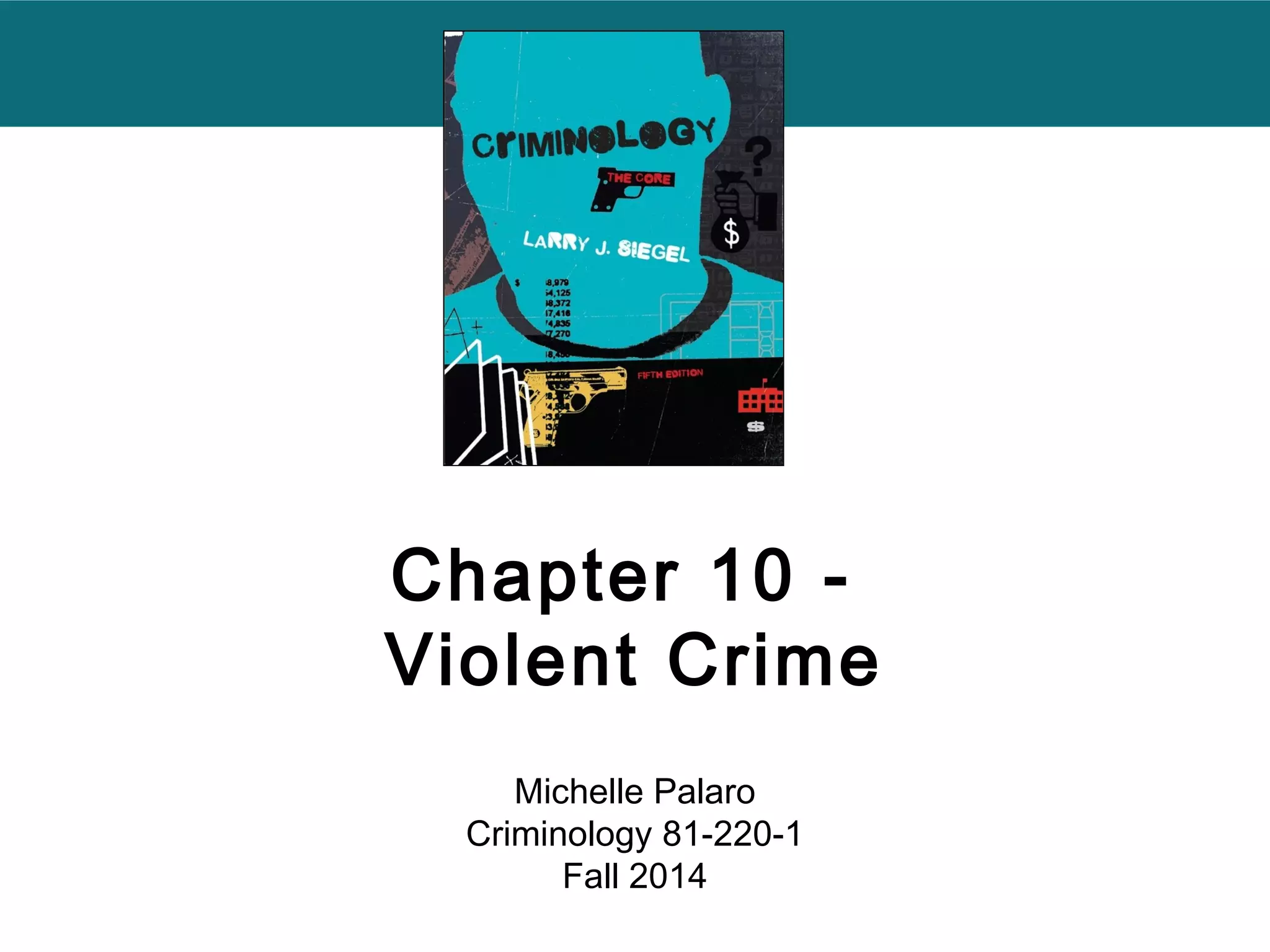
Chapter 10 - 
Violent Crime 
Michelle Palaro 
Criminology 81-220-1 
Fall 2014
Causes of Violence 
• Personal Traits 
• Ineffective Families 
• Human Instinct 
• Exposure to Violence 
• Substance Abuse 
• Firearm Availability 
• Cultural Values 
• National Values
Forcible Rape 
• The carnal knowledge of a female 
forcibly and against her will 
• Not a sexual crime 
• Used as a weapon in war
Incidence of Rape 
• UCR Data 
– 85,000 rapes reported each year 
• Population density influences rape 
• NCVS Data 
– 250,000 rapes and sexual assaults per 
year
Types of Rapes 
• Date Rape 
• Marital Rape 
• Statutory Rape
Causes of Rape 
• Evolutionary/Biological Factors 
• Male Socialization 
• Psychological Abnormality 
• Social Learning 
• Sexual Motivation
Rape and the Law 
• Proving Rape 
• Consent 
• Legal Reform
Class Discussion/Activity 
Read about the Duke rape case on page 266 in your 
textbook. Consider the following as you discuss if the rights 
of the defendants or the rights of the victims should have 
higher priority: 
•Have you heard about people who were accused of rape and then 
acquitted? 
•How did it damage their life (e.g. job, reputation, etc.)? 
•Do you think that the Duke students who were accused will be looked 
at differently even though the charges against them were dropped? 
•What type of evidence would be sufficient in a rape trial to convict the 
defendant? 
•How realistic are these expectations?
Murder and Homicide 
• Degrees of Murder 
– First-Degree 
• Premeditation and Deliberation 
– Second-Degree 
• Malice aforethought 
–Manslaughter 
• Voluntary/non-negligent 
• Involuntary/negligent 
– Deliberate Indifference
Nature and Extent of Murder 
• Since 1991 the murder rate has been steadily 
declining 
• Tends to be an urban crime 
• Victims and offenders tend to be males 
• Over half of murder victims are African- 
Americans 
• Victims and offenders tend to be under 25 years 
old 
• Offenders tend to have long criminal careers 
• “Born and Alive”
Murderous Relations 
• Intimate Partner Murder 
• Acquaintance Murders 
• Stranger Murders 
• Sexually-Based Murders 
• School Murders
Serial Killers, Mass Murderers, and 
Spree Killers 
• Serial Killer 
– A person who kills three or more 
persons in three or more separate 
events 
– Thrill Killers 
–Mission Killers 
– Expedience Killers
Serial Killers, Mass Murderers, and 
Spree Killers 
• Female Serial Killers 
– Female killers tend to be older than their 
male counterparts 
– Female killers tend to be substance 
abusers
Serial Killers, Mass Murderers, and 
Spree Killers 
• Mass Murderers 
– Revenge killers 
– Love killers 
– Profit killers 
– Terrorist killers
Serial Killers, Mass Murderers, and 
Spree Killers 
• Spree Killers 
–A killer of multiple victims whose 
murders occur over a relatively 
short span of time and often 
follow no discernible pattern
Assault and Battery 
• Nature and Extent of Assault 
• Acquaintance and Family Assault 
– Child abuse 
• Neglect 
• Child sexual abuse 
• Causes of child abuse 
– Parental abuse 
– Spousal abuse 
• Dating Violence 
– Relational aggression
Robbery 
• Robbers in Action 
– Robbers select targets that are 
vulnerable, accessible, and profitable 
• Acquaintance Robbery 
– Victims are often reluctant to report 
– Some are motivated by street justice 
– Robbers know patterns and traits of 
victims 
– Victims are often convenient targets
Class Discussion/Activity 
• Why are robberies more likely to occur in 
the winter months? 
• Come up with a plan to rob a bank. 
– How would you ensure that you get the 
money and escape (e.g. how would determine 
which bank to target, etc.)? 
– How do police use their knowledge (including 
GIS) to catch robbers?
Emerging Forms of 
Interpersonal Violence 
• Hate Crimes 
– Roots of hate 
• Thrill-seeking 
• Reactive 
• Mission 
• Retaliatory 
– Nature and extent of hate crimes 
– Controlling hate crimes 
– Free speech
Emerging Forms of 
Interpersonal Violence 
• Workplace Violence 
– Third leading cause of occupational 
death or injury 
• Stalking 
– Women more likely to be stalked than 
men 
– 75% of victims know their stalker in 
some way 
– 30% of stalkers are former intimate 
partners of their victims

81-220-1 Chapter 10

  • 1.
    Chapter 10 - Violent Crime Michelle Palaro Criminology 81-220-1 Fall 2014
  • 2.
    Causes of Violence • Personal Traits • Ineffective Families • Human Instinct • Exposure to Violence • Substance Abuse • Firearm Availability • Cultural Values • National Values
  • 3.
    Forcible Rape •The carnal knowledge of a female forcibly and against her will • Not a sexual crime • Used as a weapon in war
  • 4.
    Incidence of Rape • UCR Data – 85,000 rapes reported each year • Population density influences rape • NCVS Data – 250,000 rapes and sexual assaults per year
  • 5.
    Types of Rapes • Date Rape • Marital Rape • Statutory Rape
  • 6.
    Causes of Rape • Evolutionary/Biological Factors • Male Socialization • Psychological Abnormality • Social Learning • Sexual Motivation
  • 7.
    Rape and theLaw • Proving Rape • Consent • Legal Reform
  • 8.
    Class Discussion/Activity Readabout the Duke rape case on page 266 in your textbook. Consider the following as you discuss if the rights of the defendants or the rights of the victims should have higher priority: •Have you heard about people who were accused of rape and then acquitted? •How did it damage their life (e.g. job, reputation, etc.)? •Do you think that the Duke students who were accused will be looked at differently even though the charges against them were dropped? •What type of evidence would be sufficient in a rape trial to convict the defendant? •How realistic are these expectations?
  • 9.
    Murder and Homicide • Degrees of Murder – First-Degree • Premeditation and Deliberation – Second-Degree • Malice aforethought –Manslaughter • Voluntary/non-negligent • Involuntary/negligent – Deliberate Indifference
  • 10.
    Nature and Extentof Murder • Since 1991 the murder rate has been steadily declining • Tends to be an urban crime • Victims and offenders tend to be males • Over half of murder victims are African- Americans • Victims and offenders tend to be under 25 years old • Offenders tend to have long criminal careers • “Born and Alive”
  • 11.
    Murderous Relations •Intimate Partner Murder • Acquaintance Murders • Stranger Murders • Sexually-Based Murders • School Murders
  • 12.
    Serial Killers, MassMurderers, and Spree Killers • Serial Killer – A person who kills three or more persons in three or more separate events – Thrill Killers –Mission Killers – Expedience Killers
  • 13.
    Serial Killers, MassMurderers, and Spree Killers • Female Serial Killers – Female killers tend to be older than their male counterparts – Female killers tend to be substance abusers
  • 14.
    Serial Killers, MassMurderers, and Spree Killers • Mass Murderers – Revenge killers – Love killers – Profit killers – Terrorist killers
  • 15.
    Serial Killers, MassMurderers, and Spree Killers • Spree Killers –A killer of multiple victims whose murders occur over a relatively short span of time and often follow no discernible pattern
  • 16.
    Assault and Battery • Nature and Extent of Assault • Acquaintance and Family Assault – Child abuse • Neglect • Child sexual abuse • Causes of child abuse – Parental abuse – Spousal abuse • Dating Violence – Relational aggression
  • 17.
    Robbery • Robbersin Action – Robbers select targets that are vulnerable, accessible, and profitable • Acquaintance Robbery – Victims are often reluctant to report – Some are motivated by street justice – Robbers know patterns and traits of victims – Victims are often convenient targets
  • 18.
    Class Discussion/Activity •Why are robberies more likely to occur in the winter months? • Come up with a plan to rob a bank. – How would you ensure that you get the money and escape (e.g. how would determine which bank to target, etc.)? – How do police use their knowledge (including GIS) to catch robbers?
  • 19.
    Emerging Forms of Interpersonal Violence • Hate Crimes – Roots of hate • Thrill-seeking • Reactive • Mission • Retaliatory – Nature and extent of hate crimes – Controlling hate crimes – Free speech
  • 20.
    Emerging Forms of Interpersonal Violence • Workplace Violence – Third leading cause of occupational death or injury • Stalking – Women more likely to be stalked than men – 75% of victims know their stalker in some way – 30% of stalkers are former intimate partners of their victims

Editor's Notes

  • #3 LO1: Be familiar with the various causes of violent crime.
  • #4 LO2: Define rape and be familiar with why men commit rape.
  • #5 LO2: Define rape and be familiar with why men commit rape.
  • #6 LO2: Define rape and be familiar with why men commit rape.
  • #7 LO2: Define rape and be familiar with why men commit rape.
  • #8 LO3: Discuss the issues involving rape and the law.
  • #10 LO4: Recognize that there are different types of murder.
  • #11 LO4: Recognize that there are different types of murder.
  • #12 LO4: Recognize that there are different types of murder.
  • #13 LO4: Recognize that there are different types of murder.
  • #14 LO4: Recognize that there are different types of murder.
  • #15 LO4: Recognize that there are different types of murder.
  • #16 LO4: Recognize that there are different types of murder.
  • #17 LO5: Understand the nature and patterns of robbery.
  • #18 LO5: Understand the nature and patterns of robbery.
  • #20 LO6: Be able to discuss newly emerging forms of violence, such as stalking, hate crimes, and workplace violence.
  • #21 LO6: Be able to discuss newly emerging forms of violence, such as stalking, hate crimes, and workplace violence.