 
Michelle Palaro
CJUS 2360
Fall 2015
Chapter 9
Conducting
Constitutional
Searches
 What are the fundamental rules of search and
seizure under the 4th Amendment?
1. There must be governmental action
2. The person making the challenge must have standing,
that is, the conduct violates the challenger’s
reasonable expectation of privacy
 A situation in which (1) a person has exhibited actual
(subjective) expectation of privacy and (2) that expectation is
one that society is prepared to recognize as reasonable
 Often an implied right that falls within the shadow of other
specified rights (penumbra)
3. General searches are unlawful and restrict the
government from going beyond what is necessary
 Unrestrained general searches offend our
sense of justice
 All searches must be limited in scope
 General searches are unconstitutional
and never legal
 All searches with a warrant must be
based on:
o Probable cause
o Supported by oath and affirmation
o Particularly describing the place to be
searched, and
o The persons or things to be seized
 Facts: Prohibition agents had a warrant for intoxicating
liquor and their manufacture. They noticed a ledger
showing inventories of liquors, receipts, expenses,
including gifts to police officers, and other things relating
to the business
 Issues: Can the ledger be seized since it wasn't listed
on the warrant?
 Holding: Yes
 Rationale: The ledger was closely related to the
business of the illegal business
 https://www.law.cornell.edu/supremecourt/text/275/192
 New York v. Belton (1981)
o Landmark case for the warrantless search of a
vehicle incident to arrest
• Court held that when an officer has made a lawful custodial
arrest of the occupant of an automobile, he may search the
passenger compartment
• He may also examine the contents of any containers found
within the compartment
• If the container is within reach of the arrestee, so also will
containers in it be within his reach
o http://en.wikipedia.org/wiki/New_York_v._Belton
 After officers have obtained their search warrant
they must execute it in a timely manner
 They must not use excessive force to execute
the warrant
 There is limited authority to detain the
occupants of the premises during the search
 Officers can only search the areas where they
reasonably believe the specified items might be
found
 If the warrant states only one specific item be
sought, once it is located, the search must end
 Officers often are protected with qualified
immunity
o Exemption of a public official from civil liability for
actions performed during the course of his or her job
unless they violate a “clearly established”
constitutional or statutory right
 The government can also seize any contraband
or other evidence of a crime found during a
search with a warrant, even though it was not
specified
o Contraband is anything that is illegal for people to
own or have in their possession
 The contraband does not need to be described
in the warrant or be related to the crime
described in the warrant
o Plain view doctrine
 Allows civil inspections of private property
to determine compliance with government
rules, regulations and city ordinances
o Examples include fire building codes
 These can also be obtained so
government agents can conduct routine
inspections when occupants refuse their
entry
 Facts: Police visited Biswell, a pawn shop operator who was federally
licensed to deal in sporting weapons. They identified themselves,
inspected Biswell's books and requested entry into a locked gun
storeroom. Biswell asked whether the agents had a search warrant,
and the principle investigator responded that they did not, but that
section 923(g) of the Gun Control Act of 1968 authorized such
inspections without a search warrant. There the agents found and
seized two sawed-off rifles, items Biswell was not licensed to possess
 Issues: Did the warrantless search violate the Fourth Amendment?
 Holding: No
 Rationale: Inspections pertaining to the sale of illegal firearms are
justified and that limited threats such as this inspection to the gun
dealer’s expectation of privacy are reasonable
 http://caselaw.lp.findlaw.com/scripts/getcase.pl?court=US&vol=406&inv
ol=311
 The 4th Amendment prefers a warrant because it
necessitates judicial review of government action
 The Supreme Court has defined some searches without
a warrant to be reasonable under the 4th Amendment
guidelines:
o Consent search
o Frisks
o Plain feel/plain view
o Incident to arrest
o Automobile exception
o Exigent (emergency) circumstances
o Open fields
o Abandoned property
o Public places
 If an individual gives voluntary consent for the police to
search, the police may so without a warrant
 Any evidence found will be admissible in court
 The person may revoke the search at anytime
 Only the person whose constitutional rights might be
threatened by a search can give consent
 4th Amendment rights are specific to the person and
may not be raised on behalf of someone else or in
some abstract, theoretical way
 Consent to search an individual must be given by that
individual
 Facts: The home that a robbery suspect was leasing was
searched by the police after obtaining the consent to enter
the home from somebody who lived with the suspect
 Issues: Was the consent valid under the 4th Amendment?
 Holding: Yes
 Rationale: The Court observed that recent decisions
“clearly indicate that the consent of one who possesses
common authority over premises or effects is valid as
against the absent, non-consenting person with whom that
authority is shared”
 http://www.casebriefs.com/blog/law/criminal-procedure/criminal-procedure-
keyed-to-weinreb/the-fourth-amendment-arrest-and-search-and-seizure/united-
states-v-matlock/
 Examples of instances when individuals
cannot give valid consent to search:
o Landlord/tenant
• Even though the landlord is the legal owner, they
lack the authority to offer consent to a search of a
tenant’s premises or a seizure of the tenant’s
property
o Hotel employee/hotel guest
• Supreme Court extended the principles above to
hotel employees as well
• Only the tenant or hotel guest can give consent
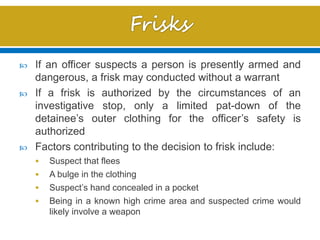
 If an officer suspects a person is presently armed and
dangerous, a frisk may conducted without a warrant
 If a frisk is authorized by the circumstances of an
investigative stop, only a limited pat-down of the
detainee’s outer clothing for the officer’s safety is
authorized
 Factors contributing to the decision to frisk include:
 Suspect that flees
 A bulge in the clothing
 Suspect’s hand concealed in a pocket
 Being in a known high crime area and suspected crime would
likely involve a weapon
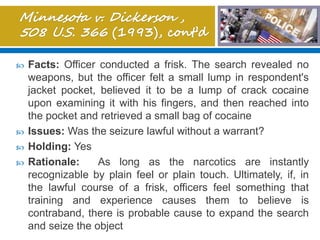
 Facts: Officer conducted a frisk. The search revealed no
weapons, but the officer felt a small lump in respondent's
jacket pocket, believed it to be a lump of crack cocaine
upon examining it with his fingers, and then reached into
the pocket and retrieved a small bag of cocaine
 Issues: Was the seizure lawful without a warrant?
 Holding: Yes
 Rationale: As long as the narcotics are instantly
recognizable by plain feel or plain touch. Ultimately, if, in
the lawful course of a frisk, officers feel something that
training and experience causes them to believe is
contraband, there is probable cause to expand the search
and seize the object
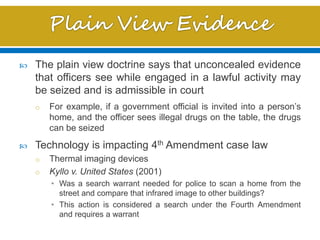
 The plain view doctrine says that unconcealed evidence
that officers see while engaged in a lawful activity may
be seized and is admissible in court
o For example, if a government official is invited into a person’s
home, and the officer sees illegal drugs on the table, the drugs
can be seized
 Technology is impacting 4th Amendment case law
o Thermal imaging devices
o Kyllo v. United States (2001)
• Was a search warrant needed for police to scan a home from the
street and compare that infrared image to other buildings?
• This action is considered a search under the Fourth Amendment
and requires a warrant
 Once a person has been lawfully taken into custody by the
police, U.S. law recognizes the necessity of permitting a
complete search for two reasons:
1. Officer safety
2. Evidence and other contraband should be recovered
 Chimel v. California (1969) – next slide
o Searches after an arrest must be immediate and must be limited to
the area within the person’s wingspan
• The area within a person’s reach or immediate control
 Schmerber v. California (1966)
o Absent the exigent circumstances, a search intrusive as drawing
blood would not be permissible without a warrant
o http://en.wikipedia.org/wiki/Schmerber_v._California
 This exception states that if a governmental
agent has probable cause to believe the vehicle
contains contraband or evidence or a crime, no
warrant is needed
 Why?
o Cars are mobile
o In the time it would take to get a warrant, the
car, driver and contraband or evidence could
be long gone
 Facts: Prohibition officers saw Carroll, suspected of alcohol sales,
driving on the highway. They gave chase, pulled them over,
searched the car and found illegal liquor. The National Prohibition
Act allowed warrantless searches of vehicles for alcohol
 Issues: Was a warrant necessary?
 Holding: No.
 Rationale: Vehicles are more mobile than homes and justify
different rules. They can be searched without a warrant provided:
1. There is probable cause to believe the vehicle’s contents
violate the law, and
2. The vehicle would be gone before a search warrant could be
obtained
 For an officer to search a vehicle without a warrant, they must have
probable cause to believe the vehicle contains contraband or
evidence
 The courts have recognized that sometimes situations
will arise that reasonably require immediate action
before evidence may be destroyed
 These circumstances include:
o Danger or physical harm to officer or others
o Danger or destruction of evidence
o Driving while intoxicated
o Hot-pursuit situations
o Individuals requiring rescuing and emergency aid
o Prevent escape
 The courts have extended the plain view doctrine
stating that anything held out to the public is not
protected by the 4th Amendment because no reasonable
expectation of privacy exists
 “Open fields” - Holds that land beyond that normally
associated with the use of that land, that is,
undeveloped land, can be searched without a warrant
 California v. Ciraolo (1986)
o Police looking from the air into a suspect’s backyard does not
violate the 4th Amendment because it is open to public view
from the air
o http://en.wikipedia.org/wiki/California_v._Ciraolo
 Searches of persons, belongings and vehicles
at international borders are reasonable under
the 4th Amendment
 The farther a person gets from the border, the
more traditional search and seizure
requirements come back into play
 United States v. Montoya de Hernandez (1985)
o Routine searches at a U.S. international border require no
objective justification, probable cause or warrant
o http://en.wikipedia.org/wiki/United_States_v._Montoya_De_Her
nandez
 Quinones-Ruiz v. United States (1994)
o The border search exception applies equally to persons
entering or exiting the country
o http://law.justia.com/cases/federal/district-
courts/FSupp/873/359/1466404/
 These are limited searches that the court
considers reasonable because societal needs
are thought to outweigh the individual’s normal
expectation of privacy:
o Administrative searches of closely regulated
businesses
o Public school searches
o Prison, Probation, and Parole searches
o Drug testing
o Community caretaking searches
 Electronic eavesdropping to searches of people, their
luggage, where they live, and their bodies, homes, hotel
rooms, businesses, obtaining evidence from a person’s
body (urine testing), or surgical removal of a bullet
lodged within a person are all cases that have been
held to constitute searches under the 4th Amendment
 Physical presence is not required to constitute a search
 In each case, the person has a reasonable expectation
of privacy
o As such, a warrant is generally required
 Title III of the Omnibus Crime Control and Safe Streets
Act of 1965
o Prohibits the interception of phone conversations unless one
party to the conversation consents
 To obtain an electronic-surveillance warrant, or wiretap
order, probable cause that a person is engaging in
particular communications must be established by the
court, and normal investigative procedures must have
already been tried

Constitutional Issues - Chapter 9

  • 1.
      Michelle Palaro CJUS2360 Fall 2015 Chapter 9 Conducting Constitutional Searches
  • 2.
     What arethe fundamental rules of search and seizure under the 4th Amendment? 1. There must be governmental action 2. The person making the challenge must have standing, that is, the conduct violates the challenger’s reasonable expectation of privacy  A situation in which (1) a person has exhibited actual (subjective) expectation of privacy and (2) that expectation is one that society is prepared to recognize as reasonable  Often an implied right that falls within the shadow of other specified rights (penumbra) 3. General searches are unlawful and restrict the government from going beyond what is necessary
  • 3.
     Unrestrained generalsearches offend our sense of justice  All searches must be limited in scope  General searches are unconstitutional and never legal
  • 4.
     All searcheswith a warrant must be based on: o Probable cause o Supported by oath and affirmation o Particularly describing the place to be searched, and o The persons or things to be seized
  • 5.
     Facts: Prohibitionagents had a warrant for intoxicating liquor and their manufacture. They noticed a ledger showing inventories of liquors, receipts, expenses, including gifts to police officers, and other things relating to the business  Issues: Can the ledger be seized since it wasn't listed on the warrant?  Holding: Yes  Rationale: The ledger was closely related to the business of the illegal business  https://www.law.cornell.edu/supremecourt/text/275/192
  • 6.
     New Yorkv. Belton (1981) o Landmark case for the warrantless search of a vehicle incident to arrest • Court held that when an officer has made a lawful custodial arrest of the occupant of an automobile, he may search the passenger compartment • He may also examine the contents of any containers found within the compartment • If the container is within reach of the arrestee, so also will containers in it be within his reach o http://en.wikipedia.org/wiki/New_York_v._Belton
  • 7.
     After officershave obtained their search warrant they must execute it in a timely manner  They must not use excessive force to execute the warrant  There is limited authority to detain the occupants of the premises during the search
  • 8.
     Officers canonly search the areas where they reasonably believe the specified items might be found  If the warrant states only one specific item be sought, once it is located, the search must end  Officers often are protected with qualified immunity o Exemption of a public official from civil liability for actions performed during the course of his or her job unless they violate a “clearly established” constitutional or statutory right
  • 9.
     The governmentcan also seize any contraband or other evidence of a crime found during a search with a warrant, even though it was not specified o Contraband is anything that is illegal for people to own or have in their possession  The contraband does not need to be described in the warrant or be related to the crime described in the warrant o Plain view doctrine
  • 10.
     Allows civilinspections of private property to determine compliance with government rules, regulations and city ordinances o Examples include fire building codes  These can also be obtained so government agents can conduct routine inspections when occupants refuse their entry
  • 11.
     Facts: Policevisited Biswell, a pawn shop operator who was federally licensed to deal in sporting weapons. They identified themselves, inspected Biswell's books and requested entry into a locked gun storeroom. Biswell asked whether the agents had a search warrant, and the principle investigator responded that they did not, but that section 923(g) of the Gun Control Act of 1968 authorized such inspections without a search warrant. There the agents found and seized two sawed-off rifles, items Biswell was not licensed to possess  Issues: Did the warrantless search violate the Fourth Amendment?  Holding: No  Rationale: Inspections pertaining to the sale of illegal firearms are justified and that limited threats such as this inspection to the gun dealer’s expectation of privacy are reasonable  http://caselaw.lp.findlaw.com/scripts/getcase.pl?court=US&vol=406&inv ol=311
  • 12.
     The 4thAmendment prefers a warrant because it necessitates judicial review of government action  The Supreme Court has defined some searches without a warrant to be reasonable under the 4th Amendment guidelines: o Consent search o Frisks o Plain feel/plain view o Incident to arrest o Automobile exception o Exigent (emergency) circumstances o Open fields o Abandoned property o Public places
  • 13.
     If anindividual gives voluntary consent for the police to search, the police may so without a warrant  Any evidence found will be admissible in court  The person may revoke the search at anytime  Only the person whose constitutional rights might be threatened by a search can give consent  4th Amendment rights are specific to the person and may not be raised on behalf of someone else or in some abstract, theoretical way  Consent to search an individual must be given by that individual
  • 14.
     Facts: Thehome that a robbery suspect was leasing was searched by the police after obtaining the consent to enter the home from somebody who lived with the suspect  Issues: Was the consent valid under the 4th Amendment?  Holding: Yes  Rationale: The Court observed that recent decisions “clearly indicate that the consent of one who possesses common authority over premises or effects is valid as against the absent, non-consenting person with whom that authority is shared”  http://www.casebriefs.com/blog/law/criminal-procedure/criminal-procedure- keyed-to-weinreb/the-fourth-amendment-arrest-and-search-and-seizure/united- states-v-matlock/
  • 15.
     Examples ofinstances when individuals cannot give valid consent to search: o Landlord/tenant • Even though the landlord is the legal owner, they lack the authority to offer consent to a search of a tenant’s premises or a seizure of the tenant’s property o Hotel employee/hotel guest • Supreme Court extended the principles above to hotel employees as well • Only the tenant or hotel guest can give consent
  • 16.
     If anofficer suspects a person is presently armed and dangerous, a frisk may conducted without a warrant  If a frisk is authorized by the circumstances of an investigative stop, only a limited pat-down of the detainee’s outer clothing for the officer’s safety is authorized  Factors contributing to the decision to frisk include:  Suspect that flees  A bulge in the clothing  Suspect’s hand concealed in a pocket  Being in a known high crime area and suspected crime would likely involve a weapon
  • 18.
     Facts: Officerconducted a frisk. The search revealed no weapons, but the officer felt a small lump in respondent's jacket pocket, believed it to be a lump of crack cocaine upon examining it with his fingers, and then reached into the pocket and retrieved a small bag of cocaine  Issues: Was the seizure lawful without a warrant?  Holding: Yes  Rationale: As long as the narcotics are instantly recognizable by plain feel or plain touch. Ultimately, if, in the lawful course of a frisk, officers feel something that training and experience causes them to believe is contraband, there is probable cause to expand the search and seize the object
  • 19.
     The plainview doctrine says that unconcealed evidence that officers see while engaged in a lawful activity may be seized and is admissible in court o For example, if a government official is invited into a person’s home, and the officer sees illegal drugs on the table, the drugs can be seized  Technology is impacting 4th Amendment case law o Thermal imaging devices o Kyllo v. United States (2001) • Was a search warrant needed for police to scan a home from the street and compare that infrared image to other buildings? • This action is considered a search under the Fourth Amendment and requires a warrant
  • 21.
     Once aperson has been lawfully taken into custody by the police, U.S. law recognizes the necessity of permitting a complete search for two reasons: 1. Officer safety 2. Evidence and other contraband should be recovered  Chimel v. California (1969) – next slide o Searches after an arrest must be immediate and must be limited to the area within the person’s wingspan • The area within a person’s reach or immediate control  Schmerber v. California (1966) o Absent the exigent circumstances, a search intrusive as drawing blood would not be permissible without a warrant o http://en.wikipedia.org/wiki/Schmerber_v._California
  • 23.
     This exceptionstates that if a governmental agent has probable cause to believe the vehicle contains contraband or evidence or a crime, no warrant is needed  Why? o Cars are mobile o In the time it would take to get a warrant, the car, driver and contraband or evidence could be long gone
  • 25.
     Facts: Prohibitionofficers saw Carroll, suspected of alcohol sales, driving on the highway. They gave chase, pulled them over, searched the car and found illegal liquor. The National Prohibition Act allowed warrantless searches of vehicles for alcohol  Issues: Was a warrant necessary?  Holding: No.  Rationale: Vehicles are more mobile than homes and justify different rules. They can be searched without a warrant provided: 1. There is probable cause to believe the vehicle’s contents violate the law, and 2. The vehicle would be gone before a search warrant could be obtained  For an officer to search a vehicle without a warrant, they must have probable cause to believe the vehicle contains contraband or evidence
  • 26.
     The courtshave recognized that sometimes situations will arise that reasonably require immediate action before evidence may be destroyed  These circumstances include: o Danger or physical harm to officer or others o Danger or destruction of evidence o Driving while intoxicated o Hot-pursuit situations o Individuals requiring rescuing and emergency aid o Prevent escape
  • 27.
     The courtshave extended the plain view doctrine stating that anything held out to the public is not protected by the 4th Amendment because no reasonable expectation of privacy exists  “Open fields” - Holds that land beyond that normally associated with the use of that land, that is, undeveloped land, can be searched without a warrant  California v. Ciraolo (1986) o Police looking from the air into a suspect’s backyard does not violate the 4th Amendment because it is open to public view from the air o http://en.wikipedia.org/wiki/California_v._Ciraolo
  • 28.
     Searches ofpersons, belongings and vehicles at international borders are reasonable under the 4th Amendment  The farther a person gets from the border, the more traditional search and seizure requirements come back into play
  • 29.
     United Statesv. Montoya de Hernandez (1985) o Routine searches at a U.S. international border require no objective justification, probable cause or warrant o http://en.wikipedia.org/wiki/United_States_v._Montoya_De_Her nandez  Quinones-Ruiz v. United States (1994) o The border search exception applies equally to persons entering or exiting the country o http://law.justia.com/cases/federal/district- courts/FSupp/873/359/1466404/
  • 30.
     These arelimited searches that the court considers reasonable because societal needs are thought to outweigh the individual’s normal expectation of privacy: o Administrative searches of closely regulated businesses o Public school searches o Prison, Probation, and Parole searches o Drug testing o Community caretaking searches
  • 31.
     Electronic eavesdroppingto searches of people, their luggage, where they live, and their bodies, homes, hotel rooms, businesses, obtaining evidence from a person’s body (urine testing), or surgical removal of a bullet lodged within a person are all cases that have been held to constitute searches under the 4th Amendment  Physical presence is not required to constitute a search  In each case, the person has a reasonable expectation of privacy o As such, a warrant is generally required
  • 32.
     Title IIIof the Omnibus Crime Control and Safe Streets Act of 1965 o Prohibits the interception of phone conversations unless one party to the conversation consents  To obtain an electronic-surveillance warrant, or wiretap order, probable cause that a person is engaging in particular communications must be established by the court, and normal investigative procedures must have already been tried

Editor's Notes

  • #6 Opinion at http://supreme.justia.com/cases/federal/us/275/192/case.html
  • #12 Opinion at http://supreme.justia.com/cases/federal/us/406/311/
  • #15 Opinion at http://caselaw.lp.findlaw.com/scripts/getcase.pl?court=us&vol=415&invol=164
  • #19 Opinion at http://caselaw.lp.findlaw.com/scripts/getcase.pl?court=US&vol=508&invol=366
  • #26 Opinion at http://supreme.justia.com/cases/federal/us/267/132/case.html