Amending the U.S. Constitution Objective 2.04
Bill of Rights 1 st  10 Amendments to the U.S. Constitution Objective 1.07
Amendment I Freedoms of: R: Religion A: Assembly P: Petition P: Press S: Speech
Limits Freedom of Speech Cannot provoke riots Cannot speak or write in a way that immediately leads to criminal activity or efforts to overthrow the government Cannot spread lies to hurt ones reputation Slander: spoken lies Libel: printed lies
Limits on Freedom of Religion Government Establishment Clause – government may not establish an official religion Free Exercise Clause – government may not prohibit people from exercising (practicing) their religion People May not break laws with religion
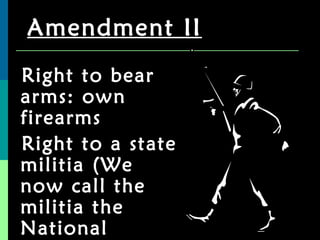
Amendment II Right to bear arms: own firearms Right to a state militia (We now call the militia the National Guard)
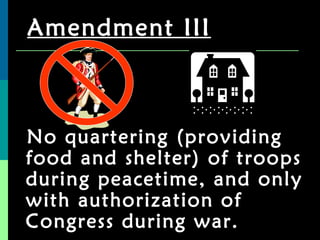
Amendment III No quartering (providing food and shelter) of troops during peacetime, and only with authorization of Congress during war.
Amendment IV  No illegal search and seizure (the searching and taking of items) Search warrant must be provided, unless probable cause is evident
Amendment V 1. Cannot be put on trial for a crime w/o a formal charge by a grand jury. 2. Protection from double jeopardy, being put on trial for the same charge twice. 3. Right to remain silent (plead the 5 th ), cannot be forced to perform self-incrimination (testify against themselves) 4. May not be denied “life, liberty, or property” w/o due process (following established legal procedures) 5. Limits powers of eminent domain, the right of the government to take private property for public use
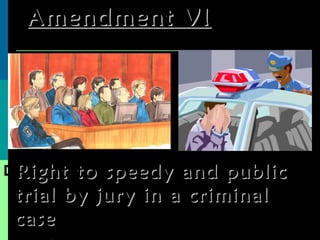
Amendment VI Right to speedy and public trial by jury in a criminal case Right to an attorney
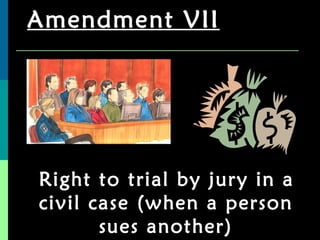
Amendment VII Right to trial by jury in a civil case (when a person sues another)
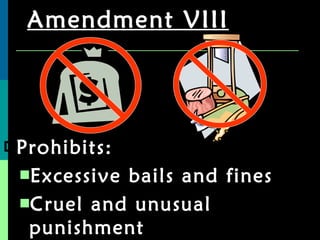
Amendment VIII Prohibits: Excessive bails and fines Cruel and unusual punishment
Amendment IX Any rights not listed are still protected Example: privacy, government interference with our personal lives
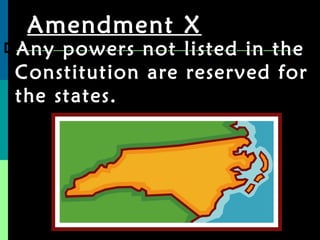
Amendment X Any powers not listed in the Constitution are reserved for the states.
11 th  Amendment (1795) Limits suits brought against states Citizens of one state cannot bring a lawsuit against another state
12 th  Amendment (1804) Electoral College must vote for President and V.P. separately No more 1 st  and 2 nd  place winners
13 th  Amendment (1865) Bans slavery and forced labor NOT the same as the Emancipation Proclamation!
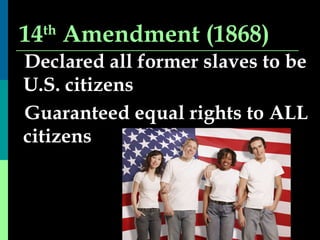
14 th  Amendment (1868) Declared all former slaves to be U.S. citizens Guaranteed equal rights to ALL citizens
15 th  Amendment (1870) Stated that race cannot be used to deny voting rights, in other words, African Americans were given the right to vote
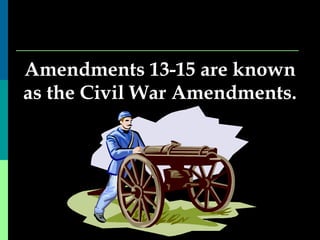
Amendments 13-15 are known as the Civil War Amendments.
16 th  Amendment (1895) Gives the authority for the federal government to collect income taxes
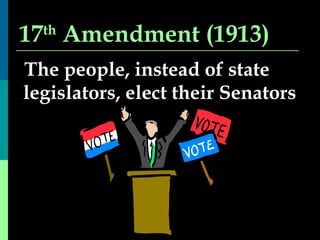
17 th  Amendment (1913) The people, instead of state legislators, elect their Senators
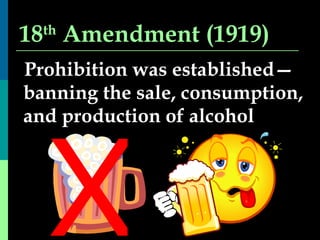
18 th  Amendment (1919) Prohibition was established—banning the sale, consumption, and production of alcohol X
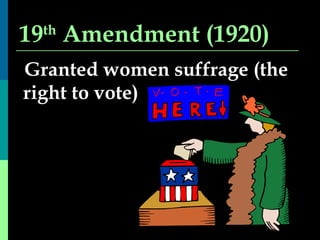
19 th  Amendment (1920) Granted women suffrage (the right to vote)
20 th  Amendment (1933) Set new date for Congress to begin its term (Jan. 3 rd ) and for the inauguration of the President and V.P. (Jan. 20 th )
21 st  Amendment (1933) Repealed (got rid of) the prohibition of alcohol
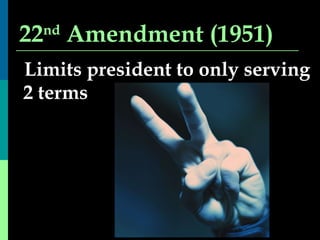
22 nd  Amendment (1951) Limits president to only serving 2 terms
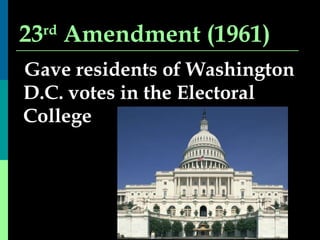
23 rd  Amendment (1961) Gave residents of Washington D.C. votes in the Electoral College
24 th  Amendment (1964) Prohibits poll taxes so that even the poor can vote
25 th  Amendment (1967) Defines the succession of the president How a new V.P. is named if the president dies
26 th  Amendment (1971) Lowered the voting age to 18
27 th  Amendment (1992) Members of Congress cannot get pay raises until the beginning of a new term Took 74,003 days to pass!

Amendments pp

  • 1.
    Amending the U.S.Constitution Objective 2.04
  • 2.
    Bill of Rights1 st 10 Amendments to the U.S. Constitution Objective 1.07
  • 3.
    Amendment I Freedomsof: R: Religion A: Assembly P: Petition P: Press S: Speech
  • 4.
    Limits Freedom ofSpeech Cannot provoke riots Cannot speak or write in a way that immediately leads to criminal activity or efforts to overthrow the government Cannot spread lies to hurt ones reputation Slander: spoken lies Libel: printed lies
  • 5.
    Limits on Freedomof Religion Government Establishment Clause – government may not establish an official religion Free Exercise Clause – government may not prohibit people from exercising (practicing) their religion People May not break laws with religion
  • 6.
    Amendment II Rightto bear arms: own firearms Right to a state militia (We now call the militia the National Guard)
  • 7.
    Amendment III Noquartering (providing food and shelter) of troops during peacetime, and only with authorization of Congress during war.
  • 8.
    Amendment IV No illegal search and seizure (the searching and taking of items) Search warrant must be provided, unless probable cause is evident
  • 9.
    Amendment V 1.Cannot be put on trial for a crime w/o a formal charge by a grand jury. 2. Protection from double jeopardy, being put on trial for the same charge twice. 3. Right to remain silent (plead the 5 th ), cannot be forced to perform self-incrimination (testify against themselves) 4. May not be denied “life, liberty, or property” w/o due process (following established legal procedures) 5. Limits powers of eminent domain, the right of the government to take private property for public use
  • 10.
    Amendment VI Rightto speedy and public trial by jury in a criminal case Right to an attorney
  • 11.
    Amendment VII Rightto trial by jury in a civil case (when a person sues another)
  • 12.
    Amendment VIII Prohibits:Excessive bails and fines Cruel and unusual punishment
  • 13.
    Amendment IX Anyrights not listed are still protected Example: privacy, government interference with our personal lives
  • 14.
    Amendment X Anypowers not listed in the Constitution are reserved for the states.
  • 15.
    11 th Amendment (1795) Limits suits brought against states Citizens of one state cannot bring a lawsuit against another state
  • 16.
    12 th Amendment (1804) Electoral College must vote for President and V.P. separately No more 1 st and 2 nd place winners
  • 17.
    13 th Amendment (1865) Bans slavery and forced labor NOT the same as the Emancipation Proclamation!
  • 18.
    14 th Amendment (1868) Declared all former slaves to be U.S. citizens Guaranteed equal rights to ALL citizens
  • 19.
    15 th Amendment (1870) Stated that race cannot be used to deny voting rights, in other words, African Americans were given the right to vote
  • 20.
    Amendments 13-15 areknown as the Civil War Amendments.
  • 21.
    16 th Amendment (1895) Gives the authority for the federal government to collect income taxes
  • 22.
    17 th Amendment (1913) The people, instead of state legislators, elect their Senators
  • 23.
    18 th Amendment (1919) Prohibition was established—banning the sale, consumption, and production of alcohol X
  • 24.
    19 th Amendment (1920) Granted women suffrage (the right to vote)
  • 25.
    20 th Amendment (1933) Set new date for Congress to begin its term (Jan. 3 rd ) and for the inauguration of the President and V.P. (Jan. 20 th )
  • 26.
    21 st Amendment (1933) Repealed (got rid of) the prohibition of alcohol
  • 27.
    22 nd Amendment (1951) Limits president to only serving 2 terms
  • 28.
    23 rd Amendment (1961) Gave residents of Washington D.C. votes in the Electoral College
  • 29.
    24 th Amendment (1964) Prohibits poll taxes so that even the poor can vote
  • 30.
    25 th Amendment (1967) Defines the succession of the president How a new V.P. is named if the president dies
  • 31.
    26 th Amendment (1971) Lowered the voting age to 18
  • 32.
    27 th Amendment (1992) Members of Congress cannot get pay raises until the beginning of a new term Took 74,003 days to pass!