 
Michelle Palaro
CJUS 2360
Fall 2015
Chapter 2
An Overview of the
U.S. Legal System
 Throughout history, law has regulated human
interactions for different reasons:
o Protect society’s interests
o Deter antisocial behavior
o Enforce moral beliefs
o Uphold individual rights
o Support those in power
o Punish lawbreakers
o Seek retribution for wrongdoing
 Consensus Theory (Plato and Aristotle)
o Holds that individuals in a society agree on basic
values, on what is inherently right and wrong, and
that laws express these values
o Social contract exists where individuals agree to give
up a portion of their individual freedom to benefit the
security of the group
 Conflict Theory (Karl Marx)
o Holds that laws are established to keep the dominant
class in power
o Explains how laws protect the interests and values of
the dominant groups in society
 Purpose of criminal justice system often discussed in
terms of the Crime Control Model and the Due Process
Model
1. The Crime Control Model:
o Emphasizes the repression of criminal conduct.
o Criminal justice system must bring criminal behavior under tight
control.
2. The Due Process Model:
o Emphasizes the rights of the individual
o Rests on the presumption of innocence
o Individual rights are not to be sacrificed for the sake of efficiency
 The basic purpose of the legal system is:
o To ensure fairness in balancing individual
and society rights and needs, while
preventing excessive government power
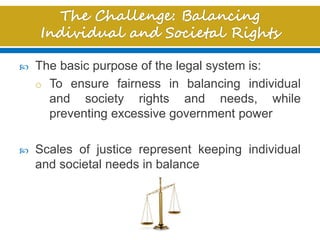
 Scales of justice represent keeping individual
and societal needs in balance
 Early English judge-made law, based on custom and
tradition that was followed throughout the country is
known as Common Law
 Royal judges traveled through territories to apply a
broader or national norm as cases were decided. Law
became more common throughout the country
 It is synonymous in American law with case law - based
on previous cases
 Common law depends heavily on precedent
(prior cases) and the doctrine of stare
decisis
o Latin for “let the decision stand”
o Requires that decisions in one case shall
be followed in all later cases having the
same or similar circumstances
o This ensures consistency in the law
 The purpose of the Constitution
remains to ensure individual liberty by
limiting government power
 The law itself controls government by
restricting how and when government
can and cannot interfere with citizen’s
lives
 Human nature dictates that different needs are
perceived at different times
o Effective law should be flexible enough to
respond to these changes
 American law is referred to as a living law,
because it is not stagnant
o It can change, expand or rescinded (repeal)
to serve the overall system
 Statutory law - laws set by legislatures or
governing bodies having jurisdiction to make
such law
o Statutory law can be referred as codified law
o Codified law - law specifically set forth in
organized, structured codes such as the US
criminal code, state statutes, or local ordinances
o Ordinances - laws or codes established at the
local level (the municipal or county level)
 No statutory law can violate the Constitution
 Who is the victim? Is it a public wrong (criminal)
or a private wrong (civil)?
 The victim in criminal law is the community,
because it disrupts the community. Society’s
welfare has been violated
o This is why the government’s name,
representing the people, versus the
defendant appears on court docket
• Ex. US v. Smith, State of Florida v. Smith
 Brief video on case:
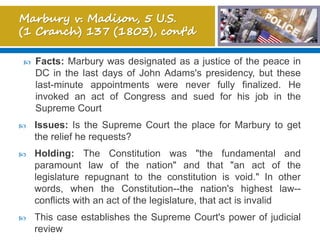
 Facts: Marbury was designated as a justice of the peace in
DC in the last days of John Adams's presidency, but these
last-minute appointments were never fully finalized. He
invoked an act of Congress and sued for his job in the
Supreme Court
 Issues: Is the Supreme Court the place for Marbury to get
the relief he requests?
 Holding: The Constitution was "the fundamental and
paramount law of the nation" and that "an act of the
legislature repugnant to the constitution is void." In other
words, when the Constitution--the nation's highest law--
conflicts with an act of the legislature, that act is invalid
 This case establishes the Supreme Court's power of judicial
review
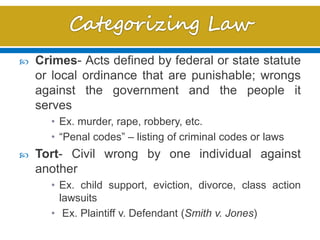
 Crimes- Acts defined by federal or state statute
or local ordinance that are punishable; wrongs
against the government and the people it
serves
• Ex. murder, rape, robbery, etc.
• “Penal codes” – listing of criminal codes or laws
 Tort- Civil wrong by one individual against
another
• Ex. child support, eviction, divorce, class action
lawsuits
• Ex. Plaintiff v. Defendant (Smith v. Jones)
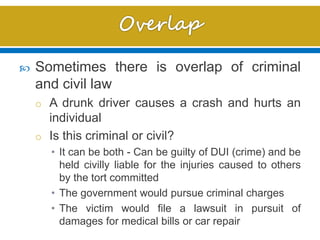
 Sometimes there is overlap of criminal
and civil law
o A drunk driver causes a crash and hurts an
individual
o Is this criminal or civil?
• It can be both - Can be guilty of DUI (crime) and be
held civilly liable for the injuries caused to others
by the tort committed
• The government would pursue criminal charges
• The victim would file a lawsuit in pursuit of
damages for medical bills or car repair
 A legal citation is a standardized way of referring to a
specific element in the law
 It has three basic parts:
o A volume number
o An abbreviation for the title
o A page or section number
 For example, the official cite for the Miranda case is
Miranda v. Arizona, 384 U.S. 436 (1966)
 Sometimes additional cites, known as string cites
(parallel citations), are given
o A string cite for this case would be Miranda v, Arizona,
384 U.S. 436, 86 S.Ct 1502, 16 L.Ed. 694 (1966)
 A legal opinion usually contains:
o A description of the facts
o A statement of the legal issues presented
o The relevant rules of law
o The holding
o The policies and reasons that support the holding
 The holding of the case is the rule of law applied to the
particular facts of the case and the actual decision
 A court may affirm (support), reverse (overturn), or
remand (return the case to the lower court)
 A case brief is an outline of a legal case
that contains:
o The case name and citation
o A summary of key facts
o The legal issues involved
o The court’s decision
o The reason for that decision
o Any separate opinions or dissents
 Shepardizing a case involves using Shepard’s
Citations
 This is a reference that tracks cases so legal
researchers can easily determine whether the
original holding has been changed through any
appeals
 Relying on a case that has been overturned or
otherwise rendered invalid could prove
disastrous for the attorney and their client
 The court has two main functions:
o Settle controversies between parties
o To decide the rules of law that apply in the specific
case
 Article III of the U.S. Constitution established the federal
judicial system
 The types of cases a court can hear depend upon its
jurisdiction:
o The authority of a legislative body to establish a law or
a court to hear case
o The authority a law has over a specific group of people
 Facts: Carter, Johns, and Thompson were arrested
after a police officer observed them through a window
bagging cocaine in Thompson's apartment
 Issue: Under the Fourth Amendment, do household
visitors have the same protection against unreasonable
searches and seizures as do residents or overnight
social guests?
 Holding: No
 Rationale: People who visit someone's home for a
short time do not have the same protection against
unreasonable police searches and seizures as do the
residents or their overnight guests
 Brief video on case:
 Facts: Passengers in a car attempted to suppress
shotgun shells found in the car
 Issue: “[W]hether standing [can] be established in the
absence of ownership of the property seized”
 Holding: No
 Rationale: The Court did not accept the “target” theory,
and reaffirmed Jones v. United States. The petitioners
had no standing and no “legally sufficient interest in a
place other than his own home.” The petitioners “could
[not] legitimately expect privacy in the areas which were
the subject of the search and seizure each sought to
contest”
 Facts: President Jimmy Carter acted without
congressional approval in ending a defense treaty with
Taiwan
 Issue: Did Congress have a constitutional role to play in
the termination of the treaty?
 Holding: The case was not proper for the Court to
consider
 Rationale: The majority believed that the issue involved
a political question, namely, how the President and
Congress would conduct the nation's foreign affairs
 The US judicial system is two-tiered, consisting
of state and federal court systems
 At either tier, there are three levels:
1. Lower court (trial court)
2. Appellate court
3. Court of last resort (Supreme court)
 These levels exist to assure that if either side
thinks procedural rules were violated, they can
appeal the case to a higher court
 Judges
 Lawyers
 Clerks of the court
 Sheriffs
 Marshals
 Bailiffs
 Standing
o Having an actual interest in the matter of dispute
 Mootness
o Exists when the issues that gave rise to a case have
either been resolved or have disappeared
 Ripeness
o When a case comes to court too soon
o Courts cannot get prematurely involved in a case
that can be resolved through other means
 The courts are only one component of the American
system of justice
 There are also law enforcement and the correctional
systems
 Law enforcement officers are known as the
“gatekeepers” of the criminal justice system
 Correctional officials handle the offenders after a court
renders that they are guilty of a crime
 The juvenile justice system is also composed of the
courts, law enforcement and corrections, though some
of the guiding principles and rules are different

Constitutional Issues - Chapter 2

  • 1.
      Michelle Palaro CJUS2360 Fall 2015 Chapter 2 An Overview of the U.S. Legal System
  • 2.
     Throughout history,law has regulated human interactions for different reasons: o Protect society’s interests o Deter antisocial behavior o Enforce moral beliefs o Uphold individual rights o Support those in power o Punish lawbreakers o Seek retribution for wrongdoing
  • 3.
     Consensus Theory(Plato and Aristotle) o Holds that individuals in a society agree on basic values, on what is inherently right and wrong, and that laws express these values o Social contract exists where individuals agree to give up a portion of their individual freedom to benefit the security of the group  Conflict Theory (Karl Marx) o Holds that laws are established to keep the dominant class in power o Explains how laws protect the interests and values of the dominant groups in society
  • 4.
     Purpose ofcriminal justice system often discussed in terms of the Crime Control Model and the Due Process Model 1. The Crime Control Model: o Emphasizes the repression of criminal conduct. o Criminal justice system must bring criminal behavior under tight control. 2. The Due Process Model: o Emphasizes the rights of the individual o Rests on the presumption of innocence o Individual rights are not to be sacrificed for the sake of efficiency
  • 5.
     The basicpurpose of the legal system is: o To ensure fairness in balancing individual and society rights and needs, while preventing excessive government power  Scales of justice represent keeping individual and societal needs in balance
  • 6.
     Early Englishjudge-made law, based on custom and tradition that was followed throughout the country is known as Common Law  Royal judges traveled through territories to apply a broader or national norm as cases were decided. Law became more common throughout the country  It is synonymous in American law with case law - based on previous cases
  • 7.
     Common lawdepends heavily on precedent (prior cases) and the doctrine of stare decisis o Latin for “let the decision stand” o Requires that decisions in one case shall be followed in all later cases having the same or similar circumstances o This ensures consistency in the law
  • 8.
     The purposeof the Constitution remains to ensure individual liberty by limiting government power  The law itself controls government by restricting how and when government can and cannot interfere with citizen’s lives
  • 9.
     Human naturedictates that different needs are perceived at different times o Effective law should be flexible enough to respond to these changes  American law is referred to as a living law, because it is not stagnant o It can change, expand or rescinded (repeal) to serve the overall system
  • 10.
     Statutory law- laws set by legislatures or governing bodies having jurisdiction to make such law o Statutory law can be referred as codified law o Codified law - law specifically set forth in organized, structured codes such as the US criminal code, state statutes, or local ordinances o Ordinances - laws or codes established at the local level (the municipal or county level)  No statutory law can violate the Constitution
  • 11.
     Who isthe victim? Is it a public wrong (criminal) or a private wrong (civil)?  The victim in criminal law is the community, because it disrupts the community. Society’s welfare has been violated o This is why the government’s name, representing the people, versus the defendant appears on court docket • Ex. US v. Smith, State of Florida v. Smith
  • 12.
  • 13.
     Facts: Marburywas designated as a justice of the peace in DC in the last days of John Adams's presidency, but these last-minute appointments were never fully finalized. He invoked an act of Congress and sued for his job in the Supreme Court  Issues: Is the Supreme Court the place for Marbury to get the relief he requests?  Holding: The Constitution was "the fundamental and paramount law of the nation" and that "an act of the legislature repugnant to the constitution is void." In other words, when the Constitution--the nation's highest law-- conflicts with an act of the legislature, that act is invalid  This case establishes the Supreme Court's power of judicial review
  • 14.
     Crimes- Actsdefined by federal or state statute or local ordinance that are punishable; wrongs against the government and the people it serves • Ex. murder, rape, robbery, etc. • “Penal codes” – listing of criminal codes or laws  Tort- Civil wrong by one individual against another • Ex. child support, eviction, divorce, class action lawsuits • Ex. Plaintiff v. Defendant (Smith v. Jones)
  • 15.
     Sometimes thereis overlap of criminal and civil law o A drunk driver causes a crash and hurts an individual o Is this criminal or civil? • It can be both - Can be guilty of DUI (crime) and be held civilly liable for the injuries caused to others by the tort committed • The government would pursue criminal charges • The victim would file a lawsuit in pursuit of damages for medical bills or car repair
  • 16.
     A legalcitation is a standardized way of referring to a specific element in the law  It has three basic parts: o A volume number o An abbreviation for the title o A page or section number  For example, the official cite for the Miranda case is Miranda v. Arizona, 384 U.S. 436 (1966)  Sometimes additional cites, known as string cites (parallel citations), are given o A string cite for this case would be Miranda v, Arizona, 384 U.S. 436, 86 S.Ct 1502, 16 L.Ed. 694 (1966)
  • 17.
     A legalopinion usually contains: o A description of the facts o A statement of the legal issues presented o The relevant rules of law o The holding o The policies and reasons that support the holding  The holding of the case is the rule of law applied to the particular facts of the case and the actual decision  A court may affirm (support), reverse (overturn), or remand (return the case to the lower court)
  • 18.
     A casebrief is an outline of a legal case that contains: o The case name and citation o A summary of key facts o The legal issues involved o The court’s decision o The reason for that decision o Any separate opinions or dissents
  • 19.
     Shepardizing acase involves using Shepard’s Citations  This is a reference that tracks cases so legal researchers can easily determine whether the original holding has been changed through any appeals  Relying on a case that has been overturned or otherwise rendered invalid could prove disastrous for the attorney and their client
  • 20.
     The courthas two main functions: o Settle controversies between parties o To decide the rules of law that apply in the specific case  Article III of the U.S. Constitution established the federal judicial system  The types of cases a court can hear depend upon its jurisdiction: o The authority of a legislative body to establish a law or a court to hear case o The authority a law has over a specific group of people
  • 21.
     Facts: Carter,Johns, and Thompson were arrested after a police officer observed them through a window bagging cocaine in Thompson's apartment  Issue: Under the Fourth Amendment, do household visitors have the same protection against unreasonable searches and seizures as do residents or overnight social guests?  Holding: No  Rationale: People who visit someone's home for a short time do not have the same protection against unreasonable police searches and seizures as do the residents or their overnight guests
  • 22.
  • 23.
     Facts: Passengersin a car attempted to suppress shotgun shells found in the car  Issue: “[W]hether standing [can] be established in the absence of ownership of the property seized”  Holding: No  Rationale: The Court did not accept the “target” theory, and reaffirmed Jones v. United States. The petitioners had no standing and no “legally sufficient interest in a place other than his own home.” The petitioners “could [not] legitimately expect privacy in the areas which were the subject of the search and seizure each sought to contest”
  • 24.
     Facts: PresidentJimmy Carter acted without congressional approval in ending a defense treaty with Taiwan  Issue: Did Congress have a constitutional role to play in the termination of the treaty?  Holding: The case was not proper for the Court to consider  Rationale: The majority believed that the issue involved a political question, namely, how the President and Congress would conduct the nation's foreign affairs
  • 25.
     The USjudicial system is two-tiered, consisting of state and federal court systems  At either tier, there are three levels: 1. Lower court (trial court) 2. Appellate court 3. Court of last resort (Supreme court)  These levels exist to assure that if either side thinks procedural rules were violated, they can appeal the case to a higher court
  • 26.
     Judges  Lawyers Clerks of the court  Sheriffs  Marshals  Bailiffs
  • 27.
     Standing o Havingan actual interest in the matter of dispute  Mootness o Exists when the issues that gave rise to a case have either been resolved or have disappeared  Ripeness o When a case comes to court too soon o Courts cannot get prematurely involved in a case that can be resolved through other means
  • 28.
     The courtsare only one component of the American system of justice  There are also law enforcement and the correctional systems  Law enforcement officers are known as the “gatekeepers” of the criminal justice system  Correctional officials handle the offenders after a court renders that they are guilty of a crime  The juvenile justice system is also composed of the courts, law enforcement and corrections, though some of the guiding principles and rules are different

Editor's Notes

  • #14 Opinion at http://caselaw.lp.findlaw.com/scripts/getcase.pl?navby=case&court=us&vol=5&invol=137
  • #22 Oral arguments available at http://www.oyez.org/cases/1990-1999/1998/1998_97_1147
  • #24 Opinion at http://supreme.justia.com/cases/federal/us/439/128/
  • #25 Opinion at http://supreme.justia.com/cases/federal/us/444/996/case.html