Chapter 19
Civil Liberties:
First Amendment Freedoms
The Unalienable Rights
Section 1
Introduction
 How does the Constitution protect the
rights of individuals against government?
 The Constitution guarantees civil rights and civil
liberties to theAmerican people.
 Many of these rights and liberties are protected by the
laws established in the Bill of Rights and the 14th
Amendment.
Key Documents
 The Declaration of Independence states that all
men have unalienable rights and that governments exist
to protect these rights.
 The Preamble to the Constitution states that
purpose of theAmerican government is to “secure the
blessings of Liberty”
to the people.
 Articles I and III of the Constitution guarantee many
key rights.
The Bill of Rights
 There was no general
listing of the rights of the
people in the Constitution
until the Bill of Rights was
ratified in 1791. Now the
Bill of Rights is an essential
part of the Constitution.
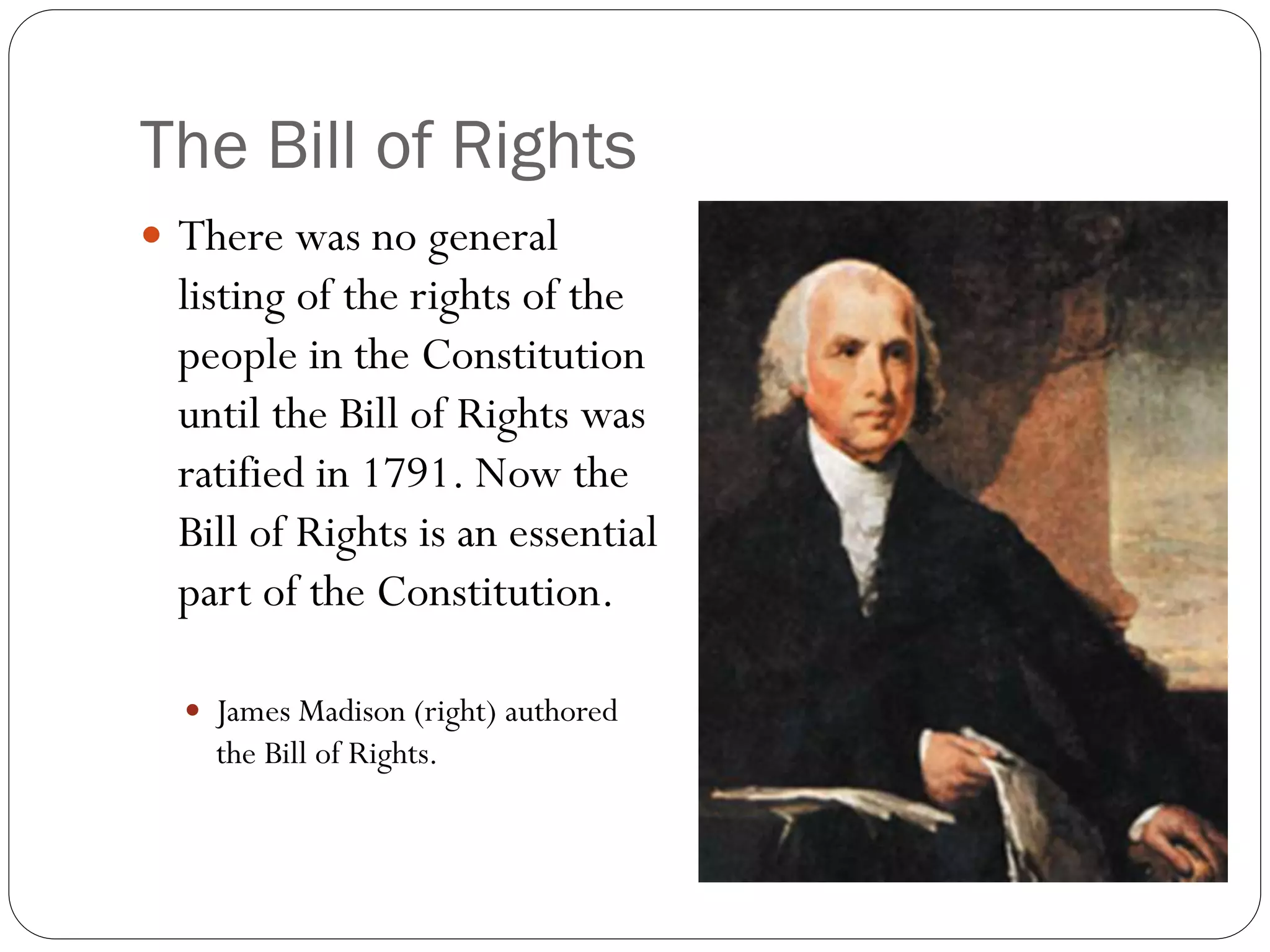
 James Madison (right) authored
the Bill of Rights.
Civil Rights and Liberties
 Civil liberties can be thought of as freedoms protected
from possible government abuse.
 Civil liberties include freedom of religion, speech, and the
press as well as the right to a fair trial.
 Civil rights can be thought of as freedoms defended by
the government.
 Civil rights include laws banning discrimination.
Limited Government
 All governments have authority over
individual citizens.
 In a democratic government such as the
United States, this authority is limited by
laws like the Bill of Rights, which specifies
individual rights and freedoms that
government cannot violate.
Relative Rights
 U.S. citizens may exercise their
own rights as long as they do
not infringe upon the rights of
others.
 For example, the right to free
speech does not protect obscene
language.
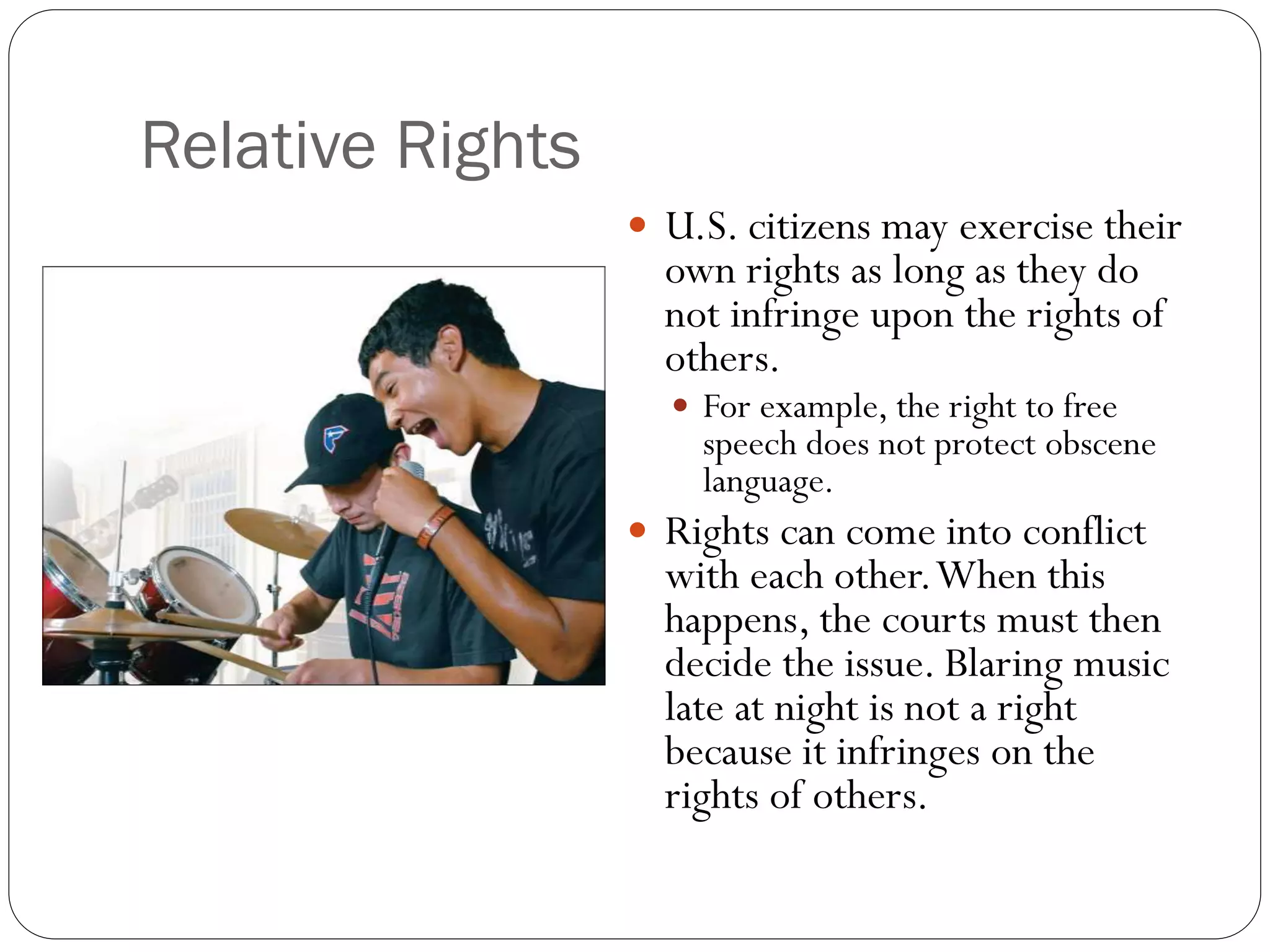
 Rights can come into conflict
with each other.When this
happens, the courts must then
decide the issue. Blaring music
late at night is not a right
because it infringes on the
rights of others.
Whose Rights?
 Most constitutional rights extend to all people in
the United States, including aliens, or non-
citizens.
 However, certain rights of aliens, such as freedom
of travel, can be restricted.
 During wartime these restrictions may increase.
 For example, inWorldWar II people of Japanese
descent were forced to relocate to internment camps.
Federalism
 The Bill of Rights applies to the actions of the
federal government, not the state governments.
 However, each state constitution contains its own
bill of rights to protect the freedoms of its
citizens.
 In addition, the 14th Amendment extends the
basic rights protected by the Bill of Rights to the
citizens of all states.
The 14th Amendment
 The 14th Amendment includes a Due Process
Clause.The Supreme Court has ruled that this
clause means no state can deny any person their
basic rights and liberties.
 Over time, through the process of incorporation,
these basic rights and liberties have been defined
as including most of the protections in the Bill of
Rights.
Gitlow v. New York, 1925
 NewYork state had convicted Benjamin Gitlow of
criminal anarchy for urging people to overthrow the
government.
 The Supreme Court upheld the conviction, but ruled for
the first time that the 1st Amendment right to free
speech also extended to the states because of the 14th
Amendment.
The 9th Amendment
 The 9th Amendment declares that the people have
rights beyond those specifically listed in the
Constitution.
 Over time the Supreme Court has determined
that some of these unlisted rights include:
 The right of a person not to be tried on the basis of
unlawfully gained evidence
 The right of a woman to choose to have an abortion
Freedom of Religion
Section 2
Introduction
 How does the 1st Amendment protect the
freedom of religion?
 The Establishment Clause of the 1st Amendment bans
Congress from passing any law to establish a religion.
 The Free Exercise Clause bans Congress from
preventing anyone from freely practicing their own
religion.
 The 14th Amendment extends these bans to the state
governments.
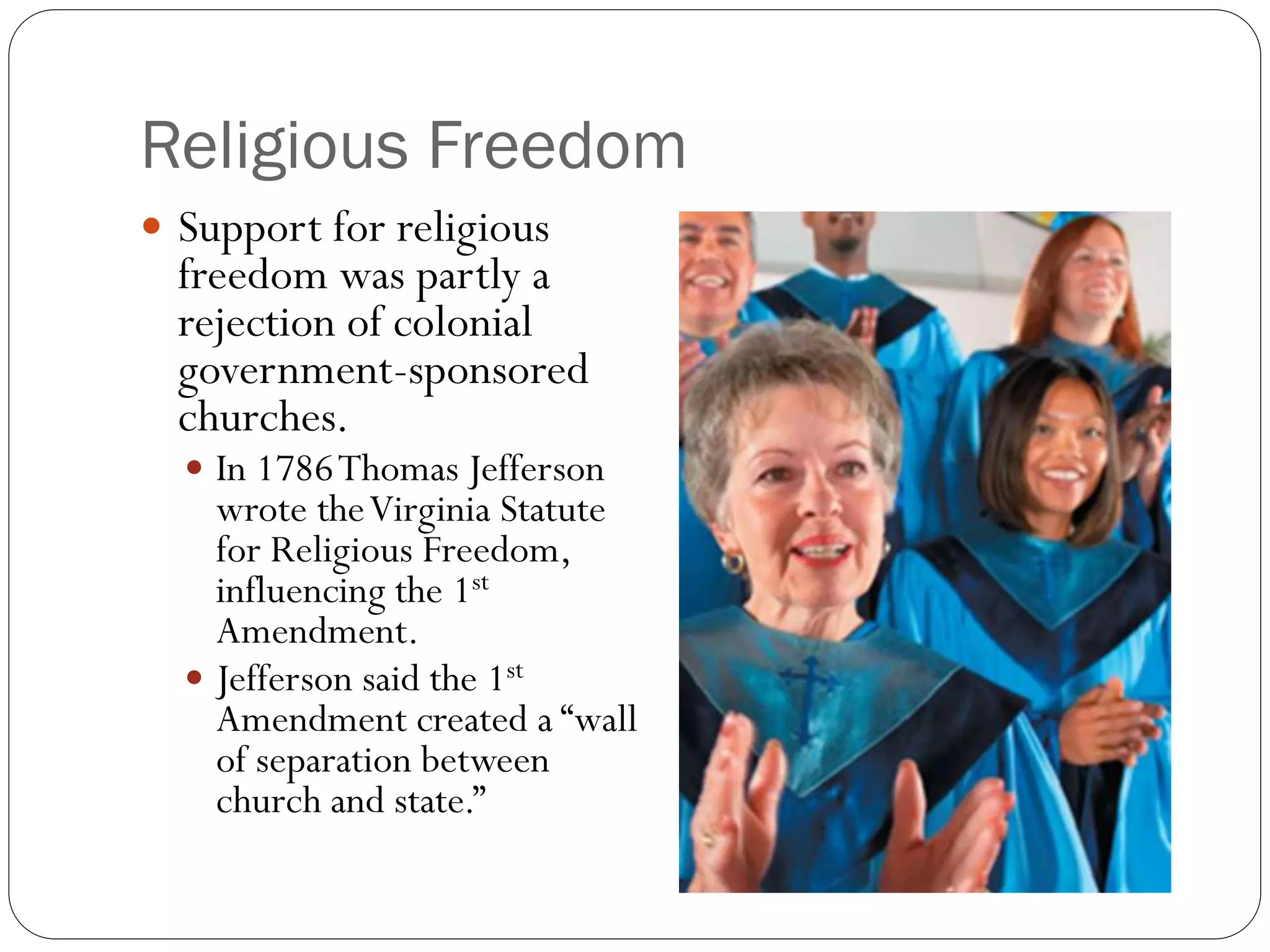
Religious Freedom
 Support for religious
freedom was partly a
rejection of colonial
government-sponsored
churches.
 In 1786Thomas Jefferson
wrote theVirginia Statute
for Religious Freedom,
influencing the 1st
Amendment.
 Jefferson said the 1st
Amendment created a “wall
of separation between
church and state.”
Church and State
 The federal government does not support a specific
religion, but does encourage religion in general.
 Most religious property and contributions to religions
are not taxed.
 Oaths of office, the national anthem, and U.S. coins
and currency make reference to God.
 The exact limits of the Establishment Clause remain
controversial.
Religion and Public Schools
 Most Supreme Court rulings on the
Establishment Clause have involved religion and
education.
 The Court has ruled that public school students may
be released during school to attend religious classes,
but only if those classes are held in private places off
school grounds.
 The Court has allowed states to fund bussing for
parochial as well as public schools, as a safety measure.
School Prayer
 The Court has found in seven major cases that the
1st Amendment requires the government to
neither aid nor oppose religion.
 This means schools cannot sponsor religious
exercises such as prayer.
School Prayer
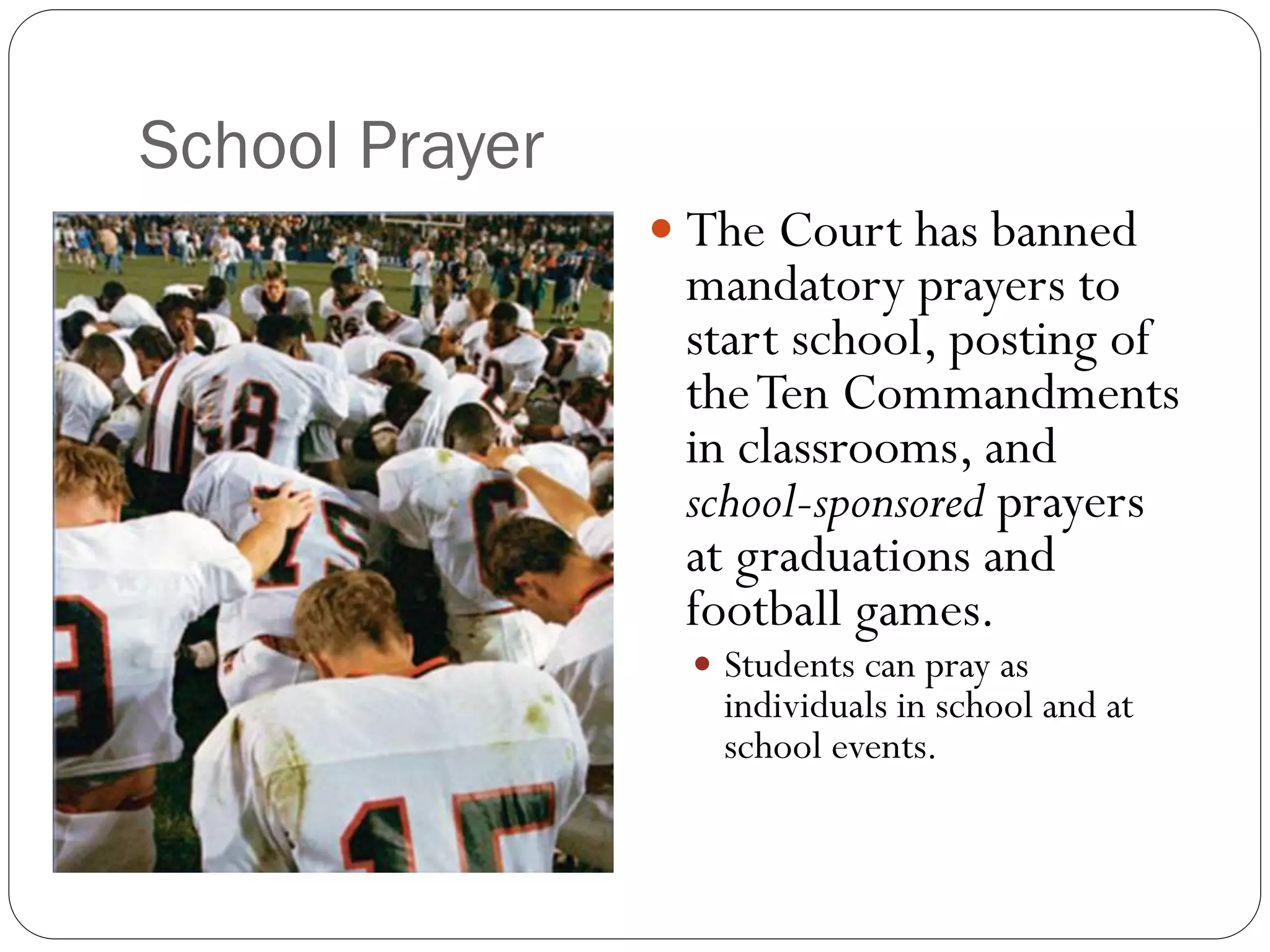
 The Court has banned
mandatory prayers to
start school, posting of
theTen Commandments
in classrooms, and
school-sponsored prayers
at graduations and
football games.
 Students can pray as
individuals in school and at
school events.
Other School Issues
 The Equal AccessAct of 1984 requires public high
schools to let student religious groups meet at school.
 The Supreme Court has ruled that this law applies to
grade schools as well.
 The Supreme Court has ruled that states cannot ban the
teaching of evolution in public schools or require the
teaching of creation science.
Parochial Schools
 Several states provide public financial aid to
parochial schools.
 Supporters argue that parochial students would
otherwise be educated at public expense and that their
parents pay taxes to support public schools.
 Opponents argue that parents could send their
children to public schools and that funding parochial
schools amounts to government sponsorship of
religious teaching.
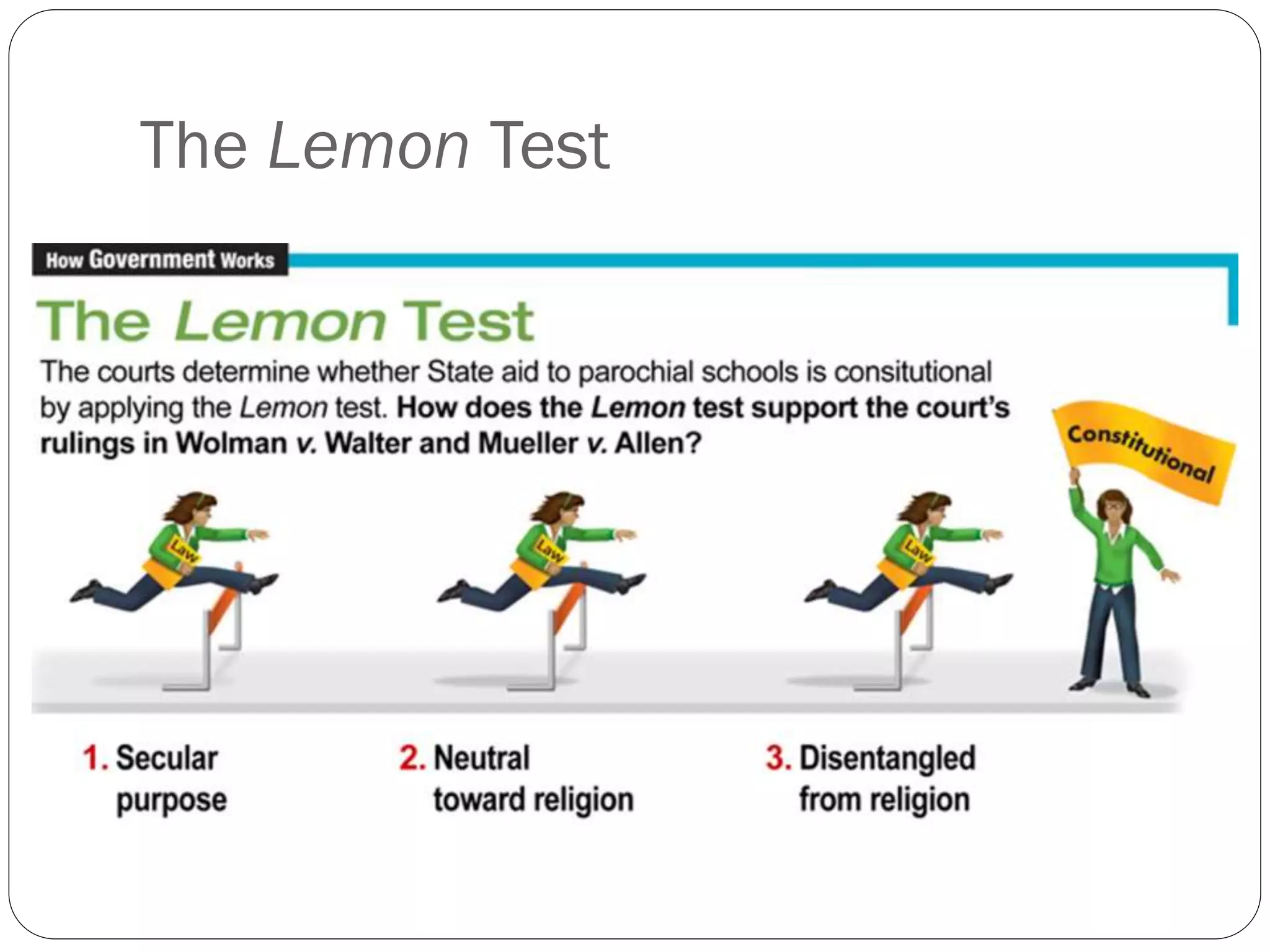
The Lemon Test
 This is a three-part test used to decide if a state
law establishes a religion.
 It is usually applied to determine if state aid to
parochial schools is constitutional.
 The test comes from the 1971 Lemon v. Kurtzman
case, where the Court struck down state financial
aid to parochial schools in Pennsylvania.
The Lemon Test
Examples of the Lemon Test
 The Court usually finds public aid for church-related
schools to be unconstitutional:
 It has banned using taxes to pay for teacher salaries, field
trips, school districts set up for a religious community,
or to reimburse parents for parochial tuition.
 The Court has allowed states to give tax deductions or
tuition vouchers to parents who send children to private
schools, which may include parochial schools.
Public Displays
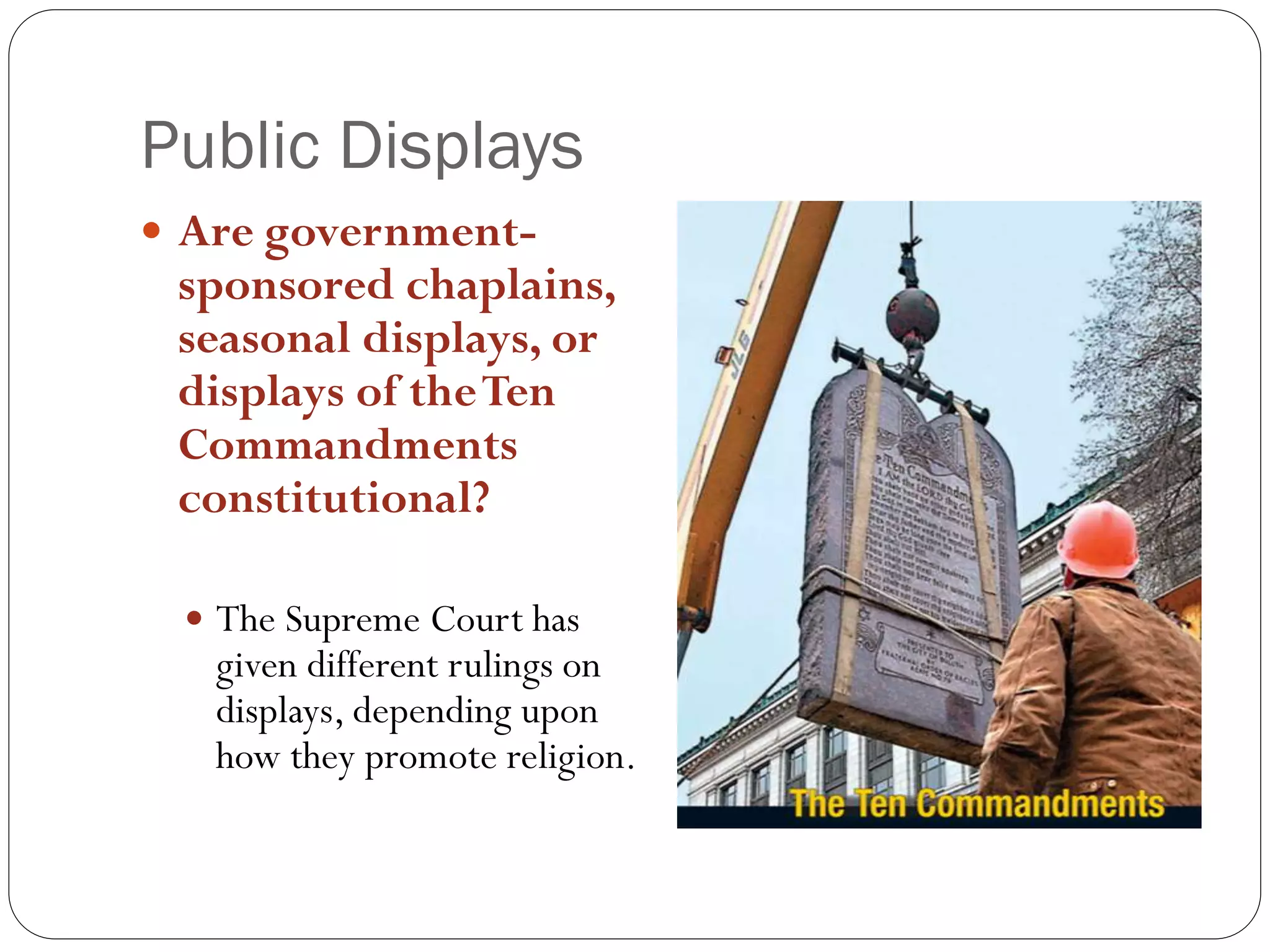
 Are government-
sponsored chaplains,
seasonal displays, or
displays of theTen
Commandments
constitutional?
 The Supreme Court has
given different rulings on
displays, depending upon
how they promote religion.
Public Displays
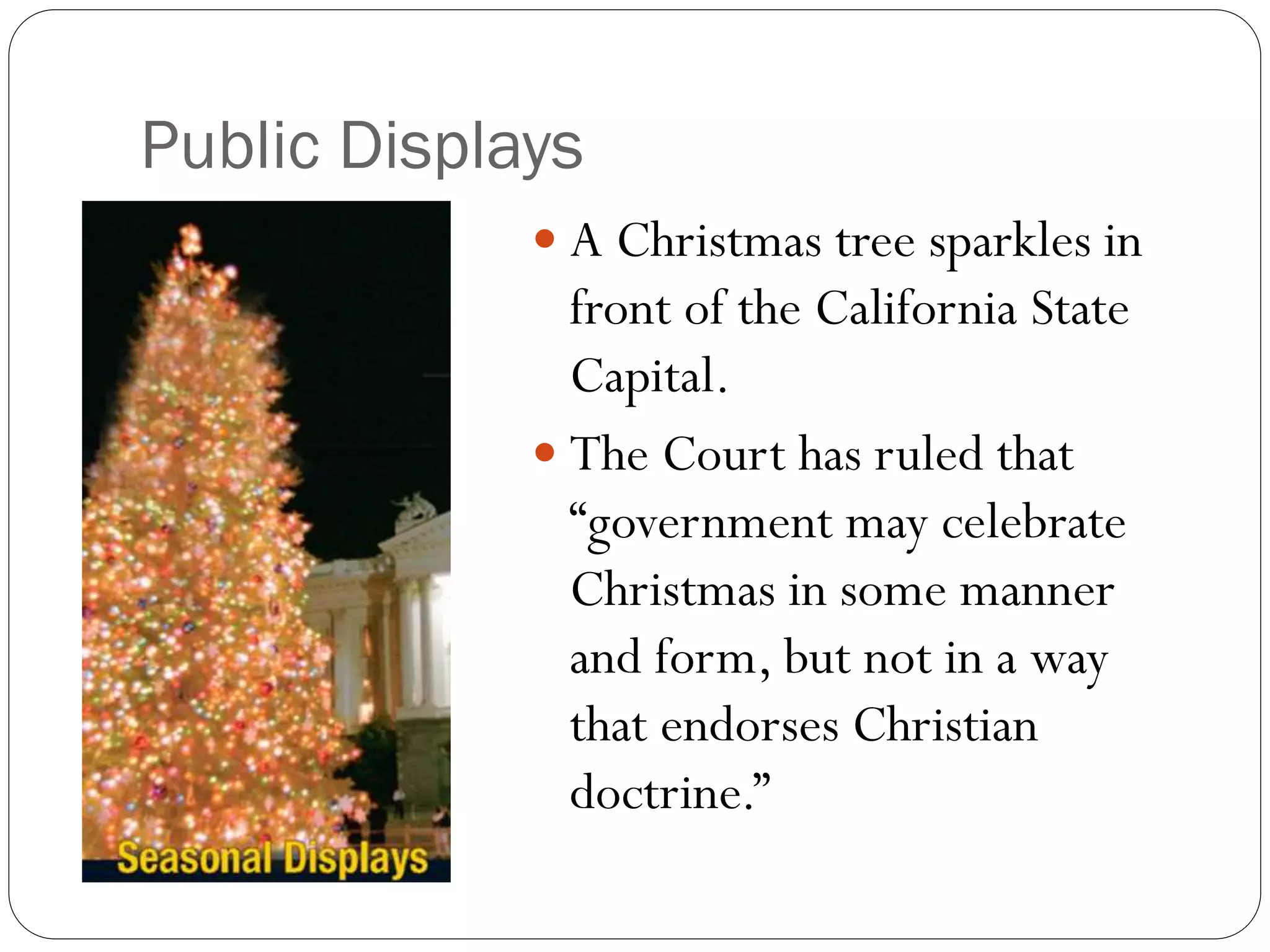
 A Christmas tree sparkles in
front of the California State
Capital.
 The Court has ruled that
“government may celebrate
Christmas in some manner
and form, but not in a way
that endorses Christian
doctrine.”
Public Displays
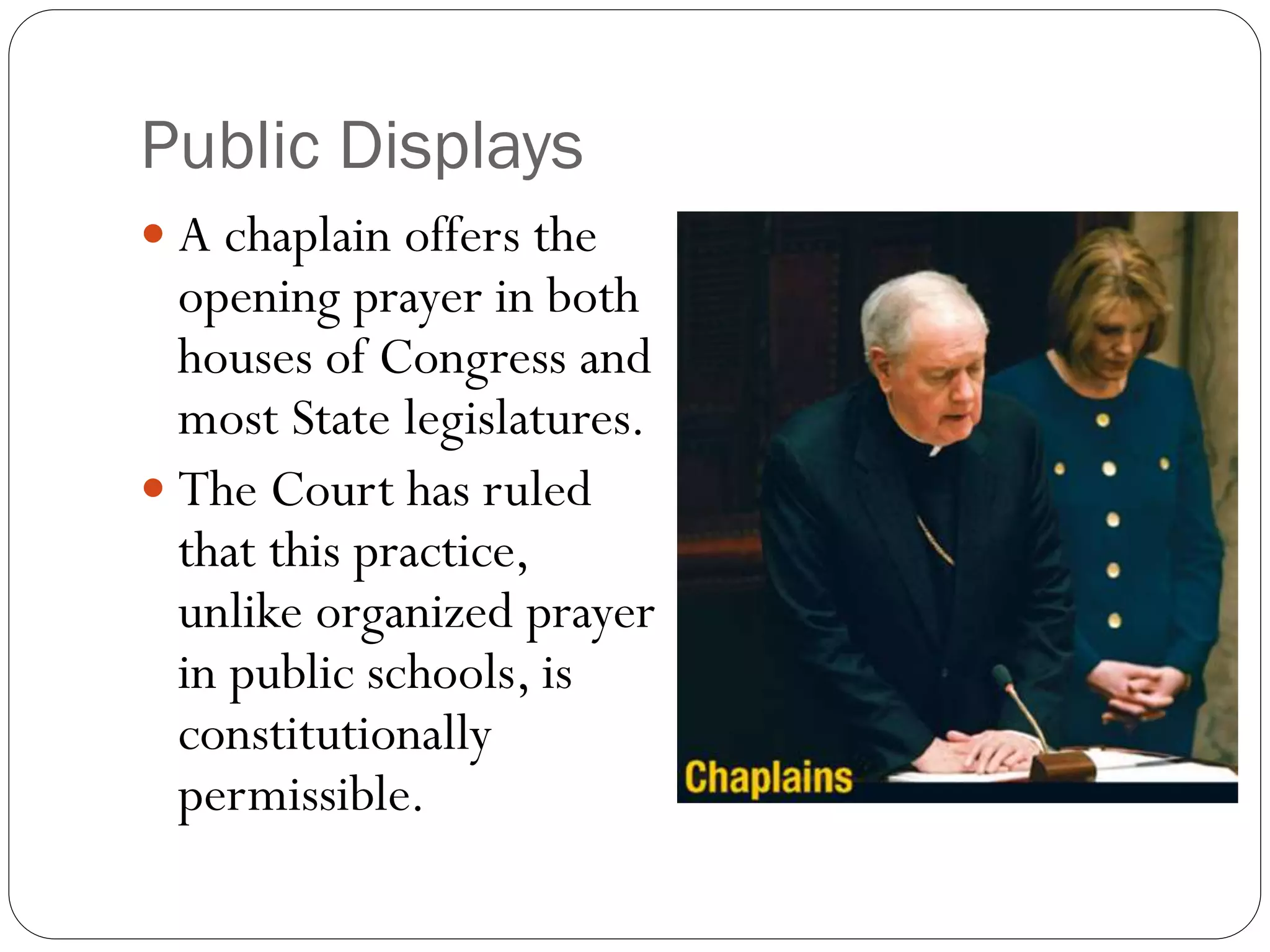
 A chaplain offers the
opening prayer in both
houses of Congress and
most State legislatures.
 The Court has ruled
that this practice,
unlike organized prayer
in public schools, is
constitutionally
permissible.
Limits on Exercise of Religion
 No government law or action can deny a person
the right to hold any religious beliefs that they
wish.
 However, no one has the right to break criminal
laws, offend public morals, or threaten public
safety while practicing their religion.
Protections
 The Supreme Court has often ruled that the Free
Exercise Clause only applies to beliefs rooted in religion.
 The Court has struck down laws requiring a license to
raise money for religious causes.
 The Court has ruled thatAmish children do not have to
attend school past the 8th grade and that Jehovah’s
Witnesses do not have to salute theAmerican flag due to
the beliefs of each religious group.
Freedom of Speech and Press
Section 3
Introduction
 What are the limits on the guarantees of
free speech and free press?
 No person has the right to libel or slander another
person.
 It is illegal to encourage others to commit a crime.
 Laws can ban the use of obscene words, printing or
distributing obscene materials, and false advertising.
Free Expression
 The 1st amendment guarantees each person the right of
free expression by speech, writing, and all other means
of communication.
 The 14th Amendment extends this federal right to citizens of
every state.
 Everyone has the right to hear what others have to say on
public issues.
 Only an informed populace can make good decisions about
public policy.
Seditious Speech
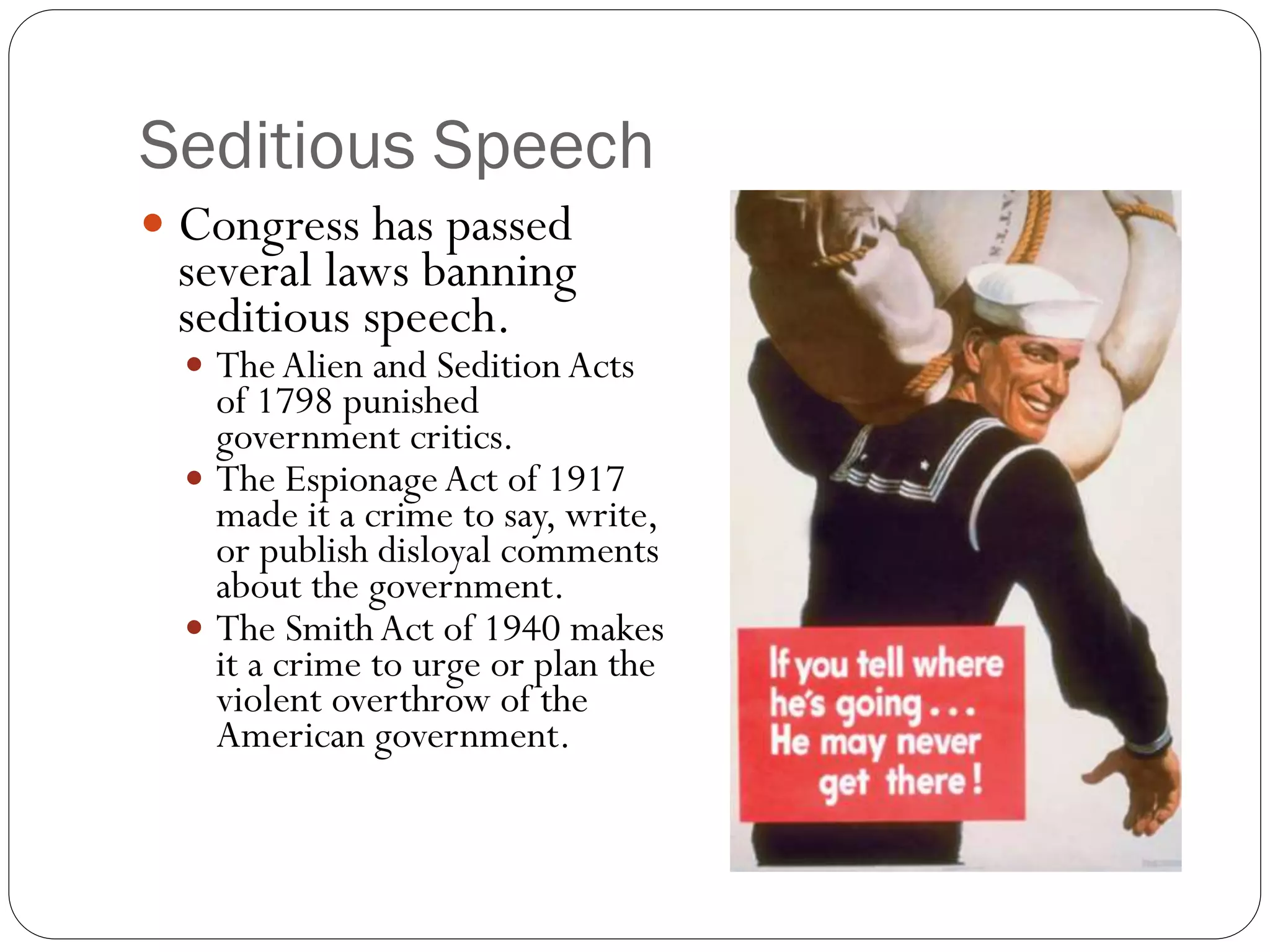
 Congress has passed
several laws banning
seditious speech.
 TheAlien and Sedition Acts
of 1798 punished
government critics.
 The EspionageAct of 1917
made it a crime to say, write,
or publish disloyal comments
about the government.
 The SmithAct of 1940 makes
it a crime to urge or plan the
violent overthrow of the
American government.
What Counts as Sedition?
 In Schenck v. United States,the Supreme Court
established the “clear and present danger rule.”
 Words can be banned if there is a strong risk that they will
encourage criminal activity.
 In Yates v. United States,the Court ruled that it is not
illegal to urge someone to believe something but it is
illegal to urge them to do something.
Obscenity
 It is illegal under federal and state law to
distribute obscene material.
 The Supreme Court created a three-part test to
determine if something is obscene.
 Material is obscene if it:
 Incites lust according to local community standards
 Deals with sexual conduct banned in an anti-obscenity
law
 Lacks serious literary, artistic, political, or scientific
value
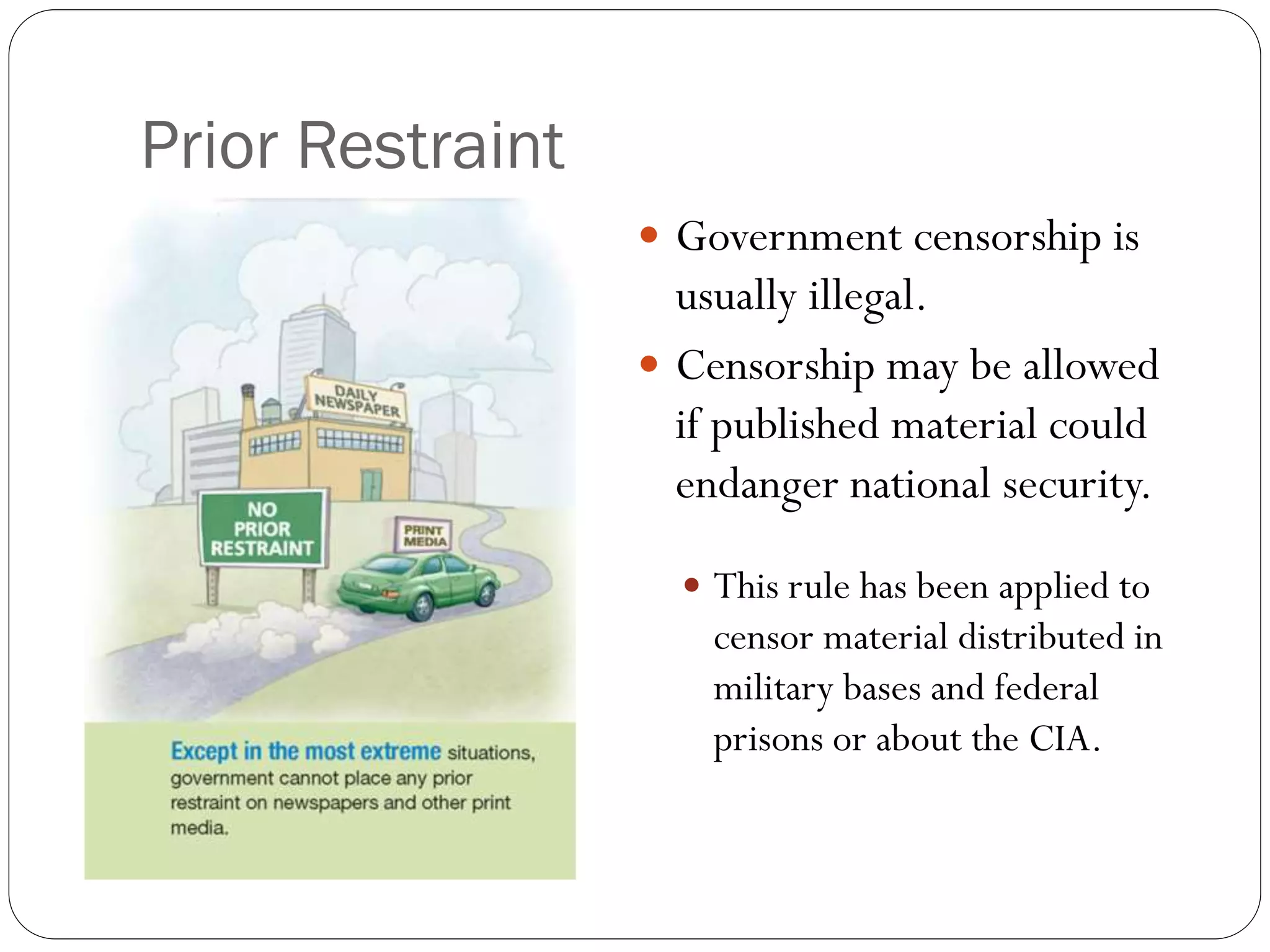
Prior Restraint
 Government censorship is
usually illegal.
 Censorship may be allowed
if published material could
endanger national security.
 This rule has been applied to
censor material distributed in
military bases and federal
prisons or about the CIA.
Prior Restraint
 Public schools have a broad power to censor
“school-sponsored expressive activities,”
including school newspapers and plays.
 School officials must show that their
censorship is in the educational interest of
the school.
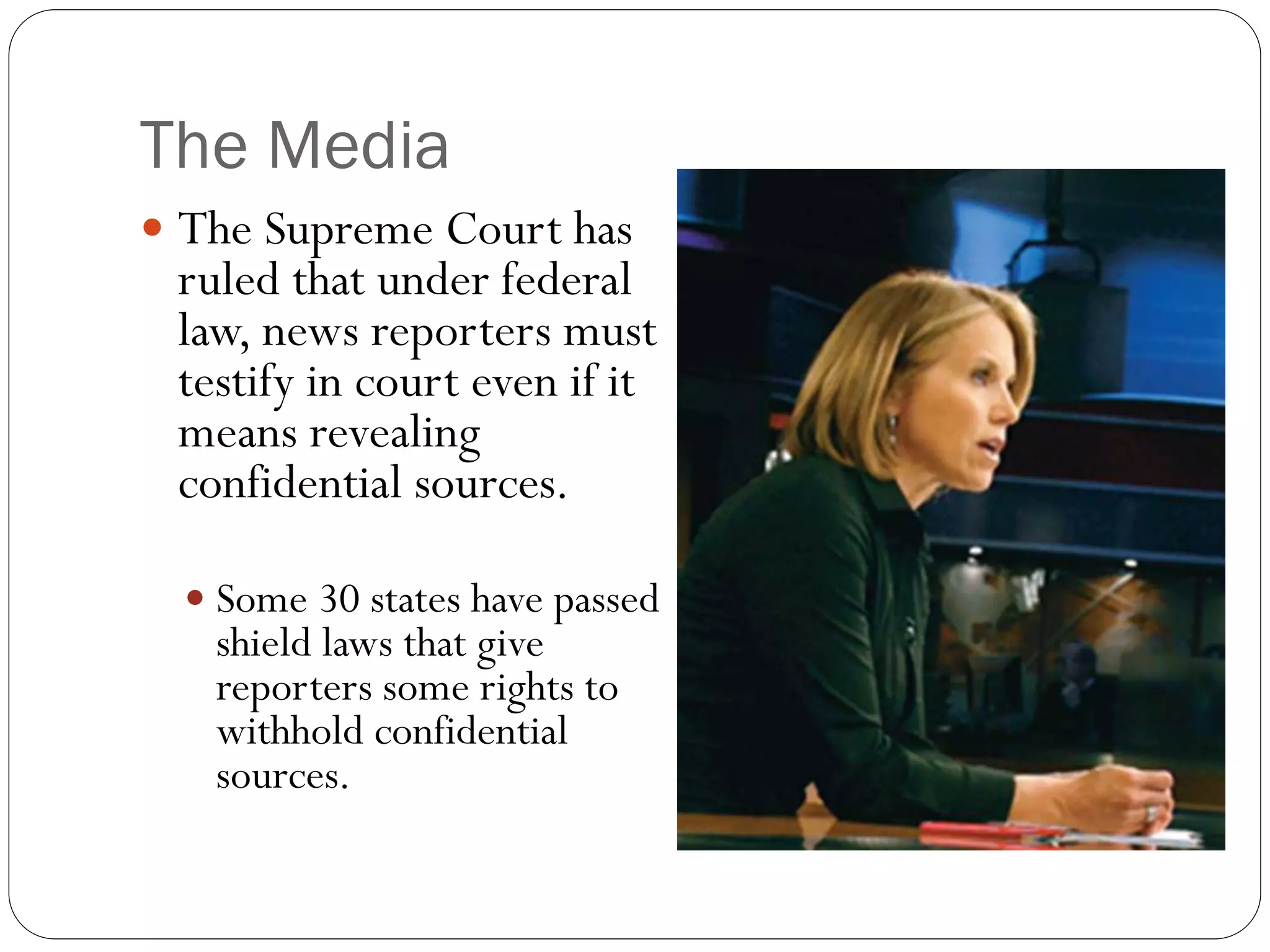
The Media
 The Supreme Court has
ruled that under federal
law, news reporters must
testify in court even if it
means revealing
confidential sources.
 Some 30 states have passed
shield laws that give
reporters some rights to
withhold confidential
sources.
The Media
 Freedom of the press does not give the movie
industry as much protection as newspapers. Films
can be censored.
 Radio and television receive the least 1st Amendment
protection.
 Radio andTV stations are licensed to broadcast their
signals on publicly owned airwaves.
 Such stations have no guaranteed 1st Amendment right to
broadcast their material.
 Instead, they fall under the commerce power of Congress.
The Media
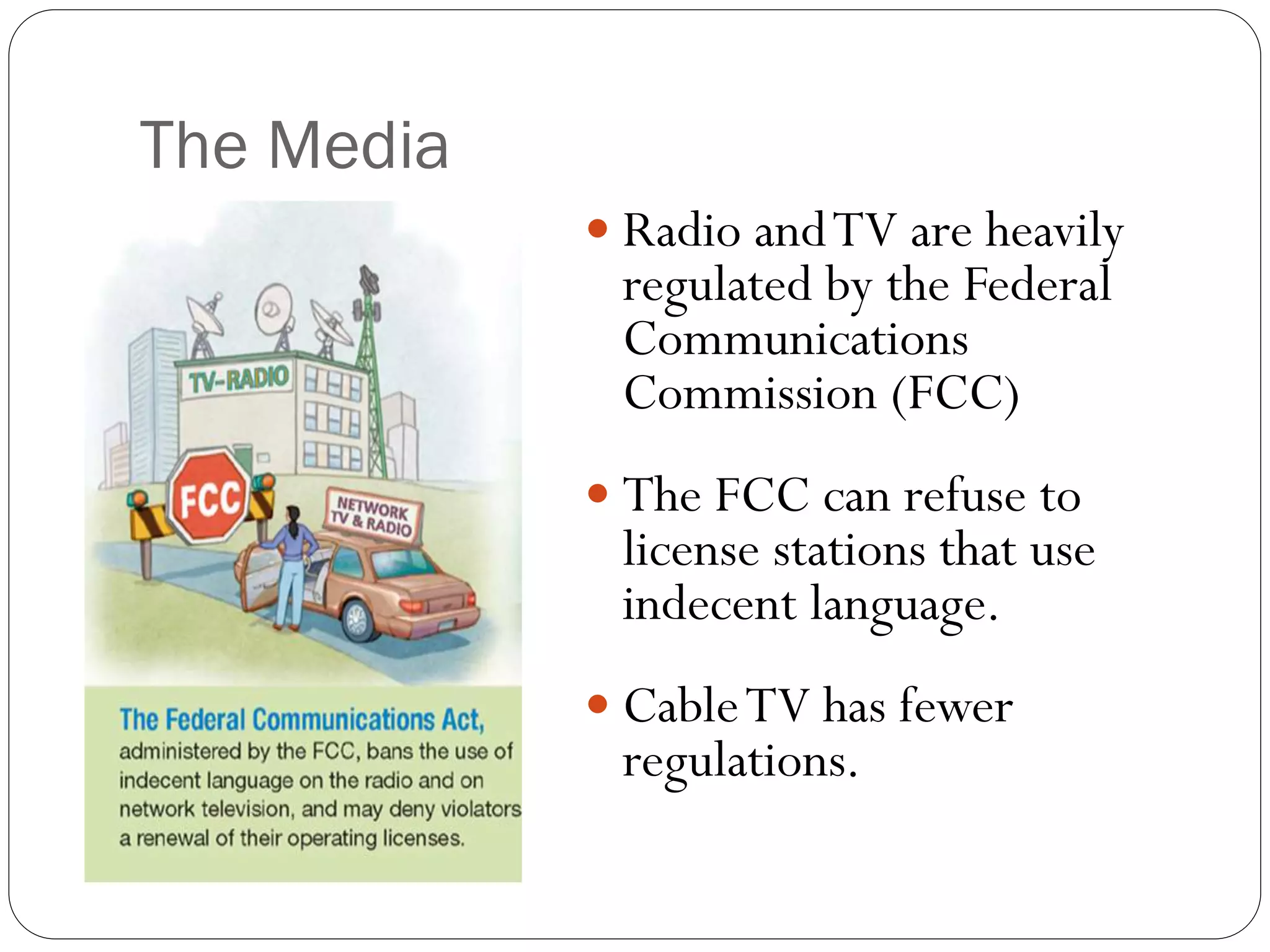
 Radio andTV are heavily
regulated by the Federal
Communications
Commission (FCC)
 The FCC can refuse to
license stations that use
indecent language.
 CableTV has fewer
regulations.
The Media
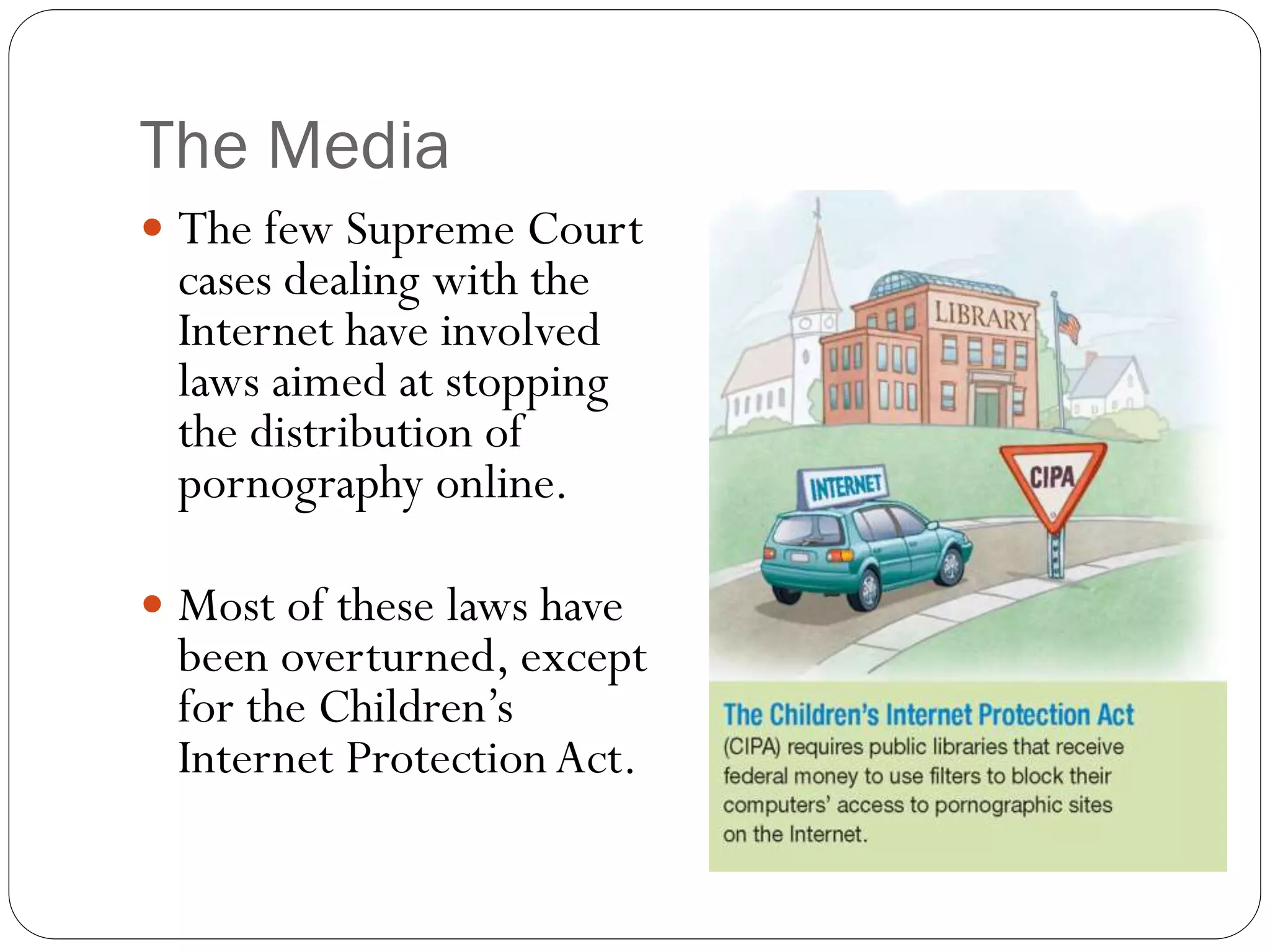
 The few Supreme Court
cases dealing with the
Internet have involved
laws aimed at stopping
the distribution of
pornography online.
 Most of these laws have
been overturned, except
for the Children’s
Internet ProtectionAct.
Symbolic Speech
 Symbolic speech is the expression of ideas by a
person’s conduct and is often meant as an act of
dissent.
 An example is picketing a workplace while on
strike to draw public attention to a controversy.
Peaceful picketing is protected speech.
 Burning theAmerican flag or a cross as a political
protest is also protected speech according to the
Supreme Court.
Symbolic Speech
If the object of the protest is within the
constitutional powers of the
government
If whatever restriction is placed on
expression is no greater than necessary
If the government’s real intent is not to
prevent dissent
Commercial Speech
 Commercial speech most often refers to
advertising.
 The Supreme Court usually strikes down
arbitrary bans on advertising.
 The government can ban false and misleading
advertisements or the advertising of illegal goods
and services.
 Congress has also banned tobacco ads on radio
and television.
Freedom of Assembly & Petition
Section 4
Introduction
 How has the Supreme Court ruled on assembly
and petition cases?
 In general, the Court protects the right of peaceful
assemblies and petitions.
 Governments have the right to set rules on how, when,
and where assemblies can take place, including
requiring permits.
 People do not have the right to trespass or to assemble
or petition on private property.
Constitutional Guarantees
 The 1st Amendment guarantees the right to
peaceful assembly and to petition the
government.
 The 14th Amendment’s Due Process Clause
extends these rights to citizens of every state.
 The Constitution does not protect assemblies or
petitions that endanger life, property, or public
safety.
Examples
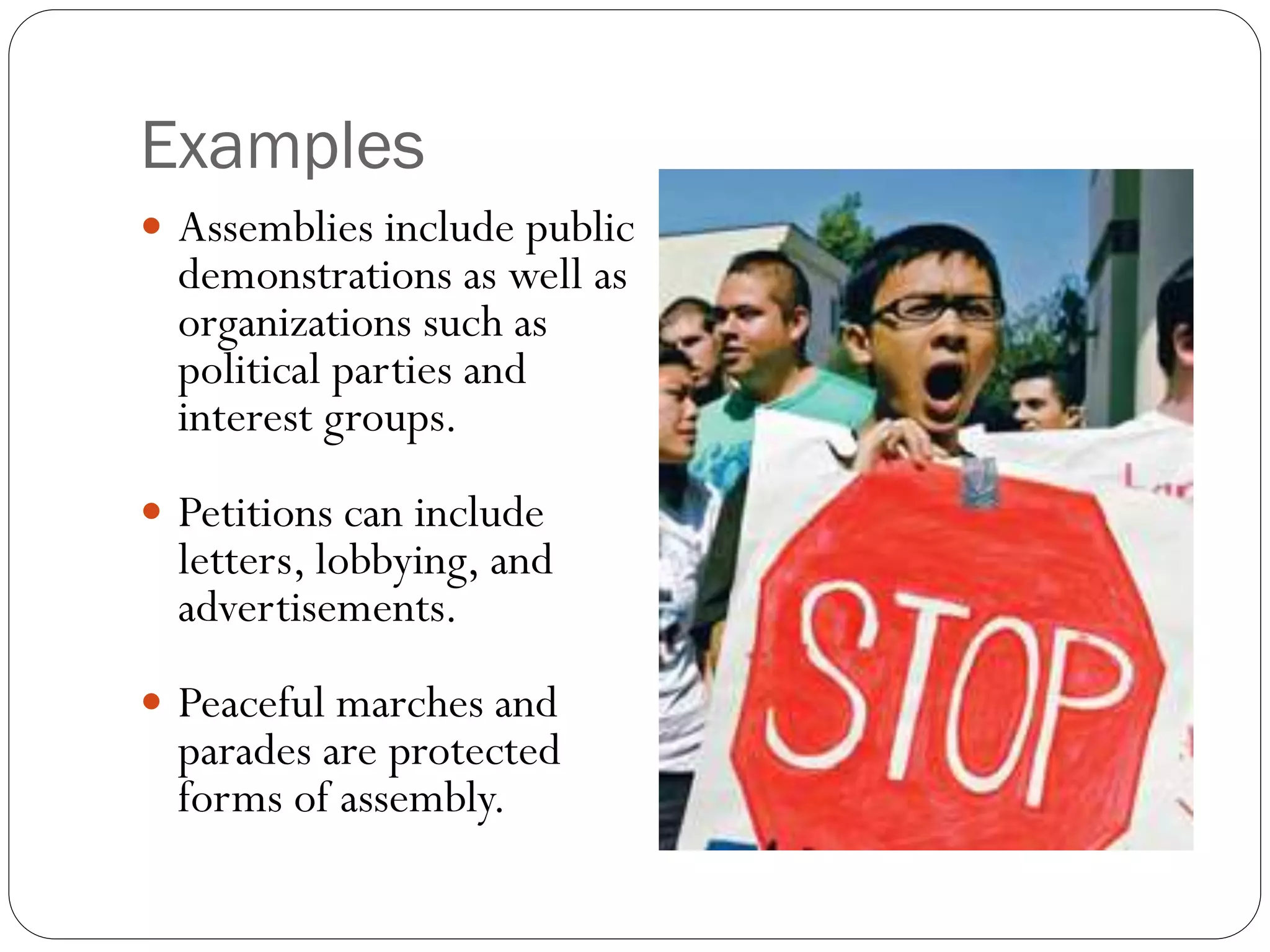
 Assemblies include public
demonstrations as well as
organizations such as
political parties and
interest groups.
 Petitions can include
letters, lobbying, and
advertisements.
 Peaceful marches and
parades are protected
forms of assembly.
Civil Disobedience
 Civil disobedience involves knowingly breaking
the law in a nonviolent way to protest a law or
public policy.
 The courts have held as a general rule that civil
disobedience is not a constitutionally protected
right.
Those who take part in civil disobedience must
accept the legal consequences of their actions.
Limits on Assembly
Governments can decide when, where,
and how assemblies can take place in order
to keep the public peace.
Government rules must be specific and
fairly administered.
Government rules must also be content
neutral.They cannot regulate gatherings
based on what might be said.
Public Demonstrations
 Demonstrations tend to take place in public places such
as streets, sidewalks, parks, or public buildings.
 This can conflict with the normal use of these facilities or
streets.
 The subject of a demonstration can also lead to public
arguments.
 The Supreme Court thus allows governments to require
advance notice and permits for demonstrations on public
property.
Gregory v. Chicago, 1969
 In 1969, a group marched from Chicago’s city hall to
the mayor’s house to protest segregation in the city’s
schools.
 A crowd of several hundred bystanders gathered to
protest against and throw objects at the marchers.
 The police, fearing violence, arrested the marchers
for disorderly conduct when they refused to leave.
 The Court ruled that the violent bystanders, not the
peaceful marchers, were disturbing the peace.
Other Court Cases
 Anti-abortion groups often hold demonstrations to
try to discourage women from going to abortion
clinics.
 The Supreme Court has ruled that judges and state
laws may impose buffer zones limiting how close
demonstrators may come to clinics.
 These measures fall within the government’s power
to limit how, when, and where assemblies take place.
Private Property
 People do not have the right to assemble or
petition on private property without permission.
No one has the absolute constitutional right to
hand out leaflets or ask for petition signatures
in a shopping mall.
However, the courts can rule that shopping
center owners should give permission for the
reasonable exercise of the right to petition.
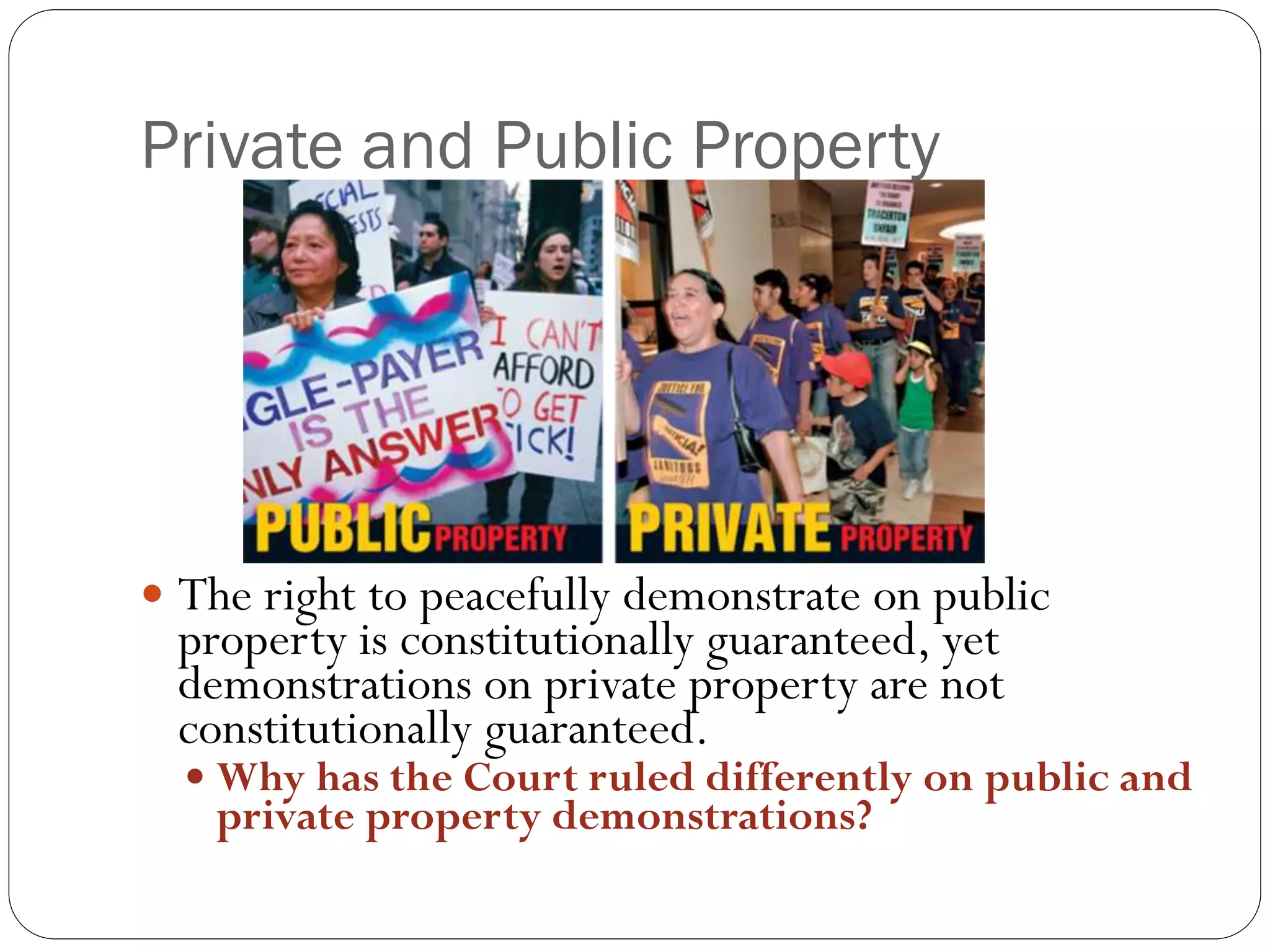
Private and Public Property
 The right to peacefully demonstrate on public
property is constitutionally guaranteed, yet
demonstrations on private property are not
constitutionally guaranteed.
 Why has the Court ruled differently on public and
private property demonstrations?
Freedom of Association
 The right to join with others to promote
political, economic, and social causes.
 It has been upheld as a constitutional right by
the Supreme Court. People cannot be fired
for belonging to associations and do not have
to reveal them to practice law.
 Associations do not have to accept members
if doing so would contradict the beliefs of the
association.

Chapter 19 presentation

  • 1.
  • 2.
  • 3.
    Introduction  How doesthe Constitution protect the rights of individuals against government?  The Constitution guarantees civil rights and civil liberties to theAmerican people.  Many of these rights and liberties are protected by the laws established in the Bill of Rights and the 14th Amendment.
  • 4.
    Key Documents  TheDeclaration of Independence states that all men have unalienable rights and that governments exist to protect these rights.  The Preamble to the Constitution states that purpose of theAmerican government is to “secure the blessings of Liberty” to the people.  Articles I and III of the Constitution guarantee many key rights.
  • 5.
    The Bill ofRights  There was no general listing of the rights of the people in the Constitution until the Bill of Rights was ratified in 1791. Now the Bill of Rights is an essential part of the Constitution.  James Madison (right) authored the Bill of Rights.
  • 6.
    Civil Rights andLiberties  Civil liberties can be thought of as freedoms protected from possible government abuse.  Civil liberties include freedom of religion, speech, and the press as well as the right to a fair trial.  Civil rights can be thought of as freedoms defended by the government.  Civil rights include laws banning discrimination.
  • 7.
    Limited Government  Allgovernments have authority over individual citizens.  In a democratic government such as the United States, this authority is limited by laws like the Bill of Rights, which specifies individual rights and freedoms that government cannot violate.
  • 8.
    Relative Rights  U.S.citizens may exercise their own rights as long as they do not infringe upon the rights of others.  For example, the right to free speech does not protect obscene language.  Rights can come into conflict with each other.When this happens, the courts must then decide the issue. Blaring music late at night is not a right because it infringes on the rights of others.
  • 9.
    Whose Rights?  Mostconstitutional rights extend to all people in the United States, including aliens, or non- citizens.  However, certain rights of aliens, such as freedom of travel, can be restricted.  During wartime these restrictions may increase.  For example, inWorldWar II people of Japanese descent were forced to relocate to internment camps.
  • 10.
    Federalism  The Billof Rights applies to the actions of the federal government, not the state governments.  However, each state constitution contains its own bill of rights to protect the freedoms of its citizens.  In addition, the 14th Amendment extends the basic rights protected by the Bill of Rights to the citizens of all states.
  • 11.
    The 14th Amendment The 14th Amendment includes a Due Process Clause.The Supreme Court has ruled that this clause means no state can deny any person their basic rights and liberties.  Over time, through the process of incorporation, these basic rights and liberties have been defined as including most of the protections in the Bill of Rights.
  • 12.
    Gitlow v. NewYork, 1925  NewYork state had convicted Benjamin Gitlow of criminal anarchy for urging people to overthrow the government.  The Supreme Court upheld the conviction, but ruled for the first time that the 1st Amendment right to free speech also extended to the states because of the 14th Amendment.
  • 13.
    The 9th Amendment The 9th Amendment declares that the people have rights beyond those specifically listed in the Constitution.  Over time the Supreme Court has determined that some of these unlisted rights include:  The right of a person not to be tried on the basis of unlawfully gained evidence  The right of a woman to choose to have an abortion
  • 14.
  • 15.
    Introduction  How doesthe 1st Amendment protect the freedom of religion?  The Establishment Clause of the 1st Amendment bans Congress from passing any law to establish a religion.  The Free Exercise Clause bans Congress from preventing anyone from freely practicing their own religion.  The 14th Amendment extends these bans to the state governments.
  • 16.
    Religious Freedom  Supportfor religious freedom was partly a rejection of colonial government-sponsored churches.  In 1786Thomas Jefferson wrote theVirginia Statute for Religious Freedom, influencing the 1st Amendment.  Jefferson said the 1st Amendment created a “wall of separation between church and state.”
  • 17.
    Church and State The federal government does not support a specific religion, but does encourage religion in general.  Most religious property and contributions to religions are not taxed.  Oaths of office, the national anthem, and U.S. coins and currency make reference to God.  The exact limits of the Establishment Clause remain controversial.
  • 18.
    Religion and PublicSchools  Most Supreme Court rulings on the Establishment Clause have involved religion and education.  The Court has ruled that public school students may be released during school to attend religious classes, but only if those classes are held in private places off school grounds.  The Court has allowed states to fund bussing for parochial as well as public schools, as a safety measure.
  • 19.
    School Prayer  TheCourt has found in seven major cases that the 1st Amendment requires the government to neither aid nor oppose religion.  This means schools cannot sponsor religious exercises such as prayer.
  • 20.
    School Prayer  TheCourt has banned mandatory prayers to start school, posting of theTen Commandments in classrooms, and school-sponsored prayers at graduations and football games.  Students can pray as individuals in school and at school events.
  • 21.
    Other School Issues The Equal AccessAct of 1984 requires public high schools to let student religious groups meet at school.  The Supreme Court has ruled that this law applies to grade schools as well.  The Supreme Court has ruled that states cannot ban the teaching of evolution in public schools or require the teaching of creation science.
  • 22.
    Parochial Schools  Severalstates provide public financial aid to parochial schools.  Supporters argue that parochial students would otherwise be educated at public expense and that their parents pay taxes to support public schools.  Opponents argue that parents could send their children to public schools and that funding parochial schools amounts to government sponsorship of religious teaching.
  • 23.
    The Lemon Test This is a three-part test used to decide if a state law establishes a religion.  It is usually applied to determine if state aid to parochial schools is constitutional.  The test comes from the 1971 Lemon v. Kurtzman case, where the Court struck down state financial aid to parochial schools in Pennsylvania.
  • 24.
  • 25.
    Examples of theLemon Test  The Court usually finds public aid for church-related schools to be unconstitutional:  It has banned using taxes to pay for teacher salaries, field trips, school districts set up for a religious community, or to reimburse parents for parochial tuition.  The Court has allowed states to give tax deductions or tuition vouchers to parents who send children to private schools, which may include parochial schools.
  • 26.
    Public Displays  Aregovernment- sponsored chaplains, seasonal displays, or displays of theTen Commandments constitutional?  The Supreme Court has given different rulings on displays, depending upon how they promote religion.
  • 27.
    Public Displays  AChristmas tree sparkles in front of the California State Capital.  The Court has ruled that “government may celebrate Christmas in some manner and form, but not in a way that endorses Christian doctrine.”
  • 28.
    Public Displays  Achaplain offers the opening prayer in both houses of Congress and most State legislatures.  The Court has ruled that this practice, unlike organized prayer in public schools, is constitutionally permissible.
  • 29.
    Limits on Exerciseof Religion  No government law or action can deny a person the right to hold any religious beliefs that they wish.  However, no one has the right to break criminal laws, offend public morals, or threaten public safety while practicing their religion.
  • 30.
    Protections  The SupremeCourt has often ruled that the Free Exercise Clause only applies to beliefs rooted in religion.  The Court has struck down laws requiring a license to raise money for religious causes.  The Court has ruled thatAmish children do not have to attend school past the 8th grade and that Jehovah’s Witnesses do not have to salute theAmerican flag due to the beliefs of each religious group.
  • 31.
    Freedom of Speechand Press Section 3
  • 32.
    Introduction  What arethe limits on the guarantees of free speech and free press?  No person has the right to libel or slander another person.  It is illegal to encourage others to commit a crime.  Laws can ban the use of obscene words, printing or distributing obscene materials, and false advertising.
  • 33.
    Free Expression  The1st amendment guarantees each person the right of free expression by speech, writing, and all other means of communication.  The 14th Amendment extends this federal right to citizens of every state.  Everyone has the right to hear what others have to say on public issues.  Only an informed populace can make good decisions about public policy.
  • 34.
    Seditious Speech  Congresshas passed several laws banning seditious speech.  TheAlien and Sedition Acts of 1798 punished government critics.  The EspionageAct of 1917 made it a crime to say, write, or publish disloyal comments about the government.  The SmithAct of 1940 makes it a crime to urge or plan the violent overthrow of the American government.
  • 35.
    What Counts asSedition?  In Schenck v. United States,the Supreme Court established the “clear and present danger rule.”  Words can be banned if there is a strong risk that they will encourage criminal activity.  In Yates v. United States,the Court ruled that it is not illegal to urge someone to believe something but it is illegal to urge them to do something.
  • 36.
    Obscenity  It isillegal under federal and state law to distribute obscene material.  The Supreme Court created a three-part test to determine if something is obscene.  Material is obscene if it:  Incites lust according to local community standards  Deals with sexual conduct banned in an anti-obscenity law  Lacks serious literary, artistic, political, or scientific value
  • 37.
    Prior Restraint  Governmentcensorship is usually illegal.  Censorship may be allowed if published material could endanger national security.  This rule has been applied to censor material distributed in military bases and federal prisons or about the CIA.
  • 38.
    Prior Restraint  Publicschools have a broad power to censor “school-sponsored expressive activities,” including school newspapers and plays.  School officials must show that their censorship is in the educational interest of the school.
  • 39.
    The Media  TheSupreme Court has ruled that under federal law, news reporters must testify in court even if it means revealing confidential sources.  Some 30 states have passed shield laws that give reporters some rights to withhold confidential sources.
  • 40.
    The Media  Freedomof the press does not give the movie industry as much protection as newspapers. Films can be censored.  Radio and television receive the least 1st Amendment protection.  Radio andTV stations are licensed to broadcast their signals on publicly owned airwaves.  Such stations have no guaranteed 1st Amendment right to broadcast their material.  Instead, they fall under the commerce power of Congress.
  • 41.
    The Media  RadioandTV are heavily regulated by the Federal Communications Commission (FCC)  The FCC can refuse to license stations that use indecent language.  CableTV has fewer regulations.
  • 42.
    The Media  Thefew Supreme Court cases dealing with the Internet have involved laws aimed at stopping the distribution of pornography online.  Most of these laws have been overturned, except for the Children’s Internet ProtectionAct.
  • 43.
    Symbolic Speech  Symbolicspeech is the expression of ideas by a person’s conduct and is often meant as an act of dissent.  An example is picketing a workplace while on strike to draw public attention to a controversy. Peaceful picketing is protected speech.  Burning theAmerican flag or a cross as a political protest is also protected speech according to the Supreme Court.
  • 44.
    Symbolic Speech If theobject of the protest is within the constitutional powers of the government If whatever restriction is placed on expression is no greater than necessary If the government’s real intent is not to prevent dissent
  • 45.
    Commercial Speech  Commercialspeech most often refers to advertising.  The Supreme Court usually strikes down arbitrary bans on advertising.  The government can ban false and misleading advertisements or the advertising of illegal goods and services.  Congress has also banned tobacco ads on radio and television.
  • 46.
    Freedom of Assembly& Petition Section 4
  • 47.
    Introduction  How hasthe Supreme Court ruled on assembly and petition cases?  In general, the Court protects the right of peaceful assemblies and petitions.  Governments have the right to set rules on how, when, and where assemblies can take place, including requiring permits.  People do not have the right to trespass or to assemble or petition on private property.
  • 48.
    Constitutional Guarantees  The1st Amendment guarantees the right to peaceful assembly and to petition the government.  The 14th Amendment’s Due Process Clause extends these rights to citizens of every state.  The Constitution does not protect assemblies or petitions that endanger life, property, or public safety.
  • 49.
    Examples  Assemblies includepublic demonstrations as well as organizations such as political parties and interest groups.  Petitions can include letters, lobbying, and advertisements.  Peaceful marches and parades are protected forms of assembly.
  • 50.
    Civil Disobedience  Civildisobedience involves knowingly breaking the law in a nonviolent way to protest a law or public policy.  The courts have held as a general rule that civil disobedience is not a constitutionally protected right. Those who take part in civil disobedience must accept the legal consequences of their actions.
  • 51.
    Limits on Assembly Governmentscan decide when, where, and how assemblies can take place in order to keep the public peace. Government rules must be specific and fairly administered. Government rules must also be content neutral.They cannot regulate gatherings based on what might be said.
  • 52.
    Public Demonstrations  Demonstrationstend to take place in public places such as streets, sidewalks, parks, or public buildings.  This can conflict with the normal use of these facilities or streets.  The subject of a demonstration can also lead to public arguments.  The Supreme Court thus allows governments to require advance notice and permits for demonstrations on public property.
  • 53.
    Gregory v. Chicago,1969  In 1969, a group marched from Chicago’s city hall to the mayor’s house to protest segregation in the city’s schools.  A crowd of several hundred bystanders gathered to protest against and throw objects at the marchers.  The police, fearing violence, arrested the marchers for disorderly conduct when they refused to leave.  The Court ruled that the violent bystanders, not the peaceful marchers, were disturbing the peace.
  • 54.
    Other Court Cases Anti-abortion groups often hold demonstrations to try to discourage women from going to abortion clinics.  The Supreme Court has ruled that judges and state laws may impose buffer zones limiting how close demonstrators may come to clinics.  These measures fall within the government’s power to limit how, when, and where assemblies take place.
  • 55.
    Private Property  Peopledo not have the right to assemble or petition on private property without permission. No one has the absolute constitutional right to hand out leaflets or ask for petition signatures in a shopping mall. However, the courts can rule that shopping center owners should give permission for the reasonable exercise of the right to petition.
  • 56.
    Private and PublicProperty  The right to peacefully demonstrate on public property is constitutionally guaranteed, yet demonstrations on private property are not constitutionally guaranteed.  Why has the Court ruled differently on public and private property demonstrations?
  • 57.
    Freedom of Association The right to join with others to promote political, economic, and social causes.  It has been upheld as a constitutional right by the Supreme Court. People cannot be fired for belonging to associations and do not have to reveal them to practice law.  Associations do not have to accept members if doing so would contradict the beliefs of the association.