Chapter 8 - 
Social Conflict, Critical Criminology, 
and Restorative Justice 
Michelle Palaro 
Criminology 81-220-1 
Fall 2014
Social Conflict and Criminologists 
• Social conflict 
– The struggle for power in society 
• Critical criminologists 
– Criminologists who believe that the 
cause of crime can be linked to 
economic, social, and political disparity
Social Conflict, Critical 
Criminology, and Restorative 
Justice
Origins of Critical Criminology 
• Karl Marx 
• National Deviancy Conference 
– How might social control cause deviancy 
• War in Vietnam, prison struggles, civil 
rights movement, feminist movement 
• Relationship between law, power, and 
crime
Contemporary Critical 
Criminology 
• Themes and Concepts 
– Connection between social class, crime, 
and social control 
– Role of the government in creating a 
criminogenic environment 
– Relationship between personal/group 
power and shaping of criminal law
Contemporary Critical Criminology 
• Themes and Concepts 
– Race and gender bias in the justice 
system 
– Relationship between capitalistic 
economy and crime rates 
–Misuse of political/social/media power to 
control behavior of others and shape 
public opinion
Contemporary Critical Criminology 
• Themes and Concepts 
– American political system 
• Death penalty, three strikes laws, USA 
Patriot Act 
• Racism 
• Sexism 
• Demystifying domination
Defining Crime and Justice 
• Crime is a political concept designed 
to protect the power and position of 
the upper classes at the expense of 
the poor
Defining Crime and Justice 
• Poor 
– Street crime 
• Middle Class 
– White-Collar Crime 
• Wealthy 
– Racism 
– Sexism 
– Profiteering
Defining Crime and Justice 
• Supranational Criminology 
– Antisocial behaviors committed by state 
officials in pursuit of their jobs as 
government representatives 
• War 
• Political Corruption 
• Illegal Domestic Surveillance 
• Human Rights Violations 
• State-Corporate Crime 
• State Violence
Defining Crime and Justice 
• Instrumental vs. Structural Theory 
– Instrumental Theory 
• Criminal law and the criminal justice system 
are capitalist instruments for controlling the 
lower class 
– Structural Theory 
• Criminal law and the criminal justice system 
are means of defending and preserving the 
capitalist system
The Cause of Crime 
• Surplus Value 
• Marginalization 
• Globalization
The Cause of Crime 
• State (Organized) Crime 
– Criminal acts committed by government 
officials 
– Illegal domestic surveillance 
– Human rights violations 
– State-corporate crime 
– State violence
The Cause of Crime 
• Crime and social institutions 
• Educational disparities 
– “Drop-out factories” 
• Class and racial disparities in 
prosecution and sentencing 
• Racial threat theory
Forms of Critical 
Criminology 
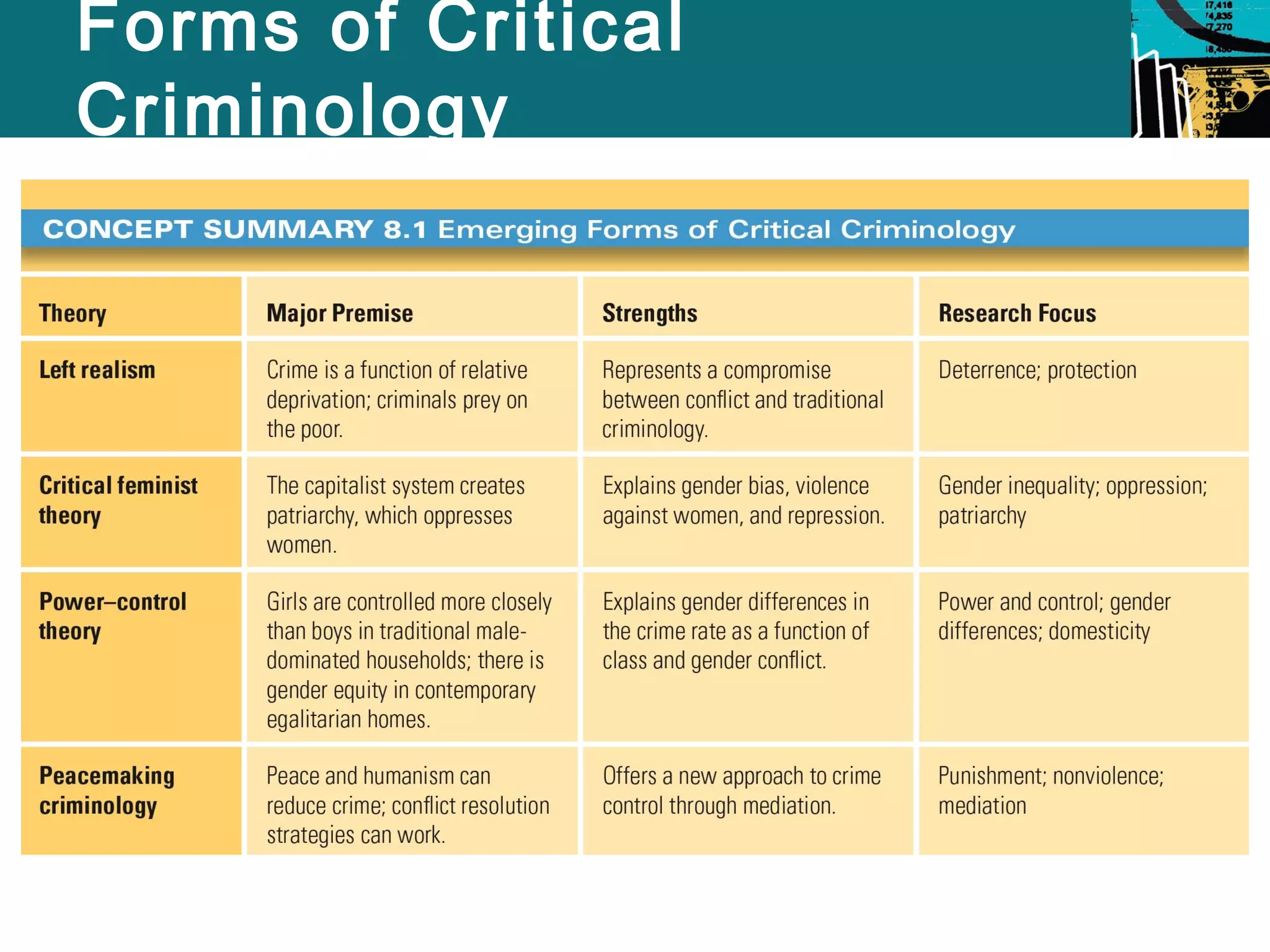
• Left Realism 
• Left Realism and crime 
– Crime is a function of relative 
deprivation under capitalism and favors 
pragmatic, community-based crime 
prevention and control 
– Crime Protection 
• Preemptive Deterrence 
• Left Realism and terrorism
Forms of Critical 
Criminology 
• Critical Feminist Theory 
– Explains both victimization and criminality 
among women in terms of gender inequality, 
patriarchy, and the exploitation of women 
under capitalism 
– Patriarchy and Crime 
• Double marginality 
• Powerlessness 
– Masculinity and crime 
• Hegemonic masculinity 
– Exploitation and Criminality
Forms of Critical 
Criminology 
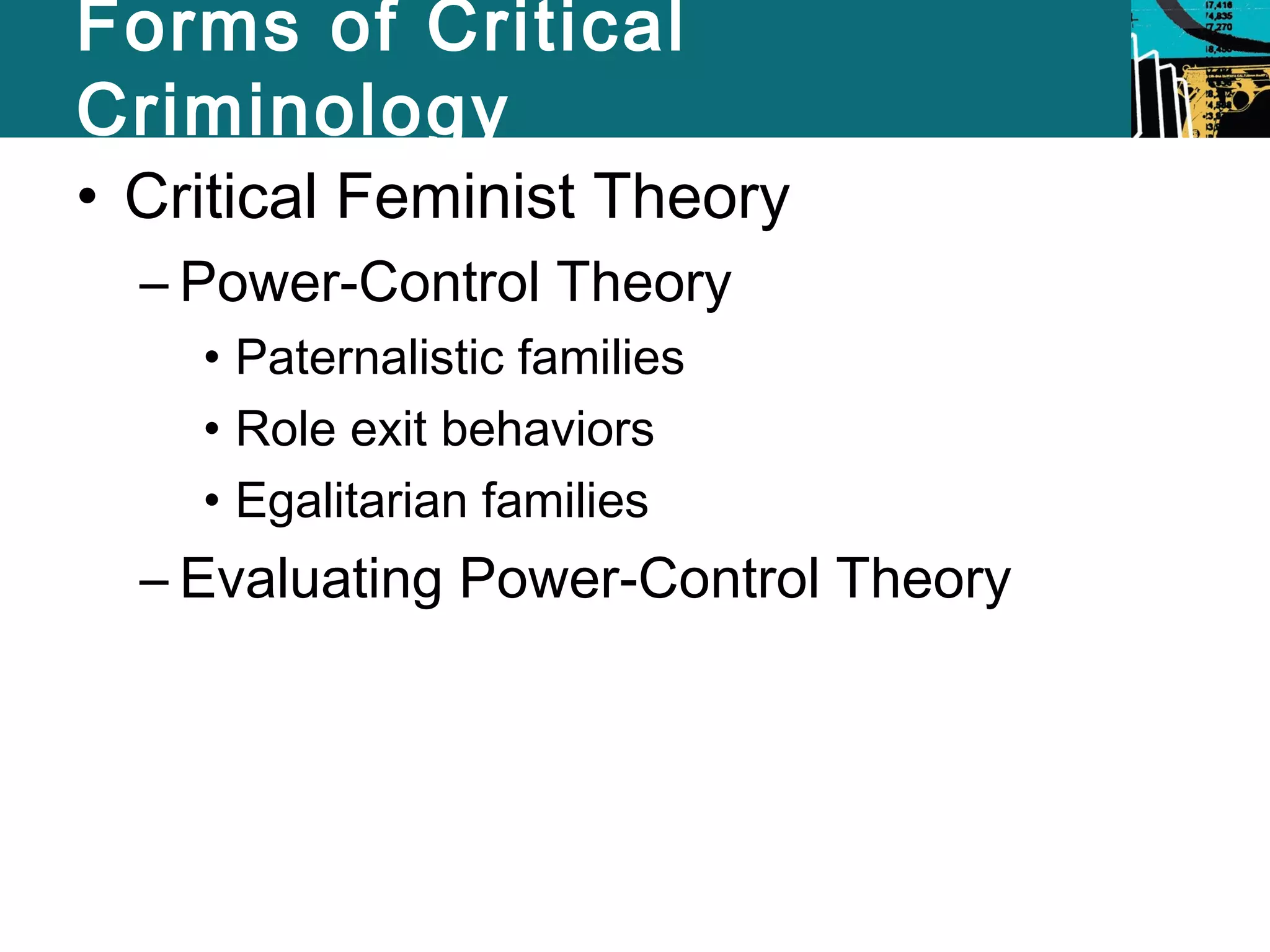
• Critical Feminist Theory 
– Power-Control Theory 
• Paternalistic families 
• Role exit behaviors 
• Egalitarian families 
– Evaluating Power-Control Theory
Forms of Critical 
Criminology 
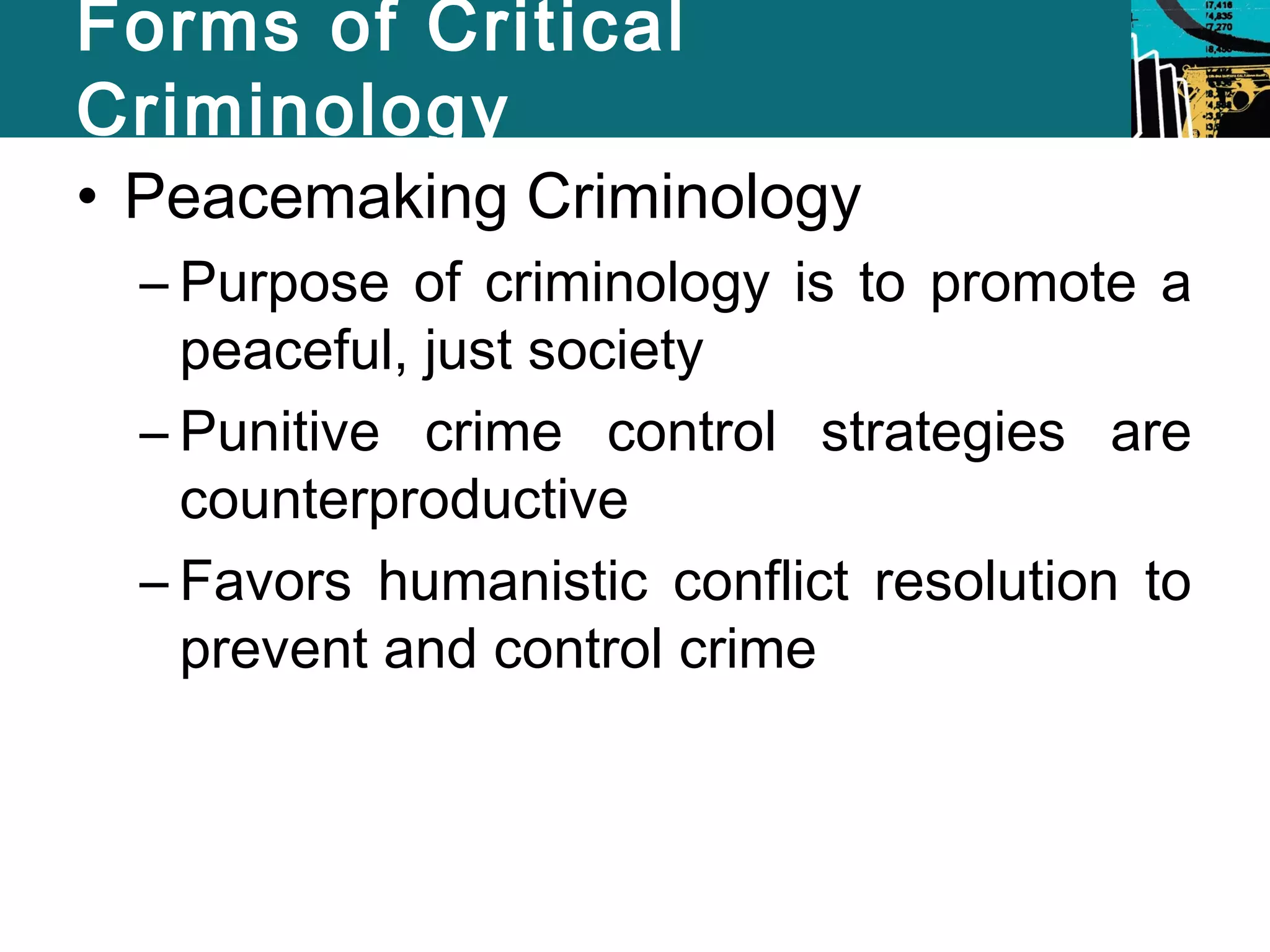
• Peacemaking Criminology 
– Purpose of criminology is to promote a 
peaceful, just society 
– Punitive crime control strategies are 
counterproductive 
– Favors humanistic conflict resolution to 
prevent and control crime
Critique of Critical 
Criminology 
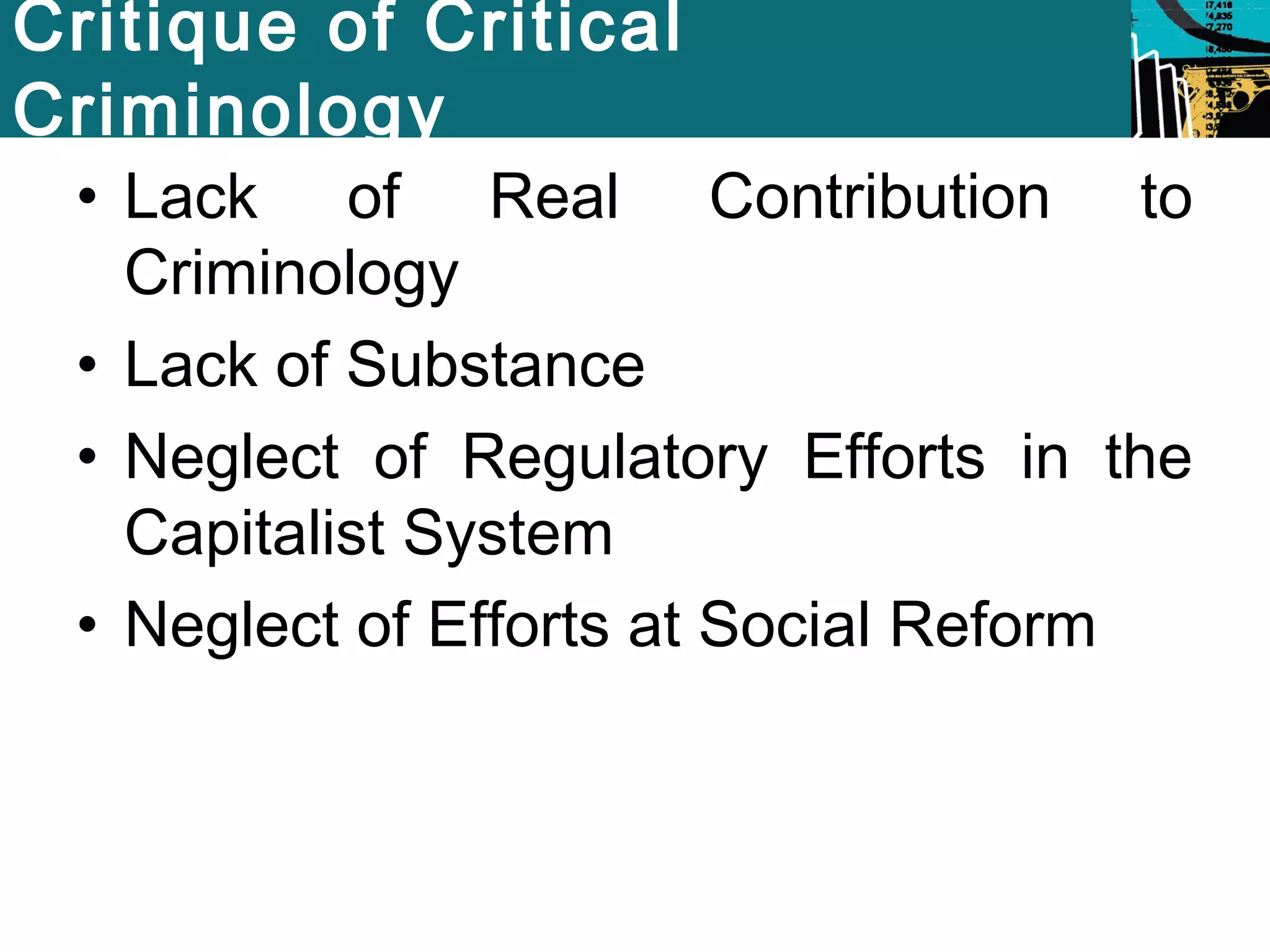
• Lack of Real Contribution to 
Criminology 
• Lack of Substance 
• Neglect of Regulatory Efforts in the 
Capitalist System 
• Neglect of Efforts at Social Reform
Forms of Critical 
Criminology
Critical Theory and Restorative 
Justice 
• The Concept of Restorative Justice 
– Failure of Old Punishment Policies 
– Restorative Justice Alternatives 
• Reintegrative Shaming
Critical Theory and Public 
Policy 
• The Process of Restoration 
– Restoration Programs 
• Sentencing circle 
– Family Group Conference 
– Reconciliation
Critical Theory and Public 
Policy 
• Balanced and Restorative Justice 
(BARJ) 
– Accountability 
– Competency development 
– Community safety 
• The Challenge of Restorative Justice

81-220-1 Chapter 8

  • 1.
    Chapter 8 - Social Conflict, Critical Criminology, and Restorative Justice Michelle Palaro Criminology 81-220-1 Fall 2014
  • 2.
    Social Conflict andCriminologists • Social conflict – The struggle for power in society • Critical criminologists – Criminologists who believe that the cause of crime can be linked to economic, social, and political disparity
  • 3.
    Social Conflict, Critical Criminology, and Restorative Justice
  • 4.
    Origins of CriticalCriminology • Karl Marx • National Deviancy Conference – How might social control cause deviancy • War in Vietnam, prison struggles, civil rights movement, feminist movement • Relationship between law, power, and crime
  • 5.
    Contemporary Critical Criminology • Themes and Concepts – Connection between social class, crime, and social control – Role of the government in creating a criminogenic environment – Relationship between personal/group power and shaping of criminal law
  • 6.
    Contemporary Critical Criminology • Themes and Concepts – Race and gender bias in the justice system – Relationship between capitalistic economy and crime rates –Misuse of political/social/media power to control behavior of others and shape public opinion
  • 7.
    Contemporary Critical Criminology • Themes and Concepts – American political system • Death penalty, three strikes laws, USA Patriot Act • Racism • Sexism • Demystifying domination
  • 8.
    Defining Crime andJustice • Crime is a political concept designed to protect the power and position of the upper classes at the expense of the poor
  • 9.
    Defining Crime andJustice • Poor – Street crime • Middle Class – White-Collar Crime • Wealthy – Racism – Sexism – Profiteering
  • 10.
    Defining Crime andJustice • Supranational Criminology – Antisocial behaviors committed by state officials in pursuit of their jobs as government representatives • War • Political Corruption • Illegal Domestic Surveillance • Human Rights Violations • State-Corporate Crime • State Violence
  • 11.
    Defining Crime andJustice • Instrumental vs. Structural Theory – Instrumental Theory • Criminal law and the criminal justice system are capitalist instruments for controlling the lower class – Structural Theory • Criminal law and the criminal justice system are means of defending and preserving the capitalist system
  • 12.
    The Cause ofCrime • Surplus Value • Marginalization • Globalization
  • 13.
    The Cause ofCrime • State (Organized) Crime – Criminal acts committed by government officials – Illegal domestic surveillance – Human rights violations – State-corporate crime – State violence
  • 14.
    The Cause ofCrime • Crime and social institutions • Educational disparities – “Drop-out factories” • Class and racial disparities in prosecution and sentencing • Racial threat theory
  • 15.
    Forms of Critical Criminology • Left Realism • Left Realism and crime – Crime is a function of relative deprivation under capitalism and favors pragmatic, community-based crime prevention and control – Crime Protection • Preemptive Deterrence • Left Realism and terrorism
  • 16.
    Forms of Critical Criminology • Critical Feminist Theory – Explains both victimization and criminality among women in terms of gender inequality, patriarchy, and the exploitation of women under capitalism – Patriarchy and Crime • Double marginality • Powerlessness – Masculinity and crime • Hegemonic masculinity – Exploitation and Criminality
  • 17.
    Forms of Critical Criminology • Critical Feminist Theory – Power-Control Theory • Paternalistic families • Role exit behaviors • Egalitarian families – Evaluating Power-Control Theory
  • 18.
    Forms of Critical Criminology • Peacemaking Criminology – Purpose of criminology is to promote a peaceful, just society – Punitive crime control strategies are counterproductive – Favors humanistic conflict resolution to prevent and control crime
  • 19.
    Critique of Critical Criminology • Lack of Real Contribution to Criminology • Lack of Substance • Neglect of Regulatory Efforts in the Capitalist System • Neglect of Efforts at Social Reform
  • 20.
    Forms of Critical Criminology
  • 21.
    Critical Theory andRestorative Justice • The Concept of Restorative Justice – Failure of Old Punishment Policies – Restorative Justice Alternatives • Reintegrative Shaming
  • 22.
    Critical Theory andPublic Policy • The Process of Restoration – Restoration Programs • Sentencing circle – Family Group Conference – Reconciliation
  • 23.
    Critical Theory andPublic Policy • Balanced and Restorative Justice (BARJ) – Accountability – Competency development – Community safety • The Challenge of Restorative Justice

Editor's Notes

  • #3 LO1: Be familiar with the ideas that underpin critical criminology.
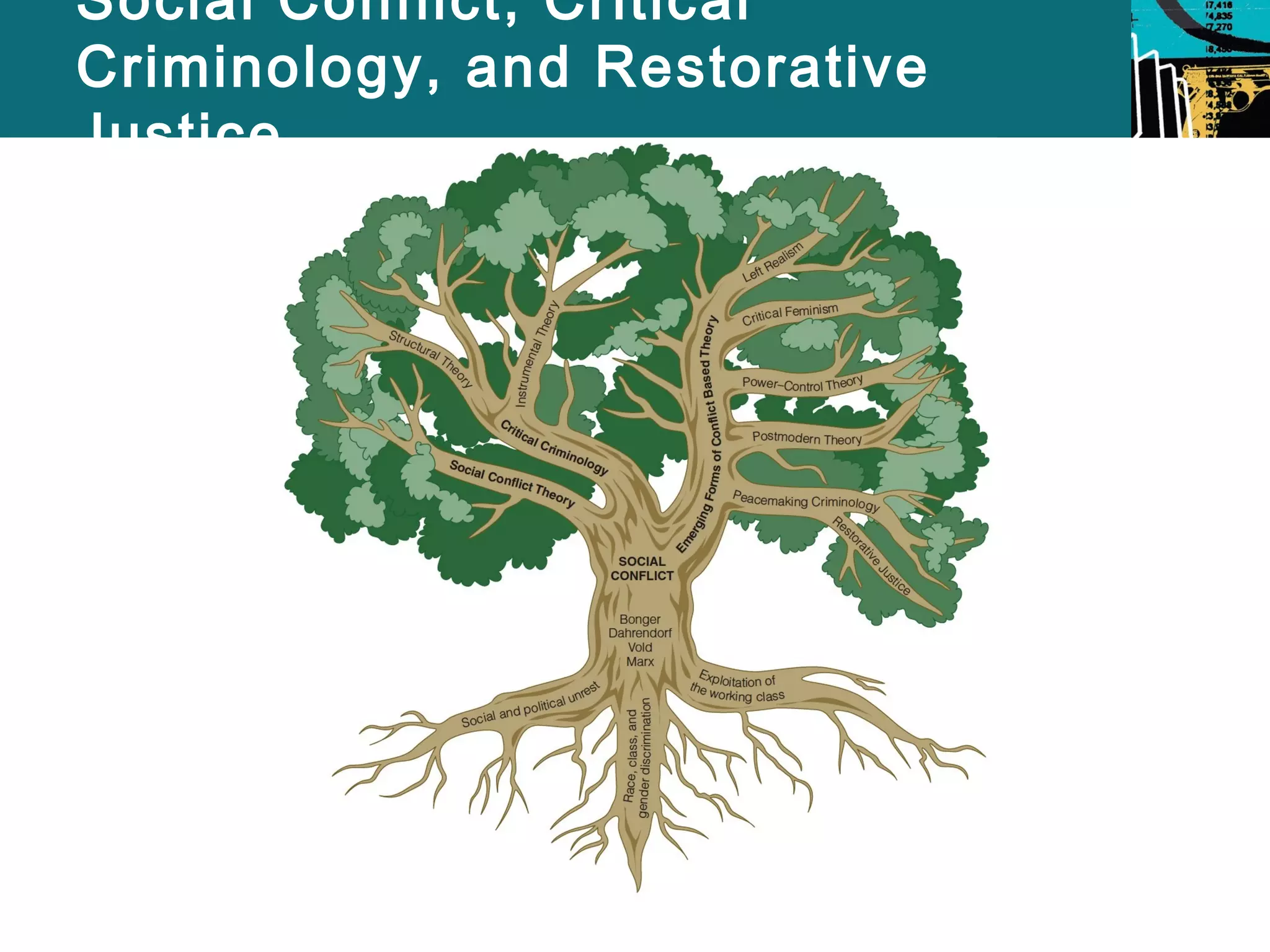
  • #4 LO1: Be familiar with the ideas that underpin critical criminology. FIGURE 8.1 The Branches of Critical Theory
  • #5 LO1: Be familiar with the ideas that underpin critical criminology.
  • #6 LO1: Be familiar with the ideas that underpin critical criminology.
  • #7 LO1: Be familiar with the ideas that underpin critical criminology.
  • #8 LO1: Be familiar with the ideas that underpin critical criminology.
  • #9 LO1: Be familiar with the ideas that underpin critical criminology.
  • #10 LO1: Be familiar with the ideas that underpin critical criminology.
  • #12 LO1: Be familiar with the ideas that underpin critical criminology.
  • #13 LO2: Link globalization to crime and criminality.
  • #14 LO3: Define the concept of state (organized) crime.
  • #15 LO1: Be familiar with the ideas that underpin critical criminology.
  • #16 LO1: Be familiar with the ideas that underpin critical criminology.
  • #17 LO5: Know some of the basic ideas of critical feminism.
  • #18 LO5: Know some of the basic ideas of critical feminism.
  • #19 LO6: Discuss how restorative justice is related to peacemaking criminology.
  • #20 LO1: Be familiar with the ideas that underpin critical criminology.
  • #21 LO4: Know the goals and findings of critical research.
  • #22 LO6: Discuss how restorative justice is related to peacemaking.
  • #23 LO6: Discuss how restorative justice is related to peacemaking.
  • #24 LO6: Discuss how restorative justice is related to peacemaking.