Creating a Republic Chapter 7 pp. 198 - 221
Section 1:  A Loose Confederation The Articles of Confederation created a  weak  central government and a  loose  alliance of independent states.
Each state writes a constitution… Cause: The states’ needed to define their governments.  CONSTITUTION: - A document that sets out the  laws, principles, organization, and processes  of government. Effect: The  rights  of citizens were defined. Limits  were placed on governments’ power.
Articles of Confederation provided a weak central government… Cause: The  Continental Congress  believed the states needed to be united, but found it difficult to create a constitution for ALL the states. Effect: The A.O.C. was  weak  because: 9 (of 13) states had to  agree  to any law. Trade  was not regulated. States did not have to contribute money to the Federal Government. No President (to  enforce  laws). No Courts (to settle  disputes ).
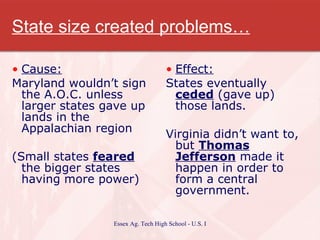
State size created problems… Cause: Maryland wouldn’t sign the A.O.C. unless larger states gave up lands in the Appalachian region (Small states  feared  the bigger states having more power) Effect: States eventually  ceded  (gave up) those lands. Virginia didn’t want to, but  Thomas Jefferson  made it happen in order to form a central government.
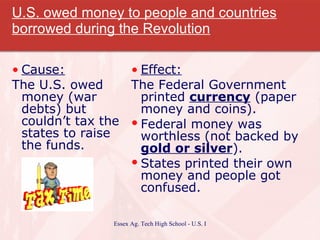
U.S. owed money to people and countries borrowed during the Revolution Cause: The U.S. owed money (war debts) but couldn’t tax the states to raise the funds. Effect: The Federal Government printed  currency  (paper money and coins). Federal money was worthless (not backed by  gold or silver ). States printed their own money and people got confused.
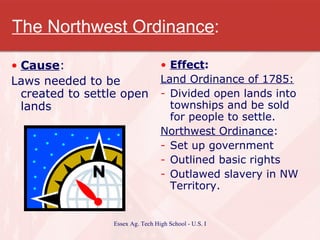
The Northwest Ordinance : Cause : Laws needed to be created to settle open lands Effect : Land Ordinance of 1785: Divided open lands into townships and be sold for people to settle. Northwest Ordinance : Set up government  Outlined basic rights Outlawed slavery in NW Territory.
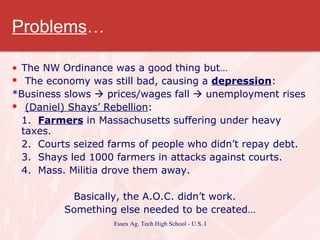
Problems … The NW Ordinance was a good thing but… The economy was still bad, causing a  depression : *Business slows    prices/wages fall    unemployment rises (Daniel) Shays’ Rebellion : 1.  Farmers  in Massachusetts suffering under heavy taxes. 2.  Courts seized farms of people who didn’t repay debt. 3.  Shays led 1000 farmers in attacks against courts. 4.  Mass. Militia drove them away. Basically, the A.O.C. didn’t work.  Something else needed to be created…
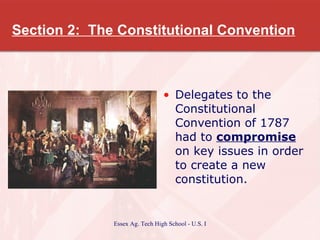
Section 2:  The Constitutional Convention Delegates to the Constitutional Convention of 1787 had to  compromise  on key issues in order to create a new constitution.
Virginia Plan – Randolph and Madison Strong National Government 3  Branches Legislative  – Create and Pass Laws  Executive  – Carry-out ( execute ) laws Judicial  – Judge the fairness of laws TWO HOUSES in Congress, ALL seats based on POPULATION QUESTION: Why may a state like New Jersey or Maryland oppose this plan?
New Jersey Plan - Paterson Same three  branches  with the same  responsibilities Congress would be ONE HOUSE…  with each state having ONE VOTE. QUESTION:  Is this fair?  To whom?
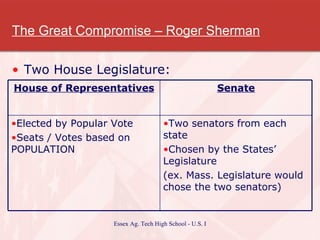
The Great Compromise – Roger Sherman Two House Legislature: Two senators from each state Chosen by the States’ Legislature (ex. Mass. Legislature would chose the two senators) Elected by Popular Vote Seats / Votes based on POPULATION Senate House of Representatives
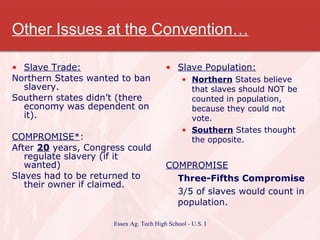
Other Issues at the Convention… Slave Trade: Northern States wanted to ban slavery. Southern states didn’t (there economy was dependent on it). COMPROMISE* : After  20  years, Congress could regulate slavery (if it wanted) Slaves had to be returned to their owner if claimed. Slave Population: Northern  States believe that slaves should NOT be counted in population, because they could not vote. Southern  States thought the opposite. COMPROMISE Three-Fifths Compromise   3/5 of slaves would count in population.
Section 3:  Ideas Behind the Constitution In writing the Constitution, Americans drew on ancient traditions,  Enlightenment  ideas, and their own experience.
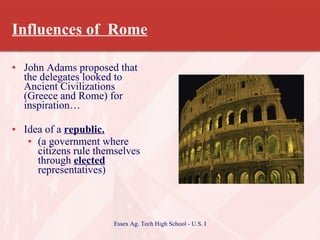
Influences of  Rome John Adams proposed that the delegates looked to Ancient Civilizations (Greece and Rome) for inspiration… Idea of a  republic. (a government where citizens rule themselves through  elected  representatives)
Lessons of Rome Good: Politicians served for the PEOPLE, not MONEY. Americans used Rome as a model for their  political debates ; often signed political essays as “Cincinnatus” or “Cicero.” For example: The Society of the Cincinnati were Revolutionary War veterans (3+ years of service)  Bad: Rome made many mistakes. Founding Fathers were cautious of  dictatorships  (governments where one person or group has total power) Republics were  vulnerable  from both the outside (invasion) and inside (decay).
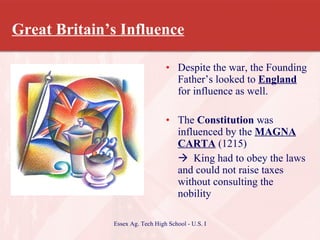
Great Britain’s Influence Despite the war, the Founding Father’s looked to  England  for influence as well. The  Constitution  was influenced by the  MAGNA CARTA  (1215)    King had to obey the laws and could not raise taxes without consulting the nobility
Another English Influence… The English Bill of Rights (1689) Elections for  Parliament  held regularly The right to a TRIAL BY JURY Keep and bear arms (own guns) HABEAS CORPUS  –  No person can be held against their will without being charged with a crime.
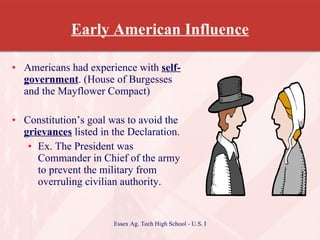
Early American Influence Americans had experience with  self-government . (House of Burgesses and the Mayflower Compact) Constitution’s goal was to avoid the  grievances  listed in the Declaration. Ex. The President was Commander in Chief of the army to prevent the military from overruling civilian authority.
The Enlightenment Influence John Locke (1690) Two Treatises on Government. Life, Liberty, and Property (Natural Rights) Government is an “ agreement ” between the ruler and the ruled. People have the right to  rebel  against a ruler who  violates  natural rights. Baron de Montesquieu (1748) Spirit of Laws Stressed the importance of government powers divided. Suggested the 3 branches  SEPARATION OF POWERS ): Legislative Executive Judicial
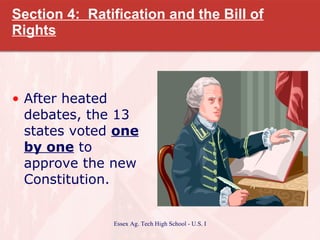
Section 4:  Ratification and the Bill of Rights After heated debates, the 13 states voted  one by one  to approve the new Constitution.
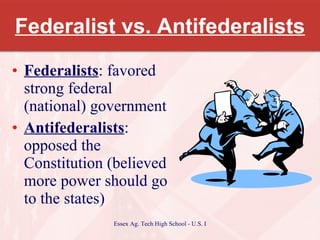
Federalist vs. Antifederalists Federalists : favored strong federal (national) government Antifederalists : opposed the Constitution (believed more power should go to the states)
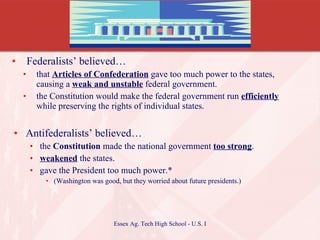
Federalists’ believed… that  Articles of Confederation  gave too much power to the states, causing a  weak and unstable  federal government. the Constitution would make the federal government run  efficiently  while preserving the rights of individual states. Antifederalists’ believed… the  Constitution  made the national government  too strong . weakened  the states. gave the President too much power.* (Washington was good, but they worried about future presidents.)
The Federalist Papers Series of essays by James Madison, Alexander Hamilton, and John Jay Written to  explain and defend  the idea of a Constitution Written under  pen names , but most people knew who they were anyway
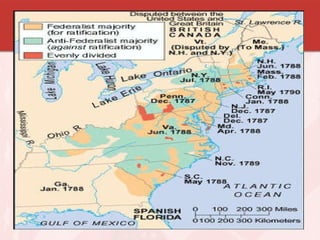
Ratification Ratify  – To  approve  [the Constitution] Federalists  – wanted to ratify the Constitution without a bill of rights.  They said it would be impossible to list everyone’s natural rights. Antifederalists  – would not ratify unless a bill of rights was included.  They said it was needed to protect basic rights (religion speech, etc…)
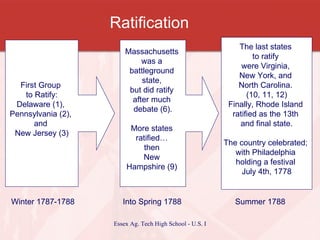
Ratification First Group  to Ratify: Delaware (1),  Pennsylvania (2),  and  New Jersey (3) Massachusetts  was a  battleground  state,  but did ratify  after much  debate (6). More states  ratified…  then  New  Hampshire (9)  The last states  to ratify  were Virginia,  New York, and  North Carolina.  (10, 11, 12) Finally, Rhode Island  ratified as the 13th  and final state. The country celebrated;  with Philadelphia  holding a festival  July 4th, 1778 Winter 1787-1788   Into Spring 1788 Summer 1788
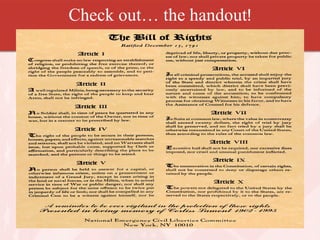
The Bill of Rights Some states ratified the Constitution on the condition that a bill of rights was added later. Amend  – to change [the Constitution]… The framers made it a difficult process. The new federal government came up with  12  amendments, however only  10  were ratified.  These became the  Bill of Rights . How many of the Ten Amendments can you name? 1._________________________ 2._________________________ 3._________________________ 4._________________________ 5._________________________ 6._________________________ 7._________________________ 8._________________________ 9._________________________ 10.________________________
 
Check out… the handout !

Chapter 7 Creating a Republic

  • 1.
    Creating a RepublicChapter 7 pp. 198 - 221
  • 2.
    Section 1: A Loose Confederation The Articles of Confederation created a weak central government and a loose alliance of independent states.
  • 3.
    Each state writesa constitution… Cause: The states’ needed to define their governments. CONSTITUTION: - A document that sets out the laws, principles, organization, and processes of government. Effect: The rights of citizens were defined. Limits were placed on governments’ power.
  • 4.
    Articles of Confederationprovided a weak central government… Cause: The Continental Congress believed the states needed to be united, but found it difficult to create a constitution for ALL the states. Effect: The A.O.C. was weak because: 9 (of 13) states had to agree to any law. Trade was not regulated. States did not have to contribute money to the Federal Government. No President (to enforce laws). No Courts (to settle disputes ).
  • 5.
    State size createdproblems… Cause: Maryland wouldn’t sign the A.O.C. unless larger states gave up lands in the Appalachian region (Small states feared the bigger states having more power) Effect: States eventually ceded (gave up) those lands. Virginia didn’t want to, but Thomas Jefferson made it happen in order to form a central government.
  • 6.
    U.S. owed moneyto people and countries borrowed during the Revolution Cause: The U.S. owed money (war debts) but couldn’t tax the states to raise the funds. Effect: The Federal Government printed currency (paper money and coins). Federal money was worthless (not backed by gold or silver ). States printed their own money and people got confused.
  • 7.
    The Northwest Ordinance: Cause : Laws needed to be created to settle open lands Effect : Land Ordinance of 1785: Divided open lands into townships and be sold for people to settle. Northwest Ordinance : Set up government Outlined basic rights Outlawed slavery in NW Territory.
  • 8.
    Problems … TheNW Ordinance was a good thing but… The economy was still bad, causing a depression : *Business slows  prices/wages fall  unemployment rises (Daniel) Shays’ Rebellion : 1. Farmers in Massachusetts suffering under heavy taxes. 2. Courts seized farms of people who didn’t repay debt. 3. Shays led 1000 farmers in attacks against courts. 4. Mass. Militia drove them away. Basically, the A.O.C. didn’t work. Something else needed to be created…
  • 9.
    Section 2: The Constitutional Convention Delegates to the Constitutional Convention of 1787 had to compromise on key issues in order to create a new constitution.
  • 10.
    Virginia Plan –Randolph and Madison Strong National Government 3 Branches Legislative – Create and Pass Laws Executive – Carry-out ( execute ) laws Judicial – Judge the fairness of laws TWO HOUSES in Congress, ALL seats based on POPULATION QUESTION: Why may a state like New Jersey or Maryland oppose this plan?
  • 11.
    New Jersey Plan- Paterson Same three branches with the same responsibilities Congress would be ONE HOUSE… with each state having ONE VOTE. QUESTION: Is this fair? To whom?
  • 12.
    The Great Compromise– Roger Sherman Two House Legislature: Two senators from each state Chosen by the States’ Legislature (ex. Mass. Legislature would chose the two senators) Elected by Popular Vote Seats / Votes based on POPULATION Senate House of Representatives
  • 13.
    Other Issues atthe Convention… Slave Trade: Northern States wanted to ban slavery. Southern states didn’t (there economy was dependent on it). COMPROMISE* : After 20 years, Congress could regulate slavery (if it wanted) Slaves had to be returned to their owner if claimed. Slave Population: Northern States believe that slaves should NOT be counted in population, because they could not vote. Southern States thought the opposite. COMPROMISE Three-Fifths Compromise 3/5 of slaves would count in population.
  • 14.
    Section 3: Ideas Behind the Constitution In writing the Constitution, Americans drew on ancient traditions, Enlightenment ideas, and their own experience.
  • 15.
    Influences of Rome John Adams proposed that the delegates looked to Ancient Civilizations (Greece and Rome) for inspiration… Idea of a republic. (a government where citizens rule themselves through elected representatives)
  • 16.
    Lessons of RomeGood: Politicians served for the PEOPLE, not MONEY. Americans used Rome as a model for their political debates ; often signed political essays as “Cincinnatus” or “Cicero.” For example: The Society of the Cincinnati were Revolutionary War veterans (3+ years of service) Bad: Rome made many mistakes. Founding Fathers were cautious of dictatorships (governments where one person or group has total power) Republics were vulnerable from both the outside (invasion) and inside (decay).
  • 17.
    Great Britain’s InfluenceDespite the war, the Founding Father’s looked to England for influence as well. The Constitution was influenced by the MAGNA CARTA (1215)  King had to obey the laws and could not raise taxes without consulting the nobility
  • 18.
    Another English Influence…The English Bill of Rights (1689) Elections for Parliament held regularly The right to a TRIAL BY JURY Keep and bear arms (own guns) HABEAS CORPUS – No person can be held against their will without being charged with a crime.
  • 19.
    Early American InfluenceAmericans had experience with self-government . (House of Burgesses and the Mayflower Compact) Constitution’s goal was to avoid the grievances listed in the Declaration. Ex. The President was Commander in Chief of the army to prevent the military from overruling civilian authority.
  • 20.
    The Enlightenment InfluenceJohn Locke (1690) Two Treatises on Government. Life, Liberty, and Property (Natural Rights) Government is an “ agreement ” between the ruler and the ruled. People have the right to rebel against a ruler who violates natural rights. Baron de Montesquieu (1748) Spirit of Laws Stressed the importance of government powers divided. Suggested the 3 branches SEPARATION OF POWERS ): Legislative Executive Judicial
  • 21.
    Section 4: Ratification and the Bill of Rights After heated debates, the 13 states voted one by one to approve the new Constitution.
  • 22.
    Federalist vs. AntifederalistsFederalists : favored strong federal (national) government Antifederalists : opposed the Constitution (believed more power should go to the states)
  • 23.
    Federalists’ believed… that Articles of Confederation gave too much power to the states, causing a weak and unstable federal government. the Constitution would make the federal government run efficiently while preserving the rights of individual states. Antifederalists’ believed… the Constitution made the national government too strong . weakened the states. gave the President too much power.* (Washington was good, but they worried about future presidents.)
  • 24.
    The Federalist PapersSeries of essays by James Madison, Alexander Hamilton, and John Jay Written to explain and defend the idea of a Constitution Written under pen names , but most people knew who they were anyway
  • 25.
    Ratification Ratify – To approve [the Constitution] Federalists – wanted to ratify the Constitution without a bill of rights. They said it would be impossible to list everyone’s natural rights. Antifederalists – would not ratify unless a bill of rights was included. They said it was needed to protect basic rights (religion speech, etc…)
  • 26.
    Ratification First Group to Ratify: Delaware (1), Pennsylvania (2), and New Jersey (3) Massachusetts was a battleground state, but did ratify after much debate (6). More states ratified… then New Hampshire (9) The last states to ratify were Virginia, New York, and North Carolina. (10, 11, 12) Finally, Rhode Island ratified as the 13th and final state. The country celebrated; with Philadelphia holding a festival July 4th, 1778 Winter 1787-1788 Into Spring 1788 Summer 1788
  • 27.
    The Bill ofRights Some states ratified the Constitution on the condition that a bill of rights was added later. Amend – to change [the Constitution]… The framers made it a difficult process. The new federal government came up with 12 amendments, however only 10 were ratified. These became the Bill of Rights . How many of the Ten Amendments can you name? 1._________________________ 2._________________________ 3._________________________ 4._________________________ 5._________________________ 6._________________________ 7._________________________ 8._________________________ 9._________________________ 10.________________________
  • 28.
  • 29.