Connectivity of graphs
A graph is said to be connected, if there is a path between any two vertices. Some graphs are “more connected” than others. Two numerical parameters :- edge connectivity &vertex connectivity  are  useful in measuring a graph’s connectedness. Connectivity of a graph
Edge connectivity
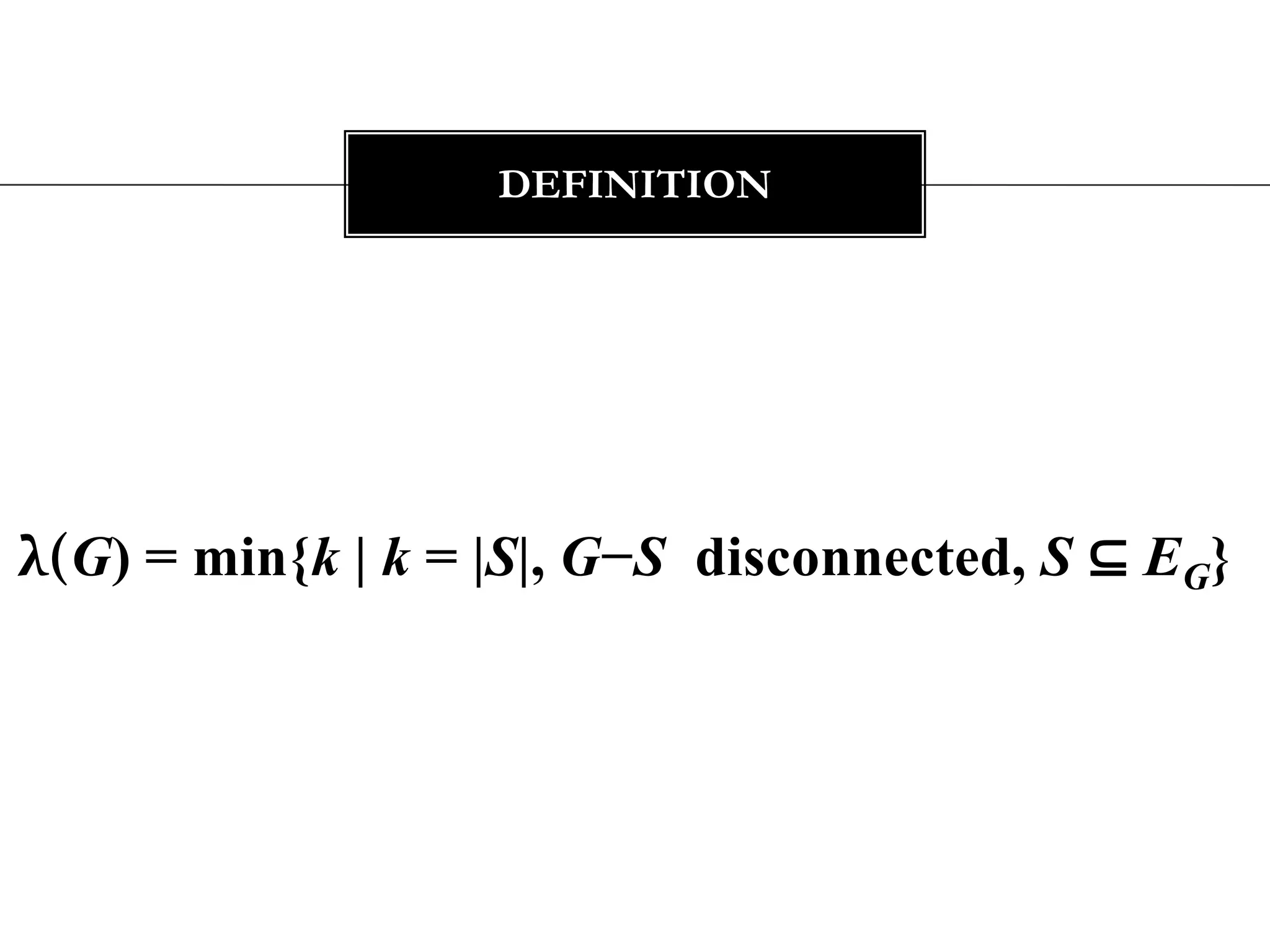
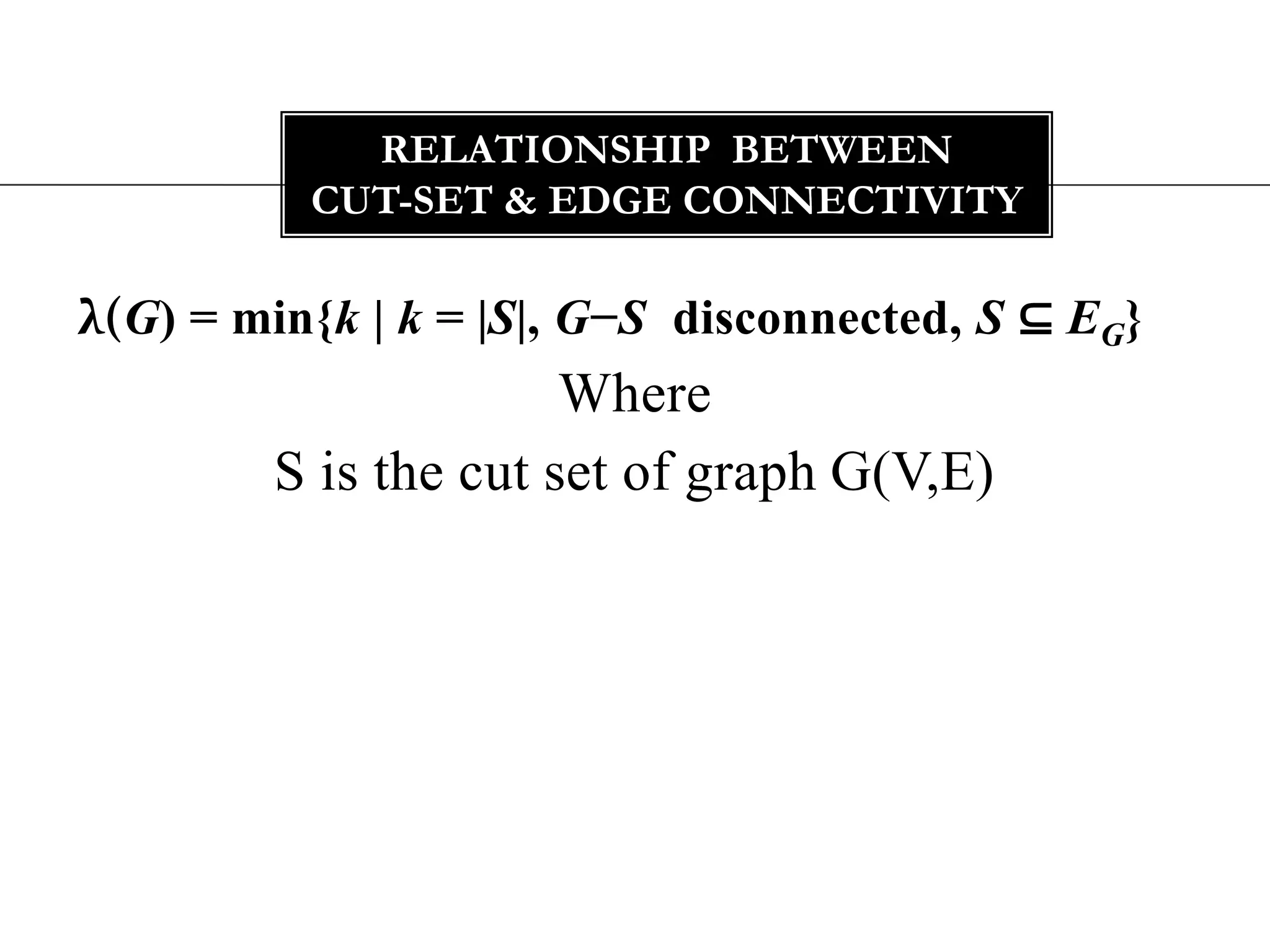
λ(G) = min{k | k = |S|, G−S  disconnected, S ⊆ EG} definition
The edge-connectivity λ(G) of a connected graph G is the smallest number of edges whose removal disconnects G.When λ(G) ≥ k, the graph G is said to be k-edge-connected.
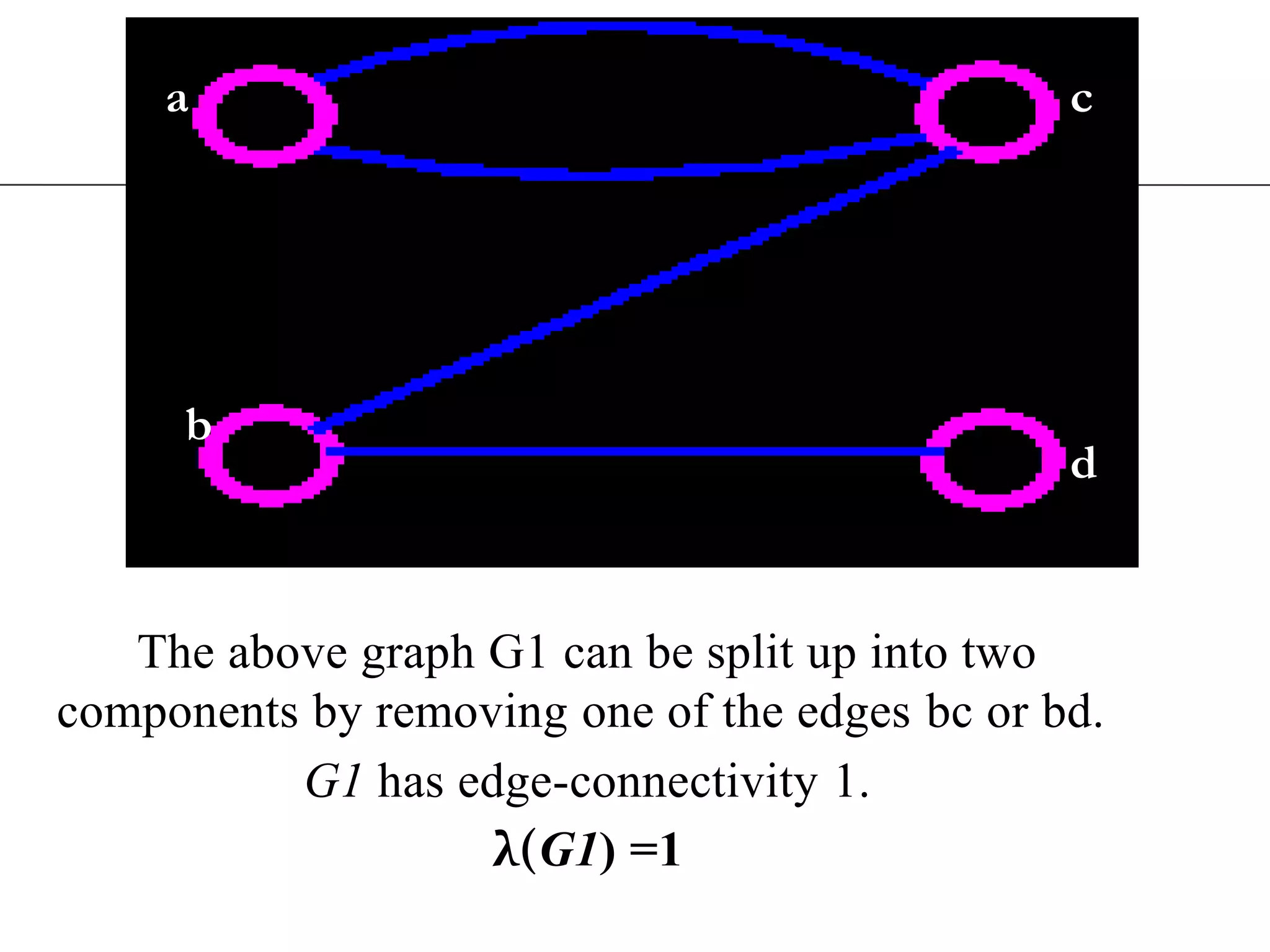
acThe above graph G1 can be split up into two components by removing one of the edges bc or bd. G1 has edge-connectivity 1.λ(G1) =1bd
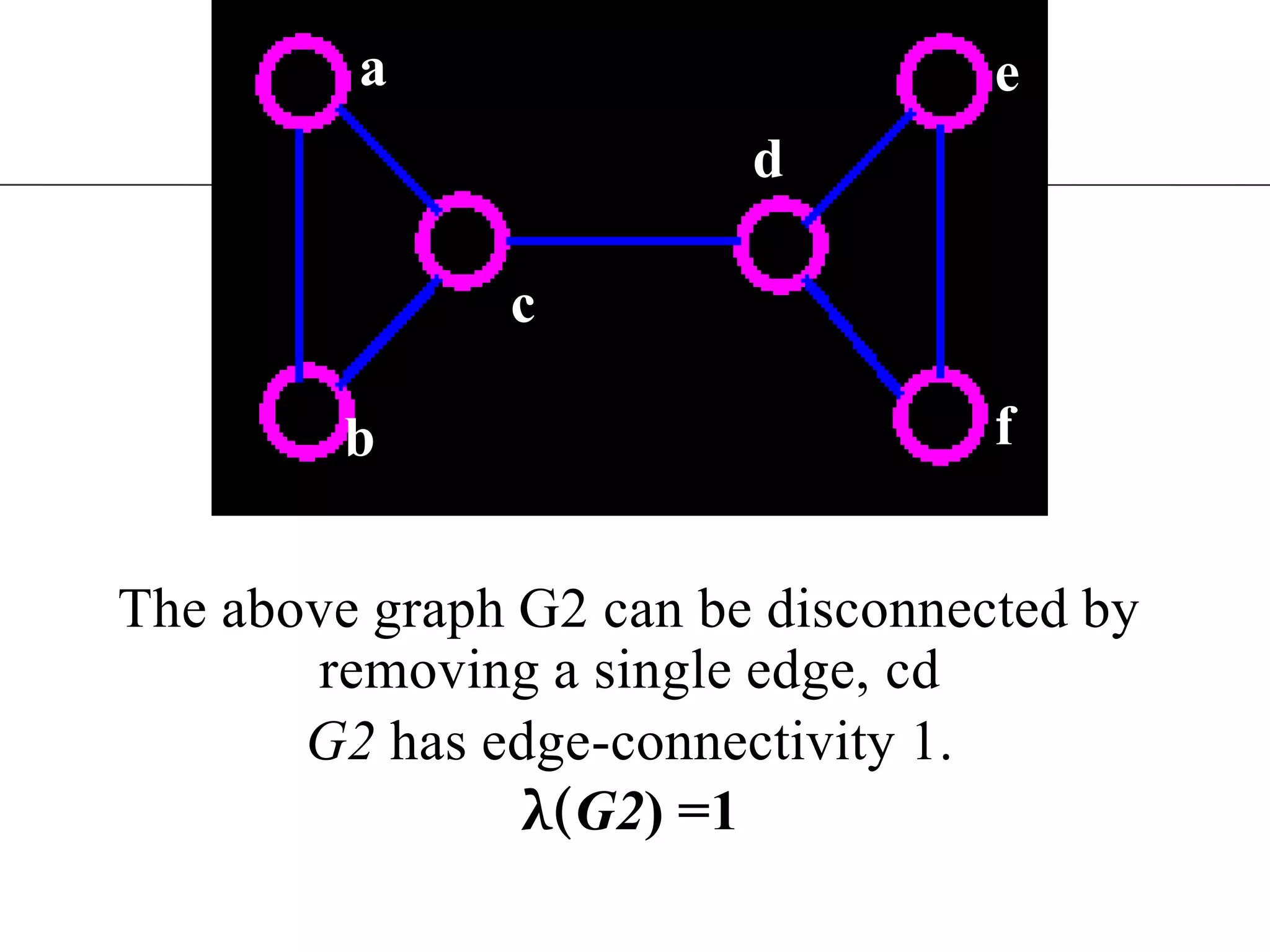
aedcThe above graph G2 can be disconnected by removing a single edge, cdG2 has edge-connectivity 1.λ(G2) =1fb
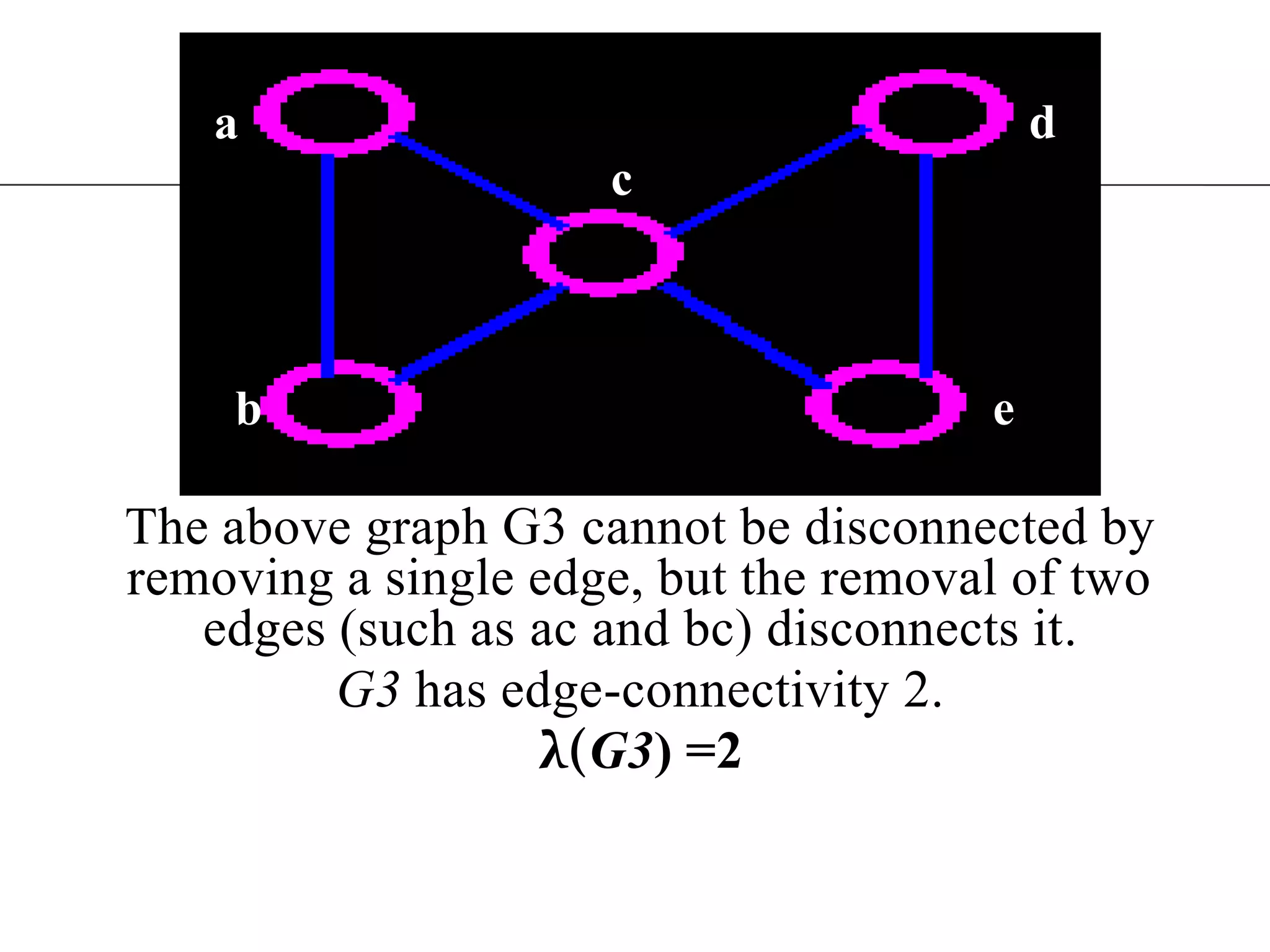
dacThe above graph G3 cannot be disconnected by removing a single edge, but the removal of two edges (such as ac and bc) disconnects it.G3 has edge-connectivity 2.λ(G3) =2be
A cut set of a connected graph G is a set S of edges with the following properties:The removal of all edges in S disconnects G.The removal of some (but not all) of edges in S does not disconnects G Cut set is also known as edge-cutCut Set
An edge- cut Sof G  consists of edges so that G −S  is disconnected.-Or-
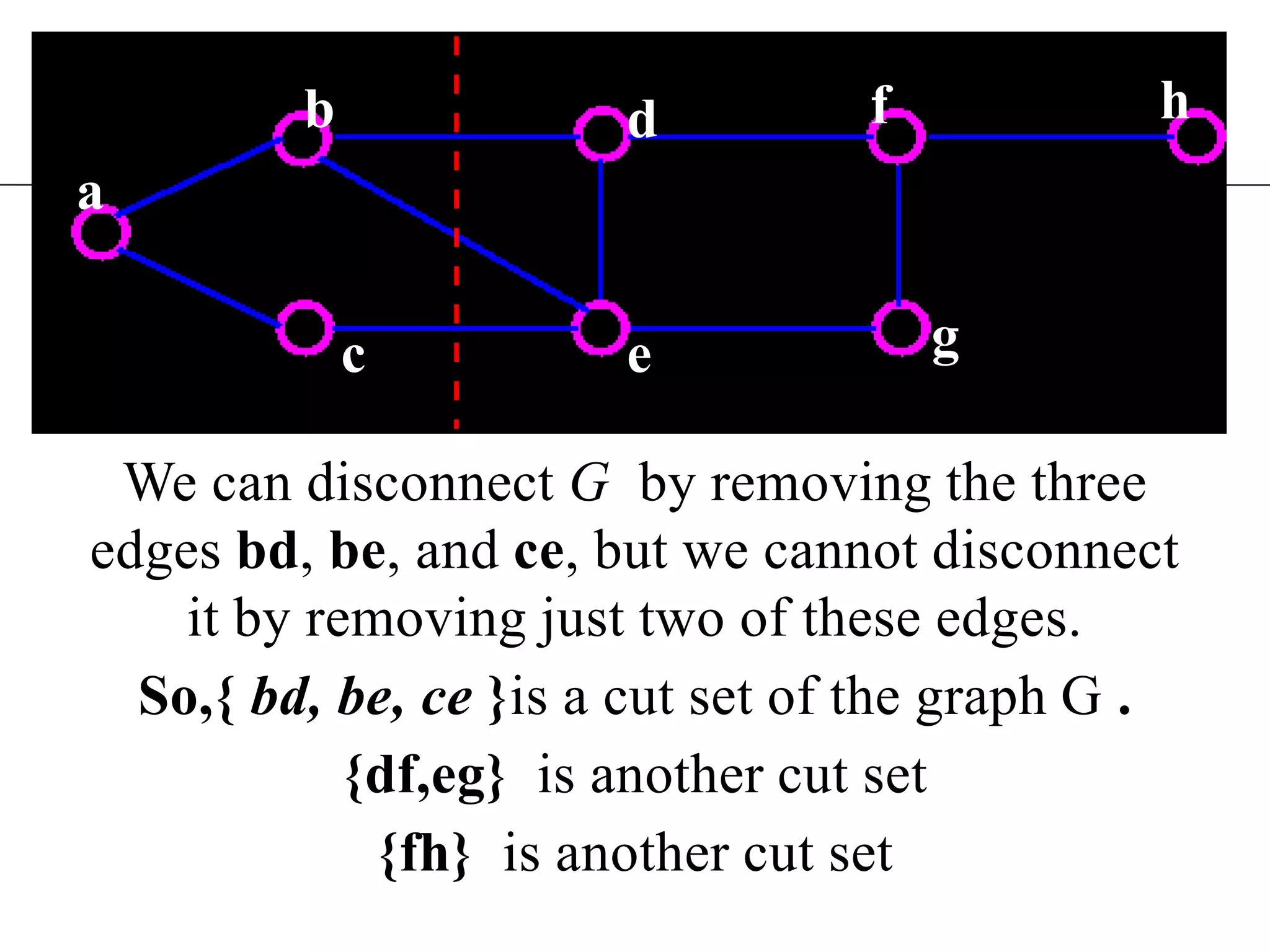
hfbdaWe can disconnect G  by removing the three edges bd, be, and ce, but we cannot disconnect it by removing just two of these edges. So,{ bd, be, ce}is a cut set of the graph G .{df,eg}  is another cut set{fh}  is another cut setgce
Or cut-edge (not edge-cut)is an edge-cut consisting of a single edge.Or A bridge is a single edge whose removal disconnects a graph bridge
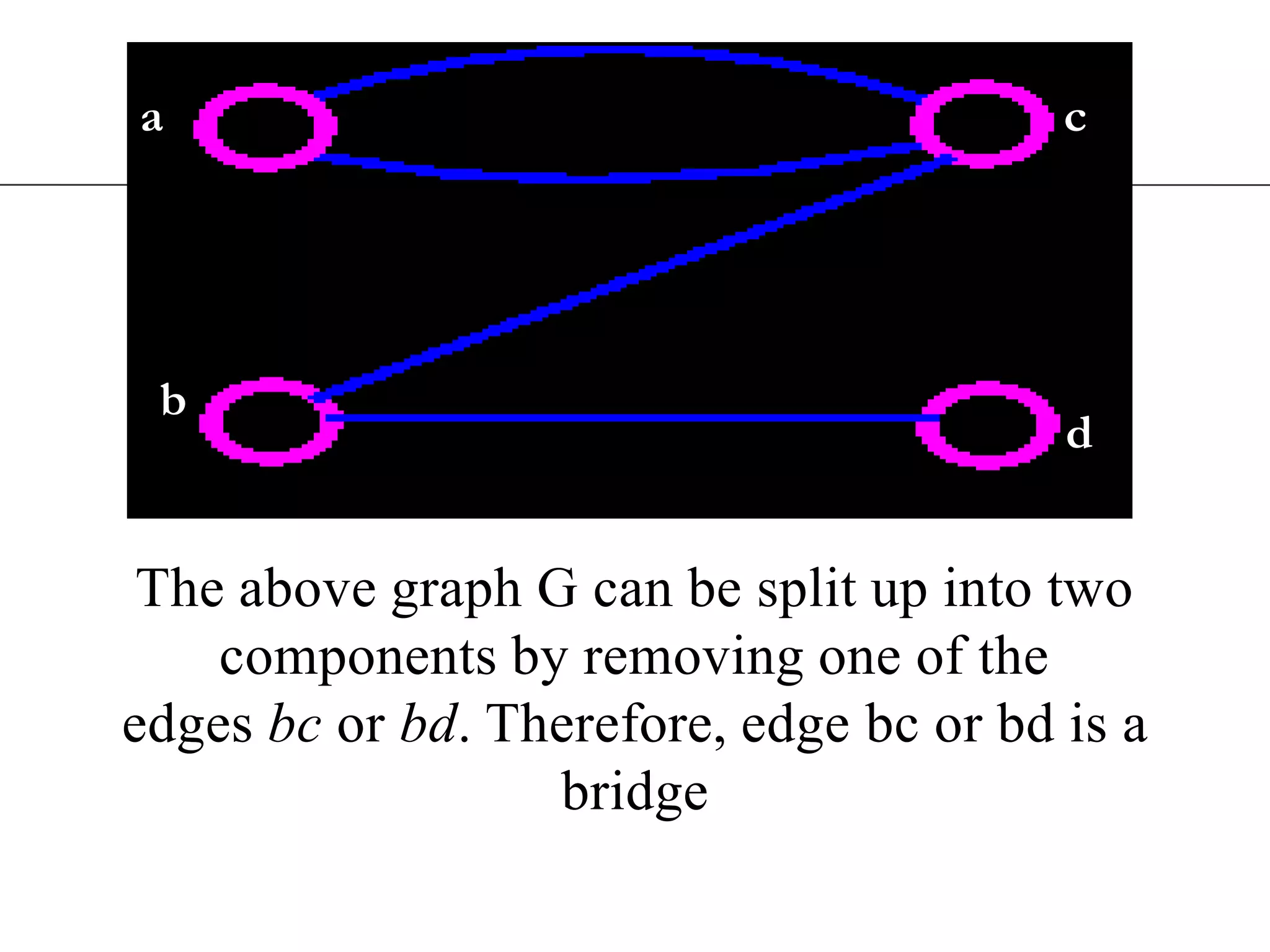
The above graph G can be split up into two components by removing one of the edges bc or bd. Therefore, edge bc or bd is a bridge acbd
λ(G) = min{k | k = |S|, G−S  disconnected, S ⊆ EG} Where S is the cut set of graph G(V,E)Relationship  between cut-set & edge connectivity
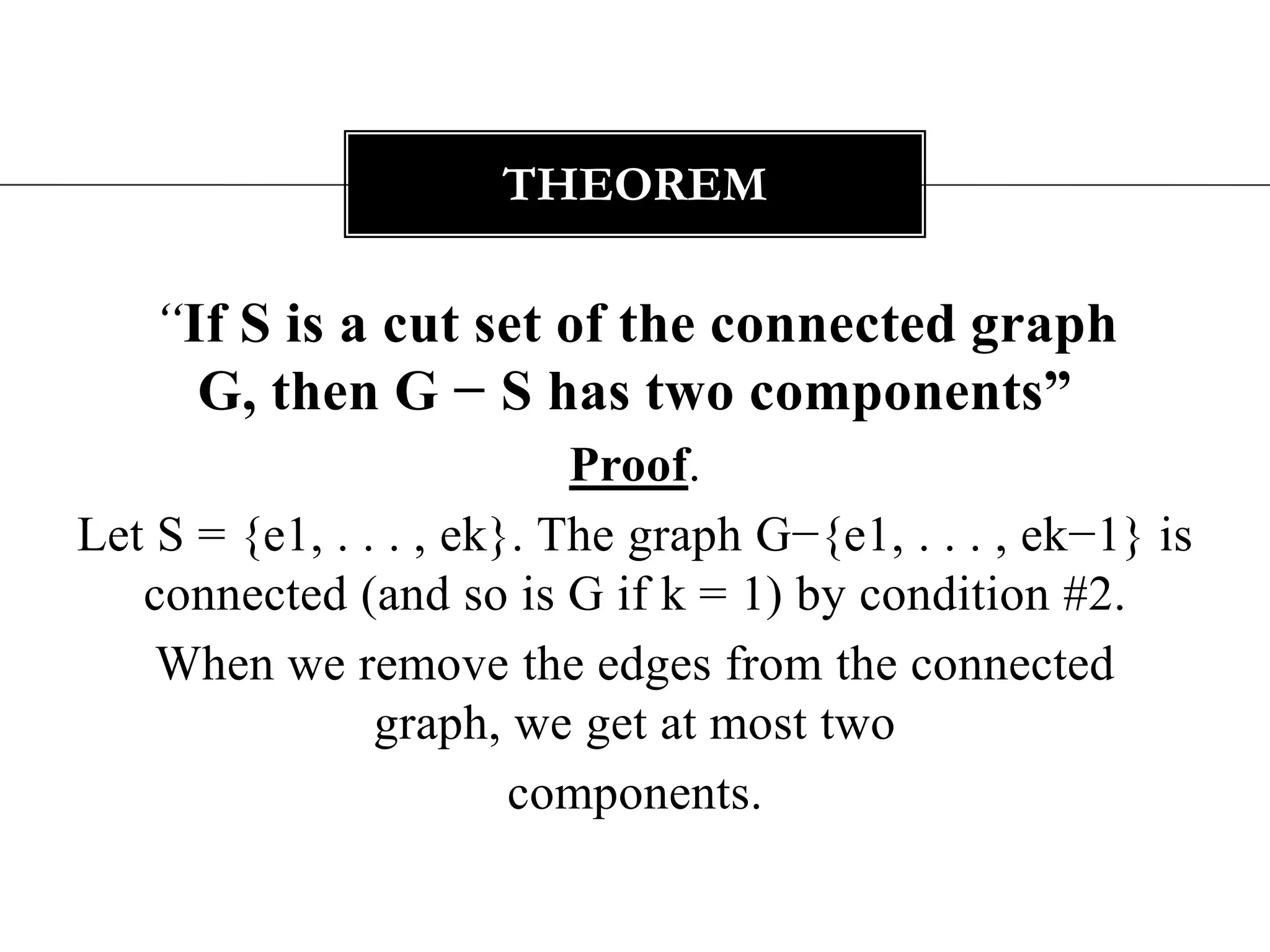
“If S is a cut set of the connected graph G, then G − S has two components”Proof. Let S = {e1, . . . , ek}. The graph G−{e1, . . . , ek−1} is connected (and so is G if k = 1) by condition #2. When we remove the edges from the connected graph, we get at most twocomponents.Theorem
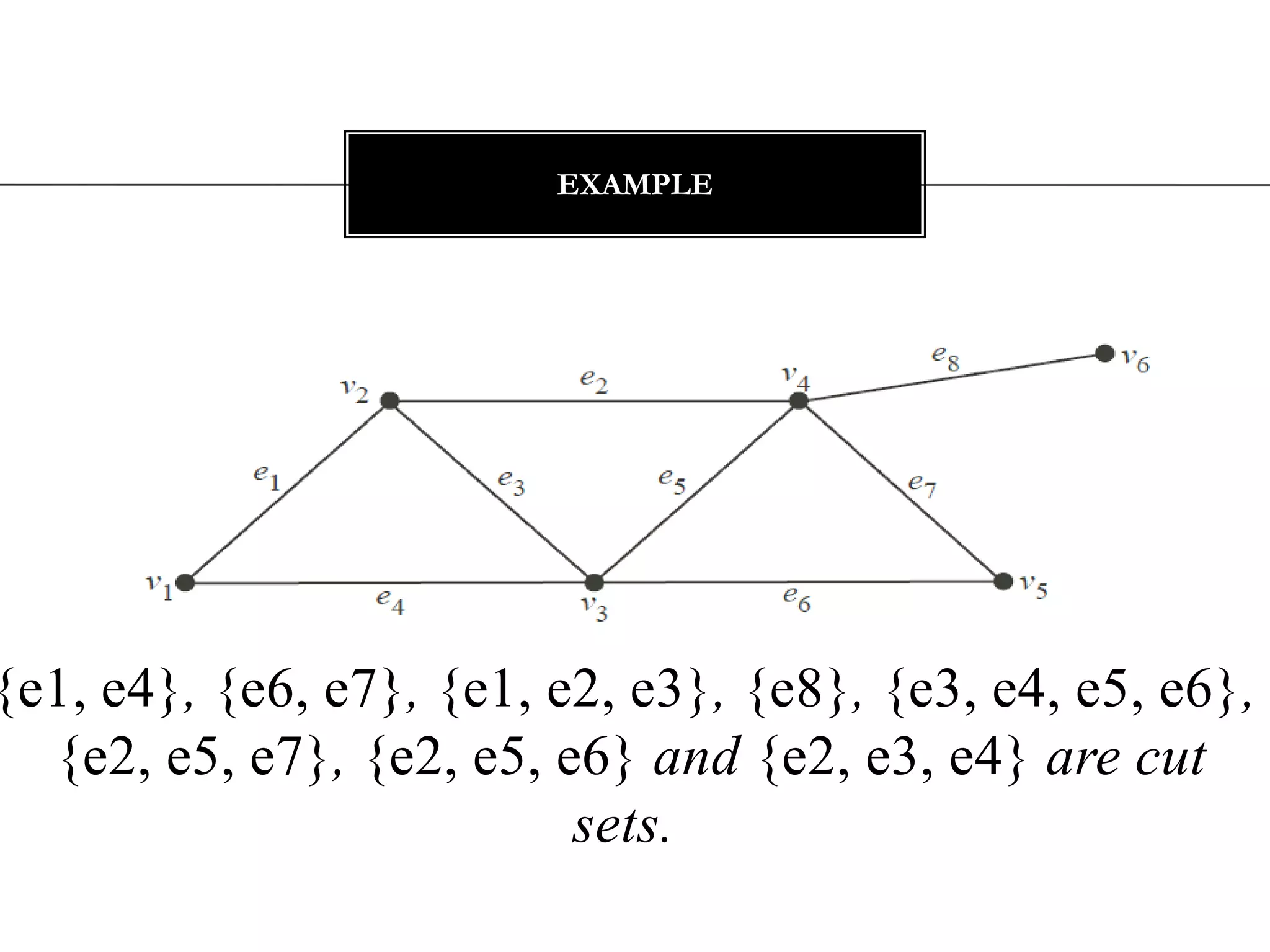
{e1, e4}, {e6, e7}, {e1, e2, e3}, {e8}, {e3, e4, e5, e6}, {e2, e5, e7}, {e2, e5, e6} and {e2, e3, e4} are cut sets.EXAMPLE
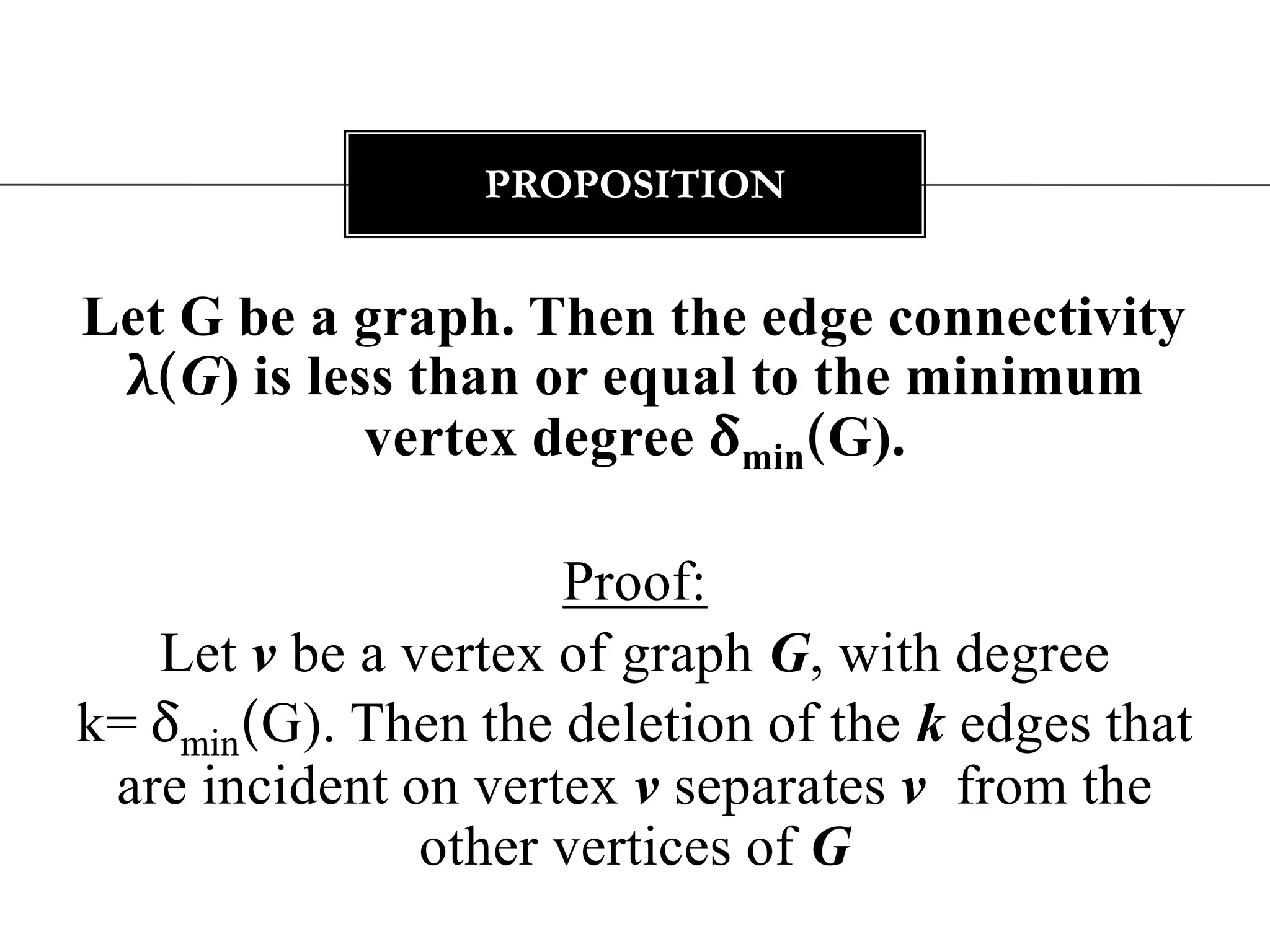
Let G be a graph. Then the edge connectivity λ(G)is less than or equal to the minimum vertex degree δmin(G). Proof:Let v be a vertex of graph G, with degree k= δmin(G). Then the deletion of the k edges that are incident on vertex v separates v  from the other vertices of GProposition
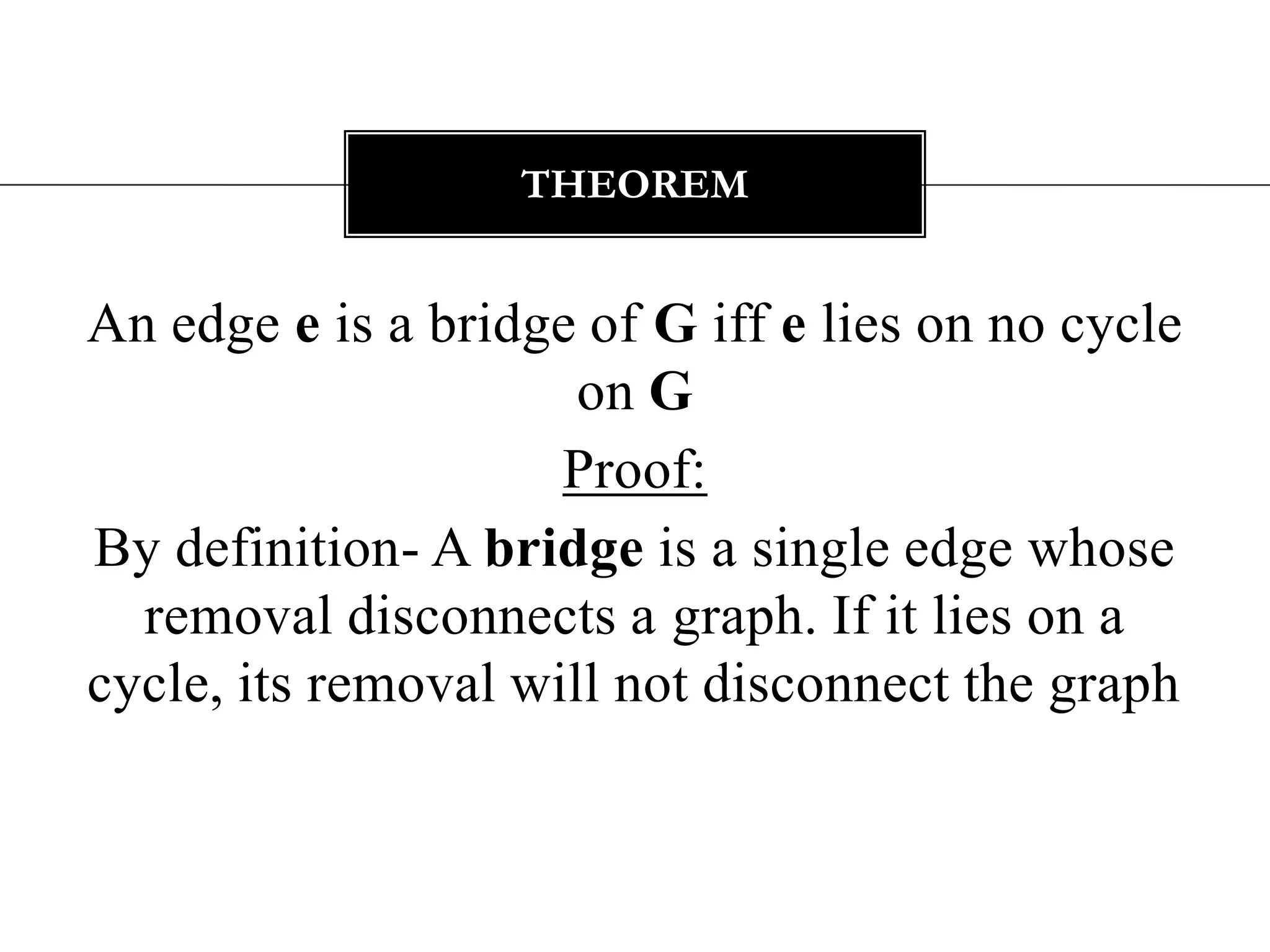
An edge e is a bridge of G iff e lies on no cycle on GProof:By definition-A bridge is a single edge whose removal disconnects a graph. If it lies on a cycle, its removal will not disconnect the graphtheorem
Vertex connectivity
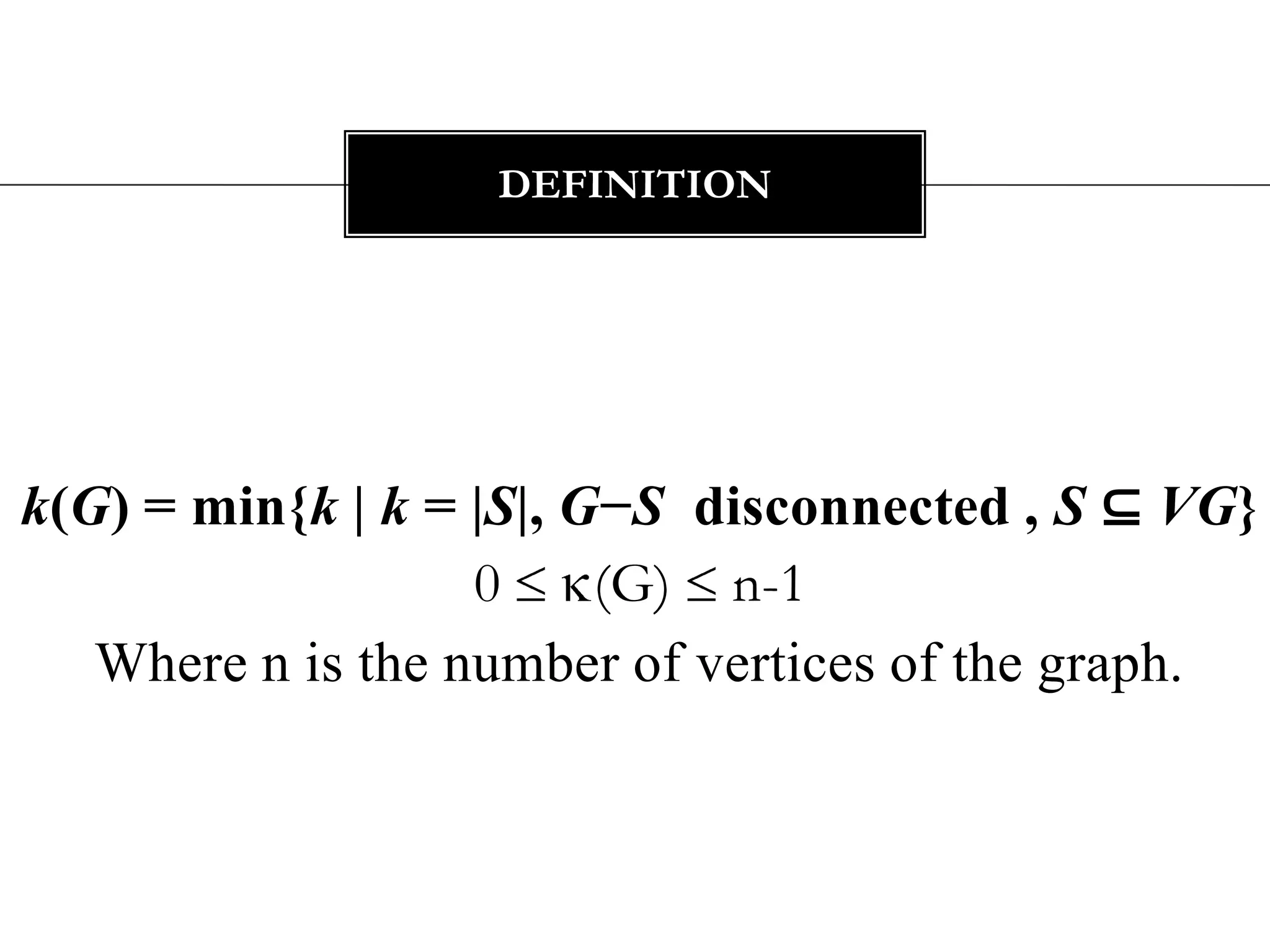
k(G) = min{k | k = |S|, G−S  disconnected , S ⊆ VG}0  (G)  n-1Where n is the number of vertices of the graph.definition
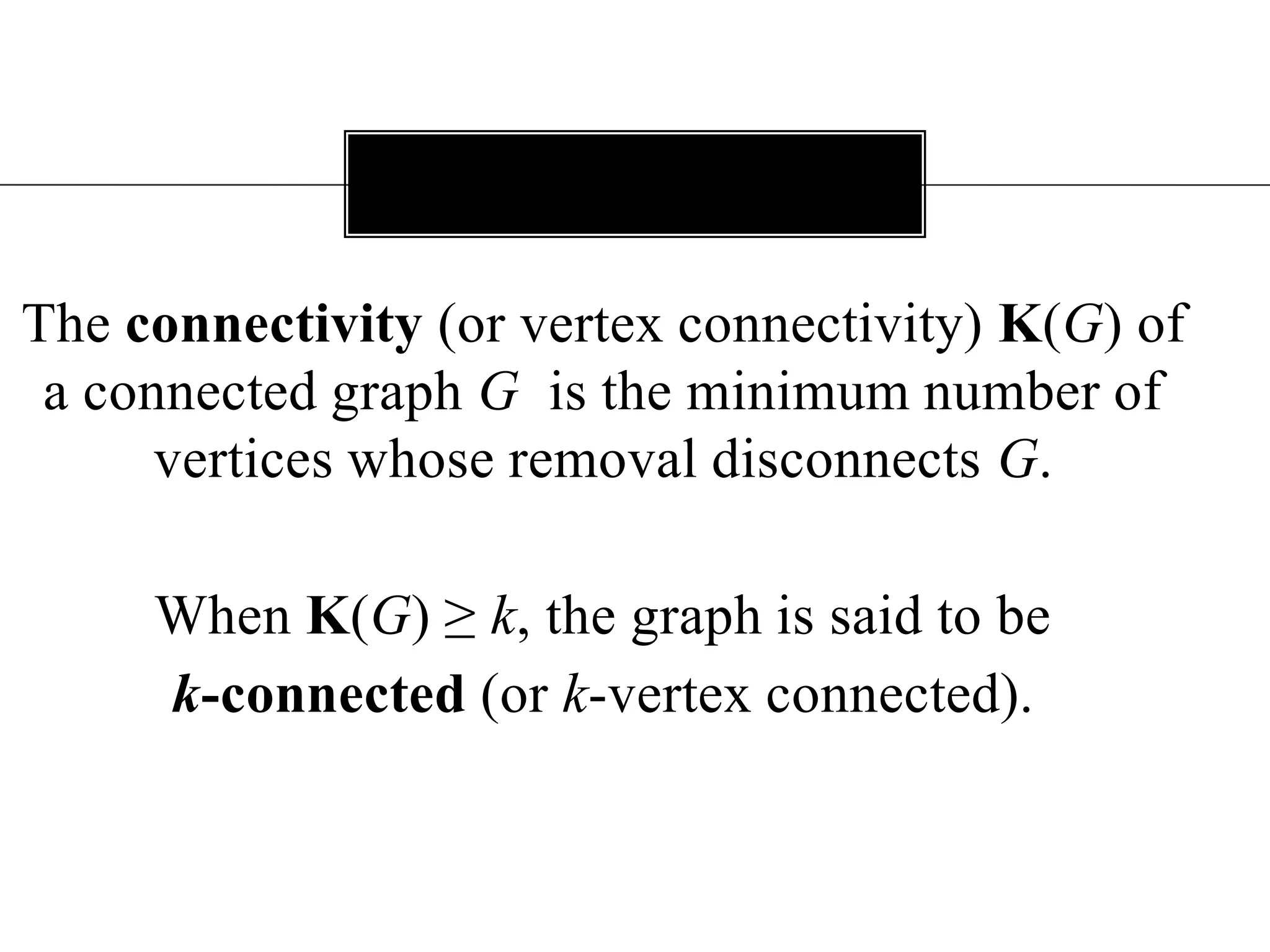
The connectivity (or vertex connectivity) K(G) of a connected graph Gis the minimum number of vertices whose removal disconnects G. When K(G) ≥ k, the graph is said to be k-connected(or k-vertex connected).
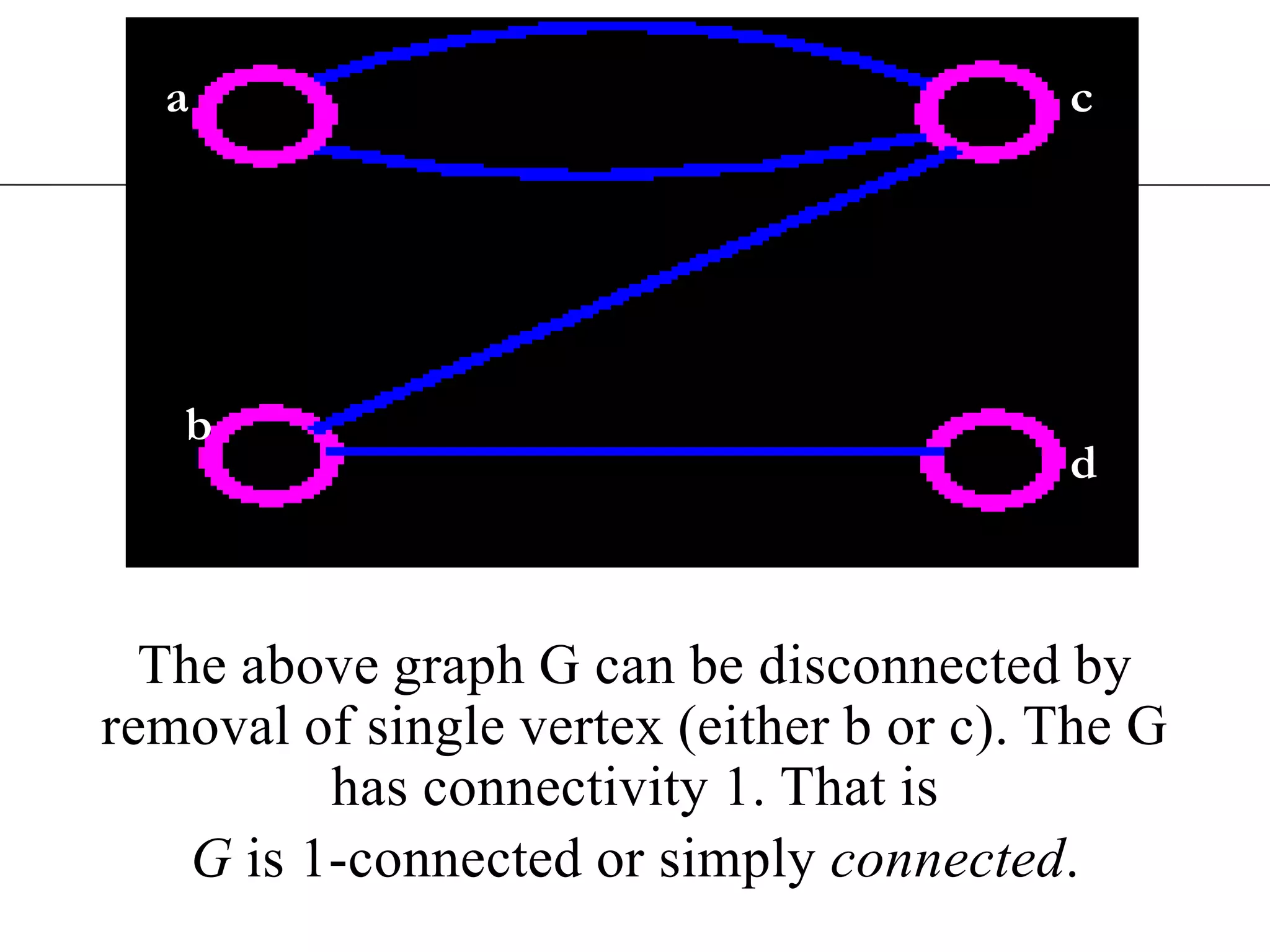
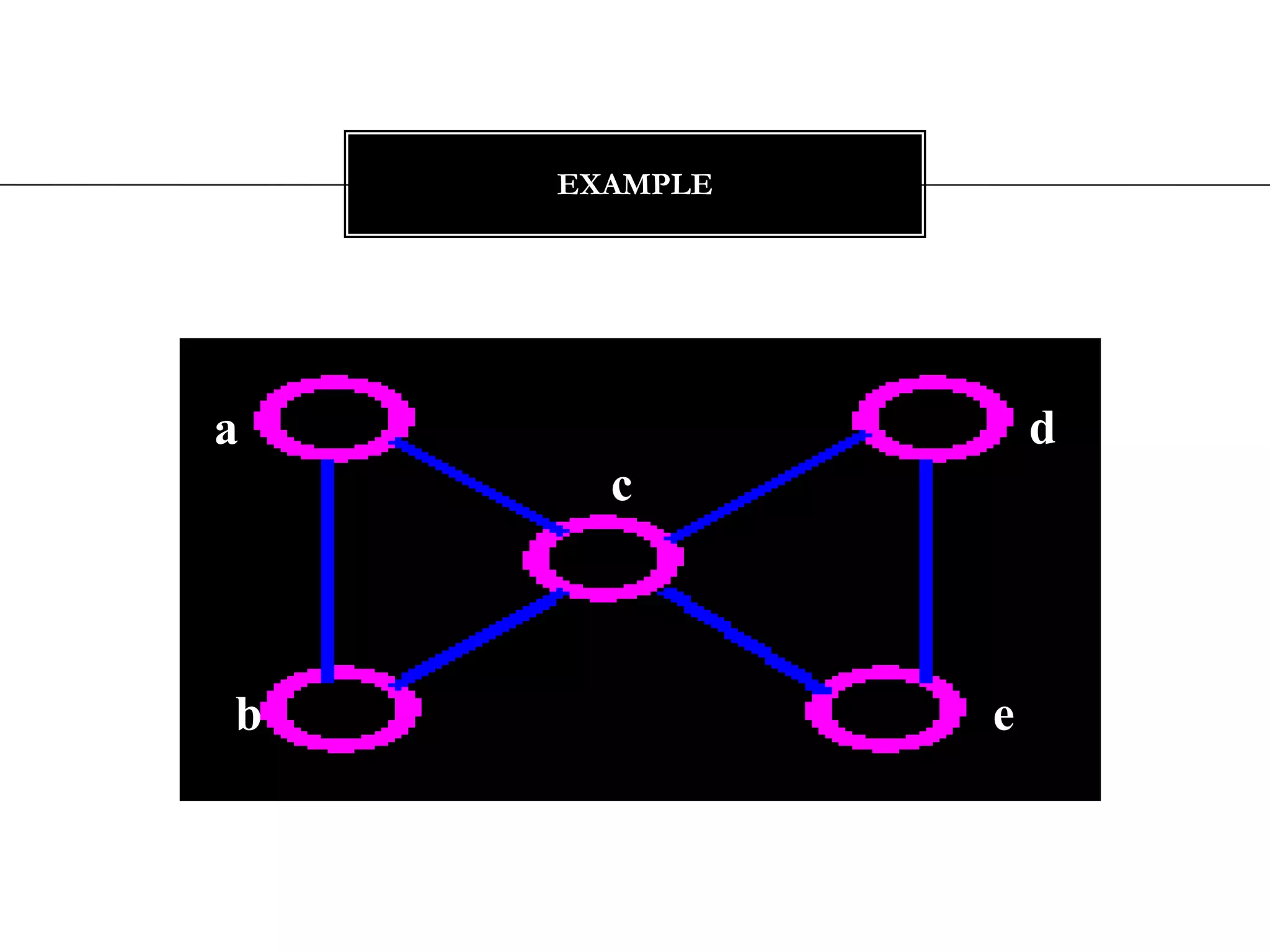
acThe above graph G can be disconnected by removal of single vertex (either b or c). The G has connectivity 1. That isG is 1-connected or simply connected.bd
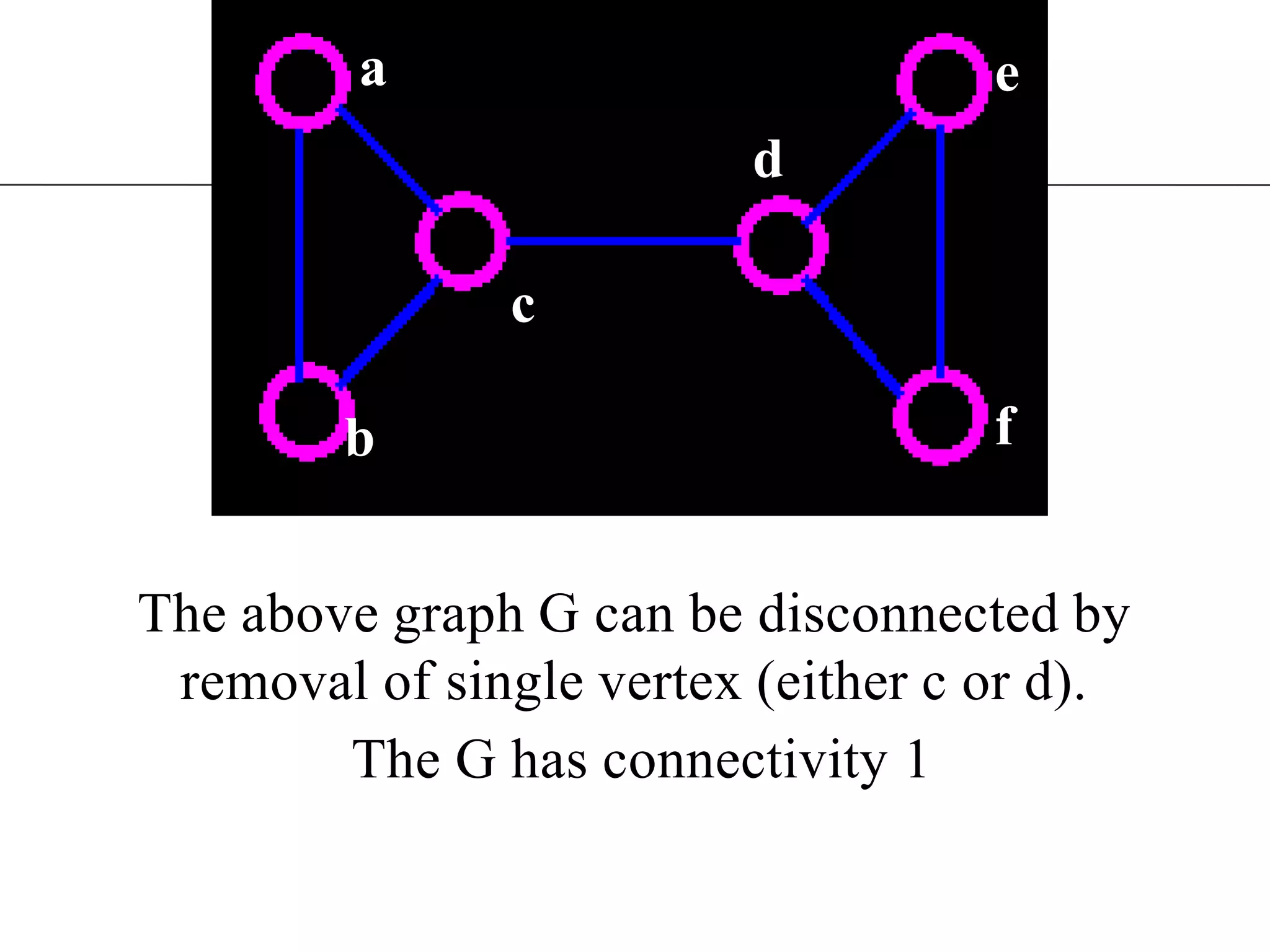
The above graph G can be disconnected by removal of single vertex (either c or d). The G has connectivity 1aedcfb
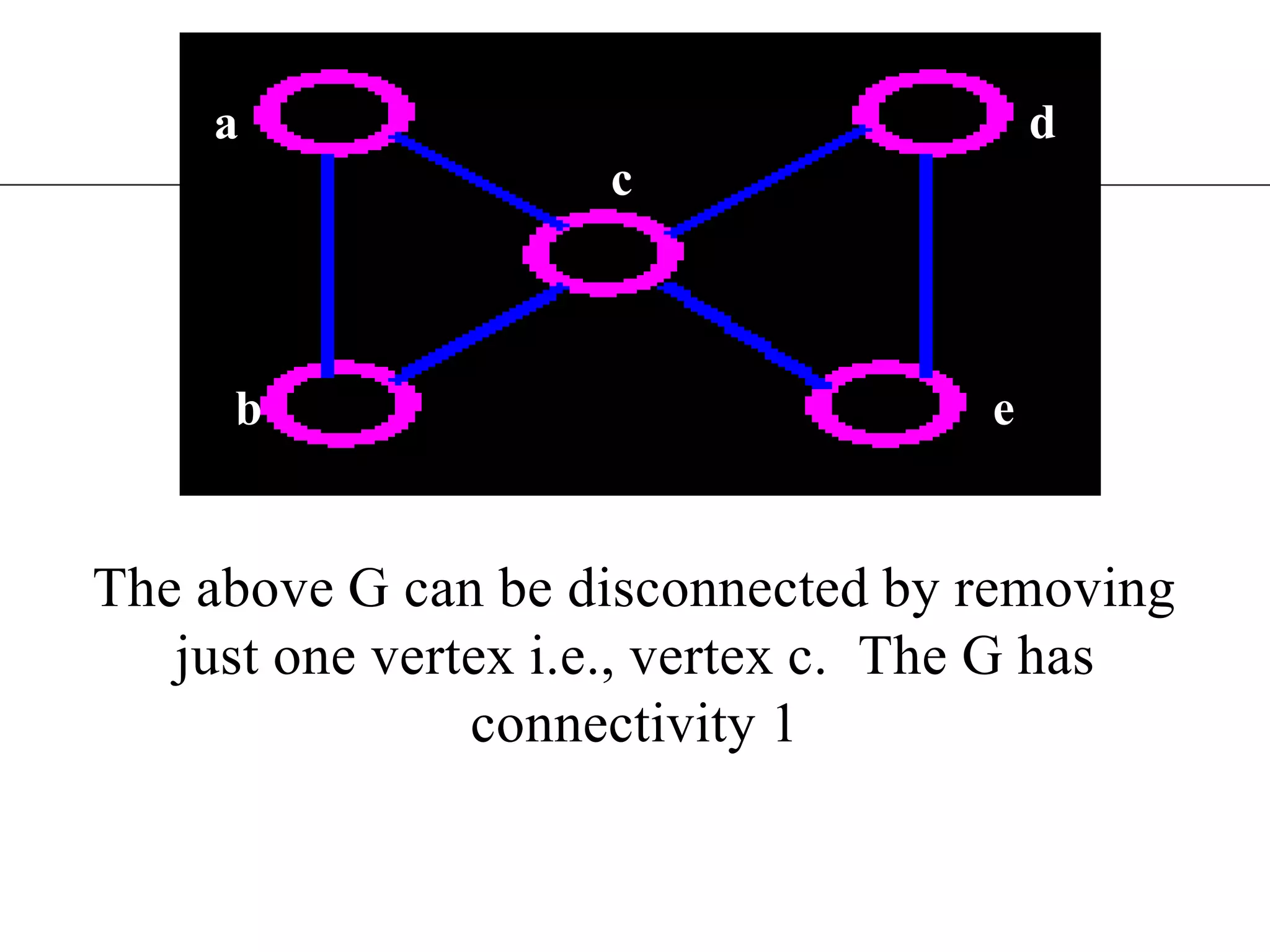
The above G can be disconnected by removing just one vertex i.e., vertex c. The G has connectivity 1dacbe
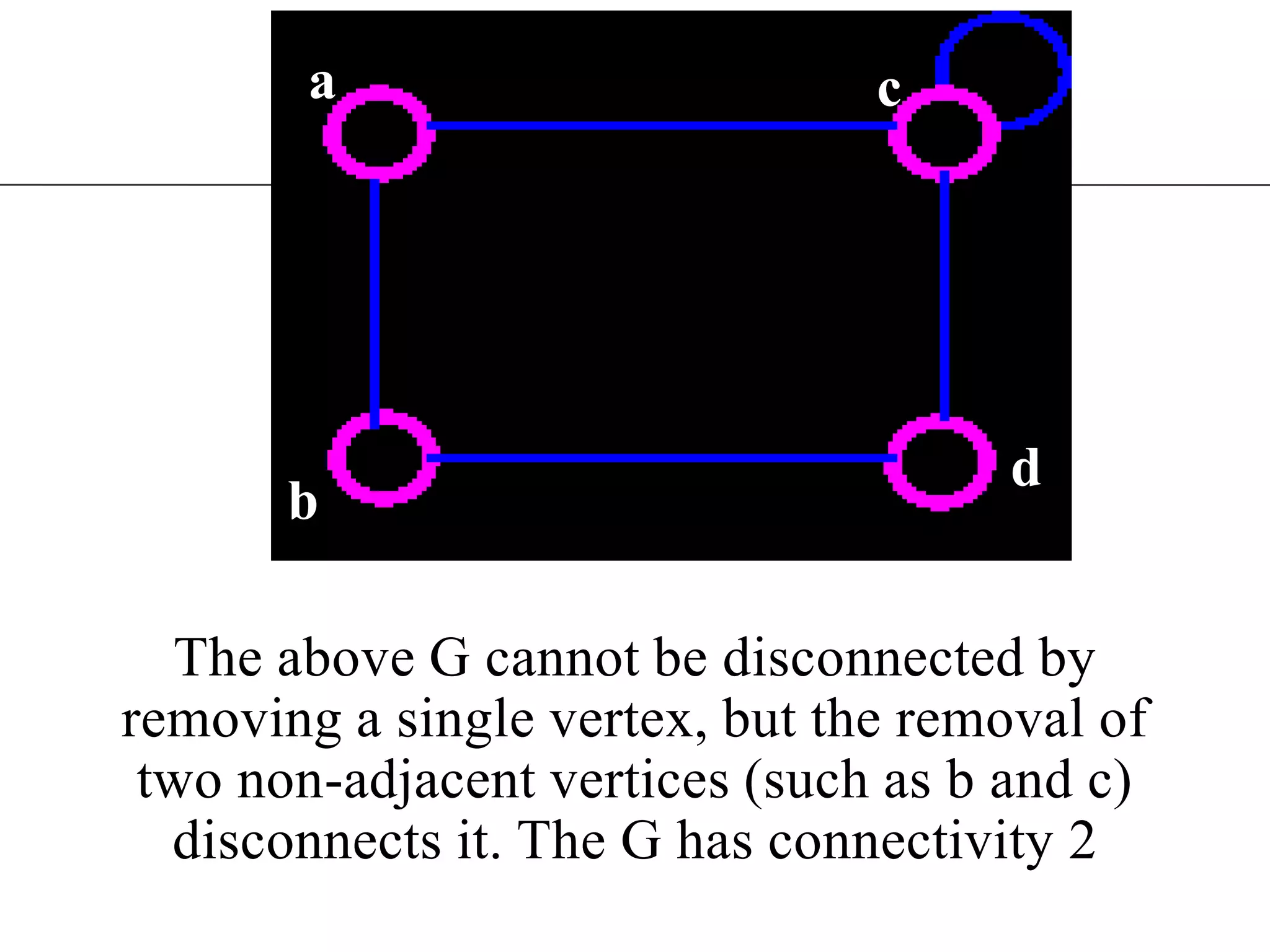
acThe above G cannot be disconnected by removing a single vertex, but the removal of two non-adjacent vertices (such as b and c) disconnects it. The G has connectivity 2db
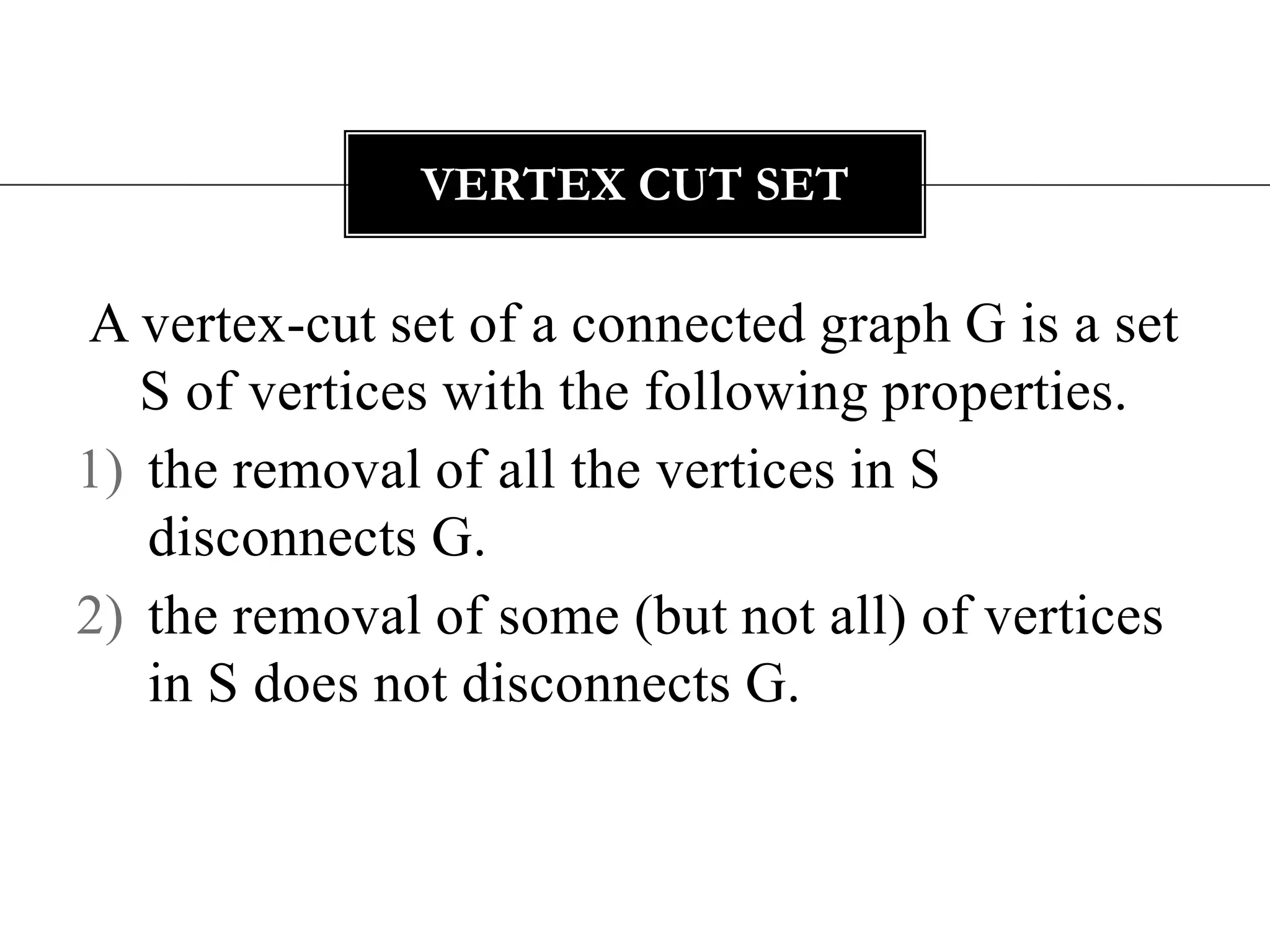
A vertex-cut set of a connected graph G is a set S of vertices with the following properties.the removal of all the vertices in S disconnects G. the removal of some (but not all) of vertices in S does not disconnects G. Vertex cut set
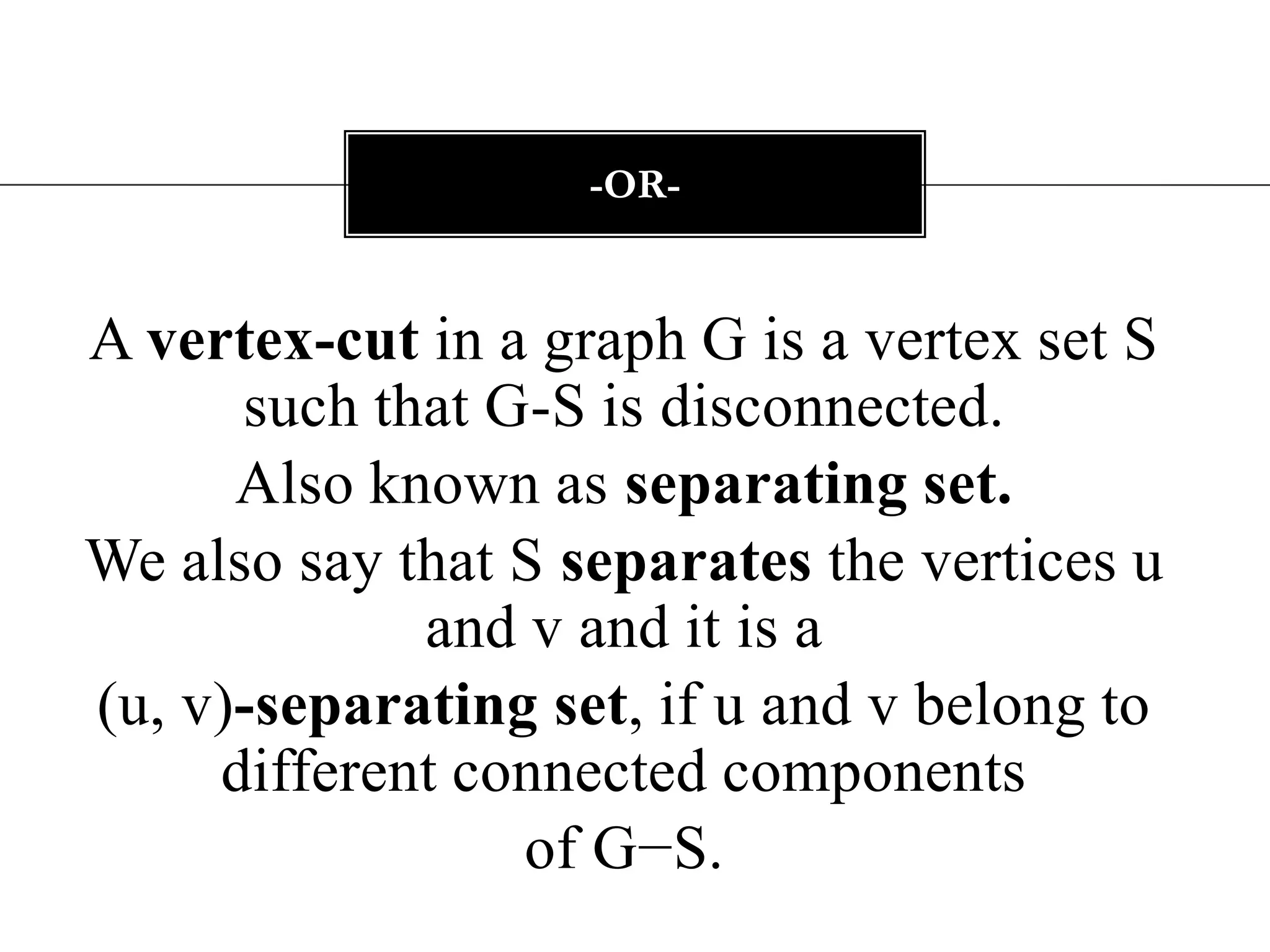
A vertex-cut in a graph G is a vertex set S such that G-S is disconnected.Also known as separating set.We also say that S separates the vertices u and v and it is a (u, v)-separating set, if u and v belong to different connected componentsof G−S.-or-
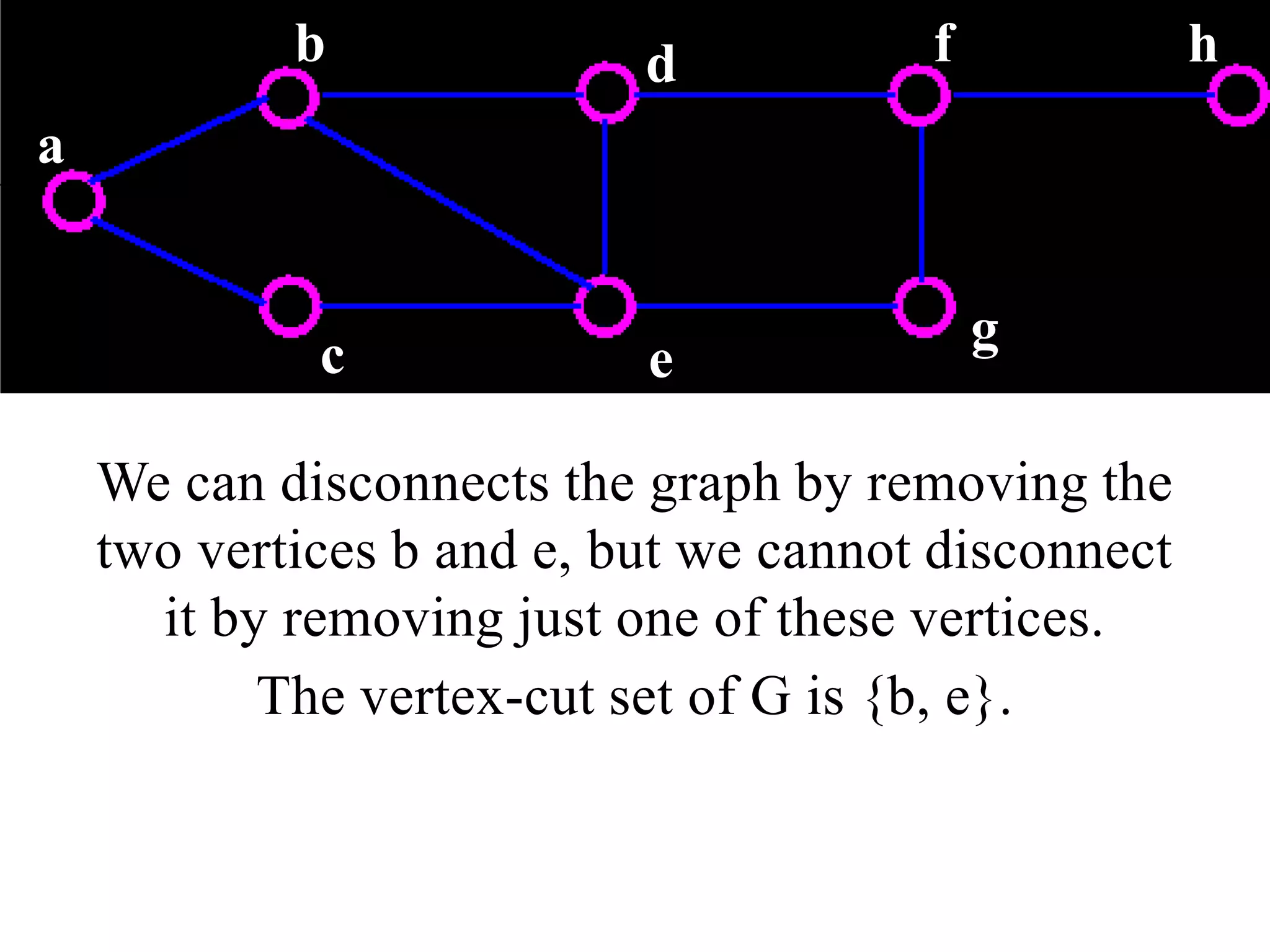
We can disconnects the graph by removing the two vertices b and e, but we cannot disconnect it by removing just one of these vertices. The vertex-cut set of G is {b, e}.bfhdagce
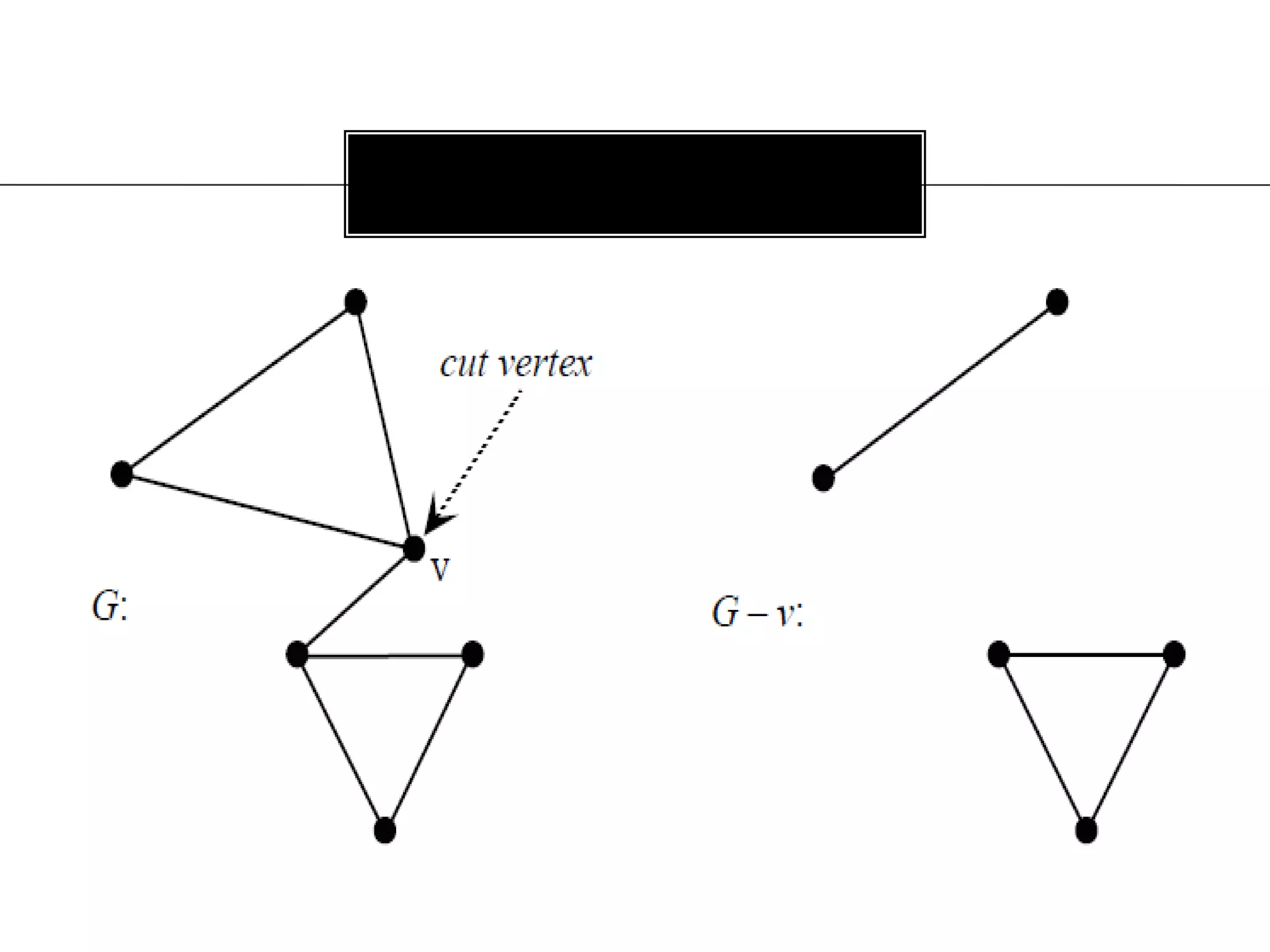
A cut-vertex (not vertex-cut) is a single vertex whose removal disconnects a graph.Cut vertex is also known as cut pointCut-Vertex
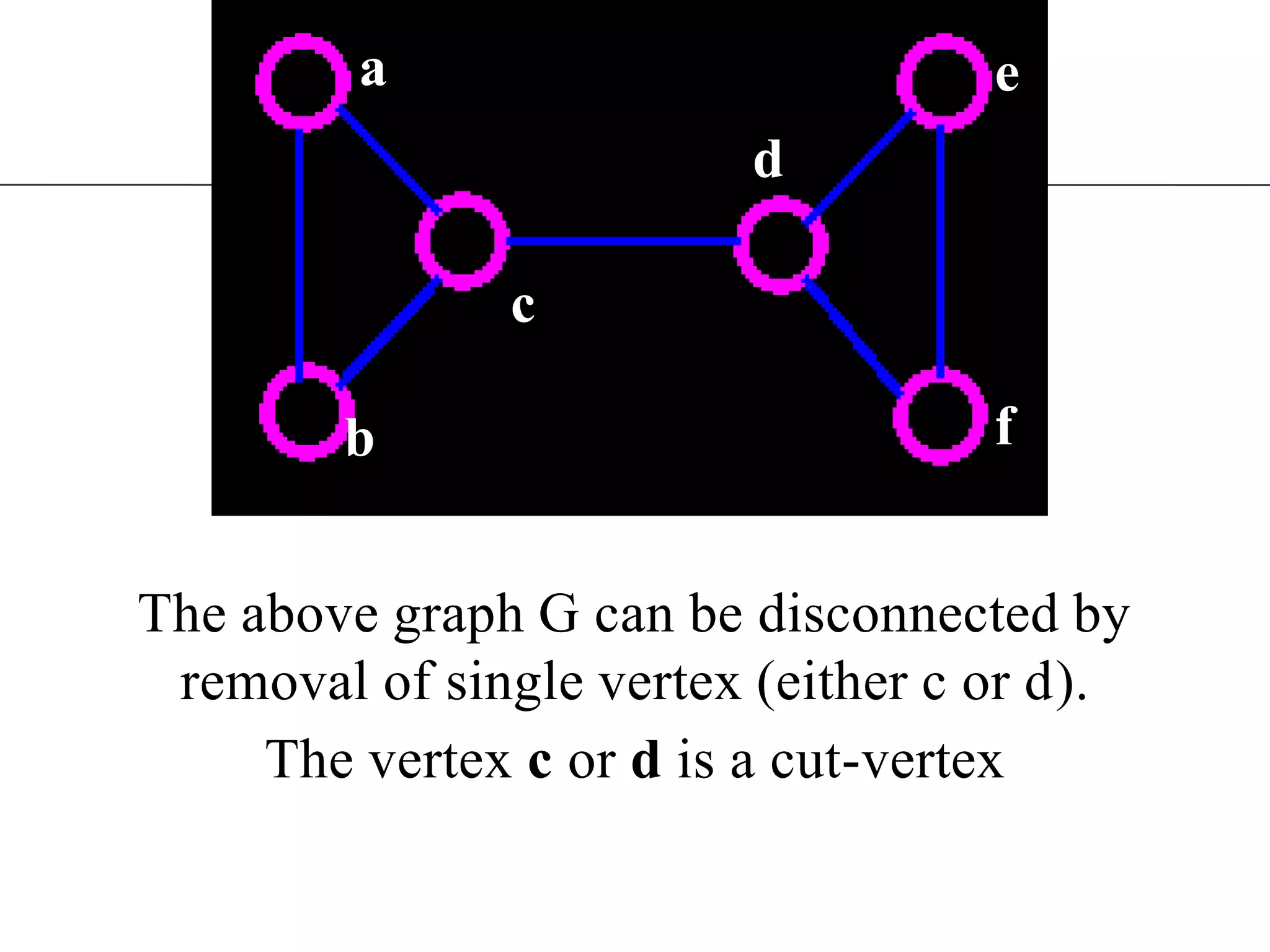
The above graph G can be disconnected by removal of single vertex (either c or d).The vertex c or d is a cut-vertexaedcfb
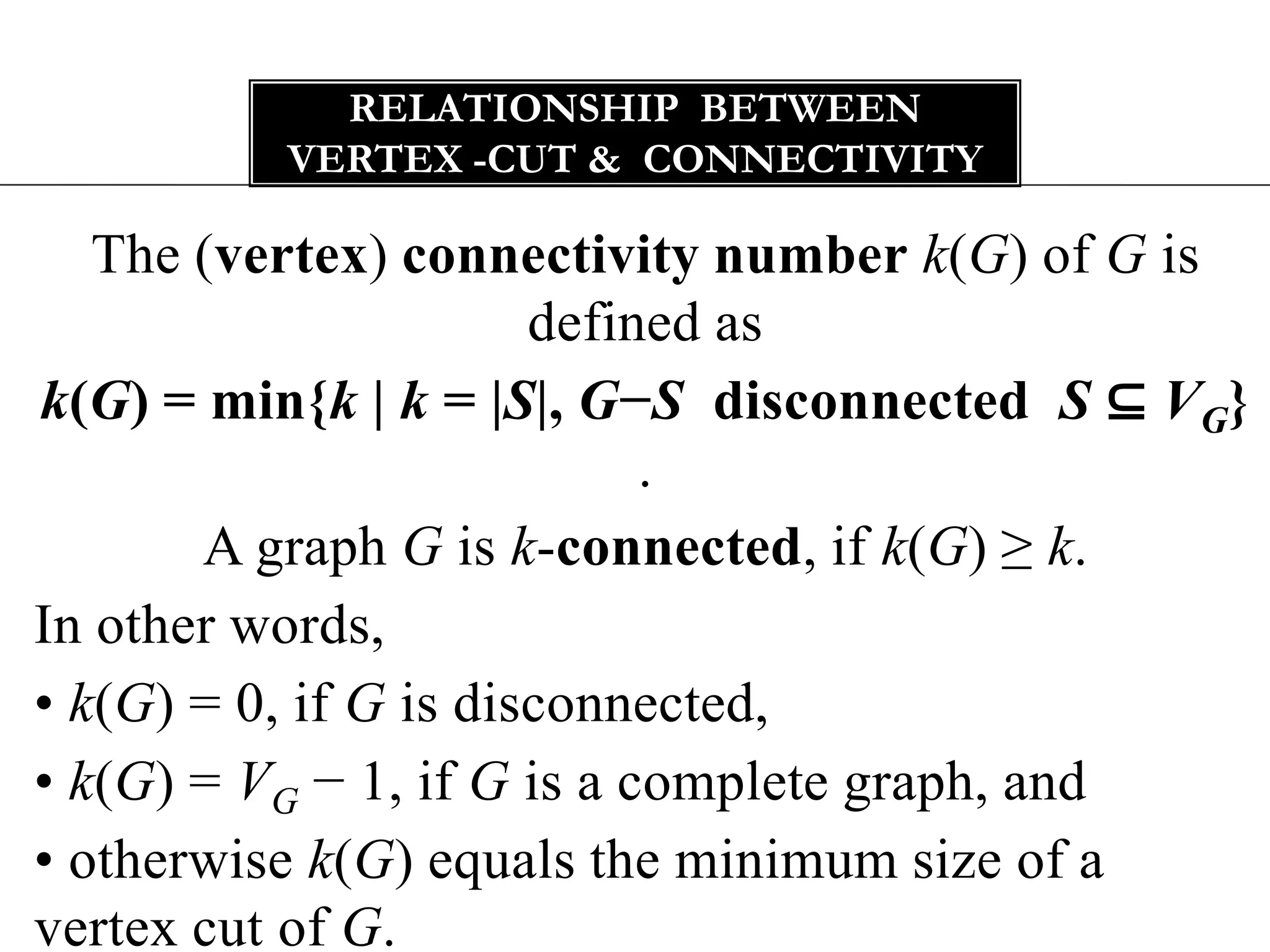
Relationship  between vertex -cut & connectivityThe (vertex) connectivity number k(G) of G is defined ask(G) = min{k | k = |S|, G−S disconnected  S ⊆ VG} .A graph G is k-connected, if k(G) ≥ k.In other words,• k(G) = 0, if G is disconnected,• k(G) = VG− 1, if G is a complete graph, and• otherwise k(G) equals the minimum size of a vertex cut of G.
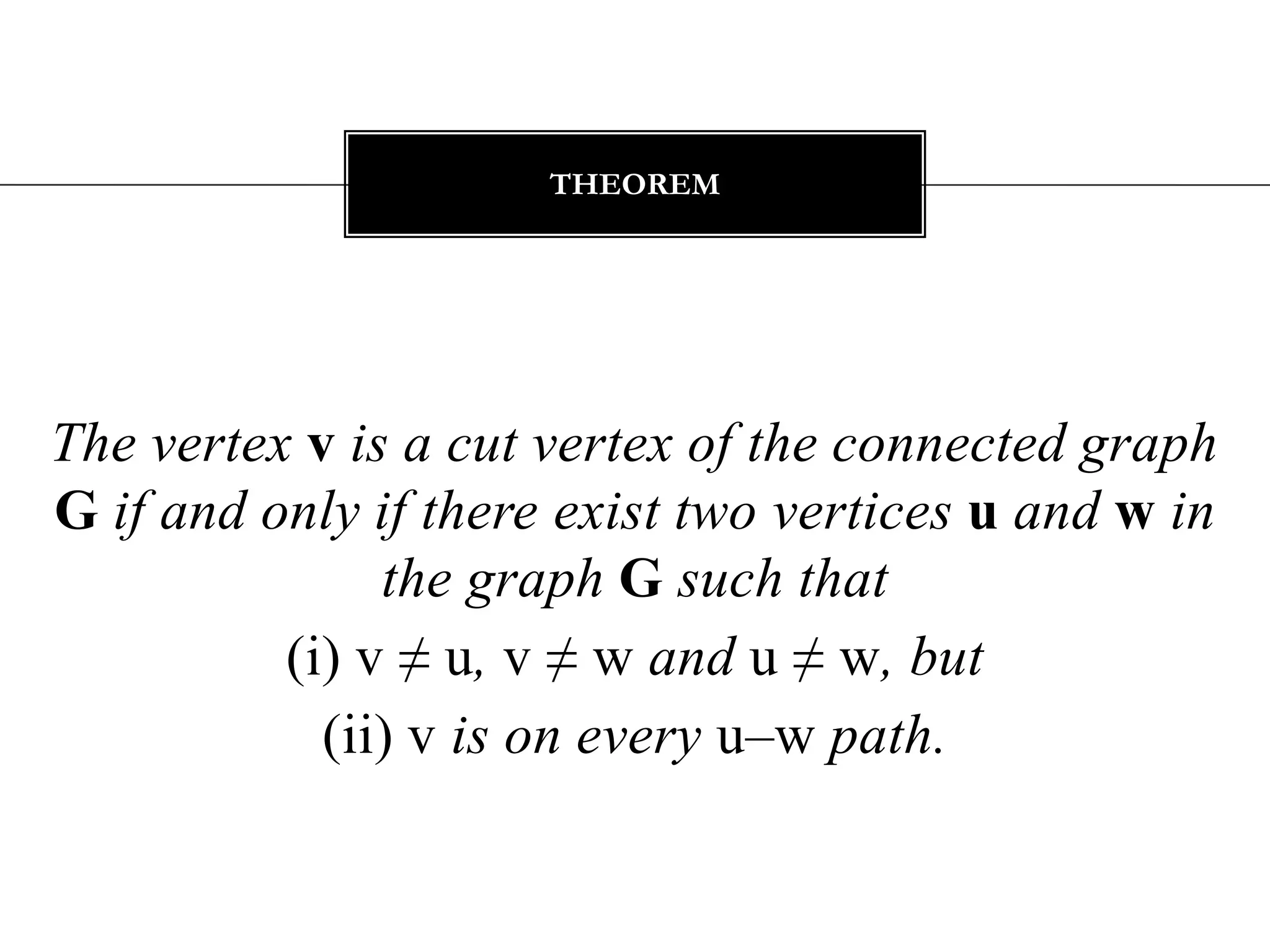
The vertex vis a cut vertex of the connected graph Gif and only if there exist two vertices u and w in the graph Gsuch that(i) v ≠u, v ≠ w and u ≠ w, but(ii) v is on every u–w path.theorem
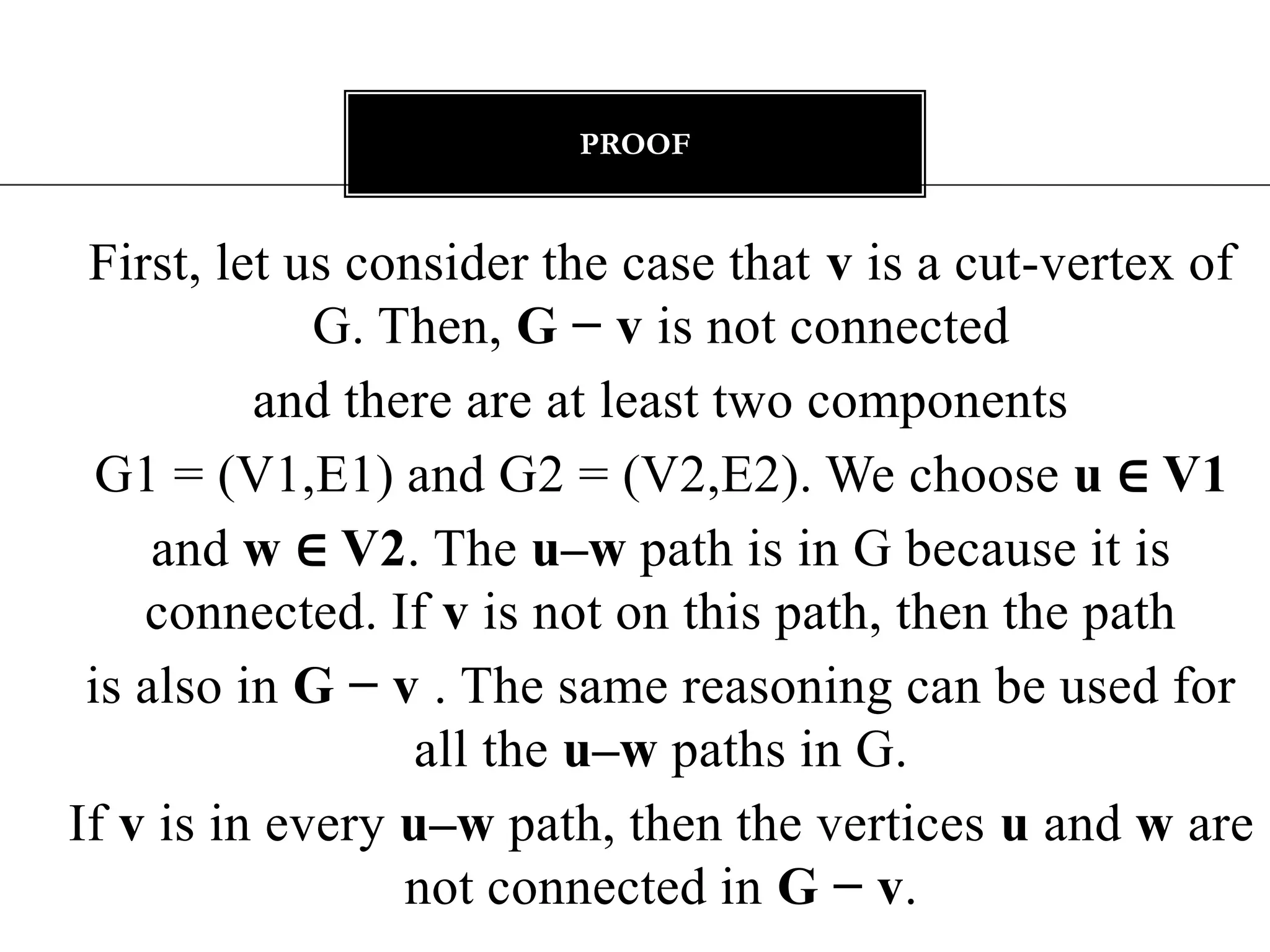
proofFirst, let us consider the case that v is a cut-vertex of G. Then, G − v is not connectedand there are at least two components G1 = (V1,E1) and G2 = (V2,E2). We choose u ∈ V1and w ∈ V2. The u–w path is in G because it is connected. If v is not on this path, then the pathis also in G − v . The same reasoning can be used for all the u–w paths in G.If v is in every u–w path, then the vertices u and w are not connected in G − v.
exampledacbe
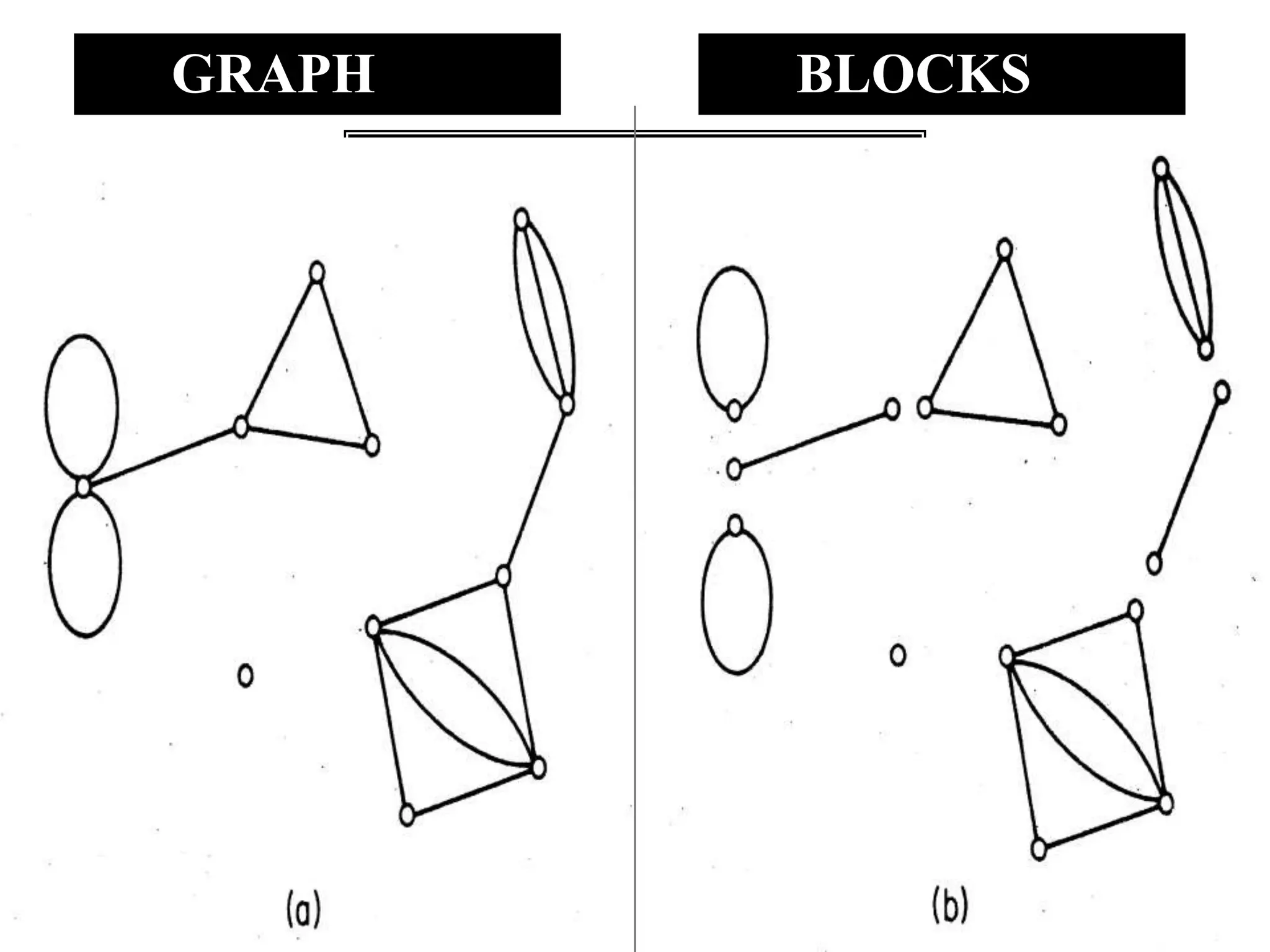
A block is a connected graph which has no cut vertices.A block of a graph is a maximal sub graph with no cut vertices.block
GRAPHBLOCKS
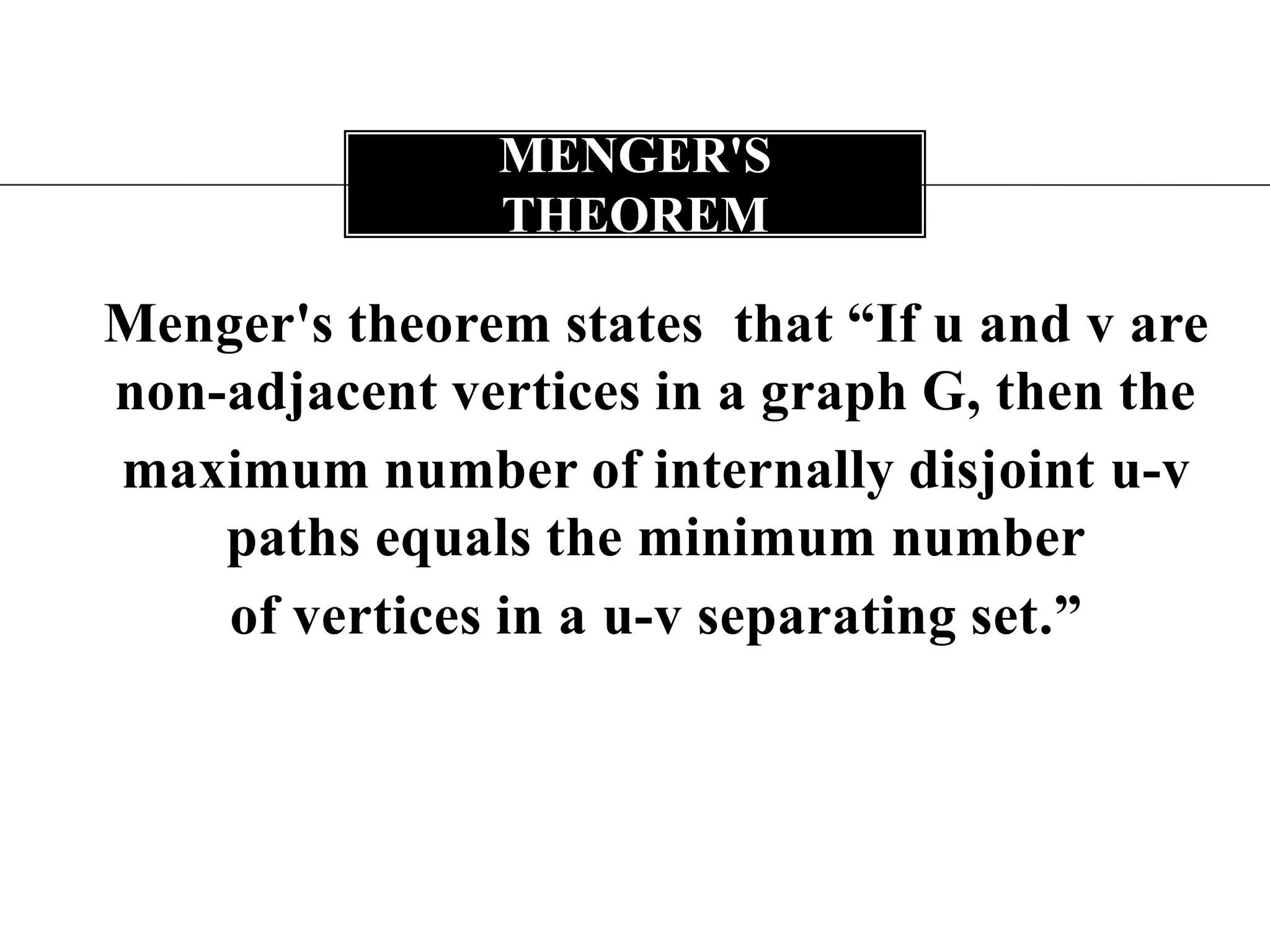
Menger's theorem states  that “If uand v are non-adjacent vertices in a graph G, then themaximum number of internally disjoint u-v paths equals the minimum numberof vertices in a u-v separating set.”Menger's theorem
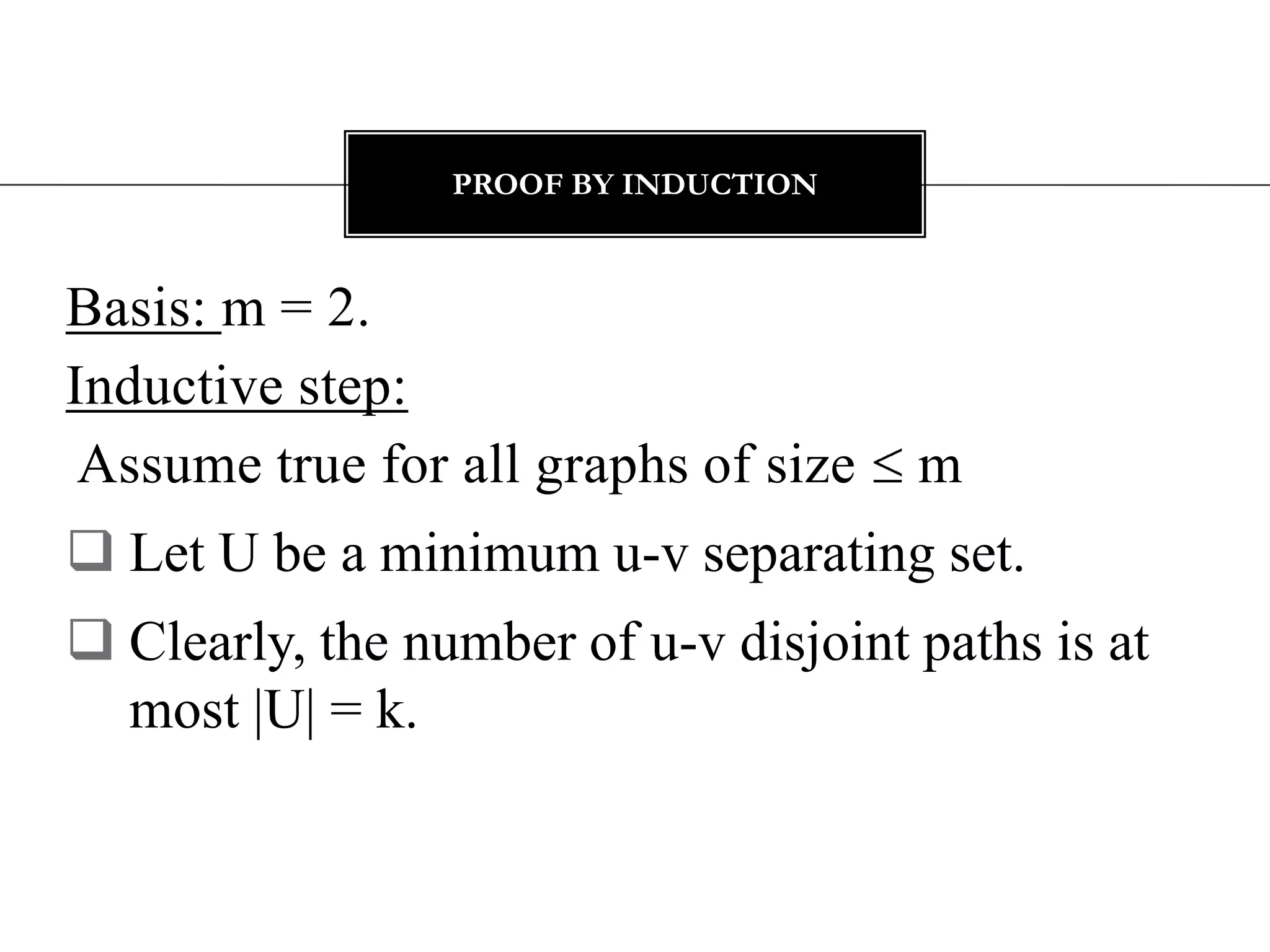
Proof by induction Basis: m = 2. Inductive step:Assume true for all graphs of size  mLet U be a minimum u-v separating set.
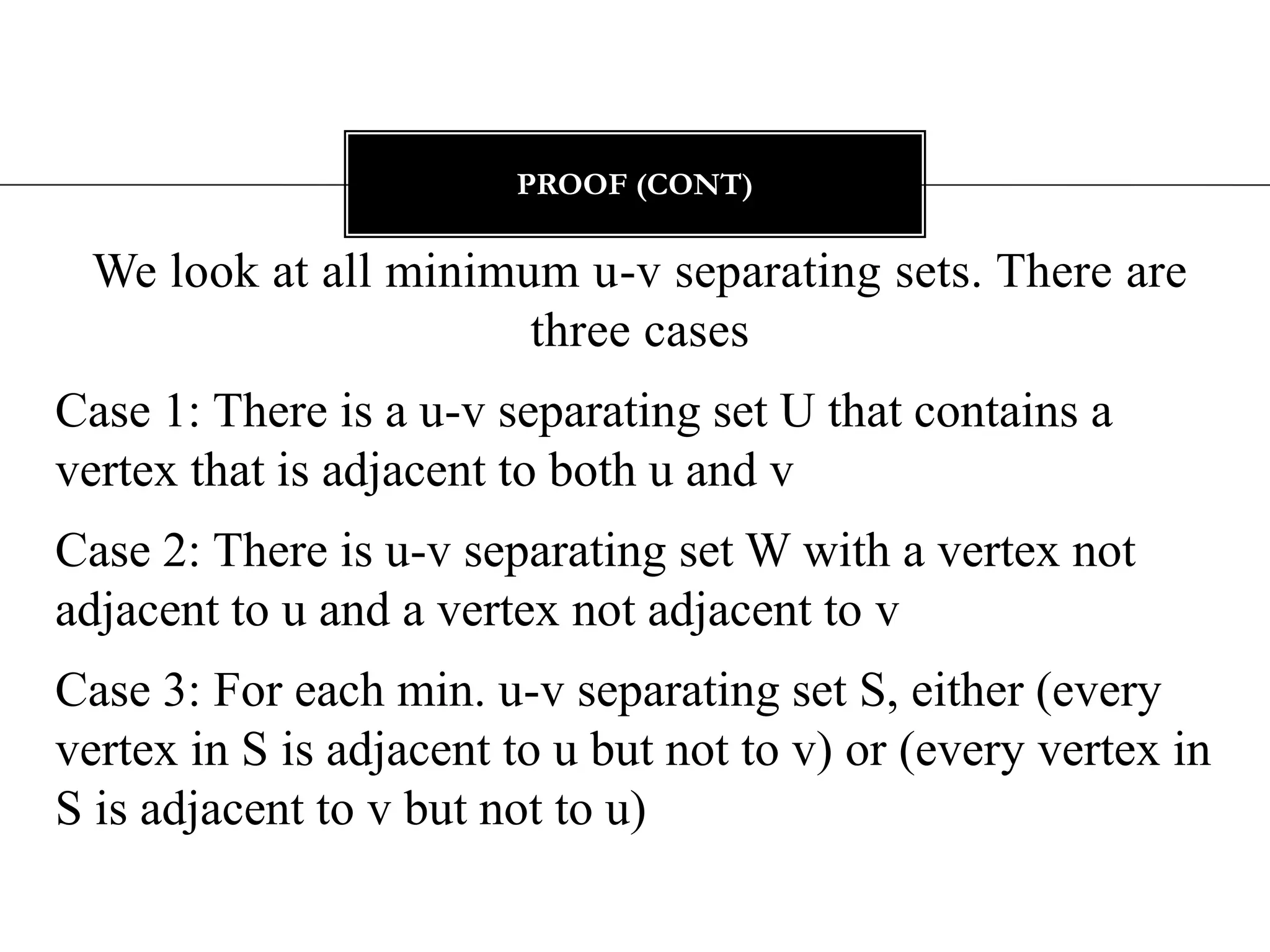
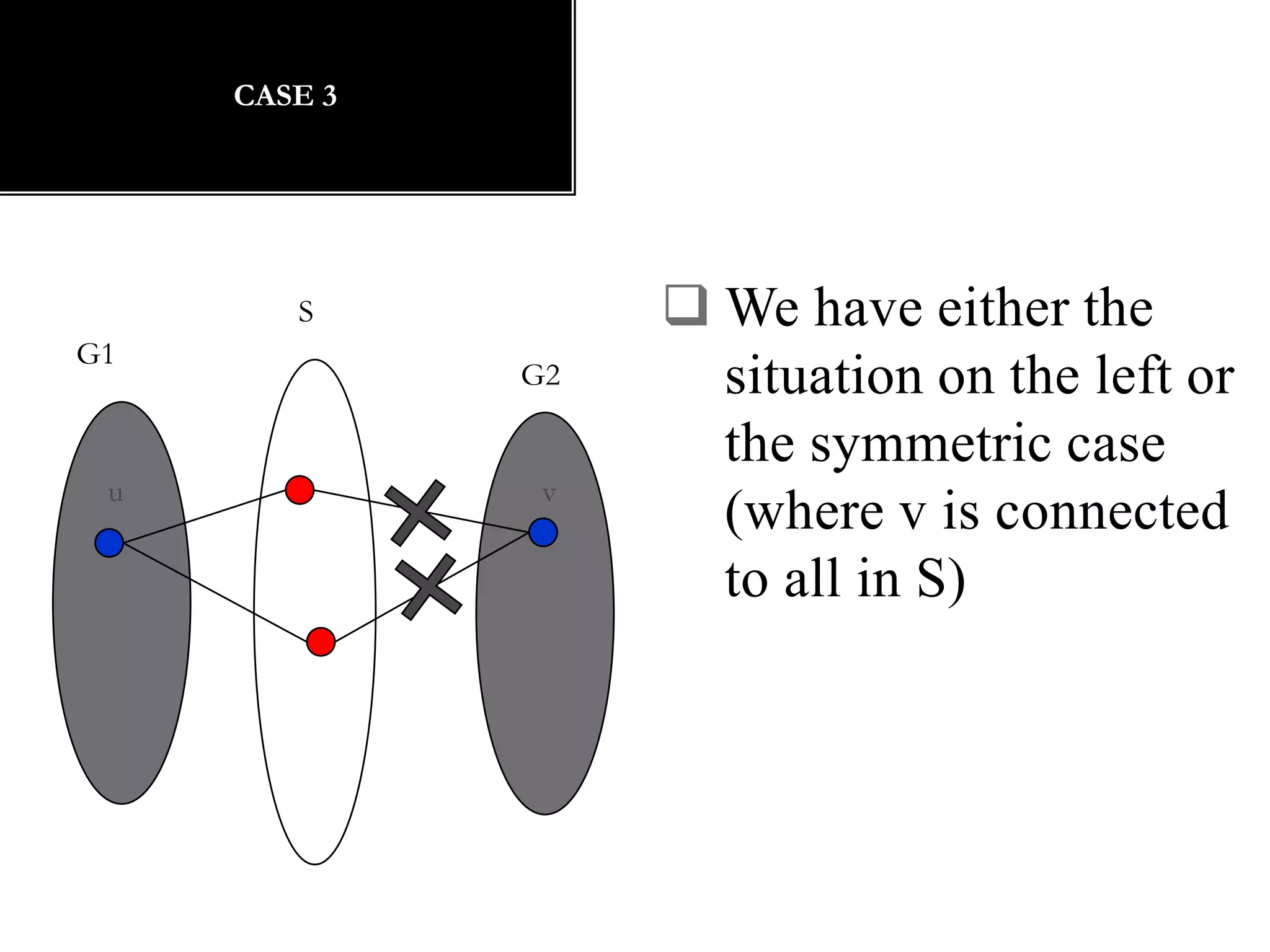
Clearly, the number of u-v disjoint paths is at most |U| = k. Proof (cont)We look at all minimum u-v separating sets. There are three casesCase 1: There is a u-v separating set U that contains a vertex that is adjacent to both u and vCase 2: There is u-v separating set W with a vertex not adjacent to u and a vertex not adjacent to vCase 3: For each min. u-v separating set S, either (every vertex in S is adjacent to u but not to v) or (every vertex in S is adjacent to v but not to u)
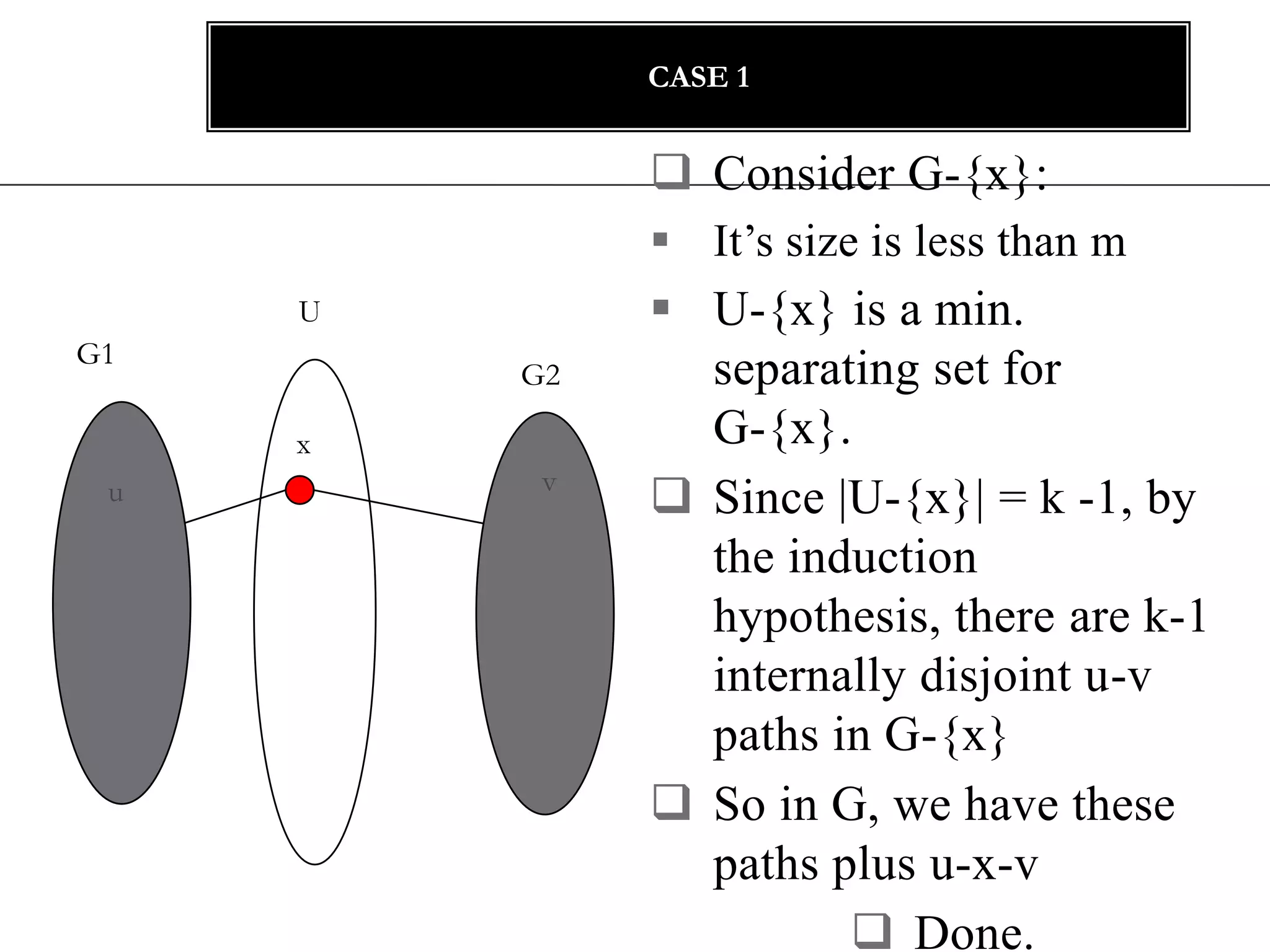
Case 1Consider G-{x}:
It’s size is less than m
U-{x} is a min. separating set for G-{x}.
Since |U-{x}| = k -1, by the induction hypothesis, there are k-1 internally disjoint u-v paths in G-{x}
So in G, we have these paths plus u-x-v
Done.UG1G2xvu
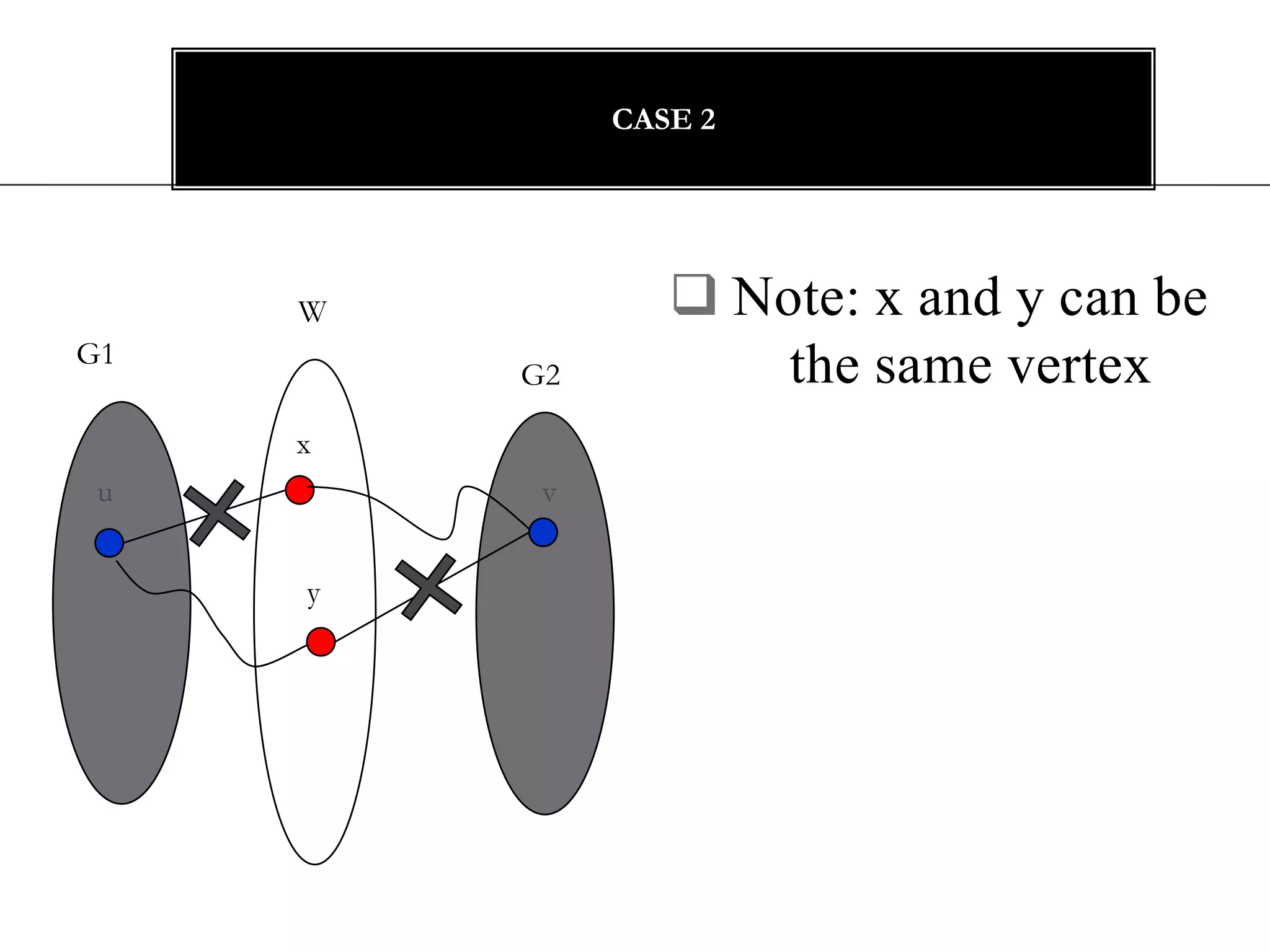
Case 2Note: x and y can be the same vertexWG1G2xuvy
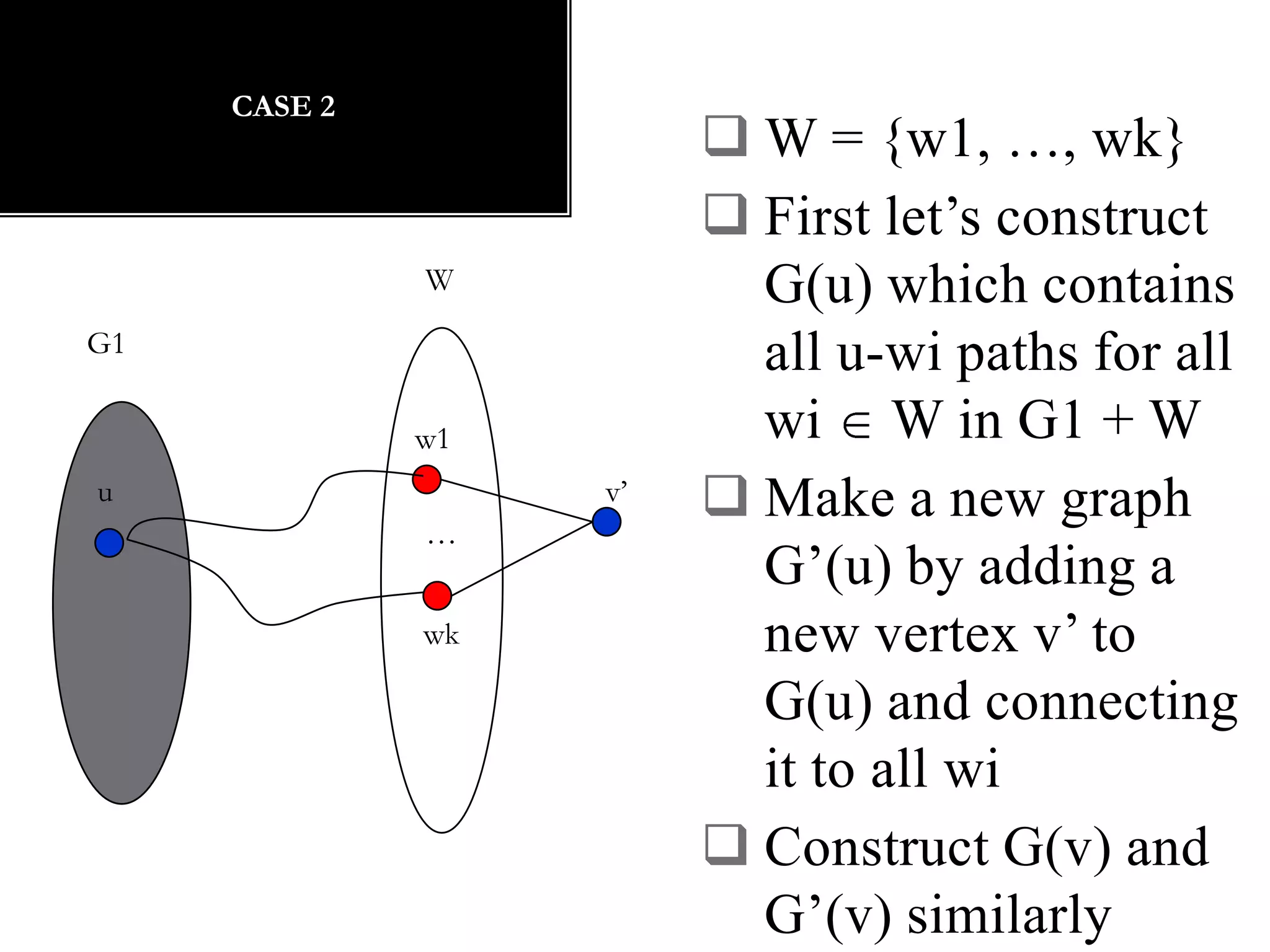
Case 2v’W = {w1, …, wk}
First let’s construct G(u) which contains all u-wi paths for all wi W in G1 + W
Make a new graph G’(u) by adding a new vertex v’ to G(u) and connecting it to all wi
Construct G(v) and G’(v) similarlyWG1w1u…wk

Connectivity of graph

  • 1.
  • 2.
    A graph issaid to be connected, if there is a path between any two vertices. Some graphs are “more connected” than others. Two numerical parameters :- edge connectivity &vertex connectivity are useful in measuring a graph’s connectedness. Connectivity of a graph
  • 3.
  • 4.
    λ(G) = min{k| k = |S|, G−S disconnected, S ⊆ EG} definition
  • 5.
    The edge-connectivity λ(G) ofa connected graph G is the smallest number of edges whose removal disconnects G.When λ(G) ≥ k, the graph G is said to be k-edge-connected.
  • 6.
    acThe above graphG1 can be split up into two components by removing one of the edges bc or bd. G1 has edge-connectivity 1.λ(G1) =1bd
  • 7.
    aedcThe above graphG2 can be disconnected by removing a single edge, cdG2 has edge-connectivity 1.λ(G2) =1fb
  • 8.
    dacThe above graphG3 cannot be disconnected by removing a single edge, but the removal of two edges (such as ac and bc) disconnects it.G3 has edge-connectivity 2.λ(G3) =2be
  • 9.
    A cut setof a connected graph G is a set S of edges with the following properties:The removal of all edges in S disconnects G.The removal of some (but not all) of edges in S does not disconnects G Cut set is also known as edge-cutCut Set
  • 10.
    An edge- cutSof G consists of edges so that G −S is disconnected.-Or-
  • 11.
    hfbdaWe can disconnect G by removing the three edges bd, be, and ce, but we cannot disconnect it by removing just two of these edges. So,{ bd, be, ce}is a cut set of the graph G .{df,eg} is another cut set{fh} is another cut setgce
  • 12.
    Or cut-edge (notedge-cut)is an edge-cut consisting of a single edge.Or A bridge is a single edge whose removal disconnects a graph bridge
  • 13.
    The above graphG can be split up into two components by removing one of the edges bc or bd. Therefore, edge bc or bd is a bridge acbd
  • 14.
    λ(G) = min{k| k = |S|, G−S disconnected, S ⊆ EG} Where S is the cut set of graph G(V,E)Relationship between cut-set & edge connectivity
  • 15.
    “If S isa cut set of the connected graph G, then G − S has two components”Proof. Let S = {e1, . . . , ek}. The graph G−{e1, . . . , ek−1} is connected (and so is G if k = 1) by condition #2. When we remove the edges from the connected graph, we get at most twocomponents.Theorem
  • 16.
    {e1, e4}, {e6,e7}, {e1, e2, e3}, {e8}, {e3, e4, e5, e6}, {e2, e5, e7}, {e2, e5, e6} and {e2, e3, e4} are cut sets.EXAMPLE
  • 17.
    Let G bea graph. Then the edge connectivity λ(G)is less than or equal to the minimum vertex degree δmin(G). Proof:Let v be a vertex of graph G, with degree k= δmin(G). Then the deletion of the k edges that are incident on vertex v separates v from the other vertices of GProposition
  • 18.
    An edge eis a bridge of G iff e lies on no cycle on GProof:By definition-A bridge is a single edge whose removal disconnects a graph. If it lies on a cycle, its removal will not disconnect the graphtheorem
  • 19.
  • 20.
    k(G) = min{k| k = |S|, G−S disconnected , S ⊆ VG}0  (G)  n-1Where n is the number of vertices of the graph.definition
  • 21.
    The connectivity (orvertex connectivity) K(G) of a connected graph Gis the minimum number of vertices whose removal disconnects G. When K(G) ≥ k, the graph is said to be k-connected(or k-vertex connected).
  • 22.
    acThe above graphG can be disconnected by removal of single vertex (either b or c). The G has connectivity 1. That isG is 1-connected or simply connected.bd
  • 23.
    The above graphG can be disconnected by removal of single vertex (either c or d). The G has connectivity 1aedcfb
  • 24.
    The above Gcan be disconnected by removing just one vertex i.e., vertex c. The G has connectivity 1dacbe
  • 25.
    acThe above Gcannot be disconnected by removing a single vertex, but the removal of two non-adjacent vertices (such as b and c) disconnects it. The G has connectivity 2db
  • 26.
    A vertex-cut setof a connected graph G is a set S of vertices with the following properties.the removal of all the vertices in S disconnects G. the removal of some (but not all) of vertices in S does not disconnects G. Vertex cut set
  • 27.
    A vertex-cut ina graph G is a vertex set S such that G-S is disconnected.Also known as separating set.We also say that S separates the vertices u and v and it is a (u, v)-separating set, if u and v belong to different connected componentsof G−S.-or-
  • 28.
    We can disconnectsthe graph by removing the two vertices b and e, but we cannot disconnect it by removing just one of these vertices. The vertex-cut set of G is {b, e}.bfhdagce
  • 29.
    A cut-vertex (notvertex-cut) is a single vertex whose removal disconnects a graph.Cut vertex is also known as cut pointCut-Vertex
  • 30.
    The above graphG can be disconnected by removal of single vertex (either c or d).The vertex c or d is a cut-vertexaedcfb
  • 32.
    Relationship betweenvertex -cut & connectivityThe (vertex) connectivity number k(G) of G is defined ask(G) = min{k | k = |S|, G−S disconnected S ⊆ VG} .A graph G is k-connected, if k(G) ≥ k.In other words,• k(G) = 0, if G is disconnected,• k(G) = VG− 1, if G is a complete graph, and• otherwise k(G) equals the minimum size of a vertex cut of G.
  • 33.
    The vertex visa cut vertex of the connected graph Gif and only if there exist two vertices u and w in the graph Gsuch that(i) v ≠u, v ≠ w and u ≠ w, but(ii) v is on every u–w path.theorem
  • 34.
    proofFirst, let usconsider the case that v is a cut-vertex of G. Then, G − v is not connectedand there are at least two components G1 = (V1,E1) and G2 = (V2,E2). We choose u ∈ V1and w ∈ V2. The u–w path is in G because it is connected. If v is not on this path, then the pathis also in G − v . The same reasoning can be used for all the u–w paths in G.If v is in every u–w path, then the vertices u and w are not connected in G − v.
  • 35.
  • 36.
    A block isa connected graph which has no cut vertices.A block of a graph is a maximal sub graph with no cut vertices.block
  • 37.
  • 38.
    Menger's theorem states that “If uand v are non-adjacent vertices in a graph G, then themaximum number of internally disjoint u-v paths equals the minimum numberof vertices in a u-v separating set.”Menger's theorem
  • 39.
    Proof by inductionBasis: m = 2. Inductive step:Assume true for all graphs of size  mLet U be a minimum u-v separating set.
  • 40.
    Clearly, the numberof u-v disjoint paths is at most |U| = k. Proof (cont)We look at all minimum u-v separating sets. There are three casesCase 1: There is a u-v separating set U that contains a vertex that is adjacent to both u and vCase 2: There is u-v separating set W with a vertex not adjacent to u and a vertex not adjacent to vCase 3: For each min. u-v separating set S, either (every vertex in S is adjacent to u but not to v) or (every vertex in S is adjacent to v but not to u)
  • 41.
  • 42.
    It’s size isless than m
  • 43.
    U-{x} is amin. separating set for G-{x}.
  • 44.
    Since |U-{x}| =k -1, by the induction hypothesis, there are k-1 internally disjoint u-v paths in G-{x}
  • 45.
    So in G,we have these paths plus u-x-v
  • 46.
  • 47.
    Case 2Note: xand y can be the same vertexWG1G2xuvy
  • 48.
    Case 2v’W ={w1, …, wk}
  • 49.
    First let’s constructG(u) which contains all u-wi paths for all wi W in G1 + W
  • 50.
    Make a newgraph G’(u) by adding a new vertex v’ to G(u) and connecting it to all wi
  • 51.
    Construct G(v) andG’(v) similarlyWG1w1u…wk
  • 52.
  • 53.
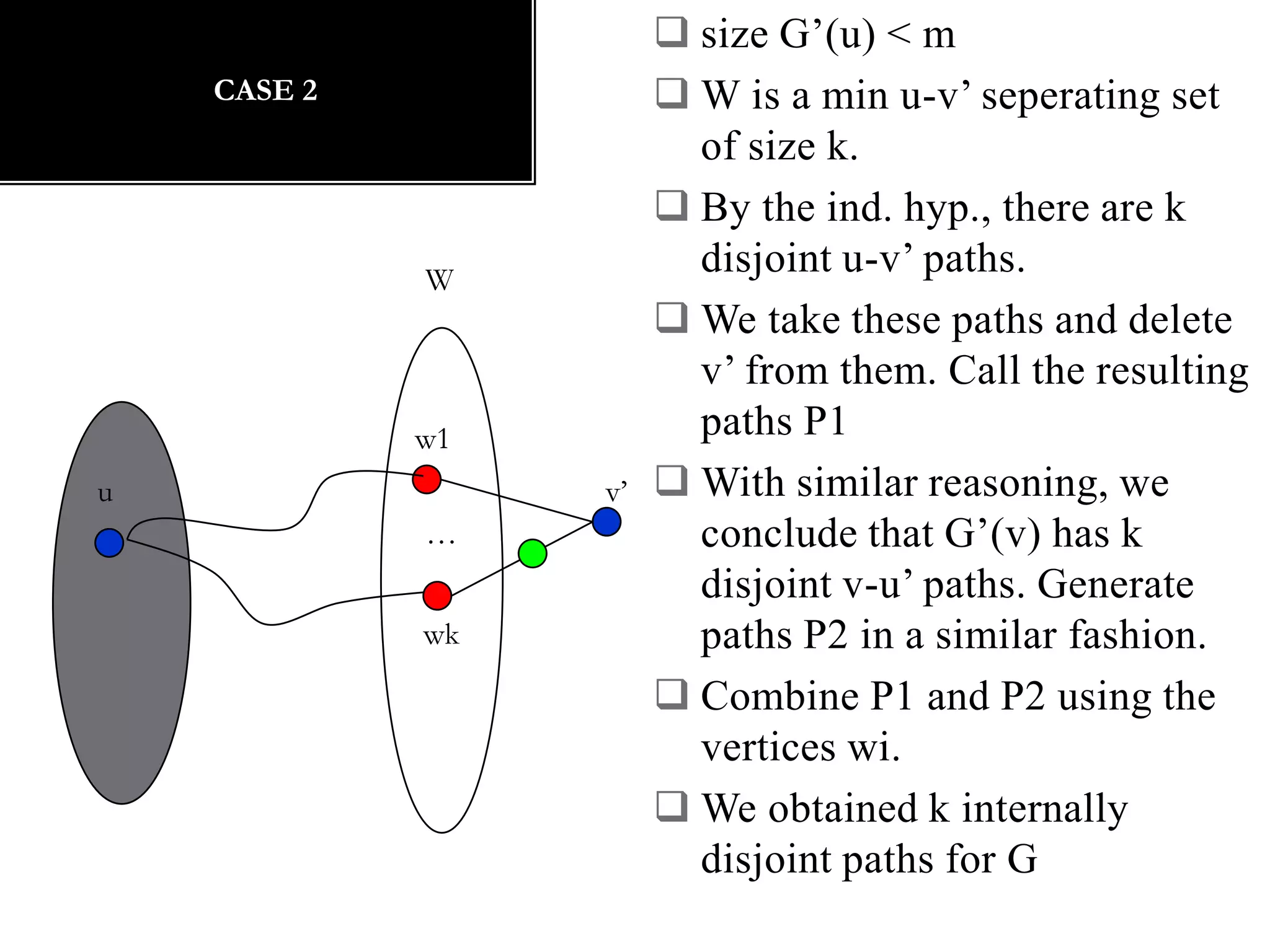
    W is amin u-v’ seperating set of size k.
  • 54.
    By the ind.hyp.,there are k disjoint u-v’ paths.
  • 55.
    We take thesepaths and delete v’ from them. Call the resulting paths P1
  • 56.
    With similar reasoning,we conclude that G’(v) has k disjoint v-u’ paths. Generate paths P2 in a similar fashion.
  • 57.
    Combine P1 andP2 using the vertices wi.
  • 58.
    We obtained kinternally disjoint paths for GWw1uv’…wk
  • 59.
    Case 3We haveeither the situation on the left or the symmetric case (where v is connected to all in S) SG1G2uv
  • 60.
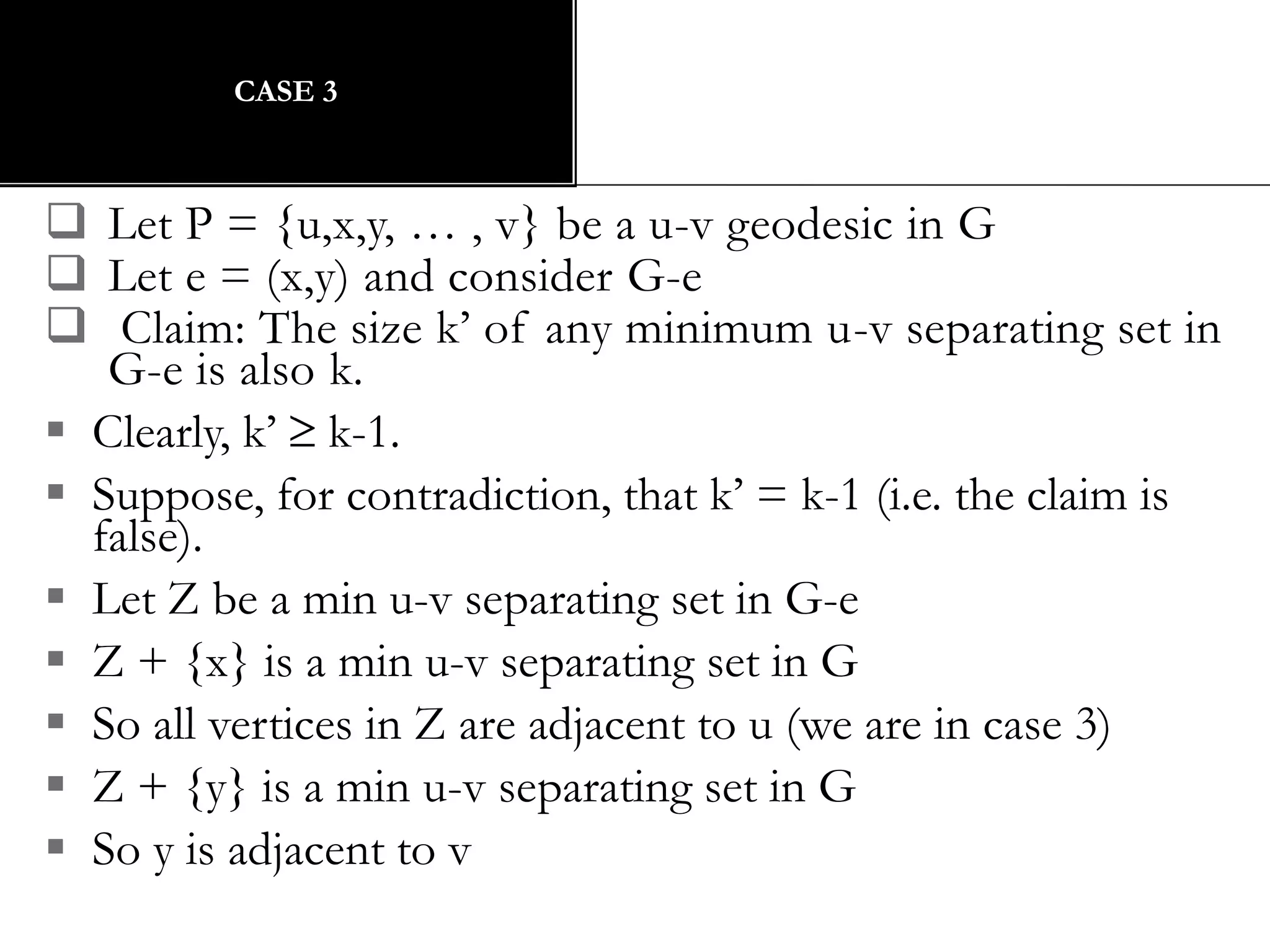
    Case 3Let P= {u,x,y, … , v} be a u-v geodesic in G
  • 61.
    Let e =(x,y) and consider G-e
  • 62.
    Claim: The sizek’ of any minimum u-v separating set in G-e is also k.
  • 63.
  • 64.
    Suppose, for contradiction,that k’ = k-1 (i.e. the claim is false).
  • 65.
    Let Z bea min u-v separating set in G-e
  • 66.
    Z + {x}is a min u-v separating set in G
  • 67.
    So all verticesin Z are adjacent to u (we are in case 3)
  • 68.
    Z + {y}is a min u-v separating set in G
  • 69.
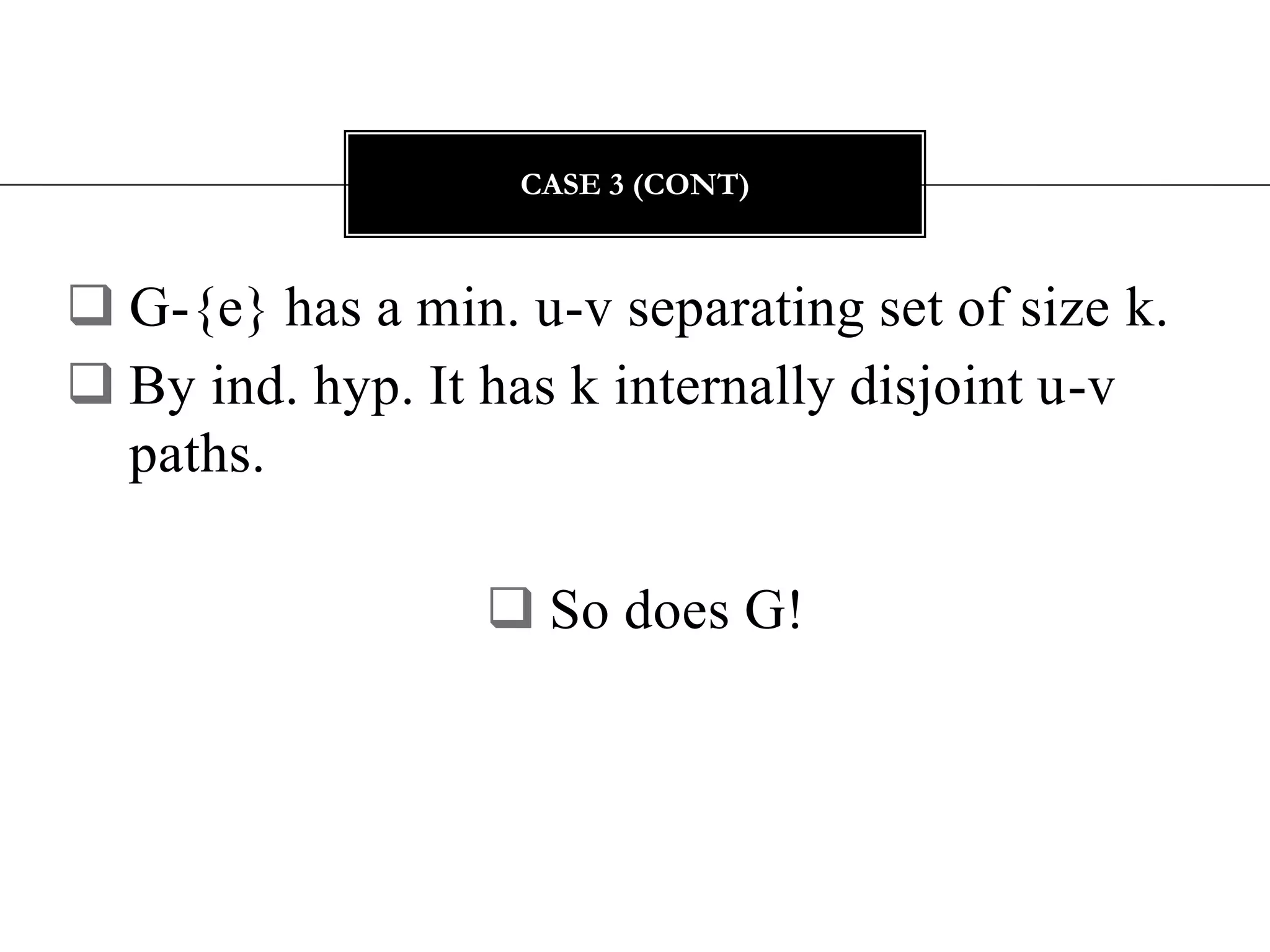
    So y isadjacent to vCase 3 (cont)G-{e} has a min. u-v separating set of size k.
  • 70.
    By ind.hyp. Ithas k internally disjoint u-v paths.
  • 71.
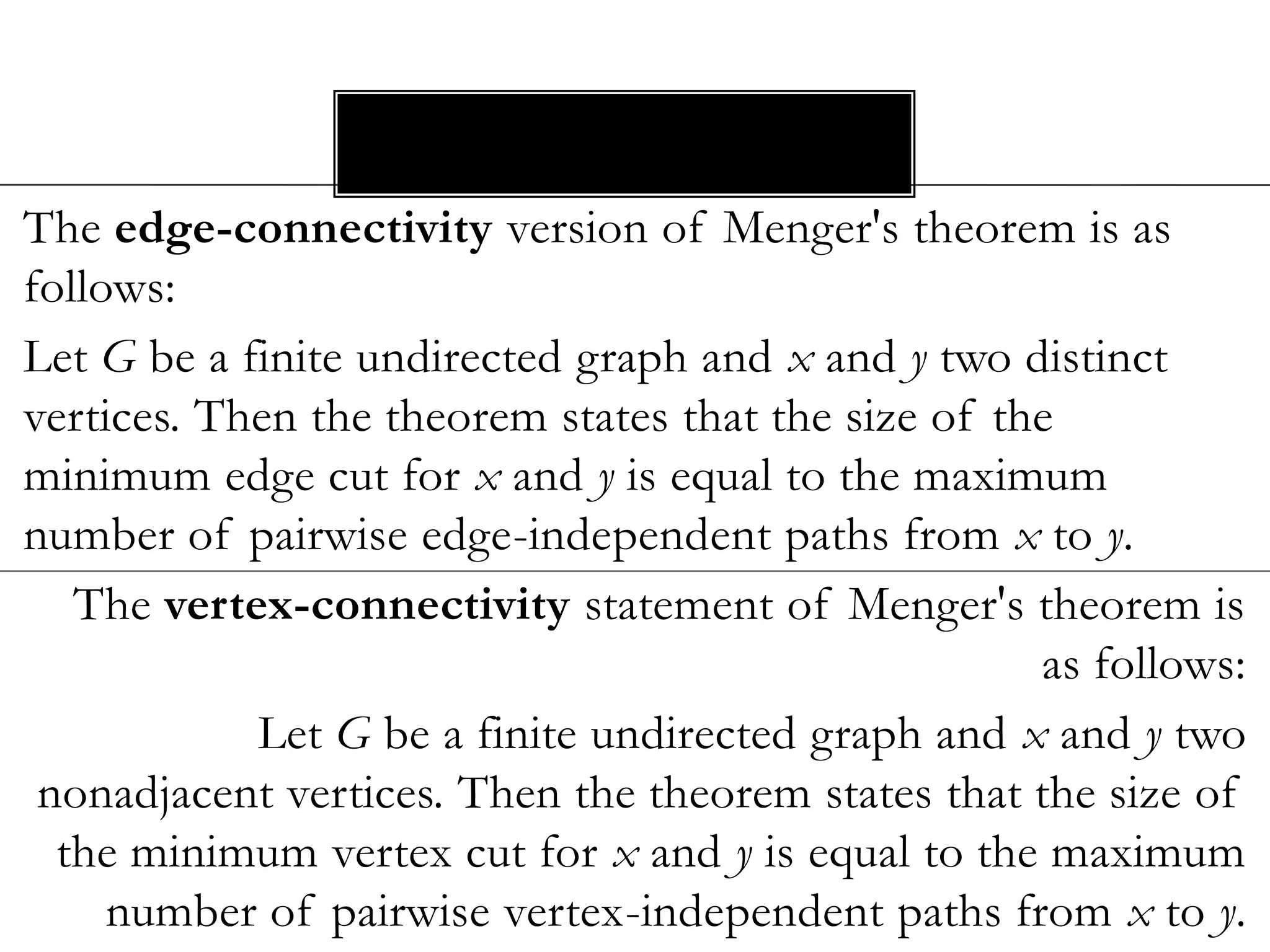
    So does G!Theedge-connectivity version of Menger's theorem is as follows:Let G be a finite undirected graph and x and y two distinct vertices. Then the theorem states that the size of the minimum edge cut for x and yis equal to the maximum number of pairwise edge-independent paths from xto y.The vertex-connectivity statement of Menger's theorem is as follows:Let G be a finite undirected graph and x and y two nonadjacent vertices. Then the theorem states that the size of the minimum vertex cut for x and yis equal to the maximum number of pairwise vertex-independent paths from x to y.
  • 72.
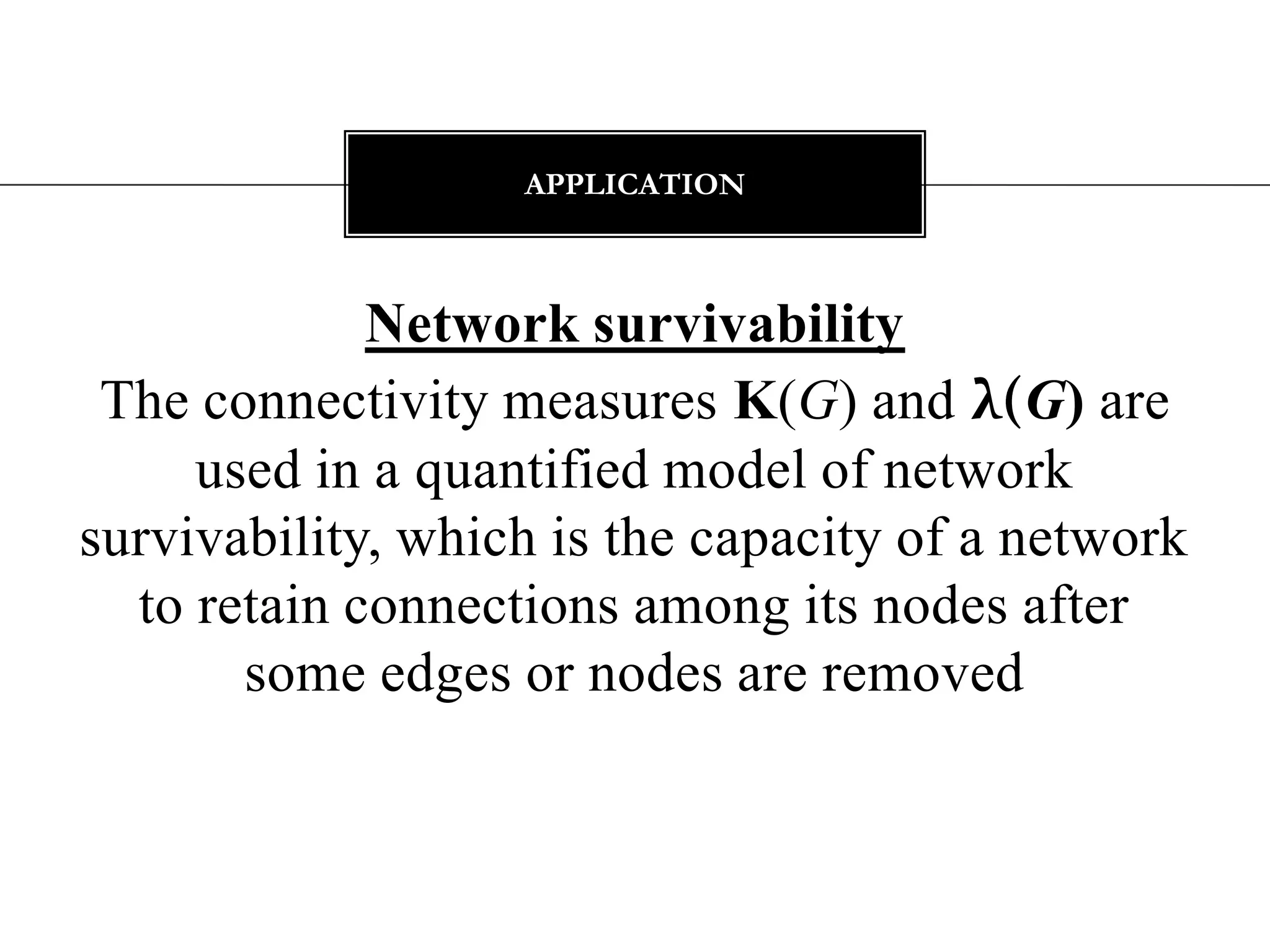
    Network survivabilityThe connectivitymeasures K(G) and λ(G) are used in a quantified model of network survivability, which is the capacity of a network to retain connections among its nodes after some edges or nodes are removedapplication
  • 73.
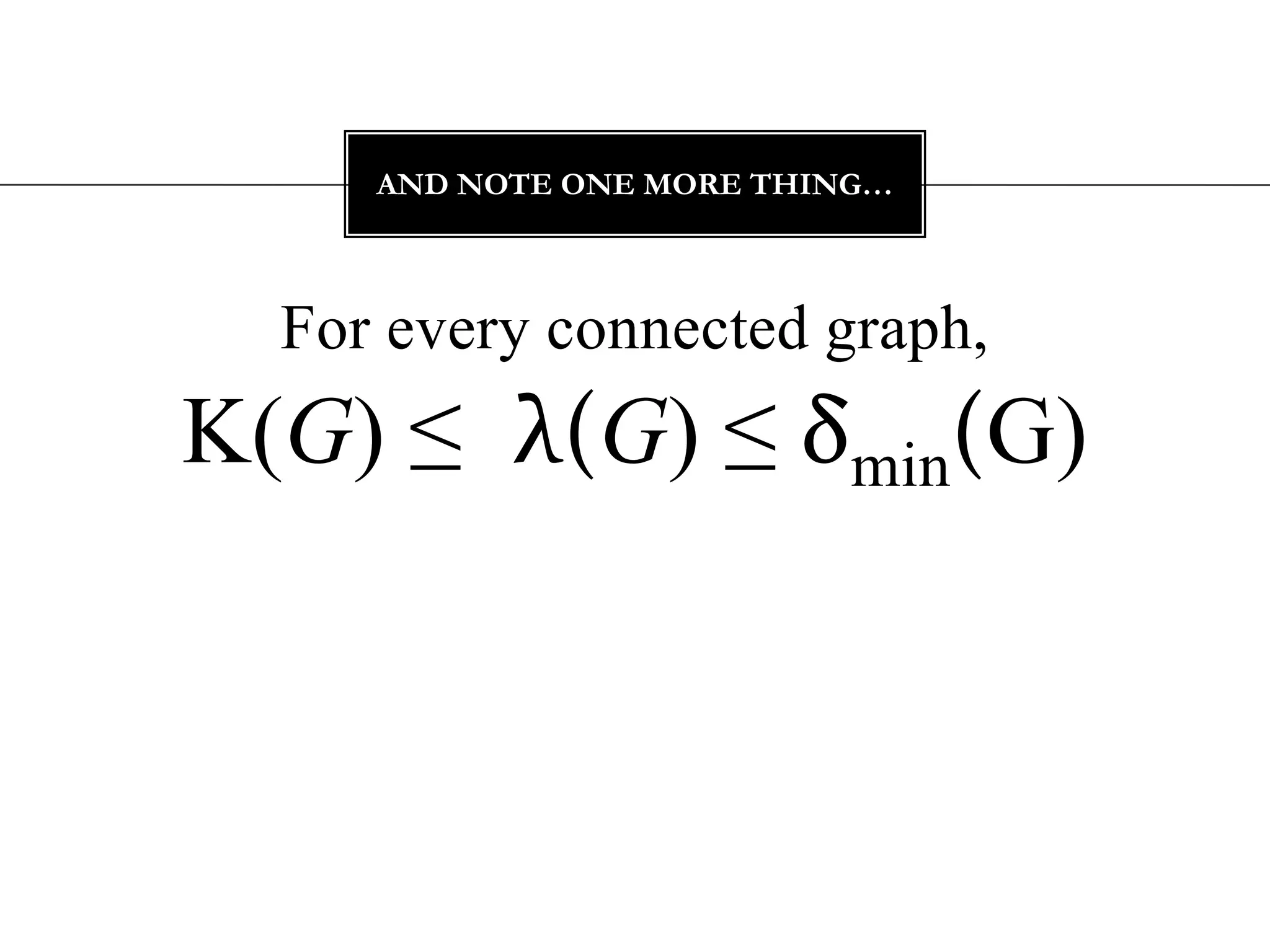
    For every connectedgraph,K(G) ≤ λ(G)≤ δmin(G)And note one more thing…
  • 74.
    Thank you foryour support….SHAMEER P H DEPT OF FUTURES STUDIES KERALA UNIVERSITY phshameer@gmail.com

Editor's Notes

  • #3 A graph is said to be connected, if there is a path between any two vertices. Some graphs are “more connected” than others. Some connected graphs can be disconnected by removal of a single vertex or single edge, where as others remain connected unless more vertices or more edges are removed. Two numerical parameters :- edge connectivity and vertex connectivity are useful in measuring a graph’s connectedness.