Downloaded 11 times
![Lecture 6: An Application of DFS :
Articulation points
Recall DFS algorithm:
DFS{G} {
for each v in V do // Initialize
visit[v] = false;
for each v in V do
if (visit[v] == false) RDFS(v);
}
RDFS(v) {
visit[v]=true;
for each w in Adj(v) do
if (visit[w] == false) {
RDFS(w);
}
}
}
1](https://image.slidesharecdn.com/ap-150325230457-conversion-gate01/75/articulation-points-in-graph-1-2048.jpg)
![Additional Information
• discover[u] – the discovery time, a counter indi-
cating when vertex u is discovered.
• pred[u] – the predecessor of u, which discovered
u.
DFS{G} {
for each v in V do // Initialize
visit[v] = false;
pred[v] = NULL;
time=0;
for each v in V do
if (visit[v] == false) RDFS(v);
}
RDFS(v) {
visit[v]=true;
discover[v] = ++time;
for each w in Adj(v) do
if (visit[w] == false) {
pred[w]=v;
RDFS(w);
}
}
}
3](https://image.slidesharecdn.com/ap-150325230457-conversion-gate01/75/articulation-points-in-graph-3-2048.jpg)
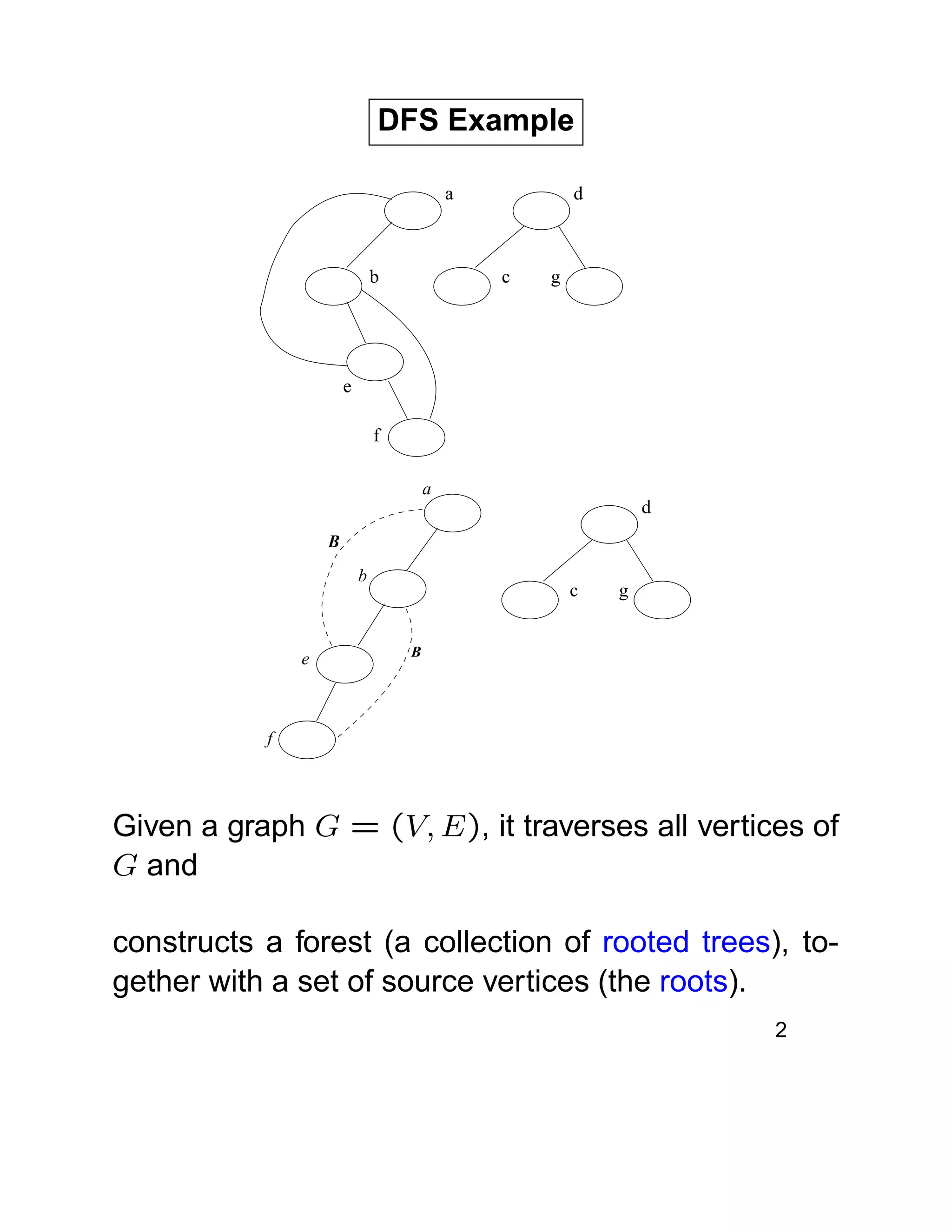
![Classification of Edges
Tree edges: which are the edges {pred[v], v} where
DFS calls are made.
Back edges: which are the edges {u, v} where v is
an ancestor of u in the tree.
4](https://image.slidesharecdn.com/ap-150325230457-conversion-gate01/75/articulation-points-in-graph-4-2048.jpg)
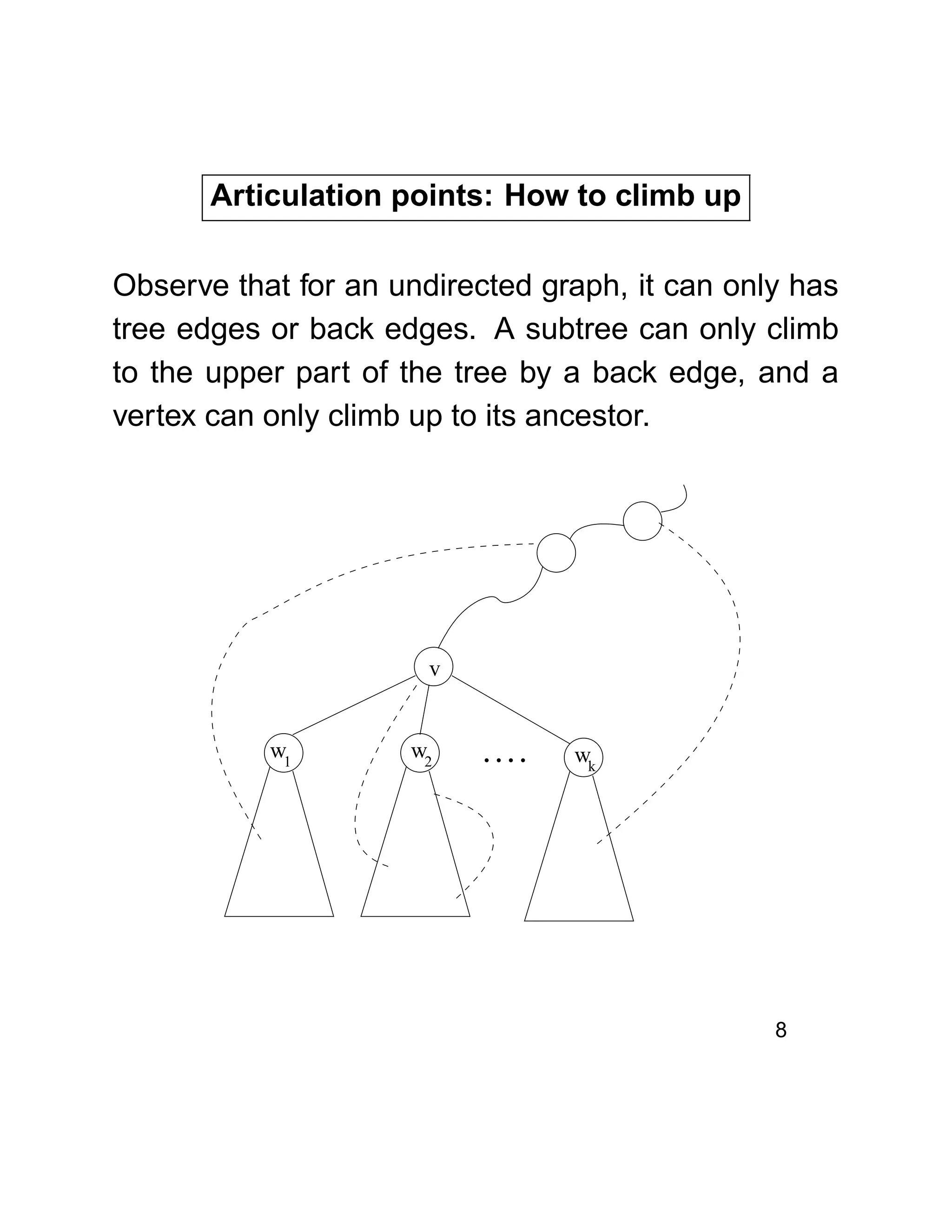
![Articulation points: Tackle observation 2
We make use of the discovery time in the DFS tree
to define ’low’ and ’high’. Observe that if we follow a
path from an ancestor (high) to a descendant (low),
the discovery time is in increasing order.
If there is a subtree rooted at a children of v which
does not have a back edge connecting to a SMALLER
discovery time than discover[v], then v is an articula-
tion point.
How do we know a subtree has a back edge climbing
to an upper part of the tree ?
Define Low[v] be the smallest value of a subtree rooted
at v to which it can climb up by a back edge.
Low[v] = min{discover[v], discover[w] : (u, w)
is a back edge for some descendant u of v}
9](https://image.slidesharecdn.com/ap-150325230457-conversion-gate01/75/articulation-points-in-graph-9-2048.jpg)
![RDFS_Compute_Low(v) {
visit[v]=true;
Low[v]=discover[v] = ++time;
for each w in Adj(v) do
if (visit[w] == false) {
pred[w]=v;
RDFS_Compute_Low(w);
// When RDFS_Compute_Low(w) returns,
// Low[w] stores the
// lowest value it can climb up
// for a subtree rooted at w.
Low[v] = min(Low[v], Low[w]);
} else if (w != pred[v]) {
// {v, w} is a back edge
Low[v] = min(Low[v], discover[w]);
}
}
10](https://image.slidesharecdn.com/ap-150325230457-conversion-gate01/75/articulation-points-in-graph-10-2048.jpg)
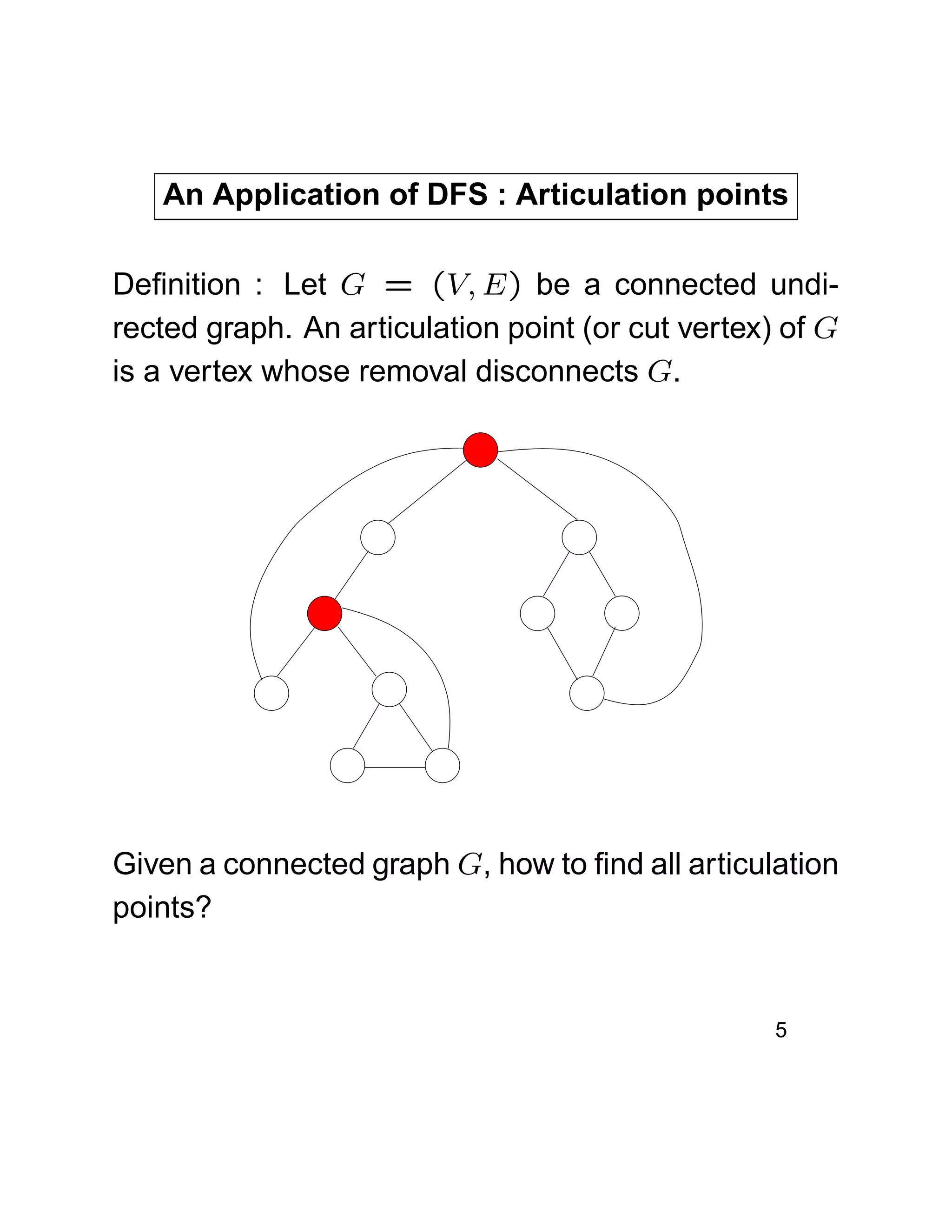
![Articulation points
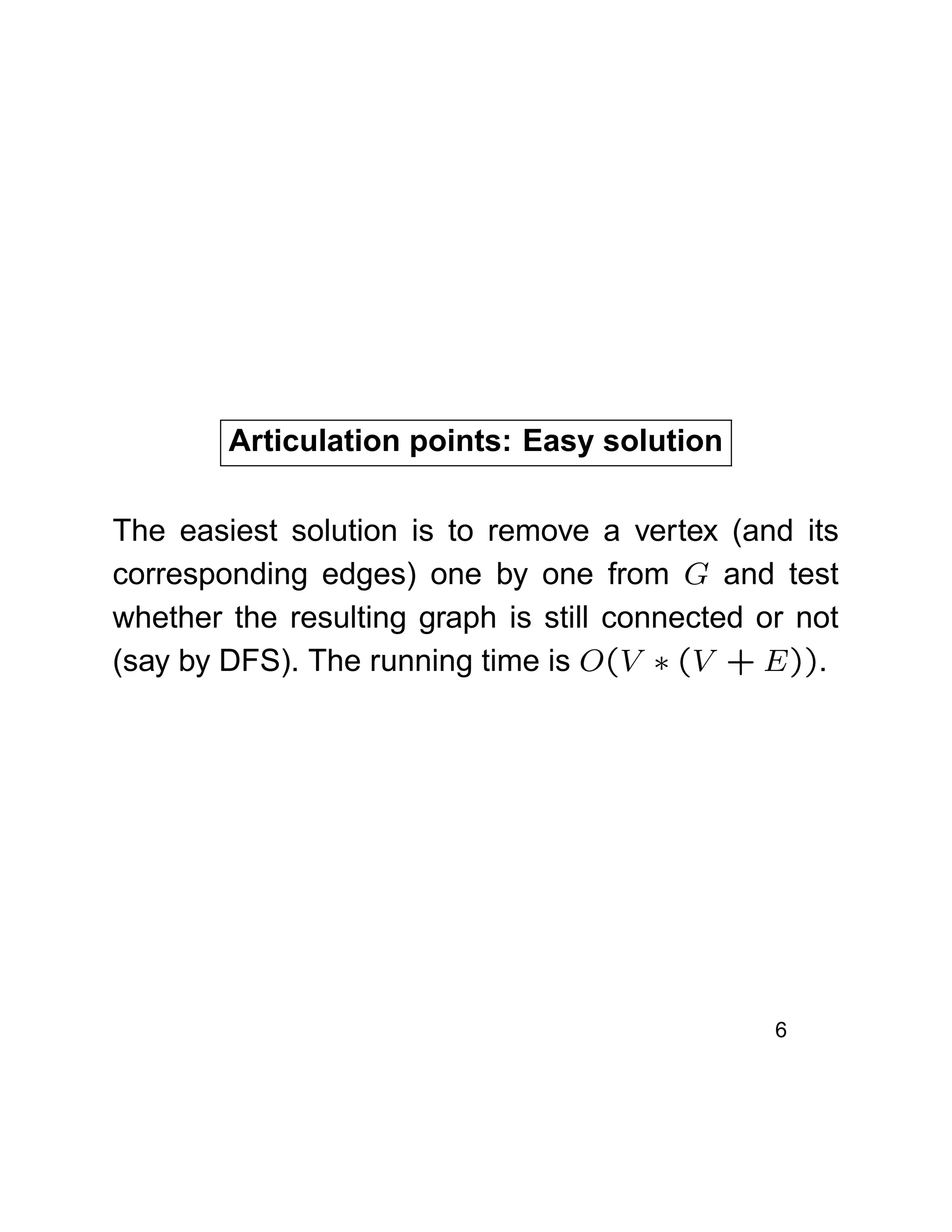
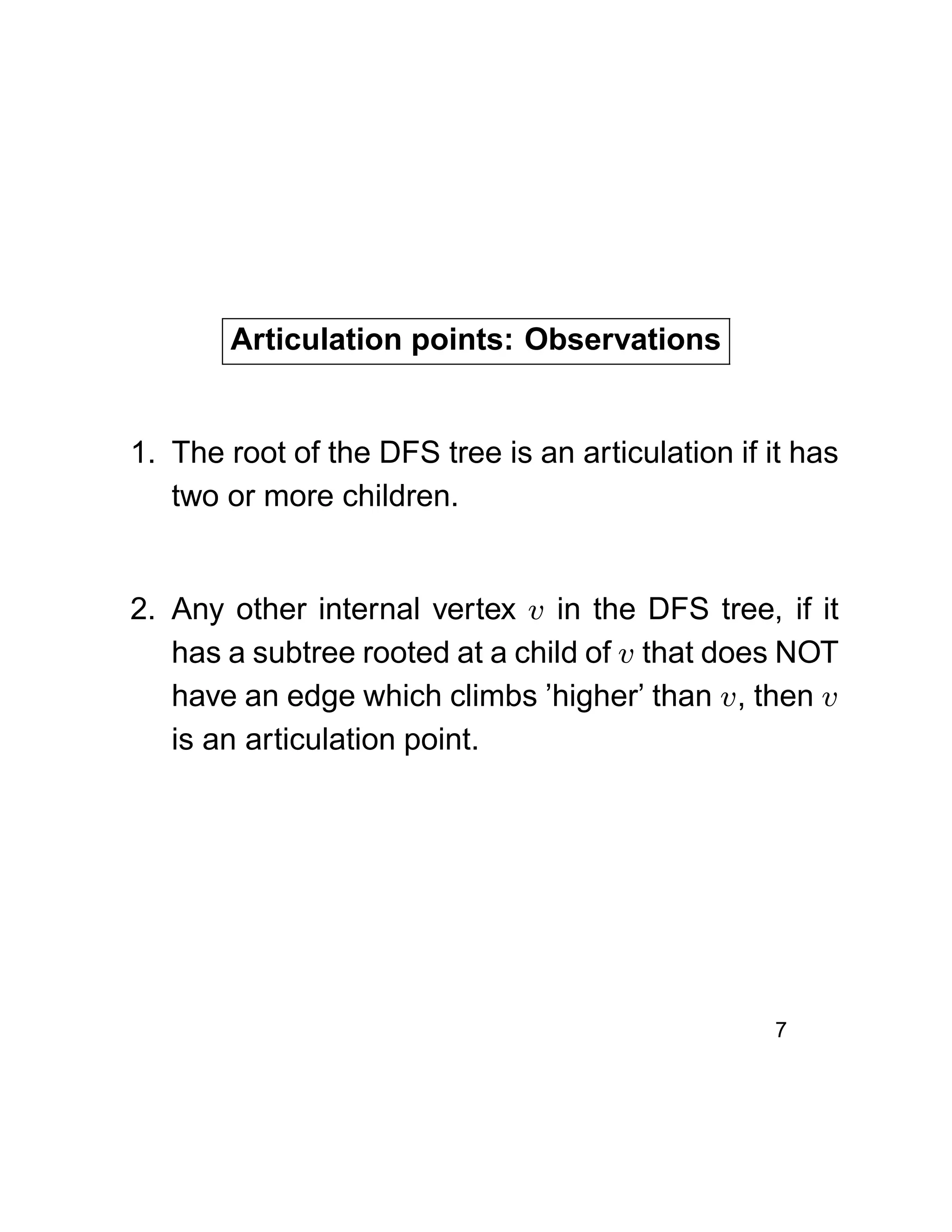
Articulation points are now determined as follows:
1. The root of the DFS tree is an articulation point if
it has two or more children.
2. Any other internal vertex v in the DFS tree is an
articulation point if v has a child w such that Low[w] ≥
discover[v].
ArticulationPoints{
for each v in V do
if (pred[v] == NULL) { //v is a root
if (|Adj(v)|>1)
articulation_point(v)=true;
} else{
for each w in Adj(v) do {
if (Low[w] >= discover[v])
articulation_point(v)=true;
}
}
}
Running time = ?
11](https://image.slidesharecdn.com/ap-150325230457-conversion-gate01/75/articulation-points-in-graph-11-2048.jpg)

This document discusses how to find articulation points in a graph using depth-first search (DFS). It begins by reviewing the DFS algorithm and concepts like discovery time. It then makes two key observations: (1) roots with two or more children and (2) internal vertices where a subtree has no back edge climbing higher are articulation points. It introduces the concept of low(v) to track the lowest discovery time reachable from v to determine if a subtree can climb higher. The algorithm runs DFS to compute low(v) values and identifies articulation points based on the two observations. The running time is O(V+E).
![Depth first search [dfs]](https://cdn.slidesharecdn.com/ss_thumbnails/depthfirstsearchdfs-190926145304-thumbnail.jpg?width=640&height=640&fit=bounds)


![[DSC Europe 25] Boris Perkovic - Lost in performance.pptx](https://cdn.slidesharecdn.com/ss_thumbnails/uq5hrp7vsuahqkxzifux-1-251204082258-fd2ee09d-thumbnail.jpg?width=640&height=640&fit=bounds)


![[DSC Europe 25] Andy Cotgreave - Nothing is new in analytics.pptx](https://cdn.slidesharecdn.com/ss_thumbnails/mba4vzcurvoh5lfrd5zw-6-251205194645-341bbbbe-thumbnail.jpg?width=640&height=640&fit=bounds)

![[DSC Europe 25] Bogdan Daniel Maruneac - AI - It starts with you.pptx](https://cdn.slidesharecdn.com/ss_thumbnails/odov3snhrcqs9hx5ny2n-4-251205085715-f1daacfe-thumbnail.jpg?width=640&height=640&fit=bounds)
![[DSC Europe 25] Dragana Ilic - AI for Big Data in Astronomy.pptx](https://cdn.slidesharecdn.com/ss_thumbnails/8palya86qaatvjhva1ms-2-dragana-ilic-ai-ilic-251208151906-652b819c-thumbnail.jpg?width=640&height=640&fit=bounds)

![[DSC Europe 25] Goran Obradovic - The Rise of Sovereign AI: Building the Regi...](https://cdn.slidesharecdn.com/ss_thumbnails/7nw2xxixrxqdxvrb5wca-6-251205085714-ab09a2ac-thumbnail.jpg?width=640&height=640&fit=bounds)


