Graph Theory
CONTENTS
 Definitions
 Types
 Terminology
 Sub-graphs
 Connectivity
 Euler definitions
Definition- Graph
Simple Finite Graph G=(V,E) consists of a
finite nonempty set V and E  V x V.
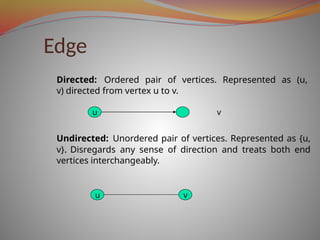
Edge
Directed: Ordered pair of vertices. Represented as (u,
v) directed from vertex u to v.
u v
Undirected: Unordered pair of vertices. Represented as {u,
v}. Disregards any sense of direction and treats both end
vertices interchangeably.
u v
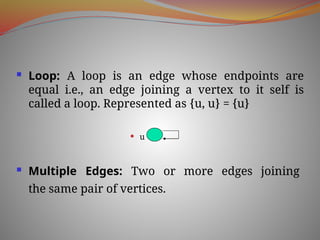
 Loop: A loop is an edge whose endpoints are
equal i.e., an edge joining a vertex to it self is
called a loop. Represented as {u, u} = {u}
 u
 Multiple Edges: Two or more edges joining
the same pair of vertices.
Simple Graph
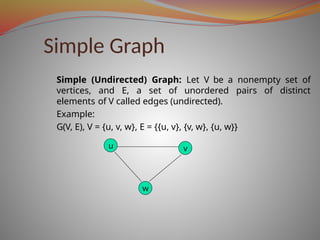
Simple (Undirected) Graph: Let V be a nonempty set of
vertices, and E, a set of unordered pairs of distinct
elements of V called edges (undirected).
Example:
G(V, E), V = {u, v, w}, E = {{u, v}, {v, w}, {u, w}}
u v
w
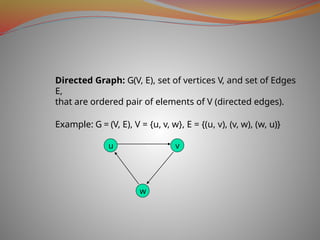
Directed Graph: G(V, E), set of vertices V, and set of Edges
E,
that are ordered pair of elements of V (directed edges).
Example: G = (V, E), V = {u, v, w}, E = {(u, v), (v, w), (w, u)}
u
w
v
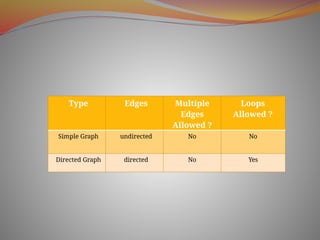
Type Edges Multiple
Edges
Allowed ?
Loops
Allowed ?
Simple Graph undirected No No
Directed Graph directed No Yes
Terminology in Undirected graphs
 u and v are adjacent if {u , v} is an edge, e is called incident with u and v.
u and v are called endpoints of {u , v}
 Degree of Vertex (deg (v)): the number of edges incident on a vertex.
A loop contributes twice to the degree .
 Pendant Vertex: deg (v) =1
 Isolated Vertex: deg (v) = 0
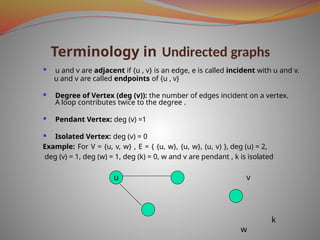
Example: For V = {u, v, w} , E = { {u, w}, {u, w}, (u, v) }, deg (u) = 2,
deg (v) = 1, deg (w) = 1, deg (k) = 0, w and v are pendant , k is isolated
u v
k
w
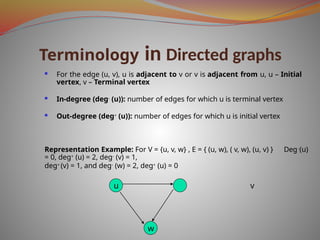
Terminology in Directed graphs
w
 For the edge (u, v), u is adjacent to v or v is adjacent from u, u – Initial
vertex, v – Terminal vertex
 In-degree (deg- (u)): number of edges for which u is terminal vertex
 Out-degree (deg+ (u)): number of edges for which u is initial vertex
Representation Example: For V = {u, v, w} , E = { (u, w), ( v, w), (u, v) } Deg-(u)
= 0, deg+ (u) = 2, deg- (v) = 1,
deg+ (v) = 1, and deg- (w) = 2, deg+ (u) = 0
u v
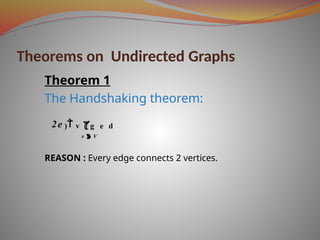
Theorems on Undirected Graphs
Theorem 1
The Handshaking theorem:
2e   d
e
g
(
v
)
v  V
REASON : Every edge connects 2 vertices.
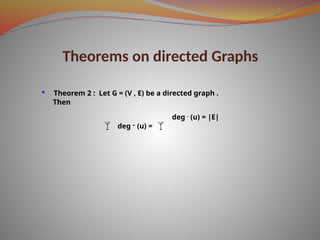
Theorems on directed Graphs
deg - (u) = |E|
 Theorem 2 : Let G = (V , E) be a directed graph .
Then
 deg + (u) = 
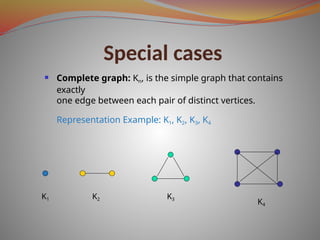
Special cases
 Complete graph: Kn, is the simple graph that contains
exactly
one edge between each pair of distinct vertices.
Representation Example: K1, K2, K3, K4
K2
K1
K4
K3
Bipartite graphs
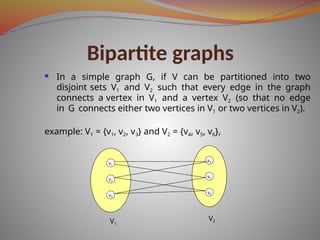
 In a simple graph G, if V can be partitioned into two
disjoint sets V1 and V2 such that every edge in the graph
connects a vertex in V1 and a vertex V2 (so that no edge
in G connects either two vertices in V1 or two vertices in V2).
example: V1 = {v1, v2, v3} and V2 = {v4, v5, v6},
v1
v2
v3
v4
v5
v6
V1
V2
Complete Bipartite graphs
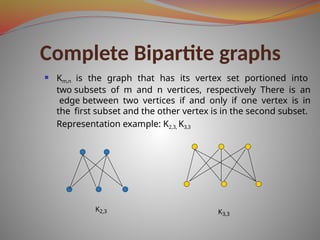
 Km,n is the graph that has its vertex set portioned into
two subsets of m and n vertices, respectively There is an
edge between two vertices if and only if one vertex is in
the first subset and the other vertex is in the second subset.
Representation example: K2,3, K3,3
K2,3 K3,3
Subgraphs
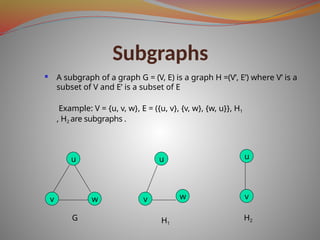
 A subgraph of a graph G = (V, E) is a graph H =(V’, E’) where V’ is a
subset of V and E’ is a subset of E
Example: V = {u, v, w}, E = ({u, v}, {v, w}, {w, u}}, H1
, H2 are subgraphs .
u
v w
u
u
w
v v
H1
H2
G
Subgraphs
v
w w
v
w
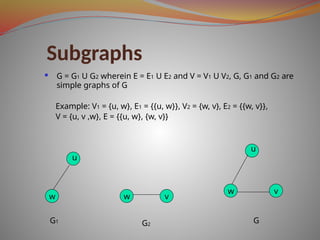
 G = G1 U G2 wherein E = E1 U E2 and V = V1 U V2, G, G1 and G2 are
simple graphs of G
Example: V1 = {u, w}, E1 = {{u, w}}, V2 = {w, v}, E2 = {{w, v}},
V = {u, v ,w}, E = {{u, w}, {w, v}}
u
u
G1
G2
G
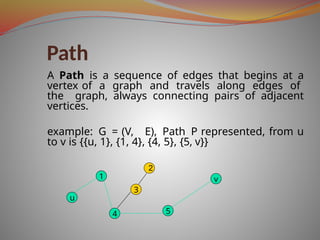
Path
1
u
3
4 5
2
A Path is a sequence of edges that begins at a
vertex of a graph and travels along edges of
the graph, always connecting pairs of adjacent
vertices.
example: G = (V, E), Path P represented, from u
to v is {{u, 1}, {1, 4}, {4, 5}, {5, v}}
v
Connectivity – Path
Definition for Directed Graphs : A Path of length k (> 0) from u
to v in G is a sequence of k+1 vertices x1,x2,…x k+1 such that xix i+1
is an edge for i=1,2,…,k-1.
For Simple Graphs, sequence is x0, x1, …, xn . In directed
multigraphs when it is not necessary to distinguish between
their edges, we can use sequence of vertices to represent
the path
Circuit/Cycle: u = v, length of path > 0
Simple Path: does not contain a vertex more than once
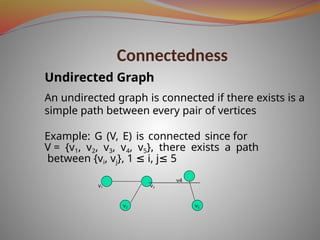
Connectedness
v2 v5
Undirected Graph
An undirected graph is connected if there exists is a
simple path between every pair of vertices
Example: G (V, E) is connected since for
V = {v1, v2, v3, v4, v5}, there exists a path
between {vi, vj}, 1 ≤ i, j≤ 5
v4
v1 v3
Connectedness
Undirected Graph
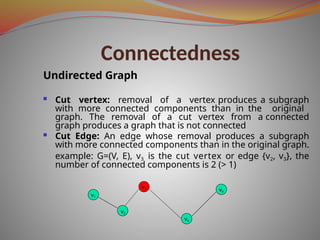
 Cut vertex: removal of a vertex produces a subgraph
with more connected components than in the original
graph. The removal of a cut vertex from a connected
graph produces a graph that is not connected
 Cut Edge: An edge whose removal produces a subgraph
with more connected components than in the original graph.
example: G=(V, E), v3 is the cut vertex or edge {v2, v3}, the
number of connected components is 2 (> 1)
v1
v2
v3
v4
v5
Euler Graph
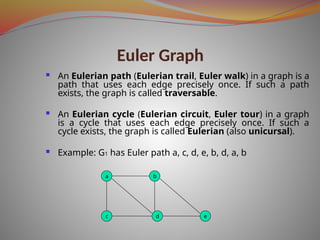
 An Eulerian path (Eulerian trail, Euler walk) in a graph is a
path that uses each edge precisely once. If such a path
exists, the graph is called traversable.
 An Eulerian cycle (Eulerian circuit, Euler tour) in a graph
is a cycle that uses each edge precisely once. If such a
cycle exists, the graph is called Eulerian (also unicursal).
 Example: G1 has Euler path a, c, d, e, b, d, a, b
a b
c d e
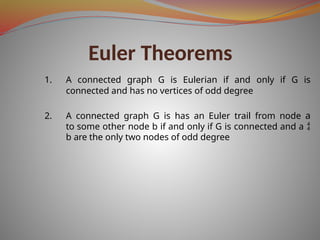
Euler Theorems
1. A connected graph G is Eulerian if and only if G is
connected and has no vertices of odd degree
2. A connected graph G is has an Euler trail from node a
to some other node b if and only if G is connected and a 
b are the only two nodes of odd degree
GRAPH THEORY PPT for students to re.pptx

  • 1.
  • 2.
    CONTENTS  Definitions  Types Terminology  Sub-graphs  Connectivity  Euler definitions
  • 3.
    Definition- Graph Simple FiniteGraph G=(V,E) consists of a finite nonempty set V and E  V x V.
  • 4.
    Edge Directed: Ordered pairof vertices. Represented as (u, v) directed from vertex u to v. u v Undirected: Unordered pair of vertices. Represented as {u, v}. Disregards any sense of direction and treats both end vertices interchangeably. u v
  • 5.
     Loop: Aloop is an edge whose endpoints are equal i.e., an edge joining a vertex to it self is called a loop. Represented as {u, u} = {u}  u  Multiple Edges: Two or more edges joining the same pair of vertices.
  • 6.
    Simple Graph Simple (Undirected)Graph: Let V be a nonempty set of vertices, and E, a set of unordered pairs of distinct elements of V called edges (undirected). Example: G(V, E), V = {u, v, w}, E = {{u, v}, {v, w}, {u, w}} u v w
  • 7.
    Directed Graph: G(V,E), set of vertices V, and set of Edges E, that are ordered pair of elements of V (directed edges). Example: G = (V, E), V = {u, v, w}, E = {(u, v), (v, w), (w, u)} u w v
  • 8.
    Type Edges Multiple Edges Allowed? Loops Allowed ? Simple Graph undirected No No Directed Graph directed No Yes
  • 9.
    Terminology in Undirectedgraphs  u and v are adjacent if {u , v} is an edge, e is called incident with u and v. u and v are called endpoints of {u , v}  Degree of Vertex (deg (v)): the number of edges incident on a vertex. A loop contributes twice to the degree .  Pendant Vertex: deg (v) =1  Isolated Vertex: deg (v) = 0 Example: For V = {u, v, w} , E = { {u, w}, {u, w}, (u, v) }, deg (u) = 2, deg (v) = 1, deg (w) = 1, deg (k) = 0, w and v are pendant , k is isolated u v k w
  • 10.
    Terminology in Directedgraphs w  For the edge (u, v), u is adjacent to v or v is adjacent from u, u – Initial vertex, v – Terminal vertex  In-degree (deg- (u)): number of edges for which u is terminal vertex  Out-degree (deg+ (u)): number of edges for which u is initial vertex Representation Example: For V = {u, v, w} , E = { (u, w), ( v, w), (u, v) } Deg-(u) = 0, deg+ (u) = 2, deg- (v) = 1, deg+ (v) = 1, and deg- (w) = 2, deg+ (u) = 0 u v
  • 11.
    Theorems on UndirectedGraphs Theorem 1 The Handshaking theorem: 2e   d e g ( v ) v  V REASON : Every edge connects 2 vertices.
  • 12.
    Theorems on directedGraphs deg - (u) = |E|  Theorem 2 : Let G = (V , E) be a directed graph . Then  deg + (u) = 
  • 13.
    Special cases  Completegraph: Kn, is the simple graph that contains exactly one edge between each pair of distinct vertices. Representation Example: K1, K2, K3, K4 K2 K1 K4 K3
  • 14.
    Bipartite graphs  Ina simple graph G, if V can be partitioned into two disjoint sets V1 and V2 such that every edge in the graph connects a vertex in V1 and a vertex V2 (so that no edge in G connects either two vertices in V1 or two vertices in V2). example: V1 = {v1, v2, v3} and V2 = {v4, v5, v6}, v1 v2 v3 v4 v5 v6 V1 V2
  • 15.
    Complete Bipartite graphs Km,n is the graph that has its vertex set portioned into two subsets of m and n vertices, respectively There is an edge between two vertices if and only if one vertex is in the first subset and the other vertex is in the second subset. Representation example: K2,3, K3,3 K2,3 K3,3
  • 16.
    Subgraphs  A subgraphof a graph G = (V, E) is a graph H =(V’, E’) where V’ is a subset of V and E’ is a subset of E Example: V = {u, v, w}, E = ({u, v}, {v, w}, {w, u}}, H1 , H2 are subgraphs . u v w u u w v v H1 H2 G
  • 17.
    Subgraphs v w w v w  G= G1 U G2 wherein E = E1 U E2 and V = V1 U V2, G, G1 and G2 are simple graphs of G Example: V1 = {u, w}, E1 = {{u, w}}, V2 = {w, v}, E2 = {{w, v}}, V = {u, v ,w}, E = {{u, w}, {w, v}} u u G1 G2 G
  • 18.
    Path 1 u 3 4 5 2 A Pathis a sequence of edges that begins at a vertex of a graph and travels along edges of the graph, always connecting pairs of adjacent vertices. example: G = (V, E), Path P represented, from u to v is {{u, 1}, {1, 4}, {4, 5}, {5, v}} v
  • 19.
    Connectivity – Path Definitionfor Directed Graphs : A Path of length k (> 0) from u to v in G is a sequence of k+1 vertices x1,x2,…x k+1 such that xix i+1 is an edge for i=1,2,…,k-1. For Simple Graphs, sequence is x0, x1, …, xn . In directed multigraphs when it is not necessary to distinguish between their edges, we can use sequence of vertices to represent the path Circuit/Cycle: u = v, length of path > 0 Simple Path: does not contain a vertex more than once
  • 20.
    Connectedness v2 v5 Undirected Graph Anundirected graph is connected if there exists is a simple path between every pair of vertices Example: G (V, E) is connected since for V = {v1, v2, v3, v4, v5}, there exists a path between {vi, vj}, 1 ≤ i, j≤ 5 v4 v1 v3
  • 21.
    Connectedness Undirected Graph  Cutvertex: removal of a vertex produces a subgraph with more connected components than in the original graph. The removal of a cut vertex from a connected graph produces a graph that is not connected  Cut Edge: An edge whose removal produces a subgraph with more connected components than in the original graph. example: G=(V, E), v3 is the cut vertex or edge {v2, v3}, the number of connected components is 2 (> 1) v1 v2 v3 v4 v5
  • 22.
    Euler Graph  AnEulerian path (Eulerian trail, Euler walk) in a graph is a path that uses each edge precisely once. If such a path exists, the graph is called traversable.  An Eulerian cycle (Eulerian circuit, Euler tour) in a graph is a cycle that uses each edge precisely once. If such a cycle exists, the graph is called Eulerian (also unicursal).  Example: G1 has Euler path a, c, d, e, b, d, a, b a b c d e
  • 23.
    Euler Theorems 1. Aconnected graph G is Eulerian if and only if G is connected and has no vertices of odd degree 2. A connected graph G is has an Euler trail from node a to some other node b if and only if G is connected and a  b are the only two nodes of odd degree