GRAPH THEORY
Ms.E.Niraimathi
Assistant professor
Department of mathematics,
Sri Sarada Niketan College of Science for Women,Karur
GRAPH
 A graph G = (V, E) consists of a set of objects V = (v1, v2,…) called vertices
and another set E = (e1, e2,…) whose elements are called edges, which that
each edge ek is identified with an unordered pair (vi, vj) of vertices.
Example:
 V = (v1, v2, v3, v4, v5)
 E = (e1, e2, e3, e4, e5, e6, e7)
SOME TYPES OF GRAPH
SELF LOOP:
 An Edge having the same vertex as both its end vertices is
called self loop.
Example:
In this figure, e1 is a self loop.
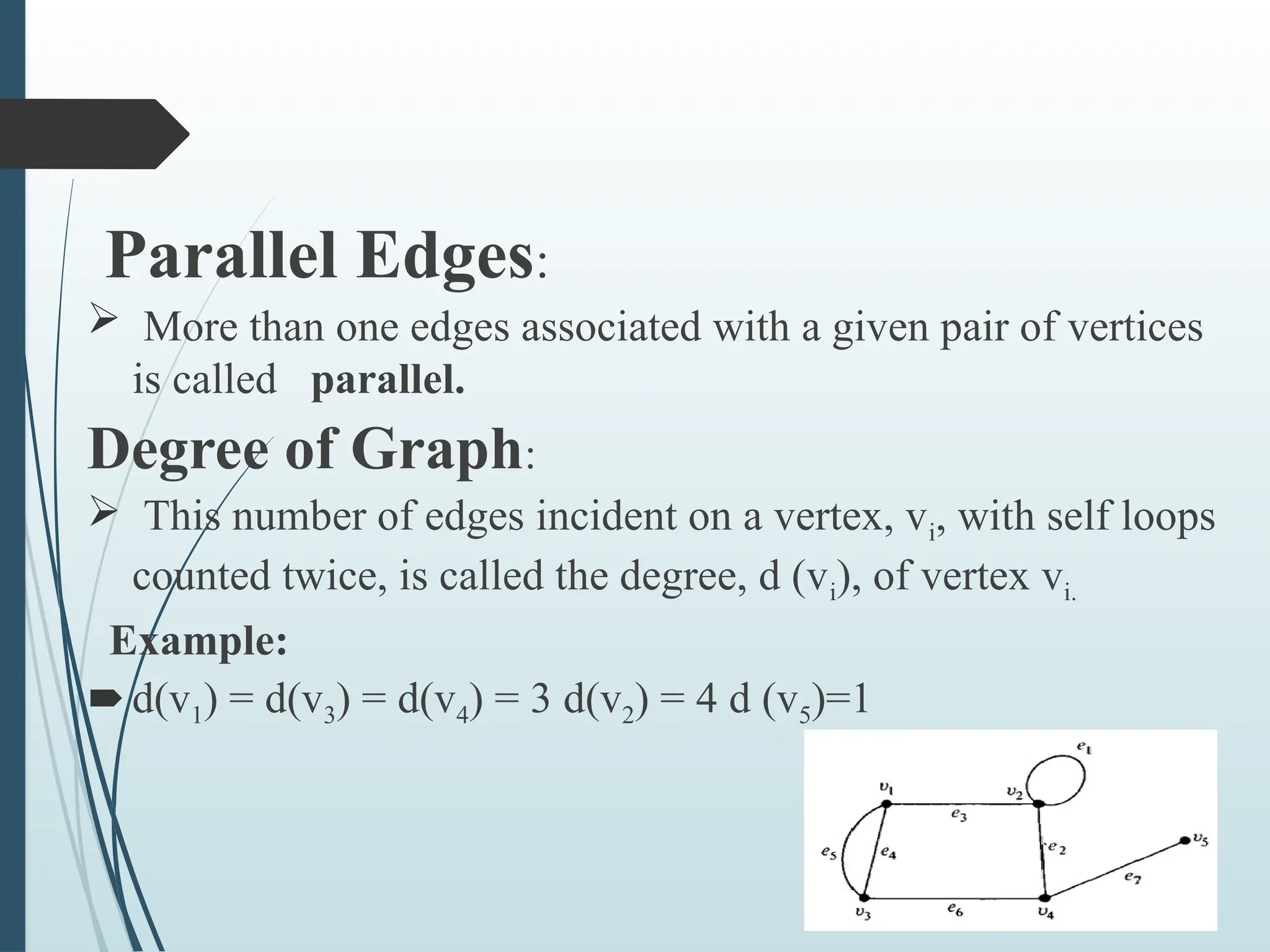
Parallel Edges:
 More than one edges associated with a given pair of vertices
is called parallel.
Degree of Graph:
 This number of edges incident on a vertex, vi, with self loops
counted twice, is called the degree, d (vi), of vertex vi.
Example:
d(v1) = d(v3) = d(v4) = 3 d(v2) = 4 d (v5)=1
Null graph
 A graph without any edges is called a null graph
Example :
 Null graph of six vertices
Simple Graph:
A graph that has neither self loop nor
parallel edges is called a simple graph.
Connected Graph:
A graph G is said to be connected, if
there is at least one path between ever
pair of vertices.
Disconnected Graph:
A graph can be split into an
independent components. Then it is
called as disconnected graph.
Complete graph:
 A simple graph in which there exists an edge between every
pair of vertices is called a complete graph.
Example:
 Complete graphs of two, three, four and five vertices.
Theorem:
The sum of the degrees of the vertices of a graph is equal to
twice the number of its edges.
Proof:
If e=uv is an edges of G, e is counted once while
counting the degree of each of u and v(even when
u=v).Hence, each edge contributes 2 to the sum of
the degree of the vertices .Thus , the m edges of G
contribute 2m to the degree sum.
Directed graph:
 A graph which have directions is called directed graph.
Undirected graph:
 A graph which have no directions is called undirected
graph.
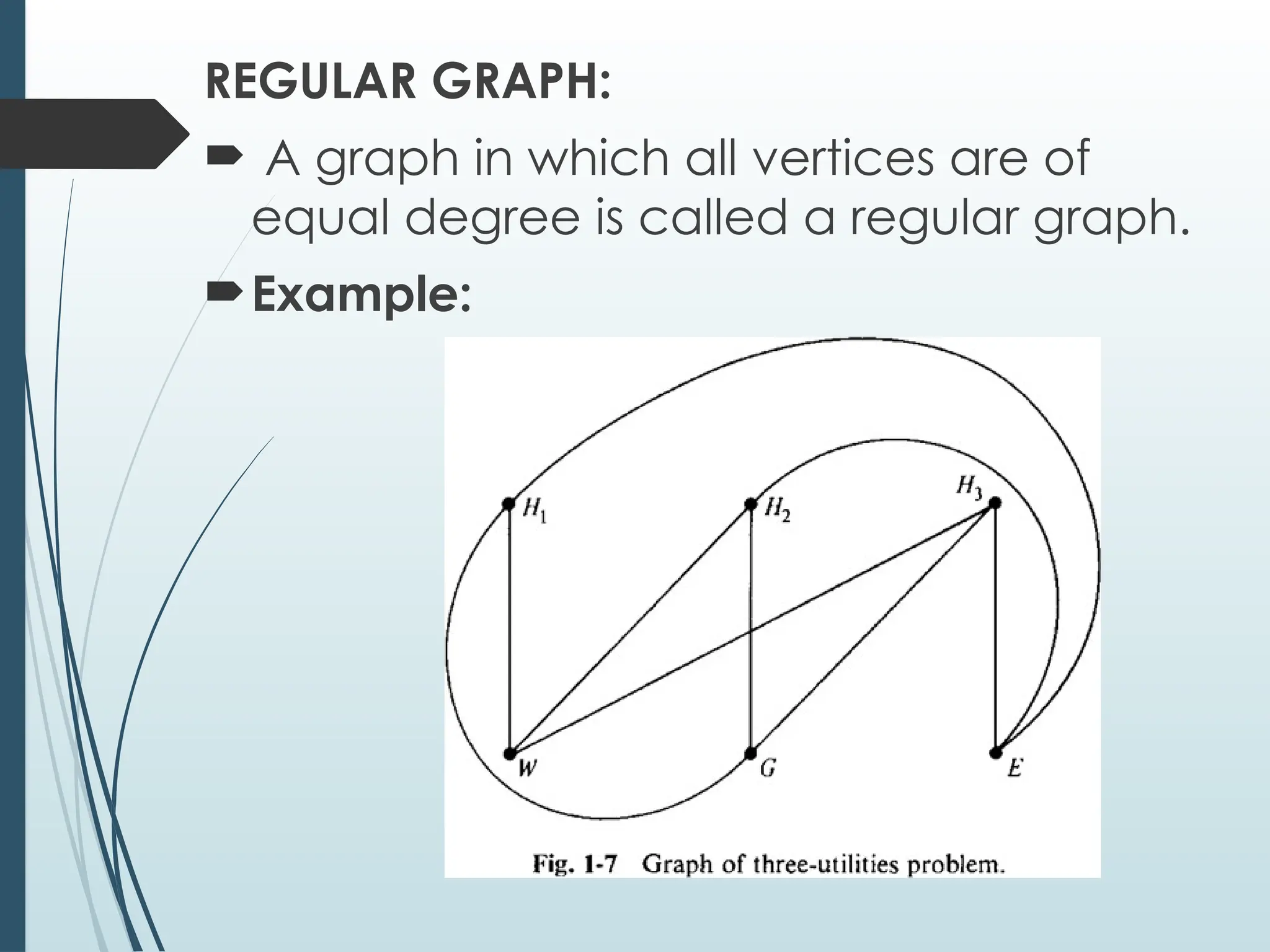
REGULAR GRAPH:
 A graph in which all vertices are of
equal degree is called a regular graph.
Example:
WALK:
 A walk is defines as a finite alternating sequence of vertices
and edges, beginning and ending with vertices, such that each
is indicient with the vertices preceding and following it. No
edge appears (is covered or traversed) more than once is a
walk. A vertex, however, may appear more than once.
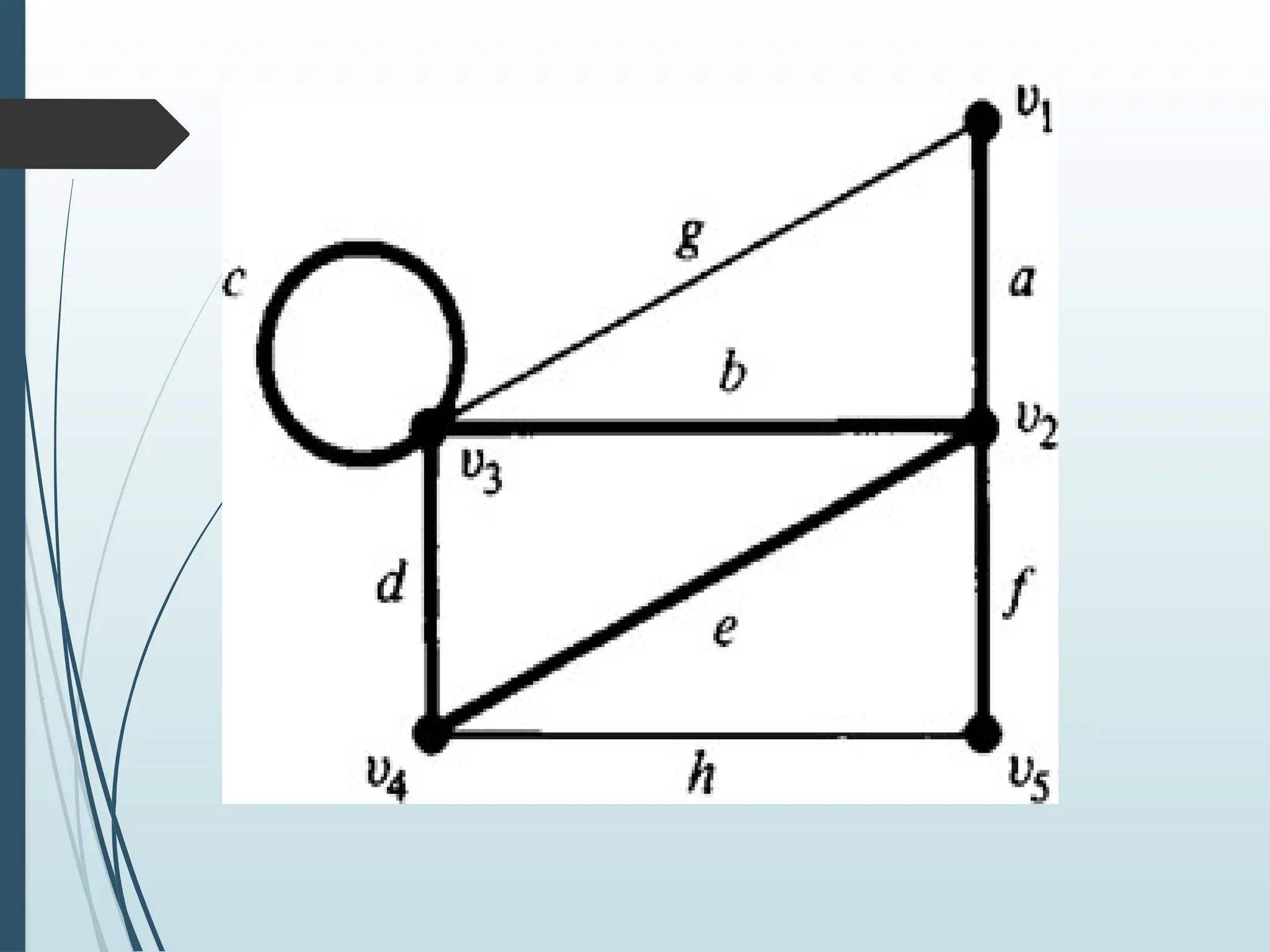
Example
 An open walk. In this figure for instance, v1av2bv3dv4fv51 is
a walk show with heavy lines.
OPEN WALK AND CLOSED WALK:
It is possible for a walk to begin and end at the same vertex. Such a walk u is called
a closed walk. A walk that is not closed. (i.e., the terminal vertices are distinct) is
called an open walk.
LENGTH OF A PATH:
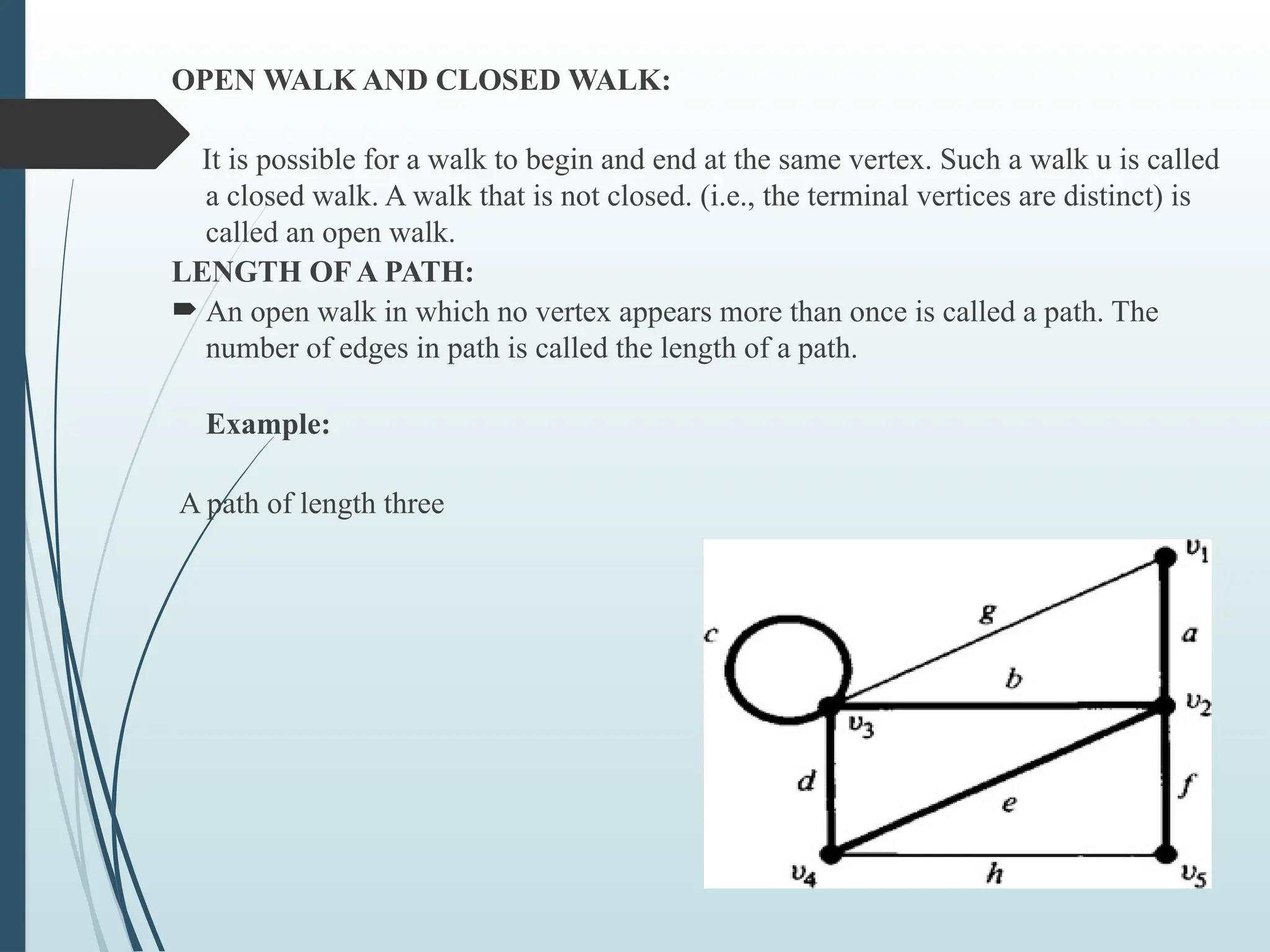
 An open walk in which no vertex appears more than once is called a path. The
number of edges in path is called the length of a path.
Example:
A path of length three
APPLICATION OF GRAPH THEORY
 Electrical engineering
 Automation engineering
 Computer science
 Computer network
Tree
 A connected acyclic graph is called a tree. In other words, a
connected graph with no cycles is called a tree.
 The edges of a tree are known as branches. Elements of trees are
called their nodes. The nodes without child nodes are called leaf nodes.
 A tree with ‘n’ vertices has ‘n-1’ edges. If it has one more edge extra
than ‘n-1’, then the extra edge should obviously has to pair up with two
vertices which leads to form a cycle. Then, it becomes a cyclic graph
which is a violation for the tree graph.
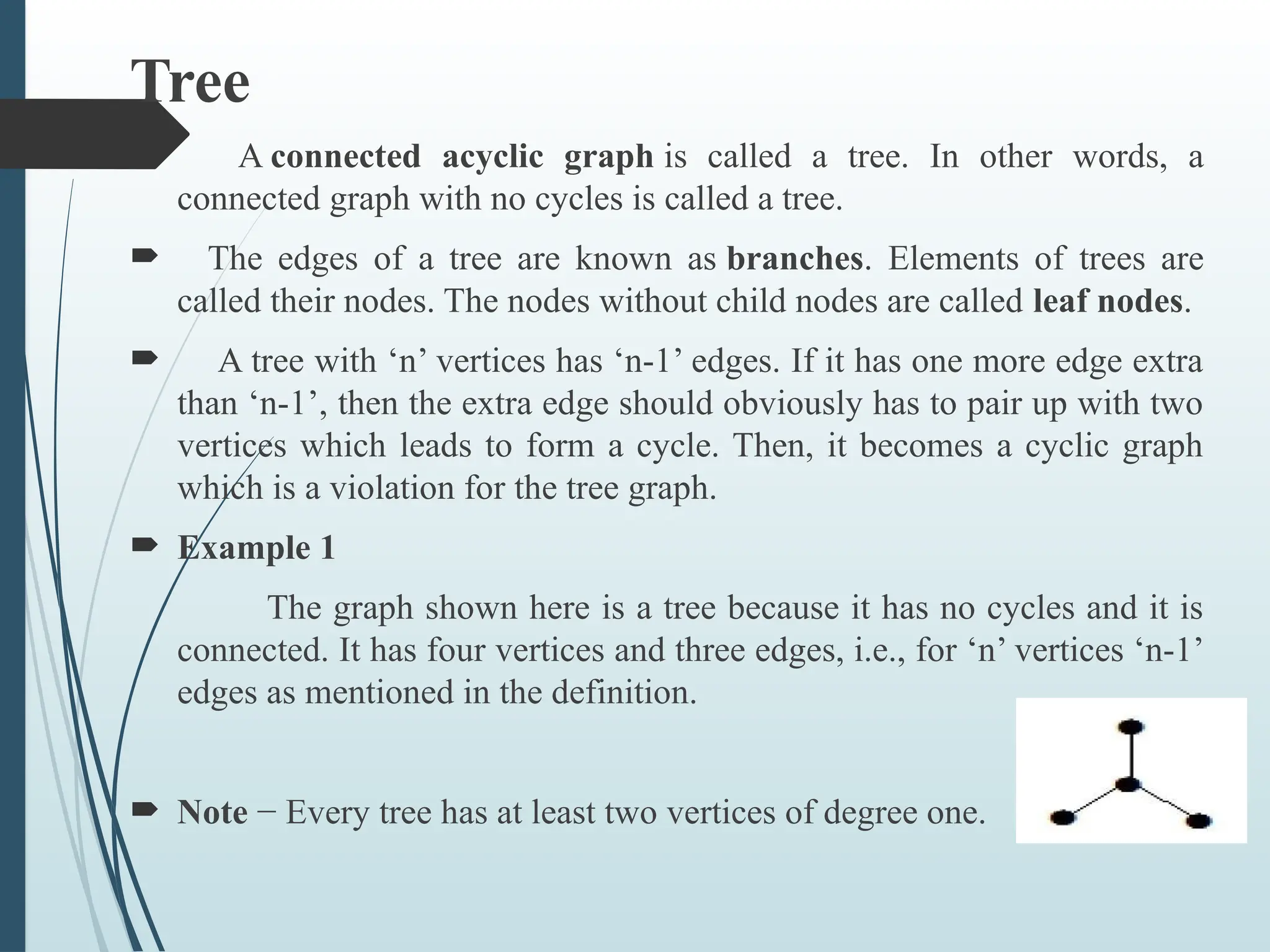
 Example 1
The graph shown here is a tree because it has no cycles and it is
connected. It has four vertices and three edges, i.e., for ‘n’ vertices ‘n-1’
edges as mentioned in the definition.
 Note − Every tree has at least two vertices of degree one.
Forest
 A disconnected acyclic graph is called a forest. In
other words, a disjoint collection of trees is called a
forest.
 Example
The following graph looks like two sub-graphs; but it is
a single disconnected graph. There are no cycles in this
graph. Hence, clearly it is a forest.
Spanning Trees
Let G be a connected graph, then the sub-graph H of G is
called a spanning tree of G if −H is a treeH contains all
vertices of G.A spanning tree T of an undirected graph G is a
subgraph that includes all of the vertices of G.
 Example
In the above example, G is a connected graph and H is a
sub-graph of G.
Clearly, the graph H has no cycles, it is a tree with six edges
which is one less than the total number of vertices. Hence H is
the Spanning tree of G.
Connectivity
 A graph is said to be connected if there is a path
between every pair of vertex. From every vertex to any
other vertex, there should be some path to traverse. That
is called the connectivity of a graph. A graph with
multiple disconnected vertices and edges is said to be
disconnected.
 Example 1
In the following graph, it is possible to travel from one
vertex to any other vertex. For example, one can traverse
from vertex ‘a’ to vertex ‘e’ using the path ‘a-b-e’.
Cut Vertex
 Let ‘G’ be a connected graph. A vertex V G is called a
∈
cut vertex of ‘G’, if ‘G-V’ (Delete ‘V’ from ‘G’) results in a
disconnected graph. Removing a cut vertex from a graph
breaks it in to two or more graphs.
 Note − Removing a cut vertex may render a graph
disconnected.
 A connected graph ‘G’ may have at most (n–2) cut vertices.
 Example
In the following graph, vertices ‘e’ and ‘c’ are the cut
vertices.
Matching
 Let ‘G’ = (V, E) be a graph. A subgraph is called a
matching M(G), if each vertex of G is incident with at
most one edge in M, i.e.,
 deg(V) ≤ 1 V G
∀ ∈
 which means in the matching graph M(G), the vertices
should have a degree of 1 or 0, where the edges should be
incident from the graph G.
 Notation − M(G)
Maximal Matching
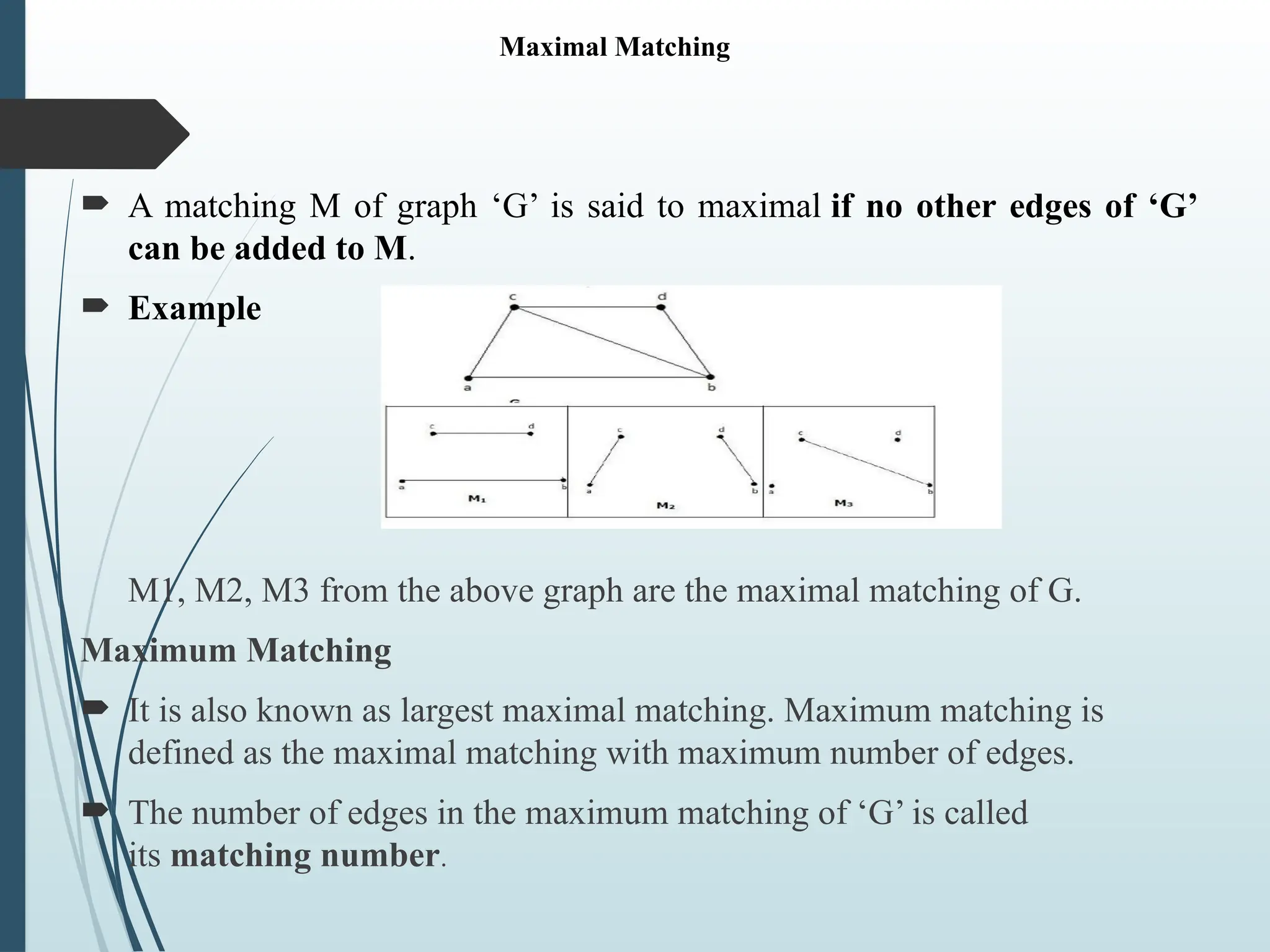
 A matching M of graph ‘G’ is said to maximal if no other edges of ‘G’
can be added to M.
 Example
M1, M2, M3 from the above graph are the maximal matching of G.
Maximum Matching
 It is also known as largest maximal matching. Maximum matching is
defined as the maximal matching with maximum number of edges.
 The number of edges in the maximum matching of ‘G’ is called
its matching number.
 Example
For a graph given in the above example, M1 and M2 are the maximum
matching of ‘G’ and its matching number is 2. Hence by using the graph
G, we can form only the subgraphs with only 2 edges maximum. Hence
we have the matching number as two.
Perfect Matching
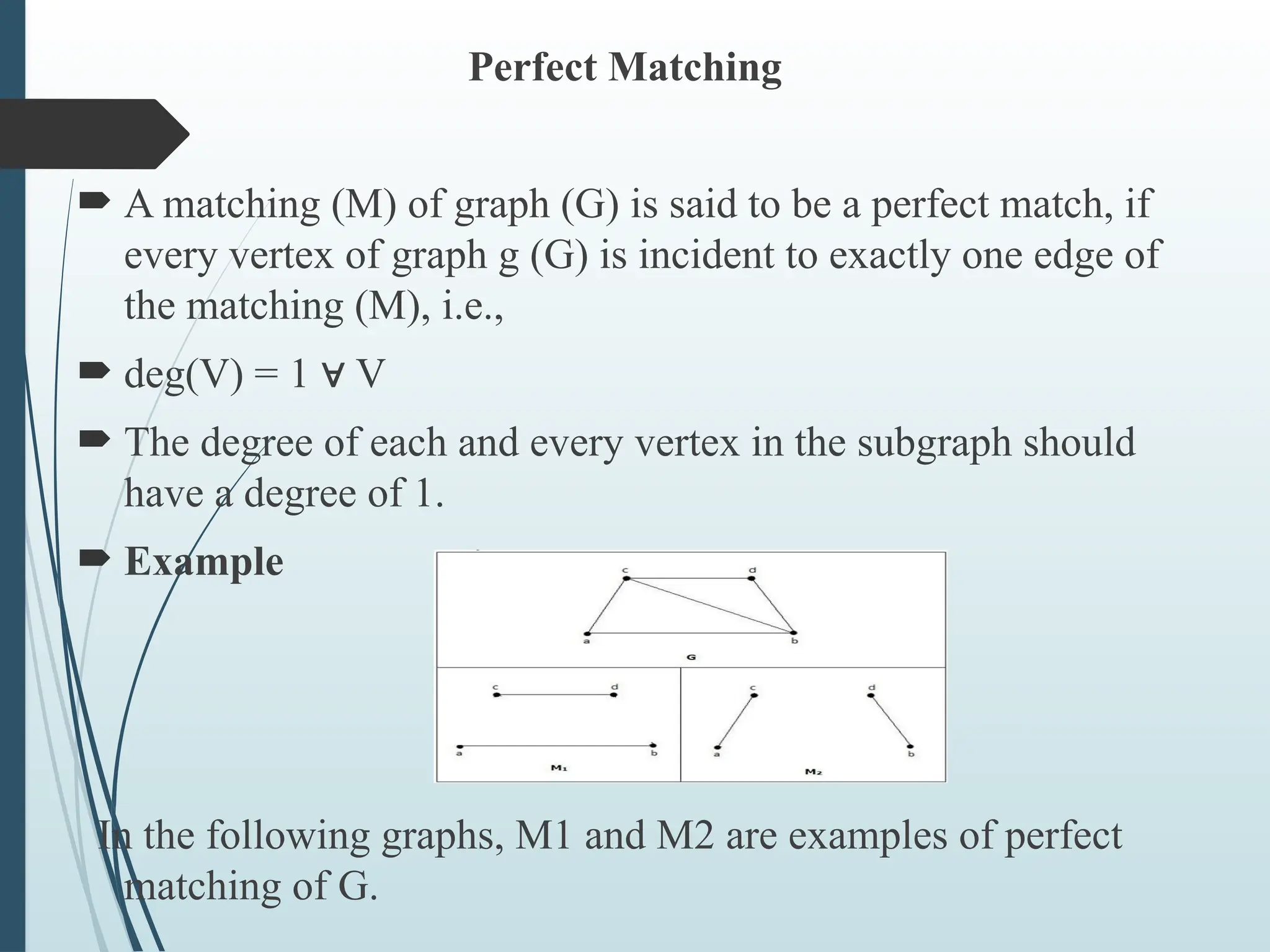
 A matching (M) of graph (G) is said to be a perfect match, if
every vertex of graph g (G) is incident to exactly one edge of
the matching (M), i.e.,
 deg(V) = 1 V
∀
 The degree of each and every vertex in the subgraph should
have a degree of 1.
 Example
In the following graphs, M1 and M2 are examples of perfect
matching of G.
Independent Line Set
 Let ‘G’ = (V, E) be a graph. A subset L of E is called
an independent line set of ‘G’ if no two edges in L
are adjacent. Such a set is called an independent line
set.
 Example
 Let us consider the following subsets −
Maximal Independent Line Set
 An independent line set is said to be the maximal independent line set of a graph
‘G’ if no other edge of ‘G’ can be added to ‘L’.
 Example
Maximum Independent Line Set
 A maximum independent line set of ‘G’ with maximum number of edges is called a
maximum independent line set of ‘G’.
Independent Vertex Set
 Let ‘G’ = (V, E) be a graph. A subset of ‘V’ is called an independent set of ‘G’ if no
two vertices in ‘S’ are adjacent.
Maximum Independent Vertex Set
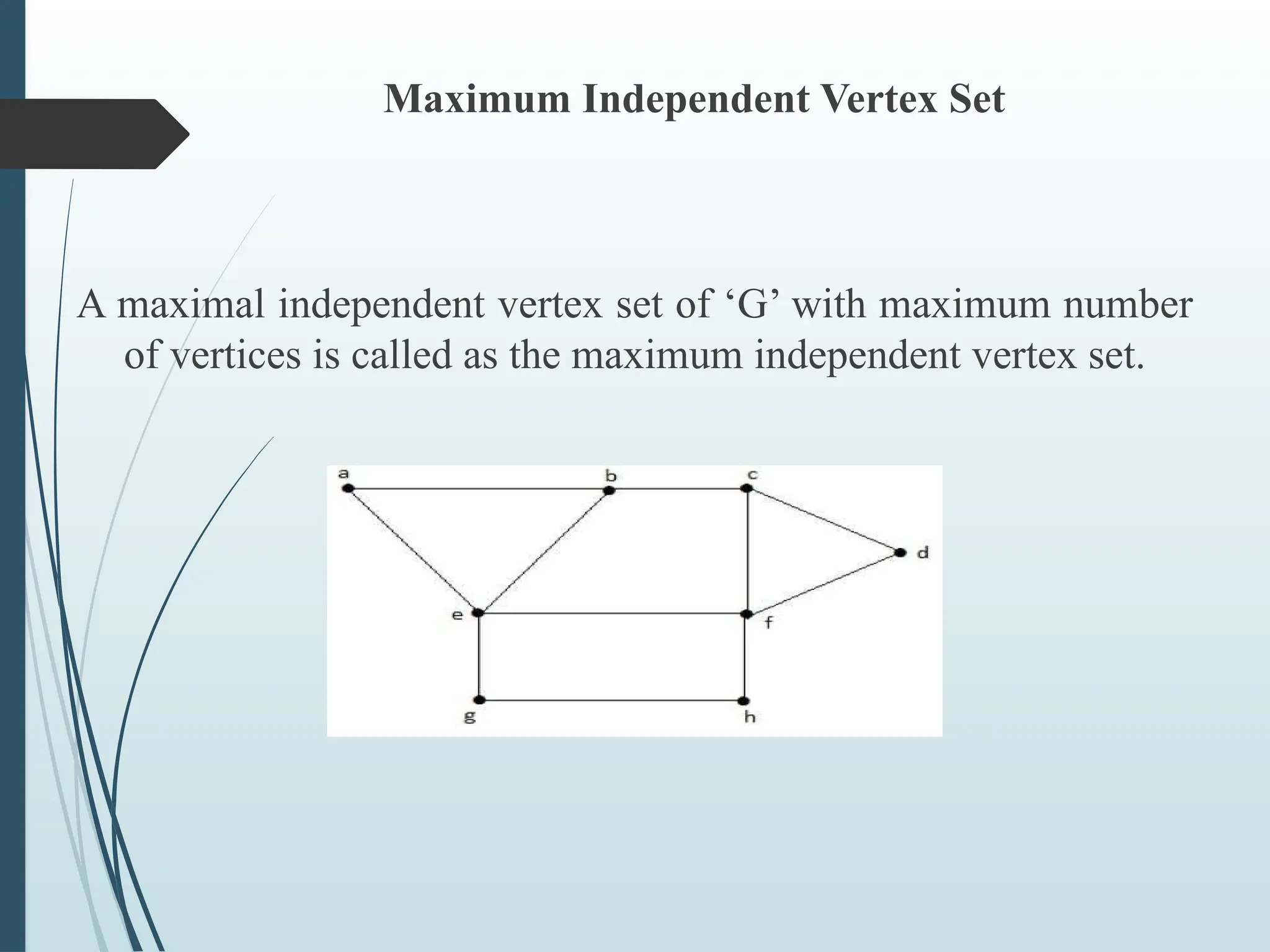
A maximal independent vertex set of ‘G’ with maximum number
of vertices is called as the maximum independent vertex set.
Vertex Coloring
 Vertex coloring is an assignment of colors to the vertices of a graph ‘G’ such
that no two adjacent vertices have the same color. Simply put, no two vertices
of an edge should be of the same color.
Chromatic Number
 The minimum number of colors required for vertex coloring of graph ‘G’ is
called as the chromatic number of G, denoted by X(G).
 χ(G) = 1 if and only if 'G' is a null graph. If 'G' is not a null graph, then χ(G) ≥
2.
 Example
 Note − A graph ‘G’ is said to be n-coverable if there is a vertex coloring that
uses at most n colors, i.e., X(G) ≤ n.
Region Coloring
 Region coloring is an assignment of colors to the regions of a planar graph
such that no two adjacent regions have the same color. Two regions are
said to be adjacent if they have a common edge.
 Example
 Take a look at the following graph. The regions ‘aeb’ and ‘befc’ are
adjacent, as there is a common edge ‘be’ between those two regions.
Applications of Graph Coloring
 Graph coloring is one of the most important concepts in
graph theory. It is used in many real-time applications
of computer science such as −
 Clustering
 Data mining
 Image capturing
 Image segmentation
 Networking
 Resource allocation
 Processes scheduling
Planar Graph
 A graph is said to be planar if it can be drawn in a plane so
that no edge cross.
 Example: The graph shown in fig is planar graph.
Properties of Planar Graphs
 If a connected planar graph G has e edges and r regions, then r ≤e.
 If a connected planar graph G has e edges, v vertices, and r
regions, then v-e+r=2.
 If a connected planar graph G has e edges and v vertices, then 3v-
e≥6.
 A complete graph Kn is a planar if and only if n<5.
 A complete bipartite graph Kmn is planar if and only if m<3 or
n>3.
 Example: Prove that complete graph K4 is planar.
Non-Planar Graph
 A graph is said to be non planar if it cannot be drawn in a
plane so that no edge cross.
 Example: The graphs shown in fig are non planar graphs.
 These graphs cannot be drawn in a plane so that no edges
cross hence they are non-planar graphs.
Properties of Non-Planar Graphs
 A graph is non-planar if and only if it contains a subgraph
homeomorphic to K5 or K3,3
THANK
YOU

GRAPH THEORY AND ITS APPLICATIONS.......

  • 1.
    GRAPH THEORY Ms.E.Niraimathi Assistant professor Departmentof mathematics, Sri Sarada Niketan College of Science for Women,Karur
  • 2.
    GRAPH  A graphG = (V, E) consists of a set of objects V = (v1, v2,…) called vertices and another set E = (e1, e2,…) whose elements are called edges, which that each edge ek is identified with an unordered pair (vi, vj) of vertices. Example:  V = (v1, v2, v3, v4, v5)  E = (e1, e2, e3, e4, e5, e6, e7)
  • 3.
    SOME TYPES OFGRAPH SELF LOOP:  An Edge having the same vertex as both its end vertices is called self loop. Example: In this figure, e1 is a self loop.
  • 4.
    Parallel Edges:  Morethan one edges associated with a given pair of vertices is called parallel. Degree of Graph:  This number of edges incident on a vertex, vi, with self loops counted twice, is called the degree, d (vi), of vertex vi. Example: d(v1) = d(v3) = d(v4) = 3 d(v2) = 4 d (v5)=1
  • 5.
    Null graph  Agraph without any edges is called a null graph Example :  Null graph of six vertices
  • 6.
    Simple Graph: A graphthat has neither self loop nor parallel edges is called a simple graph. Connected Graph: A graph G is said to be connected, if there is at least one path between ever pair of vertices. Disconnected Graph: A graph can be split into an independent components. Then it is called as disconnected graph.
  • 7.
    Complete graph:  Asimple graph in which there exists an edge between every pair of vertices is called a complete graph. Example:  Complete graphs of two, three, four and five vertices.
  • 8.
    Theorem: The sum ofthe degrees of the vertices of a graph is equal to twice the number of its edges. Proof: If e=uv is an edges of G, e is counted once while counting the degree of each of u and v(even when u=v).Hence, each edge contributes 2 to the sum of the degree of the vertices .Thus , the m edges of G contribute 2m to the degree sum.
  • 9.
    Directed graph:  Agraph which have directions is called directed graph. Undirected graph:  A graph which have no directions is called undirected graph.
  • 10.
    REGULAR GRAPH:  Agraph in which all vertices are of equal degree is called a regular graph. Example:
  • 11.
    WALK:  A walkis defines as a finite alternating sequence of vertices and edges, beginning and ending with vertices, such that each is indicient with the vertices preceding and following it. No edge appears (is covered or traversed) more than once is a walk. A vertex, however, may appear more than once. Example  An open walk. In this figure for instance, v1av2bv3dv4fv51 is a walk show with heavy lines.
  • 13.
    OPEN WALK ANDCLOSED WALK: It is possible for a walk to begin and end at the same vertex. Such a walk u is called a closed walk. A walk that is not closed. (i.e., the terminal vertices are distinct) is called an open walk. LENGTH OF A PATH:  An open walk in which no vertex appears more than once is called a path. The number of edges in path is called the length of a path. Example: A path of length three
  • 14.
    APPLICATION OF GRAPHTHEORY  Electrical engineering  Automation engineering  Computer science  Computer network
  • 15.
    Tree  A connectedacyclic graph is called a tree. In other words, a connected graph with no cycles is called a tree.  The edges of a tree are known as branches. Elements of trees are called their nodes. The nodes without child nodes are called leaf nodes.  A tree with ‘n’ vertices has ‘n-1’ edges. If it has one more edge extra than ‘n-1’, then the extra edge should obviously has to pair up with two vertices which leads to form a cycle. Then, it becomes a cyclic graph which is a violation for the tree graph.  Example 1 The graph shown here is a tree because it has no cycles and it is connected. It has four vertices and three edges, i.e., for ‘n’ vertices ‘n-1’ edges as mentioned in the definition.  Note − Every tree has at least two vertices of degree one.
  • 16.
    Forest  A disconnectedacyclic graph is called a forest. In other words, a disjoint collection of trees is called a forest.  Example The following graph looks like two sub-graphs; but it is a single disconnected graph. There are no cycles in this graph. Hence, clearly it is a forest.
  • 17.
    Spanning Trees Let Gbe a connected graph, then the sub-graph H of G is called a spanning tree of G if −H is a treeH contains all vertices of G.A spanning tree T of an undirected graph G is a subgraph that includes all of the vertices of G.  Example In the above example, G is a connected graph and H is a sub-graph of G. Clearly, the graph H has no cycles, it is a tree with six edges which is one less than the total number of vertices. Hence H is the Spanning tree of G.
  • 18.
    Connectivity  A graphis said to be connected if there is a path between every pair of vertex. From every vertex to any other vertex, there should be some path to traverse. That is called the connectivity of a graph. A graph with multiple disconnected vertices and edges is said to be disconnected.  Example 1 In the following graph, it is possible to travel from one vertex to any other vertex. For example, one can traverse from vertex ‘a’ to vertex ‘e’ using the path ‘a-b-e’.
  • 19.
    Cut Vertex  Let‘G’ be a connected graph. A vertex V G is called a ∈ cut vertex of ‘G’, if ‘G-V’ (Delete ‘V’ from ‘G’) results in a disconnected graph. Removing a cut vertex from a graph breaks it in to two or more graphs.  Note − Removing a cut vertex may render a graph disconnected.  A connected graph ‘G’ may have at most (n–2) cut vertices.  Example In the following graph, vertices ‘e’ and ‘c’ are the cut vertices.
  • 20.
    Matching  Let ‘G’= (V, E) be a graph. A subgraph is called a matching M(G), if each vertex of G is incident with at most one edge in M, i.e.,  deg(V) ≤ 1 V G ∀ ∈  which means in the matching graph M(G), the vertices should have a degree of 1 or 0, where the edges should be incident from the graph G.  Notation − M(G)
  • 21.
    Maximal Matching  Amatching M of graph ‘G’ is said to maximal if no other edges of ‘G’ can be added to M.  Example M1, M2, M3 from the above graph are the maximal matching of G. Maximum Matching  It is also known as largest maximal matching. Maximum matching is defined as the maximal matching with maximum number of edges.  The number of edges in the maximum matching of ‘G’ is called its matching number.
  • 22.
     Example For agraph given in the above example, M1 and M2 are the maximum matching of ‘G’ and its matching number is 2. Hence by using the graph G, we can form only the subgraphs with only 2 edges maximum. Hence we have the matching number as two.
  • 23.
    Perfect Matching  Amatching (M) of graph (G) is said to be a perfect match, if every vertex of graph g (G) is incident to exactly one edge of the matching (M), i.e.,  deg(V) = 1 V ∀  The degree of each and every vertex in the subgraph should have a degree of 1.  Example In the following graphs, M1 and M2 are examples of perfect matching of G.
  • 24.
    Independent Line Set Let ‘G’ = (V, E) be a graph. A subset L of E is called an independent line set of ‘G’ if no two edges in L are adjacent. Such a set is called an independent line set.  Example  Let us consider the following subsets −
  • 25.
    Maximal Independent LineSet  An independent line set is said to be the maximal independent line set of a graph ‘G’ if no other edge of ‘G’ can be added to ‘L’.  Example Maximum Independent Line Set  A maximum independent line set of ‘G’ with maximum number of edges is called a maximum independent line set of ‘G’. Independent Vertex Set  Let ‘G’ = (V, E) be a graph. A subset of ‘V’ is called an independent set of ‘G’ if no two vertices in ‘S’ are adjacent.
  • 26.
    Maximum Independent VertexSet A maximal independent vertex set of ‘G’ with maximum number of vertices is called as the maximum independent vertex set.
  • 27.
    Vertex Coloring  Vertexcoloring is an assignment of colors to the vertices of a graph ‘G’ such that no two adjacent vertices have the same color. Simply put, no two vertices of an edge should be of the same color. Chromatic Number  The minimum number of colors required for vertex coloring of graph ‘G’ is called as the chromatic number of G, denoted by X(G).  χ(G) = 1 if and only if 'G' is a null graph. If 'G' is not a null graph, then χ(G) ≥ 2.  Example  Note − A graph ‘G’ is said to be n-coverable if there is a vertex coloring that uses at most n colors, i.e., X(G) ≤ n.
  • 28.
    Region Coloring  Regioncoloring is an assignment of colors to the regions of a planar graph such that no two adjacent regions have the same color. Two regions are said to be adjacent if they have a common edge.  Example  Take a look at the following graph. The regions ‘aeb’ and ‘befc’ are adjacent, as there is a common edge ‘be’ between those two regions.
  • 29.
    Applications of GraphColoring  Graph coloring is one of the most important concepts in graph theory. It is used in many real-time applications of computer science such as −  Clustering  Data mining  Image capturing  Image segmentation  Networking  Resource allocation  Processes scheduling
  • 30.
    Planar Graph  Agraph is said to be planar if it can be drawn in a plane so that no edge cross.  Example: The graph shown in fig is planar graph.
  • 31.
    Properties of PlanarGraphs  If a connected planar graph G has e edges and r regions, then r ≤e.  If a connected planar graph G has e edges, v vertices, and r regions, then v-e+r=2.  If a connected planar graph G has e edges and v vertices, then 3v- e≥6.  A complete graph Kn is a planar if and only if n<5.  A complete bipartite graph Kmn is planar if and only if m<3 or n>3.  Example: Prove that complete graph K4 is planar.
  • 32.
    Non-Planar Graph  Agraph is said to be non planar if it cannot be drawn in a plane so that no edge cross.  Example: The graphs shown in fig are non planar graphs.  These graphs cannot be drawn in a plane so that no edges cross hence they are non-planar graphs.
  • 33.
    Properties of Non-PlanarGraphs  A graph is non-planar if and only if it contains a subgraph homeomorphic to K5 or K3,3
  • 34.