Connecting Linear and
Angular Quantities in
Human Movement
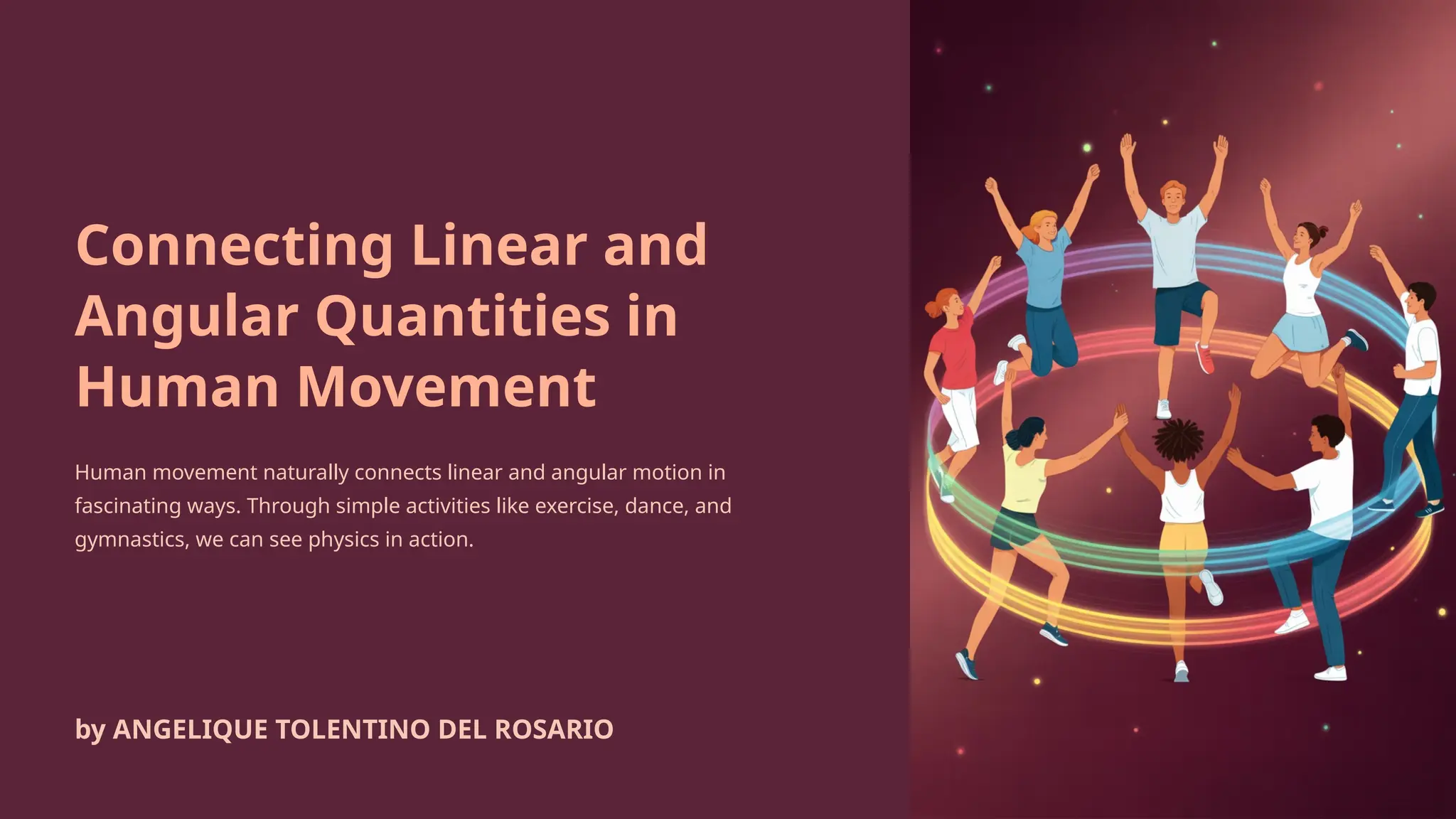
Human movement naturally connects linear and angular motion in
fascinating ways. Through simple activities like exercise, dance, and
gymnastics, we can see physics in action.
by ANGELIQUE TOLENTINO DEL ROSARIO
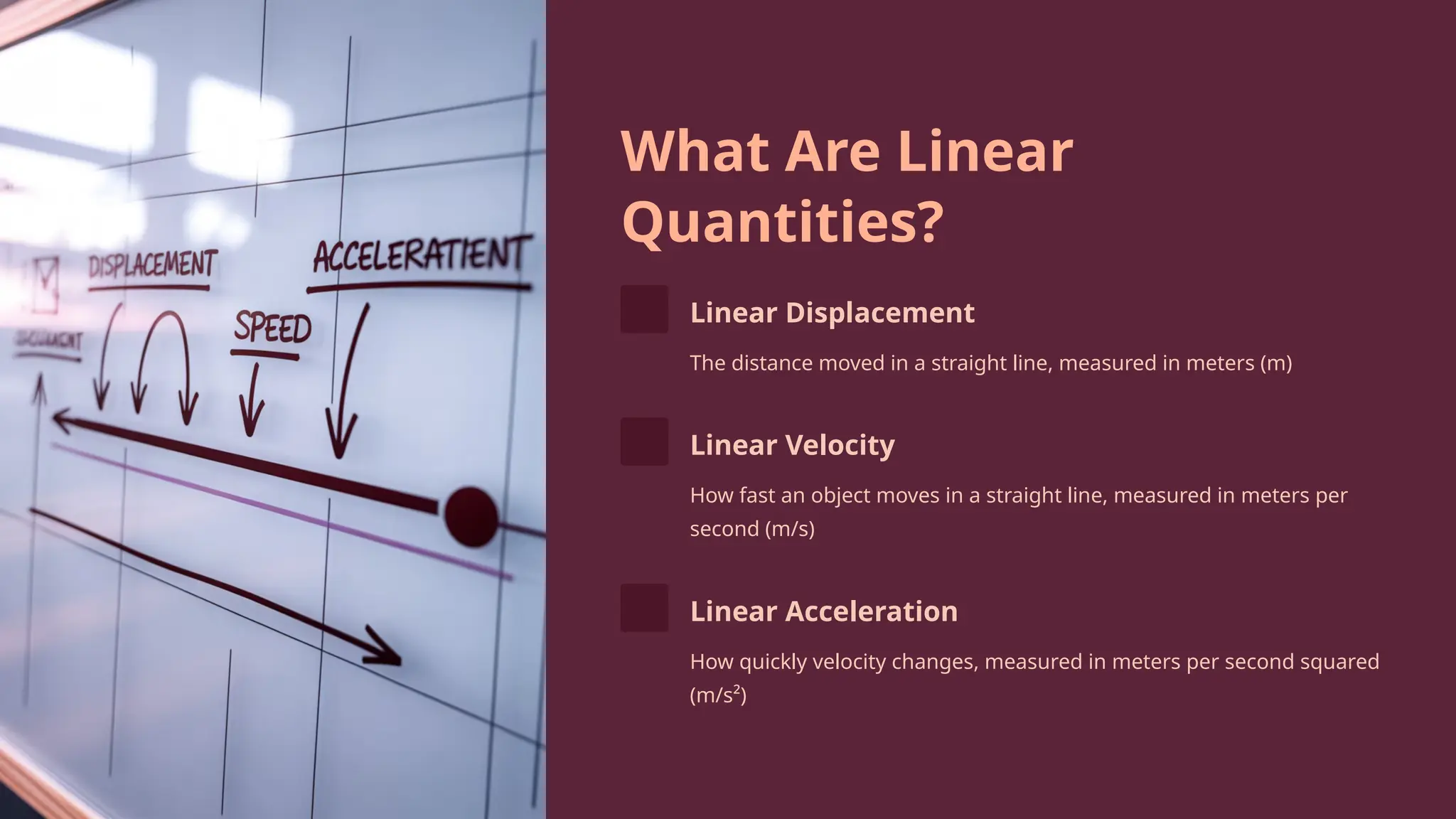
What Are Linear
Quantities?
Linear Displacement
The distance moved in a straight line, measured in meters (m)
Linear Velocity
How fast an object moves in a straight line, measured in meters per
second (m/s)
Linear Acceleration
How quickly velocity changes, measured in meters per second squared
(m/s²)
What Are Angular Quantities?
Angular Displacement (θ)
The angle through which an object
rotates, measured in radians
Angular Velocity (ω)
How quickly an object rotates,
measured in radians per second (rad/s)
Angular Acceleration (α)
Rate of change of angular velocity, in
radians per second squared (rad/s²)
How Are They Related?
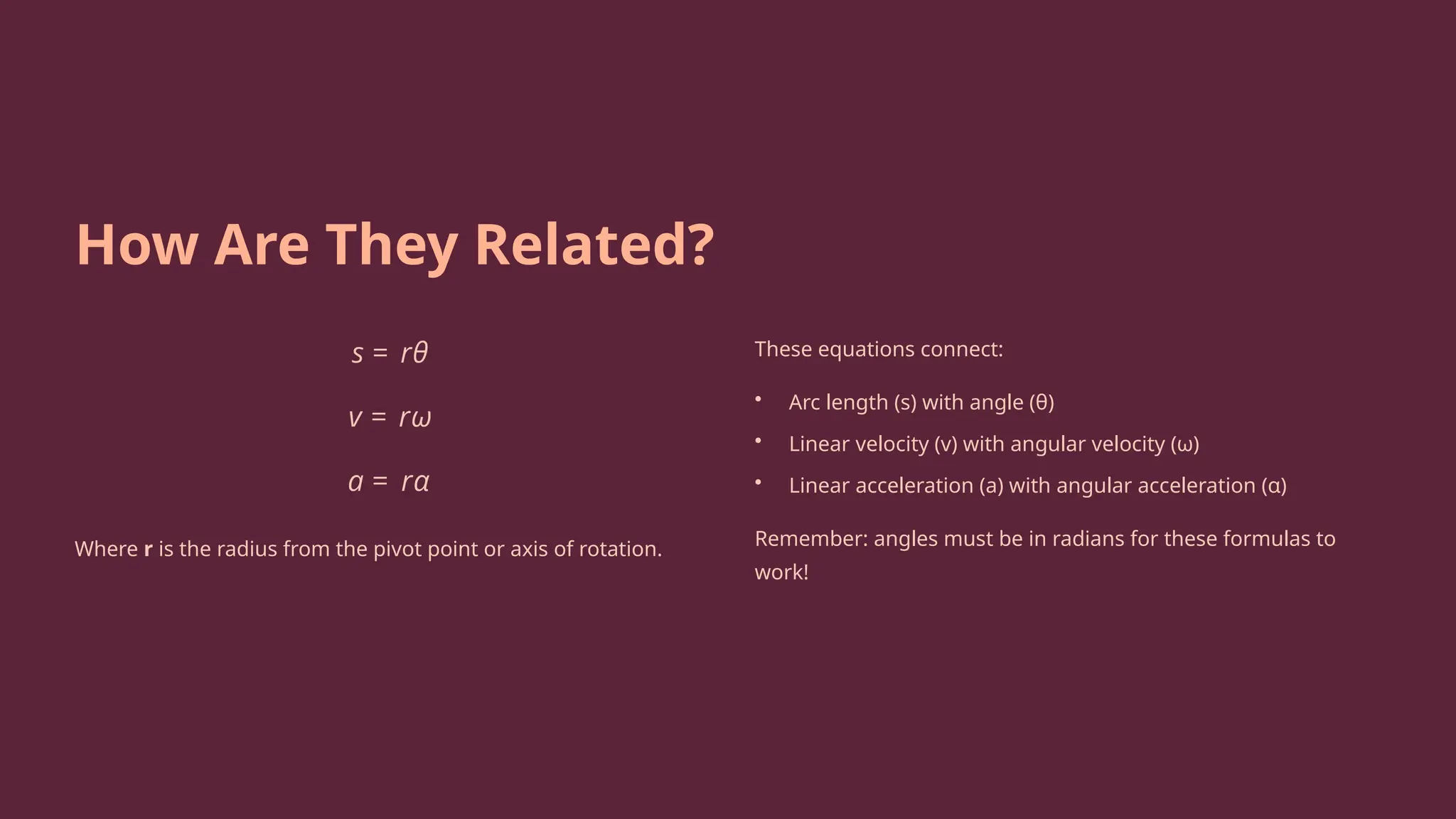
Where r is the radius from the pivot point or axis of rotation.
These equations connect:
• Arc length (s) with angle (θ)
• Linear velocity (v) with angular velocity (ω)
• Linear acceleration (a) with angular acceleration (α)
Remember: angles must be in radians for these formulas to
work!
Visualizing the Circle: The Radian
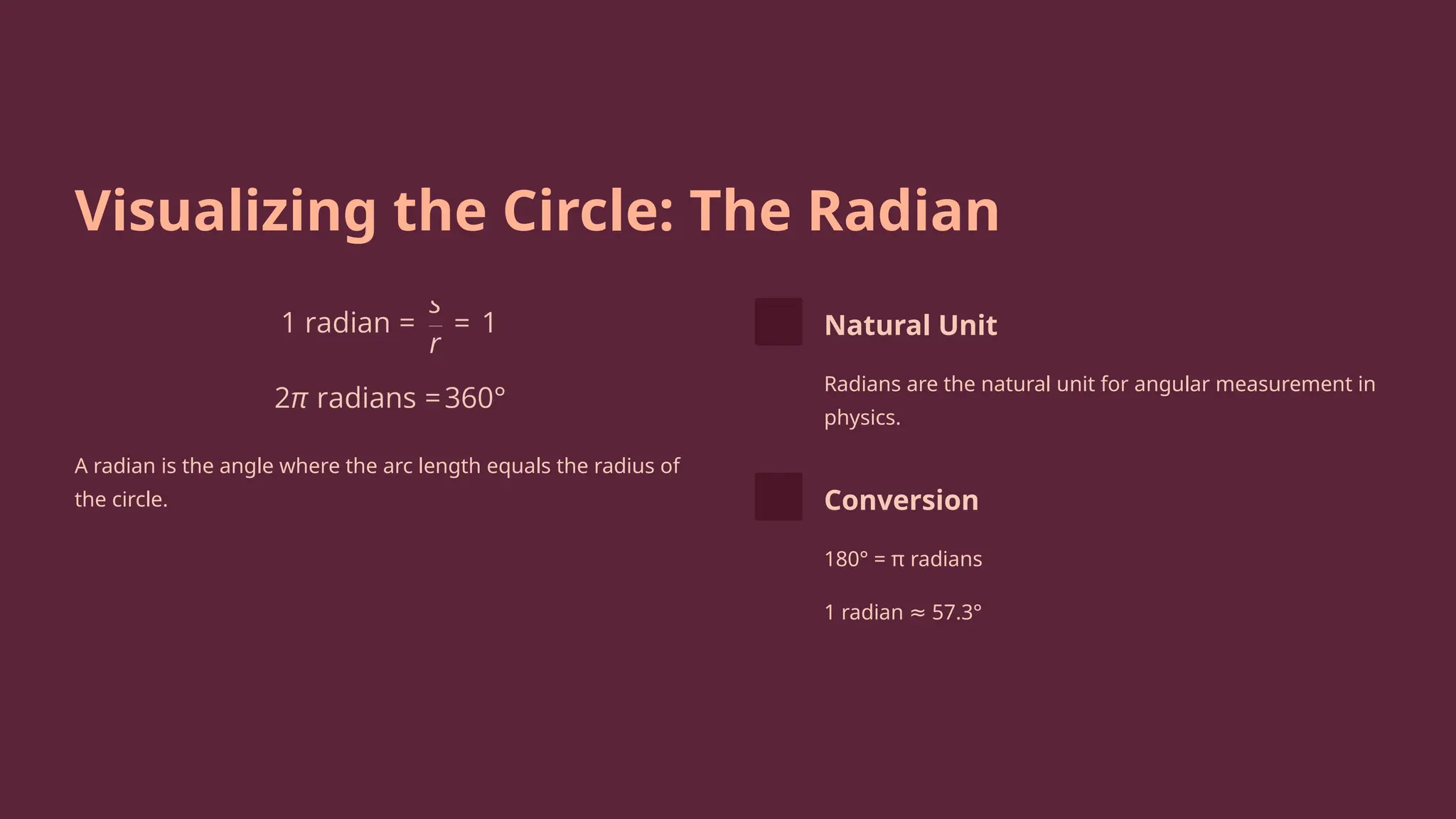
A radian is the angle where the arc length equals the radius of
the circle.
Natural Unit
Radians are the natural unit for angular measurement in
physics.
Conversion
180° = π radians
1 radian 57.3°
≈
Example: Rotating Arm While Standing
The Physics
When your arm swings through angle θ, your hand travels
along an arc.
Where r = length from shoulder to hand (typically 0.6-0.7m for
adults).
Shoulder Rotates
Joint creates angular motion (θ)
Arm Acts as Radius
Distance from joint to hand (r)
Hand Travels Distance
Linear distance along arc (s)
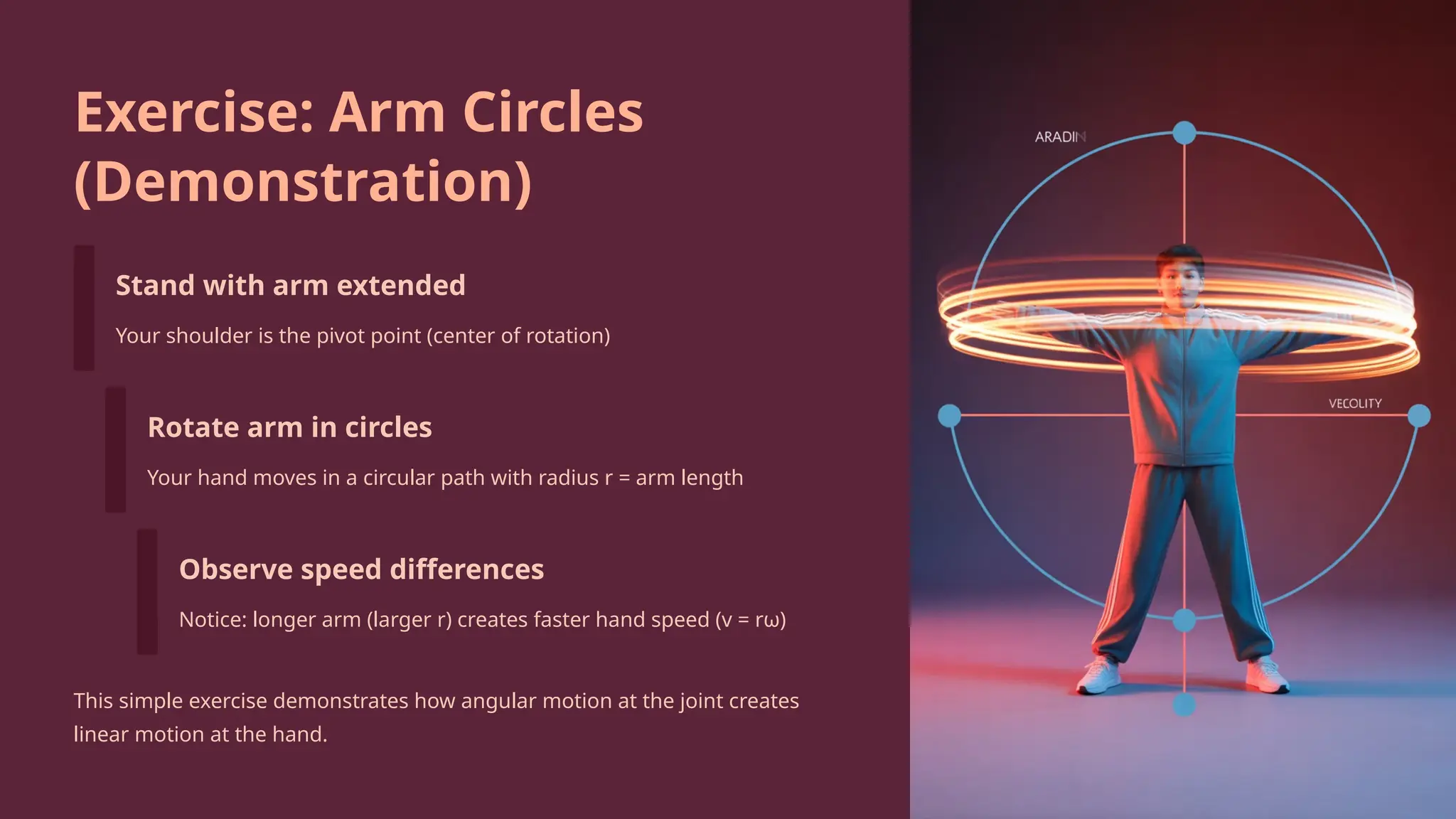
Exercise: Arm Circles
(Demonstration)
Stand with arm extended
Your shoulder is the pivot point (center of rotation)
Rotate arm in circles
Your hand moves in a circular path with radius r = arm length
Observe speed differences
Notice: longer arm (larger r) creates faster hand speed (v = rω)
This simple exercise demonstrates how angular motion at the joint creates
linear motion at the hand.
Linear and Angular Velocity: Arm Example
Example Calculation
If shoulder rotates at angular velocity ω = 1 rad/s:
Shoulder
Angular velocity (ω) = 1 rad/s
Linear velocity 0 m/s (at axis of rotation)
≈
Elbow
r 0.3 m from shoulder
≈
v = 0.3 m/s
Hand
r 0.7 m from shoulder
≈
v = 0.7 m/s
Gymnastics: Somersaults
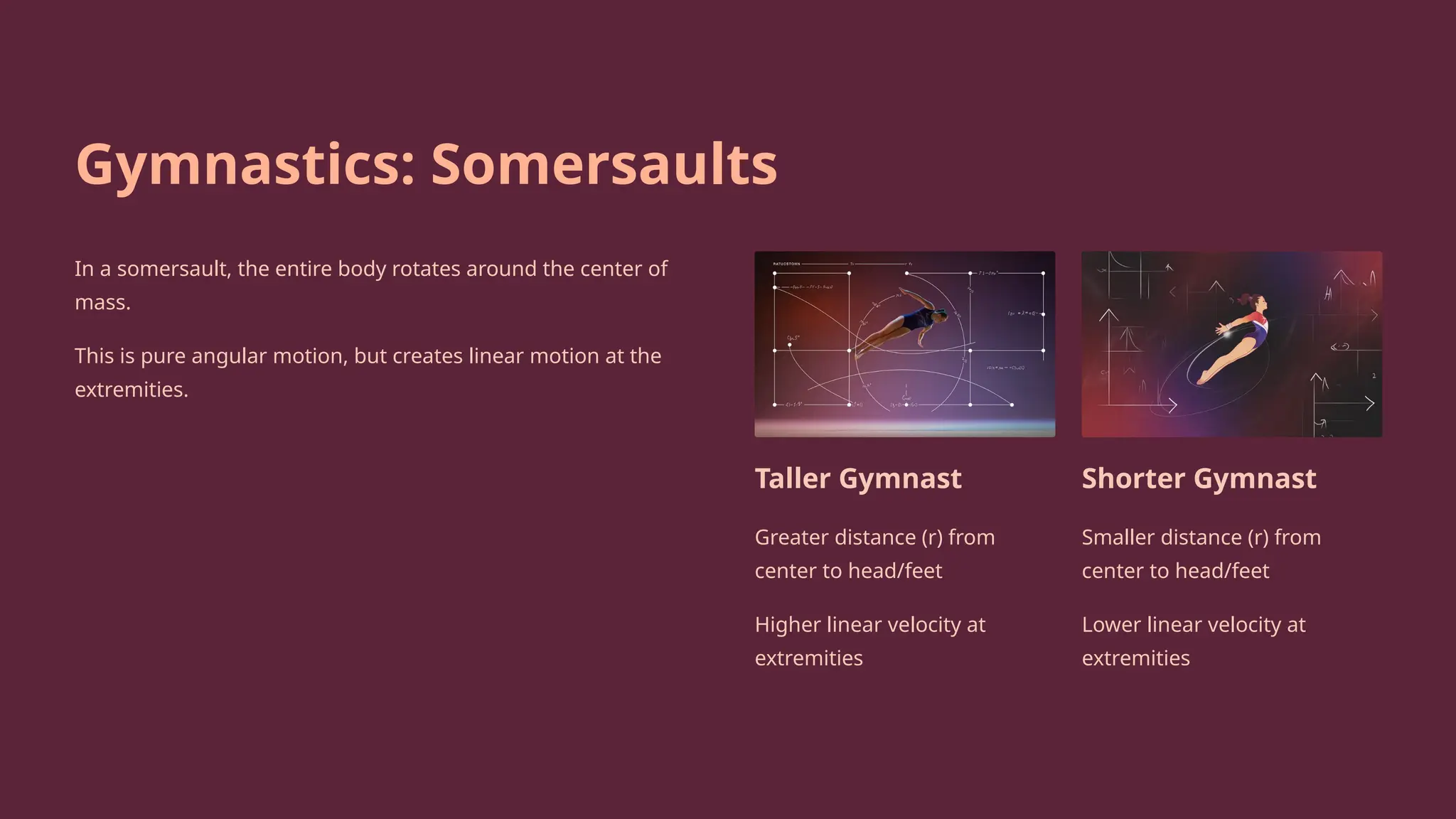
In a somersault, the entire body rotates around the center of
mass.
This is pure angular motion, but creates linear motion at the
extremities.
Taller Gymnast
Greater distance (r) from
center to head/feet
Higher linear velocity at
extremities
Shorter Gymnast
Smaller distance (r) from
center to head/feet
Lower linear velocity at
extremities
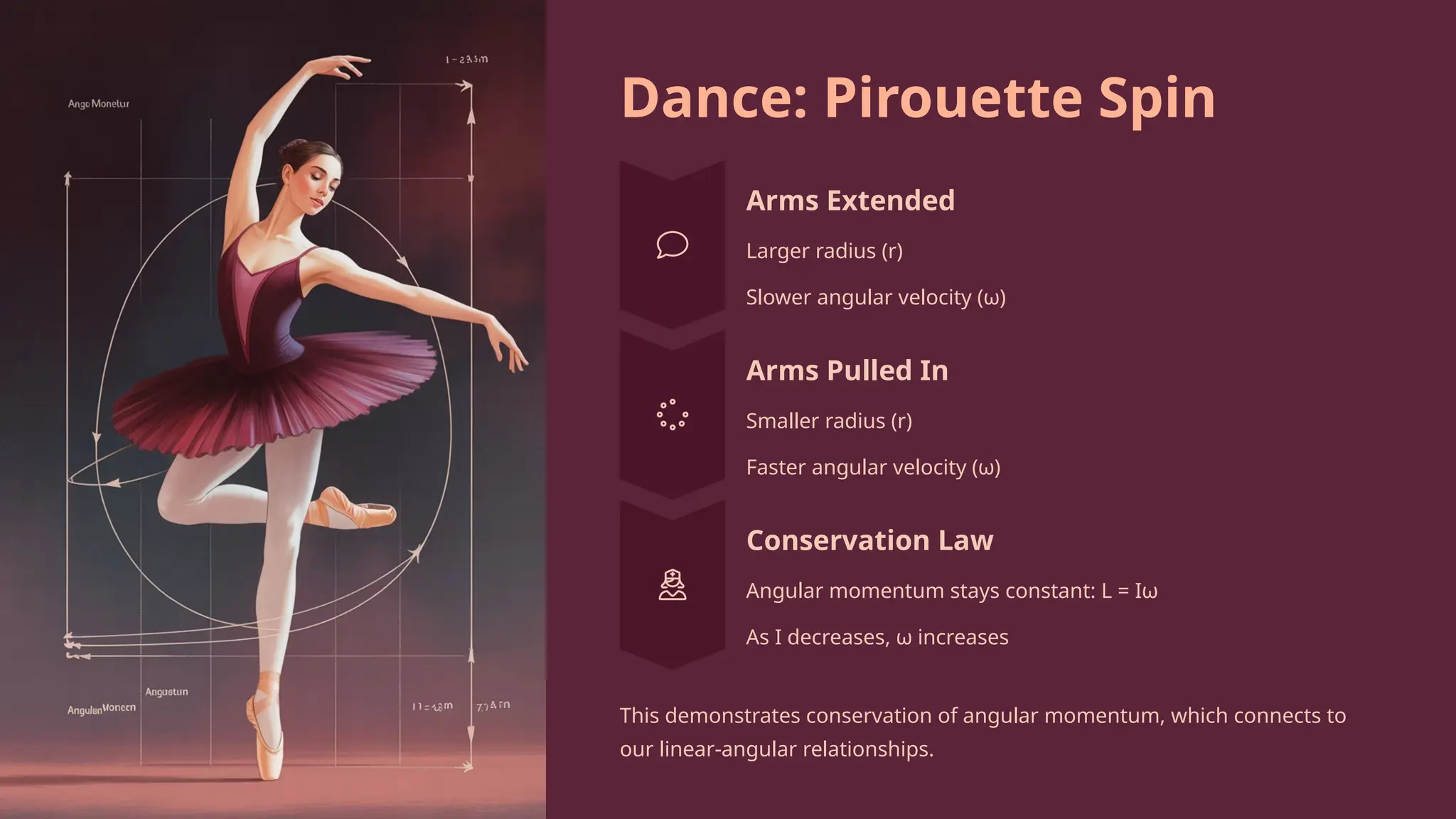
Dance: Pirouette Spin
Arms Extended
Larger radius (r)
Slower angular velocity (ω)
Arms Pulled In
Smaller radius (r)
Faster angular velocity (ω)
Conservation Law
Angular momentum stays constant: L = Iω
As I decreases, ω increases
This demonstrates conservation of angular momentum, which connects to
our linear-angular relationships.
Linking Concepts with a Hula Hoop
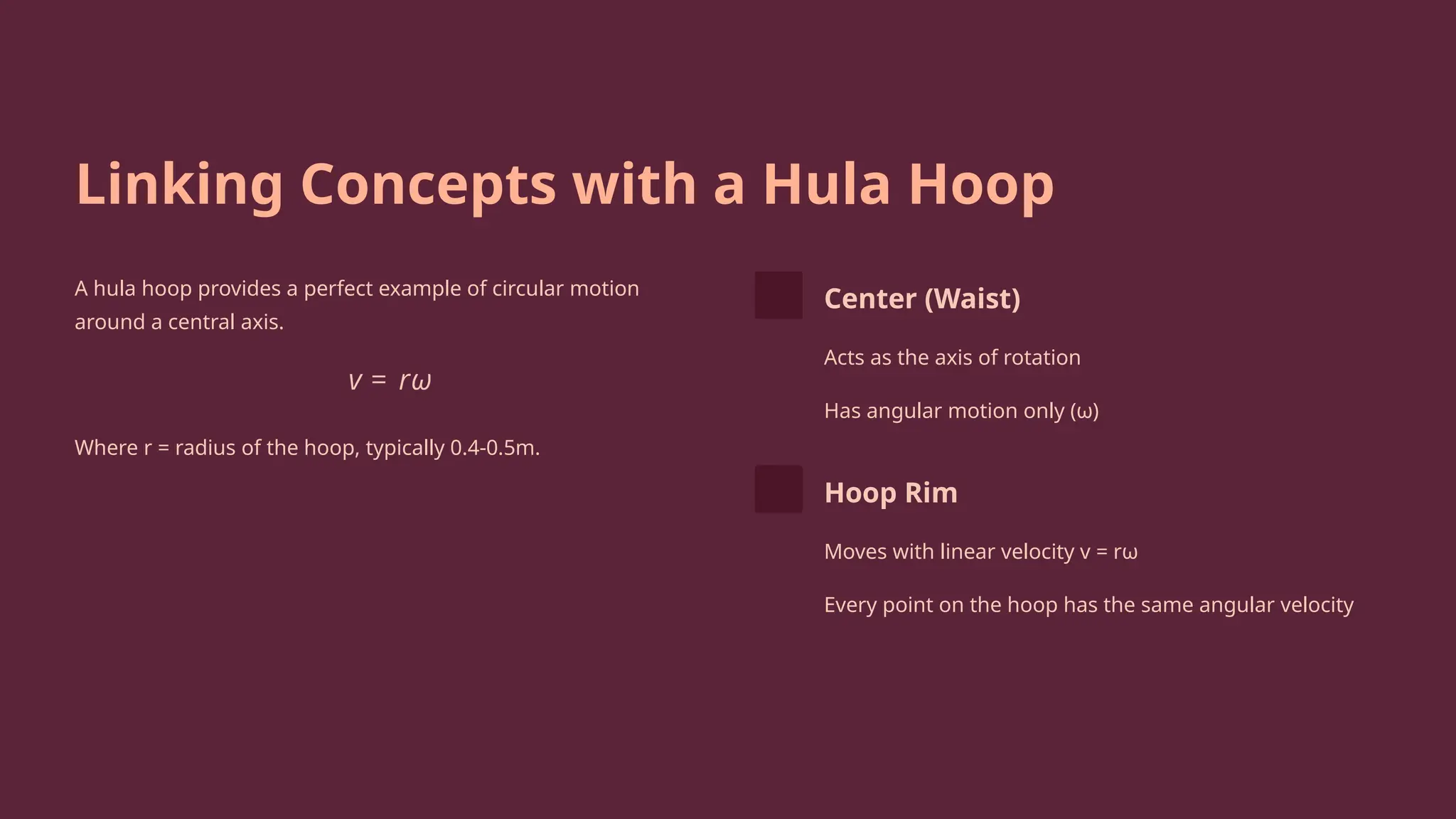
A hula hoop provides a perfect example of circular motion
around a central axis.
Where r = radius of the hoop, typically 0.4-0.5m.
Center (Waist)
Acts as the axis of rotation
Has angular motion only (ω)
Hoop Rim
Moves with linear velocity v = rω
Every point on the hoop has the same angular velocity
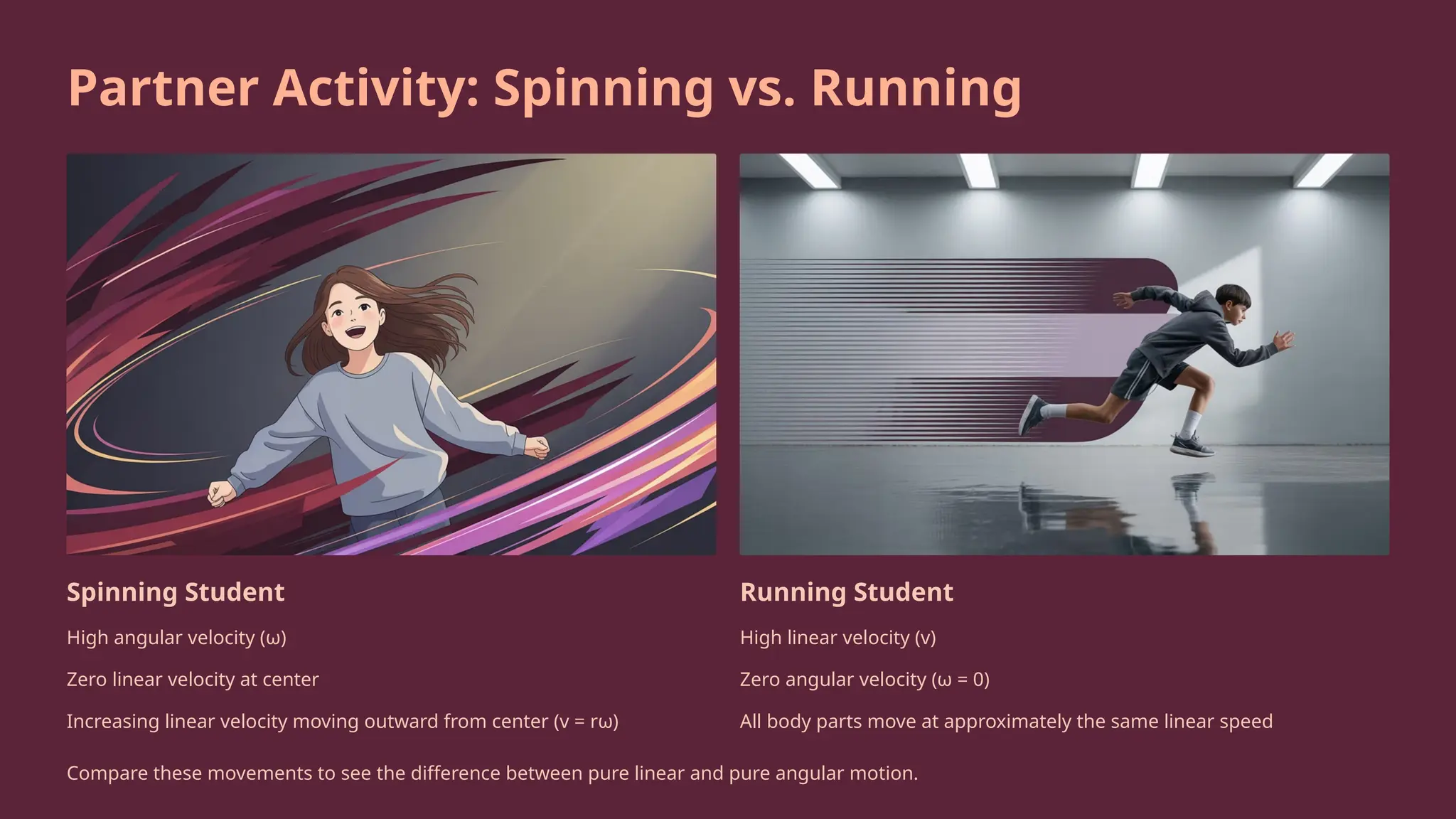
Partner Activity: Spinning vs. Running
Spinning Student
High angular velocity (ω)
Zero linear velocity at center
Increasing linear velocity moving outward from center (v = rω)
Running Student
High linear velocity (v)
Zero angular velocity (ω = 0)
All body parts move at approximately the same linear speed
Compare these movements to see the difference between pure linear and pure angular motion.
Jumping Jacks: Hands' Paths
The Motion
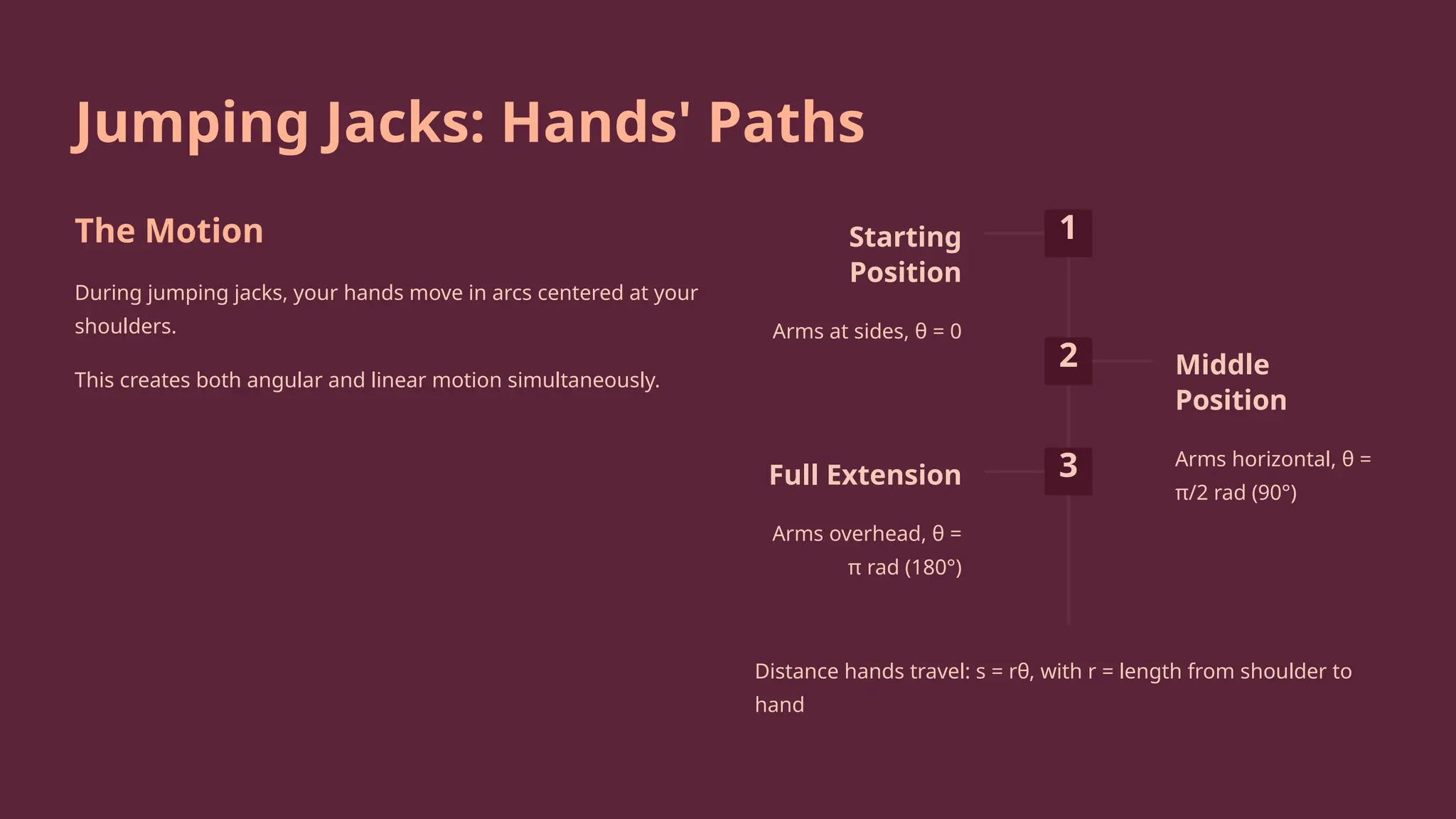
During jumping jacks, your hands move in arcs centered at your
shoulders.
This creates both angular and linear motion simultaneously.
1
Starting
Position
Arms at sides, θ = 0
2 Middle
Position
Arms horizontal, θ =
π/2 rad (90°)
3
Full Extension
Arms overhead, θ =
π rad (180°)
Distance hands travel: s = rθ, with r = length from shoulder to
hand
Measuring Angular
Displacement: Smartphone
Demo
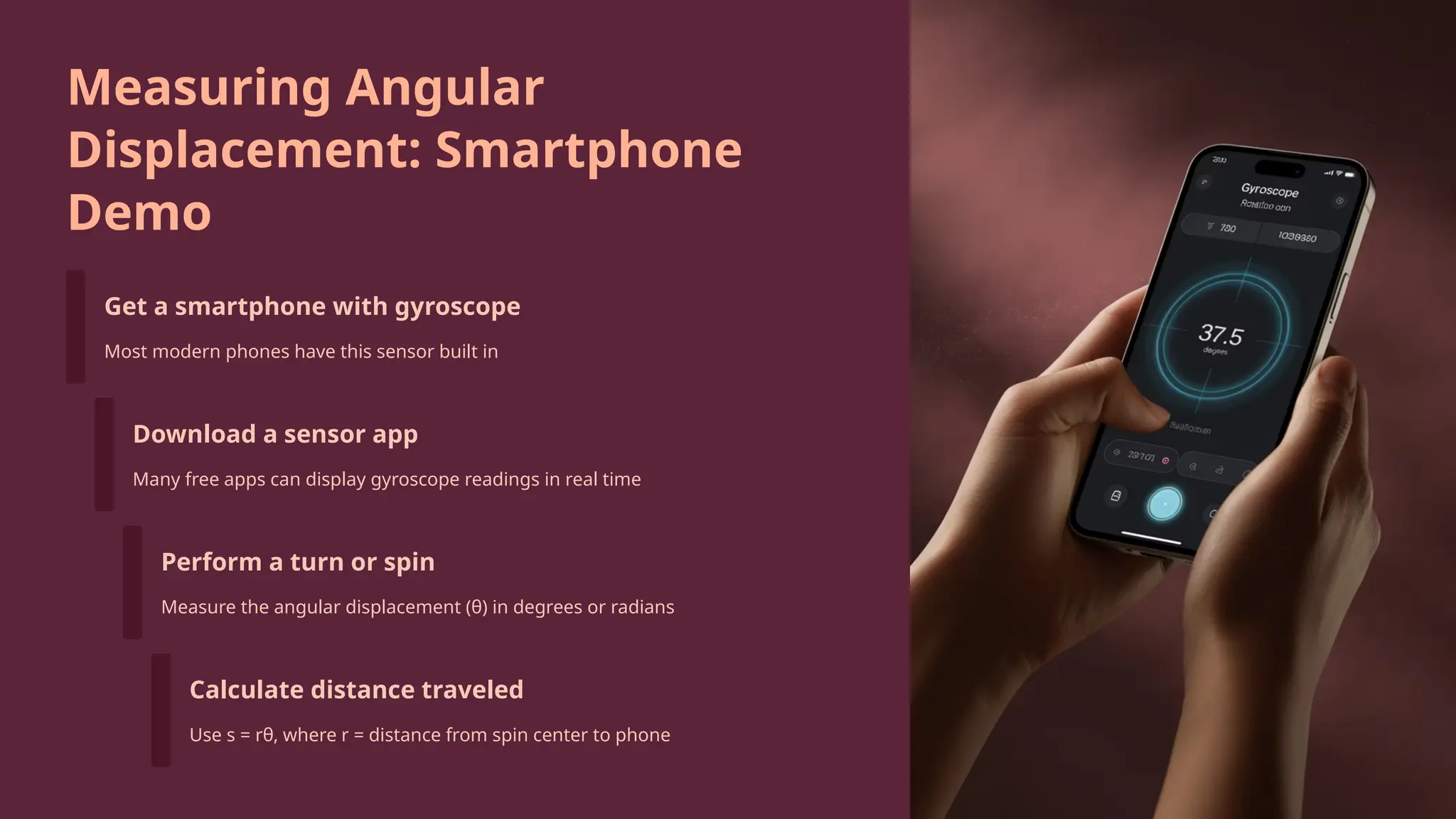
Get a smartphone with gyroscope
Most modern phones have this sensor built in
Download a sensor app
Many free apps can display gyroscope readings in real time
Perform a turn or spin
Measure the angular displacement (θ) in degrees or radians
Calculate distance traveled
Use s = rθ, where r = distance from spin center to phone
Cartwheel Example: Full Body Rotation
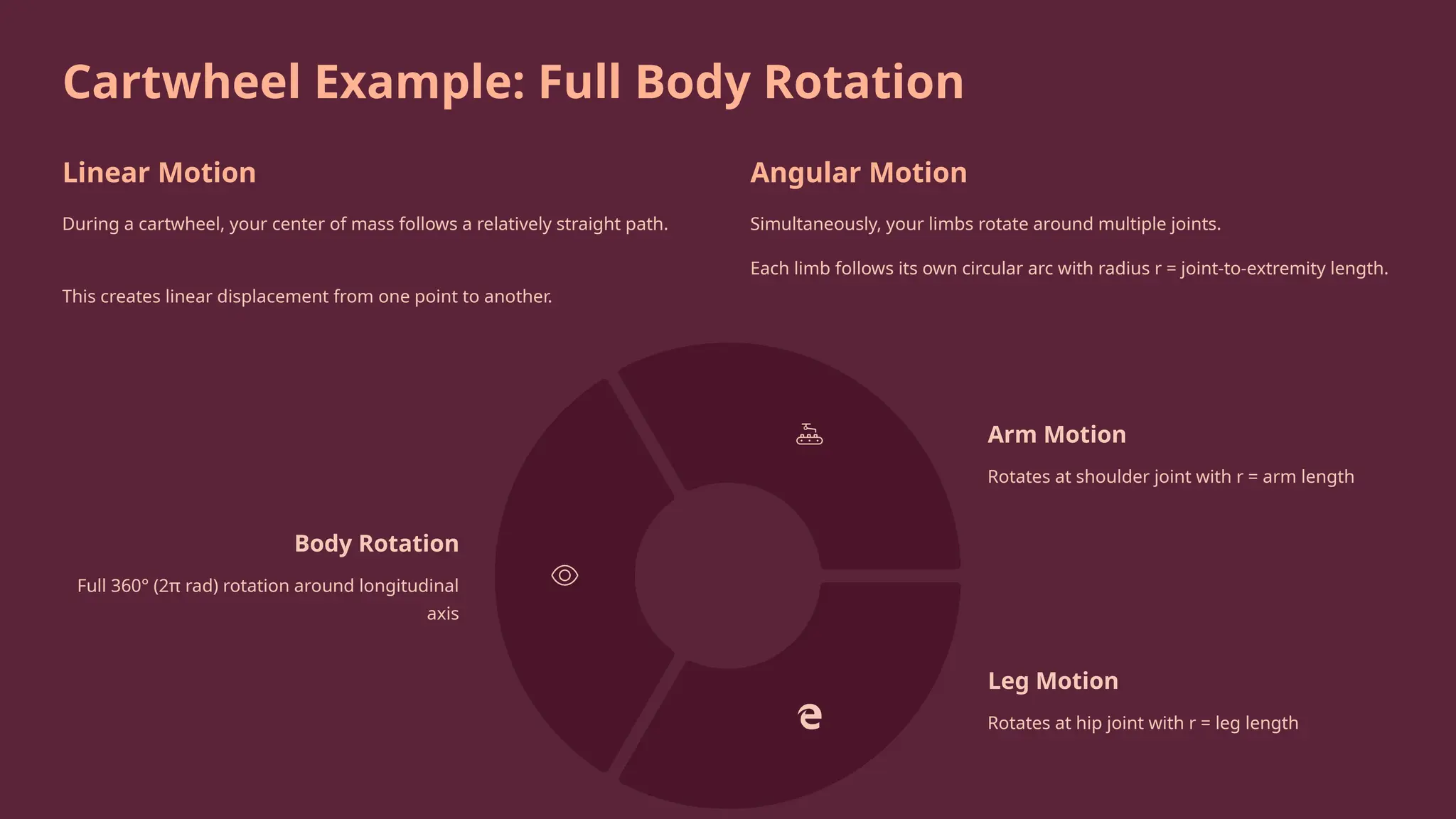
Linear Motion
During a cartwheel, your center of mass follows a relatively straight path.
This creates linear displacement from one point to another.
Angular Motion
Simultaneously, your limbs rotate around multiple joints.
Each limb follows its own circular arc with radius r = joint-to-extremity length.
Body Rotation
Full 360° (2π rad) rotation around longitudinal
axis
Arm Motion
Rotates at shoulder joint with r = arm length
Leg Motion
Rotates at hip joint with r = leg length
The Bicycle Wheel Analogy
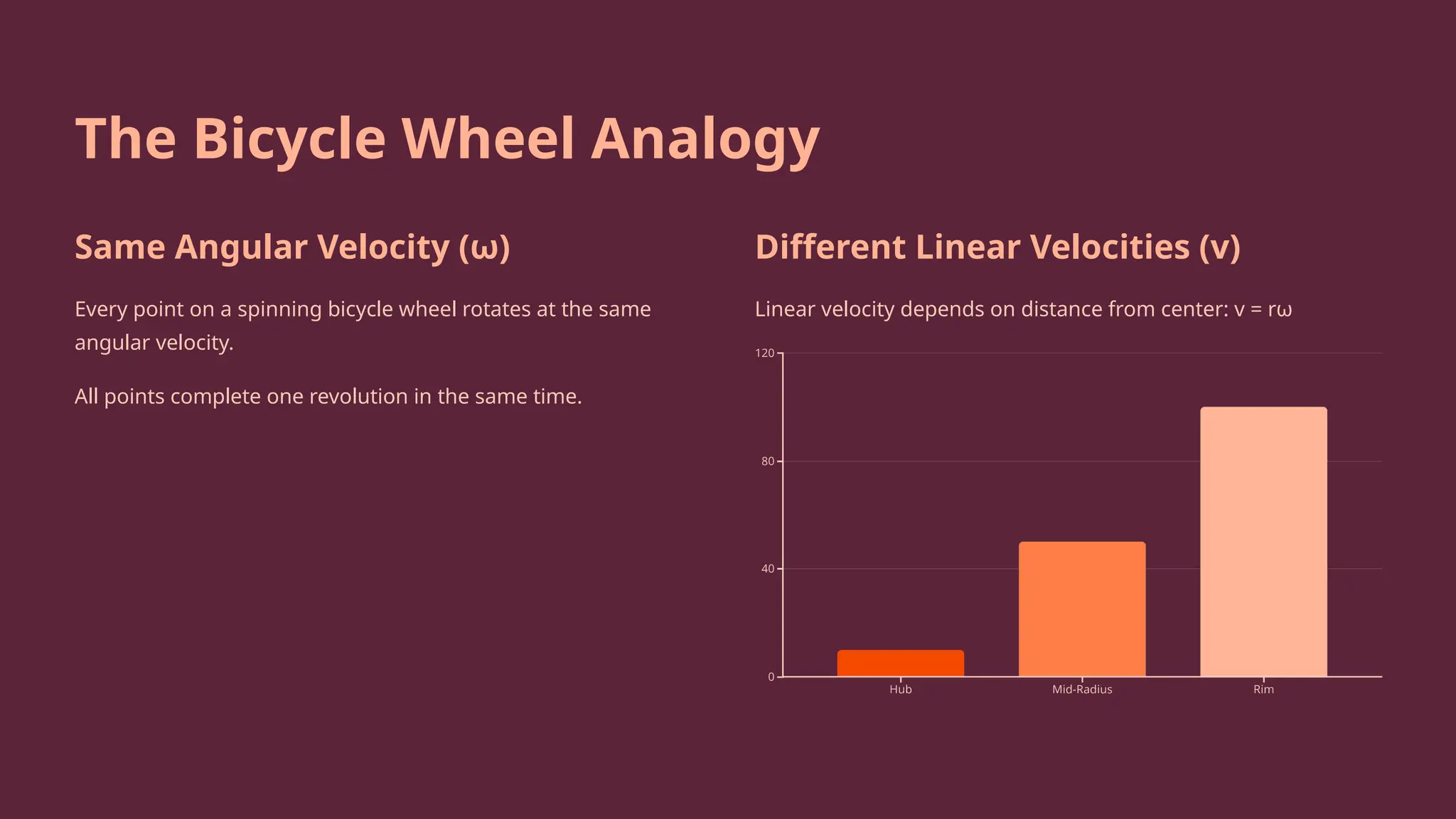
Same Angular Velocity (ω)
Every point on a spinning bicycle wheel rotates at the same
angular velocity.
All points complete one revolution in the same time.
Different Linear Velocities (v)
Linear velocity depends on distance from center: v = rω
Real-World Application: Sports
Baseball Bat
Rotates around a pivot point (hands)
Bat tip moves much faster than handle
(v = rω)
This generates more impact force at
the "sweet spot"
Soccer Kick
Leg rotates around hip joint
Foot moves in an arc with r = leg
length
Linear velocity at foot (v = rω) transfers
to ball
Activity: Create Your Own Example
Choose a movement
Simple examples: waving an arm, twirling a ribbon, swinging a leg
Identify components
Measure r (radius) from rotation center to end point
Measure angle
Use protractor or smartphone to measure angular displacement (θ)
Calculate
Find arc length (s = rθ) or linear velocity (v = rω)
Present findings
Demonstrate your movement and explain the physics behind it
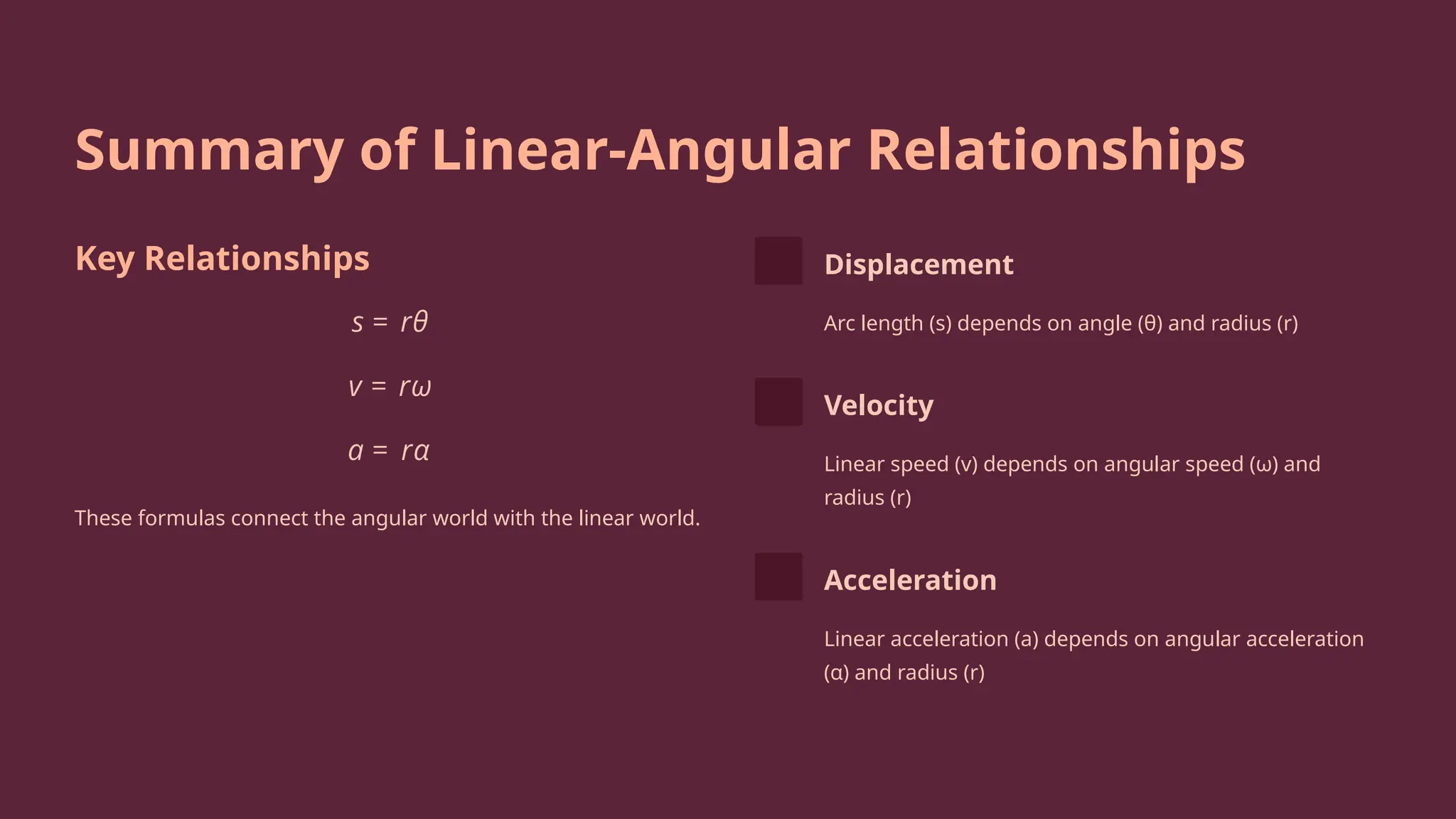
Summary of Linear-Angular Relationships
Key Relationships
These formulas connect the angular world with the linear world.
Displacement
Arc length (s) depends on angle (θ) and radius (r)
Velocity
Linear speed (v) depends on angular speed (ω) and
radius (r)
Acceleration
Linear acceleration (a) depends on angular acceleration
(α) and radius (r)
Conclusion: Why These Relationships Matter
Exercise Science
Understanding joint mechanics helps
prevent injuries and optimize
movement.
Performance Optimization
Athletes and dancers use these
principles to increase speed and
efficiency.
Physics Education
Human movement provides intuitive
examples of abstract physics concepts.
Everyday Applications
These relationships explain how tools
and machines work in daily life.
By connecting these concepts to human movement, we make physics relevant and accessible!

Connecting Linear and Angular Quantities in Human Movement.pptx

  • 1.
    Connecting Linear and AngularQuantities in Human Movement Human movement naturally connects linear and angular motion in fascinating ways. Through simple activities like exercise, dance, and gymnastics, we can see physics in action. by ANGELIQUE TOLENTINO DEL ROSARIO
  • 2.
    What Are Linear Quantities? LinearDisplacement The distance moved in a straight line, measured in meters (m) Linear Velocity How fast an object moves in a straight line, measured in meters per second (m/s) Linear Acceleration How quickly velocity changes, measured in meters per second squared (m/s²)
  • 3.
    What Are AngularQuantities? Angular Displacement (θ) The angle through which an object rotates, measured in radians Angular Velocity (ω) How quickly an object rotates, measured in radians per second (rad/s) Angular Acceleration (α) Rate of change of angular velocity, in radians per second squared (rad/s²)
  • 4.
    How Are TheyRelated? Where r is the radius from the pivot point or axis of rotation. These equations connect: • Arc length (s) with angle (θ) • Linear velocity (v) with angular velocity (ω) • Linear acceleration (a) with angular acceleration (α) Remember: angles must be in radians for these formulas to work!
  • 5.
    Visualizing the Circle:The Radian A radian is the angle where the arc length equals the radius of the circle. Natural Unit Radians are the natural unit for angular measurement in physics. Conversion 180° = π radians 1 radian 57.3° ≈
  • 6.
    Example: Rotating ArmWhile Standing The Physics When your arm swings through angle θ, your hand travels along an arc. Where r = length from shoulder to hand (typically 0.6-0.7m for adults). Shoulder Rotates Joint creates angular motion (θ) Arm Acts as Radius Distance from joint to hand (r) Hand Travels Distance Linear distance along arc (s)
  • 7.
    Exercise: Arm Circles (Demonstration) Standwith arm extended Your shoulder is the pivot point (center of rotation) Rotate arm in circles Your hand moves in a circular path with radius r = arm length Observe speed differences Notice: longer arm (larger r) creates faster hand speed (v = rω) This simple exercise demonstrates how angular motion at the joint creates linear motion at the hand.
  • 8.
    Linear and AngularVelocity: Arm Example Example Calculation If shoulder rotates at angular velocity ω = 1 rad/s: Shoulder Angular velocity (ω) = 1 rad/s Linear velocity 0 m/s (at axis of rotation) ≈ Elbow r 0.3 m from shoulder ≈ v = 0.3 m/s Hand r 0.7 m from shoulder ≈ v = 0.7 m/s
  • 9.
    Gymnastics: Somersaults In asomersault, the entire body rotates around the center of mass. This is pure angular motion, but creates linear motion at the extremities. Taller Gymnast Greater distance (r) from center to head/feet Higher linear velocity at extremities Shorter Gymnast Smaller distance (r) from center to head/feet Lower linear velocity at extremities
  • 10.
    Dance: Pirouette Spin ArmsExtended Larger radius (r) Slower angular velocity (ω) Arms Pulled In Smaller radius (r) Faster angular velocity (ω) Conservation Law Angular momentum stays constant: L = Iω As I decreases, ω increases This demonstrates conservation of angular momentum, which connects to our linear-angular relationships.
  • 11.
    Linking Concepts witha Hula Hoop A hula hoop provides a perfect example of circular motion around a central axis. Where r = radius of the hoop, typically 0.4-0.5m. Center (Waist) Acts as the axis of rotation Has angular motion only (ω) Hoop Rim Moves with linear velocity v = rω Every point on the hoop has the same angular velocity
  • 12.
    Partner Activity: Spinningvs. Running Spinning Student High angular velocity (ω) Zero linear velocity at center Increasing linear velocity moving outward from center (v = rω) Running Student High linear velocity (v) Zero angular velocity (ω = 0) All body parts move at approximately the same linear speed Compare these movements to see the difference between pure linear and pure angular motion.
  • 13.
    Jumping Jacks: Hands'Paths The Motion During jumping jacks, your hands move in arcs centered at your shoulders. This creates both angular and linear motion simultaneously. 1 Starting Position Arms at sides, θ = 0 2 Middle Position Arms horizontal, θ = π/2 rad (90°) 3 Full Extension Arms overhead, θ = π rad (180°) Distance hands travel: s = rθ, with r = length from shoulder to hand
  • 14.
    Measuring Angular Displacement: Smartphone Demo Geta smartphone with gyroscope Most modern phones have this sensor built in Download a sensor app Many free apps can display gyroscope readings in real time Perform a turn or spin Measure the angular displacement (θ) in degrees or radians Calculate distance traveled Use s = rθ, where r = distance from spin center to phone
  • 15.
    Cartwheel Example: FullBody Rotation Linear Motion During a cartwheel, your center of mass follows a relatively straight path. This creates linear displacement from one point to another. Angular Motion Simultaneously, your limbs rotate around multiple joints. Each limb follows its own circular arc with radius r = joint-to-extremity length. Body Rotation Full 360° (2π rad) rotation around longitudinal axis Arm Motion Rotates at shoulder joint with r = arm length Leg Motion Rotates at hip joint with r = leg length
  • 16.
    The Bicycle WheelAnalogy Same Angular Velocity (ω) Every point on a spinning bicycle wheel rotates at the same angular velocity. All points complete one revolution in the same time. Different Linear Velocities (v) Linear velocity depends on distance from center: v = rω
  • 17.
    Real-World Application: Sports BaseballBat Rotates around a pivot point (hands) Bat tip moves much faster than handle (v = rω) This generates more impact force at the "sweet spot" Soccer Kick Leg rotates around hip joint Foot moves in an arc with r = leg length Linear velocity at foot (v = rω) transfers to ball
  • 18.
    Activity: Create YourOwn Example Choose a movement Simple examples: waving an arm, twirling a ribbon, swinging a leg Identify components Measure r (radius) from rotation center to end point Measure angle Use protractor or smartphone to measure angular displacement (θ) Calculate Find arc length (s = rθ) or linear velocity (v = rω) Present findings Demonstrate your movement and explain the physics behind it
  • 19.
    Summary of Linear-AngularRelationships Key Relationships These formulas connect the angular world with the linear world. Displacement Arc length (s) depends on angle (θ) and radius (r) Velocity Linear speed (v) depends on angular speed (ω) and radius (r) Acceleration Linear acceleration (a) depends on angular acceleration (α) and radius (r)
  • 20.
    Conclusion: Why TheseRelationships Matter Exercise Science Understanding joint mechanics helps prevent injuries and optimize movement. Performance Optimization Athletes and dancers use these principles to increase speed and efficiency. Physics Education Human movement provides intuitive examples of abstract physics concepts. Everyday Applications These relationships explain how tools and machines work in daily life. By connecting these concepts to human movement, we make physics relevant and accessible!