ROTATIONAL MOTION

Until now we have been looking at translational motion, motion in which something shifts in position
from one moment to the next. But rotational motion is just as common. The wheels, pulleys, propellers,
drills, and audio disks rotate in order to do their job. Here our concern is mainly with the rotational
motion of rigid body, one whose shape does not change as its spins.

Angular Measure

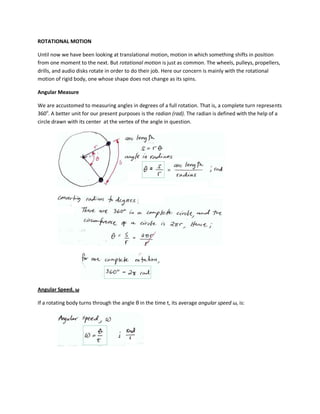
We are accustomed to measuring angles in degrees of a full rotation. That is, a complete turn represents
360o. A better unit for our present purposes is the radian (rad). The radian is defined with the help of a
circle drawn with its center at the vertex of the angle in question.


Angular Speed, ω

If a rotating body turns through the angle θ in the time t, its average angular speed ω, is:
Angular Speed and Linear Speed

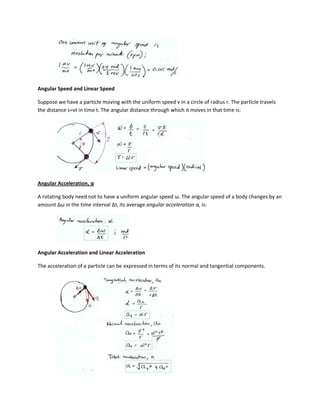
Suppose we have a particle moving with the uniform speed v in a circle of radius r. The particle travels
the distance s=vt in time t. The angular distance through which it moves in that time is:


Angular Acceleration, α

A rotating body need not to have a uniform angular speed ω. The angular speed of a body changes by an
amount Δω in the time interval Δt, its average angular acceleration α, is:


Angular Acceleration and Linear Acceleration

The acceleration of a particle can be expressed in terms of its normal and tangential components.
We must be careful to distinguish between tangential acceleration at of a particle, which represents a
change in speed, and its normal acceleration an (also known as centripetal acceleration), which
represents the change in its direction of motion. This normal acceleration is directed toward the center
of its circular path.

Example 1:

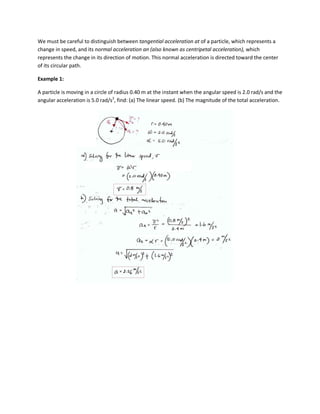
A particle is moving in a circle of radius 0.40 m at the instant when the angular speed is 2.0 rad/s and the
angular acceleration is 5.0 rad/s2, find: (a) The linear speed. (b) The magnitude of the total acceleration.
COMPARISON WITH LINEAR MOTION

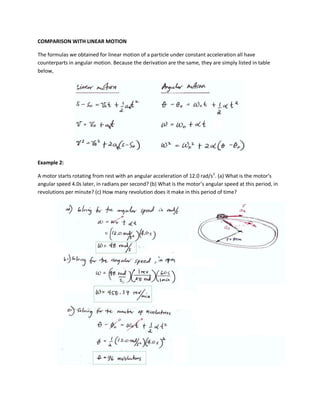
The formulas we obtained for linear motion of a particle under constant acceleration all have
counterparts in angular motion. Because the derivation are the same, they are simply listed in table
below,


Example 2:

A motor starts rotating from rest with an angular acceleration of 12.0 rad/s2. (a) What is the motor’s
angular speed 4.0s later, in radians per second? (b) What is the motor’s angular speed at this period, in
revolutions per minute? (c) How many revolution does it make in this period of time?
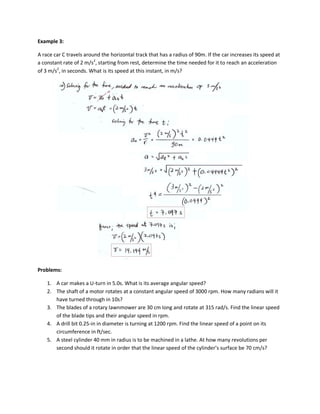
Example 3:

A race car C travels around the horizontal track that has a radius of 90m. If the car increases its speed at
a constant rate of 2 m/s2, starting from rest, determine the time needed for it to reach an acceleration
of 3 m/s2, in seconds. What is its speed at this instant, in m/s?


Problems:

    1. A car makes a U-turn in 5.0s. What is its average angular speed?
    2. The shaft of a motor rotates at a constant angular speed of 3000 rpm. How many radians will it
       have turned through in 10s?
    3. The blades of a rotary lawnmower are 30 cm long and rotate at 315 rad/s. Find the linear speed
       of the blade tips and their angular speed in rpm.
    4. A drill bit 0.25-in in diameter is turning at 1200 rpm. Find the linear speed of a point on its
       circumference in ft/sec.
    5. A steel cylinder 40 mm in radius is to be machined in a lathe. At how many revolutions per
       second should it rotate in order that the linear speed of the cylinder’s surface be 70 cm/s?

007 rotational motion

  • 1.
    ROTATIONAL MOTION Until nowwe have been looking at translational motion, motion in which something shifts in position from one moment to the next. But rotational motion is just as common. The wheels, pulleys, propellers, drills, and audio disks rotate in order to do their job. Here our concern is mainly with the rotational motion of rigid body, one whose shape does not change as its spins. Angular Measure We are accustomed to measuring angles in degrees of a full rotation. That is, a complete turn represents 360o. A better unit for our present purposes is the radian (rad). The radian is defined with the help of a circle drawn with its center at the vertex of the angle in question. Angular Speed, ω If a rotating body turns through the angle θ in the time t, its average angular speed ω, is:
  • 2.
    Angular Speed andLinear Speed Suppose we have a particle moving with the uniform speed v in a circle of radius r. The particle travels the distance s=vt in time t. The angular distance through which it moves in that time is: Angular Acceleration, α A rotating body need not to have a uniform angular speed ω. The angular speed of a body changes by an amount Δω in the time interval Δt, its average angular acceleration α, is: Angular Acceleration and Linear Acceleration The acceleration of a particle can be expressed in terms of its normal and tangential components.
  • 3.
    We must becareful to distinguish between tangential acceleration at of a particle, which represents a change in speed, and its normal acceleration an (also known as centripetal acceleration), which represents the change in its direction of motion. This normal acceleration is directed toward the center of its circular path. Example 1: A particle is moving in a circle of radius 0.40 m at the instant when the angular speed is 2.0 rad/s and the angular acceleration is 5.0 rad/s2, find: (a) The linear speed. (b) The magnitude of the total acceleration.
  • 4.
    COMPARISON WITH LINEARMOTION The formulas we obtained for linear motion of a particle under constant acceleration all have counterparts in angular motion. Because the derivation are the same, they are simply listed in table below, Example 2: A motor starts rotating from rest with an angular acceleration of 12.0 rad/s2. (a) What is the motor’s angular speed 4.0s later, in radians per second? (b) What is the motor’s angular speed at this period, in revolutions per minute? (c) How many revolution does it make in this period of time?
  • 5.
    Example 3: A racecar C travels around the horizontal track that has a radius of 90m. If the car increases its speed at a constant rate of 2 m/s2, starting from rest, determine the time needed for it to reach an acceleration of 3 m/s2, in seconds. What is its speed at this instant, in m/s? Problems: 1. A car makes a U-turn in 5.0s. What is its average angular speed? 2. The shaft of a motor rotates at a constant angular speed of 3000 rpm. How many radians will it have turned through in 10s? 3. The blades of a rotary lawnmower are 30 cm long and rotate at 315 rad/s. Find the linear speed of the blade tips and their angular speed in rpm. 4. A drill bit 0.25-in in diameter is turning at 1200 rpm. Find the linear speed of a point on its circumference in ft/sec. 5. A steel cylinder 40 mm in radius is to be machined in a lathe. At how many revolutions per second should it rotate in order that the linear speed of the cylinder’s surface be 70 cm/s?