3
Rotational Motion- ByAditya Abeysinghe
Definitions of some special terms
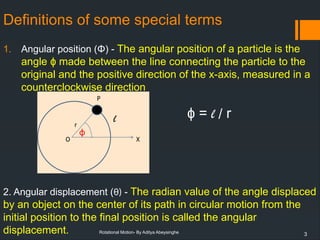
1. Angular position (Φ) - The angular position of a particle is the
angle made between the line connecting the particle to the
ɸ
original and the positive direction of the x-axis, measured in a
counterclockwise direction
2. Angular displacement (θ) - The radian value of the angle displaced
by an object on the center of its path in circular motion from the
initial position to the final position is called the angular
displacement.
=
ɸ l / r
4.
4
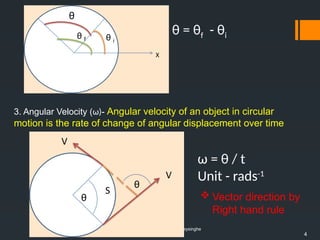
3. Angular Velocity(ω)- Angular velocity of an object in circular
motion is the rate of change of angular displacement over time
Rotational Motion- By Aditya Abeysinghe
θ = θf - θi
ω = θ / t
Unit - rads-1
Vector direction by
Right hand rule
5.
5
Rotational Motion- ByAditya Abeysinghe
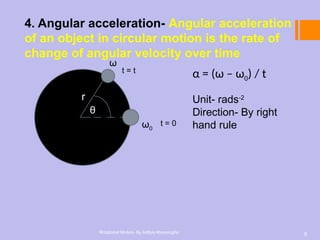
4. Angular acceleration- Angular acceleration
of an object in circular motion is the rate of
change of angular velocity over time
θ
ω
ω0
r
t = 0
t = t
α = (ω – ω0) / t
Unit- rads-2
Direction- By right
hand rule
7
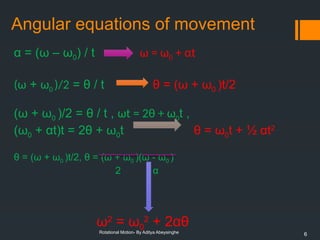
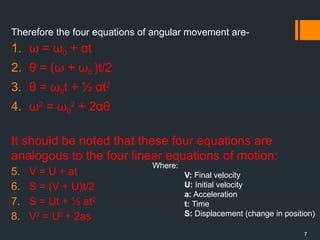
Therefore the fourequations of angular movement are-
1. ω = ω0 + αt
2. θ = (ω + ω0 )t/2
3. θ = ω0t + ½ αt2
4. ω2
= ω0
2
+ 2αθ
It should be noted that these four equations are
analogous to the four linear equations of motion:
5. V = U + at
6. S = (V + U)t/2
7. S = Ut + ½ at2
8. V2
= U2
+ 2as
Where:
V: Final velocity
U: Initial velocity
a: Acceleration
t: Time
S: Displacement (change in position)
8.
8
Rotational Motion- ByAditya Abeysinghe
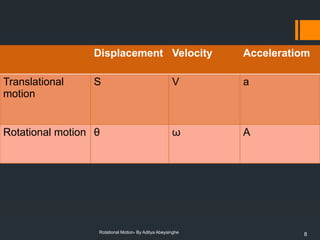
Displacement Velocity Acceleratiom
Translational
motion
S V a
Rotational motion θ ω Α
9.
9
Rotational Motion- ByAditya Abeysinghe
TORQUE
Torque is called the moment of force and is a
measure of the turning effect of the force about
a given axis.
A torque is needed to rotate an object at rest or
to change the rotational mode of an object.
The rate of change of angular momentum of an
object in rotational motion is proportional to the
external unbalanced torque. The direction of
the torque also lies in the direction of the
angular momentum.
10.
10
Rotational Motion- ByAditya Abeysinghe
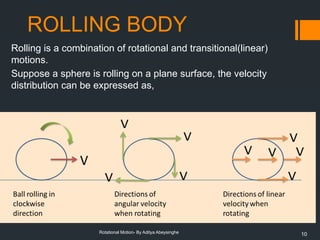
ROLLING BODY
Rolling is a combination of rotational and transitional(linear)
motions.
Suppose a sphere is rolling on a plane surface, the velocity
distribution can be expressed as,
11.
11
Rotational Motion- ByAditya Abeysinghe
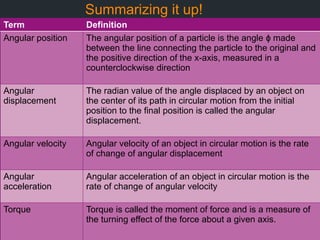
Summarizing it up!
Term Definition
Angular position The angular position of a particle is the angle made
ɸ
between the line connecting the particle to the original and
the positive direction of the x-axis, measured in a
counterclockwise direction
Angular
displacement
The radian value of the angle displaced by an object on
the center of its path in circular motion from the initial
position to the final position is called the angular
displacement.
Angular velocity Angular velocity of an object in circular motion is the rate
of change of angular displacement
Angular
acceleration
Angular acceleration of an object in circular motion is the
rate of change of angular velocity
Torque Torque is called the moment of force and is a measure of
the turning effect of the force about a given axis.
12.
12
Rotational Motion- ByAditya Abeysinghe
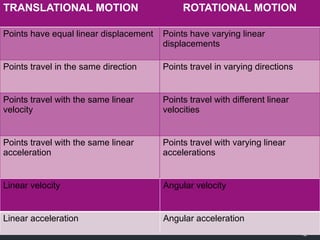
TRANSLATIONAL MOTION ROTATIONAL MOTION
Points have equal linear displacement Points have varying linear
displacements
Points travel in the same direction Points travel in varying directions
Points travel with the same linear
velocity
Points travel with different linear
velocities
Points travel with the same linear
acceleration
Points travel with varying linear
accelerations
Linear displacement Angular displacement
Linear velocity Angular velocity
Linear acceleration Angular acceleration
13.
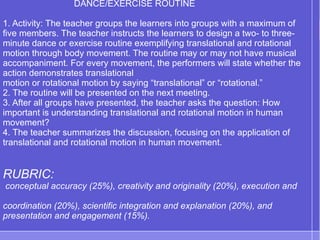
DANCE/EXERCISE ROUTINE
1. Activity:The teacher groups the learners into groups with a maximum of
five members. The teacher instructs the learners to design a two- to three-
minute dance or exercise routine exemplifying translational and rotational
motion through body movement. The routine may or may not have musical
accompaniment. For every movement, the performers will state whether the
action demonstrates translational
motion or rotational motion by saying “translational” or “rotational.”
2. The routine will be presented on the next meeting.
3. After all groups have presented, the teacher asks the question: How
important is understanding translational and rotational motion in human
movement?
4. The teacher summarizes the discussion, focusing on the application of
translational and rotational motion in human movement.
RUBRIC:
conceptual accuracy (25%), creativity and originality (20%), execution and
coordination (20%), scientific integration and explanation (20%), and
presentation and engagement (15%).