GOOD
MORNING
EVERYONE!


              HYE THERE!! HOW
              ARE YOU TODAY?
              SEEN THAT YOU
                 LOOK NOT
             INTERESTED…WHY
               NOT WE DO AN
            EXERCISE FOR A FEW
                 MINUTES?
Do you believe or
not that I can raise
    an Elephant?
DO YOU KNOW
 WHAT TOPIC
 WE WANT TO
LEARN TODAY?
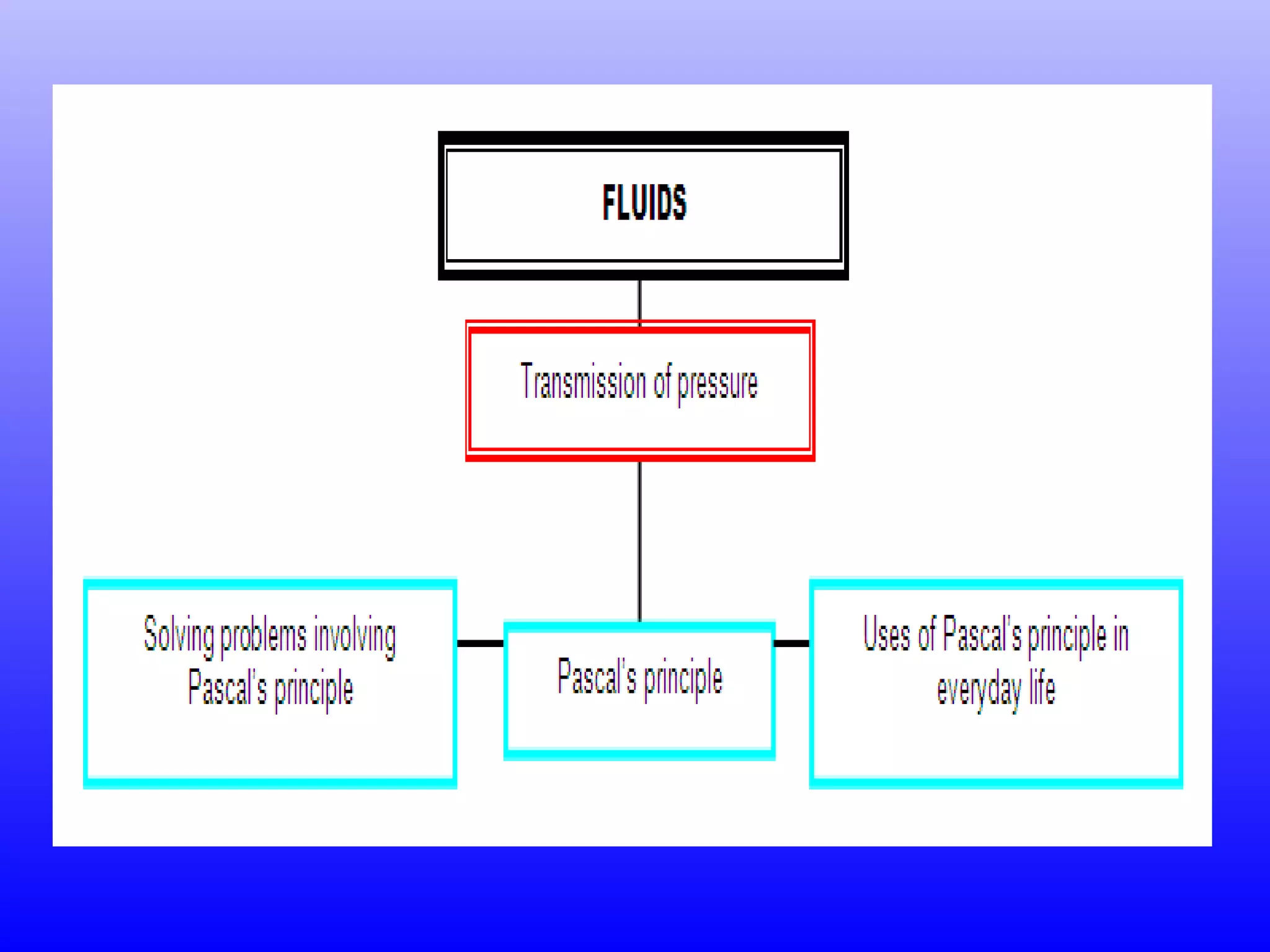
Transmission of Pressure in a
            Liquid
1. Liquids are practically incompressible.
2. The compression force causes pressure to
   act on the surface of the water.

      Pressure = Force (compression)
                 Surface area of liquid


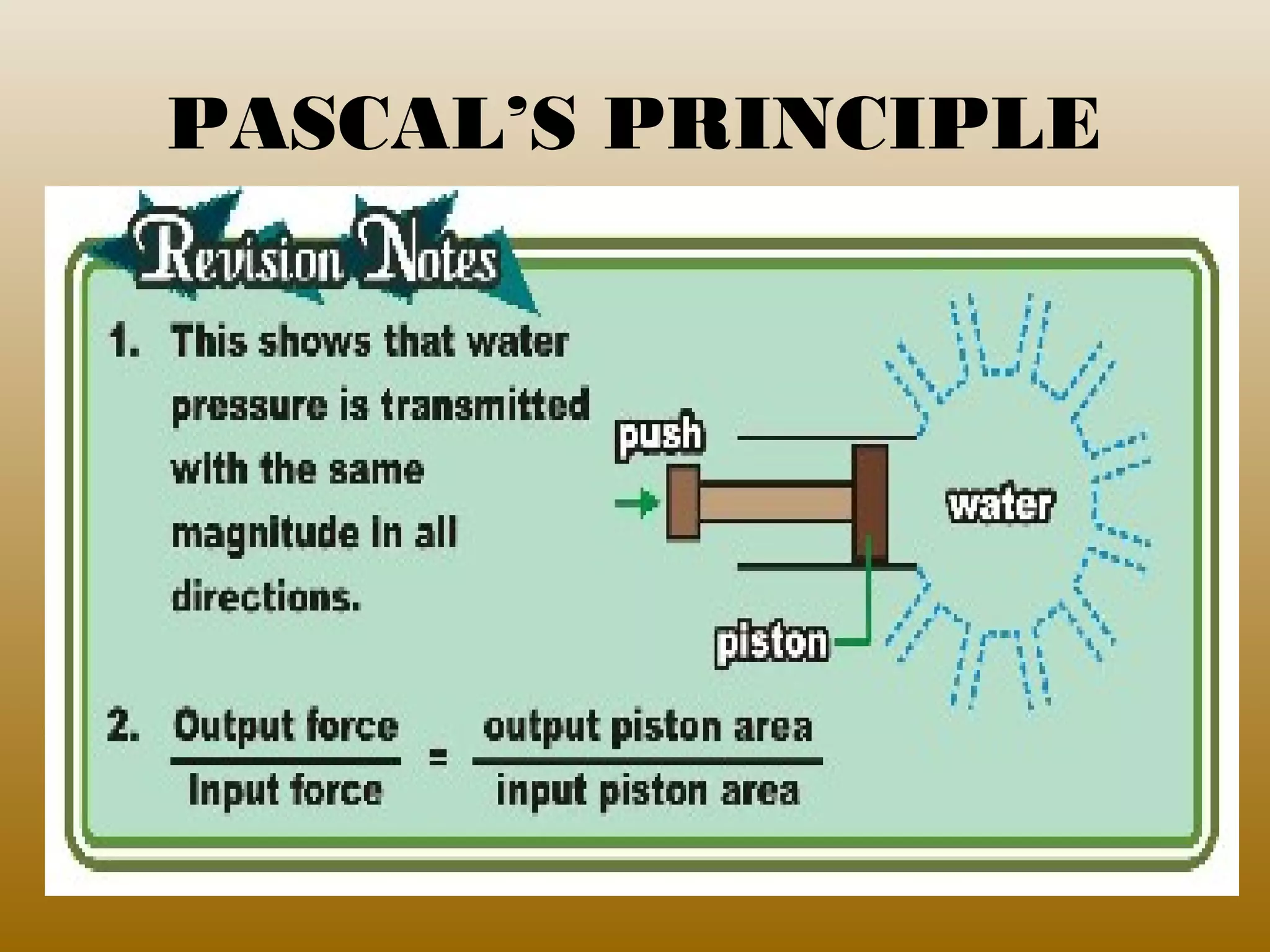
3. Pascal’s principle states that in a confined
   fluid, an externally applied pressure is
   transmitted uniformly in all direction.
Transmission of Pressure in a
            Liquid
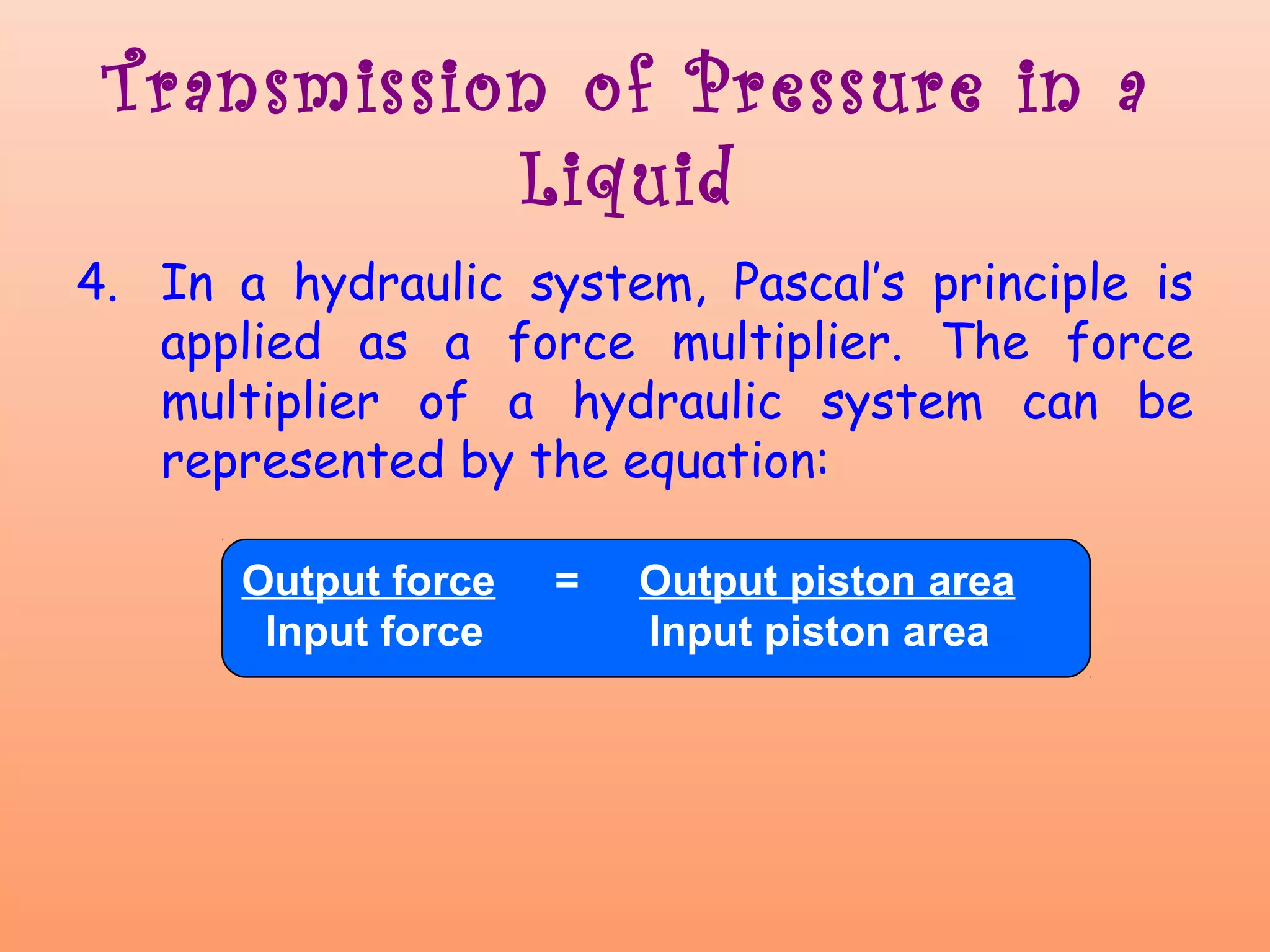
4. In a hydraulic system, Pascal’s principle is
   applied as a force multiplier. The force
   multiplier of a hydraulic system can be
   represented by the equation:

      Output force   =   Output piston area
       Input force       Input piston area
Applications of Pascal’s
       Principle
APPLICATION
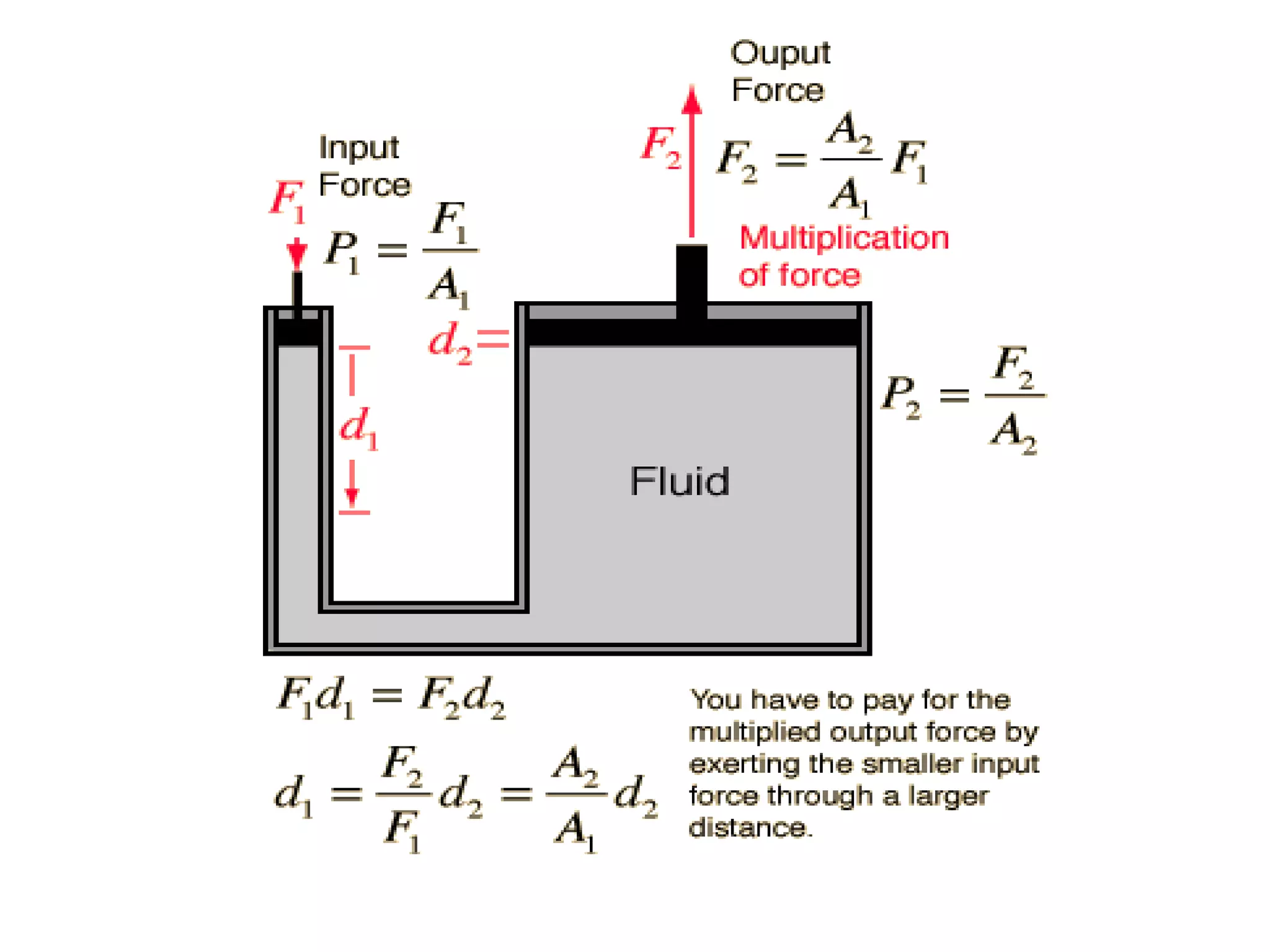
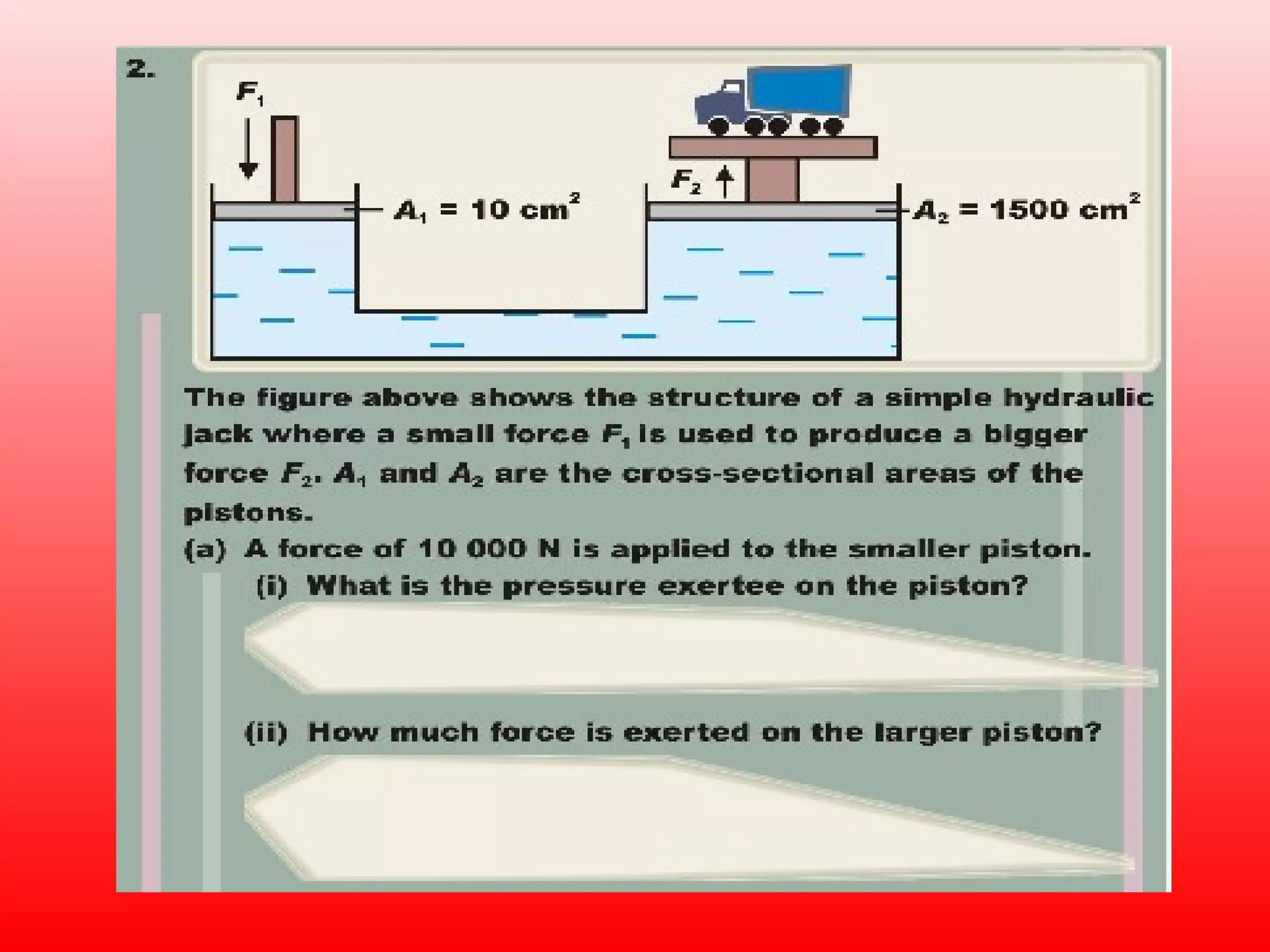
• A hydraulic lift for automobiles is
  an example of a force multiplied by
  hydraulic press, based on
  Pascal's principle. The fluid in the
  small cylinder must be moved much
  further than the distance the car is
  lifted.
For example, if the lift cylinder were 25
cm in diameter and the small cylinder
were 1.25 cm in diameter, then the ratio
of the areas is 400, so the hydraulic
press arrangement gives a multiplication
of 400 times the force. To lift a 6000
newton car, you would have to exert only
6000 N/400 = 15 N on the fluid in the
small cylinder to lift the car. However,
to lift the car 10 cm, you would have to
move the oil 400 x 10cm = 40 meters.
This is practical by pumping oil into this
small cylinder with a small compressor.
Problem Solving
Example 1:
   In hydraulic brake, a force of 80 N is
   applied to a piston with area of 4 cm2.
1. What is the pressure transmitted
   throughout the liquid?
2. If the piston at the wheel cylinder has an
   area of 8 cm2, what is the force exerted
   on it?
Solution

(a)   P = F/A
          = 80 N/4 cm 2
          = 20 N cm -2

(b)   F = P x A
           = 20 N cm -2 x 8 cm 2
           = 160 N
Problem Solving
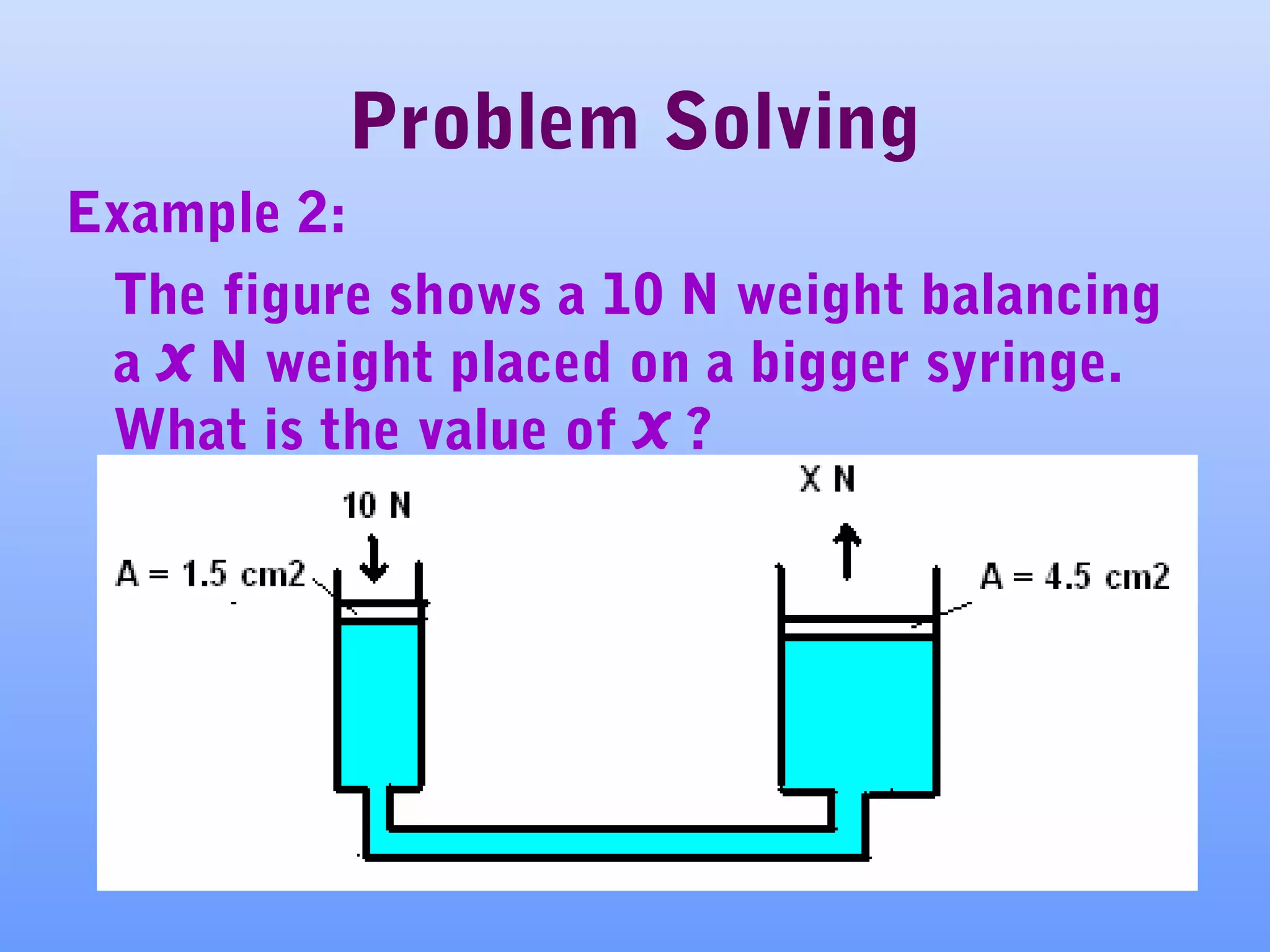
Example 2:
 The figure shows a 10 N weight balancing
 a X N weight placed on a bigger syringe.
 What is the value of X ?
Solution:

       F1/ A1 =   F2/ A2

10 N / 1.5 cm 2 = X N / 4.5 cm 2
    Therefore X = 10 / 1.5    x
4.5
                   = 30 N
Problem Solving
Example 3:


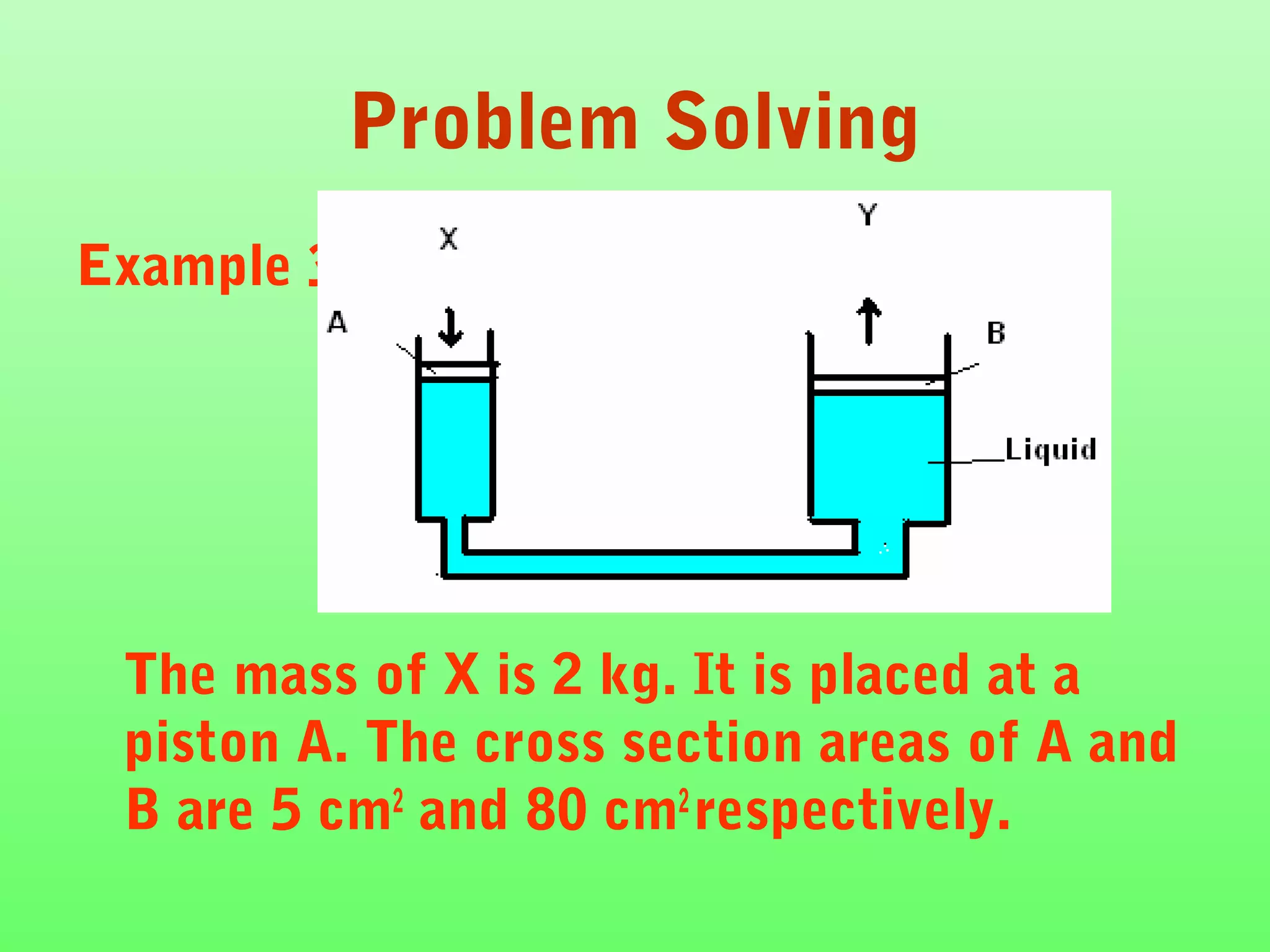
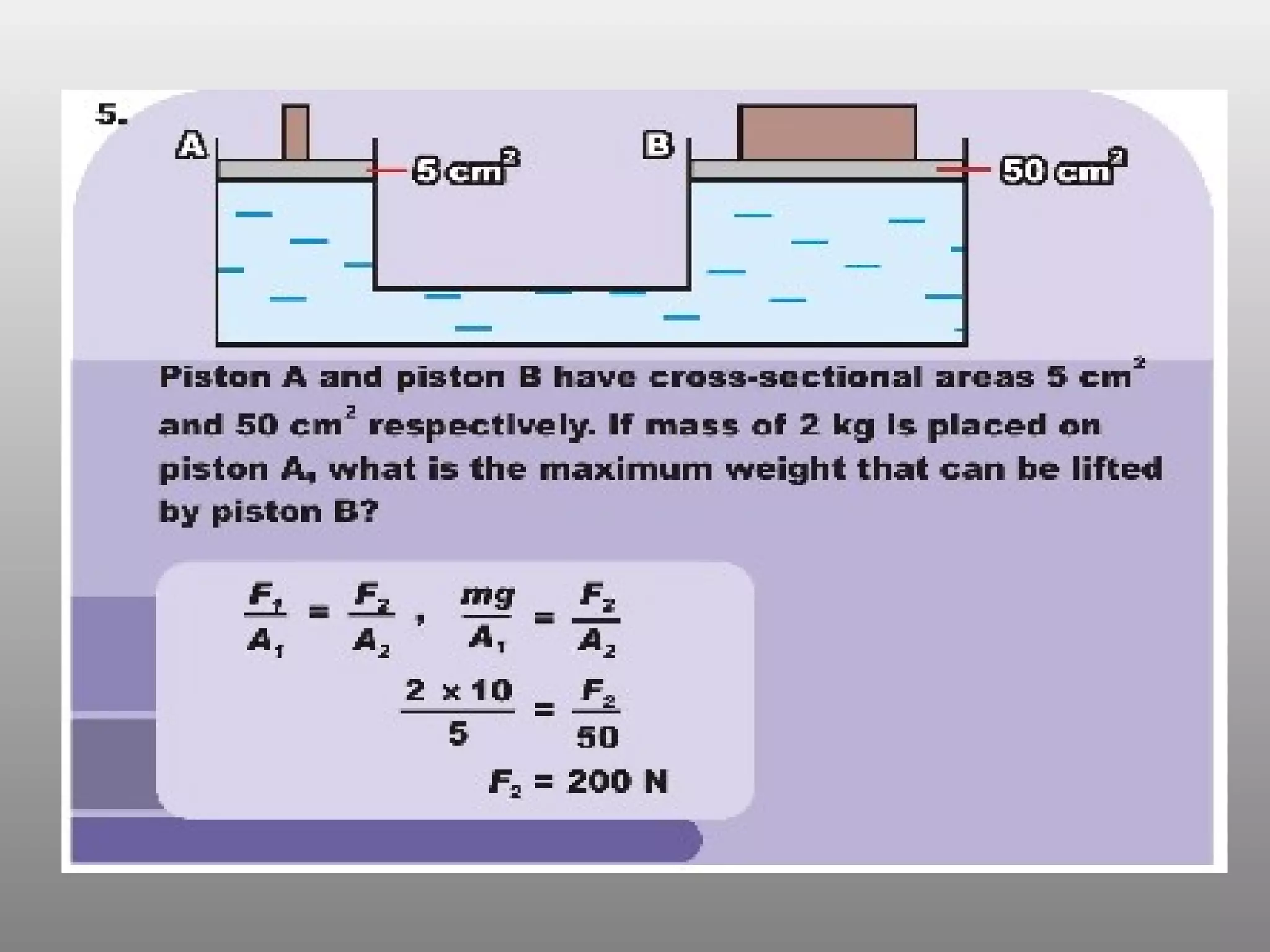
 The mass of X is 2 kg. It is placed at a
 piston A. The cross section areas of A and
 B are 5 cm2 and 80 cm2 respectively.
Problem Solving
(a) Calculate the force which acts on piston
    A
(b) Find the pressure which is exerted on
    piston B.
(c) Find the mass of Y which can be lifted
    by piston B.
(d) If piston A moves down by 20 cm, then
    piston B will go up by
Solutions
(a) Calculate the force which acts on
   piston A
                    F = mg
                      = 2 x 10 = 20 N
(b)Find the pressure which is exerted on
   piston B.
               P = F/A
                  = 20 N / 5 x 10⁻⁴ m2
                  = 40 000 N m-2
Solutions
(c)Find the mass of Y which can be lifted
    by piston B.
            F1/A1 = F2/A2
2 x 10/ 5 x 10-4 = m x 10 / 80 x 10-4
                   m = 32 kg
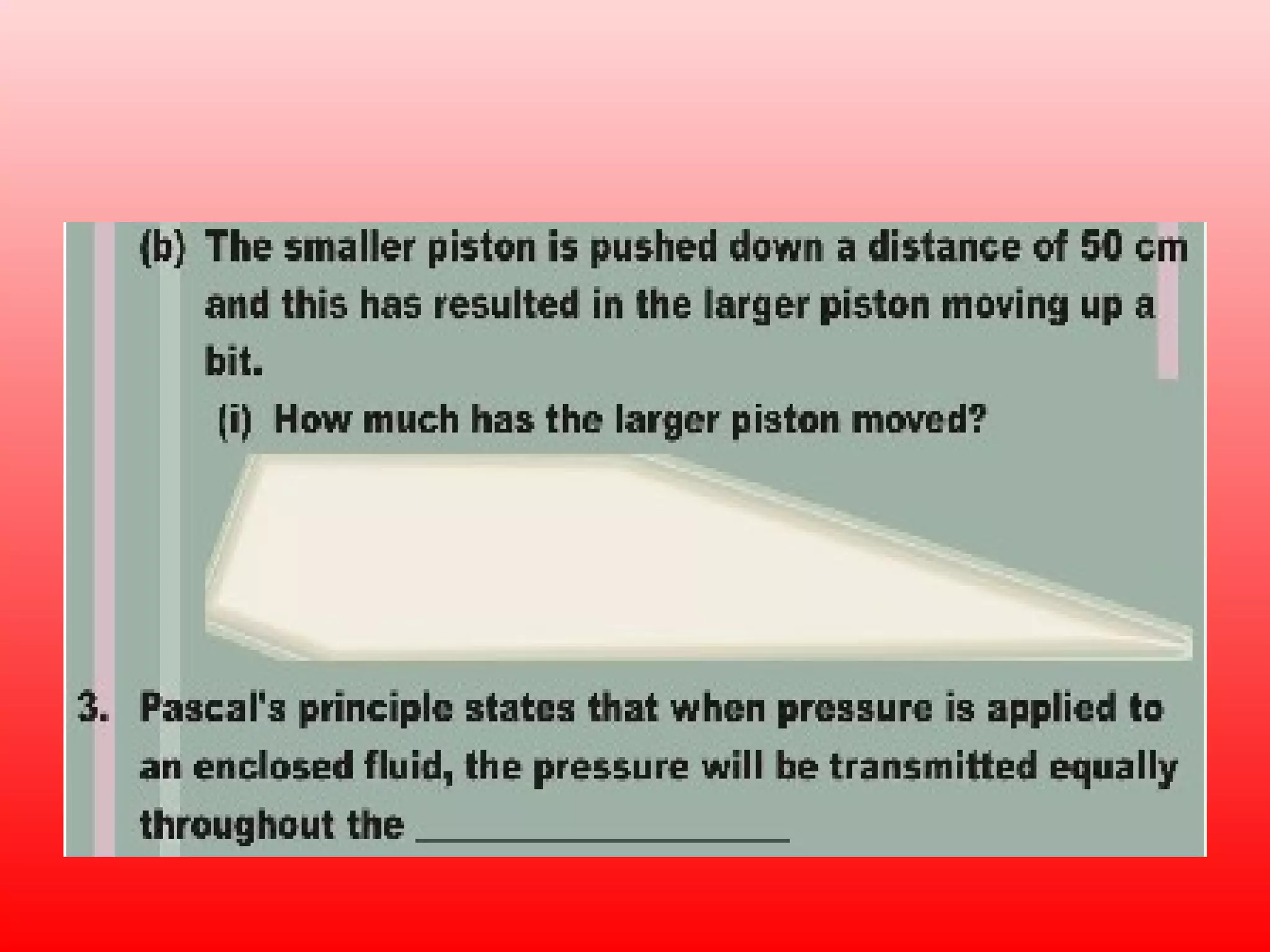
(d)If piston A moves down by 20 cm, then
    piston B will go up by
                5 x 20 cm = 80 x l cm3
                          l = 1.25 cm
PASCAL’S PRINCIPLE
8494483 pascals-principle