Adapting Farm Practices to
Climate Change:
A Real-World Example
And lots of help from: NIACS!
Dan Dostie daniel.dostie@pa.usda. gov
NRCS Project Liaison to USDA Hubs MW & NE
Natural Resources
Conservation Service
Climate Change Challenges and
Considerations in the Northeast Region
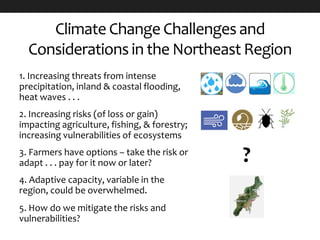
1. Increasing threats from intense
precipitation, inland & coastal flooding,
heat waves . . .
2. Increasing risks (of loss or gain)
impacting agriculture, fishing, & forestry;
increasing vulnerabilities of ecosystems
3. Farmers have options – take the risk or
adapt . . . pay for it now or later?
4. Adaptive capacity, variable in the
region, could be overwhelmed.
5. How do we mitigate the risks and
vulnerabilities?
Adapting to a changing climate
. . . more than one way to do it . . .
Each decision is unique and will vary based upon:
• Place: Location & Site Conditions
• Purpose: Goals & Objectives
• People: Values, Culture, & Resources
Developing a Climate Adaptation
Workbook to guide farmers in
making climate-informed decisions
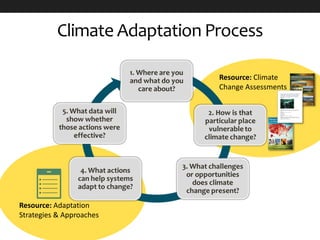
Climate Adaptation Process
Resource: Climate
Change Assessments
Resource: Adaptation
Strategies & Approaches
1
2
34
5
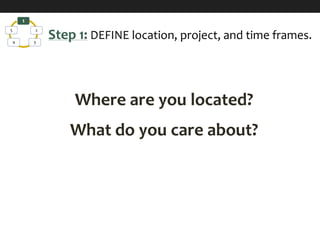
Step 1: DEFINE location, project, and time frames.
Where are you located?
What do you care about?
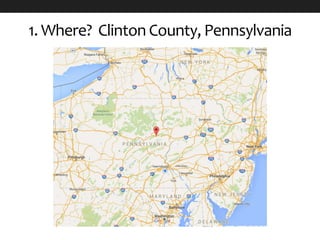
1. Where? Clinton County, Pennsylvania
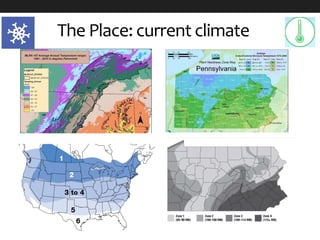
The Place: current climate
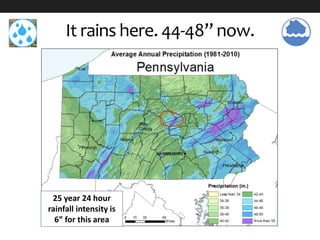
It rains here. 44-48” now.
25 year 24 hour
rainfall intensity is
6” for this area
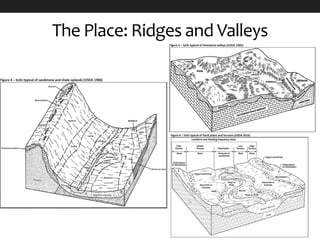
The Place: Ridges and Valleys
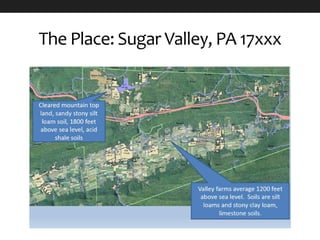
The Place: Sugar Valley, PA 17xxx
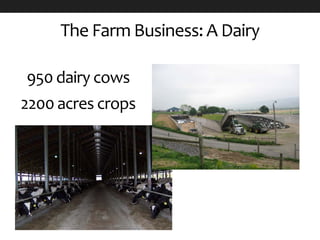
The Farm Business: A Dairy
950 dairy cows
2200 acres crops
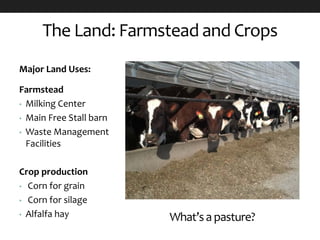
The Land: Farmstead and Crops
Major Land Uses:
Farmstead
• Milking Center
• Main Free Stall barn
• Waste Management
Facilities
Crop production
• Corn for grain
• Corn for silage
• Alfalfa hay What’sapasture?
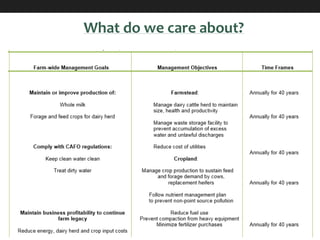
What do we care about?
1
2
3
4
5 Step 2: ASSESS site-specific climate change
impacts and vulnerabilities
How is this place & farm vulnerable
to climatic-driven change?
1
2
34
5 How is this place and farm uniquely affected by
climatic-driven changes?
1. Gather information about impacts to the region
2. Evaluate the place for risk of exposure to impacts
3. Consider the farm’s ability to adjust
4. What are the weaknesses of the system? Any
opportunities?
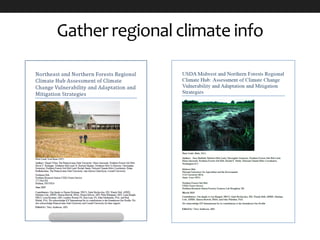
Gather regional climate info
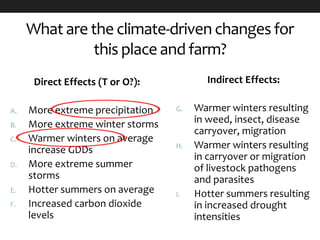
What are the climate-driven changes for
this place and farm?
Direct Effects (T or O?):
A. More extreme precipitation
B. More extreme winter storms
C. Warmer winters on average
increase GDDs
D. More extreme summer
storms
E. Hotter summers on average
F. Increased carbon dioxide
levels
Indirect Effects:
G. Warmer winters resulting
in weed, insect, disease
carryover, migration
H. Warmer winters resulting
in carryover or migration
of livestock pathogens
and parasites
I. Hotter summers resulting
in increased drought
intensities
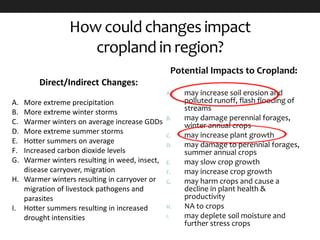
How could changes impact
cropland in region?
Potential Impacts to Cropland:
A. may increase soil erosion and
polluted runoff, flash flooding of
streams
B. may damage perennial forages,
winter annual crops
C. may increase plant growth
D. may damage to perennial forages,
summer annual crops
E. may slow crop growth
F. may increase crop growth
G. may harm crops and cause a
decline in plant health &
productivity
H. NA to crops
I. may deplete soil moisture and
further stress crops
Direct/Indirect Changes:
A. More extreme precipitation
B. More extreme winter storms
C. Warmer winters on average increase GDDs
D. More extreme summer storms
E. Hotter summers on average
F. Increased carbon dioxide levels
G. Warmer winters resulting in weed, insect,
disease carryover, migration
H. Warmer winters resulting in carryover or
migration of livestock pathogens and
parasites
I. Hotter summers resulting in increased
drought intensities
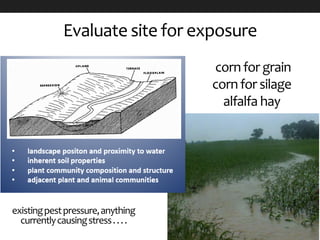
Evaluate site for exposure
existingpestpressure,anything
currentlycausingstress....
corn for grain
corn for silage
alfalfa hay
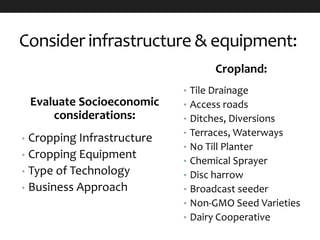
Consider infrastructure & equipment:
Evaluate Socioeconomic
considerations:
• Cropping Infrastructure
• Cropping Equipment
• Type of Technology
• Business Approach
Cropland:
• Tile Drainage
• Access roads
• Ditches, Diversions
• Terraces, Waterways
• No Till Planter
• Chemical Sprayer
• Disc harrow
• Broadcast seeder
• Non-GMO Seed Varieties
• Dairy Cooperative
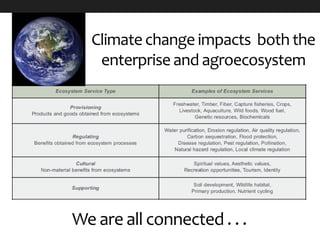
Climate change impacts both the
enterprise and agroecosystem
We are all connected . . .
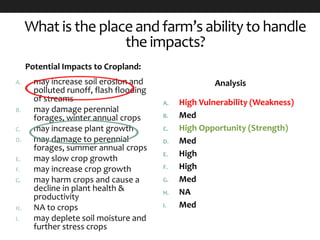
What is the place and farm’s ability to handle
the impacts?
Analysis
A. High Vulnerability (Weakness)
B. Med
C. High Opportunity (Strength)
D. Med
E. High
F. High
G. Med
H. NA
I. Med
Potential Impacts to Cropland:
A. may increase soil erosion and
polluted runoff, flash flooding
of streams
B. may damage perennial
forages, winter annual crops
C. may increase plant growth
D. may damage to perennial
forages, summer annual crops
E. may slow crop growth
F. may increase crop growth
G. may harm crops and cause a
decline in plant health &
productivity
H. NA to crops
I. may deplete soil moisture and
further stress crops
1
2
34
5
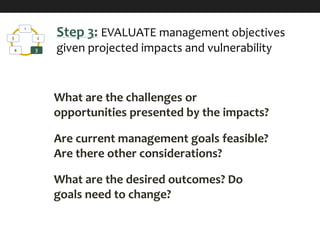
Step 3: EVALUATE management objectives
given projected impacts and vulnerability
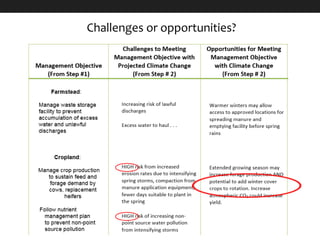
What are the challenges or
opportunities presented by the impacts?
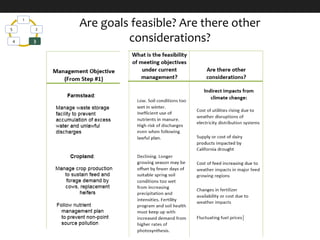
Are current management goals feasible?
Are there other considerations?
What are the desired outcomes? Do
goals need to change?
Challenges or opportunities?
1
2
34
5
Are goals feasible? Are there other
considerations?
1
2
34
5
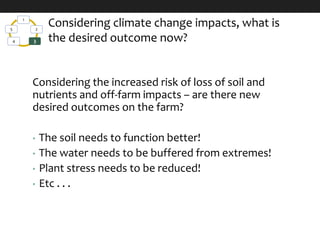
Considering climate change impacts, what is
the desired outcome now?
Considering the increased risk of loss of soil and
nutrients and off-farm impacts – are there new
desired outcomes on the farm?
• The soil needs to function better!
• The water needs to be buffered from extremes!
• Plant stress needs to be reduced!
• Etc . . .
1
2
34
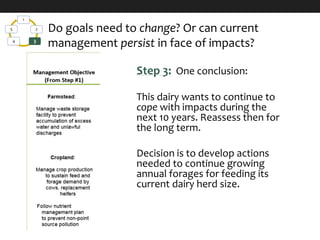
5 Do goals need to change? Or can current
management persist in face of impacts?
Step 3: One conclusion:
This dairy wants to continue to
cope with impacts during the
next 10 years. Reassess then for
the long term.
Decision is to develop actions
needed to continue growing
annual forages for feeding its
current dairy herd size.
1
2
34
5
Step 4: IDENTIFY adaptation actions
What actions can help meet
management goals and
objectives under projected
climate scenarios?
1
2
34
5
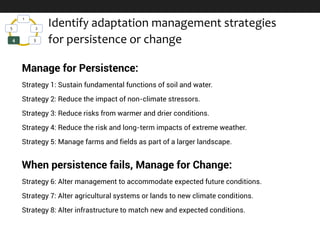
Identify adaptation management strategies
for persistence or change
Manage for Persistence:
Strategy 1: Sustain fundamental functions of soil and water.
Strategy 2: Reduce the impact of non-climate stressors.
Strategy 3: Reduce risks from warmer and drier conditions.
Strategy 4: Reduce the risk and long-term impacts of extreme weather.
Strategy 5: Manage farms and fields as part of a larger landscape.
When persistence fails, Manage for Change:
Strategy 6: Alter management to accommodate expected future conditions.
Strategy 7: Alter agricultural systems or lands to new climate conditions.
Strategy 8: Alter infrastructure to match new and expected conditions.
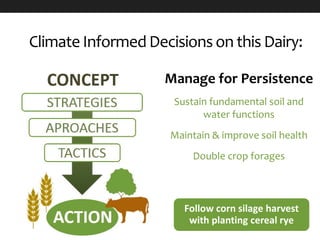
Follow corn silage harvest
with planting cereal rye
Manage for Persistence
Sustain fundamental soil and
water functions
Maintain & improve soil health
Double crop forages
Climate Informed Decisions on this Dairy:
1
2
34
5
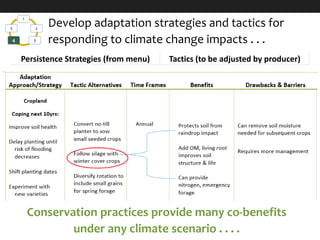
Develop adaptation strategies and tactics for
responding to climate change impacts . . .
Persistence Strategies (from menu) Tactics (to be adjusted by producer)
Conservation practices provide many co-benefits
under any climate scenario . . . .
How will we know if the implemented
actions were effective?
What lessons can we learn from these
actions to inform future management?
1
2
34
5 Step 5: MONITOR and evaluate effectiveness of
implemented actions.
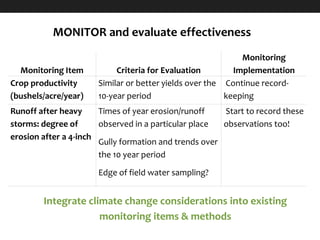
Monitoring Item Criteria for Evaluation
Monitoring
Implementation
Crop productivity
(bushels/acre/year)
Similar or better yields over the
10-year period
Continue record-
keeping
Runoff after heavy
storms: degree of
erosion after a 4-inch
Times of year erosion/runoff
observed in a particular place
Gully formation and trends over
the 10 year period
Edge of field water sampling?
Start to record these
observations too!
MONITOR and evaluate effectiveness
Integrate climate change considerations into existing
monitoring items & methods
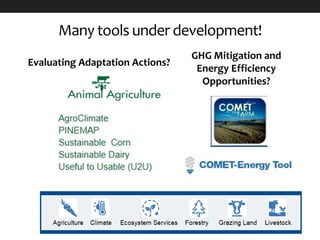
Many tools under development!
GHG Mitigation and
Energy Efficiency
Opportunities?
Evaluating Adaptation Actions?
Questions?
daniel.dostie@pa.usda.gov
USDA Climate Hubs NE, MW
Uncertain is the
future, hmmm?

Adapting Farm Practices to Climate Change: A Real-World Example

  • 1.
    Adapting Farm Practicesto Climate Change: A Real-World Example And lots of help from: NIACS! Dan Dostie daniel.dostie@pa.usda. gov NRCS Project Liaison to USDA Hubs MW & NE Natural Resources Conservation Service
  • 2.
    Climate Change Challengesand Considerations in the Northeast Region 1. Increasing threats from intense precipitation, inland & coastal flooding, heat waves . . . 2. Increasing risks (of loss or gain) impacting agriculture, fishing, & forestry; increasing vulnerabilities of ecosystems 3. Farmers have options – take the risk or adapt . . . pay for it now or later? 4. Adaptive capacity, variable in the region, could be overwhelmed. 5. How do we mitigate the risks and vulnerabilities?
  • 3.
    Adapting to achanging climate . . . more than one way to do it . . . Each decision is unique and will vary based upon: • Place: Location & Site Conditions • Purpose: Goals & Objectives • People: Values, Culture, & Resources Developing a Climate Adaptation Workbook to guide farmers in making climate-informed decisions
  • 4.
    Climate Adaptation Process Resource:Climate Change Assessments Resource: Adaptation Strategies & Approaches
  • 5.
    1 2 34 5 Step 1: DEFINElocation, project, and time frames. Where are you located? What do you care about?
  • 6.
    1. Where? ClintonCounty, Pennsylvania
  • 7.
  • 8.
    It rains here.44-48” now. 25 year 24 hour rainfall intensity is 6” for this area
  • 9.
    The Place: Ridgesand Valleys
  • 10.
    The Place: SugarValley, PA 17xxx
  • 11.
    The Farm Business:A Dairy 950 dairy cows 2200 acres crops
  • 12.
    The Land: Farmsteadand Crops Major Land Uses: Farmstead • Milking Center • Main Free Stall barn • Waste Management Facilities Crop production • Corn for grain • Corn for silage • Alfalfa hay What’sapasture?
  • 13.
    What do wecare about?
  • 14.
    1 2 3 4 5 Step 2:ASSESS site-specific climate change impacts and vulnerabilities How is this place & farm vulnerable to climatic-driven change?
  • 15.
    1 2 34 5 How isthis place and farm uniquely affected by climatic-driven changes? 1. Gather information about impacts to the region 2. Evaluate the place for risk of exposure to impacts 3. Consider the farm’s ability to adjust 4. What are the weaknesses of the system? Any opportunities?
  • 16.
  • 17.
    What are theclimate-driven changes for this place and farm? Direct Effects (T or O?): A. More extreme precipitation B. More extreme winter storms C. Warmer winters on average increase GDDs D. More extreme summer storms E. Hotter summers on average F. Increased carbon dioxide levels Indirect Effects: G. Warmer winters resulting in weed, insect, disease carryover, migration H. Warmer winters resulting in carryover or migration of livestock pathogens and parasites I. Hotter summers resulting in increased drought intensities
  • 18.
    How could changesimpact cropland in region? Potential Impacts to Cropland: A. may increase soil erosion and polluted runoff, flash flooding of streams B. may damage perennial forages, winter annual crops C. may increase plant growth D. may damage to perennial forages, summer annual crops E. may slow crop growth F. may increase crop growth G. may harm crops and cause a decline in plant health & productivity H. NA to crops I. may deplete soil moisture and further stress crops Direct/Indirect Changes: A. More extreme precipitation B. More extreme winter storms C. Warmer winters on average increase GDDs D. More extreme summer storms E. Hotter summers on average F. Increased carbon dioxide levels G. Warmer winters resulting in weed, insect, disease carryover, migration H. Warmer winters resulting in carryover or migration of livestock pathogens and parasites I. Hotter summers resulting in increased drought intensities
  • 19.
    Evaluate site forexposure existingpestpressure,anything currentlycausingstress.... corn for grain corn for silage alfalfa hay
  • 20.
    Consider infrastructure &equipment: Evaluate Socioeconomic considerations: • Cropping Infrastructure • Cropping Equipment • Type of Technology • Business Approach Cropland: • Tile Drainage • Access roads • Ditches, Diversions • Terraces, Waterways • No Till Planter • Chemical Sprayer • Disc harrow • Broadcast seeder • Non-GMO Seed Varieties • Dairy Cooperative
  • 21.
    Climate change impactsboth the enterprise and agroecosystem We are all connected . . .
  • 22.
    What is theplace and farm’s ability to handle the impacts? Analysis A. High Vulnerability (Weakness) B. Med C. High Opportunity (Strength) D. Med E. High F. High G. Med H. NA I. Med Potential Impacts to Cropland: A. may increase soil erosion and polluted runoff, flash flooding of streams B. may damage perennial forages, winter annual crops C. may increase plant growth D. may damage to perennial forages, summer annual crops E. may slow crop growth F. may increase crop growth G. may harm crops and cause a decline in plant health & productivity H. NA to crops I. may deplete soil moisture and further stress crops
  • 23.
    1 2 34 5 Step 3: EVALUATEmanagement objectives given projected impacts and vulnerability What are the challenges or opportunities presented by the impacts? Are current management goals feasible? Are there other considerations? What are the desired outcomes? Do goals need to change?
  • 24.
  • 25.
    1 2 34 5 Are goals feasible?Are there other considerations?
  • 26.
    1 2 34 5 Considering climate changeimpacts, what is the desired outcome now? Considering the increased risk of loss of soil and nutrients and off-farm impacts – are there new desired outcomes on the farm? • The soil needs to function better! • The water needs to be buffered from extremes! • Plant stress needs to be reduced! • Etc . . .
  • 27.
    1 2 34 5 Do goalsneed to change? Or can current management persist in face of impacts? Step 3: One conclusion: This dairy wants to continue to cope with impacts during the next 10 years. Reassess then for the long term. Decision is to develop actions needed to continue growing annual forages for feeding its current dairy herd size.
  • 28.
    1 2 34 5 Step 4: IDENTIFYadaptation actions What actions can help meet management goals and objectives under projected climate scenarios?
  • 29.
    1 2 34 5 Identify adaptation managementstrategies for persistence or change Manage for Persistence: Strategy 1: Sustain fundamental functions of soil and water. Strategy 2: Reduce the impact of non-climate stressors. Strategy 3: Reduce risks from warmer and drier conditions. Strategy 4: Reduce the risk and long-term impacts of extreme weather. Strategy 5: Manage farms and fields as part of a larger landscape. When persistence fails, Manage for Change: Strategy 6: Alter management to accommodate expected future conditions. Strategy 7: Alter agricultural systems or lands to new climate conditions. Strategy 8: Alter infrastructure to match new and expected conditions.
  • 30.
    Follow corn silageharvest with planting cereal rye Manage for Persistence Sustain fundamental soil and water functions Maintain & improve soil health Double crop forages Climate Informed Decisions on this Dairy:
  • 31.
    1 2 34 5 Develop adaptation strategiesand tactics for responding to climate change impacts . . . Persistence Strategies (from menu) Tactics (to be adjusted by producer) Conservation practices provide many co-benefits under any climate scenario . . . .
  • 32.
    How will weknow if the implemented actions were effective? What lessons can we learn from these actions to inform future management? 1 2 34 5 Step 5: MONITOR and evaluate effectiveness of implemented actions.
  • 33.
    Monitoring Item Criteriafor Evaluation Monitoring Implementation Crop productivity (bushels/acre/year) Similar or better yields over the 10-year period Continue record- keeping Runoff after heavy storms: degree of erosion after a 4-inch Times of year erosion/runoff observed in a particular place Gully formation and trends over the 10 year period Edge of field water sampling? Start to record these observations too! MONITOR and evaluate effectiveness Integrate climate change considerations into existing monitoring items & methods
  • 34.
    Many tools underdevelopment! GHG Mitigation and Energy Efficiency Opportunities? Evaluating Adaptation Actions?
  • 35.
    Questions? daniel.dostie@pa.usda.gov USDA Climate HubsNE, MW Uncertain is the future, hmmm?